Coring and sediment sampling
Principle: In order to ground-truth geophysical data, it is necessary to obtain a sample of the seabed. There are two main techniques available for sampling unconsolidated sediments : (1) seabed surface sampling using grab samplers to ground-truth data collected with instruments such as side scan sonars and multibeam sonar (i.e. instruments which only image the seabed surface) and (2) seabed coring to ground-truth sub-bottom profiler data (i.e. subsurface data). The most commonly used grab samplers are: Hamon, Day, Shipek and Van Veen grab. Sediment core systems include: box, gravity, piston and vibro-corer.
Basic features:
Bottom samplers usually consist of a pair of jaws or a (rotating) bucket, triggered upon impact with the seabed, which collect the seabed surface sediments. Different grabs with different collection mechanisms work best for different types of substrate. The sediment recovered by these instruments is normally collected in a large sample container placed under the sample bucket for further sub-sampling or onboard sieving.
With the exception of the box corer which consists of a metal box, all other core samplers consist of a hollow metal tube (core barrel) which is driven into the seabed, using gravity or vibration. A plastic core liner, which will contain the seabed sample, is fitted within the core barrel, and is often cut into 1m long sections after retrieval. The core samples represent a vertical profile of the sediment, allowing a stratigraphic study.
Each technique has its own advantages and disadvantages, which are summarised in the table below (Table 1). The more general (dis)advantages can be summarised as follows:
Advantages: Grabs
These are usually easy to deploy (even from a small vessels and in rougher sea conditions) and can give a very large sample.
Corers
The core samples will give an undisturbed cross section to a depth up to 30m beneath the seabed. By studying how the sediments, and the fossils within them, change over time, a picture emerges of how ocean circulation, climate and sea-level has fluctuated in the past
Disadvantages: Grabs
Washout of fine-grained sediments is an issue and blockage of the jaws by coarser particles often leads to a loss of the sample. Furthermore, the sample recovered is generally mixed and none of the original seabed structure is preserved. Larger samplers will require a winch for deployment. Moreover, samples only give information about the seabed surface.
Corers
Core samples are not as easy to acquire as grab samples. Their deployment needs larger and more specialised vessels. Not only is the acquisition more expensive, so is the core analysis and storage.
References:
Coggan, R., Populus, J., White, J., Sheehan, K., Fitzpatrick, F. and Piel, S†. (eds.). 2007. Review of Standards and Protocols for Seabed Habitat Mapping. MESH (Mapping European Seabed habitats). Available from: http://www.searchmesh.net/default.aspx?page=1442
International Society for Soil Mechanics and Geotechnical Engineering. 2005. Geotechnical and Geophysical investigation for offshore and nearshore developments. Available from: http://www.issmge.org/images/Attachments/Investigations%20for%20developments.pdf (last accessed 03/10/2012)
U.S. Environmental Protection Agency. 2003. Literature Review and Report Surface-Sediment Sampling technologies. Available from:
Table 1 Main characteristics of grab and sampling techniques, summarised from literature in the reference section
Type of sample
Type of sediment
(a) Typical area
sampled (for grabs) / (b) typical depth (for
corers)
Mechanism Advantages Disadvantages
Hamon grab Seabed surface Coarse (gravel)
(a) 0.25m2 Rectangular frame with bucket on pivoting arm; upon reaching seafloor, bucket scoops the sediment
• Robust • Easy to use
• Sediment sample is mixed
• Large grab not easily deployed from small vessels
Day grab Seabed surface to a depth of ca. 10cm Soft sediments (sands to muds)
(a) 0.1m2 Spring loaded jaws shut
upon reaching seafloor, taking section of seabed
• Deployable from small vessel (<25m)
• Easy to use
• Not effective in coarse substrate (large particles prevent closure of buckets) Shipek grab Seabed surface Large range of sediment sizes
(a) 0.04m2 Semi-circular bucket
activated by springs
• No wash out of
sediment during recovery • Deployable from small vessel (<25m)
• Small sample
Van Veen grab Seabed surface Softer sediment
(a) 0.1 or 0.2m2 Closure of two opposing jaws; large arms attached to each bucket give good leverage during closure
• Deployable from small vessel (<25m)
• Samples are not excessively disturbed
• Not recommended for coarse materials as gravel tends to get caught between the jaws • Loss of fine
sediments Box corer Shallow
subsurfac e
Soft, cohesive sediment
(a) 0.25m2 (b) 40 – 50cm
A sample box is pushed into the seabed when reaching the seabed; a scissor blade closes the base of the box after penetration
• Undisturbed ‘block’ sample
• Easy to use
• Large sample volume
• Heavy to deploy • Larger boat with
winch needed
• Limited penetration
corer ce to firm clays
to 12m seabed, using gravity
acting on a heavy free-falling instrument. A plastic liner, which holds the sample, is inserted into the steel core tube.
• Works in large range of water depths
and stiff clays is usually limited
• Vessel with winch is needed
• Water depth limited to 1000m
Piston corer
Subsurfa ce
Soft sediments
(b) 3 to 30m Similar to gravity corer, but an internal piston creates a partial vacuum above the piston, allowing the mud to rise into the core barrel easily with minimum disturbance
• Limited sediment disturbance and compaction • Long samples
• Only some research vessels have the necessary handling equipment
• Limited to soft sediment
Vibrocorer Subsurfa ce
Sands and denser soils
(b) 3 to 8m The core barrel, with inserted plastic liner, is vibrated into the seabed
• Works wherever soil conditions are unsuited to gravity corers
• Some disturbance due to vibration
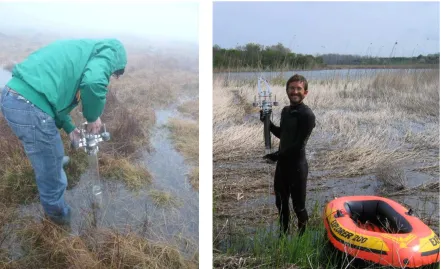
Fig. 2 Small gravity hand corer (‘Kajak corer’) used for intertidal sites. Lead weights can be added to increase penetration and the corer mechanism closes when the attached rope goes slack. The corer works very well in muddy sediments but less well in sandy sediments. © S. Gabriel