R E S E A R C H
Open Access
Effects of chromium-enriched bacillus
subtilis KT260179 supplementation on
chicken growth performance, plasma lipid
parameters, tissue chromium levels, cecal
bacterial composition and breast meat
quality
Jiajun Yang, Kun Qian
*, Wei Zhang, Yayuan Xu and Yijing Wu
Abstract
Background:Both chromium (Cr) and probioticbacillusown the virtues of regulating animal metabolism and meat
quality. Purpose of this study was to evaluate the efficiency of supplemental Cr andbacillus in the form of
chromium-enriched Bacillus subtilis KT260179 (CEBS) on chicken growth performance, plasma lipid parameters,
tissue chromium levels, cecal bacterial composition and breast meat quality.
Methods: Six hundred of 1-day-old Chinese Huainan Partridge chickens were divided into four groups randomly: Control, inorganic Cr,Bacillus subtilis, and CEBS. The feed duration was 56 days.
Results:After 28 days of treatment, broiler feed CEBS or normalB. subtilishad higher body weights than control broiler, and after 56 days, chickens given either CEBS orB. subtilishad greater body weights than control broiler or those given inorganic Cr. Plasma total cholesterol, triglycerides, and low density lipoprotein cholesterol levels declined significantly in the CEBS group compared with the control, whereas plasma high density lipoprotein cholesterol levels increased significantly. The concentration of Cr in blood and breast muscle increased after CEBS and inorganic Cr supplementation.B. subtilisand CEBS supplementation caused a significant increase in the numbers ofLactobacillusandBifidobacteriumin the caecum, while the numbers ofEscherichia coliandSalmonelladecreased significantly compared to the control. Feed adding CEBS increased the lightness, redness, and yellowness of breast meat, improved the water-holding capacity, decreased the shear force and cooking loss.
Conclusions:In all, CEBS supplementation promoted body growth, improved plasma lipid parameters, increased tissue Cr concentrations, altered cecal bacterial composition and improved breast meat quality.
Keywords:Chromium-enriched bacillus subtilis, Chicken, Growth performance, Meat quality, Bacterial composition
* Correspondence:[email protected]
The Institute of Animal Husbandry and Veterinary Medicine, Anhui Academy of Agricultural Sciences, No. 40 Nongke South Road, Hefei 230031, Anhui, People’s Republic of China
Background
With the application of modern breeding technology, the major biological characteristics of chickens or broilers, i.e. growth performance, daily weight gain, feed conversion efficiency and resistance to disease, have been improved significantly [1]. Despite the suc-cess of breeding programs in increasing meat produc-tion, the high selection intensity has resulted in negative impacts on growth performance and meat quality [2, 3].
Chromium (Cr) is an essential trace element and its beneficial effects on health are well documented in humans and animals [4]. Adding suitable dose of Cr to diet could improve the meat quality and regulate the metabolism of nutrient substances in animals [5]. Sup-plementation of the diet with trivalent Cr [Cr (III)] can be achieved using the salt chromium trichloride (CrCl3).
Low molecular weight organic Cr complexes, such as picolinic acid and nicotinate salt forms, provide a myriad of benefits with higher organic bioavailability than the inorganic forms that are most often used as a dietary supplement [6]. Although Cr nanocompos-ites have even higher bioavailability than organic sources of Cr [7], their greater cost has inhibited wide-spread use. In animal husbandry, there is a need to explore a cheap and convenient organic source of Cr for use in in-dustrial applications.
Bacillus subtilisis a probiotic bacterium that is widely used in diets of both humans and animals [8]. Oral ad-ministration ofB. subtilis can exert a range of beneficial effects, including improvement of growth, enhancement of meat characteristics, optimizing the balance of intes-tinal microbiota, prevention and treatment of some diar-rheal diseases, and reduction of serum cholesterol [9, 10]. For these reasons,B. subtilishas attracted considerable at-tention as a potentially beneficial dietary supplement for animal health.
It might be worthwhile to explore whether the com-bined use of organic Cr and B. subtilis might have a greater effect on regulating body growth and metabol-ism. Chinese Huainan Partridge chicken is a native breed in South of China. Because of special consumed habits, South of Chinese liked to choose the breed of broiler. Hence, Chinese Huainan Partridge chicken was employed to carry out this study. To test this hy-pothesis, we produce Cr-enriched B. subtilis (CEBS) which combines the virtues of B. subtilis and those of organic Cr and might induce an enhanced response to dietary supplementation. The aim of our study was to determine whether CEBS supplementation could play a role in improving body growth performance and breast meat quality, through improving lipid me-tabolism, utilization of Cr and intestinal bacterial composition on Chinese Huainan Partridge chicken.
Methods
Chicks, diets, and experimental design
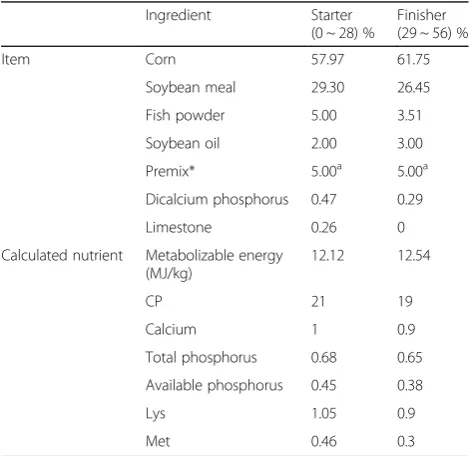
The experimental protocol used in this study, including animal management, housing, and slaughter proce-dures, was approved by the Institution of Animal Science and Welfare of Anhui Province (Number: IAS-WAP2014110528). A total of 600 1-day-old Chinese Huainan Partridge chicken were randomly allocated into four groups with six replicate of 25 each. Chickens in the control group were fed basal feedstuff; the three treatments were fed basal feedstuff with different addi-tives. Experimental diets were fed in two periods: starter (day 0–28) and finisher (day 29–56). The com-position and nutrient analysis results for the basic diet are shown in Table 1. All the nutrients met or exceeded the nutrient requirements as recommended by the NRC [11]. The birds had free access to water and feed. In the whole trial, the normal immune procedure was implemented. B. subtilis KT260179 (submitted to National Center for Biotechnology Information) was provided by the Institute of Animal Husbandry and Veterinary Medicine, Anhui Academy of Agricultural Sciences in China. The fermentation of B. subtilis KT260179 and CEBS was followed Yang et al. (CEBS: Total Cr concentration 30μg/g, Organic Cr 29.17μg/g, Live B. subtilis KT260179 1.0 × 10⁹ CFU/g). After fermented, CEBS were harvested and added to mass
Table 1Composition and nutrient analysis of the basic diet for broilers at different stages (% as fed)
Ingredient Starter
(0 ~ 28) %
Finisher (29 ~ 56) %
Item Corn 57.97 61.75
Soybean meal 29.30 26.45
Fish powder 5.00 3.51
Soybean oil 2.00 3.00
Premix* 5.00a 5.00a
Dicalcium phosphorus 0.47 0.29
Limestone 0.26 0
Calculated nutrient Metabolizable energy (MJ/kg)
12.12 12.54
CP 21 19
Calcium 1 0.9
Total phosphorus 0.68 0.65
Available phosphorus 0.45 0.38
Lys 1.05 0.9
Met 0.46 0.3
The premix provides a
feed followed 0.67 %. First, we added 0.67 L liquid CEBS to 9.33 kg mass feed and mixed with hand, then the mixed mass feed was added into blender con-tained 90 kg mass feed. The blender was employed for 20 min to mix the additives uniformity. The ways of B. subtilis KT260179 and inorganic Cr supplemen-tation was the same as the CEBS. The ratio of B. sub-tilis KT260179 (Live B. subtilis KT260179 2.0 × 10⁹ CFU/g) supplemented was 0.34 %. We prepared the inorganic Cr solution and sterilized. Then, the CrCl3 solution was homogenize with mass feed. After
prepared the four kinds of feedstuff, the population of
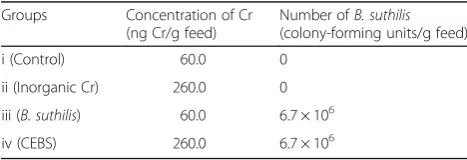
B. subtilis was counted with plate method which yeast extract peptone dextrose medium was employed. Also, the concentration of Cr in four kinds of feedstuff was measured. The results were listed in Table 2.
Growth performance and sample collections
Broilers in every replicate from each treatment group were weighed on day 0, 28, and 56. Daily feed consump-tion was accurately recorded. Daily weight gain and ratio of feed to gain (F/G) were calculated. ADG = body in-crease (g)/number of days. F/G = mass of food intake (g)/body increase (g).
After 56 days, two chickens from each replicate were selected, fasted for 12 h, and then tissues and blood were harvested under general halothane anesthesia. All blood samples were collected in 5.0 mL sterile heparinzed tubes. We removed 1 mL of each blood sample for measurement of Cr concentration. Then, remnant chick blood was centrifuged at 3000 g for 10 min to collect the plasma for biochemical assays (described below). Breast muscle was collected, which was frozen in liquid nitrogen and stored at 4 °C until analysis. The tissue of caeca from chickens was re-moved under aseptic conditions, which was stored in sterile plastic tubes in boxes packed with ice, and im-mediately sent to our laboratory for plate-counting of microorganisms.
Plasma lipid analyses
Chicken plasma total cholesterol (TC), triglycerides (TG), low density lipoprotein cholesterol (LDLC), and high density lipoprotein cholesterol (HDLC) concentrations
were measured using the appropriate detection kits (Nanjing Jiancheng Bioengineering Institute).
Tissue Cr assay
A ZEEnit 700 P atomic absorption spectrometer (Analytik Jena, Germany) was employed for assaying chromium levels in tissues. All the measurements were performed by the method described by Afridi et al. [12]. Samples of blood, breast meat (0.2 g), and 0.2 g feedstuff from all four groups were placed in beakers and digested by addition of 10 mL of a nitric acid–perchloric acid (HNO3–HClO4) mixture. The mixture was heated on a sand bath until fumes ap-peared (the temperature was controlled at 200 °C by monitoring of the sand) and the solution had mostly evaporated. After cooling, 5 mL HNO3 was added,
and the heating procedure was repeated at 180 °C. The cooled remainder was made up to 10 mL with distilled water. Eight replicates were used for each group.
Cecal sample collection and bacterial composition analysis
The bacterial composition of ceaca in different treat-ments was done with plate method [13, 14] (eosin methylene blue agar for Escherichia coli, Salmonella-Shigellaagar plate for Salmonella, de Man, Rogosa, and Sharpe agar for total Lactobacillus, and BLB agar for
Bifidobacteriumby pour plate method, including E. coli,
Salmonella, total Lactobacillus, and Bifidobacterium
which were repeated three times).
Meat Quality Analysis
Breast muscle samples were collected for meat quality at the end of the experiment. Lightness (L*), redness (a*), and yellowness (b*) of meat color was deter-mined by a Chroma meter (model CR-410, Minolta Co., Tokyo, Japan). Water-holding capacity (WHC) was estimated by determining expressible juice using a modification of the filter paper press method de-scribed by Wierbicki and Deatherage [15] as follows. The breast meat were refrigerated overnight at 4 °C and then brought to room temperature before cook-ing to measure cookcook-ing loss and shear force. The breast meat from each bird was weighed and placed into a thin walled plastic bag, then cooked to an in-ternal temperature of 70 °C on a digital thermostat water bath (HH-4, Jiangbo instrument, Jiangsu prov-ince, China) in a water-bath. Cooked meat was cooled to room temperature. The breast meat was weighed again for determination of cooking loss (%). Cutting three 1.9-mm-wide × 10 mm × 10 mm strips from the center of the muscles parallel to the muscle fibers through the thickest portion of the cooked muscle to
Table 2Concentration of Cr and number ofB. suthilisin Groups
Groups Concentration of Cr (ng Cr/g feed)
Number ofB. suthilis (colony-forming units/g feed)
i (Control) 60.0 0
ii (Inorganic Cr) 260.0 0
iii (B. suthilis) 60.0 6.7 × 10⁶
measure meat shear force. The samples were cut per-pendicular to the fiber direction using a Zwick Test-ing Machine Model Z2.5/TN1S (Zwick GmbH and Co, Germany) equipped with a Warner-Bratzler shear [16]. Peak force values were obtained in kg/mm2.
Statistical analysis
Statistical analyses of the data were performed using SPSS 16.0 (SPSS, Inc., Chicago, IL, USA). Data are presented as means ± standard error (SE). Differences between groups were compared using analyses of variance. Differences between means were assessed by the Tukey’s honestly significant difference test of post hoc multiple comparisons. Data on Body weight, Average daily gain, Average daily feed intake and Ratio of feed to gain was statistically processed as RE-PEATED measurements. A P value of less than 0.05 was considered statistically significant.
Results
Growth performance
Growth performance of Chinese Huainan Partridge chickens in different treatments was shown in Figs. 1, 2,
3 and 4. Chickens supplemented with B. subtilis
KT260179 and CEBS owned higher final body weight than the control birds or those supplemented with inorganic Cr after 28 days (P< 0.05). The index of ADG among con-trol, inorganic Cr andB. subtilisKT260179 supplemented groups was no significance (P> 0.05) at 28 days. While the result of F:G was opposite with the final body weight. Birds receivedB. subtilisKT260179 and CEBS had lower F:G (P< 0.05).
After 56 days, final body weights and ADG in CEBS group were significantly higher compared with the control and the inorganic Cr supplemented groups (P< 0.05) as well as the B. subtilis KT260179 group. While, the index of final body weight in group iv was highest of all (P< 0.05). Over the entire feeding duration, the Fig. 1Effects of different treatments on chicken body weight. The chicken were treated with control (i), inorganic Cr (ii),B. subtilis(iii) and CEBS (iv) after 28 and 56 days. Bars represent mean ± S.E. Data of Body weight was statistically processed as REPEATED measurements. Bar in same color with different small letters a and b mean significant difference at 0.05 levels (P< 0.05). Aa, Bb mean significant difference at 0.01 levels (P< 0.01)
F:G in the CEBS group was the lowest (P< 0.05). The F:G index of group iii was lower compared with the control and inorganic Cr groups (P< 0.05). There were no differences in the ADFI among the four groups either after 28 or after 56 days (P> 0.05).
Plasma lipid parameters
The results of plasma lipid parameters were listed in Table 3. The levels of lipids (TC, TG, LDLC) in chickens given B. subtilis KT260179 were significantly lower compared with the controls, but were still higher than those of the CEBS group (P< 0.05). The concentrations of HDLC in the plasma of chicken in
the CEBS and B. subtilis KT260179 groups were
higher compared with the control chicken (P< 0.05), the former being higher in CEBS than B. subtilis
KT260179 treatment (P< 0.05). The ratio of TC:LDLC was calculated, which indicated that chicken supple-mented with CEBS had the highest ratio of all (P< 0.01). Chicken supplied with B. subtilis KT260179 showed
higher TC:LDLC compared with the control and inor-ganic Cr groups (P< 0.01). The results for the ratio of TC:HDLC was that CEBS group was the lowest of all treatments (P< 0.01), and that for B. subtilis KT260179 was higher than that for CEBS but lower compared with inorganic Cr supplementation (P< 0.01). The result of TC:HDLC in control was highest of all (P< 0.01).
Tissue chromium levels
The Cr levels in breast meat and blood was measured with results shown in Fig. 5. The results indicated that chickens fed inorganic Cr had significantly more Cr in these tissues compared with the control and B. subtilis
KT260179 supplementation groups (P< 0.01). Chickens in the CEBS group had the highest Cr levels in those two tissues (P< 0.01).
Cecal bacterial composition
The cecal bacterial composition in the different groups of chickens was examined using the plate method (Table 4). Fig. 3Effects of different treatments on chicken average daily feed intake. The chicken were treated with control (i), inorganic Cr (ii),B. subtilis(iii) and CEBS (iv) after 28 and 56 days. Bars represent mean ± S.E. Data of Body weight was statistically processed as REPEATED measurements. There were no differences among groups between 28 and 56 days (P> 0.05)
Chicken given CEBS or B. subtilisKT260179 had lower numbers of E. coli and Salmonella compared with the control chicken (P< 0.05). There were no differences between the control and inorganic Cr-supplemented groups (P> 0.05). The numbers of Lactobacillus and
Bifidobacterium in the CEBS andB. subtilis KT260179 groups increased significantly compared with the con-trol and inorganic Cr-supplemented groups (P< 0.05).
Breast meat quality
The breast meat quality on color L*, a*, b*, water-holding capacity, shear force and cooking loss were measured with 28-days-old broilers, and the results are provided in Table 5. Chickens with CEBS supplied had higher results of breast meat color L*, a* and b* (P< 0.05) than chickens in control, inorganic Cr and B. subtilisKT260179 groups (P< 0.05). Birds supplemented with CEBS andB. subtilis
KT260179 had higher water-holding capacity and lower cooking loss than control group (P< 0.05). In further, the index of cooking loss in CEBS group was lowest of all (P< 0.05). The results of shear force in all three treatment groups were lower than that of control (P
< 0.05). Also, the result of CEBS group was lowest of all (P< 0.05).
Discussion
Both of Cr and B. subtilisown the ability of modulat-ing growth performance to chicken [14, 17, 18]. In our study, we supplemented a dose of 0.2 μg/g CrCl3
to basic feedstuff, which demonstrated that there was no promoting effect to Chinese Huainan Partridge chicken. Our results indicated that rates of growth were improved in chickens given B. subtilis KT260179 or CEBS supplements. Whereas chickens supple-mented with CEBS had higher average body weights and greater feed utilization efficiency than controls. The F/G index of the CEBS group was the lowest over the entire feeding period, suggesting that this treatment was more efficient than B. subtilis alone in regulating body growth performance.
Dietary supplementary Cr and B. subtilis could im-prove body lipid metabolism [19–21]. Our data sug-gested that the concentration of plasma total cholesterol and triglycerides were decreased in chicken treated with CEBS or B. subtilis. CEBS enhanced the metabolism of TC and triglyceride. HDLC, synthesized mainly in the liver and the small intestine, plays an important part in eliminating serum cholesterol [22]. The decreased content of serum lipid resulted from a decrease of TG synthesis and/or enhancement of TG hydrolysis
Table 3Effects of different treatments on chicken breast meat characteristics
Groups Meat color WHC4(%) Shear force (kg/mm2) Cooking loss (%)
L*1 a*2 b*3
i 51.85 ± 2.11a 12.63 ± 0.52a 16.14 ± 0.64a 66.62 ± 2.42a 2.79 ± 0.09a 16.89 ± 0.58a
ii 52.27 ± 2.09a 12.79 ± 0.50a 16.85 ± 0.62a 70.89 ± 2.39a,b 2.31 ± 0.08b 15.96 ± 0.57a,b
iii 54.08 ± 2.12a 13.14 ± 0.51a 16.92 ± 0.63a 71.99 ± 2.38b 2.24 ± 0.07b 15.01 ± 0.51b
iv 58.98 ± 2.08b 15.02 ± 0.49b 18.49 ± 0.58b 72.92 ± 2.40b 1.87 ± 0.10c 13.22 ± 0.48c
The different superscript small letters in the same column a, b mean significant difference at 0.05 levels (P< 0 · 05) 1
Lightness 2
Redness 3
Yellowness 4
Water-holding capacity
[23]. The decreased concentrations of hepatic TG re-vealed that lipid synthesis was reduced when the broilers were fed the B. subtilis supplemented diet, which can be associated with the improvement of plasma lipid metabolism. Likewise, supplementary in-organic Cr could improve the lipid metabolism to a slightly extent. Supplementation Cr in diet could modify the lipid metabolism especially in obesity or stress condition. The background of the supplementa-tion of Cr in diabetic or fat persons is the tendency to lose the ability to convert Cr into a form that po-tentiates insulin action [24]. Therefore, nutritional supplements could decrease the lipid paraments in plasma [25]. For healthy animals, supplementary Cr would have little effect on lipid metabolism in a Cr-sufficient diet.
Previous studies have reported that Cr supplementa-tion can increase the Cr content of tissues, although the results varied [26, 27]. In our study, the Cr contents of breast meat and blood were very significantly increased with the inorganic and CEBS supplemented. Our results here showed that the supplemental Cr in CEBS had a significant influence on Cr content of breast muscle in agreement with a previous report [28]. The effect of CEBS was greater than for inorganic Cr in this experi-ment, suggesting that CEBS had greater bioavailability as a Cr resource. The possible mechanism was that B. subtilis grew in medium contained inorganic Cr, to allow the efficient conversion of inorganic Cr into
organic forms, such as amino acid chelated Cr, or-ganic compounds are absorbed more efficiently than are inorganic forms Hence, CEBS owed more bio-availability than inorganic Cr [19, 29].
Probiotic supplements have been reported to modify the composition of the caecal microbiota [30, 31]. Simi-larly, our results here indicated that B. subtilis supple-ments could alter the bacterial flora in the caeca of treated chicken. Supplementation of 105
to 109 colony-forming units (CFU)/g of probiotics in the diet could exert beneficial effects in broilers [32]. However, Huang reported that a higher inclusion level did not always re-sult in enhanced performance in poultry [33]. There were reports on supplemental doses 28, which suggested that 106 CFU of Bacillus per gram feedstuff were suit-able. In the present study, we supplemented 106CFU/g
B. subtilis. The total Cr concentration in the CEBS treat-ment was 30 μg/g; we therefore added a 0.67 % supple-ment to the feedstuff, which conform the reported supplementary dose (0.2 μg Cr per gram feedstuff ) [34, 35].
When probiotics are used for meat quality enhance-ment, the effects have been questioned, and many different results have been shown. Some authors re-ported advantages of probiotic supplementation [36, 37], whereas others reported no beneficial effects [38]. Meat quality could be modified by the improvement of Cr utilization and intestinal bacterial composition. Our result indicated that with B. subtilis supplemented there were no significances on meat color. While, dietary addition of CEBS could improve meat color, which ad-vised that CEBS combined the virtue of Cr andB. subtilis
regulating the nutrition metabolism strongly. In the meas-urement of meat quality, water-holding capacity, shear force and drip loss are important factors because some nutrients may be lost in the exudate by water loss, which may be reflected in the juiciness, tenderness, and flavor of meat [39]. In our results, index of water-holding capacity were significantly improved withB. subtilisand CEBS sup-plemented. Likewise, indexes of shear force and drip loss were significantly lowered. Those results suggested thatB.
Table 4Effects of different treatments on cecal bacterial composition log10CFU · g−1
Groups Escherichia coli Salmonella Lactobacillus Bifidobacterium i 7.46 ± 0.14a 2.39 ± 0.03a 7.91 ± 0.15a 7.02 ± 0.06a ii 7.42 ± 0.12a 2.33 ± 0.03a 7.93 ± 0.16a 7.05 ± 0.08a iii 6.92 ± 0.13b 1.92 ± 0.04b 8.38 ± 0.16b 7.24 ± 0.06b iv 6.88 ± 0.13b 1.88 ± 0.03b 8.37 ± 0.13b 7.26 ± 0.05b The different superscript small letters in the same column a, b mean significant difference at 0.05 levels (P< 0 · 05)
Table 5Effects of different treatments on plasma lipid parameters
Groups TC mmol/L TG mmol/L LDLC mmol/L TC/LDLC HDLC mmol/L TC/HDLC
i 3.54 ± 0.11a 1.21 ± 0.05a 1.58 ± 0.06a 2.22 ± 0.06Aa 0.62 ± 0.03a 5.70 ± 0.13Aa
ii 3.47 ± 0.10a 1.15 ± 0.04a 1.51 ± 0.05a 2.29 ± 0.05Aa 0.65 ± 0.02a 5.33 ± 0.12Bb
iii 3.25 ± 0.12b 0.97 ± 0.05b 1.26 ± 0.04b 2.57 ± 0.04Bb 0.74 ± 0.03b 4.39 ± 0.14Cc
iv 3.03 ± 0.09c 0.82 ± 0.03c 1.16 ± 0.04c 2.61 ± 0.05Cc 0.92 ± 0.03c 3.29 ± 0.11Dd
TCtotal cholesterol,TGtriglycerides,LDLClow density lipoprotein cholesterol,HDLChigh density lipoprotein cholesterol,TC/LDLCratio of TC to LDLC,TC/HDLC ratio of TC to HDLC
The different superscript small letters in the same columna, b, c
mean significant difference at 0.05 levels (P < 0 · 05).Aa, Bb, Cc
subtilis supplied in feedstuff modified the breast meat quality. The effect of CEBS was greater than for CrCl3and
B. subtilisin the present experiment.
Conclusions
The results of our study indicated that feeding supple-mentary CEBS combined the benefits of Cr and probio-tics could improve chicken final body weight and ADG, decrease F:G, compared with control group. While there were no significances on ADFI. Chicken supple-mented with CEBS could modify plasma lipid parame-ters, enhance tissue Cr concentrations and improve caecal bacterial composition and breast meat quality.
Abbreviations
a*:Redness; ADG: Average daily weight gain; b*: Yellowness;B. subtilis: Bacillus subtilis; CEBS: Chromium enriched bacillus subtilis; Cr: Chromium; F/G: Ratio of feed to gain; HDLC: High density lipoprotein cholesterol; L*: Lightness; LDLC: Low density lipoprotein cholesterol; TC: Total cholesterol; TG: Triglycerides; WHC: Water-holding capacity
Acknowledgements
The authors sincerely thank Mr. Kun Qian for his help in presentation of this manuscript.
Funding
This work was sponsored by the fund of doctor startup project in Anhui Academy of Agricultural Sciences of China. The funders had no role in the design of the study and collection, analysis, and interpretation of data and in writing of the manuscript.
Availability of data and materials
The datasets supporting the conclusions of this article are included within the article.
Authors’contributions
JJY carried out the animal experiments and data analysis, and drafted the manuscript. KQ revised the manuscript. WZ and YYX participated in the animal trial. YJW helped with sample harvested and collection. All authors read and approved the final manuscript.
Competing interests
The authors declare that they have no competing interests.
Ethics approval and consent to participate
The experimental protocol used in this study, including animal management, housing, and slaughter procedures, was approved by the Institution of Animal Science and Welfare of Anhui Province (Number: IASWAP2014110528).
Received: 23 August 2016 Accepted: 21 October 2016
References
1. Havenstein G, Ferket P, Qureshi M. Growth, livability, and feed conversion of 1957 versus 2001 broilers when fed representative 1957 and 2001 broiler diets. Poult Sci. 2003;82(10):1500–8.
2. Havenstein G, Ferket P, Qureshi M. Carcass composition and yield of 1957 versus 2001 broilers when fed representative 1957 and 2001 broiler diets. Poult Sci. 2003;82(10):1509–18.
3. Le Bihan-Duval E, Millet N, Remignon H. Broiler meat quality: effect of selection for increased carcass quality and estimates of genetic parameters. Poult Sci. 1999;78(6):822–6.
4. Mertz W. Chromium in human nutrition: a review. J Nutr. 1993;123(4):626–33. 5. Lukaski HC. Chromium as a supplement. Annu Rev Nutr. 1999;19:279–302. 6. Laschinsky N, Kottwitz K, Freund B, Dresow B, Fischer R, Nielsen P.
Bioavailability of chromium (III)-supplements in rats and humans. Biometals. 2012;25(5):1051–60.
7. Eybe T, Audinot JN, Udelhoven T, Lentzen E, El Adib B, Ziebel J, Hoffmann L, Bohn T. Determination of oral uptake and biodistribution of platinum and chromium by the garden snail (Helix aspersa) employing nano-secondary ion mass-spectrometry. Chemosphere. 2013;90(6):1829–38.
8. Khochamit N, Siripornadulsil S, Sukon P, Siripornadulsil W. Antibacterial activity and genotypic-phenotypic characteristics of bacteriocin-producing Bacillus subtilis KKU213: potential as a probiotic strain. Microbiol Res. 2015; 170:36–50.
9. Kritas SK, Marubashi T, Filioussis G, Petridou E, Christodoulopoulos G, Burriel AR, Tzivara A, Theodoridis A, Piskorikova M. Reproductive performance of sows was improved by administration of a sporing bacillary probiotic (Bacillus subtilis C-3102). J Anim Sci. 2015;93(1):405–13.
10. Lei K, Li YL, Wang Y, Wen J, Wu HZ, Yu DY, Li WF. Effect of dietary supplementation of Bacillus subtilis B10 on biochemical and molecular parameters in the serum and liver of high-fat diet-induced obese mice. J Zhejiang Univ Sci B. 2015;16(6):487–95.
11. National Research Council. Nutrient Requirement of Poultry. 9th ed. Washington D.C.: National Academy Press; 1994.
12. Afridi HI, Kazi TG, Talpur FN, Arain S, Arain SS, Kazi N, Panhwar AH, Brahman KD. Evaluation of chromium and manganese in biological samples (scalp hair, blood and urine) of tuberculosis and diarrhea male human immunodeficiency virus patients. Clin Lab. 2014;60(8):1333–41.
13. Mountzouris KC, Tsirtsikos P, Kalamara E, Nitsch S, Schatzmayr G, Fegeros K. Evaluation of the efficacy of a probiotic containing Lactobacillus, Bifidobacterium, Enterococcus, and Pediococcus strains in promoting broiler performance and modulating cecal microflora composition and metabolic activities. Poult Sci. 2007;86(2):309–17.
14. Jeong JS, Kim IH. Effect of Bacillus subtilis C-3102 spores as a probiotic feed supplement on growth performance, noxious gas emission, and intestinal microflora in broilers. Poult Sci. 2014;3(12):3097–103.
15. Wierbicki E, Deatherage FE. Determination of water-holding capacity of fresh meats. Agric Food Chem. 1958;6:387–92.
16. Cason JA, Lyon CE, Papa CM. Effect of Muscle Opposition during Rigor on Development of Broiler Breast Meat Tenderness. Poult Sci. 1997;76(5):785–7. 17. Jahanian R, Rasouli E. Dietary chromium methionine supplementation could
alleviate immunosuppressive effects of heat stress in broiler chicks. J Anim Sci. 2015;93(7):3355–63.
18. Lin YC, Huang JT, Li MZ, Cheng CY, Lien TF. Effects of supplemental nanoparticle trivalent chromium on the nutrient utilization, growth performance and serum traits of broilers. J Anim Physiol Anim Nutr (Berl). 2015;99:59–65.
19. Yang J, Xu Y, Qian K, Zhang W, Wu D, Wang C. Effects of chromium-enriched Bacillus subtilis KT260179 supplementation on growth performance, caecal microbiology, tissue chromium level, insulin receptor expression and plasma biochemical profile of mice under heat stress. Br J Nutr. 2016;115(1):774–81. 20. Sadeghi M, Najaf Panah MJ, Bakhtiarizadeh MR, Emami A. Transcription
analysis of genes involved in lipid metabolism reveals the role of chromium in reducing body fat in animal models. J Trace Elem Med Biol. 2015;32:45–51. 21. Do HJ, Chung JH, Hwang JW, Kim OY, Lee JY, Shinl MJ. 1-deoxynojirimycin
isolated from Bacillus subtilis improves hepatic lipid metabolism and mitochondrial function in high-fat-fed mice. Food Chem Toxicol. 2015;75:1–7. 22. Wang MQ, Xu ZR, Zha LY, Lindemann MD. Effects of chromium
nanocomposite supplementation on blood metabolites, endocrine parameters and immune traits in finishing pigs. Anim Feed Sci Technol. 2007;139(1):69–80.
23. Walker SE, Register TC, Appt SE, Adams MR, Clarkson TB, Chen H, Isom S, Franke AA, Kaplan JR. Plasma lipid-dependent and -independent effects of dietary soy protein and social status on atherogenesis in premenopausal monkeys: implications for postmenopausal atherosclerosis burden. Menopause. 2008;15(5):950–7.
24. Wang ZQ, Zhang XH, Russell JC, Hulver M, Cefalu WT. Chromium picolinate enhances skeletal muscle cellular insulin signaling in vivo in obese, insulin-resistant JCR:LA-cp rats. J Nutr. 2006;136:415–20.
25. Toghyani M, Shivazad M, Gheisari A, Bahadoran R. Chromium
supplementation can alleviate the negative effects of heat stress on growth performance, carcass traits, and meat lipid oxidation of broiler chicks without any adverse impacts on blood constituents. Biol Trace Elem Res. 2012;146:171–80.
27. Uyanik F, Eren M, Guclu BK, Sahin N. Effects of dietary chromium supplementation on performance, carcass traits, serum metabolites, and tissue chromium levels of Japanese quails. Biol Trace Elem Res. 2005;103(2): 187–97.
28. Zha LY, Xu ZR, Wang MQ, Gu LY. Effects of chromium nanoparticle dosage on growth, body composition, serum hormones and tissue chromium in Sprague-Dawley rats. J Zhejiang Univ Sci B. 2007;8(5):323–30.
29. Stewart RDH, Griffiths NM, Thomson CD, Robinson MF. Quantitative selenium metabolism in normal New Zealand women. Br J Nutr. 1987;40: 45–54.
30. Salazar N, Binetti A, Gueimonde M, Alonso A, Garrido P, Gonzalez del Rey C, Gonzalez C, Ruas-Madiedo P, de los Reyes-Gavilan CG. Safety and intestinal microbiota modulation by the exopolysaccharide-producing strains Bifidobacterium animalis IPLA R1 and Bifidobacterium longum IPLA E44 orally administered to Wistar rats. Int J Food Microbiol. 2011;144(3):342–51. 31. Sen S, Ingale SL, Kim YW, Kim JS, Kim KH, Lohakare JD, Kim EK, Kim HS, Ryu
MH, Kwon IK, Chae BJ. Effect of supplementation of Bacillus subtilis LS 1–2 to broiler diets on growth performance, nutrient retention, caecal microbiology and small intestinal morphology. Res Vet Sci. 2012;93(1):264–8. 32. Mountzouris KC, Tsitrsikos P, Palamidi I, Arvaniti A, Mohnl M, Schatzmayr G,
Fegeros K. Effects of probiotic inclusion levels in broiler nutrition on growth performance, nutrient digestibility, plasma immunoglobulins, and cecal microflora composition. Poult Sci. 2010;89(1):58–67.
33. Huang MK, Choi YJ, Houde R, Lee JW, Lee B, Zhao X. Effects of Lactobacilli and an acidophilic fungus on the production performance and immune responses in broiler chickens. Poult Sci. 2004;83(5):788–95.
34. Anderson RA, Bryden NA, Polansky MM, Richard MP. Chromium supplementation of turkeys: effects on tissue chromium. J Agric Food Chem. 1989;37(1):131–4.
35. Hossain SM, Barreto SL, Silva CG. Growth performance and carcass composition of broilers fed supplemental chromium from chromium yeast. Anim Feed Sci Technol. 1998;71(3):217–28.
36. Mahajan P, Sahoo J, Panda PC. Effect of probiotic (Lacto-Sacc) feeding, packaging methods and season on the microbial and organoleptic qualities of chicken meat balls during refrigerated storage. J Food Sci Technol. 2000; 37(1):67–71.
37. Zhou X, Wang Y, Gu Q, Li W. Effect of dietary probiotic, Bacillus coagulans, on growth performance, chemical composition, and meat quality of Guangxi Yellow chicken. Poult Sci. 2010;89(3):588–93.
38. Zhang ZF, Zhou TX, Ao X, Kim IH. Effects ofβ-glucan and Bacillus subtilison growth performance, blood profiles, relative organ weight and meat quality in broilers fed maizesoybean meal based diets. Livest Sci. 2012;150(1–3): 419–24.
39. Chen H, Dong X, Yao Z, Xu B, Zhen S, Li C, Li X. Effects of prechilling parameters on water-holding capacity of chilled pork and optimization of prechilling parameters using response surface methodology. J Anim Sci. 2012;90(8):2836–41.
• We accept pre-submission inquiries
• Our selector tool helps you to find the most relevant journal • We provide round the clock customer support
• Convenient online submission • Thorough peer review
• Inclusion in PubMed and all major indexing services • Maximum visibility for your research
Submit your manuscript at www.biomedcentral.com/submit