R E S E A R C H
Open Access
Combination of uniform design with artificial
neural network coupling genetic algorithm:
an effective way to obtain high yield of biomass
and algicidal compound of a novel HABs control
actinomycete
Guanjing Cai
1,2†, Wei Zheng
1†, Xujun Yang
1, Bangzhou Zhang
1and Tianling Zheng
1,2*Abstract
Controlling harmful algae blooms (HABs) using microbial algicides is cheap, efficient and environmental-friendly. However, obtaining high yield of algicidal microbes to meet the need of field test is still a big challenge since qualitative and quantitative analysis of algicidal compounds is difficult. In this study, we developed a protocol to increase the yield of both biomass and algicidal compound present in a novel algicidal actinomyceteStreptomyces alboflavusRPS, which killsPhaeocystis globosa. To overcome the problem in algicidal compound quantification, we chose algicidal ratio as the index and used artificial neural network to fit the data, which was appropriate for this nonlinear situation. In this protocol, we firstly determined five main influencing factors through single factor experiments and generated the multifactorial experimental groups with a U15(15
5
) uniform-design-table. Then, we used the traditional quadratic polynomial stepwise regression model and an accurate, fully optimized BP-neural network to simulate the fermentation. Optimized with genetic algorithm and verified using experiments, we successfully increased the algicidal ratio of the fermentation broth by 16.90% and the dry mycelial weight by 69.27%. These results suggested that this newly developed approach is a viable and easy way to optimize the fermentation conditions for algicidal microorganisms.
Keywords:Novel algicidal actinomycete, Uniform design, Artificial neural network coupling genetic algorithm, High yield of biomass and algicidal compound, HABs control
Background
With the increasing influence of human activity, harmful algal blooms, also sometimes known as red tides, have happened more frequently and severely [1-3]. The tre-mendous accumulation of algal cells destroys the natural harmony of the ocean environment by discoloring the water, disrupting food-web dynamics, depleting oxygen and even poisoning the other creatures [4,5]. Many ap-proaches have been tried [6-8], and the limitation of physical and chemical methods [9] has made biological
control the research hotspot. The bacteria-algae inter-action plays an important role in both enhancing and decreasing algal bloomsin situ[10] and, with the discov-ery of numerous bacterial strains exhibiting strong and specific algicidal activity, provides a potential cheap, efficient and environmentally-friendly way to terminate the blooms or even prevent their occurrences [11-15]. Although the discovery of algicidal bacterium could be traced to 1925 [16], there are still few reports about microbial control of red tides in field tests [17]. An inev-itable problem concerns how to bring the algicidal microbes into the application stage with the help of ma-ture fermentation technologies.
Most algicidal microbes affect the growth of algae through the secreted metabolites. These algicidal me-tabolites might be proteins, peptides, amino acids, bio-* Correspondence:[email protected]
†Equal contributors
1State Key Laboratory of Marine Environmental Science and Key Laboratory
of MOE for Coast and Wetland Ecosystems, School of Life Sciences, Xiamen University, No. 422, Siming Nan Road, Xiamen 361005, China
2
ShenZhen Research Institute of Xiamen University, ShenZhen 518057, China
surfactants, and antibiotics [18]. Better understandings of the algicidal microbes require systematic studies about the chemical nature of these compounds. How-ever, they are often so effective that their concentra-tions in fermentation broth might actually be quite low. Therefore, optimizing the fermentation conditions to obtain high yield of algicidal compound seems to be beneficial for both theoretical and applied researches. But incomplete information about the target chemical becomes the biggest obstacle to a successful optimization process, which requires reliable material quantification. This seems to be a paradox, and it might be partially re-sponsible for the slow development of microbial algicides. Nevertheless, researchers have made some efforts to optimize the yield of algicidal microorganisms. The medium composition for the marine algicidal bacter-iumAlteromonas sp. DH46 were optimized using uni-form design and the bacterial dry weight successfully increased by 107% and algicidal efficiency by nearly 10% [19]. Response surface methodology was used to obtain the best fermentation conditions for the algi-cidal bacterium R2, and the final cell density success-fully increased without scarifying the algicidal rate [20]. However, these studies initially focused on the in-crease of biomass, which, theoretically speaking, has no absolute correlation with the yield of algicidal me-tabolites. The direct optimization for algicidal com-pound could be achieved when the chemical was well studied [21], but only few successful studies were re-ported when the chemical was unknown [22].
In recent years, more and more newly developed optimization strategies have been used in the fermenta-tion industry. And the problems in optimizing the yield of algicidal compound seems solvable though the ad-vanced artificial intelligence techniques with high effi-ciency and extensive application scope. One of these promising methods combines the use of artificial neural networks (ANNs) with genetic algorithms (GAs). An ANN is a computational model inspired by nervous sys-tems and is capable of machine learning and output value prediction [23]. Its high accuracy in multi-factorial and nonlinear analysis makes it a good tool to simulate fermentation results. The GA is an optimization algo-rithm based on Darwinian evolution and Mendelism in order to carry out random, adaptive and parallel global searches [24]. Fully understanding the advantages of these two computational methods, many researchers couple GA with ANN to optimize fermentation conditions and obtain significant results [25]. Considering algicidal ra-tio shows positive but nonlinear correlara-tion with the con-tent of algicidal compound, ANN and GA seems to be the excellent tools to analyze and fit the data. However, there are still no reports concerning applying this method in the fermentation optimization of algicidal microorganisms.
An actinomycete strain Streptomyces alboflavus RPS [15], which was isolated from the sediment sample of Fujian Zhangjiangkou Mangrove National Nature Re-serve, China, showed high algicidal activity against a typical harmful alga, Phaeocystis globosa. RPS lysed the algal cell by releasing an extracellular compound and the mycelial pellets were also capable of inhibiting algal growth in a seawater environment. To better understand its algicidal properties and prepare for the possible field test in future, we firstly tried to increase the production of mycelia and concentration of algicidal compound. In this new developed optimization protocol, we preferred to simplify the measurement of indexes, which took the dry mycelial weight as the biomass and algicidal ratio as the concentration of algicidal compound, to avoid un-necessary experimental errors. With the data obtained from single factor experiments and uniform design, we fully took the advantages of ANN and GA to fit the data and obtain the optimal medium compositions and culti-vation conditions. And we finally verified the optimal fermentation conditions and compared the GA-ANN method with the traditional regression model.
Results and discussion
The effects of different nutrients and cultivation conditions on the growth of RPS
In order to optimize the fermentation conditions to in-crease the production of RPS, we should first under-stand which were the major influencing factors. More practically speaking, we should found out changing which nutrients or cultivation conditions would lead to an increased yield of biomass and algicidal compounds compared to the original fermentation conditions. There-fore, we set the control group as the baseline in order to make the changes caused by different nutrients and cultiva-tion condicultiva-tions more clearly comparable.
Inorganic minerals also play a critical role in the life-cycle of microorganisms, although the requirement is much lower than that for a carbon and nitrogen source. In this study, we briefly tested the influence of different inorganic nutrient content on RPS. Judging by the bio-mass in Figure 1 (iii), the concentration of K2HPO4and MgSO4did not affect the growth of RPS very much, ex-cept for a 71.2% decrease caused by low MgSO4content. Considering the algicidal activity, the distinctions were more minor, even the low biomass in the low MgSO4 situation only reduced the algicidal ratio by 18.9%. Inter-estingly, the middle inorganic concentration (0.5 g/L K2HPO4, 0.5 g/LMgSO4•7H2O), which acted as the con-trol group, showed the highest biomass and algicidal ac-tivity, suggesting the importance of correct content of inorganics. Since the changes of these two inorganic minerals did not bring about higher yield of neither bio-mass nor algicidal compound, we would not take more
effort to optimizing the inorganic mineral content for the moment.
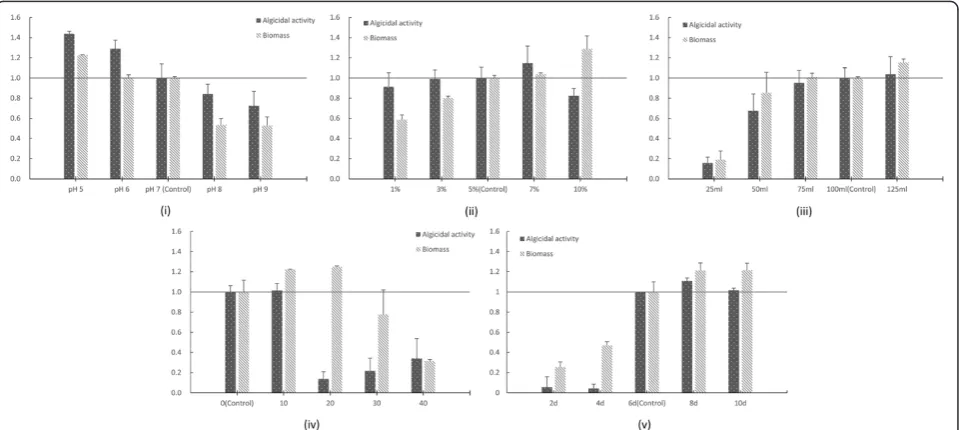
Every microbe has an optimum pH range. Most microorganisms are suited by a neutral environment while some are acidophilic or basophilic. The effect of initial pH on the fungus Ganoderma lucidum, which can produce simultaneously ganoderic acid and a poly-saccharide, has been studied [26]. And the authors find that the maximum biomass and production of ganode-ric acid is obtained at an initial pH of 6.5. However, the production of extracellular and intracellular polysac-charides becomes higher when the initial pH drops to 3.5. RPS lived better under a meta-acid environment (Figure 2 (i)). A low initial pH of 5 significantly in-creased the biomass and algicidal activity by 22.5% and 43.8%, respectively. This large improvement with low initial pH suggested that more thorough studies should be conducted.
Figure 1The effects of different nutrients on the growth of RPS. (i)Carbon sources.(ii)Nitrogen sources.(iii)Inorganic nutrients content.a) 0.5 g/L K2HPO4, 0.5 g/L MgSO4•7H2O,b)0.75 g/L K2HPO4, 0.5 g/L MgSO4•7H2O,c)0.25 g/L K2HPO4, 0.5 g/L MgSO4•7H2O,d)0.5 g/L K2HPO4,
0.75 g/L MgSO4•7H2O,e)0.5 g/L K2HPO4, 0.25 g/L MgSO4•7H2O.
Inoculum size strongly affected the growth rate of the strain. High inoculum size could bring forward the sta-tionary phase and the synthesis of metabolites, therefore also decrease the possibility of contamination. However, too high an inoculum size might also reduce the yield of products owing to the high consumption of oxygen. In Figure 2 (ii), the biomass had a positive correlation with inoculum size while the algicidal activity stayed at a high level even with the lowest inoculum size of 1%. Interest-ingly, the 10% inoculum size raised the biomass by 28.7%, but the algicidal activity decreased by 26.6% under the same inoculum size. This could be explained by the early coming of the late stationary phase blocking the synthesis of algicidal compounds. Thus, further optimization seemed to be necessary.
In most cases, the loaded volume affected the fermen-tation process owing to its association with dissolved oxygen. Lower loaded volume led to a higher oxygen transfer coefficient under the same shaking speed. In Figure 2 (iii), the biomass and algicidal activity is raised along with the volume up to 75 mL, and no huge gap is seen between 75, 100 and 125 mL. This result indicated that the high oxygen level might be a restricting factor to the growth of RPS.
RPS was isolated from the sediment sample of an estu-arine area, which explained why its biomass could reach a peak value at a salinity of 20 (124.8% compared to the control group in Figure 2 (iv)). However, the algicidal ac-tivity showed a different pattern. Only salinity levels of 0 and 10 induced the production of algicidal compounds, compared to the most fit salinity of 20 for mycelia growth. A good fermentation result under 0 salinity was beneficial for future large-scale production since high salinity has a strong corrosion effect on steel fermenta-tion tanks.
Fermentation time can characterize the growth rate of a strain, and RPS was a relatively slow-growing mi-crobe (Figure 2 (v)). The biomass continued to increase even after 8d, but the algicidal compounds were se-creted only after 6d, which might mark the beginning of the stationary phase. The slight decrease of the algi-cidal ratio at 10d also confirmed the situation in the case of high inoculum size, suggesting the importance of harvesting the fermentation broth at an appropriate growth phase in order to maximize the yield of algi-cidal compounds.
In summary, there were five factors that increased the production of RPS. Two of them (salinity and loaded volume) were not suitable for future large-scale fermen-tation conditions. Considering the importance of carbon and nitrogen content, five factors were used for the more detailed multi-factorial optimization: starch con-tent, sodium nitrate concon-tent, inoculum size, initial pH and fermentation time.
Uniform design and regression model
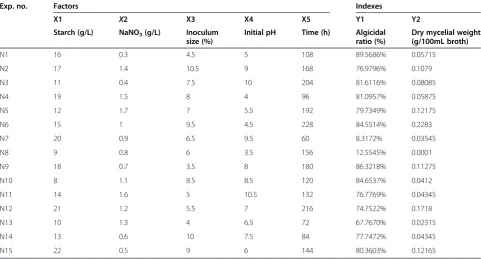
A uniform design seeks design points that are representa-tive and uniformly scattered on the domain [27]. Therefore, we could achieve the same goal as other statistical design methods, such as orthogonal design, with fewer experimen-tal groups [19,24]. Here we used the Data Processing System (Version 7.05) for the experimental design and sub-sequent data analysis along with the generation of regres-sion models. The results from the different experimental groups are presented in Table 1.
Based on the results of dry mycelial weight, a multiple regression equation was generated: Y2 = -0.543313758 + 0.022952473674X1 + 0.05158971648X3 + 0.08619420430 X4-0.0013331394535X5-0.0004410784967X1*X1-0.0013 657027343X3*X3-0.004819912252X4*X4-0.00163019147 50X1*X3 + 0.00030259683893X1*X4 + 0.0000303184098 39X1*X5-0.004189833135X3*X4 + 0.00020227979933X3* X5 + 0.000021989005098X4*X5. The correlation indexes were as follows: R= 1.0000, F value =38461.4808, p= 0.0040, Durbin-Watson value =2.17768003. The optimal fermentation conditions for a maximum biomass of 0.2598 g/100 mL were: 16.31 g/L starch, 0.52 g/L NaNO3, inoculum size 10.5%, initial pH 5.41, and fermentation time 228 h.
Also, based on the results of the algicidal ratio, another multiple regression equation was generated: Y1 = -3.97848306 + 0.31068222407X1 + 0.6327387394X 4 + 0.006103641490X5-0.005977938516X1*X1 + 0.0021 886562363X2*X2-0.022509013327X4*X4-0.000031536 339359X5*X5-0.0019135332295X1*X3-0.020236820212X1* X4 + 0.00015411255817X1*X5-0.0027135967924X3*X4 + 0. 00030307344603X3*X5-0.00006432940808X4*X5. The correlation indexes were as follows: R = 1.0000, F value = 38461.4808, p =0.0040, and Durbin-Watson value = 1.87922745. The optimal fermentation conditions for highest algicidal activity of 103% were: 18.07 g/L starch, 1.7 g/L NaNO3, inoculum size 3.5%, initial pH 5.50, and fermentation time 152 h.
Determination of the structure of artificial neural networks
Therefore, we determined the appropriate number of hidden neurons firstly (Table 2). In the case of dry my-celial weight, the training error dropped to a relatively low level when the number of hidden neurons reached nine. Even though the prediction error did not show a similar pattern, we could easily see that nine hidden neurons had the highest prediction accuracy. Thus, we determined the structure of the neural network for dry mycelial weight as 5-9-1. In the case of the algicidal ra-tio, a number of hidden neurons above nine also de-creased the training error to a low level. However, the minimum prediction error appeared only after the number of hidden neurons was 12, and so the structure
of the neural network for algicidal ratio was deter-mined as 5-12-1.
Optimization of artificial neural networks using the genetic algorithm
The precision of an ANN is greatly affected by the initial weights and thresholds of the network, and so we applied the GA, which used the sum of training error as the fitness, to seek the best weights and thresholds. The processes of optimization and the precision of the optimized neural net-works are shown in Additional file 1: Figures S1 and S2. There is no doubt that the high accuracy of these neural networks promised good simulation of fermentation and Table 1 Uniform-design-table and the results
Exp. no. Factors Indexes
X1 X2 X3 X4 X5 Y1 Y2
Starch (g/L) NaNO3(g/L) Inoculum
size (%)
Initial pH Time (h) Algicidal
ratio (%)
Dry mycelial weight (g/100mL broth)
N1 16 0.3 4.5 5 108 89.5686% 0.05715
N2 17 1.4 10.5 9 168 76.9796% 0.1079
N3 11 0.4 7.5 10 204 81.6116% 0.08085
N4 19 1.5 8 4 96 81.0957% 0.05875
N5 12 1.7 7 5.5 192 79.7349% 0.12175
N6 15 1 9.5 4.5 228 84.5514% 0.2283
N7 20 0.9 6.5 9.5 60 8.3172% 0.03545
N8 9 0.8 6 3.5 156 12.5545% 0.0001
N9 18 0.7 3.5 8 180 86.3218% 0.11275
N10 8 1.1 8.5 8.5 120 84.6537% 0.0412
N11 14 1.6 5 10.5 132 76.7769% 0.04345
N12 21 1.2 5.5 7 216 74.7522% 0.1718
N13 10 1.3 4 6.5 72 67.7670% 0.02315
N14 13 0.6 10 7.5 84 77.7472% 0.04345
N15 22 0.5 9 6 144 80.3603% 0.12165
Table 2 Error of the artificial neural network with different numbers of hidden neurons Number of
hidden neurons
Dry mycelial weight Algicidal ratio
Training error Prediction error Training error Prediction error
3 0.011 0.05911 0.08859 0.53504
4 0.0024 0.08869 0.02129 0.66232
5 0.00212 0.05847 0.00561 0.6092
6 0.00414 0.06218 0.00556 0.50672
7 0.00438 0.06918 0.00523 0.40763
8 0.00377 0.06369 0.01004 0.54822
9 0.0018 0.05719 0.00412 0.40388
10 0.00186 0.06579 0.0047 0.44591
11 0.00216 0.07613 0.00467 0.46936
therefore increased the possibility of gathering convincing results by further optimization.
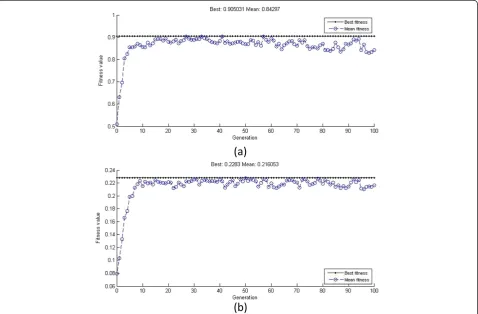
Genetic algorithm for best fermentation conditions One of the advantages of GA is that it does not require a specific objective function, which expands its applications largely, and so we used it again to obtain the best medium composition and cultivation conditions based on the neural networks. Figure 3 shows the optimization processes for each neural network. The optimal fermentation conditions were as follows: 19.93 g/L starch, 0.66 g/L NaNO3, inocu-lum size 9.2%, initial pH 5.20, and fermentation time 216 h for a maximum dry mycelial weight of 0.2283 g/100 mL; 17.76 g/L starch, 1.59 g/L NaNO3, inoculum size 8.1%, initial pH 5.23, and fermentation time 185 h for the highest algicidal ratio of 90.5%.
Verification experiments
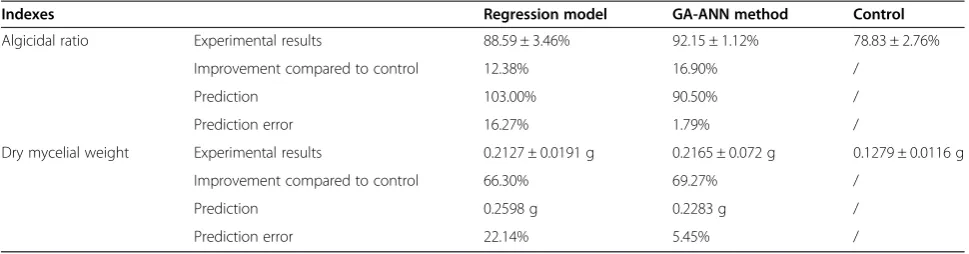
No matter how wonderful the results for the mathematic models are, experimental results are the final judges. As shown in Table 3, the optimization effects of both models were quite similar, which was not a big surprise because of the similar biases of nitrogen source, initial pH and fermentation time. The optimal fermentation conditions greatly increased the RPS biomass by 66.30%
for uniform design and 69.27% for the GA-ANN method. The algicidal activity was also enhanced, although the degrees of growth were much smaller because of the high algicidal ratio of the original. How-ever, the neural networks showed their improvement for a much higher prediction accuracy than the regres-sion models (1.79 to 16.27%, and 5.54 to 22.14%). Moreover, the extremes that came up with the regression model (inoculum size and fermentation time) implied its limited ability of optimization under complicated circumstances.
Conclusions
In this study, we innovatively combined the use of uni-form design with ANN coupling GA in the optimization of the fermentation conditions of an algicidal actinomy-cete, and reflected the efficiency of uniform design, the
‘eurytopicity’and accuracy of GA and BP-neural network, which overcame the quantitative problem of algicidal com-pound. The further application of algicidal microorganisms also became more plausible. Despite the fact that more and more researchers focus on various genetic modification methods to boost the productivity of microorganisms, fully developing the potential of the original strain by optimizing the fermentation conditions is still a more economic, fast
and environmentally safe way especially in the field of algi-cidal preparations that require more thorough theoretical studies.
In many studies, multi-factorial analysis was used in the optimization of medium composition. However, the importance of some nutrients might not be well quanti-fied because of their concentrations (such as K2HPO4in this study), while cultivation conditions (such as inocu-lum size, initial pH and fermentation time in this study) can play more critical roles and also interact with the medium composition. For example, inoculum size affects the growth rate of the strain, which is important to some slow-growing microorganisms and also directly con-nected to the consumption rate of the nutrients. Thus, in our opinion, applying single factor experiments to de-cide the important factors was necessary before proceed-ing to multifactorial optimization.
Wisely applying these multi-factorial analytical methods was even more important. In this study, we successfully saved the use of many experimental groups, thanks to the advantages of uniform design. Nevertheless, the traditional quadratic polynomial stepwise regression method showed its limitations in simulating the fermentation, the result of which were even absurd in the case of the algicidal ra-tio with nonlinear variara-tion(>100%). The ANN and GA seemed to be much more convincing based on our final verification experiments. However, it is undeniable that such great outcomes were based on the brilliant experi-mental sets coming from uniform design, and we should rationally choose and combine the algorithms, and then use their advantages to achieve our goals.
Beside the challenges during the development of micro-bial algicides, establishing a comprehensive theoretical sys-tem to guide the application of algicidal microorganisms is another difficulty that we have to face. In recent years, more and more researchers focused on the interaction mechanism between algae and microorganisms. Just like RPS, many algicidal microbes inhibit the growth of harmful algae or cause the lysis of algal cells by secreting some bio-logical active compounds, which shares quite a lot of simi-larities with alleopathy. Many studies revealed the fact that
these compounds would lyse the cells by inducing oxidative stress and destroying the photosynthetic system [2,28]. An-other important red tide control microbial factor is virus. Early in 1963, algal viruses had been isolated and identified [29]. With the gradual understanding of the crucial roles that algal virus plays in marine environment [30], virus also becomes a potential candidate for algal bloom control owing to their high efficiency and species-specificity. Except for the viruses, a newly found pathogen, which was identi-fied as the protistPseudobodosp. and could directly attack the algal cells, largely expanded our research and applica-tion prospect for algicidal microorganisms [31]. There is no doubt that microorganisms will be the key players in future red tide control [32], and the ongoing theoretical researches will serve the mature of field applications.
In a word, this study provided a clear way to optimize the fermentation conditions of a novel algicidal actino-mycete, and also laid the foundation for the develop-ment of algicidal preparations in the future.
Methods
Algal culture and evaluation of algal biomass
The Phaeocystis globosa culture was obtained from the State Key Laboratory of Marine Environmental Science (Xiamen University). The culture was maintained in ster-ilized f/2 medium under a 12 h: 12 h light-dark cycle with a light intensity of 4000 lx at 20 ± 1°C. When evaluating algal biomass, theP. globosaculture was transferred to a 24-well cell plate and the fluorescent intensity (RFU) measured under an excitation wavelength of 440 nm and emission wavelength of 680 nm (Spectra max M2, Molecular Devices Corporation). Earlier study has confirmed that this is a con-venient and accurate method to evaluate biomass [33].
Isolation and cultivation ofStreptomyces alboflavusRPS The strain was isolated from a sediment sample in the Fujian Zhangjiangkou Mangrove National Nature Reserve, China, through the dilution plating procedure with modi-fied Gause medium (soluble starch 15 g/L, NaNO31 g/L, K2HPO4 0.5 g/L, MgSO4•7H2O 0.5 g/L, FeSO4•7H2O 0.01 g/L, dissolved in natural seawater for agar plates, but Table 3 Verification of optimal fermentation conditions
Indexes Regression model GA-ANN method Control
Algicidal ratio Experimental results 88.59 ± 3.46% 92.15 ± 1.12% 78.83 ± 2.76%
Improvement compared to control 12.38% 16.90% /
Prediction 103.00% 90.50% /
Prediction error 16.27% 1.79% /
Dry mycelial weight Experimental results 0.2127 ± 0.0191 g 0.2165 ± 0.072 g 0.1279 ± 0.0116 g
Improvement compared to control 66.30% 69.27% /
Prediction 0.2598 g 0.2283 g /
dissolved in deionized water for liquid fermentation). The colony was then purified several times and identified as Streptomyces alboflavusbased on its physiological and bio-chemical characteristics and 16S rDNA sequencing. The strain was stored at -80°C in 10% (v/v) glycerol and inocu-lated into liquid medium (5%, v/v) for further study in a ro-tary shaker (28°C, 200 rpm) for 6d until the mycelia turned yellow-red. The growth of RPS was estimated using bio-mass and algicidal activity. The mycelia were collected by filtered and dried for 3 d to a constant weight as the bio-mass, and algicidal activity was evaluated by inoculating 200 μL of RPS culture into 1.8 mL of logarithmic phase algal culture (RFU≈300, 2.42 × 10⁶cells/mL), while 200μL of fresh medium was added to the algal culture as a control. The algicidal ratio was then calculated using the following formula:
Algicidal ratioð Þ ¼% F0‐Ft F0
100;
where Ft is the fluorescent intensity of the treated algal
culture, and F0 the fluorescent intensity of the control
group.
All shaken flask experiments included at least two par-allel samples.
The effects of different nutrients and cultivation conditions on the growth of RPS
We used single factor experiments, meaning only one of the nutrients or cultivation conditions was changed in each experimental group and the other influencing fac-tors remained the same as the original. The setups of each experimental group were shown below.
Carbon source: starch, glucose, sucrose, maltose and glycerol.
Nitrogen source: tryptophan, methionine, sodium nitrate, and ammonium sulfate.
Inorganic content: a) 0.5 g/L K2HPO4,
0.5 g/L MgSO4•7H2O, b) 0.75 g/L K2HPO4,
0.5 g/L MgSO4•7H2O, c) 0.25 g/L K2HPO4,
0.5 g/L MgSO4•7H2O, d) 0.5 g/L K2HPO4,
0.75 g/L MgSO4•7H2O, e) 0.5 g/L K2HPO4,
0.25 g/L MgSO4•7H2O.
Initial pH: 5, 6, 7, 8 and 9.
Inoculum size: 1, 3, 5, 7 and 10%, v/v.
Loaded volume: 25, 50, 75, 100 and 125 mL in 250 mL flasks. The biomasses were converted into 100 mL for comparison.
Salinity: 0, 10, 20, 30 and 40‰. Fermentation time: 2, 4, 6, 8 and 10 d.
To better quantify the influence of each factor and elimin-ate the minor errors caused by different experiment batches, we normalized the experimental results of the control group
(which used the same cultivation conditions as in the origin experiment) to 1 and the experimental results of the other groups were compared to that of the control group to show the differences.
Uniform design for multifactor optimization
Based on the single factor experiments above, we brought the five main influencing factors, which were starch content, sodium nitrate content, inoculum size, initial pH and fermentation time, to the next step -multifactor optimization. The Data Processing System (DPS Version 7.05) was used to generate the experi-mental design, statistical analysis and regression model using the quadratic polynomial stepwise regression method. Based on the uniform design table U15(155), 15 experimental groups with the five independent vari-ables (X1, X2, X3, X4 and X5) were set for testing the two dependent variables, Y1 (algicidal ratio) and Y2 (dry mycelial weight). Details concerning the experimental design and results are shown in Table 1. Two regression models were obtained for Y1 and Y2, followed by the acqui-sition of the optimal combination of cultivation conditions for the growth of RPS.
Combination of the artificial neural network and the genetic algorithm
The Matlab R2013a software was used for ANN model-ing and GA optimization. In this study, two separate neural network models were constructed to model the fermentation process and predict the biomass and algi-cidal activity. We used the data from uniform design as the training samples. Thus, each neural network con-sisted of five input neurons (starch content, sodium ni-trate content, inoculum size, initial pH and fermentation time) and a single output neuron (dry mycelial weight or algicidal ratio). The optimization process was made up of three steps.
2) We applied the GA to optimize the weights and thresholds of back-propagation (BP)-neural networks to increase their accuracy. To fully simulate the fermenta-tion process, we used all 15 experimental samples to train the ANN. The max epoch was set as 2000 and the training goal was 1 × 10⁻⁶. In the GA, the sum of training errors of each sample (absolute value) was defined as the fitness. The program sought the minimum fitness using the procedure of selection, crossover and mutation. The other parameter settings were as follows: maxgen = 50, sizepop = 20, Pcross = 0.8, Pmutation = 0.05.
3) With the optimal neural networks, we applied the GA again to seek the best fermentation conditions for RPS. In this step, the simulation result of the neural net-work was defined as the fitness. The algorithm sought the maximum fitness with the following parameter settings: maxgen = 100, sizepop = 80, Pcross = 0.4, Pmutation = 0.05.
Verification experiments
Finally, we verified the four groups of optimal fermenta-tion condifermenta-tions through experiments and compared the final results and accuracy of the two prediction models (regression model and neural network model).
Additional files
Additional file 1: Figure S1.Optimization of neural network for dry mycelial weight using a genetic algorithm. (a) Fitness curve of the genetic algorithm. (b) Prediction error of the network for each training sample.Figure S2.Optimization of the neural network for the algicidal ratio using a genetic algorithm. (a) Fitness curve of the genetic algorithm. (b) Prediction error of the network for each training sample.
Competing interests
The authors declare that they have no competing interests.
Authors’contributions
GC designed the study, carried out most of the experiments, established the artificial neural network and drafted the manuscript. WZ helped to design the study and participated in the statistical analysis. XY designed the uniform design experiments, participated in the measurements of biomass and algicidal ratio and helped the statistical analysis. BZ primarily studied the strain and developed the method of determining the algicidal ratio. TZ gave the scientific ideas and guidance, directed and conceived of the whole study, and provided the experimental platform and financial support. All authors read and approved the final manuscript.
Acknowledgment
This work was financially supported by the National Natural Science Foundation (40930847, 41376119), the Public Science and Technology Research Funds for Projects on the Ocean (201305016, 201305022) and the Science and Technology Innovation Funds of Shenzhen
(JCYJ20120615161239998). We also thank Prof. I. J. Hodgkiss of The University of Hong Kong for help with English.
Received: 1 April 2014 Accepted: 19 May 2014 Published: 24 May 2014
References
1. Backer L, McGillicuddy D:Harmful algal blooms.Oceanography2006,19:94. 2. Li Y, Zhu H, Guan C, Zhang H, Guo J, Chen Z, Cai G, Lei X, Zheng W,
Tian Y, Zheng T:Towards molecular, physiological and biochemical
understanding of photosynthetic inhibition and oxidative stress in the toxicAlexandrium tamarenseinduced by a marine bacterium. Appl Microbiol Biotechnol2014,98:4637–4652.
3. Yang X, Li X, Zhou Y, Zheng W, Yu C, Zheng T:Novel insights into the algicidal bacterium DH77-1 killing the toxic dinoflagellateAlexandrium tamarense.Sci Total Environ2014,482–483:116–124.
4. Anderson DM:Turning back the harmful red tide.Nature1997,388:513–514. 5. Smayda TJ:Harmful algal blooms: their ecophysiology and general
relevance to phytoplankton blooms in the sea.Limnol Oceanogr1997,
42:1137–1153.
6. Drábková M, Admiraal W, Maršálek B:Combined exposure to hydrogen peroxide and light selective effects on cyanobacteria, Green Algae, and diatoms.Environ Sci Technol2007,41:309–314.
7. Yu Z, Sun X, Song X, Zhang B:Clay surface modification and its coagulation of red tide organisms.Chin Sci Bull1999,44:617–620. 8. Nakano K, Lee TJ, Matsumura M:In situ algal bloom control by the
integration of ultrasonic radiation and jet circulation to flushing. Environ Sci Technol2001,35:4941–4946.
9. Wang D, Liu G, He E, Li J:Review on prediction, prevention and mitigation of harmful algal blooms.Adv Earth Sci2013,28:233–242. 10. Doucette GJ:Interactions between bacteria and harmful algae: a review.
Nat Toxins1995,3:65–74.
11. Wang B, Yang X, Lu J, Zhou Y, Su J, Tian Y, Zhang J, Wang G, Zheng T:
A marine bacterium producing protein with algicidal activity against Alexandrium tamarense.Harmful Algae2012,13:83–88.
12. Zhang C, Yi Y-L, Hao K, Liu G-L, Wang G-X:Algicidal activity ofSalvia miltiorrhizaBung onMicrocystis aeruginosa—Towards identification of algicidal substance and determination of inhibition mechanism. Chemosphere2013,93:997–1004.
13. Zheng X, Zhang B, Zhang J, Huang L, Lin J, Li X, Zhou Y, Wang H, Yang X, Su J, Tian Y, Zheng T:A marine algicidal actinomycete and its active substance against the harmful algal bloom speciesPhaeocystis globosa. Appl Microbiol Biotechnol2012,97:9207–9215.
14. Li D, Zhang H, Fu L, An X, Zhang B, Li Y, Chen Z, Zheng W, Lin Y, Zheng T:
A novel algicidal evidence of the effect of a fatty acid compound from the marine bacterium,Vibriosp. BS02 on the harmful dinoflagellate, Alexandrium tamarense.PLoS One2014,9:e91201.
15. Zhang B, Cai G, Wang H, Li D, Yang X, An X, Zheng X, Tian Y, Zheng W, Zheng T:Streptomyces alboflavusRPS and its novel and high algicidal activity against harmful algal bloom speciesphaeocystis globosa. PLoS One2014,9:e92907.
16. Geitler L:Uber Polyangium parasiticum n. sp., eine submerse, parasitische Myxobacteriacee.Arch Protistenkd1925,50:67–88. 17. Kang Y-H, Jung SW, Joo J-H, Han M-S:Use of immobilized algicidal
bacteria to control natural freshwater diatom blooms.Hydrobiologia
2012,683:151–162.
18. Zhang Y, Xi Y, Wu G:Advances on algicidal substances produced by algicidal bacteria.Microbiology2004,31:127–131.
19. Lin J, Zheng W, Tian Y, Wang G, Zheng T:Optimization of culture conditions and medium composition for the marine algicidal bacteriumAlteromonassp. DH46 by uniform design.J Ocean Univ China2013,12:385–391.
20. Ye J, Zhang J, Zhong Y:Optimization of fermentation condition of algicidal bacteria using response surface methodology.J Anhui Agr Sci
2011,39:14256–14259.
21. Kim SJ, Lee HK, Lee YK, Yim JH:Mutant selection ofHahella chejuensis KCTC 2396 and statistical optimization of medium components for prodigiosin yield-up.J Microbiol2008,46:183–188.
22. Kong Y, Zou P, Miao L, Qi J, Song L, Zhu L, Xu X:Medium optimization for the production of anti-cyanobacterial substances byStreptomycessp. HJC-D1 using response surface methodology.Environ Sci Pollut Res2014,
21:5983–5990.
23. Dayhoff JE, DeLeo JM:Artificial neural networks.Cancer2001,91:1615–1635. 24. Leung Y-W, Wang Y:Multiobjective programming using uniform design
and genetic algorithm.Systems Man Cybern Part C Appl Rev IEEE Trans
2000,30:293–304.
25. Nagata Y, Chu KH:Optimization of a fermentation medium using neural networks and genetic algorithms.Biotechnol Lett2003,
25:1837–1842.
27. Fang K-T, Lin DK, Winker P, Zhang Y:Uniform design: theory and application.Technometrics2000,42:237–248.
28. Zhang H, An X, Zhou Y, Zhang B, Zhang S, Li D, Chen Z, Li Y, Bai S, Lv J, Zheng W, Tian Y, Zheng T:Effect of Oxidative Stress Induced by Brevibacteriumsp. BS01 on a HAB Causing Species-Alexandrium tamarense.PLoS One2013,8:e63018.
29. Safferman RS, Morris M-E:Algal virus: isolation.Science1963,140:679–680. 30. Suttle CA:Viruses in the sea.Nature2005,437:356–361.
31. Chen Z, Lei X, Zhang B, Yang L, Zhang H, Li Y, Li D, Zheng W, Tian Y, Zheng T:First report ofPseudobodosp, a new pathogen ofChlorella vulgarisculture.PLoS One2014,9:e89571.
32. Zheng T:Red-tide control microbiology.Xiamen, China: Xiamen University Press; 2011.
33. Yin P, Wang M, Zhao L, Qi Y:The characteristics of fluorescence emission spectra in vivo ofphaeocystis globosaand quantitative analysis.J Instrum Anal2006,25:56–59.
34. Teoh EJ, Tan KC, Xiang C:Estimating the number of hidden neurons in a feedforward network using the singular value decomposition.Neural Network IEEE Trans2006,17:1623–1629.
35. Yuan H, Xiong F, Huai X:A method for estimating the number of hidden neurons in feed-forward neural networks based on information entropy. Comput Electron Agric2003,40:57–64.
doi:10.1186/1475-2859-13-75
Cite this article as:Caiet al.:Combination of uniform design with artificial neural network coupling genetic algorithm: an effective way to obtain high yield of biomass and algicidal compound of a novel HABs control actinomycete.Microbial Cell Factories201413:75.
Submit your next manuscript to BioMed Central and take full advantage of:
• Convenient online submission
• Thorough peer review
• No space constraints or color figure charges
• Immediate publication on acceptance
• Inclusion in PubMed, CAS, Scopus and Google Scholar
• Research which is freely available for redistribution