Open Access
Methodology
DADOS-Prospective: an open source application for Web-based
prospective data collection
Lam Nguyen
1, Anand Shah
2, Matthew Harker
3, Henrique Martins
3,
Mariana McCready
3, Andreia Menezes
3, Danny O Jacobs
4and
Ricardo Pietrobon*
3,5Address: 1School of Medicine, University of North Carolina-Chapel Hill, Chapel Hill, NC 27599, USA, 2School of Medicine, University of
Pennsylvania, 3450 Hamilton Walk, Philadelphia, PA, 19104, USA, 3Center for Excellence in Surgical Outcome, Division of Orthopaedic Surgery,
Duke University Medical Center, Box 3094, Durham, NC, 27710, USA, 4Department of Surgery, Duke University Medical Center, Box 3704,
Durham, NC, 27710, USA and 5Division of Orthopaedic Surgery, Department of Surgery, Duke University Medical Center, Durham, NC, 27710,
USA
Email: Lam Nguyen - [email protected]; Anand Shah - [email protected]; Matthew Harker - [email protected]; Henrique Martins - [email protected]; Mariana McCready - [email protected];
Andreia Menezes - [email protected]; Danny O Jacobs - [email protected]; Ricardo Pietrobon* - [email protected] * Corresponding author
Abstract
Background: Randomized, prospective trials involving multi-institutional collaboration have become a central part of clinical and translational research. However, data management and coordination of multi-center studies is a complex process that involves developing systems for data collection and quality control, tracking data queries and resolutions, as well as developing communication procedures. We describe DADOS-Prospective, an open-source Web-based application for collecting and managing prospective data on human subjects for clinical and translational trials. DADOS-Prospective not only permits users to create new clinical research forms (CRF) and supports electronic signatures, but also offers the advantage of containing, in a single environment, raw research data in downloadable spreadsheet format, source documentation and regulatory files stored in PDF format, and audit trails.
Results: Feedback from formal and field usability tests was used to guide the design and development of DADOS-Prospective. To date, DADOS-Prospective has been implemented in five prospective clinical studies at our institution. Four of these studies are still in the CRF creation phase and one study has been entirely launched.
Conclusion: DADOS-Prospective has significant advantages over existing Web-based data collecting programs. At our institution, it has been demonstrated to be an efficient tool for prospective clinical studies.
Background
Randomized, prospective trials involving multi-institu-tional collaboration have become a central part of clinical
and translational research. However, data management and coordination of multi-center studies is a complex process that involves developing systems for data
collec-Published: 13 November 2006
Source Code for Biology and Medicine 2006, 1:7 doi:10.1186/1751-0473-1-7
Received: 21 July 2006 Accepted: 13 November 2006
This article is available from: http://www.scfbm.org/content/1/1/7
© 2006 Nguyen et al; licensee BioMed Central Ltd.
tion and quality control, tracking data queries and resolu-tions, as well as developing communication procedures, to name a few. Such cumbersome processes have deemed traditional, paper-based data collection and management systems increasingly less efficient. More recently, the Internet has arisen as an efficient and secure tool for col-lecting and managing information in single-site and multi-site prospective clinical trials and observational studies involving registries [1].
Advances in Web-based data collection have allowed for remote data entry through clinical research forms (CRF) that can be accessed on the Internet from anywhere. Since information can be collected from different locations and stored into a secure central database, the Internet facili-tates the onerous task of data quality control involved in multi-institutional studies, allowing for real-time central-ized data monitoring and auditing. Furthermore, com-pared to the traditional paper-based method, Web-based data entry offers the advantage of faster availability of data for sharing, processing and analysis, and, importantly, greater security for data storage and archiving [2].
Commercial products have greatly evolved over the years to maximize efficiency of Web-based data collection in studies involving multiple centers and large data regis-tries. However, some of these commercial tools can be expensive, difficult to use, and may require considerable customization in order to implement [3]. In this article, we describe DADOS-Prospective, an open-source Web-based application for collecting and managing data on human subjects for clinical and translational trials. DADOS-Prospective not only permits users to securely archive and download data and to create new CRFs, but also offers the advantage of containing, in a single envi-ronment, CRFs, raw research data in regular spreadsheet format, source documentation and regulatory files stored in PDF format, and audit trails. The combination of these factors in a single location greatly streamlines the research process, allowing for efficient data collection and study management. We outline below the design objectives, software architecture, implementation, usability, and future directions for DADOS-Prospective.
Methods
Design objectives
In designing the DADOS-Prospective application, our pri-mary objective was to build a Web-based tool for data col-lection on human subjects for clinical and translational trials. Furthermore, we required that the application's data collection tool achieve full compliance with Title 21 Code of Federal Regulations (21 CFR Part 11) for Electronic Records and Electronic Signatures and HIPAA guidelines for storing and collecting patient data on secure data-base[4]. Specifically, DADOS-Prospective was to
com-pletely integrate 21 CFR Part 11 and HIPAA guidelines by satisfying the following requirements:
1. Support electronic signatures.
2. Have a trail record for changes made to the data entry once the form has been signed
3. Be maintained in a secure protocol such as HTTPS
4. Allow for storage of source documentation in PDF (portable document format) attached to each subject record in order to facilitate audits performed remotely.
Within the framework of these requirements, we specifi-cally outlined several technical features that are highly desirable for DADOS-Prospective. Before developing the application, we analyzed similar tools, including com-mercially available products, and recommendations from HIPAA (Health Privacy and Accountability Act) and Title 21 Code of Federal Regulations (21 CFR Part 11) for Elec-tronic Records and ElecElec-tronic Signatures (FDA, 2005) [4]. Our search resulted in a series of technical objectives for the program:
1. The application should be able to create clinical research forms (CRFs) based on a templating system that takes previous CRFs as their model.
2. CRFs should allow for any type of fields (dates, pictures, text, etc) and these fields should be arranged in any table format.
3. The application should be able to contain non-tradi-tional fields such as upload of electronic fields and image files with immediate display (for clinical images such as x-rays, computerized tomography, etc)
4. CRFs should be easy to modify once created, but CRFs should not be modified once data have been entered. The latter feature preserves data integrity.
5. Data extraction should be simple and easy to use, pro-viding all the data required by data analysts in a spread-sheet format.
6. DADOS-Prospective should serve as a study manage-ment system, containing the capability to support future interview scheduling, and the ability to add/update patient information and participating users in a simple process.
these three factors allows for easy auditing of the applica-tion.
8. The technology should be user-friendly so that users can create and modify CRFs and enter data directly on the interface, reducing the number of pop-up windows and the number of clicks needed to navigate through the application and save information.
Software architecture
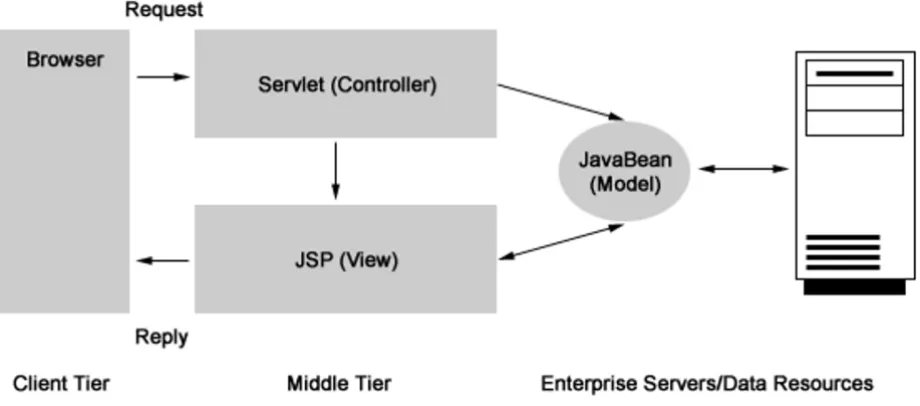
The software was modeled after other software applica-tions designed by our group using JAVA as the program-ming language, MVC2 as the design model and, because of the need of achieving functionality for feedback and system growth, the evolutionary prototyping was used [5]. The idea behind the Model-View-Controller design model (MVC) is that an application consists of three critical com-ponents: a Model, Views of the Model, and Controllers. The Model is the part of the application that contains the actual application logic. The Model facilitates database access, computes numbers, and manipulates data struc-tures. The View and Controller represent the user interface of the application. The user interface is conceptually split into input and output components. The Controller is an input component that supplies information to the Model. The View is an output component which displays infor-mation from the Model. The View typically communicates with the Model by registering itself as a callback and responding to events generated by the Model. [see Figure
1, adapted from Pietrobon R, Shah A, Kuo P, Harker M, McCready M, Butler C, Martins H, Moorman CT, Jacobs DO: Duke Surgery Research Central: an open-source Web application for the improvement of compliance with research regulation. BMC Med Inform Decis Mak 2006, 6(1): 32].
Implementation
There are three different levels of access to DADOS-Pro-spective: administrator, coordinator, and interviewer. The administrator, typically a Webmaster, has total access to all projects enrolled in the application, including the abil-ity to modify the content of any study that has not been launched. The administrator has exclusive rights to extract research data for analysis at any time. Coordinators may create new studies, access and modify forms for only those studies that belong to them. As in the case of administra-tor access, coordinaadministra-tors may not modify the content of a study for which data entry has been initiated; this feature serves to protect data integrity. Interviewer access is strictly limited to data entry.
Each principal investigator (PI) is initially given access to the DADOS-Prospective website as a coordinator by using a login ID and password. Once authenticated into the application, the PI may create a new study and view a list of projects he/she is currently conducting. When a new project is created, different roles can be assigned (i.e. PI, coordinator, interviewer). Once assigned as a PI, the user
Model-View-Controller (MVC) design paradigm Figure 1
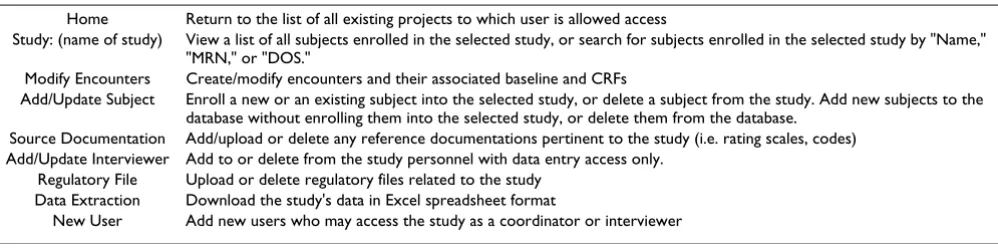
may no longer create or modify forms. Only the coordina-tor and the administracoordina-tor can create and modify the con-tent of a study. The coordinator may modify a study assigned to them by selecting its name and using the tool-bar at the top of the page, as shown in Figure 2. Each of the options in the toolbar is explained in detail in Table 1.
When creating a new study, the coordinator may utilize the navigation toolbar described in Table 1 to setup the study's content. Choosing the tab labeled "modify encounter," the coordinator may create the different encounters (i.e. Eligibility, Test Results, Treatment 1) for the study. Once all encounters are created, they may be
arranged in a desired sequence by using the up/down arrows next to each encounter to move them up or down the list [see Figure 2]. Note, the software defines "base-line" as the day of the first encounter with a patient, thus the encounter on top of the list is automatically defined as the baseline encounter [see Figure 2]. For subsequent encounters, all numerical values entered into the boxes underneath baseline will be interpreted as the number of weeks until the next encounter is to be executed, counting from the date on which the baseline encounter (the very first encounter on the list) is completed. With this feature, the program calculates the exact date on which an encoun-ter is to take place, giving the users easy access to all future
Navigational toolbar Figure 2
interview scheduling. Simply clicking on a patient's name will display all previously defined encounters and the date when each encounter will occur.
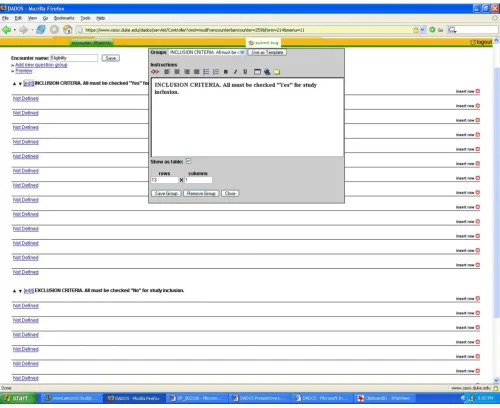
The coordinator can define a CRF for each encounter by selecting "define form." He/she has the option to select an existing form to edit or use "as is" that has been created in the system from previous studies, or the user can choose to create a new form which can be customized to fit his/ her particular study [see Figure 2]. Once the new form is created, it is then saved and added to the list of existing forms that can be used as a template for creating future forms. DADOS-Prospective has a mechanism for creating CRFs based on a templating system that takes previous CRFs as their model. The application offers a unique fea-ture that allows the investigator to customize the CRF to any table format [see Figure 3]. Furthermore, the coordi-nator may define any field in the form to specific types, such as text, dates, pictures, etc [see Figure 4]. The program also supports non-traditional fields that can add Internet links and upload electronic files, including most image and video formats. This feature is highly desirable for investigators who wish to create questions that require subjects to view an external Web link or an image file such as an x-ray. Once customization is complete, selecting the "save" button applies the changes to the form. All forms can be continually modified and improved upon as long as data has not been entered. Only the updated version of the form is kept in the database to avoid confusion of multiple versions. Once data collection has begun, users may no longer edit the forms; this feature preserves data integrity.
Coordinators enroll patients into their study by using the "add/update subjects" tab in the toolbar. Selecting a patient's name brings forth the list of encounters that have been previously defined and the date on which the encounters are to take place [see Figure 5]. As mentioned earlier, this date is automatically calculated using the
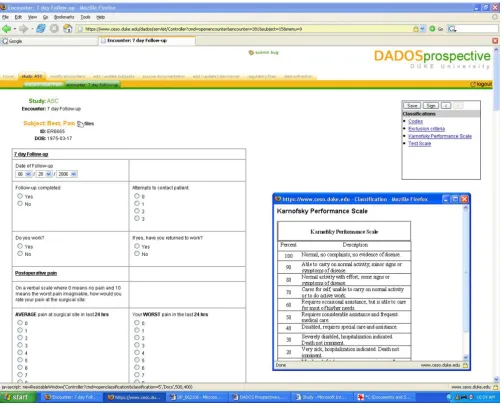
pro-gram's baseline function; however, this date may be man-ually set or modified by clicking on the calendar icon displayed next to the date. Should the coordinators wish to upload files for an encounter, such as uploading mag-netic resonance images for the "Radiographic Diagnosis" encounter, they may do so using the icons under the "Files" heading [see Figure 5]. Data for the selected patient may be entered by clicking on each encounter and filling out the customized form and saving the information or signing it using the floating window buttons. The coordi-nators may perform the data entry themselves, or they assign the task to an "interviewer," whose access to the study is strictly limited to data entry. Interviewers may be added or removed by utilizing the "Add/Update Inter-viewer" function in the navigation toolbar. Additionally, in an effort to facilitate data entry, DADOS-Prospective allows the coordinator to upload any reference/source document (i.e. inclusion/exclusion criteria, rating scales, Web links, image files, etc.) relevant to the study onto the application where it can be instantly accessed by an inter-viewer. As described earlier, these documents can be uploaded and accessed by selecting the "source docu-ment" tab on the navigation toolbar. Once uploaded, a coordinator or an interviewer may select the desired refer-ence documents to be displayed in a floating window that appears on the screen as they fill out data forms [see Fig-ure 6]. This featFig-ure is highly convenient during instances when the interviewer/coordinator may feel compelled to double check criteria and/or grading scales in order to accurately enter data into the form. Similarly, the coordi-nator can also add and access regulatory files, such as IRB related materials, study procedure protocol and labora-tory certifications, onto the program by utilizing the "reg-ulatory files" tab function.
DADOS-Prospective contains an audit trail capability that enables PI's and coordinators to track changes each time data in a form is edited. This feature is crucial for main-taining data quality, especially when the tasks of data
Table 1: Navigation toolbar. Functions for each of the menu items found on the DADOS-Prospective navigation toolbar.
Home Return to the list of all existing projects to which user is allowed access
Study: (name of study) View a list of all subjects enrolled in the selected study, or search for subjects enrolled in the selected study by "Name," "MRN," or "DOS."
Modify Encounters Create/modify encounters and their associated baseline and CRFs
Add/Update Subject Enroll a new or an existing subject into the selected study, or delete a subject from the study. Add new subjects to the database without enrolling them into the selected study, or delete them from the database.
Source Documentation Add/upload or delete any reference documentations pertinent to the study (i.e. rating scales, codes) Add/Update Interviewer Add to or delete from the study personnel with data entry access only.
Regulatory File Upload or delete regulatory files related to the study Data Extraction Download the study's data in Excel spreadsheet format
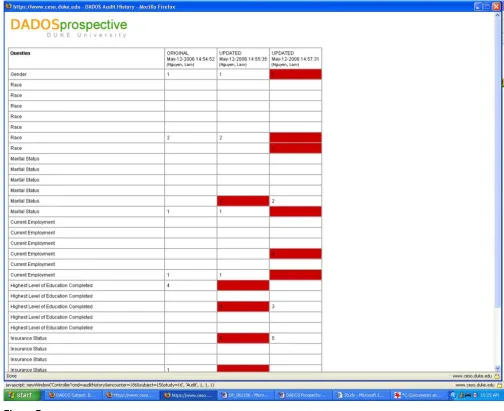
entry and data quality control are handled by two differ-ent parties. An "audit trail" link is displayed adjacdiffer-ent to each data form, thus improving the visibility for data quality control and making data auditing easy and simple [see Figure 5]. Clicking on the link, the user will see the CRF with fields that have recently been edited highlighted in red, showing the latest entry and all previous entries plus date and time of modification [see Figure 7].
As data is entered onto the forms, it is automatically stored in password-protected, encrypted servers at the host institution. At any time during the data collection process, only an administrator can extract the data for analysis by using the tab labeled "Data extraction" in the
navigation toolbar. The program stores data in a spread-sheet format, making it readily available for analysis upon extraction.
Results
Usability
To date, DADOS-Prospective has been implemented in five different studies conducted by various departments within the Duke University Health System. Four of these studies are still in the form creation phase, and one study has been officially launched. Our initial experiences have indicated that DADOS-Prospective has been used with rel-ative ease by the investigators and the software has stream-lined their study creation and management processes.
Form creation Figure 3
Formal usability
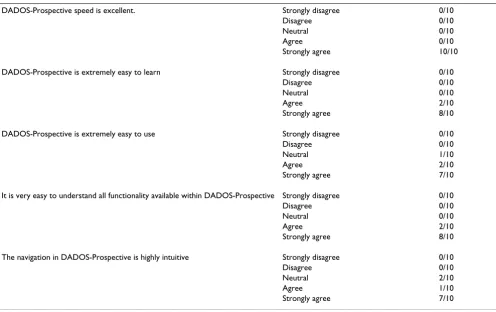
Usability testing was performed in accordance with previ-ous novel software applications from our institution [6]. Formal usability tests were performed using 10 physician-investigators who were computer literate by self-report. Each investigator was given a brief, 30 minute tutorial on DADOS-Prospective with an explanation of its purpose and basic functionality. Users were given 45 minutes to then explore the program on their own and complete a questionnaire that is summarized in Table 2. Formal usa-bility results demonstrated that, from the perspective of researchers, DADOS-Prospective application presented good speed (100 percent strongly agreed), was easy to learn and use, had a functionality that was easily under-standable, and a navigation that was intuitive [see Table
2]. No further features were requested during the formal usability analysis phase.
Field usability
The first three months of field usability measurement were focused primarily on fixing minor software prob-lems related to coding, including buttons that were not working appropriately, navigational issues related to users being taken to the wrong page after completing a task, and the implementation of a consistent interface across all pages of the application. After initial field testing was completed, the system was tested with actual CRFs from various departments and tested with mock patient data. Additional navigational problems were identified and several features were requested to improve usability.
Form configuration Figure 4
Requested features included: navigational issues, addi-tional form creation functions, addition of a function for "subject search," and additional data extraction methods.
Current utilization
The DADOS-Prospective application is currently being used in five different studies. Four of these studies are still in the CRF creation phase and one study has been entirely launched. The active study in DADOS-Prospective replaced a pre-existing database process. The database is a registry for subjects who will undergo outpatient surgery (approximately 40 subjects per day), and houses the data-base that is used for retrospective studies for the Depart-ment of Anesthesiology. ImpleDepart-mentation for this project included creating special plug-ins for the CRF which
would allow for surgical procedures to be added to a list on the data collection form. This enables alternatives to be added and/or updated on the CRF when the plug-in is used for the purposes of form creation, even after the study has gone live, thus maintaining the integrity of the data collection and recognizing the ever-changing possi-bilities for surgical procedures and techniques. Feedback from data entry specialists indicates that they prefer the new database using DADOS-Prospective compared to the old database, adding that it is much easier to use and their process has been significantly streamlined.
Discussion
Numerous programs have emerged to take advantage of the Internet as a primary means for collecting data in
ran-Subject interface Figure 5
domized, prospective clinical trials [1,7-11]. However, many of them are expensive, difficult to use, or they are only tailored to specific study designs. For example, com-mercial Windows-based software applications are limited in their ability to centralize data for file sharing in multi-institutional studies, to comply with HIPAA regulations in order to support electronic signatures, and to maintain an audit trail of use [12]. While commercial products do not permit modification of source code, we are confident that the modifiable source code of DADOS-Prospective will encourage users to utilize and improve upon the features in this release. Furthermore, unlike DADOS-Prospective, many existing open-source applications either do not have the flexibility to allow users to simultaneously cus-tomize study designs and CRFs for multiple clinical stud-ies covering different medical subspecialtstud-ies within the
same software, or do not support user autonomy that allows individual users to create future studies at anytime (Web-based Electronic Patient Record System, Berlin, Ger-many; CARE Application, Hershey, PA; WARG study, Stockholm, Sweden; Delphi Method, New Heaven, CT).
We developed DADOS-Prospective as an open-source program that not only addresses the limitations of exist-ing commercial platforms, but also possesses the versatil-ity to create and manage any type of prospective clinical study. As such, the program is fully customizable by the institutional user. In addition to achieving full compli-ance with HIPAA regulations, the ability of the program to create virtually any CRF format allows investigators to use DADOS-Prospective to develop studies in any medical specialty. Furthermore, by possessing the capability to
Data entry Figure 6
support future interview scheduling as well as a patient database monitoring system, DADOS-Prospective steps beyond the task of data collection and management and acts as a complete study management system. Most nota-bly, the program contains in one single location source documents, regulatory files, raw data in spreadsheet for-mat, audit trails, interview scheduling, patient database, and CRFs. This feature greatly enhances the visibility of the two crucial aspects of coordination and management of studies and data, thereby making DADOS-Prospective an ideal tool in conducting prospective clinical trials. More crucially, due to the fact that it was designed to work under slow Internet data transfer speeds, DADOS-Pro-spective is especially suitable for multicenter proDADOS-Pro-spective
international studies, thus taking advantage of a large population base. One limitation we have discovered is the lack of communication channels between users within the software application; this is a function that we feel would greatly enhance the management of the multicenter stud-ies. We are currently developing potential solutions for this issue.
Whereas previous Web-based prospective clinical studies may have taken up to nine months to develop using exist-ing tools, our initial experiences have demonstrated that complex studies were developed within 3–4 months using DADOS-Prospective. The program's user-friendly inter-face makes DADOS-Prospective quite easy to use and does
Audit trail Figure 7
not require much training. Although several studies launched at our own institution had few minor issues with some features (saving follow-up dates, updating patient registration information, minor difficulties editing CRFs with certain versions of Microsoft Internet Explorer), these problems were quickly addressed and corrected. We have also recognized the need to constantly increase the security of our software and are currently seeking new ways to do this.
Conclusion
We have demonstrated that the current version of DADOS-Prospective has significant advantages over exist-ing Web-based data collectexist-ing programs. The program's ease of use, enhanced visibility for data auditing, versatil-ity of CRF creation, simple data query mechanisms, and full compliance with HIPAA regulations make DADOS-Prospective an ideal tool for creating and managing pro-spective clinical trials.
Availability and requirements
Project name: DADOS-Prospective
Project home page: http://www.ceso.duke.edu/ (click link for "Free software")
Operating systems: Linux and Windows
Programming language: Java
Other requirements: Tomcat 5.x
License: GNU General Public License. This license ensures that the source code can be freely distributed, modified, or even sold, as long as the source code is provided with every copy of the application. The source code for the application is available at no charge.
Any restrictions to use by non-academics: None.
Abbreviations used
CRF: Clinical research form
HIPAA: Health Insurance Portability and Accountability Act
Table 2: Formal usability. Results from formal usability tests.
DADOS-Prospective speed is excellent. Strongly disagree 0/10
Disagree 0/10
Neutral 0/10
Agree 0/10
Strongly agree 10/10
DADOS-Prospective is extremely easy to learn Strongly disagree 0/10
Disagree 0/10
Neutral 0/10
Agree 2/10
Strongly agree 8/10
DADOS-Prospective is extremely easy to use Strongly disagree 0/10
Disagree 0/10
Neutral 1/10
Agree 2/10
Strongly agree 7/10
It is very easy to understand all functionality available within DADOS-Prospective Strongly disagree 0/10
Disagree 0/10
Neutral 0/10
Agree 2/10
Strongly agree 8/10
The navigation in DADOS-Prospective is highly intuitive Strongly disagree 0/10
Disagree 0/10
Neutral 2/10
Agree 1/10
Publish with BioMed Central and every scientist can read your work free of charge "BioMed Central will be the most significant development for disseminating the results of biomedical researc h in our lifetime."
Sir Paul Nurse, Cancer Research UK
Your research papers will be:
available free of charge to the entire biomedical community
peer reviewed and published immediately upon acceptance
cited in PubMed and archived on PubMed Central
yours — you keep the copyright
Submit your manuscript here:
http://www.biomedcentral.com/info/publishing_adv.asp
BioMedcentral
PI: Principal investigator
MVC: Model-View-Controller
Competing interests
The author(s) declared that they have no competing inter-ests.
Authors' contributions
All authors have read and approved the final manuscript. LN assisted in the design of the application, field tests for detection of bugs, design and analysis of usability tests, and manuscript draft. AS assisted in the design of the application, field tests for bug detection, and revision of manuscript draft. MH assisted in the design of the appli-cation, field tests for bug detection, and revision of man-uscript draft. HM assisted in the design of the application, wrote source code, and revised manuscript draft. MM assisted in the design of the application, field tests for bug detection, design and analysis of usability tests, and revised manuscript draft. AM assisted in the design of the application, field tests for bug detection, and revised man-uscript draft. DJ assisted in the design of the application, field tests for bug detection, and revision of manuscript draft. RP assisted in the design of the application, field tests for detection of bugs, design and analysis of usability tests, and manuscript draft.
Acknowledgements
We would like to acknowledge Erika Nielsen for administrative assistance.
References
1. Lallas CD, Preminger GM, Pearle MS, Leveillee RJ, Lingeman JE, Sch-wope JP, Pietrow PK, Auge BK: Internet based multi-institu-tional clinical research: a convenient and secure option. J Urol
2004, 171(5):1880-1885.
2. Lopez-Carrero C, Arriaza E, Bolanos E, Ciudad A, Municio M, Ramos J, Hesen W: Internet in clinical research based on a pilot expe-rience. Contemp Clin Trials 2005, 26(2):234-243.
3. Cooper CJ, Cooper SP, Del Junco DJ, Shipp EM, Whitworth R, Cooper SR: Web-based data collection: detailed methods of a questionnaire and data gathering tool. Epidemiol Perspect Innov
2006, 3:1.
4. 21 CFR Part 11: Electronic Records; Electronic Signatures [http://www.fda.gov/ora/compliance_ref/part11/]. .
5. Pietrobon R, Shah A, Kuo P, Harker M, McCready M, Butler C, Mar-tins H, Moorman CT, Jacobs DO: Duke Surgery Research Cen-tral: an open-source Web application for the improvement of compliance with research regulation. BMC Med Inform Decis Mak 2006, 6:32.
6. Shah A, Jacobs DO, Martins H, Harker M, Menezes A, McCready M, Pietrobon R: DADOS-Survey: an open-source application for CHERRIES-compliant Web surveys. BMC Med Inform Decis Mak
2006, 6:34.
7. Winget M, Kincaid H, Lin P, Li L, Kelly S, Thornquist M: A web-based system for managing and co-ordinating multiple multisite studies. Clin Trials 2005, 2(1):42-49.
8. Lindh JD, Kublickas M, Westgren M, Rane A: Internet based clini-cal trial protocols -- as applied to a study of warfarin pharma-cogenetics. Br J Clin Pharmacol 2004, 58(5):482-487.
9. Schmidt JR, Vignati AJ, Pogash RM, Simmons VA, Evans RL: Web-based distributed data management in the childhood asthma research and education (CARE) network. Clin Trials
2005, 2(1):50-60.
10. Fritsche L SK Lindemann G, Kunz R, Budde K, Neumayer H: A Web-based Electronic Patient Record System as a Means for Col-lection of Clinical Data. ISMDA 2000:198-205.
11. Deshpande AM, Shiffman RN, Nadkarni PM: Metadata-driven Del-phi rating on the Internet. Comput Methods Programs Biomed
2005, 77(1):49-56.