M E T H O D O L O G Y
Open Access
An effective virus-based gene silencing method
for functional genomics studies in common bean
Claudia Díaz-Camino
1, Padmanaban Annamalai
2, Federico Sanchez
1, Aardra Kachroo
2and Said A Ghabrial
2*Abstract
Background:Common bean (Phaseolus vulgarisL.) is a crop of economic and nutritious importance in many parts of the world. The lack of genomic resources have impeded the advancement of common bean genomics and thereby crop improvement. Although concerted efforts from the“Phaseomics”consortium have resulted in the development of several genomic resources, functional studies have continued to lag due to the recalcitrance of this crop for genetic transformation.
Results:Here we describe the use of a bean pod mottle virus (BPMV)-based vector for silencing of endogenous genes in common bean as well as for protein expression. This BPMV-based vector was originally developed for use in soybean. It has been successfully employed for both protein expression and gene silencing in this species. We tested this vector for applications in common bean by targeting common bean genes encoding nodulin 22 and stearoyl-acyl carrier protein desaturase for silencing. Our results indicate that the BPMV vector can indeed be employed for reverse genetics studies of diverse biological processes in common bean. We also used the BPMV-based vector for expressing the green fluorescent protein (GFP) in common bean and demonstrate stable GFP expression in all common bean tissues where BPMV was detected.
Conclusions:The availability of this vector is an important advance for the common bean research community not only because it provides a rapid means for functional studies in common bean, but also because it does so without generating genetically modified plants. Here we describe the detailed methodology and provide essential guidelines for the use of this vector for both gene silencing and protein expression in common bean. The entire VIGS procedure can be completed in 4-5 weeks.
Background
Common bean (Phaseolus vulgaris) is the world’s most important food legume for direct human consumption in developing countries such as Latin America and East-ern Africa. Although common bean production occurs in a wide range of cropping systems and environments, Latin America with its 8 million hectares in common bean production is the most important region as it accounts for nearly half of the global output [1].
Thus far, common bean crop improvement through biotechnological approaches has been limited due to its recalcitrance for genetic transformation. Genetic trans-formation of common bean has been achieved by using biolistic or Agrobacterium tumefaciens-based methods,
but with low efficiency [2-8] and thus is not amenable for high throughput molecular and genetic techniques for analysis of gene function. An efficient common bean root transformation protocol for different cultivars and landraces ofPhaseolus spp. with A. rhizogenesK599 was recently reported [9]. This method, even though is use-ful to study genes involved in microbial symbiosis or root architecture, is not applicable to genes involved in other traits, such as those controlling shoot develop-ment and flowering.
Virus-induced gene silencing (VIGS) is an appealing reverse-genetic strategy that allows gene functional ana-lysis in species not amenable to stable genetic transfor-mation. However, its success relies on the ability of viral vectors to infect the plant species of interest. There are few examples of viral vectors that are suitable for use as VIGS vectors for legumes; these include pea early browning virus (PEBV), bean pod mottle virus (BPMV),
* Correspondence: [email protected]
2
Department of Plant Pathology, 201F Plant Science Building, University of Kentucky, 1405 Veterans Drive, Lexington, KY 40546-0312, USA
Full list of author information is available at the end of the article
a pseudorecombinant strain of cucumber mosaic virus (CMV) and apple latent spherical virus (ALSV). PEBV (genusTobravirus) was successfully used inPissum sati-vum [10], Medicago truncatula and Lathyrus odorata [11]. BPMV (genusComovirus) has been widely used to silence genes or to express foreign proteins in Glycine max [12-16]. Vectors based on a pseudorecombinant strain of CMV (genusCucumovirus) and ALSV (genus Cheravirus) have been used for VIGS in soybean [17-19].
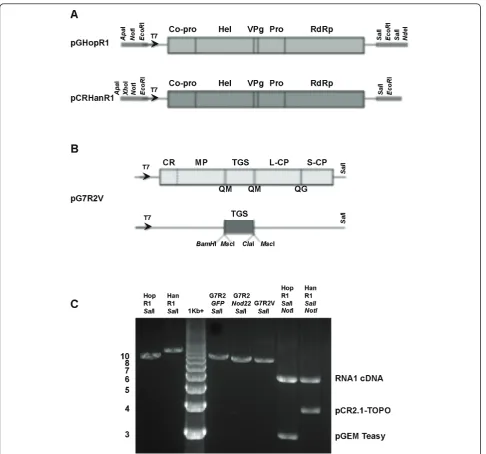
The BPMV genome is expressed via the synthesis and subsequent proteolytic processing of polyprotein precur-sors. RNA1 encodes five mature proteins required for replication (Figure 1A), whereas RNA2 encodes a puta-tive cell-to-cell movement protein (MP) and two coat proteins (L-CP and S-CP). For developing BPMV-RNA2 as a vector, the target gene sequences were inserted into the BPMV vector recognition sites forBamHI andMscI, which were engineered into the RNA2 within the coding sequences of MP and L-CP. Proteinase cleavage sites were created by duplicating the cleavage site between MP and L-CP to flank the heterologous sequences (Figure 1B). This ensures proper processing of the recombinant viral RNA2-encoded polyprotein (for details see reference #12 and legend for Figure 1).
As far as we know all commercially available cultivars of soybean are susceptible to BPMV infection. In contrast, only a few common bean varieties including the cultivar Black Valentine are susceptible to BPMV. To demonstrate gene silencing mediated by BPMV vec-tors in common bean, we targeted the genes (PvNod22 and PvSACPDs) that encode, respectively, nodulin 22 (Nod22) and stearoyl-acyl carrier protein desaturases (SACPDs) in the cultivar Black Valentine. Furthermore, we used the BPMV vector for expressing the green fluorescent protein (GFP) in common bean and shown stable GFP expression in all common bean tissues where BPMV was detected thus establishing that the BPMV vector is also suitable for expression of heterolo-gous proteins in common bean.
Methods
Construction of viral vectors and in vitro transcription For generating aNod22 silencing vector, a 360-bp DNA fragment was amplified from aNod22cDNA clone [20] using sequence-specific primers withBamHI and MscI sites (printed in bold):Nod22-FWD-5’GAGGCG
GGAT-CCCAGGCGCTGT-TG’3; Nod22-REV-5’ GTCTTC
T-GGCCACTCTCCGTGCCC3’. The GFP gene was amplified by PCR from plasmid pSITE-2CA [21] using
the primer pair GFP-FWD 5’
ATCCGGATCCGTGAG-CAAGGGCGAGGAGCTGTT3’andGFP-REV-5’
ACC-TTGGCCACTTGTACAGCTCGTCCATGCCGAGAG3’.
PCR amplification was performed at 94°C for 1 min, 55°C for 1 min and 72°C for 1 min for 30 cycles. The GFPandNod22amplified PCR products were gel puri-fied and digested with BamHI and MscI and sub-cloned into pGG7R2-V previously digested with the same restriction enzymes and further verified by sequencing [12]. Construction of BPMV-VIGS for silencing GmSACPDs was previously described [13]. The recombinant BPMV-SACPDRNA2 transcript plus RNA1 from BPMV Kentucky strain Hopkins (K-Hop) or Hancock (K-Han) strains, were used for inoculation. To use plasmid pGG7R2-V as an empty vector control, the plasmid was first digested by MscI and then re-ligated, giving rise to pGG7R2-M. This action removes theGFPfragment in pGG7R2-V [12]. Transcripts from pGG7R2-M, but not from pGG7R2-V, are infectious. Transcript from pGG7R2-M, plus transcript from RNA1 (subgroup I) cDNA from strain K-Hop or from RNA1 (subgroup II) cDNA from strain K-Han were used for inoculation. The wild type strain K-Hop, which induces very severe symptoms in soybean, is a naturally occurring partial diploid that is diploid for RNA 1 (subgroups I and II) and monoploid for RNA 2 (subgroup II; [22]). Monoploid RNA1 reassortants con-taining RNA1 (subgroup I) induces significantly less severe symptoms than the naturally occurring partial diploid strain K-Hop [22]. Plasmid constructs were used for in vitro transcription as previously described [23]. Briefly, capped RNA transcripts were synthesized by incubating 1 to 5 μg of linearized plasmids in a 100-μl reaction mixture containing 40 mM Tris-HCl,
pH 7.5; 6 mM MgCl2; 2 mM spermidine; 10 mM
dithiothreitol; 50 units of RNasin (Promega Corp., Madison, WI, U.S.A.); 0.5 mM each ATP, CTP, and UTP; 0.1 mM GTP; 0.5 mM cap-analogue (m7G[5g]G) (New England Biolabs, Ipswich, MA, U.S.A.]; and 50 units of T7 RNA polymerase (New England Biolabs) at 37°C for 2 h. Yield and integrity of the transcripts were analyzed by electrophoresis on a 1.0% agarose gel. RNA1 transcript, derived from RNA1 cDNA, and recombinant RNA2 transcript were used to rub inocu-late fully expanded unifoliate leaves of common bean or soybean.
Plant inoculation and growth conditions
Sample preparation, RNA extraction and soybeanNod22
RT-PCR analysis
Plant material from two biological replicates was col-lected 15 or 25 dpi, immediately frozen in liquid nitro-gen and stored at -80°C. Total RNA from leaf and root tissues was isolated using the TRIzol reagent (Invitro-gen) according to manufacturer’s instructions. RNA in samples was then precipitated by adding lithium chlor-ide (LiCl) to a 2M final concentration. Resultant pellets were re-suspended in water and the concentration and quality of each sample were determined using a Nano-Drop ND-1000 spectrophotometer (NanoNano-Drop Technol-ogies) and by gel electrophoresis, respectively. All samples were subsequently treated with DNase I (Amp. grade, Invitrogen) to remove any residual DNA contam-ination. Reverse transcription and first-stranded cDNA synthesis was carried out using Superscript II (Invitro-gen). Common bean and soybean RNA preparations were analyzed by RT-PCR using specific primers (Table 1). The number of amplification cycles was reduced from 30 to 26 for evaluating the relative differences in transcript levels.
Primer design and qRT-PCR analysis
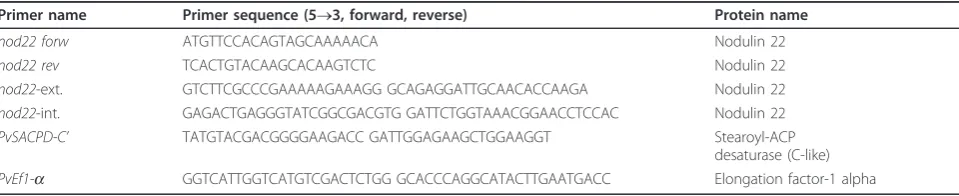
Gene-specific primers to generate 140-150 bp PCR pro-ducts were designed using the OligoPerfect™ (Invitro-gen) software. Gene specific primers to amplify PvSACPD-C like (PvSACPD-C’) and PvEf1-a were designed based on EST records available in the database (Table 1). Two pairs of non-overlappingPvNod22 speci-fic primers were used to determine the real abundance of theNod22transcript (nod22-int. andnod22-ext.). By using a complex cDNA mixture, primers were prelimi-narily tested in semi-quantitative RT-PCR assays to ver-ify the production of a unique PCR fragment of the expected length. Real-time RT-PCR reactions were per-formed in optical reaction tubes using an iCycler iQ5 apparatus (BioRad, Hercules, CA, USA).Pvnod22 and PvSACPD-C’transcript levels were determined with the SuperScript III SYBR Green One-Step qRT-PCR System (Invitrogen) according to the manufacturer’s protocol in a final volume of 25 μL including 0.4 mM of each pri-mer, 12.5 μL of the SYBR Premix (2X), 100 ng of total
RNA, and sterile distilled DEPC-treated water. The cycling conditions were: 3 min at 50°C for cDNA synth-esis, preheating for 5 min at 95°C followed by 40 cycles (denaturing for 15 s at 95°C, annealing and elongation for 15 s at 55.8°C and data acquisition at 81°C). A nega-tive control reaction without template was also included for each primer combination. The melt curve protocol began immediately after amplification and consisted of 1 min at 55°C followed by 80-10 s steps with a 0.5°C increase in temperature at each step, to ensure the absence of primer-dimers and a single PCR product. Threshold values for threshold cycle (Ct) determination were generated automatically by the iCycler iQ5 soft-ware. Transcript levels for each of the target genes (PvNod22 and PvSACPD-C’) were normalized to the endogenous elongation factor PvEf1-a transcript level. Three technical replicates were analyzed for each biolo-gical replicate. Each biolobiolo-gical replicate resulted in simi-lar trends and we report a mean value for each experiment.
Visualization of GFP expression in leaves and roots of HopV and HopGFP treated plants
GFP was observed under a Zeiss LSM 510 Meta confo-cal microscope attached to an Axiovert 200 M. GFP excitation was obtained at 488 nm using an Argon laser, an HFT UV 488/543/633 main dichroic excitation mir-ror and a BP 500-550 IR emission filter for detection. Simultaneously, autofluorescence was observed by excit-ing at 543 nm with a He/Ne laser; with the same main dichroic excitation mirror, a LP 560 emission filter and a BG 39 dichroic beam splitter. Images were processed using Adobe Photoshop 7.0 software (Adobe Systems Inc., Mountain View, CA, U.S.A.).
Results
BPMV-based VIGS vector effectively silencesNod22
expression in common bean
PvNod22was isolated from a common bean (Phaseolus vulgaris L.) cDNA library derived from Rhizobium -infected roots [20]. Nod22 deduced sequence reveals regions of high identity to thea-crystallin domain found ina-crystallin lens chaperones and other small heat-shock
Table 1 Sequences of primers used for RT-PCR and qRT-PCR.
Primer name Primer sequence (5®3, forward, reverse) Protein name
nod22 forw ATGTTCCACAGTAGCAAAAACA Nodulin 22
nod22 rev TCACTGTACAAGCACAAGTCTC Nodulin 22
nod22-ext. GTCTTCGCCCGAAAAAGAAAGG GCAGAGGATTGCAACACCAAGA Nodulin 22
nod22-int. GAGACTGAGGGTATCGGCGACGTG GATTCTGGTAAACGGAACCTCCAC Nodulin 22
PvSACPD-C’ TATGTACGACGGGGAAGACC GATTGGAGAAGCTGGAAGGT Stearoyl-ACP
desaturase (C-like)
proteins (sHSPs). Gene sequence comparisons between
PvNod22 and its homologue in soybean GmNod22
(GeneBank accession: CO978845, DB962750, DB979602) revealed an amino acid identity level of 88-89% (See addi-tional file 1: Alignment of Nod22 sequences). The
pheno-type of Nod22-silenced common bean plants was
characterized by the development of systemic necrotic lesions and extensive interveinal necrosis, which was apparent two weeks postinoculation (Figure 2, VIG-SNod22). A similar phenotype was also observed in Nod22-silenced soybean plants (Figure 3, VIGSNod22).
The level of theNod22mRNA expressed 15 days posti-noculation (15 dpi) was determined by usingnod22-int. andnod22-ext. primer sets and the coding sequence of PvEf1-a as a reference transcript in common bean (Table 1; see also additional file 2: Annealing positions of Nod22 primers). The results indicated that Nod22 was not induced during viral infection (Figure 2, mock versus vector). AlthoughNod22expression levels varied in Nod22-silenced plants (Figure 2, lower panel; VIG-SNod22P1-P3), these were diminished considerably (up to 50%) compared to mock and vector-treated plants.
Figure 2Virus-induced gene silencing ofPvNod22in common bean plants mediated by the BPMV-RNA2 vector. Silencing ofPvNod22
induces necrotic phenotypes in 3 week-old common bean plants (upper panel, VIGSNod22). Relative levels of expression ofNod22transcript in common bean treated plants (lower panel). Expression levels ofNod22transcript were determined by qRT-PCR at 2 weeks post inoculation. Mock, mock-inoculated plants; vector, empty vector-inoculated plants; VIGSNod22P1-P3,Nod22silenced common bean plants. The primers
Similar results were also obtained in Nod22-silenced soybean plants (data not shown).
We were also interested in determining whether the source of RNA1 (determinant of symptom severity in BPMV-infected plants [23]) may have a bearing on the resultant silencing phenotype. For this purpose, the transcript of recombinant RNA2 (R2-Nod22) was mixed with either RNA1 derived from the mild strain K-Han-cock (R1-Han, BPMV-subgroup II [24]) or the relatively severe strain K-Hopkins (R1-Hop, BPMV subgroup I). The treatment involving the R1-Han and R2-Nod22 mixture was referred to as HanN. Similarly the treat-ment involving R1-Hop and R2-Nod22 was designated HopN. The results shown in Figure 4 suggest that, regardless of the differences in virus symptom severity between the two strains, the silencing phenotypes were very similar albeit differing in intensity (Figure 4; com-pare HopN and HanN).
Silencing ofSACPDsin common bean causes similar morphological changes to those induced in soybean plants
In addition to Nod22, we silencedPvSACPDs in com-mon bean. Expressed sequence tags (ESTs from libraries prepared from pod, nodule or leaf tissues) encoding putative SACPD-like proteins were identified from the database (The DFCI Phaseolus vulgaris Gene Index [PhvGI], CV534591, TC14891, TC12707; [25]). Nucleo-tide sequences of PvSACPDs were compared with the soybean genes GmSACPD-A, B and C. Our analysis indicated that common beanSACPDsare related to the soybean isoformsGmSACPD-A/B (PvSACPD-A/B-like or A’/B’) and C (PvSACPD-C-like or C’). Due to the high sequence similarity ofSACPDs between common bean and soybean, we used a recombinant BPMV-based vector previously used to silence all threeGmSACPDsin soybean [13]. The recombinant RNA2-SACPDconstruct includes a highly conserved 258 bp fragment from
GmSACPD-A. This sequence is highly conserved among all three GmSACPD isoforms as well as among the PvSACPDs isoforms (See additional file 3: Alignment of SACPDsequences).
The results indicated that SACPD-silenced common bean plants indeed contained lower amounts of the SACPD-C’ transcript 15 and 25 dpi (Figure 5, left Figure 3Virus-induced gene silencing ofGmNod22in soybean
plants mediated by the BPMV-RNA2 vector. Silencing of
GmNod22induces necrotic phenotypes in 3 week-old soybean plants (VIGSNod22, right panel). Vector control is shown in the left panel.
Figure 4VIGS phenotype in common bean is independent of the BPMV strain used as a source of RNA1. (Upper panels). Symptoms and silencing phenotype of common bean plants treated with HopV or HopN. HopV: RNA1, transcript from BPMV strain K-Hop (moderate/relatively severe in soybean) RNA1 and empty vector (V). HopN: RNA1 transcript from BPMV strain K-Hop plus recombinant RNA2-nod22(N). (Lower panels). Same as upper panels except that the RNA1 transcript in the treatments HanV and HanN was derived from the mild strain K-Han. Enlarged views of the middle leaflets are shown in the right panels.
Figure 5 VIGS ofPvSACPDin common bean plants by the BPMV-RNA2 vector using two BPMV strains as sources of RNA1. Variation inSACPD-C’transcript relative amounts in common bean plants inoculated with treatments: HopV (RNA1 from strain K-Hop plus empty vector), HanV (RNA1 from strain K-Han plus empty vector), HopD and HanD, RNA1 from strains H-Hop and K-Han, respectively, plus recombinant RNA2-SACPD(D). Black solid bars,
SACPD-C’expression levels in treated plants 15 dpi, stripped bars,
panel). Phenotypic silencing was apparent after two weeks and its effect proceeded over time. The phenotypes of plants silenced forSCAPDswere similar regardless of the source of RNA1 in the inoculum. As was the case with theNod22-silenced plants, the inoculum containing RNA1 from the mild strain K-Han (R1-Han) and the recombinant RNA2-SACPD(D; treatment HanD) pro-duced a silencing phenotype (Figure 5, HanD) similar to, but less intense than, that induced when RNA1 was derived from the moderate/relatively severe strain K-Hop (compare HanD and K-HopD; Figure 5). Although the VIGS phenotypes of plants treated with HanD and HopD were largely similar, HopD appears to be more efficient in silencingSACPDsin common bean (histogram in Fig-ure 5, left panel). This is consistent with the intensity of the phenotypic changes observed in the corresponding SACPDs-silenced plants (Figure 5, right panel). It is of interest that, though largely similar, the silencing pheno-type induced by HanD in soybean (a treatment including RNA1 from a mild strain) was considerably more intense than that induced by HopD or G-7D (RNA1 from a rela-tively severe or a moderate strain, respecrela-tively) (Figure 6), thus emphasizing that the VIGS phenotypes in both soybean and common bean are independent of the source of BPMV RNA1 (Figures 5 and 6).
Expression levels of foreign genes from BPMV vectors in common bean
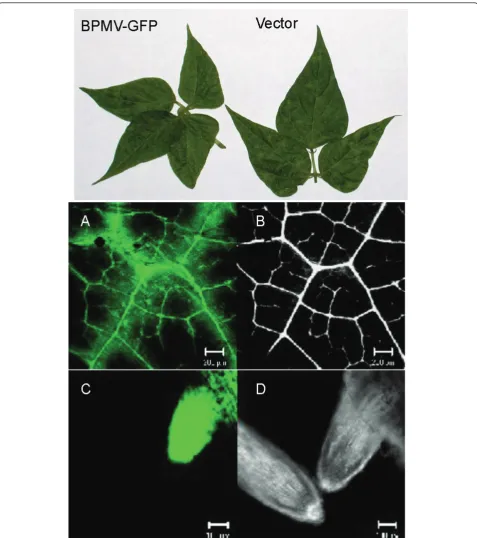
Common bean seedlings were inoculated on their pri-mary leaves with leaf extracts prepared from plants infected with empty vector and the recombinant vector carrying GFP sequence (BPMV-GFP). The first and sec-ond trifoliolate leaves as well as the roots of GFP-expressing plants, but not the empty vector-treated plants showed intense fluorescence under UV light 15 dpi. Confocal microscopy further confirmed the expres-sion of GFP in the tissues of BPMV-GFP-treated com-mon bean plants (Figure 7). GFP expression was intense and stable through at least four serial passages.
Discussion
We used the BPMV-based vector, previously described for applications in soybean [12], for gene silencing stu-dies in common bean. To our knowledge, this is the first report that documents efficient and stable silencing of endogenous genes in common bean by VIGS. We also demonstrated stable and efficient systemic expres-sion of the marker protein GFP, thus establishing that the BPMV vector is suitable for expression of heterolo-gous proteins in common bean. The BPMV-GFP vector was previously shown to be stable after four serial pas-sages in soybean cv Essex [12] and three paspas-sages in common bean cv. Black Valentine [[12]; reported as data not shown]. Here we extend this finding by using confocal microscopy to demonstrate efficient GFP expression in all common bean tissues where BPMV is detected.
The BPMV-RNA2 vector is the only available plant-virus-based vector that is appropriate for stable expres-sion of foreign proteins in common bean. Although the cowpea mosaic virus (CPMV)-RNA2 vector [26] could potentially be used for these applications, there is con-cern about its genetic stability due to homologous recombination as a consequence of the duplication of the cleavage sites. In engineering the BPMV-RNA2 vec-tor, we altered the nucleotide sequence of the duplicated regions without affecting its amino acid sequence in order to minimize the chances of homologous recombi-nation [12]. Recently, Zhang et al [27] reported the development of a modified BPMV-RNA2 expression vector similar to that previously reported for the CPMV-RNA2 vector [26], in which they replaced the duplicated Q/M cleavage site with a foot and mouth virus autocatalytic 2A peptide. Incorporation of a 2A sequence between GFP (or protein of interest) and L-CP precludes the need to duplicate viral sequences and therefore is advantageous in terms of the genetic stabi-lity of constructs [26,28]. Cleavage at a 2A site occurs between the last two amino acids of the sequence, resulting in that GFP (or the protein of interest) having all but one of the 2A amino acids attached to its C ter-minus, whereas the L-CP has only an additional proline at its N-terminus. Thus, the expressed protein (GFP) using such a vector is still not authentic in that it con-tains ~20 or more amino acids derived from the 2A sequence. Furthermore, due to the incompleteness of the cleavage mediated by 2A peptide, a significant por-tion of the L-CP subunits could carry GFP fused to their N termini, and these fusion proteins can be incor-porated into virus particles. Such particles are predicted to be empty (noninfectious) since the N-terminus of the L-CP, now fused to GFP, is not available to interact with the viral RNA [28]. Because of these reasons, the Figure 6Silencing phenotypes ofSACPDs in soybean. Plants of
stability of the recombinant vector could be difficult to maintain through serial passage, a matter that was not tested by Zhang et al. [27].
In addition to protein expression in common bean, we used the BPMV-RNA2 vector to demonstrate efficient and stable silencing of endogenous genes coding for Nod22 and SACPDs. Nod22 is a small-heat shock pro-tein (sHSP). sHSPs constitute a diverse family of mole-cular chaperones, crucial components of plant stress tolerance and normal development. Indeed,Nod22 tran-scripts are accumulated in response to pathogens [29] and root nodule development [20]. Remarkably, when this protein is over-expressed inE. coli, it confers pro-tection against oxidative stress [20]. Phenotypic results on functional analysis of Nod22 in common bean and soybean, achieved in this work, characterized by the appearance of systemic necrotic lesions and interveinal necrosis (Figure 2) further supported the hypothesis that Nod22 is involved in plant defense responses.
Likewise SACPDs are also well known to be involved in plant defense [30]. SACPD is the archetype member of a family of soluble fatty acid (FA) desaturases; these enzymes play an important role in regulating the overall levels of desaturated FAs in the cell. A mutation in the SACPD encoding SSI2 gene in Arabidopsis results in constitutive expression of pathogenesis-related (PR) genes, spontaneous lesion formation, increased accumu-lation of the phytohormone salicylic acid, and enhanced resistance to bacterial and oomycete pathogens [31]. Analysis of suppressor mutations has shown that the altered defense signaling in the ssi2plants is a result of their altered FA profile [32-35]. SilencingSACPDgenes in soybean and rice also induce similar phenotypes as in Arabidopsis [13,36]. Our work shows that this FA-derived defense-signaling pathway is also conserved in common bean (Figure 5).
The choice of BPMV strain(s) to use for VIGS studies in common bean is not an issue since the symptoms induced by infection involving RNA1s from both strain K-Han (mild symptoms on soybean) and K-Hop (mod-erate/relatively severe symptoms on soybean) are rela-tively mild on common bean and do not appear to interfere with the VIGS phenotypes (Figures 4 and 5). Provided efficient silencing can be achieved, it is obviously preferable to use symptomless or very mild virus strains in VIGS studies, mainly because of easier detection of silencing phenotypes. However, to use such symptomless virus strains, the inoculation protocol becomes cumbersome since the inoculum has to be increased in an alternative symptomatic host. For exam-ple, ALSV inoculum has first to be increased in Chenop-dium quinoaand following two passages in C. quinoa, total RNA was prepared from the infected leaves and
used to inoculate soybean leaves via particle
bombardment [19]. Furthermore, It should be empha-sized that the virus-induced symptoms become evident long after the onset of virus infection and replication. Using genomics and proteomics technologies it was pos-sible to identify at least 250 host factors that affect virus replication [37]. Thus it is much more complicated than perceived in previous reports that commented on the rationale for using symptomless virus strains for VIGS work [17,19,27,38].
Agroinfection is the most cost effective and efficient method for inoculating plants with virus-based vectors [39] and thus ideal for high-throughput applications including screening of cDNA libraries or EST collec-tions. Although agroinfection has been used successfully for several different plant species, it is not yet amenable for use in common bean or soybean. We routinely and successfully use the transcript rub-inoculation method to introduce the BPMV vector into soybean and com-mon bean. The efficiency of the transcript inoculation method depends on the quantity and quality of transcripts, regardless of the source of RNA1. In our experience, we obtain better RNA1 transcript yield with plasmid pGHoR1 than with plasmids pGG7R1 or pCRHaR1 [23]. Considering that the VIGS phenotype is independent of the source strain of RNA 1, we routinely use pGHoR1 in our studies. We generally obtain 40-80% infection rate (average 60%), and this is very satisfactory for our purpose since we get 100% infection with first passage plants. Use of biolistics to introduce the vector into individual plants with 35S promoter-driven DNA constructs using a gene gun [27,38] seems unnecessary considering the stability of our vector and the need to use transcripts only once for inoculation. We and others have successfully silenced or over-expressed a large number of soybean and common bean genes using the transcript rub-inoculation method [[13-16,40] and Ghabrial, unpublished]. Until Agrobac-terium-mediated inoculation methods become available for soybean and common bean, the transcript rub inoculation method has proven efficient for our laboratory.
Conclusion
that the BPMV vector is suitable for expression of het-erologous proteins in common bean.
Additional material
Additional file 1: Alignment ofNod22sequences. Partial alignment of nucleotide sequence ofPvNod22with its homolog from soybean
GmNod22. The alignment includes the region ofPvNod22used for generating theNod22silencing fragment. Numbers indicate nucleotide positions. Nucleotide sequences ofPvNod22[20] andGmNod22
(GeneBank accession numbers: CO978845, DB962750, DB979602) are 90% identical within this region. Nucleotide positions that are different between the two sequences are shaded.
Additional file 2: Annealing positions ofNod22primers. Full-length nucleotide sequence ofNod22cDNA is shown with the 5’UTR underlined and the sequence corresponding to the silencing fragment shaded. The initiation (ATG) and termination (GTA) codons are printed in bold. The nucleotide sequences of the primer pairsnod22-ext,nod22-int. andnod22are indicated by solid red, solid blue and dashed arrows, respectively.
Additional file 3: Alignment ofSACPDsequences. Nucleotide sequence alignment of the region corresponding to theGmSACPD
silencing fragment in three soybean SACPD-coding genes (GmSACPD-A, B, orC) and common bean SACPD genes (PvSACPD-A’/B’andC’). Numbers indicate nucleotide positions. The nucleotide sequence of the
GmSACPDfragment used to induceSACPDsilencing in soybean and common bean is underlined. The percent identity between the silencing fragment andPvSACPD-A’/B’is 93% while the percent identity between this fragment andC’is 72%. Conserved nucleotides between the silencing fragment and the differentSACPD sequencesare shaded
Acknowledgements and Funding
This work was funded in part by grants from United Soybean Board and Kentucky soybean Promotion Board (to SAG and AK) and from DGAPA UNAM IN203807 and IN202009. We thank Xochitl Alvarado-Affantranger and Wendy Havens for their technical support and Amy Crume for greenhouse care.
Author details
1Departamento de Biología Molecular de Plantas, Instituto de Biotecnología,
Universidad Nacional Autónoma de México, Av. Universidad 2001, Colonia Chamilpa, CP 62210, Cuernavaca, Morelos, México.2Department of Plant
Pathology, 201F Plant Science Building, University of Kentucky, 1405 Veterans Drive, Lexington, KY 40546-0312, USA.
Authors’contributions
CDC, PA and SAG designed the experiments; CDC and PA performed the experiments; CDC, FS, AK and SAG analyzed the data, CDC and SAG wrote the paper with contributions from all the authors. All authors read and approved the final manuscript.
Competing interests
The authors declare that they have no competing interests.
Received: 5 May 2011 Accepted: 13 June 2011 Published: 13 June 2011
References
1. Consultative Group on International Agricultural Res. (CGIAR).[http:// www.cgiar.org/impact/research/beans.html].
2. Brasileiro ACM, Aragao FJL, Rossi S, Dusi DMA, Barros LMG, Rech EL:
Susceptibility of common and tepary beans to Agrobacterium spp strains and improvement of Agrobacterium-mediated transformation using microprojectile bombardment.J Am Soc Hortic Sci1996,
121:810-815.
3. Christou P:Biotechnology applied to grain legumes.Field Crop Res1997,
53:83-97.
4. Zhang ZY, Coyne DP, Mitra A:Factors affecting Agrobacterium-mediated transformation of common bean.J Am Soc Hortic Sci1997,
122:300-305.
5. Aragao FJL, Vianna GR, Albino MMC, Rech EL:Transgenic dry bean tolerant to the herbicide glufosinate ammonium.Crop Sci2002,
42:1298-1302.
6. Liu ZC, Park BJ, Kanno A, Kameya T:The novel use of a combination of sonication and vacuum infiltration in Agrobacterium-mediated transformation of kidney bean (Phaseolus vulgaris L.) with lea gene.Mol Breeding2005,16:189-197.
7. Veltcheva M, Svetleva D, Petkova S, Perl A:In vitro regeneration and genetic transformation of common bean (Phaseolus vulgaris L.)-Problems and progress.Sci Hortic-Amsterdam2005,107:2-10.
8. Zambre M, Goossens A, Cardona C, Van Montagu M, Terryn N, Angenon G:
A reproducible genetic transformation system for cultivated Phaseolus acutifolius (tepary bean) and its use to assess the role of arcelins in resistance to the Mexican bean weevil.Theor Appl Genet2005,
110:914-924.
9. Estrada-Navarrete G, Alvarado-Affantranger X, Olivares JE, Diaz-Camino C, Santana O, Murillo E, Guillen G, Sánchez-Guevara N, Acosta J, Quinto C, Li DX, Gresshoff PM, Sánchez F:Agrobacterium rhizogenes transformation of the Phaseolus spp.: A tool for functional genomics.Mol Plant Microbe In2006,19:1385-1393.
10. Constantin GD, Krath BN, MacFarlane SA, Nicolaisen M, Johansen IE, Lund OS:Virus-induced gene silencing as a tool for functional genomics in a legume species.Plant J2004,40:622-631.
11. Gronlund M, Constantin G, Piednoir E, Kovacev J, Johansen IE, Lund OS:
Virus-induced gene silencing in Medicago truncatula and Lathyrus odorata.Virus Res2008,135:345-349.
12. Zhang CQ, Ghabrial SA:Development of Bean pod mottle virus-based vectors for stable protein expression and sequence-specific virus-induced gene silencing in soybean.Virology2006,344:401-411. 13. Kachroo A, Fu DQ, Havens W, Navarre D, Kachroo P, Ghabrial SA:An oleic
acid-mediated pathway induces constitutive defense signaling and enhanced resistance to multiple pathogens in soybean.Mol Plant Microbe In2008,21:564-575.
14. Fu DQ, Ghabrial S, Kachroo A:GmRAR1 and GmSGT1 are required for basal, R gene-mediated and systemic acquired resistance in soybean.
Mol Plant Microbe In2009,22:86-95.
15. Selote D, Kachroo A:RPG1-B-derived resistance to AvrB-expressing Pseudomonas syringae requires RIN4-like proteins in soybean.Plant Physiology2010,153:1199-1211.
16. Singh AK, Fu DQ, El-Habbak M, Navarre D, Ghabrial S, Kachroo A:Silencing genes encoding omega-3 fatty acid desaturase alters seed size and accumulation of bean pod mottle virus in soybean.Mol Plant Microbe Interact2011,24:506-515.
17. Nagamatsu A, Masuta C, Senda M, Matsuura H, Kasai A, Hong J-S, Kitamura K, Abe J, Kanazawa A:Functional analysis of soybean genes involved in flavonoid biosynthesis by virus-induced gene silencing.Plant Biotechnol J2007,5:778-790.
18. Igarashi A, Yamagata K, Sugai T, Takahashi Y, Sugawara E, Tamura A, Yaegashi H, Yamagishi N, Takahashi T, Isogai M, Takahashi H, Yoshikawa N:
Apple latent spherical virus vectors for reliable and effective virus-induced gene silencing among a broad range of plants including tobacco, tomato, Arabidopsis thaliana, cucurbits, and legumes.Virology
2009,386:407-416.
19. Yamagishi N, Yoshikawa N:Virus-induced gene silencing in soybean seeds and the emergence stage of soybean plants with Apple latent spherical virus vectors.Plant Mol Biol2009,71:15-24.
20. Mohammad A, Miranda-Rios J, Estrada Navarrete G, Quinto C, Olivares J, Garcia-Ponce B, Sanchez F:Nodulin 22 from Phaseolus vulgaris protects Escherichia coli cells from oxidative stress.Planta
2004,219:993-1002.
21. Chakrabarty R, Banerjee R, Chung SM, Farman M, Citovsky V, Hogenhout SA, Tzfira T, Goodin M:pSITE vectors for stable integration or transient expression of autofluorescent protein fusions in plants: Probing Nicotiana benthamiana-virus interactions.Mol Plant Microbe In2007,
20:740-750.
22. Gu H, Zhang C, Ghabrial SA:Novel naturally occurring bean pod mottle virus reassortants with mixed heterologous RNA1 genomes.
23. Gu HC, Ghabrial SA:The bean pod mottle virus proteinase cofactor and putative helicase are symptom severity determinants.Virology2005,
333:271-283.
24. Gu HC, Clark AJ, de Sa PB, Pfeiffer TW, Tolin S, Ghabrial SA:Diversity among isolates of bean pod mottle virus.Phytopathology2002,
92:446-452.
25. The DFCI Phaseolus vulgaris Gene Index (PhvGI).[http://compbio.dfci. harvard.edu/].
26. Gopinath K, Wellink J, Porta C, Taylor KM, Lomonossoff GP, van Kammen A:
Engineering cowpea mosaic virus RNA-2 into a vector to express heterologous proteins in plants.Virology2000,267:159-173. 27. Zhang C, Bradshaw JD, Whitham SA, Hill JH:The development of an
efficient multipurpose bean pod mottle virus viral vector set for foreign gene expression and RNA silencing.Plant Physiol2010,153:52-65. 28. Sainsbury F, Canizares MC, Lomonossoff GP:Cowpea mosaic virus: the
plant virus-based biotechnology workhorse.Annu Rev Phytopathol2010,
48:437-455.
29. Melotto M, Monteiro-Vitorello CB, Bruschi AG, Camargo LEA:Comparative bioinformatic analysis of genes expressed in common bean (Phaseolus vulgaris L.) seedlings.Genome2005,48:562-570.
30. Kachroo A, Kachroo P:Fatty acid-derived signals in plant defense.Annu Rev Phytopathol2009,47:153-176.
31. Kachroo P, Shanklin J, Shah J, Whittle EJ, Klessig DF:A fatty acid desaturase modulates the activation of defense signaling pathways in plants.P Natl Acad Sci USA2001,98:9448-9453.
32. Kachroo A, Lapchyk L, Fukushige H, Hildebrand D, Klessig D, Kachroo P:
Plastidial fatty acid signaling modulates salicylic and jasmonic acid-mediated defense pathways in the Arabidopsis ssi2 mutant.Plant Cell
2003,15:2952-2965.
33. Kachroo A, Venugopal SC, Lapchyk L, Falcone D, Hildebrand D, Kachroo P:
Oleic acid levels regulated by glycerolipid metabolism modulate defense gene expression in Arabidopsis.P Natl Acad Sci USA2004,
101:5152-5157.
34. Xia Y, Gao QM, Yu KS, Lapchyk L, Navarre D, Hildebrand D, Kachroo A, Kachroo P:An intact cuticle in distal tissues is essential for the induction of systemic acquired resistance in plants.Cell Host Microbe2009,
5:151-165.
35. Venugopal SC, Jeong RD, Mandal MK, Zhu SF, Chandra-Shekara AC, Xia Y, Hersh M, Stromberg AJ, Navarre D, Kachroo A, Kachroo P:Enhanced disease susceptibility 1 and salicylic acid act redundantly to regulate resistance gene-mediated signaling.Plos Genet2009,5:e100565. 36. Jiang CJ, Shimono M, Maeda S, Inoue H, Mori M, Hasegawa M, Sugano S,
Takatsuji H:Suppression of the rice fatty-acid desaturase gene OsSSI2 enhances resistance to blast and leaf blight diseases in rice.Mol Plant Microbe In2009,22:820-829.
37. Nagy PD, Pogany J:Global genomics and proteomics approaches to identify host factors as targets to induce resistance against tomato bushy stunt virus.Adv Virus Res2010,76:123-177.
38. Zhang C, Yang CL, Whitham SA, Hill JH:Development and use of an efficient DNA-based viral gene silencing vector for soybean.Mol Plant Microbe In2009,22:123-131.
39. Grimsley N, Hohn B, Hohn T, Walden R:Agroinfection, an alternative route for viral-infection of plants by using the Ti plasmid.P Natl Acad Sci USA
1986,83:3282-3286.
40. Zhou H, Lin J, Morgan RL, Zhong W, Ma W:Pseudomonas syringae Type III effector HopZ1 targets a host enzyme to suppress isoflavone biosynthesis and promote infection in soybean.Cell Host & Microbe2011,
9:177-186.
doi:10.1186/1746-4811-7-16
Cite this article as:Díaz-Caminoet al.:An effective virus-based gene silencing method for functional genomics studies in common bean. Plant Methods20117:16.
Submit your next manuscript to BioMed Central and take full advantage of:
• Convenient online submission
• Thorough peer review
• No space constraints or color figure charges
• Immediate publication on acceptance
• Inclusion in PubMed, CAS, Scopus and Google Scholar
• Research which is freely available for redistribution