Anale. Seria Informatică. Vol. IX fasc. 1 – 2011
Annals. Computer Science Series. 9th Tome 1st Fasc. – 2011
125
A
A
s
s
s
s
o
o
c
c
i
i
a
a
t
t
i
i
o
o
n
n
R
R
u
u
l
l
e
e
G
G
r
r
a
a
n
n
u
u
l
l
a
a
t
t
i
i
o
o
n
n
u
u
s
s
i
i
n
n
g
g
R
R
o
o
u
u
g
g
h
h
S
S
e
e
t
t
s
s
o
o
n
n
I
I
n
n
t
t
u
u
i
i
t
t
i
i
o
o
n
n
i
i
s
s
t
t
i
i
c
c
F
F
u
u
z
z
z
z
y
y
A
A
p
p
p
p
r
r
o
o
x
x
i
i
m
m
a
a
t
t
i
i
o
o
n
n
S
S
p
p
a
a
c
c
e
e
s
s
a
a
n
n
d
d
G
G
r
r
a
a
n
n
u
u
l
l
a
a
r
r
C
C
o
o
m
m
p
p
u
u
t
t
i
i
n
n
g
g
B
B.. KK.. TTrriippaatthhyy aanndd DD.. PP.. AAcchhaarrjjyyaa School of Computing Sciences and Engineering
VIT University, Vellore, India
ABSTRACT: Association rule granulation is a common data mining technique used to extract knowledge from the universe. To characterize the elements of the universe and to extract knowledge about the universe we classify the elements of the universe based on indiscernibility relation. However, in many information systems we find numerical attribute values that are almost similar instead of full identical. To handle such type of information system, we use
( , )α β - indiscernibility due to rough set on intuitionistic fuzzy
approximation space with ordering rules. So, the classification results in a set of classes called granules and are basic building blocks of the knowledge about the universe. Granular computing processes these granules and produces possible patterns and associations. In this paper we study the concept of almost indiscernibility and knowledge granulation along with the association rules using granular computing method. We process the granules obtained as the result of classification and find the association rules between them.
KEYWORDS: Association rules, indiscernibility, rough sets, ordering rules, granule, granular computing.
Introduction
Anale. Seria Informatică. Vol. IX fasc. 1 – 2011
Annals. Computer Science Series. 9th Tome 1st Fasc. – 2011
recent research. Researchers proposed many methods to mine knowledge from the rapidly growing voluminous digital data. Most of our traditional tools to mine knowledge are crisp, deterministic, and precise in character. Real life situations are quite opposite to that. For a complete description of a real life system often one should require by far more detailed data than a human being could recognize simultaneously, process and understand. It leads to the extension of the concept of crisp sets so as to model imprecise data that can enhance their modeling power.
The first notion in this direction of information granulation, by L. A. Zadeh [Zad94, Zad96a, Zad96b] is very important for logic, computer science, philosophy and others. The basic idea behind this is to process vagueness and incompleteness.
Another approach in this direction to capture impreciseness is the notion of rough sets [Paw91, PS07a, PS07b, PS07c] introduced by Z. Pawlak. This is an effective tool for uncertainty management, and it has wide applications in artificial intelligence [DG98, SC02, JKJ06, Reb06, ZPZ06, JQ07]. In this notion it is assumed that information is associated with every object and objects can be seen through information only. Therefore, object with same information cannot be discerned and appear as same. This leads to indiscernibility of objects of the universe that form clusters of indistinguishable objects. Hence, according to rough set the information granulation is due to indiscernibility of objects caused by lack of information about them. Equivalence relation is the simplest representation of the indiscernibility and is sufficient for many real life applications [Paw98]. However, in many applications transitivity of equivalence relation is not being satisfied. Therefore, indiscernibility relation is formalized as a tolerance relation [SS96].
Anale. Seria Informatică. Vol. IX fasc. 1 – 2011
Annals. Computer Science Series. 9th Tome 1st Fasc. – 2011
127 knowledge). Therefore, the concept of indiscernibility is prior to the concept of granularity [Zad94, Zad96a, Zad96b, Paw98].
It is also seen that in real life data, two different objects x and y may have attribute values that are almost identical, if not exactly identical. It indicates that attribute values could be identical up to certain extent. We consider an information granulation where attribute values are not always quantitative, rather subjective having imprecise meanings. This indiscernibility relation on different domains of attributes is formalized as a fuzzy tolerance relation or fuzzy proximity relation [De99]. Thus from rough set on fuzzy approximation space point of view information granulation is due to almost indiscernibility relation of objects caused by insufficient information about them.
Processing the granules to find knowledge about the universe is called granular computing. Granular computing processes these granules and produces possible patterns and associations among the attribute values of the objects of the universe. Association rule [LLT05] is a type of relationship among attribute values of the objects of the universe.
In this paper we propose an association rule granulation model that use rough set on intuitionistic fuzzy approximation spaces, ordering rules and granular computing to establish associations between the attribute values of the objects of the universe of discourse.
1. Rough sets on intuitionistic fuzzy approximation spaces
Rough set on intuitionistic fuzzy approximation space is founded on the assumption that in real life applications with every object we associate some information (data, knowledge). This information is not exactly identical but almost identical. This is because objects characterized by the almost same information are almost indiscernible in the view of available information. For example, if objects are patients suffering from certain disease, symptoms of the disease form information about patients. These symptoms are almost identical rather full identical. At this point we generalize Pawlak’s approach of indiscernibility [Paw98]. Keeping view to this the almost indiscernibility relation generated in this way is the mathematical basis of rough set on intuitionistic fuzzy approximation space.
Anale. Seria Informatică. Vol. IX fasc. 1 – 2011
Annals. Computer Science Series. 9th Tome 1st Fasc. – 2011
attributes helps the universal set to create an intuitionistic fuzzy approximation space on the universe.
The motivation behind the study is that the notion of almost indiscernibility relation is a generalization of indiscernibility relation with the use of intuitionistic fuzzy proximity relation and is mainly applicable on information systems where the attribute values are subjective having vague or imprecise meaning rather than quantitative. Also, the notion of intuitionistic fuzzy approximation space defined with the help of intuitionistic fuzzy proximity relation is a generalization of Pawlak’s [Paw91] approximation space. Therefore, the rough set on intuitionistic fuzzy approximation space [Tri06] generalizes the Pawlak’s [Paw91] rough set and provides better result in real life problems under study.
However, for completeness of the paper we provide the basic notions of rough sets on intuitionistic fuzzy approximation spaces. We use standard notation µ for membership and ν for non-membership functions associated with an intuitionistic fuzzy set.
Definition 1.1 An intuitionistic fuzzy relation R on a universal set U is an intuitionistic fuzzy set defined on U U× .
Definition 1.2 An intuitionistic fuzzy relation R on U is said to be an intuitionistic fuzzy proximity relation if the following properties hold.
( , ) 1 and ( , ) 0
R x x R x x x U
µ = ν = ∀ ∈
( , ) ( , ), ( , ) ( , ) ,
R x y R y x R x y R y x x y U
µ =µ ν =ν ∀ ∈
Definition 1.3 Let R be an intuitionistic fuzzy (IF) proximity relation on U. Then for any ( ,α β)∈J, where J ={( ,α β) α β, ∈[0, 1] and
0≤α+β ≤1}, the ( ,α β)-cut 'Rα β, ' of R is given by
{
}
, ( , ) R( , ) and R( , ) Rα β = x y µ x y ≥α ν x y ≤β
Definition 1.4 Let R be an IF-proximity relation on U. We say that two elements x and y are ( ,α β)-similar with respect to R if ( , )x y ∈Rα β, and we write x Rα β, y.
Definition 1.5 Let R is an IF-proximity relation on U. We say that two elements x and y are ( ,α β)-identical with respect to R for ( ,α β)∈J,
written as xR( , )α β yif and only if x Rα β, y or there exists a sequence of elements u u u1, 2, 3,L,unin U such that x Rα β, u u R1, 1 α β, u u R2, 2 α β, u3,
, ,u Rn α βy.
Anale. Seria Informatică. Vol. IX fasc. 1 – 2011
Annals. Computer Science Series. 9th Tome 1st Fasc. – 2011
129 It is also easy to see that for any ( ,α β)∈J, R( ,α β) is an equivalence relation on U. We denote Rα β*, the set of equivalence classes generated by
the equivalence relation R( ,α β) for each fixed ( ,α β)∈J .
Definition 1.6 Let U be a universal set and R be an intuitionistic fuzzy proximity relation on U. The pair ( , )U R is an intuitionistic fuzzy approximation space (IF-approximation space). An IF-approximation space
( , )U R generates usual approximation space( , ( ,U R α β)) of Pawlak for every( ,α β)∈J .
Definition 1.7 The rough set on X in the generalized approximation space
( , ( ,U R α β))is denoted by (Xα β, ,Xα β, ), where *
, { , and }
Xα β =U Y Y∈Rα β Y ⊆X
and *
, { , and }
Xα β =U Y Y∈Rα β Y∩X ≠φ
Definition 1.8 Let X be a rough set in the generalized approximation space ( , ( ,U R α β)). Then we define the ( ,α β)-boundary of X with respect to R denoted by BNRα β, (X) as BNRα β, ( )X =Xα β, −Xα β, .
Definition 1.9 Let X be a rough set in the generalized approximation space ( , ( ,U R α β)). Then X is ( ,α β)-discernible with respect to R if and only if Xα β, =Xα β, and X is ( ,α β)-rough with respect to R if and only if
, ,
Xα β ≠Xα β.
2. Almost indiscernibility and knowledge granulation
From the previous section, it is clear that rough set on intuitionistic fuzzy approximation space is due to almost indiscernibility relation generated by information about the objects of interest. This is because we are unable to discern some objects up to certain extent. Therefore, we have to consider clusters of almost indiscernible objects as fundamental concepts of knowledge.
Let U be the universe and A be a set of attributes. With each attribute
x∈A we associate a set of its values Vx, called the domain of x. The pair
( , )
S = U A will be called an information system. Let B⊆A. For a chosen
, J
Anale. Seria Informatică. Vol. IX fasc. 1 – 2011
Annals. Computer Science Series. 9th Tome 1st Fasc. – 2011
by f ax( ) = f x a( , ) denotes the value of attribute a for element x.
Obviously, it can be proved that the relation IB( , )α β is an equivalence
relation on U. Also, we notice that IB( , )α β is not exactly the indiscernibility relation defined by Pawlak [Paw98]; rather it can be viewed as an almost indiscernibility relation on U. For α =1, β =0 the almost indiscernibility relation, IB( , )α β reduces to the indiscernibility relation. Thus, it generalizes the Pawlak’s indiscernibility relation. The family of all equivalence classes of IB( , )α β , i.e., the partition generated by B for
, J
α β∈ , will be denoted by U IB( , )α β ; an equivalence class of IB( , )α β , i.e., the block of the partition U IB( , )α β , containing x will denoted by
, ( )
Bα β x .
If ( , )x y ∈IB( , )α β , then we will say that x and y are Bα β, -
indiscernible. Blocks of the partition U IB( , )α β (or the equivalence classes
of the relation IB( , )α β ) are referred as Bα β, −granules or Bα β, - elementary concepts. These are the basic building concepts of our knowledge in the rough set on intuitionistic fuzzy approximation space.
3. Ordered information table
Let I =( , , {U A Vx:x∈A}, {fx:x∈A}) be an information system, where U is a finite non-empty set of objects called the universe and A is a non-empty finite set of attributes. For every x∈A V, xis the set of values that attribute
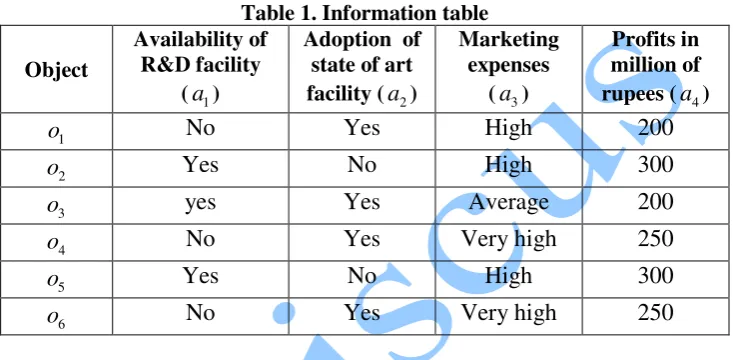
x may take and fx:U →Vx is an information function. In practical applications, there are various possible interpretations of objects such as cases, states, patients, processes, and observations. Attributes can be interpreted as features, variables, and characteristics. A special case of information systems called information table or attribute value table where the columns are labeled by attributes and rows are by objects. For example: consider the information Table 1, in which we have VR&D ={Yes, No}.
Similarly, VSoA ={Yes, No}, VMkt ={High, Very high, Average}, and
Profit {200,300, 250}
V = .
Anale. Seria Informatică. Vol. IX fasc. 1 – 2011
Annals. Computer Science Series. 9th Tome 1st Fasc. – 2011
131 perceived or measured by using a finite number of properties. At the same time, it does not consider any semantic relationships between distinct values of a particular attribute [Yao00]. Different values of the same attribute are considered as distinct symbols without any connections, and therefore on simple pattern matching we consider horizontal analyses to a large extent. Hence, in general one uses the trivial equality relation on values of an attribute as discussed in standard rough set theory [Paw91].
Table 1. Information table
Object
Availability of R&D facility
(a1)
Adoption of state of art facility (a2)
Marketing expenses
(a3)
Profits in million of rupees (a4)
1
o No Yes High 200
2
o Yes No High 300
3
o yes Yes Average 200
4
o No Yes Very high 250
5
o Yes No High 300
6
o No Yes Very high 250
However, in many real life applications it is observed that the attribute values are not exactly identical but almost identical. This is because objects characterized by the almost same information are almost indiscernible in the view of available information. For example, if objects are patients suffering from certain disease, symptoms of the disease form information about patients. These symptoms are almost identical rather full identical. At this point we generalize Pawlak’s approach of indiscernibility. Keeping view to this, the almost indiscernibility relation generated in this way is the mathematical basis of rough set on intuitionistic fuzzy approximation space as discussed in the previous section. Generalized information table may be viewed as information tables with added semantics. For the problem of knowledge mining, we introduce order relations on attribute values [YY01]. However, it is not appropriate in case of attribute values that are almost indiscernible. In this paper we use rough sets on intuitionistic fuzzy approximation space to find the attribute values that are
( , )α β -identical before introducing the order relation. This is because exactly ordering is not possible when the attribute values are almost identical. For
1,
Anale. Seria Informatică. Vol. IX fasc. 1 – 2011
Annals. Computer Science Series. 9th Tome 1st Fasc. – 2011
Generalized information tables may be viewed as information tables with added semantics. For association rule granulation, when attribute values are almost identical, we introduce order relation on attribute values. An ordered information table is defined as OIT={IT,{px:x∈A}} where, IT
is a standard information table and px is an order relation on attribute x. An ordering of values of a particular attribute x naturally induces an ordering of objects:
{ }x x( ) x x( ) ap b⇔ f a p f b
where, p{ }x denotes an order relation on U induced by the attribute x. An
object oi is ranked ahead of object oj if and only if the value of oi on the
attribute x is ranked ahead of the value of oj on the attribute x. For example, information Table 1 becomes order information table on introduction of the following ordering relations.
1 2
: Yes No
: Yes No
a
a
p p
p p
3 4
: Very high High Average
: 300 250 200
a
a
p p p
p p p
For a subset of attributes P⊆A, we define:
{ } ( ) ( )
( ) ( )
P x x x
x x x
x P
x x P
a b f a f b x P
f a f b
∈
∈
⇔ ∀ ∈
⇔ ∧
⇔
p p
p
I p
It indicates that a is ranked ahead of b if and only if a is ranked ahead of b according to all attributes in P. The above definition is a straightforward generalization of the standard definition of equivalence relations in rough set theory [Paw82, Paw91], where the equality relation is used. Knowledge mining based on order relations is a concrete example of applications on generalized rough set model with non equivalence relations [Yao98, YL96].
4. Association rule granulation model
Anale. Seria Informatică. Vol. IX fasc. 1 – 2011
Annals. Computer Science Series. 9th Tome 1st Fasc. – 2011
133 information table or information system containing almost indiscernible attribute values. In granular computing, a set of attribute values is called an association rule if they satisfy certain criteria. If a set of attribute values is an association rule, all the attribute values in the set are said to be associated with one another. To find association rules we find granules based on each attribute. To check whether a set of attribute values is an association rule or not, we perform the AND operation among the bit representation of the attribute values of this set. If number of 1’s in the result of AND operation is greater than or equal to minimum support, then it is an association rule, otherwise it is not an association rule.
Figure 1. Association rule granulation model
The above proposed association rule granulation model consists of problem definition, information system, processed information system, granular view of the processed information system, ordered information table, and association rule granulation. Problem definition and incorporation of prior
Ordered information
table
Granular computing view of information
system Processed information
system Problem
under study
Information system
Intuitionistic fuzzy proximity relation
Rough set on intuitionistic fuzzy approximation space
Ordering rules Granular view of
order information system
Anale. Seria Informatică. Vol. IX fasc. 1 – 2011
Annals. Computer Science Series. 9th Tome 1st Fasc. – 2011
knowledge are the fundamental steps of any model in which we identify the right problem. The potential validity or usefulness of an individual data element or pattern of data elements may change dramatically from individual to individual, organization to organization, or task to task because of the acquisition of knowledge and reasoning may involve in vagueness and incompleteness. It is very difficult for common human to obtain useful information that is hidden in the accumulated voluminous data. Finding association between attribute values generally understandable is also highly problematic. There is much need for dealing with the incomplete and vague information in classification, concept formulation, and data analysis. To this end here we use intuitionistic fuzzy proximity relation for processing data and data classification after removal of noise and missing data. This step takes the most time needed for computing the association rule extracting process. This processed information system is further processed by using rough set on intuitionistic fuzzy approximation space to give a granular computing view of the information syatem. The resultant information system is further processed by ordering rules to produce ordered information table. Finally, we extract the association rules between attribute values with the help of evaluation and interpretation.
5. Association rule granulation using granular computing
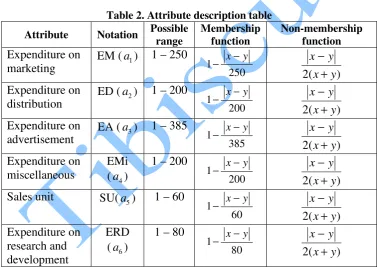
In this section, to demonstrate our model we take into consideration an information system of a group of companies where we study the business strategies of different cosmetic companies in a country. In the Table 2 given below, we consider few parameters for business strategies to get maximum sales; their possible range of values and an intuitionistic fuzzy proximity relation which characterized the relationship between parameters. The companies with more expenditure in marketing, more expenditure in advertisement, more expenditure in distribution, more expenditure in miscellaneous, and more expenditure on research and development is being an ideal case. But such type of cases is rare in practice. So, it is essential to study the association rules between the attribute values of a company to get the maximum sales.
The membership and non-membership functions have been adjusted such that the sum of their values should lie in [0, 1] and also these functions must be symmetric. The first requirement necessitates a major of 2 in the denominators of the non-membership functions.
Anale. Seria Informatică. Vol. IX fasc. 1 – 2011
Annals. Computer Science Series. 9th Tome 1st Fasc. – 2011
135 means, all expenditure incurred for corporate promotion, which includes event marketing, sales promotion, direct marketing etc. which comes to around 6%. The advertising expenditure includes promotional activities using various medium like television, newspaper, internet etc. which comes around 36%. The miscellaneous expenditure is mainly incurred through activities like corporate social responsibility and it leads to maximum of 28%. The distribution cost includes expenses on logistic, supply chain etc. and it comes around 24%. The investment made on new product development and other research activities are taken on research and development activities and it takes around 6%. However we have not considered many other parameters that do not influence the sales of a company and to make our analysis simple. The average of the data collected is considered to be the representative figure and tabulated below. The notations and abbreviations used in the following analysis are presented in Table 2.
Table 2.Attribute description table
Attribute Notation Possible
range Membership function Non-membership function Expenditure on marketing
EM (a1) 1 – 250
1
250
x−y − 2( ) x y x y − + Expenditure on distribution
ED (a2) 1 – 200
1
200
x−y − 2( ) x y x y − + Expenditure on advertisement
EA (a3) 1 – 385
1
385
x−y − 2( ) x y x y − + Expenditure on miscellaneous EMi (a4)
1 – 200
1
200
x−y − 2( ) x y x y − + Sales unit SU(a5) 1 – 60
1 60
x−y − 2( ) x y x y − + Expenditure on research and development ERD (a6)
1 – 80
1 80
x−y − 2( ) x y x y − +
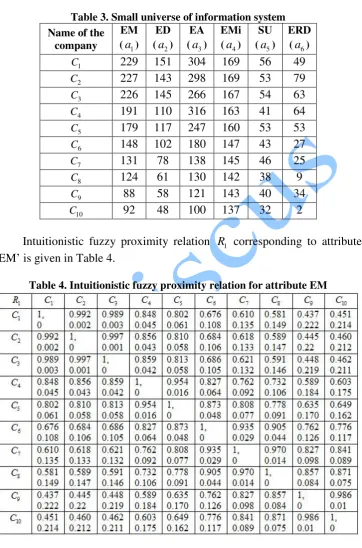
In Table 3 we present the data obtained from ten different companies. However, we keep confidential their identity due to various official reasons. Here, we use the notation Ci, i=1, 2,3,L,10 for different companies for the
Anale. Seria Informatică. Vol. IX fasc. 1 – 2011
Annals. Computer Science Series. 9th Tome 1st Fasc. – 2011
Table 3.Small universe of information system
Name of the company
EM (a1)
ED (a2)
EA (a3)
EMi (a4)
SU (a5)
ERD (a6)
1
C 229 151 304 169 56 49
2
C 227 143 298 169 53 79
3
C 226 145 266 167 54 63
4
C 191 110 316 163 41 64
5
C 179 117 247 160 53 53
6
C 148 102 180 147 43 27
7
C 131 78 138 145 46 25
8
C 124 61 130 142 38 9
9
C 88 58 121 143 40 34
10
C 92 48 100 137 32 2
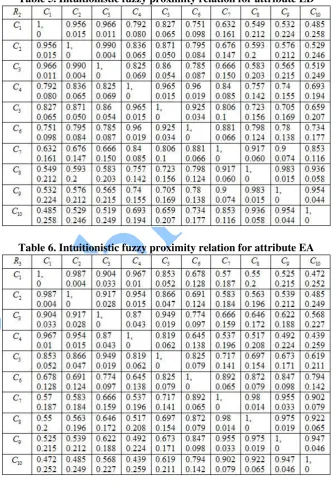
Intuitionistic fuzzy proximity relation R1 corresponding to attribute ‘EM’ is given in Table 4.
Anale. Seria Informatică. Vol. IX fasc. 1 – 2011
Annals. Computer Science Series. 9th Tome 1st Fasc. – 2011
137 Intuitionistic fuzzy proximity relation R2 corresponding to attribute
‘ED’ is given in Table 5. Intuitionistic fuzzy proximity relation R3 corresponding to attribute ‘EA’ is given in Table 6.
Table 5. Intuitionistic fuzzy proximity relation for attribute ED
Anale. Seria Informatică. Vol. IX fasc. 1 – 2011
Annals. Computer Science Series. 9th Tome 1st Fasc. – 2011
Intuitionistic fuzzy proximity relation R4 corresponding to attribute
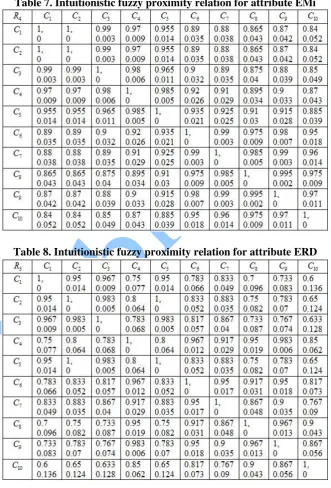
‘EMi’ is given in Table 7. Intuitionistic fuzzy proximity relation R5 corresponding to attribute ‘SU’ is given in Table 8.
Table 7. Intuitionistic fuzzy proximity relation for attribute EMi
Anale. Seria Informatică. Vol. IX fasc. 1 – 2011
Annals. Computer Science Series. 9th Tome 1st Fasc. – 2011
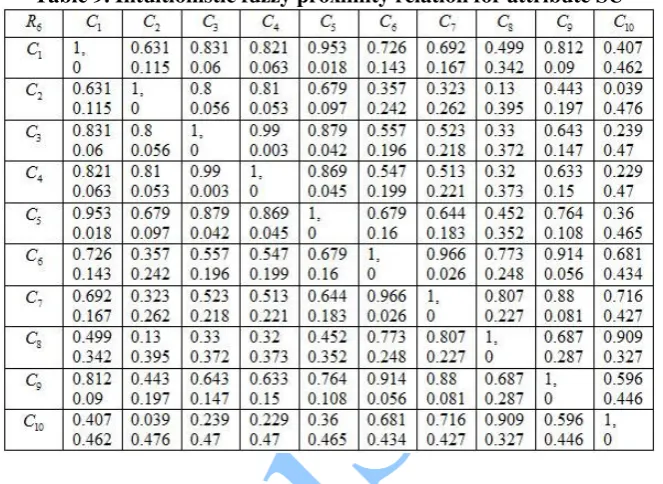
139 Intuitionistic fuzzy proximity relation R6 corresponding to attribute ‘ERD’ is given in Table 9.
Table 9. Intuitionistic fuzzy proximity relation for attribute SU
On considering the degree of dependency values α ≥0.92, β <0.08
for membership and non-membership functions, the intuitionistic fuzzy approximation space ( , ( ,U R α β)) have the following equivalence classes. This is termed as the granular computing view of the information system.
,
1 1 2 3 4 5 6 7 8 9 10
,
2 1 2 3 4 5 6 7 8 9 10
,
3 1 2 4 3 5 6 7 8 9 10
,
4 1 2 3 4 5 6 7 8 9 10
,
5 1
/ {{ , , },{ , },{ , , },{ , }}
/ {{ , , },{ , , },{ },{ , , }}
/ {{ , , },{ , },{ },{ , , , }}
/ {{ , , , , , , , , , }}
/ {{ ,
U R C C C C C C C C C C
U R C C C C C C C C C C
U R C C C C C C C C C C
U R C C C C C C C C C C
U R C C
α β
α β
α β
α β
α β
= = = =
= 2 3 5 4 6 7 8 9 10 ,
6 1 5 2 3 4 6 7 8 9 10
, , },{ , , , , },{ }}
/ {{ , },{ },{ , },{ , },{ },{ , }}
C C C C C C C C
U Rα β = C C C C C C C C C C
Anale. Seria Informatică. Vol. IX fasc. 1 – 2011
Annals. Computer Science Series. 9th Tome 1st Fasc. – 2011
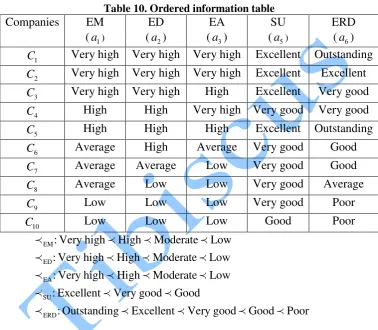
excellent. Since the equivalence class U R/ 4α β, contains only one group, the universe is ( , )α β -indiscernible according to the attribute EMi and hence do not require any ordering while establishing association rules between the attribute values. Therefore, the ordered information table of the small universe Table 3 is given in Table 10.
Table 10. Ordered information table Companies EM
(a1)
ED (a2)
EA (a3)
SU (a5)
ERD (a6)
1
C Very high Very high Very high Excellent Outstanding
2
C Very high Very high Very high Excellent Excellent
3
C Very high Very high High Excellent Very good
4
C High High Very high Very good Very good
5
C High High High Excellent Outstanding
6
C Average High Average Very good Good
7
C Average Average Low Very good Good
8
C Average Low Low Very good Average
9
C Low Low Low Very good Poor
10
C Low Low Low Good Poor
EM
ED
EA
SU
ERD
: Very high High Moderate Low : Very high High Moderate Low : Very high High Moderate Low : Excellent Very good Good
: Outstanding Excellent Very good Good Poor
p p p p
p p p p
p p p p
p p p
p p p p p
Anale. Seria Informatică. Vol. IX fasc. 1 – 2011
Annals. Computer Science Series. 9th Tome 1st Fasc. – 2011
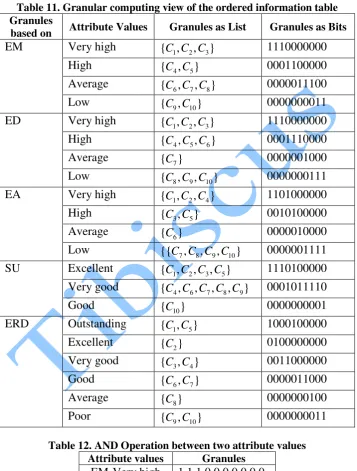
141 AND operation is greater than or equal to the minimum support 2, thus {EM-very high, SU- excellent} is an association rule.
Table 11. Granular computing view of the ordered information table Granules
based on Attribute Values Granules as List Granules as Bits
Very high { ,C C C1 2, 3} 1110000000
High {C C4, 5} 0001100000
Average {C C C6, 7, 8} 0000011100 EM
Low {C C9, 10} 0000000011
Very high { ,C C C1 2, 3} 1110000000
High {C C C4, 5, 6} 0001110000
Average {C7} 0000001000
ED
Low {C C C8, 9, 10} 0000000111
Very high { ,C C C1 2, 4} 1101000000
High {C C3, 5} 0010100000
Average {C6} 0000010000
EA
Low {{C C C C7, 8, 9, 10} 0000001111
Excellent { ,C C C C1 2, 3, 5} 1110100000
Very good {C C C C C4, 6, 7, 8, 9} 0001011110 SU
Good {C10} 0000000001
Outstanding { ,C C1 5} 1000100000
Excellent {C2} 0100000000
Very good {C C3, 4} 0011000000
Good {C C6, 7} 0000011000
Average {C8} 0000000100
ERD
Poor {C C9, 10} 0000000011
Table 12. AND Operation between two attribute values
Attribute values Granules
EM-Very high SU-Excellent
Anale. Seria Informatică. Vol. IX fasc. 1 – 2011
Annals. Computer Science Series. 9th Tome 1st Fasc. – 2011
Let us consider the attribute values EM-very high, ED-high, and SU-good. The AND operation among bit representation of attribute values EM-very high, ED-high, and SU-good is shown in the Table 13. Since number of 1’s in the AND operation is less than the minimum support 2, {EM-very high, ED-high, SU-good} is not an association rule. It indicates that there are no two objects satisfying this association rule.
Table 13. AND Operation between two attribute values
Attribute values Granules
EM-Very high ED-High SU-Excellent
1 1 1 0 0 0 0 0 0 0 0 0 0 1 1 1 0 0 0 0 0 0 0 0 0 0 0 0 0 1 AND 0 0 0 0 0 0 0 0 0 0
From the analysis it is clear that {EM-very high, SU- excellent} is an association rule with bit representation 1110000000. It means that, the attribute values EM-very high, and SU- excellent is an association rule of length 2 since it consists of two attribute values of two different attributes. The objects of the universe that is supporting to this association rule are
1, 2,
C C and C3. In order to find the association between the attribute and attribute values, we find all possible association rules of length two, and then all possible association rules of length three and so on.
Conclusion
Anale. Seria Informatică. Vol. IX fasc. 1 – 2011
Annals. Computer Science Series. 9th Tome 1st Fasc. – 2011
143
References
[De99] S. K. De – Some Aspects of Fuzzy sets, Rough sets and Intuitionistic Fuzzy sets, Ph.D. thesis, IIT, Kharagpur, 1999
[DG98] I. Duntsch, G. Gediga - Uncertainty Measures of Rough Set Prediction, Artificial Intelligence, Vol. 106, pp. 109 – 137, 1998
[JKJ06] G. Jeon, D. Kim, J. Jeong - Rough Sets Attributes Reduction Based Expert System in Interlaced Video Sequences, IEEE Transactions Consumer Electronics, Vol. 52 (4), pp. 1348 – 1355, 2006
[JQ07] R. Jensen, Q. Shen – Fuzzy Rough Sets Assisted Attribute Selection, IEEE Transactions on Fuzzy Systems, Vol. 15(1), pp. 73 – 89, 2007
[LLT05] E. Louie, T. Y. Lin, Xiaohua Tony Hu – Analysis of Using Granules to Find Association Rules, IEEE International Conference on Granular Computing, Beijing, China, pp. 556-560, 2005
[Paw82] Z. Pawlak – Rough Sets, International Journal of Computer and Information Sciences, Vol. 11(5), pp. 341-356, 1982
[Paw91] Z. Pawlak - Rough Sets, Theoretical aspect of Reasoning about Data, Kluwer Academic Publishers, 1991
[Paw98] Z. Pawlak – Granularity of Knowledge, Indiscernibility and Rough Sets, IEEE World Congress on Computational Intelligence, Vol. 1, pp. 106 – 110, 1998
[PS07a] Z. Pawlak, A. Skowron - Rudiments of rough sets, Information Science, An International Journal, Vol. 177(1), pp.3–27, 2007
[PS07b] Z. Pawlak, A. Skowron - Rough sets some extensions, Information Science, An International Journal, Vol. 177(1), pp.28–40, 2007
[PS07c] Z. Pawlak, A. Skowron - Rough sets and Boolean reasoning, Information Science, An International Journal, Vol. 177(1), pp.41–73, 2007
Anale. Seria Informatică. Vol. IX fasc. 1 – 2011
Annals. Computer Science Series. 9th Tome 1st Fasc. – 2011
[SC02] Q. Shen, A. Chouchoulas - A Rough Fuzzy Approach for Generating Classification Rules, Pattern Recognition, Vol. 35 (11), pp. 2425 – 2438, 2002
[SS96] A. Skowron, J. Stepaniuk – Tolerance Approximation Spaces, Fundamenta Informaticae, Vol. 27, pp. 245 – 253, 1996
[Tri06] B. K. Tripathy – Rough sets on Intuitionistic Fuzzy Approximation Spaces, Notes on Intuitionistic Fuzzy Sets, Vol. 12, No. 1, pp 45-54, 2006
[Yao00] Y. Y. Yao –Information tables with neighborhood semantics, in Data Mining and Knowledge Discovery: Theory, Tools, and Technology, Vol. 2, B. V. Dasarathy (Ed.), Society for Optical Engineering, Bellingham, Washington, pp. 108–116, 2000
[Yao98] Y. Y. Yao – Generalized Rough Set Models, In: Rough Sets in Knowledge Discovery, L. Polkowski, and A. Skowron (Eds.), Physica-Verlag, Heidelberg, pp. 286-318, 1998
[YL96] Y. Y. Yao, T. Y. Lin – Generalization of rough sets using modal logic, International Journal of Intelligent Automation and Soft Computing, Vol. 2, pp.103–129, 1996
[YY01] Y. Y. Yao, Ying Sai – Mining Ordering Rules using Rough Set Theory, Bulletin of International Rough Set Society, Vol. 5, pp. 99–106, 2001
[Zad94] L. Zadeh – Fuzzy Graphs, Rough Sets and Information Granularity, Third International Workshop on Rough Sets and Soft Computing, San Jose, November 10 – 12, 1994
[Zad96a] L. Zadeh – The Key Rules of Information Granulation and Fuzzy Logic in Human Reasoning, Concept Formulation and Computing with Words, Fifth IEEE International Conference of Fuzzy Systems, New Orleans, September 8 – 11, 1996
[Zad96b] L. Zadeh – Information Granulation, Fuzzy Logic and Rough Sets, Fourth International Workshop on Rough Sets, and Machine Discovery, Tokyo, November 6 – 8, 1996