Exercise restrictions trigger
psychological dif
fi
culty in active and
athletic adults with hypertrophic
cardiomyopathy
Rebecca C Luiten,1Kelly Ormond,2Lisa Post,3Irfan M Asif,4Matthew T Wheeler,5 Colleen Caleshu5
To cite:Luiten RC, Ormond K, Post L,et al. Exercise restrictions trigger psychological difficulty in active and athletic adults with hypertrophic cardiomyopathy.
Open Heart2016;3:e000488.
doi:10.1136/openhrt-2016-000488
▸Additional material is available. To view please visit the journal (http://dx.doi.org/ 10.1136/openhrt-2016-000488).
Received 15 June 2016 Revised 1 September 2016 Accepted 6 September 2016
For numbered affiliations see end of article.
Correspondence to Colleen Caleshu, MS, CGC; ccaleshu@stanfordhealthcare. org
ABSTRACT
Objective:We examined the extent and nature of the
psychological difficulty experienced by athletic adults with hypertrophic cardiomyopathy (HCM), correlates of that difficulty and coping mechanisms.
Methods:A survey assessed athletic history and
psychological impact of exercise restrictions. LASSO penalised linear regression identified factors associated with psychological difficulty. Semistructured interviews provided deeper insight into the nature and origins of psychological difficulty.
Results:54 individuals (33% female, mean age 55.9)
completed the survey. The majority were recreational athletes at the time of restriction (67%). There was a drop in athleticism after diagnosis, including time spent exercising ( p=0.04) and identification as an athlete ( p=0.0005). Most respondents (54%) found it stressful and/or difficult to adjust to exercise restrictions. Greater psychological morbidity was associated with history of elite or competitive athletics, athletic identity and decrease in time spent exercising. 16 individuals (44% female, mean age 52.4) were interviewed. Long-term effects included weight gain and uncertainty about exercising safely. The role of exercise in interviewees’lives contracted significantly after restriction, from multiple functions (eg, social, stress relief, fitness) to solely health maintenance. Interviewees reported a unique form of social support: having family and friends participate with them in lower intensity exercise. Lack of understanding from family or friends and avoiding exercise completely were
detrimental to coping.
Conclusions:Athletic adults with HCM experience
multifaceted, lasting difficulty adjusting to exercise recommendations. These data can guide clinicians in identifying patients at highest risk for distress and in helping to bolster coping and adaptation.
INTRODUCTION
Hypertrophic cardiomyopathy (HCM) confers an increased risk of sudden cardiac death (SCD).1 2 To reduce this risk, indivi-duals with HCM are advised to avoid
high-intensity exercise and competitive sports.3–5 Sports medicine physicians and cardiologists have made significant strides in domains such as understanding the incidence of SCD in athletes, developing improved standards for cardiovascular screening and better defining resuscitation methods after cardiac arrest.6 However, the psychological implica-tion of restricting the exercise regimens of individuals with inherited cardiovascular disease needs further exploration. In prelim-inary studies investigating the psychological impact of having an inherited cardiovascular condition, participants report that lifestyle changes, especially exercise modification, are one of the difficult aspects of living with their disease.7 8 Studies investigating the psy-chological impact of exercise restriction in elite athletes note a variety of negative emotions experienced upon restriction and
KEY QUESTIONS
What is already known about this subject? ▸ It is well established that elite athletes
experi-ence significant psychological distress when restricted from exercise. Additionally, clinical observations show even recreational athletes experience distress when restricted; however, no research has been performed on the nature or extent of this distress.
What does this study add?
▸ This study is the first investigation into the nature and extent of the psychological distress experienced by non-elite athletic adults with hypertrophic cardiomyopathy when restricted from athletic activity.
How might this impact on clinical practice? ▸ These data can guide clinicians in identifying
patients at highest risk for distress in response to exercise recommendations and in helping to bolster coping and adaptation.
on September 12, 2020 by guest. Protected by copyright.
find that the length of exercise restriction correlates with the severity of the distress experienced.9–11 Similar studies note that social support from friends and family and proper education from healthcare providers is helpful in coping with this psychological distress.12 13 While these studies provide initial insights into the impact of preparticipation screening and subsequent restriction in elite athletes,9 14very little is known about the experience of non-elite athletes, who make up the bulk of athletic adults with HCM.15
We sought to delineate the key features of the psychological distress associated with exercise restric-tions in active and athletic adults with HCM and to identify correlates of distress. We also investigated adaptive and maladaptive coping techniques partici-pants used while adjusting to recommended exercise modifications.
METHODS
Thefirst step of the study involved a brief survey, which garnered quantitative data on athleticism and distress. For the second step of the study, a subset of survey respondents who all identified as athletes or active indi-viduals, and experienced distress were selected for indepth interviews. The recruitment process is outlined in online supplementaryfile 1.
The survey was mailed to all individuals with HCM >16 years of age cared for at the Stanford Center for Inherited Cardiovascular Disease (n=488). The survey assessed self-identification as an athlete or active individ-ual, athletic history, adherence with exercise restrictions and psychological difficulty with exercise recommenda-tions (see online supplementary file 2). Psychological difficulty was assessed with two items on a five-point Likert scale rating agreement that (1) exercise recom-mendations were ‘difficult for me to adjust to’ and (2) changes in exercise were ‘upsetting or stressful’. Survey data were analysed in R.16 To assess what factors are independently associated with greater psychological diffi -culty, we performed multivariate linear regression mod-elling using the LASSO method.17
To explore the dimensions of psychological difficulty and coping mechanisms, we conducted semistructured interviews with a subset of survey respondents. Qualitative methodology such as interviews allows for gathering of rich data regarding a social/psychological phenomenon or lived experience.18 19Interviewees were purposively selected based on their survey responses, using the following criteria: self-identified as athletes or active individuals, following exercise recommendations in some way for at least 1 year, self-described difficulty adjusting to recommendations and English-speaking.
Interviews were conducted via telephone, recorded and transcribed verbatim. Every interview was conducted in English by a single interviewer for consistency, and lasted 30–60 (mean 45) min. Interview questions are listed in online supplementaryfile 3. Data saturation was
reached after 16 interviews, as no new themes had arisen in the prior three interviews.18 19
Interview transcripts were analysed using adapted grounded theory methodology.20 Initial codes and themes were generated from review of a subset (4) of interviews. Additional themes were added as they arose in subsequent interviews.
This study received institutional review board approval from Stanford University.
RESULTS
Participant demographics
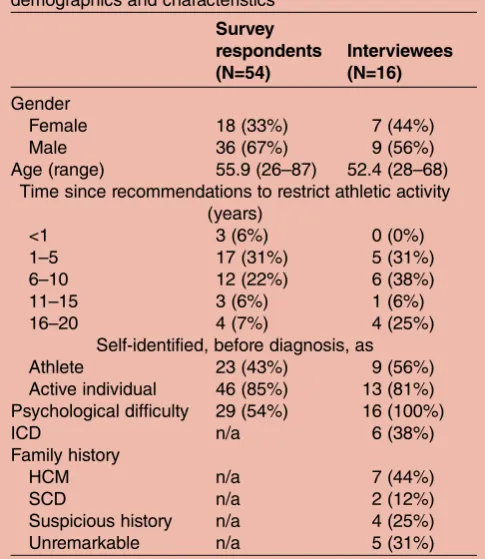
A total of 54 respondents (33% female, mean age 55.9, response rate 11.1%) completed the survey (table 1).
Survey respondents reported a marked drop in athleti-cism (table 2). Fewer individuals self-identified as ath-letes currently (14.8%) than prior to their diagnoses (42.6%; p=0.0005). There was a drop in mean time spent exercising (6.2 hours/week 2 years prior to diag-nosis to 4.7 hours/week currently, p=0.04). The majority (81.5%) participated in competitive athletics at some point in their lives and six had been elite competitors; however, only seven survey respondents (13%) indicated they were currently engaging in competitive athletics ( p<0.0001) and none were elite.
The majority of individuals indicated they found exer-cise recommendations stressful and/or difficult to adjust
Table 1 Survey respondent and interviewee demographics and characteristics
Survey respondents (N=54)
Interviewees (N=16)
Gender
Female 18 (33%) 7 (44%)
Male 36 (67%) 9 (56%)
Age (range) 55.9 (26–87) 52.4 (28–68) Time since recommendations to restrict athletic activity
(years)
<1 3 (6%) 0 (0%)
1–5 17 (31%) 5 (31%)
6–10 12 (22%) 6 (38%)
11–15 3 (6%) 1 (6%)
16–20 4 (7%) 4 (25%)
Self-identified, before diagnosis, as
Athlete 23 (43%) 9 (56%)
Active individual 46 (85%) 13 (81%) Psychological difficulty 29 (54%) 16 (100%)
ICD n/a 6 (38%)
Family history
HCM n/a 7 (44%)
SCD n/a 2 (12%)
Suspicious history n/a 4 (25%)
Unremarkable n/a 5 (31%)
Data expressed as n (%) or mean (range).
Family history at diagnosis; HCM, hypertrophic cardiomyopathy; ICD, implantable cardioverter defibrillator; SCD, sudden cardiac death.
on September 12, 2020 by guest. Protected by copyright.
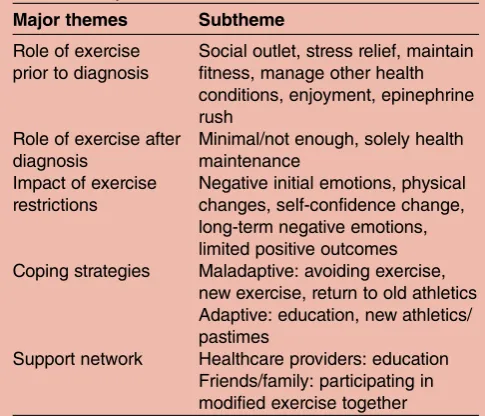
to (29/41, 54%). Multiple indicators of athleticism were independently associated with greater psychological diffi -culty: perception by self or by others as an athlete prior to diagnosis, prior elite athletics and current or prior competitive athletics (see online supplementary file 4). Individuals who spent more hours per week exercising prior to diagnosis had greater psychological difficulty, as did individuals who experienced a greater drop in their weekly hours of exercise after diagnosis. Psychological difficulty was not associated with age, gender, time since restriction or hours per week spent exercising currently (see online supplementary file 4). Of the 54 survey respondents, 21 met our purposive sampling criteria for interviews and 16 (9 male, 7 female, mean age 52.4) were interviewed (table 1). Five interviewees had previ-ously engaged in elite athletics (three on college varsity teams; one in the Olympics; one on a national team). All 16 interviewees indicated they were only engaging in recreational athletics at the time of their exercise restric-tion. Themes from interviews are outlined intable 3and further detailed below.
Role of exercise
Nearly every interviewee (15/16) indicated that exercise served multiple purposes in their life prior to their diag-nosis (see online supplementary file 5). The majority (13/16) stated that sports and exercise had a large social role in their lives, helping to create and maintain friendships and/or romantic relationships. Interviewees also reported that exercise helped them cope with stress (7/16), maintain fitness (7/16) and manage other health concerns, including diabetes, attention deficit hyperactivity disorder and weight (6/16).
[Exercise] always played a very important role in my life. I enjoy beingfifty years old and am able to out do a lot
of twenty year olds. There are many other benefits as well. It is a stress relief…I am in a very high stress busi-ness and it helps me keep an even keel there…the social aspect is… my friends are basically similar people… there is a certain level of social compatibility that goes along with it in that we all enjoy doing the same kind of things.…(Male, age 52, restricted 2 years)
Interviewees also noted pure enjoyment (5/16) and adrenaline or competitive aspects (5/16) as reasons for prior participation in athletics. A quarter of interviewees indicated that athletics was part of their career path prior to their diagnosis; however, only one of these four individuals reported they engaged in elite athletics.
Interviewees indicated that after diagnosis, exercise lost most of its original functions in their lives. Half reported that the current role of exercise was minimal and not enough for them. Interviewees felt they could not find ways to incorporate exercise into their lives in the same way it once was. Half indicated that now their main motivation for exercising was simply to maintain their health.
I exercise to maintain my health but it’s not the center of something that’s really enjoyable. And I still wish that I could find a way to do that. (Male, age 66, restricted 8 years)
In contrast to the majority (13/16) that valued exer-cise as a social outlet before diagnosis, no interviewees identified exercise to have a social role in their lives cur-rently. Six individuals reported that the loss of the social outlet of athletics was difficult to adjust to.
Impact of exercise restrictions
On learning about recommended exercise restrictions, the majority (13/16) of individuals experienced negative emotions: sadness (9/16), feeling limited (4/16), fear Table 2 Athletic characteristics of survey respondents
Survey respondents (N=54)
At peak
Before
diagnosis Currently
Athleticism*
Professional 1 (2%) 0 (0%) 0 (0%)
Elite 6 (11%) 0 (0%) 0 (0%)†
Competitive 28 (52%) 17 (31%) 7 (13%)† Recreational 18 (33%) 36 (67%) 38 (70%)
None 1 (2%) 1 (2%) 9 (17%)
Hours/week exercising
15.0 (7.80) 6.2 (4.69) 4.7 (3.73)†
Self-identify as athlete
23 (43%) 8 (15%)†
Others identify you as athlete
19 (35%) 7 (13%)†
Data expressed as n (%) or mean (SD).
*Professional, athletes receiving payment; Elite, Olympic or NCAA athlete; Competitive, any athletics with tryouts; Recreational, any athletics not requiring tryouts.
†p Value≤0.01 for current versus prior.
Table 3 Major themes from interviews
Major themes Subtheme
Role of exercise prior to diagnosis
Social outlet, stress relief, maintain fitness, manage other health conditions, enjoyment, epinephrine rush
Role of exercise after diagnosis
Minimal/not enough, solely health maintenance
Impact of exercise restrictions
Negative initial emotions, physical changes, self-confidence change, long-term negative emotions, limited positive outcomes Coping strategies Maladaptive: avoiding exercise,
new exercise, return to old athletics Adaptive: education, new athletics/ pastimes
Support network Healthcare providers: education Friends/family: participating in modified exercise together
on September 12, 2020 by guest. Protected by copyright.
(3/16) and denial about having a potentially lethal car-diovascular condition and needing exercise restrictions (3/16).
A doctor told me one of the first things that I couldn’t do was scuba dive …and I remember thinking that it wasn’t so much the loss of scuba diving; it was just the fact that I couldn’t perform an activity…I just remember thinking…‘is this how it’s going to be? I’ve got all of these future restrictions’. (Male, age 48, restricted 8 years)
Most individuals (11/16) reported physical changes as a result of their exercise restrictions with many (9/16) citing weight gain and a few (2/16) citing loss of muscle strength. Five individuals reported a change in self-confidence associated with these physical changes. Long-term emotional effects include fear and uncer-tainty about how to exercise safely (8/16) and feelings of limitation (7/16). Several interviewees (6/16) reported that they still pined for their prior lives. Finally, several individuals (5/16) reported they still continue to struggle to decrease the intensity of exercise.
I went out for a little ride yesterday, but I think eight years after it [the diagnosis] and [it’s] hard to slow down. And it’s kind of disgusting because the impulse and what feels good is still to go fast. (Male, age 66, restricted 8 years)
The majority of interviewees (12/16) could not iden-tify positive outcomes from their exercise recommenda-tions when specifically asked. In contrast, nearly all (14/ 16) could point to positive outcomes associated with the diagnosis (but not with exercise modifications), includ-ing knowinclud-ing what was ‘wrong’ with them, being more intune with their bodies, and refocusing their life prior-ities. The four interviewees who were able to identify positive outcomes from changes in their athletics pointed to new hobbies and increased time with family and friends.
Coping strategies
The majority of individuals (12/16) reported some sort of coping strategy that they felt was maladaptive, although the strategies varied between interviewees. Six individuals reported that completely avoiding exercise was detrimental. Many (9/16) tried to fill the role of exercise with new athletics with about half (4/9) of those individuals reporting that was not helpful because of the drop in intensity level.
Well, one of the things I also tried was to do was play golf. It was a joke. (Male, age 53, restricted 16 years)
Some individuals (5/16) chose to return to their prior form of exercise at a lower intensity and for three indivi-duals, this was unhelpful because they could not exercise to the full extent of their previous abilities.
Well, one was to go back to the same sport and to try and ride slow…I just couldn’t make an adjustment to do that and it was maybe a mistake to do so. (Male, age 66, restricted 8 years)
All interviewees were able to identify strategies that successfully helped them adapt to the change in their exercise regimen. Educating themselves on HCM and the exercise recommendations was the most frequent adaptive coping strategy (11/16), including participating in research studies, support groups or educational con-ferences as means to achieve this. Many (9/16) found that getting involved in the HCM community helped them cope. The majority (11/16) of individuals reported that they were eventually able to learn to adjust their exercise activities tofit their physician’s recommen-dations. Four reported this happened as they naturally came to terms with their diagnosis and exercise recom-mendations; however, seven individuals reported that their acceptance was not passive and that they had to actively choose to work towards mental and emotional acceptance.
What I did to help myself deal with the recommenda-tions? I tried to work within them…I think it was more just‘this is what I can do and it sucks and it’s [expletive], but I have to do something, so let me work within it and see how it goes’. (Male, age 29, restricted 2 years)
While a quarter of interviewees found participating in new forms of athletics unhelpful, six reported it was beneficial. Additionally, some (6/16) interviewees found engaging in new non-athletic pastimes helpful, such as wine clubs, rifle shooting or astronomy. Of note, all interviewees that found engaging in new pastimes or new exercise helpful had previously used exercise as a social outlet and most selected new pastimes were social in nature. Finally, a handful of individuals (4/16) reported they adapted to their exercise recommenda-tions by adjusting their overall stress levels, including by changing jobs or retiring.
Support network
Interviewees identified two main sources of support, healthcare providers and friends and family, with helpful and unhelpful things performed by these two groups. Most (11/16) interviewees found education on both their condition and exercise recommendations from their healthcare providers to be helpful. Yet, many (7/ 16) interviewees had received conflicting or inaccurate information from healthcare providers, which they found distressing. Similarly, interviewees also struggled with the vagueness of the exercise recommendations; a majority (11/16) indicated they wanted clearer and more con-crete recommendations, such as a maximum heart rate, a maximum speed or an individualised training plan.
They just give you the guideline and say ‘try to do as much as you can. Have exercise in your life,’but it’s not
on September 12, 2020 by guest. Protected by copyright.
really more than general. I don’t get many specifics…I would like to tailor it better [to me] to allow more oppor-tunity for exercise to play a stronger role. (Female, age 63, restricted 19 years)
Beneficial support from friends and family included doing modified exercise with the interviewee (9/16) and talking about their restrictions and diagnosis (9/ 16). Conversely, some said it was difficult when their friends and family would not slow down their activities or exercise with them. Some (5/16) interviewees indi-cated that verbal and physical reminders of their restric-tions were difficult and cited examples such as invites to activities they could no longer partake in. Additionally, the majority (10/16) of interviewees were negatively affected by family or friends who did not understand the emotional and physical difficulty of the exercise recommendations.
Because a lot of times, if I was venting to a friend who didn’t really play sports, they’re like,‘Okay. Why are you upset about it? I don’t really get it. Let’s just go to the mall or go do something else’; but for people who are athletes who are then told don’t exercise, it’s a little bit different. (Female, age 28, restricted 10 years)
DISCUSSION
Our data reveal that active and athletic adults experi-ence multifaceted, lasting psychological distress in response to being advised to restrict their exercise regimen. They also provide insight into the duration, sources and nature of the distress experienced by these individuals, adaption strategies and which individuals are more likely to experience distress.
The high prevalence of psychological difficulty among survey respondents and the lasting negative effects reported by interviewees substantiate prior anecdotal reports that for some people, lifestyle changes are a par-ticularly hard part of having an inherited cardiovascular disease.7 8 Notably, our findings on middle-aged active and athletic individuals echo the negative emotions experienced by younger, elite athletes pulled from sport for a wide range of reasons.9–11 We show here that psy-chological distress is not limited to young or elite ath-letes. Consistent with prior reports,9–11 we find an association between high level of athletic competitive-ness and greater psychological difficulty. However, it is notable that none of our survey respondents or intervie-wees were engaging in high-level athletics at the time they were advised to modify their exercise and only a minority of them had ever engaged in elite athletics. Thus, while distress may be greatest among the most elite athletes, it is still present among recreationally active adults. Our data reveal that athletic identity plays an important role in shaping one’s experience, beyond level of competitiveness. Even when accounting for pre-vious competitive and elite athletics, those who were
perceived by themselves and/or others to be an athlete experienced greater psychological difficulty.
It appears that the negative psychological impact of exercise restrictions lingers. We found that the majority of interviewees were still experiencing negative effects of their restrictions many years later. Similarly, among survey respondents, distress was not associated with length of time since they had been advised to change their exercise regimen. This is consistent with prior work on temporary athletic restriction due to injury or cardiovascular disease, which found the length of exer-cise restriction correlates with the severity of distress experienced.9–11 In contrast to many injured athletes who return to sport, consensus recommendations for individuals with HCM are for permanent restriction from competitive and intense athletics.
The contraction of the role that exercise plays in one’s life proved to be psychologically distressing for many individuals as they struggled to fill its void. Consistent with this, a greater drop in time spent exercising was associated with greater psychological difficulty. Additionally, it is striking that even many years after pulling back from intense exercise, the majority of inter-viewees could not identify positive effects from this change in their lives. This is likely not representative, given that we intentionally interviewed individuals who had difficulty with exercise restrictions. However, the stark contrast between their reports of positive effects of the diagnosis and the lack of positive effects from exer-cise recommendations is notable.
When attempting to fill the void of exercise, intervie-wees often chose to pursue new pastimes, new forms of athletics or involvement in the community. Generally, the choice of coping strategies seemed to be highly individua-lised and variable. Further confirming this is the variance in maladaptive techniques used by interviewees. While the majority of interviewees implemented a maladaptive coping strategy at some point during their adaption process, these strategies were highly variable and did not seem to depend on interviewee’s demographics.
It is well established that social support is important in coping and adaption in general21 and studies also find this in athletic restriction specifically.13 22 Our data provide insight into effective forms of social support spe-cific to exercise restriction: having family and friends do modified exercise with the patient and ensuring that family and friends recognise and understand the emo-tional impact of being limited athletically. The social nature of athleticism is evident throughout our data. We found that all individuals seeking new athletics or pas-times had previously used exercise as a social outlet and chose new athletics or pastimes that were social in nature. It is also notable that being perceived by others as an athlete was an independent factor contributing to psychological difficulty. Taken together, these findings underscore critical social components to the role of exercise, athletic identity, psychological difficulty trig-gered by restrictions, and coping.
on September 12, 2020 by guest. Protected by copyright.
International guidelines differ somewhat in their recommendations for athletes with inherited heart disease, including in how specific they are about differ-ent sports.5 23 There is also ongoing debate regarding whether current exercise guidelines result in the over-restriction of individuals with inherited cardiovascular disease.24 Recent and active research aims to assess the safety of exercise for these patients (ClinicalTrials.gov: NCT02549664).24 25 The prevalent and lasting psycho-logical distress observed in our sample supports the need for a careful examination of exercise restrictions for patients with inherited cardiovascular disease, includ-ing consideration of the magnitude of the impact on quality of life and the reduction in risk of sudden death.
CLINICAL IMPLICATIONS
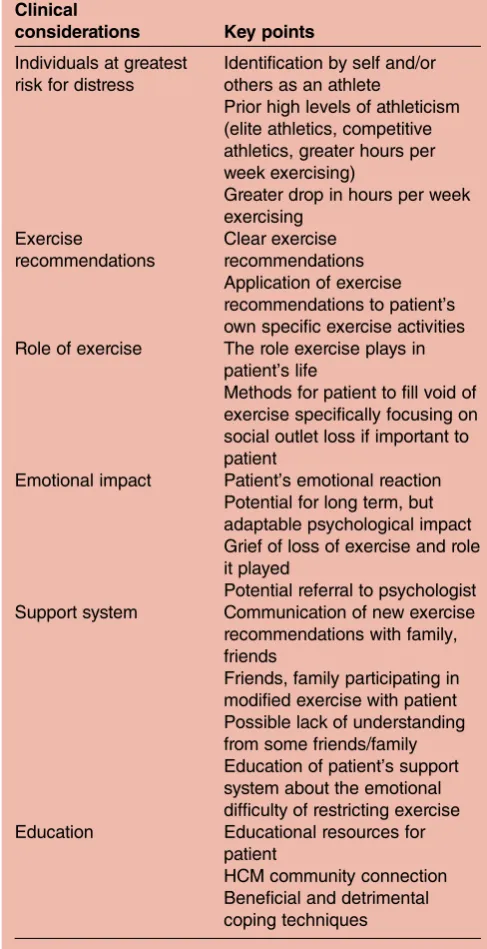
Our findings show that the individuals at greatest risk for psychological difficulty are those who have competed at a high level, who have a strong personal and social identity as an athlete and who experience a drop in time spent exercising (table 3). Additionally, our fi nd-ings may help guide cardiologists, nurses and genetic counsellors caring for patients with HCM in addressing the psychological distress experienced by their patients in response to exercise recommendations (table 4).
Our interviewees’ distress, difficulty with previous mis-information and desire for concrete individualised ath-letic recommendations all suggest that athletes with inherited cardiovascular disease may benefit from spe-cific clinical interventions to address their athletic needs.
LIMITATIONS
This study was limited to a self-selected population of adult patients with HCM seen at the Stanford Center for Inherited Cardiovascular Disease. The experiences of this population may not be representative of patients with other inherited cardiovascular diseases or of patients managed in other settings. Since our interviews intentionally focused on patients who had difficulty adjusting to exercise recommendations, our data, by design, cannot speak to the full range of psychological effects triggered by exercise recommendations. In the interest of survey brevity, we did not use a validated measure of distress.
CONCLUSIONS
This study delineated key components of the psycho-logical distress caused by exercise restriction in athletic and active adults with HCM. This distress includes long-term emotional effects of uncertainty while exercising, feeling limited and a reduction in the role of exercise. Additionally, this study highlights those individuals who at highest risk for psychological morbidity: individuals who previously competed at a high level, have a strong personal and social identity as an athlete and those who experience a drop in time spent exercising. Ourfindings
indicate the need for clinicians to specifically address the emotional impact of exercise restrictions and provide insight into how clinicians can help patients adapt.
Author affiliations
1Cancer Genetics, Banner MD Anderson Cancer Center, Gilbert, Arizona, USA; Department of Genetics, Stanford University, Stanford, California, USA 2Department of Genetics, Stanford Center for Biomedical Ethics, Stanford University School of Medicine, Stanford, California, USA
3Department of Psychiatry and Behavioral Sciences, Stanford University, Stanford, California, USA
4Department of Family Medicine, University of South Carolina Greenville, Greenville, South Carolina, USA
5Stanford Center for Inherited Cardiovascular Disease, Stanford University School of Medicine, Stanford, California, USA
Table 4 Key clinical considerations regarding psychological distress induced by exercise restrictions
Clinical
considerations Key points
Individuals at greatest risk for distress
Identification by self and/or others as an athlete
Prior high levels of athleticism (elite athletics, competitive athletics, greater hours per week exercising)
Greater drop in hours per week exercising
Exercise
recommendations
Clear exercise recommendations Application of exercise recommendations to patient’s own specific exercise activities Role of exercise The role exercise plays in
patient’s life
Methods for patient to fill void of exercise specifically focusing on social outlet loss if important to patient
Emotional impact Patient’s emotional reaction Potential for long term, but adaptable psychological impact Grief of loss of exercise and role it played
Potential referral to psychologist Support system Communication of new exercise
recommendations with family, friends
Friends, family participating in modified exercise with patient Possible lack of understanding from some friends/family Education of patient’s support system about the emotional difficulty of restricting exercise Education Educational resources for
patient
HCM community connection Beneficial and detrimental
coping techniques on September 12, 2020 by guest. Protected by copyright.
AcknowledgementsThe authors thank the individuals who participated in this study. The authors also thank the Stanford Quantitative Sciences Unit for statistical consultation.
Contributors All authors contributed equally to the design of this study. Main recruitment efforts, data collection and analysis were performed by RCL. KO and LP contributed to data analysis for the qualitative data. CC contributed to the quantitative data analysis. All authors edited and proofed the final manuscript. The Stanford Quantitative Sciences Unit helped with a statistical consultation
Funding Stanford University School of Medicine-Genetics Department, National Society of Genetic Counselors-Cardiovascular Special Interest Group.
Competing interests None declared.
Ethics approval Stanford University.
Provenance and peer review Not commissioned; externally peer reviewed.
Data sharing statement No additional data are available.
Open Access This is an Open Access article distributed in accordance with the Creative Commons Attribution Non Commercial (CC BY-NC 4.0) license, which permits others to distribute, remix, adapt, build upon this work non-commercially, and license their derivative works on different terms, provided the original work is properly cited and the use is non-commercial. See: http:// creativecommons.org/licenses/by-nc/4.0/
REFERENCES
1. Allegue C, Gil R, Blanco-Verea A,et al. Prevalence of HCM and long QT syndrome mutations in young sudden cardiac death-related cases.Int J Legal Med2011;125:565–72.
2. Doolan A, Langlois N, Semsarian C. Causes of sudden cardiac death in young Australians.Med J Aust2004;180:110–12. 3. Priori SG, Wilde AA, Horie M,et al. Executive summary: HRS/
EHRA/APHRS expert consensus statement on the diagnosis and management of patients with inherited primary arrhythmia syndromes.J Arrhythmia2014;30:29–47.
4. Maron BJ, Zipes DP, Kovacs RJ,et al. Eligibility and disqualification recommendations for competitive athletes with cardiovascular abnormalities: preamble, principles, and general considerations.
J Am Coll Cardiol2015;132:e256–61.
5. Gersh BJ, Maron BJ, Bonow RO,et al. 2011 ACCF/AHA guideline for the diagnosis and treatment of hypertrophic cardiomyopathy.
J Thorac Cardiovasc Surg2011;142:e153–203.
6. Corrado D, Basso C, Pavei A,et al. Trends in sudden cardiovascular death in young competitive athletes.JAMA2006;296:1593–601.
7. Aatre RD, Day SM. Psychological issues in genetic testing for inherited cardiovascular diseases.Circ Cardiovasc Genet 2011;4:81–90.
8. Meulenkamp TM, Tibben A, Mollema ED,et al. Predictive genetic testing for cardiovascular diseases: impact on carrier children.
Am J Med Genet Part A2008;146A:3136–46.
9. Asif IM, Price D, Fisher LA,et al. Stages of psychological impact after diagnosis with serious or potentially lethal cardiac disease in young competitive athletes: a new model.J Electrocardiol 2015;48:298–310.
10. Smith AM, Stuart MJ, Wiese-Bjornstal DM,et al. Competitive athletes: preinjury and postinjury mood state and self-esteem.
Mayo Clin Proc1993;68:939–47.
11. Smith AM, Scott SG, Wiese DM. The psychological effects of sports injuries. Coping.Sports Med1990;9:352–69.
12. Cox S, O’Donoghue AC, McKenna WJ,et al. Health related quality of life and psychological wellbeing in patients with hypertrophic cardiomyopathy.Heart1997;78:182–7.
13. Manuel JC, Shilt JS, Curl WW,et al. Coping with sports injuries: an examination of the adolescent athlete.J Adolesc Health
2002;31:391–3.
14. Asif I, Price D, Jenkins J,et al. Psychological implications of advanced cardiac screening: no differences in anxiety levels based on reason for false positive result.Br J Sports Med2014;48:563. 15. Reineck E, Rolston B, Bragg-Gresham JL,et al. Physical activity
and other health behaviors in adults with hypertrophic cardiomyopathy.Am J Cardiol2013;111:1034–9.
16. Team RS.RStudio: integrated development for R. RStudio Inc, 2015. 17. Tibshirani R. Regression Shrinkage and Selection via the Lasso.
J Roy Stat Soc B1996;58:267–88.
18. Beery TA. Essentials on qualitative research methods: clinical considerations for allied professionals.Heart Rhythm2010;7:572–4. 19. Miles M, Huberman A.Qualitative data analysis: an expanded
sourcebook. 2nd edn. 1994. http://search.ebscohost.com/login. aspx?direct=true&db=psyh&AN=1995-97407-000&site=ehost-live 20. Strauss A, Corbin J. Basics of qualitative research: grounded theory
procedure and techniques.Qual Sociol1990;13.
21. Thoits PA. Social support as coping assistance.J Consult Clin
Psychol1986;54:416–23.
22. Clement D, Granquist MD, Arvinen-Barrow MM. Psychosocial aspects of athletic injuries as perceived by athletic trainers.J Athl
Train2013;48:512–21.
23. Elliot PM, Anastasakis A, Borger MA,et al., Authors/Task Force members. 2014 ESC guidelines on diagnosis and management of hypertrophic cardiomyopathy.Eur Heart J2014;35:2733–79. 24. Ackerman M. Long QT syndrome and sports participation.
JACC Clin Electrophysiol2015;1:500–2.
25. Aziz PF, Sweeten T, Vogel RL,et al. Sports participation in genotype positive children with long QT syndrome.JACC Clin
Electrophysiol2015;1:62–70.
on September 12, 2020 by guest. Protected by copyright.