Corresponding author, email:[email protected] (Anoj Adhikari).
Journal of Research in Weed
Science
Journal homepage: www.jrweedsci.com
Original Research Article
Effect of establishment method and different weed management
practices on dry direct seeded rice (DDSR) at Rampur, Chitwan
Anoj Adhikari
a,*, Asmita Sapkota
b, Prakash Regmi
b, Suman Neupane
b, Suraksha Sapkota
b,
Surakshya Ghimire
b, Bishnu Prasad Kandel
aa Department of plant Breeding, Post Graduate program, Institute of Agriculture and Animal Science, Tribhuvan University, Kirtipur, Kathmandu, Nepal.
b Tribhuvan University, Institute of Agriculture and Animal Science, Gokuleshwor Campus, Gokuleshwor, Baitadi, Nepal.
A R T I C L E I NF O R MA T I O N A B S T R A C T
Received: 20 March 2019 Revised: 2 May 2019 Accepted: 4 May 2019 Available online: 5 May 2019 DOI:10.26655/JRWEEDSCI.2019.4.4
To evaluate most economical and efficient weed management practices in dry direct seeded rice, a field experiment was conducted at research block of AFU Rampur, Chitwan during the Kharif 2016 season. The treatments consisted of two establishment practices viz., zero till and conventional tillage and eight weed management practices such as weedy check, weed free, Pendimethalin followed by hand weeding at 20 DAS 1 kg a.i ha-1, Pendimethalin followed by 2,
4-D ethyl ester at 25 DAS 1 kg a.i ha-1, pendimethalin followed by bispyribac-Na
at 25 DAS at 25 g a.i ha-1, pendimethalin followed by ethoxysulfuron at 25 DAS
25 g a.i ha-1, pendimethalin followed by penoxsulam at 25 DAS 25 g a.i ha-1,
pendimethalin followed by (ethoxysulfuron + bispyribac-Na. The experiment was conducted in split plot design with three replications. The result of experiment showed that non-significant difference was notice among the establishment method. However, significant difference was observed in weed management practices in all the traits expect number of weeds m-2, number of
weed species m-2, and dry weight of broad leaf, narrow leaf and sedges weeds.
The higher number of weeds m-2 was found in weedy check plot which resulted
in higher weed infestation at all the stages as compared to other weed management practices. Application of pendimethalin followed by hand weeding at 20 DAS recorded higher weed control efficiency which reflected in higher yield of 4202 kg ha-1 was recorded under this treatment as compared to weedy
check plot (1292.13 kg ha-1) but rest of the treatments are statistically at par
with other weed management practices.
KEYWORDS
Dry direct seeded rice Pre-emergence Post emergence Weed management Zero tillage
Introduction
Rice (Oryza sativa) is the second most important crop being the major staple food for more than
20% to agriculture gross domestic product (AGDP) and contributes nearly 50% of the calorie requirement of Nepalese people. Productivity of rice is very low as compared to developed country. Weeds are a major constraint to the success of DSR in general and that to Dry-DSR in particular (Johnson and Mortimer, 2005; Singh et al. 2006; Rao et al. 2007). Availability of herbicides of different selectively and specificity has proved to be milestone for the success of DSR and switch from TPR. In DSR first 30-45 days after sowing is the critical period and weeds must be managed effectively in this period, failing which there will be much loss in the yield. Among various factors responsible for low paddy productivity, weed is one of the major factors which affect the productivity. Maity and Mukherjee (2008) reported that uncontrolled weeds reduced the yield by 96% in Dry - DSR and 61% in wet -DSR. Yield loss in rice due to uncontrolled weeds was 96 % in dry DSR, 61 % in wet DSR and 40 % in the machinery -transplanted crop (Kim and Pyon, 1998). Choubey et al. (2001) considering these facts, the experiment was conducted to study the effect of establishment method and different weed management practices on yield and weed controlling efficiency in dry direct seeded rice. The main aim of this research was conducted to evaluate effect of establishment method and different weed management practices on dry direct seeded rice at mid hill of Nepal.
Materials and Methods
Field experiment was conducted at AFU Agronomy Research Farm, Rampur, Chitwan, Nepal
during main Kharif 2016. The site is located 9.8 km South-West from Bharatpur, headquarter of
Chitwan district. This location is situated at 270 37’ N latitude and 840 25’ E longitudes with the
elevation of 256 m above mean sea level. Geographically, the experimental location falls in the inner terai region of Central Development Region of Nepal. The experiment was laid out in split plot design with two factors and replicated thrice. The main factors were establishment method (zero and conventional tillage) and sub factors were weed management practice along these treatments weedy check, weed free, pendimethalin followed by hand weeding, pendimethalin followed by 2, 4-D ethyl ester, pendimethalin followed by bispyribac-Na, pendimethalin followed by penoxsulam, pendimethalin followed by ethoxysulfuron, pendimethalin followed by (bispyribac-Na +
ethoxysulfuron) were also managed in each replication. The size of individual plot was 22.4 m2 (7 x
3.2 m) with the total experimental area of 1391.2 m2. Bund of 0.5 m width separated the two
Main factors: Establishment method: Zero tillage and Conventional tillage. Sub factors: Weed management practices: T1: Weedy check , T2: Weed free, T3: pendimethalin followed by hand
weeding (1000 g a.i. ha-1), T4: pendimethalin followed by 2, 4-D ethyl ester (500 g. a.i. ha-1 38 % EC),
T5: pendimethalin followed by bispyribac-Na (25 g a.i. ha-1 10% SC), T6: pendimethalin followed by
penoxsulam (25 g a.i. ha-1 24 % SC), T7: pendimethalin followed by ethoxysulfuron(25 g a.i. ha-1 15
% WG) , T8: pendimethalin followed by (bispyribac-Na + ethoxysulfuron) (25 g a.i. ha-1 + 25 g a.i.
ha-1).
Results and Discussion
Observation on number of weed species
Number of weed per m2
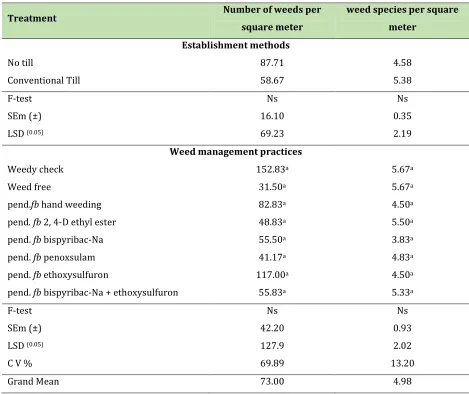
The results revealed that there was no significant difference among the establishment methods
on number of weeds m-2 and weed species recorded during Kharif 2016 season, however,
numerically higher weeds were recorded under no till plot as compared to conventional till. Whereas, the effect of different weed management practices on number of weeds and species was also non-significant. The average number of weed per square meter was 73.19 and range from 31.50 to 152.83 among different weed management practices. The number of weed per square meter was not significantly influenced by weed management practices as well as by the establishment method and its interaction with management practices. No till resulted in comparatively higher than conventional tillage. The highest number of weed per square meter was obtained from weedy check plot. It was statically at par with other method of weed management practices (Table 1).
Number of weed species per m2
Table 1. Effect of establishment methods and weed management on number of weed and number of species per square meter of rice.
Treatment Number of weeds per
square meter
weed species per square meter
Establishment methods
No till 87.71 4.58
Conventional Till 58.67 5.38
F-test Ns Ns
SEm (±) 16.10 0.35
LSD (0.05) 69.23 2.19
Weed management practices
Weedy check 152.83a 5.67a
Weed free 31.50a 5.67a
pend.fb hand weeding 82.83a 4.50a
pend. fb 2, 4-D ethyl ester 48.83a 5.50a
pend. fb bispyribac-Na 55.50a 3.83a
pend. fb penoxsulam 41.17a 4.83a
pend. fb ethoxysulfuron 117.00a 4.50a
pend. fb bispyribac-Na + ethoxysulfuron 55.83a 5.33a
F-test Ns Ns
SEm (±) 42.20 0.93
LSD (0.05) 127.9 2.02
C V % 69.89 13.20
Grand Mean 73.00 4.98
pend. fb: pendimethalin followed by.
Observation on dry weight of weeds per m2
Broad leaf
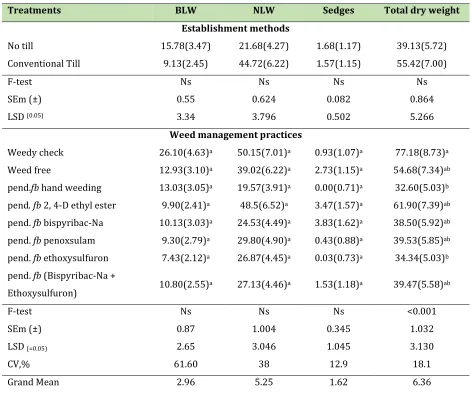
The average broad leaf weeds dry weight of rice was 2.96 m-2 and range from 2.12 to 4.63 m-2
among different weed management practices. The broad leaf weeds dry weight per square meter was not significantly influenced by weed management practices and establishment method and its interaction with management practices. No till resulted in comparatively higher than conventional tillage. The highest broad leaf weeds dry weight was obtained from the weedy check plot. It was statistically at par with other weed management practices (Table 2).
Narrow leaf
The average narrow leaf weeds dry weight of rice was 5.245 and range from 4.45 to 7.01 among different weed management practices. The narrow leaf weeds dry weight was not significantly influenced by weed management practices and the establishment method and its interaction with management practices. Conventional tillage resulted in comparatively higher than no till. The highest narrow leaf weeds dry weight was obtained from the weedy check plot. It was statistically at per with other weeds management practices (Table 2).
Table 2. Effect of establishment methods and weed management on dry weight of different
categories of weeds per square meter (g) of rice.
Treatments BLW NLW Sedges Total dry weight
Establishment methods
No till 15.78(3.47) 21.68(4.27) 1.68(1.17) 39.13(5.72)
Conventional Till 9.13(2.45) 44.72(6.22) 1.57(1.15) 55.42(7.00)
F-test Ns Ns Ns Ns
SEm (±) 0.55 0.624 0.082 0.864
LSD (0.05) 3.34 3.796 0.502 5.266
Weed management practices
Weedy check 26.10(4.63)a 50.15(7.01)a 0.93(1.07)a 77.18(8.73)a
Weed free 12.93(3.10)a 39.02(6.22)a 2.73(1.15)a 54.68(7.34)ab
pend.fb hand weeding 13.03(3.05)a 19.57(3.91)a 0.00(0.71)a 32.60(5.03)b
pend. fb 2, 4-D ethyl ester 9.90(2.41)a 48.5(6.52)a 3.47(1.57)a 61.90(7.39)ab
pend. fb bispyribac-Na 10.13(3.03)a 24.53(4.49)a 3.83(1.62)a 38.50(5.92)ab
pend. fb penoxsulam 9.30(2.79)a 29.80(4.90)a 0.43(0.88)a 39.53(5.85)ab
pend. fb ethoxysulfuron 7.43(2.12)a 26.87(4.45)a 0.03(0.73)a 34.34(5.03)b
pend. fb (Bispyribac-Na +
Ethoxysulfuron) 10.80(2.55)
a 27.13(4.46)a 1.53(1.18)a 39.47(5.58)ab
F-test Ns Ns Ns <0.001
SEm (±) 0.87 1.004 0.345 1.032
LSD (=0.05) 2.65 3.046 1.045 3.130
CV,% 61.60 38 12.9 18.1
Grand Mean 2.96 5.25 1.62 6.36
Sedges
The average sedges dry weight of rice was 1.16 and range from 0.71 to 1.62 among different weed management practices. The sedges dry weight was not significantly influenced by weed management practices and the establishment method and its interaction with management practices. No till resulted in comparatively higher than conventional tillage. The highest sedges were obtained from the weedy check plot. It was statistically at par with other weeds management practices (Table 2).
Average total dry weight of weed
The average total dry weed weight of rice was 6.36 m-2 and range from 5.03 to 8.73 m-2 among
different weed management practices (Table 2). The total dry weed weight per square meter was significantly influenced by weed management practices but not by the establishment method and its interaction with management practices. Conventional resulted in comparatively higher than no till. The highest total dry weed weight per square meter was obtained from weedy check method. It was significantly higher than pendimethalin followed by hand weeding and pendimethalin followed by Ethoxysulfuron but statistically at per with other weed management practices.
Observation on yield attributes
Effective tiller per m2
The average number of effective tiller of rice was 258.815 m-2 and range from 187.5 to 301.67 m-2
among different weed management practices (Table 3). The effective tillers per square meter were significantly influenced by weed management practices but not by the establishment method and its interaction with management practices. No till resulted in comparatively higher than conventional tillage. The highest effective tillers per square meter were obtained from pre-emergence application of Pendimethalin followed by hand weeding. It was significantly higher than weedy check but statistically at par with other weed management practices. The pre-emergence application of Pendimethalin followed by either 2, 4-D ethyl ester, Bispyribac Na or Ethoxysulfuron resulted the similar number of effective tillers per square meter as compared to weedy check.
Number of grain per panicle
The average number of grains per panicle of rice was 152.07 m-2 and range from 115.93 to
significantly influenced by weed management practices. Whereas, the establishment method and its interaction with management practices were not significant. Conventional tillage resulted in application of pendimethalin followed by hand weeding. It was significantly higher than weed check but statistically at per with other weed management practices. The pre-emergence application of pendimethalin followed by either 2, 4-D ethyl ester, Bispyribac Na or Ethoxysulfuron resulted the similar number of grains per panicle as compared to weedy check.
Thousand grain weight
The average number of thousand grain weight of rice was 14.665 and range from 13.34 to 16.85 among different weed management practices (Table 3). The thousand grain weight was significantly influenced by weed management practices but not by the establishment method and its interaction with management practices. No till resulted in comparatively higher than conventional tillage. The highest thousand grain weight was obtained from pre-emergence application of Pendimethalin followed by Ethoxysulfuron. It was significantly higher than weed free, Pendimethalin followed by hand weeding and pendimethalin followed by 2, 4-D ethyl ester but statistically at par with other weed management practices. The pre-emergence application of Pendimethalin followed by penoxsulam, pendimethalin followed by bispyribac-Na, pendimethalin followed by bispyribac Na + ethoxysulfuron and weedy check resulted in similar number of thousand grain weight as compared to weed free.
Sterility percentage
Table 3. Effect of establishment methods and weed management on yield attributes of rice.
Treatments Effective tillers m-2
Number of grains per panicle
Thousand grain weight
Sterility percentage Establishment methods
No till 261.28 147.06 14.76 14.62
Conventional Till 256.35 157.08 14.57 11.56
F-test Ns Ns Ns Ns
SEm (±) 17.53 7.03 0.243 1.408
LSD (=0.05) 106.67 42.75 1.478 8.566
Weed management practices
Weedy check 187.50b 115.93b 15.46ab 24.26a
Weed free 279.03a 165.34a 13.34b 10.38b
pend. fb hand weeding 301.67a 171.61a 13.48b 10.57b
pend. fb 2, 4-D ethyl ester 224.58ab 125.05ab 14.05b 14.71b
pend. fb bispyribac-Na 268.19ab 164.23a 14.28ab 13.03b
pend. fb penoxsulam 278.75a 153.92ab 14.76ab 10.56b
pend. fb ethoxysulfuron 239.72ab 150.43ab 16.85a 9.64b
pend. fb (bispyribac-Na +
ethoxysulfuron) 291.11
a 170.08a 15.10ab 11.54b
F-test <0.05 <0.05 <0.05 <0.05
SEm (±) 26.01 14.38 0.825 2.498
LSD (=0.05) 78.88 43.63 2.391 7.578
CV % 23.10 21.56 13 19.67
Grand Mean 258.82 152.07 14.67 13.09
pend. fb: pendimethalin followed by. Observation on yield
Grain yield
The average grain yield of rice was 3459.67 kg ha-1 and range from 1292.13 to 4202.15 kg ha-1 among
The efficacy of Pendimethalin alone is high reported by several authors (Moody, 1991; Valverde and Gressel, 2005) or in combination with hand weeding was reported so effective in controlling weeds in dry direct seeded rice (Ramamoorthy et al. 1998; Singh et al. 2006; Bhurer et al. 2013).
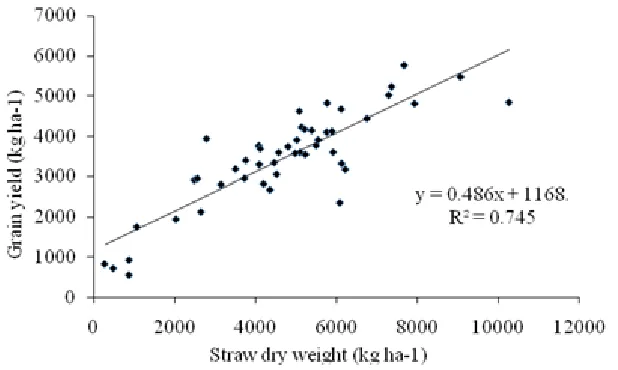
Figure 1. Relationship between grain yield and number of grains per panicle of DDSR at AFU, Rampur, Chitwan.
Straw yield
The average straw yield was 4672.78 kg ha-1 and range from 1205.52 to 5679.37 kg ha-1 among
different weed management practices. Relationship between grain yield and straw dry weight is presented in figure 2. The straw yield was significantly influenced by weed management practices whereas the establishment methods and its interaction with management practices were not significant. Conventional tillage resulted in comparatively higher than No till. The highest straw yield is obtained in the plots of pre-emergence application of Pendimethalin followed by hand weeding. It was significantly higher than weed check but statistically at per with other weed management practices.
Total biomass
The average biomass was 7648.81 kg ha-1 and range from 2316.75 to 9293.22 kg ha-1 among
different weed management practices (Table 4). The average biomass was significantly influenced by weed management practices. Whereas the establishment method and its interaction with management practices was not significant. Conservation tillage resulted in comparatively higher than No till. The higher biomass is obtained in the plots of pre-emergence application of pendimethylin followed by hand weeding .It was significantly higher than weed check but statically at per with other weed management practices.
Table 4. Effect of establishment methods and weed management on grain yield (kg ha-1), straw
yield (kg ha-1), biomass weight (kg ha-1) and harvest index (%).
Treatments Grain yield
(kg ha-1)
Straw yield (kg ha-1)
Total Biomass (kg ha-1)
HI
Establishment methods
No till 3335.17 4168.20 7036.45 45.89
Conventional Till 3584.17 5177.36 8259.75 40.53
F-test Ns ns Ns Ns
SEm (±) 318.00 905.6 873.7 4.47
LSD (=0.05) 1935.00 5510.7 5316.6 27.18
Weed management practices
Weedy check 1292.13b 1205.52b 2316.75b 27.73
Weed free 3640.90a 4847.12a 7978.29a 39.30
pend. fb hand weeding 4202.15a 5679.37a 9293.22a 57.72
pend. fb 2, 4-D ethyl ester 3701.24a 4641.86a 7824.92a 54.29
pend. fb bispyribac-Na 3780.03a 5450.29a 8701.11a 38.82
pend. f b penoxsulam 3282.43a 5068.67a 7891.56a 35.95
pend. fb ethoxysulfuron 3638.40a 5335.03a 8464.05a 36.97
pend. fb (Bispyribac-Na +
ethoxysulfuron) 4140.09a 5154.40a 8714.88a 41.90
F-test <0.001 <0.001 <0.001 Ns
SEm (±) 302.20 928.4 973.6 6.41
LSD (0.05) 916.70 2815.9 2953 19.45
CV % 34.41 47.02 40.84 39.77
Harvest index
The average harvest index was 43.21%and range from 27.73 to 57.72% among different weed management practices (Table 4). The harvest index was non-significantly influenced by weed management practices. Whereas the establishment method and its interaction with management practices was not significant. No till resulted in comparatively higher than conservation tillage. The higher harvest index was obtained in the plots of pre-emergence application of pendimethylin followed by hand weeding. It was statically at par with other weed management practice.
Conclusion
The grain yield, straw yield, and biomass was significantly influenced by weed management practices in which highest yield is obtained in the plot of pre emergence application of pendimethalin followed by hand weeding which was significantly higher than weedy check but statistically at par with other weed management practices. The Harvest index was not significantly influenced by weed management practices in which higher value was obtained in the plot of pre emergence application of pendimethalin followed by hand weeding and was statically at par with
other weed management practices. The effective tiller per m2 and number of grain per panicle were
significantly influenced by weed management practices. This was higher in pre emergence application of pendimethalin followed by hand weeding. This was significantly higher than weedy check but statically at par with other weed management practices. The pre emergence application of pendimethalin followed by either 2, 4-D ethyl ester, Bispyribac-Na or ethoxysulfuron resulted similar effect on effective tiller. Whereas pendimethalin followed by 2, 4-D ethyl ester, pendimethalin followed by penoxsulam and pendimethalin followed by ethoxysulfuron have same effect on number of grain per panicle. Sterility percentage was significantly influenced by weed management practices. The higher sterility percentage were obtained in the plot of weedy check except weedy check plot other weed control method are statistically similar.
Acknowledgments
Authors were grateful to NMRP, Rampur family for providing research materials and research field.
Conflict of Interest
References
Choubey N.K, Kolhe S.S, Tripathi R.S. 2001. Relative performance of cyhalofop - butyl for weed control in direct- seeded rice. Ind. J. Weed Sci. 33: 132-135.
Kim H.H, Pyon J.Y. 1998. Weed occurrence and yield loss due to weeds in different direct seeded rice paddy fields. Kor. J. Weed Sci. 18: 12-19.
Bhurer K.P, Yadav D.N, Ladha J.K, Thapa R.B, Pandey K. 2013. Effect of integrated weed
management practices on performance of dry direct seeded rice (Oryza sativa L.). Agron J
Nepal. 3: 53-63.
Johnson D.E, Mortimer A.M. 2005. Issues for integrated weed management and decision support in direct-seeded rice. In “Rice Is Life: Scientific Perspectives for the 21st Century” (Toriyama K, Heong K. L, Hardy B. Eds.), pp. 211–214. International Rice Research Institute, Los Ban˜os, Philippines and Japan International Research Center for Agricultural Sciences, Tsukuba, Japan.
Maity S.K, Mukherjee P.K. 2008. Integrated weed management in dry direct - seeded rice (Oryza
sativa L.). Ind. J. Agro. 53: 116-120.
MoAD. 2015. Statistical information on Neplese Agriculture 2014/15. Ministry of Agriculture and Development, Agribusiness Promotion and Statistics Davison, Kathmandu, Nepal.
Moody K. 1991. Weed management in rice. In pimental, D (Ed). Hand book of pest management in
agriculture, 2nd Ed. CRC Press, Boca Raton. FL. USA, pp 301-328.
Ramamoorthy K, Arokiaraj A, Balasubramanian A. 1998. Effect of irrigation and chemical weed control on crop yield and nutrient uptake by upland rice and associated weeds under rice-blackgram intercropping system. Oryza. 33: 264-268.
Rao A.N, Johnson D.E, Sivaprasad B, Ladha J.K, Mortimer A.M. 2007. Weed management in direct-seeded rice. Adv Agron. 93: 153-255.
Valverde B.E, Gressel J. 2005. Implication and containment of gene flow from herbicideresistant rice (Oryza sativa). In “Proceeding of 20th Asian Pacific weed sciences society” pp 63-84. Ho Chi
Singh S, Bhusan L, Ladha K.K, Gupta R.K, Rao A.N, Sivprasad B. 2006. Weed management in dry seeded rice cultivated on furrow irrigated raised bed planting system. Crop Protec. 25: 487-495.
Cite this article as: Anoj Adhikari, Asmita Sapkota, Prakash Regmi, Suman Neupane, Suraksha
Sapkota, Surakshya Ghimire, Dipendra Ghimire, Bishnu Prasad Kandel. Effect of establishment method and different weed management practices on dry direct seeded rice (DDSR) at Rampur,
Chitwan. Journal of Research in Weed Science, 2019, 2(4), 332-344. DOI: