http://mojem.um.edu.my 18
[1]
Institute of Education,
International Islamic University Malaysia
[2]
Institute of Graduate Studies, University of Malaya Malaysia
[3]
School of Business,
University Kuala Lumpur Malaysia
Corresponding Author: Institute of Graduate Studies University of Malaya Malaysia
Email: [email protected]
ABSTRACT
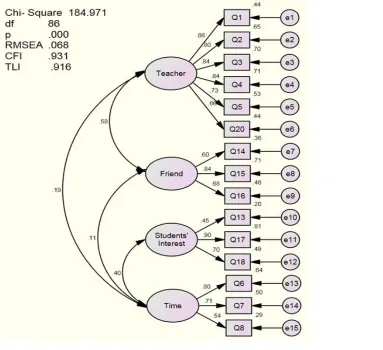
The study circle (Halaqah) program has been introduced by one of the Islamic universities in Malaysia to disseminate the knowledge and skills for overcoming the drawbacks and challenges among students, which is a unique system for learning. However, there has been no research conducted to evaluate the students’ motivation to involve in the study circle program. Hence the purpose of this study is to develop and validate the measurement model of study circle for assessing the students’ confirmation and motivation to involve in study circle program in higher education. A total of 200 undergraduate students were involved in the study circle program. They were from various bachelor degree programs such as Islamic Revealed Knowledge and Human Sciences, Economics, Engineering, Education, and Information and Communications Technology. The questionnaires’ validity was performed using Exploratory Factor Analysis (EFA). The findings as analyzed by Structural Equation Modelling (SEM) revealed that the overall fit indices showed a satisfactory fit to the empirical data: χ2 (df = 86) = 184.971; p = 0.000; RMSEA = 0.068; CFI = 0.931; TLI = 0.916. The parameters were free from offending estimates. The results also contributed toward successful integration of study circle by developing and validating the measurement model of study circle in higher education. The significance of this study stands on its contribution to developing and validating the study circle model that could be applied by future researchers in the diverse context of higher education.
Keyword: study circle, structural equation modelling, higher education, exploratory factor analysis
JULY 2014, VOLUME 2, ISSUE 3, 18 - 32 E-ISSN NO: 2289 – 4489
Development and Validation of the Study Circle Model in Higher Education: The Application of Structural Equation Modeling
http://mojem.um.edu.my 19
INTRODUCTION
Students of this new generation are not so concerned about Islamic rules and regulations. So, they can automatically go astray. Islamic universities play a paramount role to rescue the students from unexpected perilous condition. To disseminate the knowledge and skills for overcoming the drawbacks and challenges, a Malaysian Islamic university has introduced ‘Study Circle’ (Halaqah) under Credited Co-curricular Activity Centre (CCAC). On 25th May, 2001 the University Senate meetings approved the establishment of the CCAC which was formally established in July, 2001. This CCAC credited different types of modules and programs which are study circle, leadership and management skills, communication and debating skills, sports and physical program to education. The target of this university is to apply all these programs for generating graduates to serve the Ummah. Consequently these graduates will be capable to overcome all the challenges of this Universe and also will be better to pursue the true meaning of Ihsan which is a wide-ranging perception. Ihsan has been derived from the word ahsan; the actual meaning of ahsan is the best. Therefore by comprehending the proper connotation of Ihsan individuals accomplish their duty professionally, dexterously and with concrete Adab. Regarding Ihsan one Hadith has been narrated explicitly by Abu Huraira that one day our Prophet Mohammad (SWA) was asked by the angel Gabriel “What is Ihsan (perfection)?” In reply the Prophet (SWA) said:
“To worship Allah as if you see Him, and if you cannot achieve this state of devotion then you must consider that He is looking at you”(Shahi al-Bukhari, Volume 1, No 47).
Among all programs of CCAC this study only focuses on the Study Circle program. Study Circle is considered as the garden of Nur and Yaqin; where Nur is pondered as an opposite supervision of people who are intensely indulged into the fitna of this akhir zaman. Yaqin, on the other hand, is considered as the explicit approach to face all the natural impediments of this mundane world such as trial, enticement, lure, and failures. The whole issues of Iman are the whole issues of Yaqin. Entering into this garden of Nur and Yaqin students learn the lesson of Haqq (fact) and Batil (falsehood). The head of the CCAC Shuriye (2011) cites, “Halaqah is not just reading classical manuscript rather it is a discussion on a particular theme, point, issue or a topic; something similar to . . . round-table forums or seminars” (p. 106). Students of the Islamic university are expected to enlighten their lives by the vivid religious light of the Study Circle program.
http://mojem.um.edu.my 20
Nevertheless the idea of these pillars of Halaqah and education “is not a mere process of engagement but a dynamic method to obtain value-laden graduates” (Shuriye, 2011, p. 101). Students of Study Circle learn about the three categories of Adab namely, ‘Adab Ahli Dunia’, ‘Adab Ahli Deen’ and ‘Adab Ahli Khusus’. The teaching of ‘Adab Ahli Dunia’ relates to memorizing of oratory and beautiful expression, rhyme, and citation which are needed to go forward in this worldly life. The second category of ‘Adab Ahli Deen’ is obligatory to train the personality, discipline the organs of human body, observe the limitation of the worldly life and abandon the lust and vehement desire for the world. ‘Adab Ahli Khusus’ is taught to purify the heart and soul, be aware of Allah’s administration in solitude, fulfil promises with others, observe time, awareness of vulgarity of mind and thought, and to maintain Adab in a state of commitment. Therefore, the Islamic university upholds these perceptions by Study Circle program for instilling the best moral and ethical value-laden Islamic philosophy into the graduates. For infiltrating and imparting Islamization of knowledge as well as religious values, Study Circle possesses certain visions and missions which are as follows:
The vision:
Develop the right understanding and thought in the name of Allah the Almighty. Enhance and manifest it in the right speech and action.
Visualize the right means of livelihood.
Exhibit the right effort and concentration, meditation. Liberate ourselves from the slavery of Thought and desire. Obtain the real happiness in this world and the hereafter.
Praise Allah for his Taufiq and Hidayah” (Study Circle Module, 2007).
The mission:
Venture into the prime institutions and global market. Interact with all levels of society, community and nations. Show them the root of evil and formulae to solve it. Identify who are our real enemy.
Organize the team and leadership.
Nurture the conscience and inner strength” (Study Circle Module, 2007).
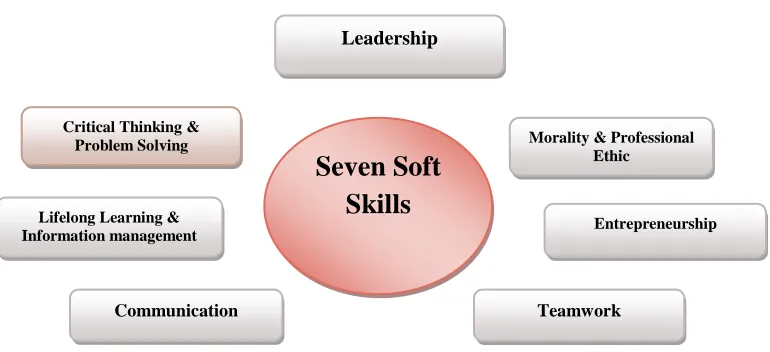
http://mojem.um.edu.my 21 Figure 1. Seven soft skills to be inculcated in students.
All undergraduate students are given practical knowledge on these seven soft skills from the Islamic perspective. By the perception of these seven soft skills Study Circle attempts to divulge intrinsic worth, edify the awareness and personality, amplify concrete understandings, improve aptitudes and heighten abilities and temperament of the graduates of the Islamic university. CCAC can be considered as a sanctified tree where the leaves and fruits stand as the symbol of skills, the trunk is the symbol of leadership and the roots of the tree are excellent example of spirituality. In the Holy Qur’an Allah (swt) declares:
“Have you not considered how Allah presents an example, [making] a good word like a good tree, whose root is firmly fixed and its branches [high] in the sky?” (Surah Al- Ibrahim, verse-24).
Study Circle provides this spiritual knowledge among all graduates to enhance their cognizance, acuity, religious values, management aptitudes and worldview. To receive firm Yakin (certainty of belief) al-Iman and to stimulate learners Study Circle inculcates seven wonders namely, Love, Fear, Ikhlas, Tawakkal, Sabar, Shukur, and Raja’ (hope).
Critical Thinking & Problem Solving
Teamwork Leadership
Morality & Professional Ethic
Entrepreneurship Lifelong Learning &
Information management
Communication
http://mojem.um.edu.my 22
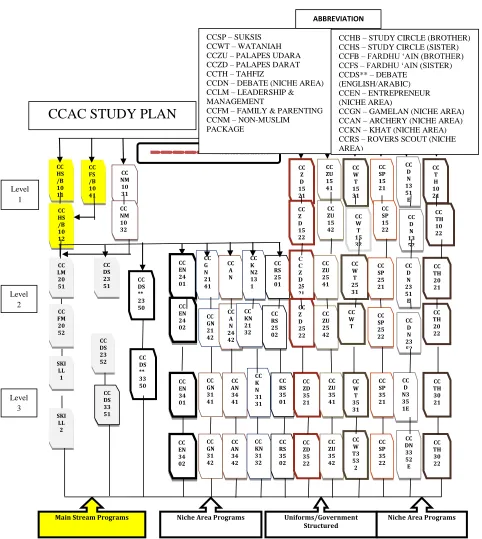
In addition, CCAC offers some diverse and optional courses which point towards a great contribution of CCAC for “building of balanced personality and enriching one’s experiences in life” (Shuriye, 2011, p. 103). The following Figure 2 spells out the whole study plan and noticeably demonstrates entire programs controlled by CCAC. The paramount purpose of offering all these courses is to ensure that graduates of the university are politely equipped and systematized with their academic knowledge in conjunction with their skill knowledge. All these courses are considered as packages sustaining some specific principles including spirituality, leadership, Islamization, internationalization, critical thinking, and so forth.
In this case Study Circle assists to fulfil the demand of spirituality through four packages, namely: Fardu’ Ain (CCFB/S 10), special package for non-Muslim, Halaqah1 (CCHB/S 10) and Halaqah2 (CCHB/S 10). Fardu’ Ain is conducted in a typical classroom style comprising a maximum 35 students per class. Halaqah1 and Halaqah2, in contrast, is handled through group discussion having maximum 15 students per session. These three packages are involved in the mainstream program of the CCAC.
Students are required to complete the three packages indicated by yellow colour in the following CCAC Study Plan (2013/2014) during their level one academic status/year as shown in Figure 2. Based on various demands, needs, interests and claims of a large number of students coming from diverse educational background CCAC has generated explicit teaching modules. The objectives of Fardu’ Ain (CCFB/S 10) teaching module are to “equip the students with basic knowledge of important practices in day-to-day life of a Muslim, teach the students the proper ways of performing the daily ‘Ibadah, inculcate the spirit of ‘Ibadah to achieve a balanced personality” (CCAC Study Circle Module, 2013-2014). As a learning outcome it is expected from the Fardu’ Ain (CCFB/S 10) that at the end of the course students will be capable to “explain the basic daily ‘Ibadah and its importance in Muslims’ life, demonstrate how to perform the daily ‘Ibadah as prescribed by Shariah” (CCAC Study Circle Module, 2013-2014).
http://mojem.um.edu.my 23 Figure 2. CCAC Study Plan (2013/2014)
CC DS ** 23 50 CC HS /B 10 11 CC HS /B 10 12 CC FS /B 10 41 CC NM 10 31 CC NM 10 32 CC DS 23 51 CC LM 20 51 CC FM 20 52 SKI LL 1 SKI LL 2 CC DS 23 52 CC DS 33 51 CC DS ** 33 50 CC EN 24 01 CC EN 24 02 CC EN 34 01 CC EN 34 02 CC G N 21 41 CC GN 21 42 CC GN 31 41 CC GN 31 42 CC A N 24 41 CC A N 24 42 CC AN 34 41 CC AN 34 42 CC K N2 13 1 CC KN 21 32 CC K N 31 31 CC KN 31 32 CC RS 25 01 CC RS 25 02 CC RS 35 01 CC RS 35 02 CC Z D 15 21 CC Z D 15 22 C C Z D 25 21 CC Z D 25 22 CC ZD 35 21 CC ZD 35 22 CC ZU 15 41 CC ZU 15 42 CC ZU 25 41 CC ZU 25 42 CC ZU 35 41 CC ZU 35 42 CC W T 15 31 CC W T 15 32 CC W T
25 31 CC W T 25 32 CC W T 35 31 CC W T3 53 2 CC SP 15 21 CC SP 15 22 CC SP 25 21 CC SP 25 22 CC SP 35 21 CC SP 35 22 CC D N 13 51 E CC D N 13 52 E CC D N 23 51 E CC D N 23 52 E CC D N3 35 1E CC DN 33 52 E CC T H 10 21 CC TH 10 22 CC TH 20 21 CC TH 20 22 CC TH 30 21 CC TH 30 22 WITH PERMISSION ADMISSION
CCAC STUDY PLAN
ABBREVIATION
CCSP – SUKSIS CCWT – WATANIAH CCZU – PALAPES UDARA CCZD – PALAPES DARAT CCTH – TAHFIZ
CCDN – DEBATE (NICHE AREA) CCLM – LEADERSHIP & MANAGEMENT
CCFM – FAMILY & PARENTING CCNM – NON-MUSLIM PACKAGE
CCHB – STUDY CIRCLE (BROTHER) CCHS – STUDY CIRCLE (SISTER) CCFB – FARDHU ‘AIN (BROTHER) CCFS – FARDHU ‘AIN (SISTER) CCDS** – DEBATE
(ENGLISH/ARABIC) CCEN – ENTREPRENEUR (NICHE AREA)
CCGN – GAMELAN (NICHE AREA) CCAN – ARCHERY (NICHE AREA) CCKN – KHAT (NICHE AREA) CCRS – ROVERS SCOUT (NICHE AREA) Level 1 Level 2 Level 3
Main Stream Programs Niche Area Programs
(Four Semesters)
Uniforms/Government Structured
Programs
Niche Area Programs
http://mojem.um.edu.my 24
Likewise the objectives of Halaqah2 (CCHB/S 10) module are to “equip students with knowledge, adab and skills of Istiqamah (steadfastness) to face contemporary challenges, instill the principles of Istiqamah in students’ personality, inculcate strong conscience of Istiqamah through Da’wah and tarbiyah” (CCAC Study Circle Module, 2013/2014). In Halaqah2, like Halaqah1, students’ need to memorize Mathurat-Kubra, selected five Doa’, some selected Qur’anic verses such as Surah Al-Furqan 63-77 and Surah Al-Mu’minun 1-11, five selected Hadith (12, 17, 20, 27, 38) among forty Hadith. Consequently, the learning outcome of Halaqah2 (CCHB/S 10) module is that students will be able to “explain the significance of Istiqamah in life, demonstrate the quality of Istiqamah in class activities, and suggest solution to contemporary problems from [the] Islamic perspective” (CCAC Study Circle Module, 2013/2014).
Each student of study circle is assessed in accordance with their class participation, Islamic dress, punctuality, teamwork, akhlaq, presentation, assignment, memorization, practical test and final examination. However it is obviously noticed that some students of Study Circle were reluctant to attend the class. To them performing such a lot of activities in study circle class is toilsome and over burdens them by adding to their academic schedule. They also consider that study circle program always forces them to give equal emphasis to some work that they do not prefer to do. Most of the students face difficulties memorizing the selected memorization package by one semester. Nevertheless, it is important to consider that the Study Circle program assists the graduates to enrich their fundamental Islamic teachings and Islamic way of life.
In addition, Hayati (2000) examined the significance of Halaqah in inculcating spirituality among IIUM Gombak students. Ahmad (2010) investigated the importance of discussion method of teaching being used in the Halaqah. Yet, in their findings no model has been developed to persuade the students to be involved in the study circle. As such, the broad objective of this study is to develop and validate the study circle measurement model for evaluating students’ confirmation and motivation to involve in the study circle program in higher education.
METHODOLOGY
http://mojem.um.edu.my 25
Research Instrument
A five-point Likert scale that demonstrated degrees of agreement (from strongly disagree to strongly agree) was applied to capture the students’ perceptions about the study circle. The questionnaire was locally developed by authors as well as experts. The instrument consisted of two parts. The first section collected demographic information and second section consisted of 20 items. After developing the questionnaire, the preliminary exploratory factor analysis was conducted in a pilot test for validating the items. Nevertheless, the results of the pilot test showed that each of the items demonstrated a single underlying factor, with the exception of three items (Q9, Q10 and Q12). These three items were reconstructed for the final instrument.
Reliability and Validity of Instrument
The instrument reliability and validity tests were performed by using SPSS. The questionnaire validity was conducted using exploratory factor analysis (EFA). The purpose of the EFA is to develop and validate the psychometric properties to assess the underlying factors influencing the students’ involvement in the study circle program. The preliminary EFA was estimated with 20 items. The findings of EFA showed that the students’ perceptions of study circle are represented by the five underlying components while the fifth component was represented by two items, with the exception of item (Q10) which had cross loading. As a result, the researchers decided to drop the items to validate and estimate the instrument. After deleting the items (Q10, Q11, Q12 and Q19), the results of EFA demonstrated that the extent of inter-correlation among the variables is statistically significant. There was no correlation greater than .80 which exhibits that the items were free from multi-collinearity. Similarly, the inter-correlation among the items justified the beginning of EFA as demonstrated by anti-image matrices where all variables showed more than .64 correlations between them. The Kaiser-Meyer-Olkin assessment of sampling adequacy was .855, showing the suitability of the data for EFA. In the meantime, Bartlett's Test of Sphericity was found to be statistically significant (p = .000), which was identifying the adequate correlation between the variables. Moreover, the four-factor elucidation achieved from the EFA with varimax rotation after dropping few items, the total variance explained by the measures was 65.022% which depicted that the items were competent for endorsing student involvement in study circles. The items were factorable into four dimensions such as teacher, friend, students’ interest and time. Besides, the greater Eigen value was achieved on the first component of 5.493, while the other three components discovered values of 2.415, 1.298 and 1.198, respectively. Communalities estimates for each of the variables were greater than .521.
http://mojem.um.edu.my 26
.827; it explained 7.488% of the total variance. A set of 4 reliability analyses were executed on the responses that evaluated each construct for students. A synopsis of the reliability for all factors is exhibited in Table 1.
Table 1
Cronbach’s Alpha for Each Factor Measured
Respondents
Factors
Cronbach’s alpha
Values
Students
Teacher
.884
Friend
.732
Students’ interest
.687
Time
.711
RESULTS
The Hypothesized Study Circle Measurement Model
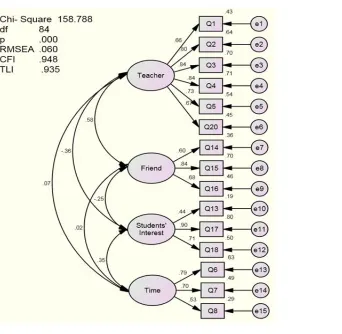
http://mojem.um.edu.my 27 Figure 3. The Hypothesized Study Circle Measurement Model
The Revised Study Circle Measurement Model
http://mojem.um.edu.my 28 Figure 4. The Revised Study Circle Measurement Model
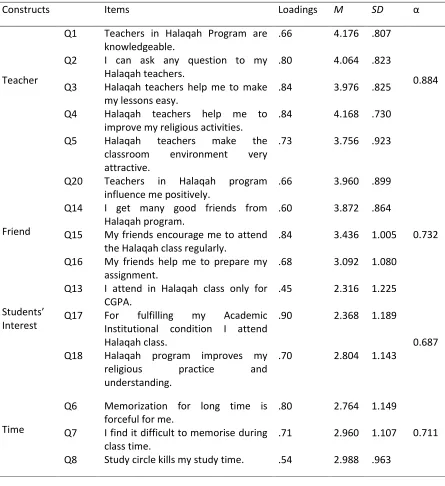
http://mojem.um.edu.my 29 Measurement of the Variables of the Revised Study Circle Model
Constructs Items Loadings M SD α
Teacher
Q1 Teachers in Halaqah Program are knowledgeable.
.66 4.176 .807
0.884 Q2 I can ask any question to my
Halaqah teachers.
.80 4.064 .823
Q3 Halaqah teachers help me to make my lessons easy.
.84 3.976 .825
Q4 Halaqah teachers help me to improve my religious activities.
.84 4.168 .730
Q5 Halaqah teachers make the classroom environment very attractive.
.73 3.756 .923
Q20 Teachers in Halaqah program influence me positively.
.66 3.960 .899
0.732 Friend
Q14 I get many good friends from Halaqah program.
.60 3.872 .864
Q15 My friends encourage me to attend the Halaqah class regularly.
.84 3.436 1.005
Q16 My friends help me to prepare my assignment.
.68 3.092 1.080
Students’ Interest
Q13 I attend in Halaqah class only for CGPA.
.45 2.316 1.225
0.687 Q17 For fulfilling my Academic
Institutional condition I attend Halaqah class.
.90 2.368 1.189
Q18 Halaqah program improves my religious practice and understanding.
.70 2.804 1.143
Time
Q6 Memorization for long time is forceful for me.
.80 2.764 1.149
0.711 Q7 I find it difficult to memorise during
class time.
.71 2.960 1.107
http://mojem.um.edu.my 30
DISCUSSION
The result of this empirical research demonstrated that in study circle teachers are knowledgeable and students are free to ask any question to them. Moreover teachers assist the students to make their lessons easy and help the students to improve their religious activities and practices. Cruickshank, Jenkins, and Metcalf (2003) opine that effective teachers support students in multifarious ways and assist to fulfil their demands for belonging and victory. Study circle teachers, likewise, make the classroom environment very attractive and influence students positively. Thus from the findings it is perceivable that teachers are well experienced, helpful, caring and cordial with the students. Irvine (2001) cites “Students defined caring teachers as those who set limits, provided structure, held high expectations, and pushed them to achieve” (p. 6-7).
Students’ interest, therefore, was another valid factor of this study. Shroff and Vogel (2010) noted that “student interest has a positive effect on learning and academic achievement” (p. 279). After analyzing the data it was noticed that students attend in study circle class only for maintaining their CGPA and for fulfilling the requirement of their academic institutional condition too. Hence, this Study Circle program motivates students to improve their religious practices and understanding. The students however say that they involve themselves in study circle program only for certain mandatory conditions enforced by their educational institution. On the other hand, it is acknowledged that through this program their religious knowledge expands tremendously.
Notwithstanding, students are very enthusiastic regarding their friends. The data analysis showed that they make many good friends through the study circle program. These friends, accordingly, encourage them to attend the class regularly. Again, friends are so helpful to the students in preparing their assignments. Apparently it is found that friends have more capabilities to influence their classmates to be attentive in their study.
Concerning time schedule of study circle class, students are not contented as “Time Tracking is fairly straightforward” (Poser, 2003, p. 3). Therefore result indicated that students feel forceful for memorizing long time and also they face difficulty to memorize the selected texts during the class period. Even they comprehend that study circle program tasks eat into other academic study time. Subsequently, as can be seen from the results, time becomes a major challenging factor for students to cope up with their regular class time.
Eventually, the findings also revealed significant positive interrelationships among the constructs, namely, teacher and friend, and students’ interest and time of the study circle measurement model.
CONCLUSION
http://mojem.um.edu.my 31
Moreover, students’ interest is very obvious from the findings which indicate that they are bound to attend study circle class only for fulfilling university requirements. Besides these they also admitted that through this course they get inspiration to improve the depth of their religious expertise. Thus it should be the target of each student to learn not merely for achieving higher degree rather for acquiring religious knowledge and applying it throughout their whole lives. Therefore students have to ensure that “they apply the received education in their individual and social life” (Al-Khalediy, 2011, p. 44).
Students’ passionate love, in other words, towards their friends is evident from the data analysis. They get stimulation to be more attentive in the class and studies from their friends. Students prepare assignments with the co-operation of their friends. According to Khaled al-Khalediy (2011) for achieving the goal of study co-operation is essential. Therefore coming to study circle class students find good friends. Allah (SWT) proclaims, “Friends on that Day will be foes one to another, except al-Muttaqun” (Az-Zukhruf, Verse-67). Good friends, likewise, are essential to stay on the path of Istiqamah. Regarding good friends Prophet Muhammad (SWA) says, “A person is likely to follow the faith of his friend, so look whom you befriend” (Abu Dawood, 1419H/1999M, Volume-1, Hadith No. 2696, p. 244).
Finally time has been found to be a valid and challenging factor among all valid factors of this study. The reason being that in study circle students are to memorize some selected Qur’anic verses, Hadiths and Doas. During class time they are to memorize these selected items; nonetheless students feel boredom and face difficulties in memorizing. To them study circle class time mars another study time, too. Consequently it can be recommended that to resolve these timing problem teachers can assist students by providing some additional time except their class time to the students to finish their memorization package within the ten sessions during each semester.
RECOMMENDATION
This current group study was merely constrained among diverse undergraduate pupils of International Islamic University, Malaysia. Without using any qualitative approach, data of this study was only collected by distributing survey questionnaires among undergraduate students of IIUM. As a result a challenging question would be rise while generalizing Study Circle measurement model in higher education. It is suggested for the future researchers to include lecturers along with the students.
http://mojem.um.edu.my 32
REFERENCES
Al-den, A. T., & Muslin, K. (1999). Translation of meanings of the noble Qur’an in the English language. Al-Madinah: King Fahd complex for the printing of the holy Qur’an.
Ahmad, T. S. (2010). Discussion method in enhancing Students’ learning competence: A case study of CCAC Halaqah Programme in IIUM. Unpublished Master Dissertation, Institute of Education: International Islamic University Malaysia.
Al-Khalediy, K. (2011). Education and methods of teaching in Islam in the era of az-zarnooji. Retrieved from http://boocu.com/education-and-methods-of-teaching-in-islam-in-the-era-of-az-zarnooji/
Byrne, B. M. (2000). Structural equation modeling with AMOS: Basic concepts, applications and programming. Mahwah, NJ: Erlbaum.
Cruickshank, D. R., Jenkins, D. B., & Metcalf, K. K. (2003). The act of teaching. NewYork, NY: McGraw-Hill.
Dawood, A. (1419H/1999M). Musnad Abu Dawood. Egypt: Daru-Al-Hegrah.
Hair, J. F., Jr., Black, W. C., Babin, B. J., & Anderson, R. E. (2006). Multivariate data analysis: A global perception. Upper Saddle River, NJ: Pearson.
Hayati, N. B. S. (2000). The perception of students on the importance of the IIUM Halaqah program in enhancing their knowledge of Islamic education. Unpublished Master Directed Research, Institute of Education, International Islamic University Malaysia.
Irvine, J. J. (2001). Caring, competent teachers in complex classrooms. Washington, DC: AACTE.
MuÍammad, A. (1403AH). Al-JÉmiÑ. Al-Qahirah: Al-Maktabah al-Salafiyyah.
Poser, B. (2003). Time management for students. Retrieved from www.yorku.ca/cdc/lsp
Shroff, R. H., & Vogel, D. R. (2010). An investigation on individual students’ perceptions of interest utilizing a blended learning approach. International Journal on E-Learning, 9(2), 279-294.
Shuriye, A. O. (2011). The role of credited co-curricular programmes on the internationalization and infusing values into student’s personality: The IIUM Model. Journal of Emerging Trends in Educational Research and Policy Studies, 2(2), 100-107.
Study Circle 1 (2007). (1st ed.). Co-curricular Activity Centre, Student Development Division, International Islamic University Malaysia.