The Usability Evaluation Of Fakih Method
Based On Technology For Students With
Hearing Difficulties: The User’s
Retrospective
Muhammad Sayuti Bin Sabdan [1], Norlidah Alias [2], Nazean Jomhari [3] Khairul Azhar Jamaludin[4] and Dorothy DeWitt [5]
[1] Faculty of Education, University of Malaya Kuala Lumpur
[2] Faculty of Education, University of Malaya Kuala Lumpur
[email protected] [3] Faculty of Science and Computer, University of Malaya Kuala Lumpur [email protected] [4] Faculty of Education, University of Malaya Kuala Lumpur
[email protected] [5] Faculty of Education,
University of Malaya Kuala Lumpur
[email protected] ABSTRACT
The study is aimed at evaluating the FAKIH method based on technology in teaching al-Quran, based on the user’s retrospective. The participants of this study were five students selected based on hearing difficulties. The study employed the user evaluation framework. Teacher’s journals were used to determine the frequency and percentage of repetition of al-Quran learning as well as mastery level of all selected five students. The findings suggest that all five students benefited from this method, as they were able to master hijaiyyah letters, letters and words with diacritics, tajwid knowledge and two-word sentences. In addition, most of them were able to recite al-Quran fluently using hand-signals.
Keywords: User’s retrospective, usability evaluation, FAKIH method, technology, students with hearing difficulties.
INTRODUCTION
According to Hong, Wang, Yuan, Xu, Jiang, Yan, and Chua (2011) more than 66 million people in the world are having hearing difficulties. Realizing this fact, the Ministry of Education Malaysia (Kementerian Pendidikan Malaysia, KPM) has developed the Standardized Curriculum for Children with Hearing Difficulties in Primary School (Kurikulum Standard Sekolah Rendah Pendidikan Khas Bagi Murid Bermasalah Pendengaran / KSSRPK Bermasalah Pendengaran) based on the Malaysia Educational Blueprint 2013-2025 (2012). Prior to the new curriculum, students with hearing difficulties were taught using the same curriculum for normal schools (Mohd Zuri Ghani & Aznan Che Ahmad, 2011).
Correspondently, Islamic education for students with special needs was implemented in KSSRPK (KSSRPK bermasalah pendengaran, 2011). In achieving the National Education Philosophy (National Education Blusprint 2012, p. E4) this subject similarly implemented JERIS elements (physical, emotion, spiritual, intellectual and social) in developing wholesome students (KSSRPK bermasalah pendengaran, 2011). It is believed that the Islamic education is an effective medium for achieving this aspiration ('Abdullah Nasih 'Ulwan, 1981).
Similar attention should also be given for students with hearing difficulties (Ab Aziz Mohd Zin, Mohamad Kamil Ab Majid, Anisah Ab Ghani, Mohd Fauzi Hamat, Nor Raudah Hj Siren, &
www.mojet.net
Juwairiah Hassan, 2009). Therefore, KSSRPK did not exclude them (the Muslims) and the subject was made compulsory for them (Hamdi Ishak, Ab Halim Tamuri, Rosadah Abdul Majid, & Safani Bari, 2012). The KSSRPK emphasizes FAKIH method as the medium of instruction to teach Quran reading for these students (KSSRPK bermasalah pendengaran, 2011). FAKIH method employs the representations of numbers and color to teach al-Quran recital (KSSRPK bermasalah pendengaran, 2011). Specifically, it uses magnetic buttons and board as learning aid to teach these students to learn (Nor ‘Aziah Mohd Daud, 2012).
In 2011, the Centre for Quranic Research (CQR) of Universiti Malaya in collaboration with FAKIH Intellect Academy in a pilot project for curriculum development of Islamic education for students with special needs. The selected students for this program were those having autism, hearing difficulties, Down syndrome or cerebral-palsy.
In February 2012, the teaching of al-Quran classes for these special students, especially for those with hearing difficulties were progressively conducted at Research and Development department of University of Malaya (CQR, 2011). The classes were under the supervision of CQR and FAKIH Intellect Academy (CQR, 2011). However, it is noted that there was no specified research conducted on the evaluation of FAKIH method for children with special needs.
Statement of problem
The majority of the people with hearing disabilities were not given an ample exposure to al-Quran education (Global Deaf Muslim, 2014). With such condition, they were slightly neglected in learning al-Quran compared to the normal children (Ab Aziz Mohd Zin et al., 2009; Global Deaf Muslim, 2014). In addition, a fragment of the society or community still has poor awareness and empathy towards this issue (Hasnah Toran, Mohd Hanafi Mohd Yasin, Mohd Mokhtar Tahar, & Norasuzaini Sujak, 2009). The mainstream al-Quran learning such as Kelas al-Quran and Fardu Ain (KAFA) under the Malaysian Islamic Development Department or Jabatan Agama Islam Malaysia (JAKIM), Religious Primary School (Sekolah Rendah Agama, SRA), the State Religious School (Sekolah Agama Negeri, SAN) under the State Islamic Affairs Department (Jabatan Agama Islam Negeri, JAIN) only focus on the normal children and thus, the children with special needs are excluded from these classes (Norakyairee Mohd Raus, Noorjihan Jaafar, Nurul Asiah, & Ab. Halim Tamuri, 2013).
Norakyairee Mohd Raus and Ab Halim Tamuri (2011) noted a similar insufficiency of support in al-Quran learning using Braille for visually impaired students. Even though the Islamic subject was designed for them, the focus on al-Quran learning using Braille was not evident. The scenario is found to be similar for students with hearing and other physical difficulties. Norakyairee Mohd Raus et al. (2013) support that there is no specified al-Quran learning class for them under the blueprint, which are supervised under the Ministry of Education (Kementerian Pendidikan Malaysia, KPM), Ministry of Health (Kementerian Kesihatan Malaysia, KKM) and the Welfare Department (Jabatan Kebajikan Masyarakat, JKM).
Realizing the above fact, the current study is designed to evaluate the use of FAKIH method through technology for students with hearing difficulties in learning al-Quran.
Research objective
The current study is aimed at evaluating the FAKIH method for students with hearing difficulties based on teachers’ journal in order to answer the following research question:
www.mojet.net
1) What is the level of efficacy of FAKIH method for students with hearing difficulties based on the teachers’ journal?
METHODOLOGY
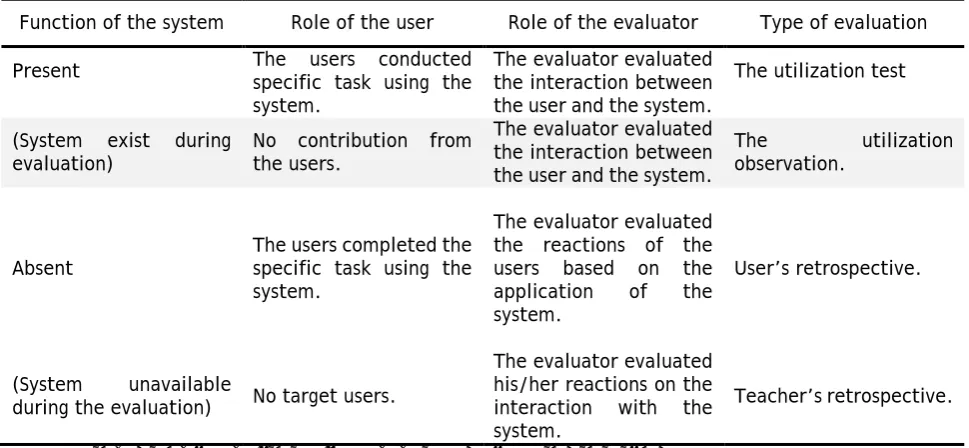
The current study employs the user evaluation framework by Chai and Chen (2004) in Norlidah Alias’s (2010) study. The framework outlines three different categories of usage evaluation such as:
1. A system that is still under evaluation but attainable in the form of physical product or model used, or only in the form of document.
2. The demands based on the needs of the user. 3. The evaluator who evaluates the product.
The above categories are depending on the aim of the evaluation, and the role of the evaluator is flexible, depending on the situation that affects the evaluation view. Table 1 summarizes the role for each evaluation category in determining the evaluation selection.
Table 1 The User Evaluation Framework
Function of the system Role of the user Role of the evaluator Type of evaluation Present The users conducted specific task using the
system.
The evaluator evaluated the interaction between the user and the system.
The utilization test
(System exist during
evaluation) No contribution from the users.
The evaluator evaluated the interaction between the user and the system.
The utilization observation.
Absent The users completed the specific task using the system.
The evaluator evaluated the reactions of the users based on the application of the system.
User’s retrospective.
(System unavailable
during the evaluation) No target users.
The evaluator evaluated his/her reactions on the interaction with the system.
Teacher’s retrospective.
Adapted from Norlidah Alias, Dorothy Dewitt & Saedah Siraj (2013).
Participants
The participants are five students with hearing difficulties, age 14 to 25 from Fakih Intelek Academy. They learned al-Quran using the FAKIH method starting January 2013 to December 2013. Nielsen (2000) suggested that the selected participants should be exposed to the method before evaluation in helping them to familiarize with the system.
Teacher’s journal evaluation
The researcher collected the frequency and percentage data based on the teacher’s journal across five learning themes as below:
• Level 1: hijaiyyah letters
• Level 2: letters and words with ‘lines’
• Level 3: tajwid knowledge
• Level 4: reading the cursive writing (of Arabic transcript)
www.mojet.net
The data were categorized in a table for frequency and percentage count for all themes above. The formula used for determining the percentage is as below:
For example, if the researcher were to calculate the frequency count (f) of Level 1 (hijaiyyah letters) for each student,
( f ) = The frequency in Level 1 (hijaiyyah letters) --- x 100 Overall frequency in all themes
FINDINGS
The overall percentage for each level for all five students is presented in Figure 1.1
Figure 1. The percentage of frequency of teaching for each category.
The findings in Figure 1 reveal that Level 4: reading cursive writing (of Arabic transcript) has the highest percentage compared to other levels, with 47.3 percent. It is also apparent that the selected students have lower difficulties in Level 3: tajwid knowledge as the frequency of repetition of learning is the lowest, with only 5.1 percent.
On the other hand, in Level 1: hijaiyyah letters and Level 2: letters and words with ‘lines’, the percentage is average (22% for Level 1 and 25.5% for Level 2). It is found that all five students exemplified difficulties in learning to read al-Quran in Level 1 and 2.
DISCUSSION AND IMPLICATION
Based on the findings in the teacher’s journal, it is apparent that the students’ understanding and achievements have improved. Surprisingly, by the end of the study, they were able to recite al-Quran fluently. It is proven that FAKIH method contributed to this success as the students’ mastery in all four levels has improved.
Therefore, it is relevant to state that FAKIH method has helped the students with hearing
22 25,5
5,1
47,3
0 5 10 15 20 25 30 35 40 45 50
Level 1: hijaiyyah
letters Level 2: letters and words with ‘lines’ Level 3: tajwidknowledge Level 4: reading thecursive writing (of Arabic transcript)
www.mojet.net
difficulties to read and recite al-Quran fluently. The findings of the current study are in line with previous study and prove that the possibility of success in learning al-Quran for students with physical difficulties is high (Hamdi Ishak et al., 2012; Heni Herlina, Martias & Ganda Sumekar, 2013; Juwairiah Hassan, 2009; Nafiseh Alaghehband Ghadim, Norlidah Alias, Syar Meeze, Mohd Rashid, & Mohd Yakub Zulkifli Mohd Yusoff, 2013; Nofira Fadhillah et al., 2013; Nur Hannah Saari, Cila Umat, & Kamarul Shukri Mat Teh, 2012; Sumaya Abusaleh, Eman AbdelFattah, Zain Alabadi, & Ahmad Sharieh, 2010).
The current study makes a significant contribution to the body of literature as the findings prove that the implemented method is beneficial and effective for these students to not only learn but also understand and master the content of al-Quran. As mentioned by Hamdi Ishak et al. (2012) and Juwairiah Hassan (2009), students with hearing difficulties have a high potential to comprehend and master the knowledge of Islam. It is hoped, based on the findings, that this method will be largely implemented in al-Quran classes under JAKIM. In addition, it is hoped that these students would feel closer to Allah as learning al-Quran is a stepping stone towards that (Hamdi Ishak et al., 2012; Juwairiah Hassan, 2009).
RECOMMENDATION FOR THE FUTURE RESEARCH
It is suggested that future researchers conduct a similar study using experimental design to further determine the effectiveness of FAKIH method based on technology and visual learning style for students with hearing difficulties. In addition, it is relevant to investigate the efficacy of this method for students with learning difficulties.
Future researchers are encouraged to conduct a similar study in the national special education schools for the hearing impaired (Sekolah Kebangsaan Pendidikan Khas Masalah Pendengaran or SKPK Masalah Pendengaran), classes in educational integration for special children and other inclusive programs across Malaysia as this approach has been widely used since 2011.
REFERENCES
Ab Aziz Mohd Zin, Mohamad Kamil Ab Majid, Anisah Ab Ghani, Mohd Fauzi Hamat, Nor Raudah Hj Siren, & Juwairiah Hassan. (2009). Dakwah Islam terhadap Orang Kurang Upaya. Kuala Lumpur: Universiti Malaya Kuala Lumpur.
'Abdullah Nasih 'Ulwan. (1981). Tarbiat al-Aulad Fi al-Islam. Beirut: Darul al-Salam.
Centre of Quranic Research (CQR) (2011). http://cqr.um.edu.my/?modul=Events_and_Activities&pilihan=FAKIH_Learning&subpilihan=Background
Chai, C. S., & Chen, D. (2004). A review on usability evaluation methods for instructional multimedia: An analytical framework. Retrieved from Instructional Journal of Multimedia, 31(3), 231. ERIC Fulltext:http://www.eric.ed.gov/contentdelivery/servlet/ERICServlet?acc.no=ED501628
Global Deaf Muslim. (2014). Retrieved from http://www.globaldeafmuslim.org/about/projects/
Hamdi Ishak, Ab Halim Tamuri, Rosadah Abdul Majid, & Safani Bari. (2012). Amalan Pengajaran Guru dalam Pengajaran dan Pembelajaran Pendidikan Islam di Sekolah Kebangsaan Pendidikan Khas (Masalah Pendengaran). JIAE: Journal of Islamic and Arabic Education, 2(4), 11-24.
www.mojet.net
Hasnah Toran, Mohd Hanafi Mohd Yasin, Mohd Mokhtar Tahar, & Norasuzaini Sujak. (2009). Sokongan dan halangan yang dihadapi pelajar-pelajar kurang upaya di sebuah institusi pengajian tinggi di Malaysia. AJTLHE: ASEAN Journal of Teaching and Learning in Higher Education, 1(2), 18-29.
Heni Herlina, Martias & Ganda Sumekar. (2013). Efektifitas Metode Al-Bayan untuk meningkatkan kemampuan membaca Huruf Hijaiyah bagi anak Tunarungu. Jurnal Ilmiah Pendidikan Khusus (E-Jupekhu), 2(3).
Hong, R., Wang, M., Yuan, X. T., Xu, M., Jiang, J., Yan, S., & Chua, T. S. (2011). Video accessibility enhancement for hearing- impaired users. Transactions on Multimedia Computing, Communications, and Applications (TOMCCAP), 75(1), 24. doi: 10.1145/2037676.2037681.
Juwairiah Hassan. (2009). Pelaksanaan dakwah kepada orang pekak di Terengganu. Sarjana Usuluddin. Jabatan Dakwah Dan Pembangunan Insan, Akademi Pengajian Islam, Universiti Malaya, Kuala Lumpur.
Kurikulum Standard Sekolah Rendah Pendidikan Khas. (2011). Pendidikan Islam Masalah Pendengaran Tahun dua. Putrajaya: Bahagian Pembangunan Kurikulum Kementerian Pelajaran Malaysia.
Malaysia Education Blueprint 2013-2025. (2012, September). Preliminary Report. Retrieved from http://www.moe.gov.my/userfiles/file/PPP/Preliminary-Blueprint-Eng.pdf
Mohd Zuri Ghani, & Aznan Che Ahmad. (2011). Penghantar Pendidikan Khas. Pulau Pinang: Universiti Sains Malaysia.
Nafiseh Alaghehband Ghadim, Norlidah Alias, Syar Meeze, Mohd Rashid, & Mohd Yakub Zulkifli Mohd Yusoff. (2013). Mother’s Perspective Toward al-Quran Education for Hearing Impaired Children in Malaysia. The Malaysian Online Journal of Educational Technology, 1(4), 26.
Nielsen, J. (2010). Why you only need to test with 5 users. Retrieved from http://www.useit.com/articles/why-you-only-need-to-test-with-5-users/
Norakyairee Mohd Raus, & Ab Halim Tamuri. (2011). Program Tilawah al-Quran di Masjid Bagi Golongan Bermasalah Penglihatan: Realiti dan Cabaran Semasa. Seminar Pengurusan Masjid Inovatif Peringkat Antarabangsa, 23-25 April 2011, IAIN ar-Raniry, Banda Aceh, Aceh.
Norakyairee Mohd Raus, Noorjihan Jaafar, Nurul Asiah, & Ab. Halim Tamuri. (2013). Pendidikan al-Quran bagi Anak Istimewa: Guru sebagai murabbi. Bengkel Modul Pembangunan Kelas Pendidikan Al-al-Quran Bagi Anak Istimewa. Kuala Lumpur.
Nor ‘Aziah Mohd Daud. (2012). Kaedah mudah pelajari al-Quran bagi OKU: Fakih al- Quran hadiah buat golongan istimewa. Kuala Lumpur: Centre of Quranic Research.
Norlidah Alias. (2010). Pembangunan Modul Pedagogi Berasaskan Teknologi dan Gaya Pembelajaran Felder-Silvermen Kurikulum Fizik Sekolah Menengah: Pembangunan Kurikulum. Tesis Dr. Falsafah. Universiti Malaya, Kuala Lumpur.
Norlidah Alias, Dorothy Dewitt, & Saedah Siraj. (2013). Development of Science Pedagogical Module based on learning styles and technology. Kuala Lumpur: Pearson.
Nur Hannah Saari, Cila Umat, & Kamarul Shukri Mat Teh. (2013). Factors affecting the learning of the Holy Quran among severely and profoundly hearing-impaired children with a cochlear implant. Journal of Humanities and Social Science (JHSS), 2(1), pp. 85-92.
www.mojet.net
Sumaya Abusaleh, Eman AbdelFattah, Zain Alabadi, & Ahmad Sharieh. (2010). The effects of Educational Multimedia for Scientific Signs in the Holy Quran in improving the creative thinking skills for deaf children. In Innovations in Computing Sciences and Software Engineering (pp. 403-408). The Netherlands: Springer.
www.mojet.net