AND COMMUNICATION FUNCTIONS IN INDIA’S
DEVELOPMENT SECTOR
Manoj K Das
Abstract
T
he paper investigates the visibility and demand for communication for development (C4D) related careers and functions in the development sector in India. Differentiating between information and communication functions that constitute C4D, the empirical study, based on analysis of popular job websites in the sector, reveals that while the combined share of information and communication job positions account for a miniscule proportion of the overall new openings in thesector, the visibility of communication specific jobs is particularly inconsequential. Corroborating this finding further by triangulating responses from both employers
and employees in the sector, the paper calls for the need to acknowledge the relevance of trained communication personnel in programme planning, implementation and
evaluation. The paper contends that contrary to popular perception in the field,
information and communication functions in the sector need specialised skill sets, and professionals trained in the discipline are better suited for the purpose. Pointing out some key areas where professionals trained in information and communication particularly suit in the development sector in India, the paper argues that the sector should open up the space for such professionals. Academic and training centres need
to respond by providing the right type of perspective and training as required by the field.
Keywords: development sector, c4d, information, communication, job websites, NGO.
Introduction
India has been witnessing a steady growth of the development sector during the last two decades. Not only is the ecosystem of the sector marked by conspicuous
presence of a large number of not-for-profit Non-Government Organisations (NGOs) (Mahapatra, 2014), the corporate sector too has emerged as a key player
required by national law. The state of course continues to be a major player with
a battery of development schemes and programmes for its population. With the emphasis of government programmes being increasingly on a mission mode,
meaning that projects have clearly defined objectives, scopes, implementation
timelines and milestones, measurable outcomes and service levels, one observes growing professionalisation and corporatisation of the public-sector development initiatives in contemporary times.
Further, international donor agencies operating in the country and global consultancy companies – both Indian as well as from outside – dot the mosaic of the development sector environment in the country today. While the thrust continues to
be on conventional programmatic areas, newer fields have come within the ambit of
the sector as a response to emerging issues and priorities. Even as activists claim that space for civil society in the country is shrinking due to the regulatory environment,
including restrictions on foreign funding of NGOs (Bhatnagar, 2016), the requirement
for multi-skilled professionals with high-end expertise and knowledge are on a rise in the development sector. This is attested by the fact that a leading job website catering to the sector in the country, devNetJobsIndia.org, claims that its newsletters reach to
445,000 jobseekers, indicating a vibrant job market for development professionals in the country today. Indeed, one finds considerable number of such jobs being
advertised and publicised today– an unprecedented scenario not witnessed even two decades back. As a senior functionary in a prominent international agency in the
country who has been in the field for more than two decades admits to this author.
In the late 1990s or even early 2000, one had to look out for
development sector opportunities mostly in the weekly classified
columns in local newspapers. Or, it was just word of mouth that sometimes worked. At best, one could register with a placement agency to get a call for an initial recruitment interview. Things have changed. Today there are dedicated websites that carry large number of job advertisements for the sector.
(Kripa Shankar Yadav, Project Manager, Save the Children, India)
Increasing specialisation of development organisations’ thematic intervention areas, compulsion to reconcile interdisciplinary approaches, pressures to demonstrate success among other factors, have all contributed to progressive formalisation of
the sector requiring employment of different types of professionals with varied and
relevant skill sets, knowledge and expertise. Where do communication professionals stand in this milieu? If communication is so indispensable in development
current paper attempts to address three specific objectives: one, to elicit the share of
information and communication related jobs vis-a-vis other jobs as advertised by the
development organisations in India; two, to examine the functional nature of such jobs and determine the skills demanded of such positions; and three, to scrutinise the key potential areas where personnel trained in the field of communication may particularly fit in the sector thereby adding value to the practice of development.
Theoretical Background
Academic and public discourses on human development, particularly since the early
1960s, have unequivocally emphasised on the relevance and need for communication
in the development process. A considerable body of literature in communication for development attests to this fact. In recent times, scholars have disputed that such theorisation is often not manifested in the development sector and there is a wide
fissure between the book-view and the field-view as communication continues to remain in the periphery in development programmes. As Sylvia Balit (2010) rightly
points out, communication in development is still a marginalised appendage and is most easily dispensed with whenever there is a budget cut in organisations. In
India’s context, Das (2017), through his analysis of diverse rights-based NGOs in
India, illustrates how the role of communication is undermined in varying degrees in development organisations notwithstanding their ideological and methodological orientations.
Communication as a critical element in socio-cultural, economic and political development continues to be widely articulated in academic and public discourses by scholars. Notably, the concept and thrust of development communication itself has
undergone change over time. As Moemeka (1994) points out, equity, social justice,
access and participation became integral to such a renewed understanding. Implicit in such a conceptualisation is the crucial distinction made between information and
communication. Dagron (2009) articulates that information is a top-down one-way
process, while communication is a two-way or multiple dialogic processes made possible through effective participation of all the stakeholders of the development programme. In this sense, the relationship between participatory development and
communication is so intense that one cannot be accomplished without the other; in
fact, as Dagron (ibid) rightly argues, they are synonymous.
Such a distinction is particularly instructive in terms of identifying different
information and communication functions in the development sector. Quarry and Ramirez (2009) articulate that information is associated with telling and
change. Conceptually, C4D encompasses all these functions, though the thrust may vary depending on the context, need, approach and ideological basis of development agencies.
The distinction between persuasion and understanding also becomes critical
here. As Moemeka (1994) argues, communication rejects the idea of persuasion as
its chief role and replaces it with understanding as the crucial factor. Communication, in this sense, is a catalyst in the empowering process as local people discover and articulate their genuine problems based on their lived experience, identify root causes responsible for their problem (rather than allowing the external elite experts to do so), and collectively take recourse to actions that will solve their problems – a
phenomenon Paulo Freire (1968/2005) terms as conscientisation process. To better
exemplify this, when ICT (Information and Communication Technologies) like smart phones are used to disseminate information to the masses, it is an information
project in Dagronian sense. On the other hand, when the same ICT is used to engage
community in the conscientisation process as has been evidenced in the case of internet
radio and Bultoo radio initiatives of CGnetSwara in India (Mudliar & Donner, 2015; Marathe, Neil, Pain, & Theis, 2015), it is clearly a case of communication project. In
this case, whether the technology is used more for I or C determines whether it is an information or communication project. Similarly, organisational visibility campaigns are information and not communication exercises. Communication projects need far greater intelligent and holistic understanding of developmental issues and also skills on the part of the facilitator who create an enabling communication environment as
Melkote, Krishnatray & Krishnatray (2008) demonstrate through their case study on
de-stigmatisation of leprosy.
Scholars have argued that communication roles, ironically though, are heavily
undervalued in the development sector in India. Das (2017), for instance, through
his experiential case studies in India, argues that very few organisations in the
sector have separate communication departments; most of these departments,
wherever they are there, focus on corporate communication and fund-raising activities rather than giving the much-needed critical communication inputs to the development programmes that the organisation runs. Communication often, he contends, is undermined or at best subsumed in development programmes and is taken for granted to be a non-specialised or a generalist task – a conjecture that
is fallacious and also earlier articulated by scholars in the global context (Balit, 2010; Dagron, 2009, Quarry & Ramirez, 2009). These contributions, though highly significant, are either too general based more on personal conviction and experience and lack concrete empirical evidence, or too specific that baulk general
applicability. Further, since such contributions refer to a period till last decade, it is pertinent to try appreciate and update our understanding towards the close of the current decade. Also, given that development communication almost invariably forms a core course in programmes like mass communication taught in a large number of colleges and universities and also in programmes like Development
roles and functions in the development sector in the country today becomes all the more relevant.
Methodology
Few jobsites dedicated to the development sector have emerged as the main
source of information on careers in India’s development sector today; these sites also reflect the job trends in the market, particularly in terms of specialised skills
and attributes in demand. For the purpose of the current study, a total of two such
popular jobsites were studied over a period of three months covering March to May 2017 and attempts were made to identify and examine all the information
and communication related jobs. Jobs that either had one or more of the following
attributes were selected for content analysis: (i) job titles with the explicit term communication or/and information, (ii) advertisements that sought applicants with academic background in communication or communication related field, and (iii) jobs that were associated with our classification of information and communication related task/s explained in the earlier section. The two websites selected for the study were http://www. devnetjobindia.org and http://www.indevjobs.org. Their selection
was based on the maximum preferences employers, contacted by the author for the
current inquiry, expressed for putting their job advertisement. A daily exhaustive
review of the job sites was carried out and log sheets – developed for the study
and pretested –filled up. Repeated advertisements for the same position during the period were discarded in the study to avoid double counting. Key search-words like
communication, information, public relations, documentation, website, reporting,
stories, IEC, behaviour change communication (BCC), media, journalism, advocacy,
were also used to identify relevant ads from the job sites. Attempt was made to
identify and differentiate information specific jobs and communication specific jobs and those that had elements of both as explained earlier in Section 2. The validity of
the data elicited was followed up by responses from key senior functionaries in six
international/national level donor and major implementing agencies – four based in National Capital Region of Delhi, and one each in Lucknow and Bhopal; three of the
organisations have distinct communication departments while three did not, and in the case of the former, respondents included the functionaries of the communication department. The sample of organisations was purposefully chosen and personal rapport was employed to collect responses from functionaries both through
structured questionnaires and in-depth telephonic interviews. Such functionaries are part of the recruitment team for their organisations. The questionnaires had both close-ended and open-ended questions to capture organisational understanding as
well as personal perspectives of the respondents.
In addition to the responses from the key functionaries, responses were also
sought from junior and mid-level employees in the NGO sector. The key criteria
post-graduate degree in mass communication from a recognised Indian university and were either working in the communication departments or other departments in organisations in the development sector. Responses from a total of nine such respondents working in seven organisations in NCR region were received either
through a questionnaire or an in-depth telephonic interview.
Findings and Analysis
Figure 1: Information and Communication Job Ads on Devnetobsindia.org (March-May 2017)
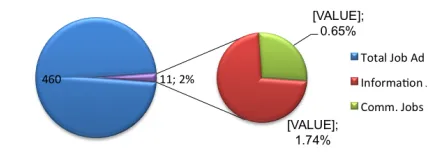
Figure 2: Information and Communication Job Ads on Indevjobsindia.org (March-May 2017)
Figures 1 and 2 report the data elicited from the content analysis of the job sites under study and succinctly reveal the reality from the field in India today. As seen from the figures, a considerable number of positions were advertised by the development
sector in India during the brief period of three months indicating that the sector is emerging as a major market for employment of skilled professionals. Ironically, however, there were very few openings for information and communication related
jobs. Thus, of the total 993 jobs advertised on devNetJobsIndia.org during the three-month period, only 22 (2 percent) of the jobs could be commonly categorised as
information and communication related jobs. An attempt to distinguish between information and communication jobs in the backdrop of our discussion earlier reveals
that a miniscule five positions (i.e., less than one percent of the total advertised jobs
during the period) were related to hard core communication tasks. The rest of the
17 jobs were information specific jobs that included skills and tasks in PR, report
writing, designing IEC materials, developing video footage stories, writing notes for senior management, designing and managing the digital social media, and looking
indevjobs.org where around 2 percent of jobs (11 out of 460 advertised) had any relevance to communication and information roles. Communication specific jobs
constituted a little more than half a percent of the total jobs advertised on the site during the period while information jobs constituted less than two percent of the total jobs. The information and communication positions on both the sites related
to mid-managerial and junior levels. Only in the case of two communication jobs –
one in UNICEF, a large development player, and another in an international client (name not mentioned in the ad) were there positions for senior levels. Cutting across
organisations, a clear pattern emerges reflecting a gross institutional misunderstanding
about communication and their failure to distinguish between it and information, and this is further evidenced from interviews with employees in the sector. As a
respondent who works as the Communication Officer in one international donor
agency, for instance, reveals that her key job roles are to write reports to be sent
to its international headquarters and coordinating workshops. Roles for most of
such respondents interviewed include event management, assisting in advertising and public relations campaigns, documentation and report writing. It must be noted that while information constitutes an important component of C4D approach, not all information functions can be included in C4D’s ambit.
How much does the development sector appreciate the need to have employees trained in communication for communication and information related functions? From the study of the attributes and skill set for the jobs advertised, it emerges that information and communication functions are, as yet, largely not considered
specialised functional areas that require special set of skills and perspectives. Thus, of all the 22 information and communication positions/roles jobs advertised on devNetJobsIndia.org, only five required a post graduate degree or diploma in mass
communication or journalism. The rest did not have mention of any compulsory
requirement of communication specific degree, assuming that such tasks do not
need any special training, skills and perspectives. In case of indevjobs.org, a glaring similarity is noticed.
When corroborated with the findings from the responses of the employers/
senior level functionaries, the picture becomes sharper. As in one organisation, a senior functionary in the Communication Department admits that while they ensure that employees in the department have a post graduate degree or diploma in
communication, the primary role the latter are expected to perform are: managing
their campaigns on the social media, report writing and event management. In another funding agency, a key functionary in the Communication Department
reveals: “Our division is concerned with branding and PR and we look out for people with experience in advertising, news media, event management; degree in
communication is ok (emphasis added), but we emphasise more on experience…”
The particular organisation has a separate Media Advocacy Department and its
key role is to pitch the success stories whenever received from partner organisations
through the Development Department. None, however, in the Media Advocacy
Often, a glaring mismatch between the job title and the job role is observed. Thus, for a position of Communication Officer in one organisation, the job role specified tasks like taking notes and secretarial assistance. It is clear from this that
there is a gross lack of understanding of not only the critical distinction between communication and information in the sector, but also the term communication is very loosely used so as to obscure its meaning far from what it is or is supposed to be. Interestingly, responses received from entry level or mid-level employees in the communication departments in the organisations approached reveal that there is a general lack of clarity even among them with regards to the distinction between information and communication. This applies to also those professionals who had their education in disciplines like mass communication raising possible doubts about the course and training that is imparted to the students in the Indian university system. An entry level Communication personnel in a donor agency ironically reveals that her role principally as one responsible for documentation and event management
activities of the organisation is in sync with her qualification which in this case was
a post-graduation in mass communication.
On the issue of how easy or difficult it is for those qualified in mass
communication to get a job in the sector as such, one employee with background in the discipline who has joined the communication department of an organisation
a year back responded: “We are not easily accepted in development sector, until the job is a communication specific one. And there aren’t many communication jobs
on the offer.” For those with training in communication willing to join programme divisions there are extra challenges. Echoing in a similar vein, a respondent in a
different organisation admits, “I always wanted to be in programme implementation. But wherever I went for interview, almost everywhere, I was asked why somebody from communication wanted to be in the programme sector, as if I was a misfit.”
From the triangulation of the study of the jobsites, responses from employers
and that from the employees, one can safely surmise few lessons. One, that communication specific jobs are still not a priority in the Indian development sector;
the story is not so different in the case of information related jobs as well, but it is relatively much better than the former. Two, from the examination of whatever little jobs are dedicated to communication and information functions, it becomes obvious that the third sector in India still largely understands it as PR and advertising closely linked to its resource generation needs, documentation, report writing, at
best designing IEC materials, and even secretarial assistances. Three, the frequent
mismatch between the job titles and the job roles demonstrate that the sector is unable to distinguish between information and communication, thereby drawing
parallel with what Dagron (2009) had argued about the scenario in the global context.
Making a Case for Communication Professionals in the
Development Sector
The scope for communication professionals in development initiatives in countries
like India can be perceived of in at least six broad and significant, but not
necessarily mutually exclusive, areas. First, in facilitating the ingenious use of ICTs by the underprivileged and helping them voice and share their issues and taking these to their logical conclusion by assisting them to solve these, communication professionals can add immense value to development programmes. The prodigious reach, access and use of affordable smart phones, internet technology and social media even in the rural areas in the world’s second largest online market (Internet
and Mobile Association, 2018; Doron & Jeffrey, 2013) and enormous potential of
these technologies in the areas of development open up scope for such interventions. This is much more than conventional use of social media by organisations for campaign and advocacy (which is one-way top-down communication). Very few organisations in India are known to have imaginatively experimented with using
ICTs for kindling the empowerment process; references have been made of such atypical initiatives earlier in section two in this paper. Mass Communication
students have a knack for using media technologies. Having undergone a course on development communication they are expected to understand the theory and
practice of the field including the societal politics and that of communication like no
other from competing disciplines and this holds them in good stead to contribute to such communication functions in development initiatives, particularly in those that subscribe to participatory approaches.
An associated second area can be identified in the realm of traditional and
non-traditional alternative media and their potential use by the community in development programs. Use of community radio, community video, community newspaper need not be restricted to projects in themselves but can be well integrated with the
development programs of organisations. Quarry & Ramirez (2009), for example,
has illustrated how video as a communication method can solve an alarming war-like crisis emanating from a communication stalemate between stakeholders. The exchange of video documentaries made by each competing group facilitating
dialogue between the aboriginal Kaminuriak herd and the state development agencies in Canada in the 1970s stands as classic testimony to the utility of small
media technologies in development. This is another area which has not been hitherto explored fully in India despite a favourable policy environment or lack of it. Since students trained in mass communication are expected to know the skills of media production and content generation, they enjoy almost an exclusive natural advantage of being community trainers and facilitators in such initiatives.
A third potential area that lends niche for mass communication students in the
development sector is in the domain of social movements organisations (SMOs)
traditional news media. News media not only lend credibility to the movements, but
also help in mobilising their constituency and in enlarging their scope (Gamson & Wolfdfeld,1993); however, movements position themselves as poor competitors for
sources of news. With a nose for news and professionally trained in news reporting and feature writing for the media and well-grounded in development issues, mass
communication professionals in SMOs who spend considerable time in the field have
the natural advantage of both covering stories on the life and struggle of the people in the remote areas and contribute untold stories and articles to the news media for publication. Professional journalists whose focus is mostly on urban based events have serious time constraints and often have neither interest nor skills to cover these
stories that demand in-depth and investigative reporting. Building linkages between
grassroots and the mainstream media and nurturing and sustaining relationships with the latter is critical for social organisations and personnel trained in the area can play important role in this.
A fourth area that merits attention in this discussion is the field of advocacy in
which communication students again have an edge over others. Advocacy entails
strategic communication with various key stakeholders: legislators, bureaucrats,
judiciary and media (NCAS, n.d). Activists with sound background in communication should be able to design strategic advocacy campaigns with each of the stake holders and implement them. Preparing various advocacy tools like information materials, fact sheets, reports, brochures, etc. is their forte. They are skilled to produce video and audio documentaries as evidences from the grassroots for use in their organisations’ advocacy campaigns and in this they outsmart their counterparts from other competing disciplines. In particular, when it comes to media advocacy, their contribution in preparing press kits and press releases, training spokesperson within the grassroots organisation and the community, providing leads to journalists to cover stories of mutual interest, conducting events and press conferences, building and nurturing relationship with the news media is unparalleled. Advocacy necessitates a lot of research and literature review including analysis of news media contents.
Mass communication-trained personnel with good grounding in communication
research can employ their skills in this.
Fifth, given the fact that most organisations in the social sector strive to bring perceptible positive change in the attitude and behaviour of the population, social
marketing and behaviour change communication (BCC) has emerged as significant
C4D strategies that needs specially trained communication persons. These strategies need good understanding of the target audiences for which formative studies are to be carried out. The importance of communication planning can
never be undermined in development programmes. Mass communication students
ideally learn all these as part of their course and so are in an advantageous position over their counterparts from other disciplines. If information and communication functions are seen as two extremes of a continuum, it is obvious from the above
discussion that both have a significant role to play in the development practice in
can bring in. Blending of both in various doses depending on problem at stake
becomes critical for a communication practitioner to decide. Last but not the least, trained people in communication need to be valued in development organisations
in that they can not only give critical communication inputs to the specific
development programs, but can also design overall communication programs of the organisations.
Conclusion
The state, grassroots, national and international NGOs, corporate houses, consultancy
groups, donor agencies – all contribute to and constitute the development sector in
India. The sector, as this paper indicates, today positions itself as a perceptible field
of formal employment for development professionals. Ironically, however, C4D functions in the sector still continue to remain at the margin. Distinguishing between information and communication functions that constitute C4D, the paper attempted to demonstrate that there is general predisposition for the former. Even as C4D job openings in general are few and far between, communication functions in particular are all the more de-prioritised. The examination of the job advertisements by the development sector in this study buttressed by responses from the key functionaries
and employees in the NGOs bear testimony to this. As for information functions, as the study showed, these are not well defined and often spills over into areas that are
outside the purview of C4D often making it a generalist’s domain. It is ironically so
despite the overarching theoretical recognition of the significance of communication
in development practice. This paper argued for opening up the development sector to properly trained communication professionals who can contribute to the C4D needs of the development programmes.
Of course, not everything is fine with the training of C4D professionals and
with the teaching of development communication courses in the country. There is a global consensus today on the dearth of well-trained C4D professionals in the market that is left with no option for the development organisations other than to recruit
university graduates with degree in journalism, public relations and marketing;
such recruits lack in theoretical and applied knowledge of communication for
development strategies (Khanna, 2017). India is no exception. In this respect, an examination of the course curricula on development communication/C4D in the Indian universities would have further benefitted the paper. However, this merits a separate inquiry and was beyond the scope of the current study. Nevertheless,
As this paper argued, there is a wide scope for communication professionals in the development sector. However, this has not been explored fully. Towards this, both the development sector as well as the communication training institutes should respond positively. The former has to acknowledge that communication is an indispensable idea in development and that it is a highly skilled function and
needs special attributes that only a person trained in the field can bring. They
have to display their seriousness towards communication by not only recruiting communication personnel for various programmes, but also by setting up dedicated communication departments within, that engages in serious processes.
References
Balit, S. (2010, May). Communicating with decision makers. Glocal Times, 14. Retrieved from https:// glocaltimes.mah.se/index.php/gt/article/download/164/163
Bhatnagar, G. V. (2016, June 11). Modi regime using FCRA to block aid flow to marginalised communities, say activists. Retrieved from https://thewire.in/law/modi-regime-using-fcra-to block-aid-flow-to-marginalised-communities-say-activists
Dagron, A. G. (2009). Playing with fire: Power, participation, and communication for development.
Development in Practice, 19, 453-465. doi:http://dx.doi.org/10.1080/09614520902866470
Das, B. (2013). Communication research in India. In Y. Singh (Ed.), Indian sociology (3): Identity, communication and culture (pp.159- 208). New Delhi: Oxford University Press.
Das, M. K. (2017). Prioritising communication in development initiatives: The missing link between theory and practice in India’s development sector. The Journal of Development Communication, 28 (1-2), 12-22. Doron, A., & Jeffrey, R. (2013). The great Indian phone book: How the cheap cell phone changes business,
politics, and daily life. London: C. Hurst and Company.
Freire, P. (2005). Pedagogy of the oppressed. (M. B. Ramos, Trans.). New York: Continuum. (Original work published 1968).
Gamson, W. A., & Wolfdfeld, G. (1993). Movements and media as interacting systems. Annals of the American Academy of Political and Social Sciences, 528, 114-125. https://doi.org/10.1177/0002716293528001009 Internet and mobile association of India & Kantar IMRB. (2018). Mobile internet report 2017. Retrieved from
https://cms.iamai.in/Content/ResearchPapers/2b08cce4-e571-4cfe-9f8b-86435a12ed17.pdf
Khanna, A. (2017). Communication for development (C4d) in the university curriculum: Need and prospects.
The Journal of Development Communication, 28 (1-2), 23-33.
Mahapatra, D. (2014, February 23). India witnessing NGO boom, there is 1 for every 600 people. Times of India. Retrieved from https://timesofindia.indiatimes.com/india/India-witnessing-NGO-boom-there-is-1-for-every-600-people/articleshow/30871406.cm
Marathe, M., O’Neil, J., Pain, P., & Thies, W. (2015). Revisiting CGNet Swara and its impact in rural India.
ICTD (May 15-18). http://dx.doi.org/10.1145/2737856.2738026
Melkote, S. R., & Steeves, H.L. (2010). Communication for development in the third world: Theory and practice for empowerment. New Delhi: Sage.
Melkote, S. R., Krishnatray, P., & Krishnatray, S. (2008). Destigmatizing leprosy: Implications for communication theory and practice. In H. Zoller & M.J. Dutta (Eds.), Emerging perspective in health communication: Meaning, culture and power (pp. 129-154). London: Routledge.
Moemeka, A. A. (1994). Development communication: A historical and conceptual overview. In A.A. Moemeka (Ed.), Communication for development: A new pan-disciplinary perspective (pp.3-22). Albany, N.Y: State University of New York Press.
Mudliar, P., & Donner., J. (2015). Experiencing interactive voice response (IVR) as a participatory medium: The case of CGNet Swara in India. Mobile Media and Communication, 3, 366-382. doi: https://doi. org/10.1177/2050157915571591
National Centre for Advocacy Studies (NCAS). (n.d.). Resource kit for people-centred advocacy and campaign planning. Pune: National Centre for Advocacy Studies.
Quarry, W., & Ramirez, R. (2009). Communication for another development: Listening before telling. London: Zed Books.
Sparks, C. (2007). Globalization, development and the mass media. London: Sage.
Acknowledgements
The author is thankful to Prof. Dipankar Sinha of the Department of Political Science, University of Cal-cutta, and Mr. Subhendu Bhattacharjee, General Manager (Development Support), Child Rights and You, New Delhi for going through the initial draft of the paper and for providing critical inputs and comments. He is also grateful to all the key informants and respondents of various NGOs for their contributions to the study.