Simranjit Kaur et al, International Journal of Computer Science and Mobile Applications,
Vol.4 Issue. 6, June- 2016, pg. 6-12 ISSN: 2321-8363 Impact Factor: 4.123
A Survey Paper on the Evaluation Criteria of
Open Source Cloud Computing Solutions
Simranjit Kaur
1, Dr.Sumesh Sood
2 E-mail: [email protected], [email protected]1
Research Scholar, Department of Research, Innovation & Consultancy, Punjab Technical University, Kapurthala – 144601, India
2
Principal, Swami Satyanand College of Management & Technology, Amritsar – 143001, India
Abstract
Cloud computing is the recent area of research where a cloud is used to access everything like data, files, software, etc. The cloud computing deploys its services to the organizations according to their requirement. Open source software is software code that is freely available and open for modification and improvement. If open source is used in collaboration with cloud computing, it adds to the productivity and applicability. There is a number of open source software available in the market. This paper provides a survey of the open source cloud solutions and also discusses the criteria for evaluating their stability, performance, and features. The primary focus of the evaluation criteria is on the components like storage, virtualization, and management.
Keywords: Cloud computing, open source software, open source cloud computing solutions, Evaluation Criteria.
1. Introduction
Simranjit Kaur et al, International Journal of Computer Science and Mobile Applications,
Vol.4 Issue. 6, June- 2016, pg. 6-12 ISSN: 2321-8363 Impact Factor: 4.123
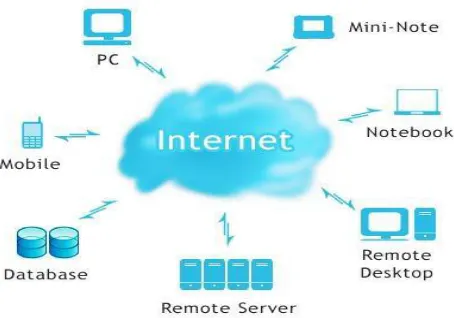
Figure 1: Internet Cloud
Thus, cloud computing provides shared resources, applications, software and resources over the internet according to demands of the user. It also helps in improving the availability of IT resources. By providing easy use of the IT resources, the Cloud computing has advantages over the other computing techniques.
1.1 Cloud Deployment Strategies
This section of the paper explains the basic cloud deployment strategies proposed by NIST [1]. A cloud can be deployed using any of the below-mentioned strategies:
Private cloud:
The private cloud infrastructure is available for exclusive use by a single organization that comprises of multiple consumers or business units. The organization owned, managed and operated it by itself, by a third party or by a combination of both. This infrastructure may exist on or off premises.
Community cloud:
The community cloud infrastructure is exclusively designed for a specific community of consumers who have shared concerns (e.g., mission, security requirements, policy, and compliance considerations). These clouds are owned, managed, and operated by the organizations in the community, a third party, or by combination of these. It exists on or off premises.
Public cloud:
This cloud infrastructure is provisioned for general public for its open use. The public clouds are owned, managed, and operated by a business, academic, or government organization, or some combination of them. But it exists only in the premises of the cloud provider.
Hybrid cloud:
Simranjit Kaur et al, International Journal of Computer Science and Mobile Applications,
Vol.4 Issue. 6, June- 2016, pg. 6-12 ISSN: 2321-8363 Impact Factor: 4.123
1.2 Cloud Delivery Models
This section of the paper describes the various cloud delivery models namely SaaS, PaaS, and IaaS provided by NIST [1] [9].
Software as a Service (SaaS):
The capability is provided to the consumer to use the applications running on a cloud infrastructure with little or no customizations. The applications are accessible through a thin client interface, such as a web browser, or a program interface by client’s devices. In these, the consumer is not responsible for controlling or managing the cloud infrastructure, network, servers, operating systems, and storage or application capabilities. But there is an exception of limited user-specific application configuration settings.
Platform as a Service (PaaS):
The capability is provided to the consumer where they develop and deploy product onto the cloud infrastructure. These are consumer-created or acquired applications which are created using programming languages, libraries, services, and tools supported by the provider. The consumer is not responsible for managing or controlling the underlying cloud infrastructure including network, servers, operating systems, or storage. The client has control over the deployed applications and possibly configuration settings for the application-hosting environment.
Infrastructure as a Service (IaaS):
The capability is provided to the consumer to create customized application environments. There is the provision of processing, storage, networks, and other fundamental computing resources. In this, the consumer can deploy and run arbitrary software that includes operating systems and applications. The consumer has the control over operating systems, storage, and deployed applications. But limited control of select networking components like host firewalls.
2. Open Source Software
Open source software is a recent phenomenon that has revolutionized the software industry. It is developed with public collaboration and is freely available. According to Open Source Initiative (OSI) [6] Open source software is software that is freely used, changed, and shared (in modified or unmodified form) by anyone many people make open source software and distribute under license. The main elements in this definition are [4]:
1. The software must be redistributed without restriction. 2. The source code must be made available.
3. The license may require improved versions of the software to carry a different name or version from the original software.
Open Source Software (OSS) is leading in the market of some of the software categories. In the future, it is going to play a significant role in the desktop publications. It is used in many areas because it is an ethical, legal and safe use of technology [5].
Some of the advantages [5] of the open source software are:
Lower Cost
Freedom to use
Interoperability
Maximum Choice
Openness
Centralized Access
Distributed Computing
Simranjit Kaur et al, International Journal of Computer Science and Mobile Applications,
Vol.4 Issue. 6, June- 2016, pg. 6-12 ISSN: 2321-8363 Impact Factor: 4.123
3. Open Source with Cloud Computing
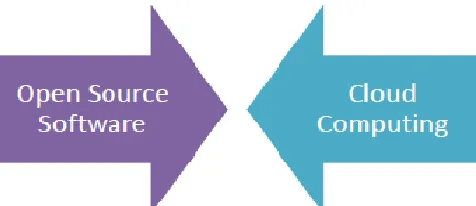
There is strong synergy between Open Source Software (OSS) and cloud computing. Open source provides raw materials to build private and public clouds. There is a close relationship between OSS and Cloud Computing. Cloud computing and open-source software are bonded in a circle. Cloud computing directly benefits from the use of OSS, because it eliminates critical dependencies that can impact the service delivery model. The utilization of open source software results in mature and diverse clouds. Open source software enables cloud providers to share the code provided without an end user license agreement. Fig. 2 shows interaction of open source software with cloud computing [5].
Figure 2: Open source Software with Cloud Computing
4.
S
OMEE
XAMPLESO
FO
PENS
OURCEC
LOUDC
OMPUTINGS
OLUTIONSThere are many open source cloud computing solutions available due to the growth of cloud computing [3] [5] [4] [10] [11] [12] [13] [15]. Some popular tools are [17]:
Eucalyptus
Eucalyptus is an open source based cloud software that has the infrastructure as a service software for building private clouds that are AWS (Amazon Web Services) compatible. It is a system that provides the ability to run and control the entire virtual machine instances deployed across a variety physical resources [8] [16].
Abiquo
Abiquo is flexible open-source based cloud computing platform. It is for large organizations. It allows the customers to build rapidly and manage a fully automated and governed, public, private or hybrid cloud [19].
OpenNebula
Simranjit Kaur et al, International Journal of Computer Science and Mobile Applications,
Vol.4 Issue. 6, June- 2016, pg. 6-12 ISSN: 2321-8363 Impact Factor: 4.123
OpenStack
OpenStack is an IaaS offering complete open source development, and it helps companies in the development of their infrastructure solutions [7] [14] [18].
Globus Nimbus
Nimbus is an open source based cloud platform and infrastructure that delivers the power and versatility of clouds to the scientific users [21].
The open source cloud computing solutions are not limited to the contents of this section. It is the growing area of research.
However, as there are some of the cloud platforms, each having its characteristics and advantages, the question arises how to make a reasonable choice.
This paper provides a brief criterion to find a solution to this problem and for better decision making.
5. Evaluation Criteria
For evaluating the cloud platforms, there is a requirement of a standard set of criteria for comparison [22][23][24]. The criterion used is divided into six main categories: storage, virtualization, network, management, security and vendor support.
Storage criteria:
For virtual machine storage, the management and functionalities are critical to achieving flexible and scalable implementations. This criterion focuses on the technologies that implement cloud storage through direct-attached storage, storage area networks, and network-attached storage. It also involves backup features and techniques.
Virtualization Criteria:
Virtualization criteria focus on VM type and technology. It also focuses on monitoring and reconfiguration features. It is support for migration and provisioning. It provides resource prioritization, hot configuration.
Network Criteria:
Network connectivity is highly dependent on the actual implementation. It binds the cloud components together and connects it with its administrators and end-users. Its focus is on describing support for VLAN services, firewall support, Ethernet quality of service and integration capabilities.
Management Criteria:
Simranjit Kaur et al, International Journal of Computer Science and Mobile Applications,
Vol.4 Issue. 6, June- 2016, pg. 6-12 ISSN: 2321-8363 Impact Factor: 4.123
integration of hardware and software, focus on host-guest OS integration, individual and mass management of hosts and guests, accounting, recovery, availability and features alert.
Security Criteria:
In the installation of the cloud, there is the significant risk of the security. It focuses on security-related capabilities such as data encryption, directory services integration, authorization levels and auditing events for specific resources for both the VM and storage servers. The security reports are available for cloud administrators, evaluation of third-party product and certifications of compliance with security standards. It also provides secure management access.
Community and Vendor Support Criteria:
The product support is divided between a user community and a vendor. Community criteria focus freely available support channels of the user or developer communities related to the product and its quality. Vendor-related criteria are concerned with direct vendor support channels. It is related to with the possibility of a SLA contract. It covers aspects of customer relations such as public issue tracking, proactive updates, and CRM-like approaches. It also includes the completeness of open-source, free product versions and related documentation. It is responsible for tracking record, future viability, and the possibility of third-party auditing.
6. Conclusion
Thus, the open source cloud computing is a flexible paradigm which has reached heights by facilitating a large number of users with unlimited services. But there is a need to evaluate the performance of the open source cloud computing solutions so that from a pool some of the best solutions can be selected for the particular purpose and according to the requirement. Thus, by using the given set of criteria the open source cloud computing solutions can be evaluated. For future, it is suggested to evaluate these solutions on the basis of the performance evaluation.
References
[1] Mell, P., and Grance, T., The NIST Definition of Cloud Computing, US Nat’l Inst. Of Standards and Technology, 2011.
[2] Eviwiekpaefe, A. E., & Ajakaiye, F. (2014). The trend and challenges of cloud computing: a literature review. International Letters of Social and Humanistic Sciences, (05), 13-20.
[3] Wind, S. (2011, September). Open source cloud computing management platforms: Introduction, comparison, and recommendations for implementation. In Open Systems (ICOS), 2011 IEEE Conference on (pp. 175-179). IEEE.
[4] Rodriguez-Martinez, M., Seguel, J., & Greer, M. (2010, July). Open source cloud computing tools: A case study with a weather application. In Cloud Computing (CLOUD), 2010 IEEE 3rd International Conference on (pp. 443-449). IEEE.
[5] Kotwani, Gunjan, and Pawan Kalyani. "Applicability of Open Source Software (OSS) with Cloud Computing." International Journal of Inventive Engineering and Sciences 1.10 (2013).
[6] http://opensource.org/
[7] Sefraoui, O., Aissaoui, M., & Eleuldj, M. (2012). OpenStack: toward an open-source solution for cloud computing. International Journal of Computer Applications, 55(3), 38-42.
[8] Nurmi, D., Wolski, R., Grzegorczyk, C., Obertelli, G., Soman, S., Youseff, L., & Zagorodnov, D. (2009, May). The eucalyptus open-source cloud-computing system. In Cluster Computing and the Grid, 2009. CCGRID'09. 9th IEEE/ACM International Symposium on (pp. 124-131). IEEE.
[9] Serrano, N., Gallardo, G., & Hernantes, J. (2015). Infrastructure as a Service and Cloud Technologies. IEEE Software, (2), 30-36.
Simranjit Kaur et al, International Journal of Computer Science and Mobile Applications,
Vol.4 Issue. 6, June- 2016, pg. 6-12 ISSN: 2321-8363 Impact Factor: 4.123
[11]Li, C., Xie, J., & Zhang, X. (2013, November). Performance evaluation based on open source cloud platforms for high performance computing. In Intelligent Networks and Intelligent Systems (ICINIS), 2013 6th International Conference on (pp. 90-94). IEEE.
[12]Cordeiro, T., Damalio, D., Pereira, N., Endo, P., Palhares, A., Gonçalves, G., & Mångs, J. E. (2010, November). Open source cloud computing platforms. In Grid and Cooperative Computing (GCC), 2010 9th International Conference on (pp. 366-371). IEEE.
[13]Pillai, A. S., & Swasthimathi, L. S. (2012). A study on open source cloud computing platforms. EXCEL International Journal of Multidisciplinary Management Studies, 2(7), 31-40.
[14]Wen, X., Gu, G., Li, Q., Gao, Y., & Zhang, X. (2012, May). Comparison of open-source cloud management platforms: OpenStack and OpenNebula. InFuzzy Systems and Knowledge Discovery (FSKD), 2012 9th International Conference on (pp. 2457-2461). IEEE.
[15]Peng, J., Zhang, X., Lei, Z., Zhang, B., Zhang, W., & Li, Q. (2009, December). Comparison of several cloud computing platforms. In Information Science and Engineering (ISISE), 2009 Second International Symposium on (pp. 23-27). IEEE.
[16]https://www.eucalyptus.com/
[17]https://gigaom.com/2009/11/06/10-top-open-source-resources-for-cloud-computing/ [18]https://www.openstack.org/
[19]http://www.abiquo.com/ [20]http://opennebula.org/
[21]http://www.nimbusproject.org/
[22]Voras, I., Mihaljević, B., Orlić, M., Pletikosa, M., Pavić, T., Zimmer, K., ... & Tomić, S. (2011, May). Evaluating open-source cloud computing solutions. In MIPRO, 2011 Proceedings of the 34th International Convention (pp. 209-214). IEEE.
[23]Voras, I., Orlić, M., & Mihaljević, B. (2012). An early comparison of commercial and open-source cloud platforms for scientific environments. InAgent and Multi-Agent Systems. Technologies and Applications (pp. 164-173). Springer Berlin Heidelberg.