Variational Inference in Nonconjugate Models
Chong Wang [email protected]
Machine Learning Department Carnegie Mellon University Pittsburgh, PA, 15213, USA
David M. Blei [email protected]
Department of Computer Science Princeton University
Princeton, NJ, 08540, USA
Editor:Neil Lawrence
Abstract
Mean-field variational methods are widely used for approximate posterior inference in many prob-abilistic models. In a typical application, mean-field methods approximately compute the posterior with a coordinate-ascent optimization algorithm. When the model is conditionally conjugate, the coordinate updates are easily derived and in closed form. However, many models of interest—like the correlated topic model and Bayesian logistic regression—are nonconjugate. In these models, mean-field methods cannot be directly applied and practitioners have had to develop variational algorithms on a case-by-case basis. In this paper, we develop two generic methods for nonconju-gate models, Laplace variational inference and delta method variational inference. Our methods have several advantages: they allow for easily derived variational algorithms with a wide class of nonconjugate models; they extend and unify some of the existing algorithms that have been derived for specific models; and they work well on real-world data sets. We studied our methods on the correlated topic model, Bayesian logistic regression, and hierarchical Bayesian logistic regression.
Keywords: variational inference, nonconjugate models, Laplace approximations, the multivariate delta method
1 Introduction
Mean-field variational inference lets us efficiently approximate posterior distributions in complex probabilistic models (Jordan et al., 1999; Wainwright and Jordan, 2008). Applications of variational inference are widespread. As examples, it has been applied to Bayesian mixtures (Attias, 2000; Corduneanu and Bishop, 2001), factorial models (Ghahramani and Jordan, 1997), and probabilistic topic models (Blei et al., 2003).
The basic idea behind mean-field inference is the following. First define a family of distribu-tions over the hidden variables where each variable is assumed independent and governed by its own parameter. Then fit those parameters so that the resulting distribution is close to the condi-tional distribution of the hidden variables given the observations. Closeness is measured with the Kullback-Leibler divergence. Inference becomes optimization.
of the other variables, both hidden and observed. (This class contains the models mentioned above.) For such models, which are calledconditionally conjugatemodels, it is easy to derive a coordinate ascent algorithm that optimizes the parameters of the variational distribution (Beal, 2003; Bishop, 2006). This is the principle behind software tools like VIBES (Bishop et al., 2003) and Infer.NET (Minka et al., 2010), which allow practitioners to define models of their data and immediately approximate the corresponding posterior with variational inference.
Many models of interest, however, do not enjoy the properties required to take advantage of this easily derived algorithm. Such nonconjugate models1 include Bayesian logistic regression (Jaakkola and Jordan, 1997), Bayesian generalized linear models (Wells, 2001), discrete choice models (Braun and McAuliffe, 2010), Bayesian item response models (Clinton et al., 2004; Fox, 2010), and nonconjugate topic models (Blei and Lafferty, 2006, 2007). Using variational inference in these settings requires algorithms tailored to the specific model at hand. Researchers have devel-oped a variety of strategies for a variety of models, including approximations (Braun and McAuliffe, 2010; Ahmed and Xing, 2007), alternative bounds (Jaakkola and Jordan, 1997; Blei and Lafferty, 2006, 2007; Khan et al., 2010), and numerical quadrature (Honkela and Valpola, 2004).
In this paper we develop two approaches to mean-field variational inference for a large class of nonconjugate models. First we developLaplace variational inference. This approach embeds Laplace approximations—an approximation technique for continuous distributions (Tierney et al., 1989; MacKay, 1992)—within a variational optimization algorithm. We then developdelta method variational inference. This approach optimizes a Taylor approximation of the variational objective. The details of the algorithm depend on how the approximation is formed. Formed one way, it gives an alternative interpretation of Laplace variational inference. Formed another way, it is equivalent to using a multivariate delta approximation (Bickel and Doksum, 2007) of the variational objective. Our methods are generic. Given a model, they can be derived nearly as easily as traditional coordinate-ascent inference. Unlike traditional inference, however, they place fewer conditions on the model, conditions that are less restrictive than conditional conjugacy. Our methods significantly expand the class of models for which mean-field variational inference can be easily applied.
We studied our algorithms with three nonconjugate models: Bayesian logistic regression (Jaakkola and Jordan, 1997), hierarchical logistic regression (Gelman and Hill, 2007), and the cor-related topic model (Blei and Lafferty, 2007). We found that our methods give better results than those obtained through special-purpose techniques. Further, we found that Laplace variational in-ference usually outperforms delta method variational inin-ference, both in terms of computation time and the fidelity of the approximate posterior.
Related work. We have described the various approaches that researchers have developed for specific models. There have been other efforts to examine generic variational inference in noncon-jugate models. Paisley et al. (2012a) proposed a variational inference approach using stochastic search for nonconjugate models, approximating the intractable integrals with Monte Carlo meth-ods. Gershman et al. (2012) proposed a nonparametric variational inference algorithm, which can be applied to nonconjugate models. Knowles and Minka (2011) presented a message passing al-gorithm for nonconjugate models, which has been implemented in Infer.NET (Minka et al., 2010); their technique applies to a subset of models described in this paper.2
1. Carlin and Polson (1991) coined the term “nonconjugate model” to describe a model that does not enjoy full condi-tional conjugacy.
Laplace approximations have been used in approximate inference in more complex models, though not in the context of mean-field variational inference. Smola et al. (2003) used them to approximate the difficult-to-compute moments in expectation propagation (Minka, 2001). Rue et al. (2009) used them for inference in latent Gaussian models. Here we want to use them for variational inference, in a method that can be applied to a wider range of nonconjugate models.
Finally, we note that the delta method was first used in variational inference by Braun and McAuliffe (2010) in the context of the discrete choice model. Our method generalizes their ap-proach.
Organization of this paper. In Section 2 we review mean-field variational inference and define the class of nonconjugate models to which our algorithms apply. In Section 3, we derive Laplace and delta-method variational inference and present our full algorithm for nonconjugate inference. In Section 4, we show how to use our generic method on several example models and in Section 5 we study its performance on these models. In Section 6, we summarize and discuss this work.
2 Variational Inference and a Class of Nonconjugate Models
We consider a generic model with observationsxand hidden variablesθandz,
p(θ,z,x) =p(x|z)p(z|θ)p(θ). (1)
The distinction between the two hidden variables will be made clear below. The inference problem is to compute the posterior,
p(θ,z|x) =R p(θ,z,x)
p(θ,z,x)dzdθ.
This is intractable for many models because the denominator is difficult to compute; we must ap-proximate the distribution. In variational inference, we apap-proximate the posterior by positing a simple family of distributions over the latent variablesq(θ,z)and then finding the member of that family which minimizes the Kullback-Leibler (KL) divergence to the true posterior (Jordan et al., 1999; Wainwright and Jordan, 2008).3
In this section we review variational inference and discuss mean-field variational inference for the class of conditionally conjugate models. We then define a wider class of nonconjugate models for which mean-field variational inference is not as easily applied. In the next section, we derive algorithms for performing mean-field variational inference in this larger class of models.
2.1 Mean-field Variational Inference
Mean-field variational inference is simplest and most widely used variational inference method. In mean-field variational inference we posit a fully factorized variational family,
q(θ,z) =q(θ)q(z). (2)
In this family of distributions the variables are independent and each is governed by its own distri-bution. This family usually does not contain the posterior, whereθandzare dependent. However, it is very flexible—it can capture any set of marginals of the hidden variables.
Under the standard variational theory, minimizing the KL divergence between q(θ,z)and the posterior p(θ,z|x)is equivalent to maximizing a lower bound of the log marginal likelihood of the observed datax. We obtain this bound with Jensen’s inequality,
logp(x) =logR p(θ,z,x)dzdθ
≥Eq[logp(θ,z,x)]−Eq[logq(θ,z)]
,
L
(q), (3)whereEq[·]is the expectation taken with respect toqand note the second term is the entropy ofq. We call
L
(q)the variational objective.Setting∂
L
(q)/∂q=0 shows that the optimal solution satisfies the following,q∗(θ)∝exp
Eq(z)[logp(z|θ)p(θ)] , (4) q∗(z)∝expEq(θ)[logp(x|z)p(z|θ)] . (5)
Here we have combined the optimal conditions from Bishop (2006) with the particular factorization of Equation 1. Note that the variational objective usually contains many local optima.
These conditions lead to the traditional coordinate ascent algorithm for variational inference. It iterates between holdingq(z)fixed to updateq(θ)from Equation 4 and holdingq(θ)fixed to update q(z)from Equation 5. This converges to a local optimum of the variational objective (Bishop, 2006). When all the nodes in a model areconditionally conjugate, the coordinate updates of Equation 4 and Equation 5 are available in closed form. A node is conditionally conjugate when its conditional distribution given its Markov blanket (i.e., the set of random variables that it is dependent on in the posterior) is in the same family as its conditional distribution given its parents (i.e., its factor in the joint distribution). For example, in Equation 1 suppose the factor p(θ) is a Dirichlet and both factors p(z|θ)and p(x|z)are multinomials. This means that the conditionalp(θ|z) is also a Dirichlet and the conditional p(z|x,θ)is also a multinomial. This model, which is latent Dirichlet allocation (Blei et al., 2003), is conditionally conjugate. Many applications of variational inference have been developed for this type of model (Bishop, 1999; Attias, 2000; Beal, 2003).
However, if there exists any node in the model that is not conditionally conjugate then this coordinate ascent algorithm is not available. That setting arises in many practical models and does not permit closed-form updates or easy calculation of the variational objective. We will develop generic variational inference algorithms for a wide class of nonconjugate models. First, we define that class.
2.2 A Class of Nonconjugate Models
We present a wide class of nonconjugate models, still assuming the factorization of Equation 1.
2. We assume the distribution p(z|θ)is in the exponential family (Brown, 1986),
p(z|θ) =h(z)expη(θ)⊤t(z)−a(η(θ)) , (6)
where h(z) is a function of z; t(z) is the sufficient statistic; η(θ) is the natural parameter, which is a function of the conditioning variables; anda(η(θ))is the log partition function. We also assume that η(θ) is twice differentiable; sinceθis real-valued, this is satisfied in most statistical models. Unlike in conjugate models, these assumptions do not restrict p(θ) andp(z|θ)to be a conjugate pair; the conditional distributionp(θ|z)is not necessarily in the same family as the priorp(θ).
3. The distribution p(x|z)is in the exponential family,
p(x|z) =h(x)exp
t(z)⊤ht(x),1i . (7)
We set up this exponential family so that the natural parameter forxis all but the last compo-nent oft(z)and the last component is the negative log normalizer−a(·). Thus, the distribution ofzis conjugate to the conditional distribution ofx; the conditional p(z|θ,x)is in the same family as p(z|θ)(Bernardo and Smith, 1994).
Our terminology follows these assumptions: θ is the nonconjugate variable, z is the conjugate variable, andxis theobservation.
This class of models is larger than the class of conditionally conjugate models. Our expanded class also includes nonconjugate models like the correlated topic model (Blei and Lafferty, 2007), dynamic topic model (Blei and Lafferty, 2006), Bayesian logistic regression (Jaakkola and Jordan, 1997; Gelman and Hill, 2007), discrete choice models (Braun and McAuliffe, 2010), Bayesian ideal point models (Clinton et al., 2004), and many others. Further, the methods we develop below are easily adapted more complicated graphical models, those that contain conjugate and nonconjugate variables whose dependencies are encoded in a directed acyclic graph. Appendix A outlines how to adapt our algorithms to this more general case.
Example: Hierarchical language modeling. We introduce the hierarchical language model, a simple example of a nonconjugate model to help ground our derivation of the general algorithms. Consider the problem of unigram language modeling. We are given a collection of documents
D
= x1:Dwhere each documentxd is a vector of word counts, observations from a discrete vocabulary of lengthV. We model each document with its own distribution over words and place a Dirichlet prior on that distribution. This model is used, for example, in the language modeling approach to information retrieval (Croft and Lafferty, 2003).We want to place a prior on the Dirichlet parameters, a positive V-vector, that govern each document’s distribution over terms. In theory, every exponential family distribution has a conjugate prior (Bernardo and Smith, 1994) and the prior to the Dirichlet is the multi-gamma distribution (Kotz et al., 2000). However, the multi-gamma is difficult to work with because its log normalizer is not easy to compute. As an alternative, we place a log normal distribution on the Dirichlet parameters. This is not the conjugate prior.
The full generative process is as follows:
(a) Draw multinomial parameterzd|θ∼Dirichlet(exp{θ}). (b) Draw word countsxd∼Multinomial(N,zd).
Given a collection of documents, our goal is to compute the posterior distribution p(θ,z1:D|x1:D). Traditional variational or Gibbs sampling methods cannot be easily used because the normal prior on the parametersθis not conjugate to the Dirichlet(exp{θ})likelihood.
This language model fits into our model class. In the notation of the joint distribution of Equa-tion 1,θ=θ,z=z1:D, andx=x1:D. The per-document multinomial parameterszand word counts xare conditionally independent given the Dirichlet parametersθ,
p(z|θ) =∏dp(zd|θ),
p(x|z) =∏d∏np(xdn|zd).
In this case, the natural parameterη(θ) =exp{θ}. This model satisfies the assumptions: the log normal p(exp{θ}) is not conjugate to the Dirichlet p(zd|exp{θ}) but is twice differentiable; the Dirichlet is conjugate to the multinomialp(xd|zd)and the multinomial is in the exponential family.
Below we will use various components of the exponential family form of the Dirichlet:
h(zd) =∏iz−di1; t(zd) =logzd; ad(η(θ)) =∑ilogΓ(exp{θi} −logΓ(∑iexp{θi}). (8) We will return to this model as a simple running example.
3 Laplace and Delta Method Variational Inference
We have defined a class of nonconjugate models. Variational inference is difficult to derive for these models because p(θ)is not conjugate to p(z|θ). Specifically, the update in Equation 4 does not necessarily have the form of an exponential family we can work with and it is difficult to use
Eq(θ)[logp(z|θ)]in the update of Equation 5.
We will develop two variational inference algorithms for this class: Laplace variational infer-enceanddelta method variational inference. Both use coordinate ascent to optimize the variational parameters, iterating between updating q(θ) and q(z). They differ in how they update the vari-ational distribution of the nonconjugate variable q(θ). In Laplace variational inference, we use Laplace approximations (MacKay, 1992; Tierney et al., 1989) within the coordinate ascent updates of Equation 4 and Equation 5. In delta method variational inference, we apply Taylor approxi-mations to approximate the variational objective in Equation 3 and then derive the corresponding updates. Different ways of taking the Taylor approximation lead to different algorithms. Formed one way, this recovers the Laplace approximation. Formed another way, it is equivalent to using a multivariate delta approximation (Bickel and Doksum, 2007) of the variational objective function.
In both variants, the variational distribution is the mean-field family in Equation 2. The vari-ational distribution of the nonconjugate variableq(θ)is a Gaussian; the variational distribution of the conjugate variableq(z)is in the same family as p(z|η(θ)). In Laplace inference, these forms emerge from the derivation. In delta method inference, they are assumed. The complete variational family is,
where(µ,Σ)are the parameters for a Gaussian distribution andφis a natural parameter forz. For ex-ample, in the hierarchical language model of Section 2.2,φis a collection ofDDirichlet parameters. We will sometimes suppress the parameters, writingq(θ)forq(θ|µ,Σ).
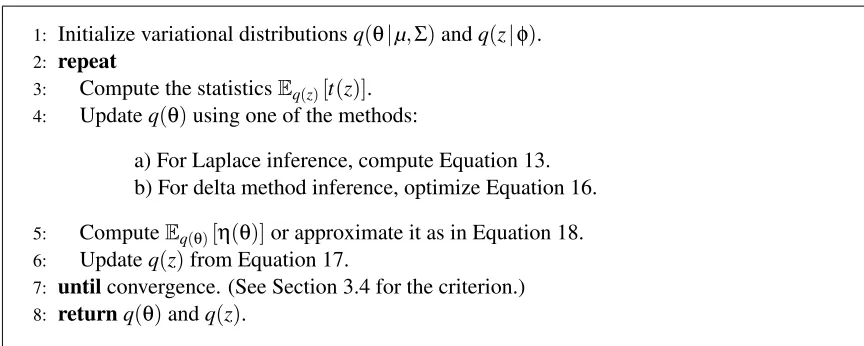
Our algorithms are coordinate ascent algorithms, where we iterate between updating the non-conjugate variational distributionq(θ)and updating the conjugate variational distributionq(z). In the subsections below, we derive the update forq(θ)in each algorithm. Then, for both algorithms, we derive the update forq(z). The full procedure is described in Section 3.4 and Figure 1.
3.1 Laplace Variational Inference
We first review the Laplace approximation. Then we show how to use it in variational inference.
3.1.1 The Laplace Approximation
Laplace approximations use a Gaussian to approximate an intractable density. Consider approxi-mating an intractable posterior p(θ|x). (There is no hidden variablezin this set up.) Assume the joint distribution p(x,θ) = p(x|θ)p(θ) is easy to compute. Laplace approximations use a Taylor approximation around the maximum a posterior (MAP) point to construct a Gaussian proxy for the posterior. They are used for continuous distributions.
First, notice the posterior is proportional to the exponentiated log joint
p(θ|x) =exp{logp(θ|x)}∝exp{logp(θ,x)}.
Let ˆθbe the MAP ofp(θ|x), found by maximizing logp(θ,x). A Taylor expansion around ˆθgives
logp(θ|x)≈logp(θˆ|x) +1
2(θ−θ)ˆ ⊤H(θ)(θˆ −θ)ˆ . (9) The termH(θ)ˆ is the Hessian of logp(θ|x)evaluated at ˆθ,H(θ)ˆ , ▽2logp(θ|x)|
θ=θˆ. In the Taylor expansion of Equation 9, the first-order term (θ−θ)ˆ ⊤▽logp(θ|x)|
θ=θˆ equals zero. The reason is that ˆθis the maximum of logp(θ|x)and so its gradient▽logp(θ|x)|θ=θˆis zero. Exponentiating Equation 9 gives the approximate Gaussian posterior
p(θ|x)≈ 1 Cexp
−1
2(θ−θ)ˆ ⊤ −H(θ)ˆ
(θ−θ)ˆ ,
whereCis a normalizing constant. In other words,p(θ|x)can be approximated by
p(θ|x)≈
N
(θˆ,−H(θ)ˆ −1).This is the Laplace approximation. While powerful, it is difficult to use in multivariate settings, for example, when there are discrete hidden variables. Now we describe how we use Laplace approximations as part of a variational inference algorithm for more complex models.
3.1.2 Laplace Updates in Variational Inference
We adapt the idea behind Laplace approximations to update the variational distributionq(θ). First, we combine the coordinate update in Equation 4 with the exponential family assumption in Equa-tion 6,
Define the function f(θ)to contain the terms inside the exponent of the update,
f(θ),η(θ)⊤E
q(z)[t(z)]−a(η(θ)) +logp(θ). (11)
The terms of f(θ) come from the model and involve q(z) or θ. Recall that q(z) is in the same exponential family asp(z|θ),t(z)are its sufficient statistics, andφis the variational parameter. We can computeEq(z)[t(z)]from a basic property of the exponential family (Brown, 1986),
Eq(z)[t(z)] =∇a(φ).
Seen another way, f(θ) =Eq(z)[logp(θ,z)]. This function will be important in both Laplace and delta method inference.
The problem with nonconjugate models is that we cannot updateq(θ)exactly using Equation 10 becauseq(θ)∝exp{f(θ)} cannot be normalized in closed form. We approximate the update by taking a second-order Taylor approximation of f(θ)around its maximum, following the same logic as from the original Laplace approximation in Equation 9. The Taylor approximation for f(θ) around ˆθis
f(θ)≈ f(θ) +ˆ ▽f(θ)(θˆ −θ) +ˆ 1
2(θ−θ)ˆ ⊤▽
2f(θ)(θˆ −θ)ˆ , (12)
where▽2f(θ)ˆ is the Hessian matrix evaluated at ˆθ. Now let ˆθbe the value that maximizes f(θ). This implies that▽f(θ) =ˆ 0 and Equation 12 simplifies to
q(θ)∝exp{f(θ)} ≈expf(θ) +ˆ 1 2(θ−θ)ˆ
⊤▽2f(θ)(θˆ −θ)ˆ . Thus the approximate update forq(θ)is to set it to
q(θ)≈
N
θˆ,−▽2f(θ)ˆ −1. (13)
Note we did not assumeq(θ)is Gaussian. Its Gaussian form stems from the Taylor approximation. The update in Equation 13 can be used in a coordinate ascent algorithm for a nonconjugate model. We iterate between holdingq(z)fixed while updatingq(θ)from Equation 13, and holding q(θ)fixed while updatingq(z). (We derive the second update in Section 3.3.) Each time we update q(θ)we must use numerical optimization to obtain ˆθ, the optimal value of f(θ).
We return to the hierarchical language model of Section 2.2, whereθare the log of the parame-ters to the Dirichlet distribution. Implementing the algorithm to updateq(θ)involves forming f(θ) for the model at hand and deriving an algorithm to optimize it.
With the model equations in Equation 8, we have
f(θ) =exp(θ)⊤E
q(z)[t(z)]−D(∑ilogΓ(exp(θi)−logΓ(∑iexp(θi)))−(1/2)θ⊤θ. (14)
The expected sufficient statistics of the conjugate variable are
Eq(z)[t(z)] =∑dEq(zd)[t(zd)] =∑dΨ(φd)−Ψ(∑iφdi),
3.2 Delta Method Variational Inference
In Laplace variational inference, the variational distributionq(θ)Equation 13 is solely a function of ˆ
θ, the maximum of f(θ)in Equation 11. A natural question is, would other values ofθbe suitable as well? To consider such alternatives, we describe a different technique for variational inference. We approximate the variational objective
L
in Equation 3 and then optimize that approximation.Again we focus on updatingq(θ)in a coordinate ascent algorithm and postpone the discussion of updating q(z). We set the variational distributionq(θ) to be a Gaussian
N
(µ,Σ), where the parameters are free variational parameters fit to optimize the variational objective. (Note that in Laplace inference, this Gaussian family came out of the derivation.) We isolate the terms of the objective in Equation 3 related toq(θ), and we substitute the exponential family form of p(z|θ)in Equation 6,L
(q(θ)) =Eq(θ)η(θ)⊤Eq(z)[t(z)]−a(η(θ)) +logp(θ)
+12log|Σ|.
The second term comes from the entropy of the Gaussian,
−Eq(θ)[logq(θ)] = 1
2log|Σ|+C,
whereCis a constant and is excluded from the objective. The first term isEq(θ)[f(θ)], where f(·) is the same as defined for Laplace inference in Equation 11. Thus,
L
(q(θ)) =Eq(θ)[f(θ)] +12log|Σ|.We cannot easily compute the expectation in the first term. So we use a Taylor approximation of f(θ)around a chosen value ˆθ(Equation 12) and then take the expectation,
L
(q(θ))≈ f(θ) +ˆ ▽f(θ)ˆ ⊤(µ−θ)+ˆ 12(µ−θ)ˆ ⊤▽2f(θ)(µˆ −θ)]] +ˆ 1 2 Tr
▽2
f(θ)Σˆ +log|Σ|
, (15)
where Tr(·)is the Trace operator. In the coordinate update ofq(θ), this is the function we optimize with respect to its variational parameters{µ,Σ}.
To fully specify the algorithm we must choose ˆθ, the point around which to approximate f(θ). We will discuss three choices. The first is to set ˆθto be the maximum of f(θ). With this choice, maximizing the approximation in Equation 15 givesµ=θˆ andΣ=−▽2f(θ)ˆ −1. Notice this is the update derived in Section 3.1. We have given a different derivation of Laplace variational inference. The second choice is to set ˆθ as the mean of the variational distribution from the previous iteration of coordinate ascent. If the prior p(θ) is Gaussian, this recovers the updates derived in Ahmed and Xing (2007) for the correlated topic model.4 In our study, we found this algorithm did not work well. It did not always converge, possibly due to the difficulty of choosing an appropriate initial ˆθ.
The third choice is to set ˆθ=µ, that is, the mean of the variational distribution q(θ). With this choice, the variable around which we center the Taylor approximation becomes part of the optimization problem. The objective is
L
(q(θ))≈ f(µ) +1 2Tr▽2
f(µ)Σ +1
2log|Σ|. (16)
This is the multivariate delta method for evaluatingEq(θ)[f(θ)](Bickel and Doksum, 2007). Delta method variational inferenceoptimizes this objective in the coordinate update ofq(θ).
In more detail, we first optimize µwith gradient methods and then optimizeΣin closed form Σ=−▽2f(µ)−1.Note this is more expensive than Laplace variational inference because optimizing Equation 16 requires the third derivative▽3f(θ). Braun and McAuliffe (2010) were the first to use the delta method in a variational inference algorithm, developing this technique for the discrete choice model. If we assume the prior p(θ)is Gaussian then we recover their algorithm. With the ideas presented here, we can now use this strategy in many models.
We return briefly to the unigram language model. The delta method update forq(θ)optimizes Equation 16, using the specific f(·) found in Equation 14. While Laplace inference required the digamma function and logΓ function, delta method inference will further require the trigamma function.
3.3 Updating the Conjugate Variable
We derived variational updates forq(θ)using two methods. We now turn to the update for the varia-tional distribution of the conjugate variableq(z). We show that both Laplace inference (Section 3.1) and delta method inference (Section 3.2) lead to the same update. Further, we have implicitly as-sumed thatEq(z)[t(z)]in Equation 11 is easy to compute. We will confirm this as well.
We first derive the update for q(z) when using Laplace inference. We apply the exponential family form in Equation 6 to the exact update of Equation 5,
logq(z) =logp(x|z) +logh(z) +Eq(θ)[η(θ)]⊤t(z) +C,
whereCis a constant not depending onz. Now we usep(x|z)from Equation 7 to obtain
q(z)∝h(z)exp n
Eq(θ)[η(θ)] +t(x) ⊤
t(z)o, (17)
which is in the same family asp(z|θ)in Equation 6. This is the update forq(z).
Recall that η(θ) maps the nonconjugate variable θ to the natural parameter of the conjugate variablez. The update forq(z)requires computingEq(θ)[η(θ)]. For some models, this expectation is computable. If not, we can take a Taylor approximation ofη(θ)around the variational parameter µ,
ηi(θ)≈ηi(µ) +▽η(µ)i⊤(θ−µ) +12(θ−µ)⊤▽ 2η
i(µ)(θ−µ),
whereη(θ)is a vector andiindexes theith component. This requiresη(θ)is twice differentiable, which is satisfied in most models. Sinceq(θ) =
N
(µ,Σ), this means thatEq(θ)[ηi(θ)]≈ηi(µ) +12Tr ▽2
ηi(µ)Σ . (18)
(Note that the linear termEq(θ) ▽
ηi(µ)T(θ−µ)
=0.)
Using delta method variational inference to updateq(θ), the update forq(z)is identical to that in Laplace variational inference. We isolate the relevant terms in Equation 3,
L
(q(z)) =Eq(z) hlogp(x|z) +logh(z) +Eq(θ)[η(θ)]⊤t(z) i
1: Initialize variational distributionsq(θ|µ,Σ)andq(z|φ).
2: repeat
3: Compute the statisticsEq(z)[t(z)].
4: Updateq(θ)using one of the methods:
a) For Laplace inference, compute Equation 13. b) For delta method inference, optimize Equation 16.
5: ComputeEq(θ)[η(θ)]or approximate it as in Equation 18.
6: Updateq(z)from Equation 17.
7: untilconvergence. (See Section 3.4 for the criterion.)
8: returnq(θ)andq(z).
Figure 1: Nonconjugate variational inference
Setting the partial gradient∂
L
(q(z))/∂q(z) =0 gives the same optimalq(z)of Equation 5. Com-puting this update reduces to the approach for Laplace variational inference in Equation 17.We return again to the unigram language model with log normal priors on the Dirichlet param-eters. In this model, we can computeEq(θ)[η(θ)]exactly by using properties of the log normal,
Eq(θ)[η(θ)] =Eq(θ)[exp{θ}] =exp{µ+diag(Σ)/2}.
Recall thatxd are the word counts for documentd and note that it is its own sufficient statistic in a multinomial count model. Given the calculation ofEq(θ)[η(θ)]and the model-specific calculations in Equation 8, the update forq(zd)is
q(zd) =Dirichlet(exp(µ+diag(Σ)/2) +xd).
This completes our derivation in the example model. To implement nonconjugate inference we need this update forq(z)and the definition of f(·)in Equation 14.
3.4 Nonconjugate Variational Inference
We now present the full algorithm for nonconjugate variational inference. In this section, we will be explicit about the variational parameters. Recall that the variational distribution of the non-conjugate variable is a Gaussianq(θ|µ,Σ); the variational distribution of the conjugate variable is q(z|φ), whereφis a natural parameter in the same family asp(z|η(θ)).
The algorithm is as follows. Begin by initializing the variational parameters. Iterate between updating q(θ) and updatingq(z) until convergence. Update q(θ) by either Equation 13 (Laplace inference) or optimizing Equation 16 (Delta method inference). Update q(z) from Equation 17. Assess convergence by measuring theL2norm of the mean of the nonconjugate variable,Eq[θ].
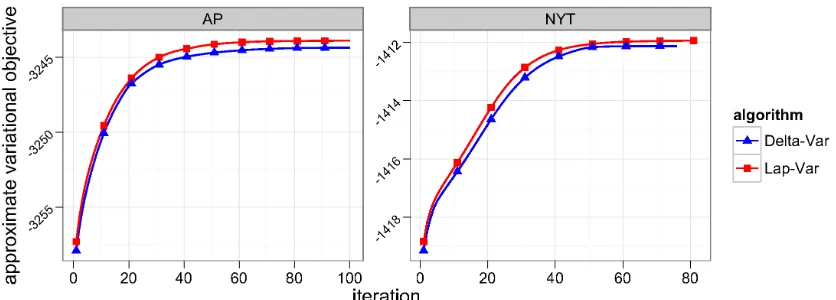
Figure 2: The approximate variational objective from Equation 19 goes up as a function of the iteration. This is for document-level inference in the correlated topic model. The left plot is for a collection from theAssociated Press; the right plot is for a collection from the New York Times. (See Section 4.1 and Section 5.1 for details about the model and data.)
delta method inference requires third derivatives. We study the empirical difference between these methods in Section 5.
Our algorithm (in either setting) is based on approximately optimal coordinate updates for the variational objective, but we cannot compute that objective. However, we can compute an approx-imate objective at each iteration with the same Taylor approximation used in the coordinate steps, and this can be monitored as a proxy. The approximate objective is
L
≈ f(θ) +ˆ ▽f(θ)ˆ ⊤(µ−θ)+ˆ 12(µ−θ)ˆ ⊤▽2f(θ)(µˆ −θ)ˆ +1
2 Tr ▽2
f(θ)Σˆ +log|Σ|
−Eq(z)[logq(z)] (19)
where f(θ)is defined in Equation 11 and ˆθis defined as for Laplace or delta method inference.5 Figure 2 shows this score at each iteration for two runs of inference in the correlated topic model. (See Section 4.1 for details about the model.) The approximate objective increases as the algorithm proceeds, and these plots were typical. In practice, as did Braun and McAuliffe (2010) in their setting, we found that this is a good score to monitor.
4 Example Models
We have described a generic algorithm for approximate posterior inference in nonconjugate models. In this section we derive this algorithm for several nonconjugate models from the research litera-ture: the correlated topic model (Blei and Lafferty, 2007), Bayesian logistic regression (Jaakkola and Jordan, 1997), and hierarchical Bayesian logistic regression (Gelman and Hill, 2007). For each
ˇ
kK
D
N
z
d;nx
d;nf
0; †
0g
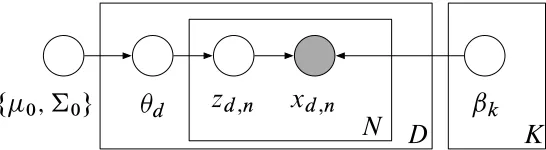
Figure 3: The graphical representation of the correlated topic model (CTM). The nonconjugate variable is θ; the conjugate variable is the collection z =z1:N; the observation is the collection of wordsx=x1:N.
model, we identify the variables—the nonconjugate variableθ, conjugate variablez, and observa-tionsx—and we calculate f(θ)from Equation 11. (The calculations of f(θ)are in the appendices.) In the next section, we study how our algorithms perform when analyzing data under these models.6
4.1 The Correlated Topic Model
Probabilistic topic models are models of document collections. Each document is treated as a group of observed words that are drawn from a mixture model. The mixture components, called “topics,” are distributions over terms that are shared for the whole collection; each document exhibits them with individualized proportions.
Conditioned on a corpus of documents, the posterior topics place high probabilities on words that are associated under a single theme; for example, one topic may contain words like “bat,” “ball,” and “pitcher.” The posterior topic proportions reflect how each document exhibits those themes; for example, a document may combine the topics ofsportsandhealth. This posterior decomposition of a collection can be used for summarization, visualization, or forming predictions about a document. See Blei (2012) for a review of topic modeling.
The per-document topic proportions are a latent variable. In latent Dirichlet allocation (LDA) (Blei et al., 2003)—which is the simplest topic model—these are given a Dirichlet prior, which makes the model conditionally conjugate. Here we will study the correlated topic model (CTM) (Blei and Lafferty, 2007). The CTM extends LDA by replacing the Dirichlet prior on the topic proportions with a logistic normal prior (Aitchison, 1982). This is a richer prior that can capture correlations between occurrences of the components. For example, a document aboutsportsis more likely to also be abouthealth. The CTM is not conditionally conjugate. But it is a more expressive model: it gives a better fit to texts and provides new kinds of exploratory structure.
Suppose there areKtopic parametersβ1:K, each of which is a distribution overVterms. Letπ(θ) denote the multinomial logistic function, which maps a real-valued vector to a point on the simplex with the same dimension,π(θ)∝exp{θ}. The CTM assumes a document is drawn as follows:
1. Draw log topic proportionsθ∼
N
(µ0,Σ0). 2. For each wordn:(a) Draw topic assignmentzn|θ∼Mult(π(θ)).
N
f
0; †
0g
mz
m;nt
m;nM
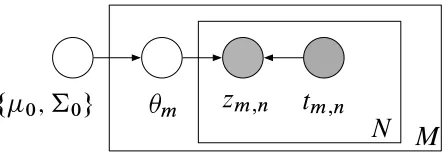
Figure 4: The graphical representation of hierarchical logistic regression. (When M=1, this is standard Bayesian logistic regression.)The nonconjugate variable is the vector of coeffi-cientsθm, the conjugate variable is the collection of observed classes for each data point, zm=zm,1:N. (In this case there is no additional observationxdownstream.)
(b) Draw wordxn|zn,β∼Mult(βzn).
Figure 3 shows the graphical model. The topic proportionsπ(θ)are drawn from a logistic normal distribution; their correlation structure is captured in its covariance matrixΣ0. The topic assignment variableznindicates from which topic thenth word is drawn.
Holding the topics β1:K fixed, the main inference problem in the CTM is to infer the condi-tional distribution of the document-level hidden variables p(θ,z1:N|x1:N,β1:K). This calculation is important in two contexts: it is used when forming predictions about new data; and it is used as a subroutine in the variational expectation maximization algorithm for fitting the topics and logistic normal parameters (meanµ0and covarianceΣ0) with maximum likelihood. The corresponding per-document inference problem is straightforward to solve in LDA, thanks to conditional conjugacy. In the CTM, however, it is difficult because the logistic normal onθis not conjugate to the multi-nomial onz. Blei and Lafferty (2007) used a Taylor approximation designed specifically for this model. Here we apply the generic algorithm from Section 3.
In terms of the earlier notation, the nonconjugate variable is the topic proportionsθ, the conju-gate variable is the collection of topic assignmentsz=z1:N, and the observation is the collection of wordsx=x1:N. The variational distribution for the topic proportionsθis Gaussian,q(θ) =
N
(µ,Σ); the variational distribution for the topic assignments is discrete,q(z) =∏nq(zn|φn)where eachφn is a distribution overKelements. In delta method inference, as in Braun and McAuliffe (2010), we restrict the variational covarianceΣto be diagonal to simplify the derivative of Equation 16. Laplace variational inference does not require this simplification. Appendix B gives the detailed derivations of the algorithm.Besides the CTM, this approach can be adapted to a variety of nonconjugate topic models, including the topic evolution model (Xing, 2005), Dirichlet-multinomial regression (Mimno and McCallum, 2008), dynamic topic models (Blei and Lafferty, 2006; Wang et al., 2008), and the discrete infinite logistic normal distribution (Paisley et al., 2012b).
4.2 Bayesian Logistic Regression
coefficients inRp; there is a coefficient for each feature. Bayesian logistic regression assumes the following conditional process:
1. Draw coefficientsθ∼
N
(µ0,Σ0).2. For each data pointnand its covariatestn, draw its class label from
zn|θ,tn∼Bernoulli
σ(θ⊤tn)zn,1σ(−θ⊤tn)zn,2
,
whereσ(y),1/(1+exp(−y))is the logistic function.
Figure 4 shows the graphical model. Given a data set of labeled feature vectors, the posterior inference problem is to compute the conditional distribution of the coefficients p(θ|z1:N,t1:N). The issue is that the Gaussian prior on the coefficients is not conjugate to the conditional likelihood of the label.
This is a subset of the model class in Section 2.2. The nonconjugate variableθis identical and the variablezis the collection of observed classes of each data point,z1:N. Note there is no additional observed variable xdownstream. The variational distribution need only be defined for the coeffi-cients, q(θ) =
N
(µ,Σ). Using Laplace variational inference, our approach recovers the standard Laplace approximation for Bayesian logistic regression (Bishop, 2006). This gives a connection between standard Laplace approximation and variational inference. Delta method variational infer-ence provides an alternative. Appendix C gives the detailed derivations.An important extension of Bayesian logistic regression is hierarchical Bayesian logistic regres-sion (Gelman and Hill, 2007). It simultaneously models related logistic regresregres-sion problems, and estimates the hyperparameters of the shared prior on the coefficients. WithMrelated problems, we construct the following hierarchical model:
1. Draw the global hyperparameters,
Σ−01∼Wishart(ν,Φ0), (20)
µ0∼
N
(0,Φ1). (21)2. For each problemm:
(a) Draw coefficientsθm∼
N
(µ0,Σ0).(b) For each data pointnand its covariatestmn, draw its class label,
zmn|θm,tmn∼Bernoulli(σ(θm⊤tmn)zmn,1σ(−θ⊤
mtmn)zmn,2).
As for the CTM, we use nonconjugate inference as a subroutine in a variational EM algorithm (where the M step is regularized). We construct f(θm)in Equation 11 separately for each problemm, and fit the hyperparametersµ0andΣ0from their approximate expected sufficient statistics (Bishop, 2006). This amounts to MAP estimation with priors as specified above. See Appendix C for the complete derivation.
5 Empirical Study
We studied nonconjugate variational inference with correlated topic models and Bayesian logis-tic regression. We found that nonconjugate inference is more accurate than the existing methods tailored to specific models. Between the two nonconjugate inference algorithms, we found that Laplace inference is faster and more accurate than delta method inference.
5.1 The Correlated Topic Model
We studied Laplace inference and delta method inference in the CTM. We compared it to the original inference algorithm of Blei and Lafferty (2007).
We analyzed two collections of documents. The Associated Press (AP) collection contains 2,246 documents from the Associated Press. We used a vocabulary of 10,473 terms, which gave a total of 436K observed words. TheNew York Times(NYT) collection contains 9,238 documents from theNew York Times. We used a vocabulary of 10,760 terms, which gave a total of 2.3 million observed words. For each corpus we used 80% of the documents to fit models and reserved 20% to test them.
We fitted the models with variational EM. At each iteration, the algorithm has a set of topics β1:Kand parameters to the logistic normal{µ0,Σ0}. In the E-step we perform approximate posterior inference with each document, estimating its topic proportions and topic assignments. In the M-step, we re-estimate the topics and logistic normal parameters. We fit models with different kinds of E-steps, using both of the nonconjugate inference methods from Section 3 and the original approach of Blei and Lafferty (2007). To initialize nonconjugate inference we set the variational mean parameter µ=0 for log topic proportionsθand computed the corresponding updates for the topic assignments z. We initialize the topics in variational EM to random draws from a uniform Dirichlet.
With nonconjugate inference in the E-step, variational EM approximately optimizes a bound on the marginal probability of the observed data. We can calculate an approximation of this bound with Equation 19 summed over all documents. We monitor this quantity as we run variational EM.
To test our fitted models, we measured predictive performance on held-out data with predictive distributions derived from the posterior approximations. We follow the testing framework of Asun-cion et al. (2009) and Blei and Lafferty (2007). We fix fitted topics and logistic normal parameters M={β1:K,µ0,Σ0}. We split each held-out document in to two halves (w1,w2)and form the
ap-proximate posterior log topic proportionsqw1(θ)using one of the approximate inference algorithms
and the first half of the documentw1. We use this to form an approximate predictive distribution,
p(w|w1,M)≈R
θ∑zp(w|z,β1:K)qw1(θ)dθ≈∑Kk=1βkwπk,
whereπk∝exp{Eq[θk]}. Finally, we evaluate the log probability of the second half of the document using that predictive distribution; this is theheld out log likelihood. A better model and inference method will give higher predictive probabilities of the unseen words. Note that this testing frame-work puts the approximate posterior distributions on the same playing field. The quantities are comparable regardless of how the approximate posterior is formed.
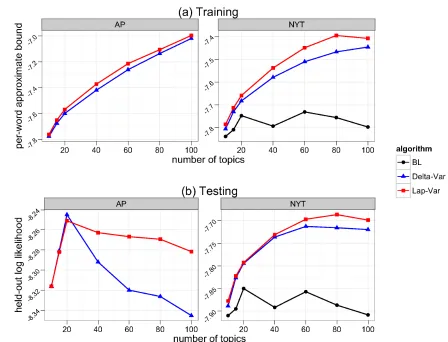
Blei and Lafferty’s (2007) objective (which is a true bound on the marginal of the data) behaves erratically. This is illustrated for theNew York Timescorpus; on theAssociated Presscorpus, it does not come close to the approximate bound and is not plotted.
Figure 5 (b) shows that on held out data, Blei and Lafferty’s approach, tailored for this model, performed worse than both of our algorithms. Our conjecture is that while this method gives a strict lower bound on the marginal, it might be a loose bound and give poor predictive distributions. Our methods use an approximation which, while not a bound, might be closer to the objective and give better predictive distributions. The held out likelihood plots also show that when the number of topics increases the algorithms eventually overfit the data. Finally, note that Laplace variational inference was always better than both other algorithms.
Finally, Figure 6 shows the approximate bound and the held out log likelihood as functions of running time.7 From Figure 6 (a), we see that even though variational EM is not formally optimizing this approximate objective (see Equation 19), the increase at each iteration suggests that the marginal probability is also increasing. The plot also shows that Laplace inference converges faster than delta method inference. Figure 6 (b) confirms that Laplace inference is both faster and gives better predictive performance.
5.2 Bayesian Logistic Regression
We studied our algorithms on Bayesian logistic regression in both standard and hierarchical settings. In the standard setting, we analyzed two data sets. With theYeastdata (Elisseeff and Weston, 2001), we form a predictor of gene functional classes from features composed of micro-array expression data and phylogenetic profiles. The data set has 1,500 genes in the training set and 917 genes in the test set. For each gene there are 103 covariates and up to 14 different gene functional classes (14 labels). This corresponds to 14 independent binary classification problems. With theScenedata (Boutell et al., 2004), we form a predictor of scene labels from image features. It contains 1,211 images in the training set and 1,196 images in the test set. There are 294 images features and up to 6 scene labels per image. This corresponds to 6 independent binary classification problems.8
We used two performance measures. First we measured accuracy, which is the proportion of test-case examples correctly labeled. Second, we measured average log predictive likelihood. Given a test-case inputtwith labelz, we compute the log predictive likelihood,
logp(z|µ,t) =z1logσ(µ⊤t) +z2logσ(−µ⊤t),
whereµis the mean of variational distributionq(θ) =
N
(µ,Σ). Higher likelihoods indicate a better fit. For both accuracy and predictive likelihood, we used cross validation to estimate the generaliza-tion performance of each inference algorithm. We set the priorsµ0=0 andΣ0=I.We compared Laplace inference (Section 3.1), delta method inference (Section 3.2), and the method of Jaakkola and Jordan (1997). Jaakkola and Jordan’s (1996) method preserves a lower bound on the marginal likelihood with a first-order Taylor approximation and was developed specif-ically for Bayesian logistic regression. (We note that Blei and Lafferty’s bound-preserving method for the CTM was built on this technique.)
Figure 5: Laplace variational inference is “Lap-Var”; delta method variational inference is “Delta-Var”; Blei and Lafferty’s method is “BL.” (a) Approximate per-word lower bound against the number of topics. A good approximation will go up as the number of topics increases, but not necessarily indicate a better predictive performance on the held out data. (b) Per-word held-out log likelihood against the number of topics. Higher numbers are better. Both nonconjugate methods perform better than Blei and Lafferty’s method. Laplace inference performs best. Blei and Lafferty’s method was erratic in both collections. (It is not plotted for the AP collection.)
Figure 6: In this figure, we set the number of topics as K =60. (Others are similar.) (a) The per-word approximate bound during model fitting with variational EM. Though it is an approximation of the variational EM objective, it converges in practice. (b) The per-word held out likelihood during the model fitting with variational EM. Laplace inference performs best in terms of speed and predictive performance.
better log predictive likelihood.9 The t-test showed that both Laplace and delta method inference are better than Jaakkola and Jordan’s method.
We next examined a data set of student performance in a collection of schools. With theSchool data, our goal is to use various features of a student to predict whether he or she will perform above or below the median on a standardized exam.10 The data came from the Inner London Edu-cation Authority. It contains examination records from 139 secondary schools for the years 1985, 1986 and 1987. It is a random 50% sample with 15,362 students. The students’ features contain four student-dependent features and school-dependent features. The student dependent features are
9. Previous literature, for example, Xue et al. (2007) and Archambeau et al. (2011) treatYeastandSceneas multi-task problems. In our study, we found that our standard Bayesian logistic regression algorithms performed the same as the algorithms developed in these papers.
Yeast Scene
Accuracy Log Likelihood Accuracy Log Likelihood Jaakkola and Jordan (1996) 79.7% -0.678 87.4% -0.670
Laplace inference 80.1% -0.449 89.4% -0.259
Delta method inference 80.2% -0.450 89.5% -0.265
Table 1: Comparison of the different methods for Bayesian logistic regression using accuracy and averaged log predictive likelihood. Higher numbers are better. These results are averaged from five random starts. (The variance is too small to report.) Bold results indicate sig-nificantly better performance using a standard t-test. Laplace and delta method inference perform best.
the year of the exam, gender, VR band (individual prior attainment data), and ethnic group; the school-dependent features are the percentage of students eligible for free school meals, percentage of students in VR band 1, school gender, and school denomination. We coded the binary indicator of whether each was below the median (“bad”) or above (“good”). We use the same 10 random splits of the data as Argyriou et al. (2008).
In this data, we can either treat each school as a separate classification problem, pool all the schools together as a single classification problem, or analyze them with hierarchical logistic re-gression (Section 4.2). The hierarchical model allows the predictors for each school to deviate from each other, but shares statistical strength across them. Let pbe the number of covariates. We set the prior on the hyperparameters to the coefficients toν=p+100,Φ0=0.01I, andΦ1=0.01I ( see Equation 20 and Equation 21) to favor sparsity. We initialized the variational distributions to q(θ) =
N
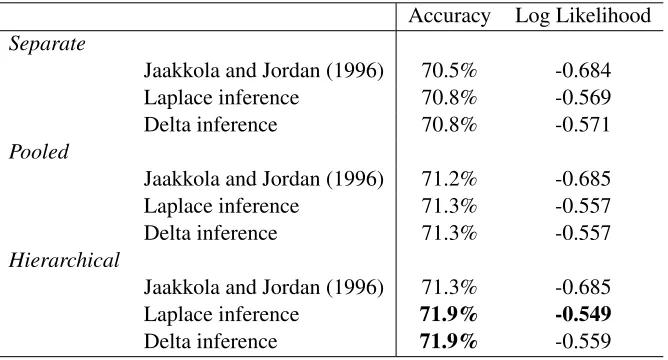
(0,I).Table 2 gives the results. A standard t-test (at level 0.05) showed that the hierarchical models are better than the non-hierarchical models both in terms of accuracy and predictive likelihood. With predictive likelihood, Laplace variational inference in the hierarchical model is significantly better than all other approaches.
6 Discussion
Accuracy Log Likelihood Separate
Jaakkola and Jordan (1996) 70.5% -0.684 Laplace inference 70.8% -0.569 Delta inference 70.8% -0.571 Pooled
Jaakkola and Jordan (1996) 71.2% -0.685 Laplace inference 71.3% -0.557 Delta inference 71.3% -0.557 Hierarchical
Jaakkola and Jordan (1996) 71.3% -0.685 Laplace inference 71.9% -0.549
Delta inference 71.9% -0.559
Acknowledgments
We thank Jon McAuliffe and the anonymous reviewers for their valuable comments. Chong Wang was supported by Google Ph.D. and Siebel Scholar Fellowships. David M. Blei is supported by NSF IIS-0745520, NSF IIS-1247664, NSF IIS-1009542, ONR N00014-11-1-0651, and the Alfred P. Sloan foundation.
Appendix A. Generalization to Complex Models
We describe how we can generalize our approaches to more complex models. Suppose we have a directed probabilistic model with latent variablesθ=θ1:mand observationsx. (We will not dif-ferentiate notation between conjugate and nonconjugate variables.) The log joint likelihood of all latent and observed variables is
logp(θ,x) =∑mi=1logp(θi|θπi) +logp(x|θ),
whereπiare the indices of the parents ofθi, the variables it depends on.
Our goal is to approximate the posterior distribution p(θ|x). Similar to the main paper, we use mean-field variational inference (Jordan et al., 1999). We posit a fully-factorized variational family
q(θ) =∏mi=1q(θi),
and optimize ach factorq(θi)to find the member closest in KL-divergence to the posterior.
As in the main paper, we solve this optimization problem with coordinate ascent, iteratively optimizing each variational factor while holding the others fixed. Recall that Bishop (2006) shows that this leads to the following update
q(θi)∝exp{E−i[logp(θ,x)]}, (22)
where E−i[·]denotes the expectation with respect to∏j,j6=iq(θj).
Many of the terms of the log joint will be constant with respect to θi and absorbed into the constant of proportionality. This allows us to simplify the update in Equation 22 to be q(θi)∝ exp{f(θi)}where
f(θi) =E−i[logp(θi|θπi)] +∑{j:i∈πj}E−i
logp(θj|θπj)
+E−i[logp(x|θ)]. (23)
As in the main paper, this update is not tractable in general. We use Laplace variational inference (Section 3.1) to approximate it, although delta method variational inference (Section 3.2) is also applicable. In Laplace variational inference, we take a Taylor approximation of f(θi) around its maximum ˆθi. This naturally leads toq(θi)as a Gaussian factor,
q∗(θi)≈
N
(θˆi,−▽2f(θˆi)−1).Now suppose each factor is in the exponential family. (This is weaker than the conjugacy assumption, and describes most graphical models from the literature.) The log joint likelihood becomes
logp(θ,x) =∑mi=1 η(θπi)
⊤t(θ
i)−a(η(θπi))
+logp(x|θ),
whereη(·)are natural parameters,t(·)are sufficient statistics, anda(η(·))are log normalizers. (All are overloaded.) Substituting the exponential family assumptions into f(θi)gives
f(θi) =E−i[η(θπi)]
⊤
t(θi)
+∑{j:i∈πj}
E−i
η(θπj)
⊤
E−i[t(θj)]−E−i
a(η(θπj))
+E−i[t(θ)]⊤t(x)−E−i[a(η(θ))].
Here we can use further Taylor approximations of the natural parametersη(·), sufficient statistics t(·), and log normalizersa(·)in order to easily take their expectations.
Finally, for some variables we may be able to exactly compute f(θi)and form theq∗(θi) with-out further approximations. (These are conjugate variables for which the complete conditional p(θi|θ−i,x)is available in closed form.) These variables were separated out in the main paper; here we note that they can be updated exactly in the coordinate ascent algorithm.
Appendix B. The Correlated Topic Model
The correlated topic model is described in Section 4.1. We identify the quantities from Equation 6 and Equation 7 that we need to compute f(θ)in Equation 11,
h(z) =1, t(z) =∑nzn, η(θ) =θ−log{∑kexp{θk}},
a(η(θ)) =0.
With this notation,
f(θ) =η(θ)⊤Eq(z)[t(z)]−12(θ−µ0)⊤Σ
−1
0 (θ−µ0),
whereEq(z)[t(z)]is the expected word counts of each topic under the variational distributionq(z). Let π ∝exp{η(θ)} be the topic proportions. Using ∂πi/∂θj =πi(1[i=j]−πj), we obtain the gradient and Hessian of the function f(θ)in the CTM,
▽f(θ) =E
q(z)[t(z)]−π ∑Kk=1
Eq(z)[t(z)]
k−Σ
−1
0 (θ−µ0), ▽2f(θ)i j= (−πi1
[i=j]+πiπj)∑Kk=1
Eq(z)[t(z)]
k−(Σ
−1 0 )i j.
where 1[i=j]=1 ifi= jand 0 otherwise. Note that▽f(θ)is all we need for Laplace inference. In delta method variational inference, we also need to compute the gradient of
Trace▽2f(θ)Σ = −
∑Kk=1πkΣkk+πTΣπ
∑Kk=1
Eq(z)[t(z)]
k−Trace(Σ
−1 0 Σ).
Following Braun and McAuliffe (2010), we assumeΣis diagonal in the delta method. (In Laplace inference, we do not need this assumption.) This gives
∂Trace▽2f(θ)Σ ∂θi
These quantities let us implement the algorithm in Figure 1 to infer the per-document posterior of the CTM hidden variables.
As we discussed Section 4.1, we use this algorithm in variational EM for finding maximum like-lihood estimates of the model parameters. The E-step runs posterior inference on each document. Since the variational family is the same, the M-step is as described in Blei and Lafferty (2007).
Appendix C. Bayesian Logistic Regression
Bayesian logistic regression is described in Section 4.2.
The distribution of the observationsz1:N fit into the exponential family as follows, h(z) =1, t(z) = [z1, . . . ,zN],
η(θ) = [logσ(θ⊤tn),logσ(−θ⊤tn)]Nn=1, a(η(θ)) =0.
In this set up,t(z)represents the whole set of labels. Sincez is observed, its “expectation” is just itself. With this notation, f(θ)from Equation 11 is
f(θ) =η(θ)⊤t(z)−12(θ−µ0)⊤Σ−01(θ−µ0).
The gradient and Hessian of f(θ)are
▽f(θ) =∑N
n=1tn zn,1−σ(θTtn)
−Σ−1
0 (θ−µ0), ▽2f(θ) =−
∑Nn=1σ(θTt
n)σ(−θTtn)tntnT−Σ−01. (24) This is the standard Laplace approximation to Bayesian logistic regression (Bishop, 2006).
For delta variational inference, we also need the gradient for Trace▽2
f(θ)Σ . It is
∂Trace▽2f(θ)Σ ∂θi
=−
N
∑
n=1
σ(θTtn)σ(−θTtn)(1−2σ(θTtn))tntnTΣtn.
Here we do not need to assumeΣis diagonal, since the special structure of the Hessian in Equa-tions 24 makes the computation of Trace▽2f(θ)Σ fairly simple.
C.1 Hierarchical Logistic Regression
Here we describe how we update the global hyperparameters (µ0,Σ0) (Equations 20 and 21) in hierarchical logistic regression. At each iteration, we first compute the variational distribution of coefficientsθmfor each problemm=1, ...,M,
q(θm) =
N
(µm,Σm).We then estimate the global hyperparameters(µ0,Σ0)using the MAP estimate. These come from the following update equations,
µ0= Σ0Φ
−1 1 M +Ip
!−1
∑Mm=1µm M ,
Σ0=
References
A. Ahmed and E. Xing. On tight approximate inference of the logistic normal topic admixture model. InWorkshop on Artificial Intelligence and Statistics, 2007.
J. Aitchison. The statistical analysis of compositional data. Journal of the Royal Statistical Society, Series B, 44(2):139–177, 1982.
C. Archambeau, S. Guo, and O. Zoeter. Sparse Bayesian multi-task learning. InAdvances in Neural Information Processing Systems, 2011.
A. Argyriou, T. Evgeniou, and M. Pontil. Convex multi-task feature learning. Maching Learning, 73:243–272, December 2008.
A. Asuncion, M. Welling, P. Smyth, and Y. Teh. On smoothing and inference for topic models. In Uncertainty in Artificial Intelligence, 2009.
H. Attias. A variational Bayesian framework for graphical models. InAdvances in Neural Informa-tion Processing Systems, 2000.
D. Barber. Bayesian Reasoning and Machine Learning. Cambridge University Press, 2012.
M. Beal. Variational Algorithms for Approximate Bayesian Inference. PhD thesis, Gatsby Compu-tational Neuroscience Unit, University College London, 2003.
J. Bernardo and A. Smith. Bayesian Theory. John Wiley & Sons Ltd., Chichester, 1994.
D. Bertsekas. Nonlinear Programming. Athena Scientific, 1999.
P. Bickel and K. Doksum. Mathematical Statistics: Basic Ideas and Selected Topics, volume 1. Pearson Prentice Hall, Upper Saddle River, NJ, 2nd edition, 2007.
C. Bishop. Variational principal components. In International Conference on Artificial Neural Networks, volume 1, pages 509–514. IET, 1999.
C. Bishop.Pattern Recognition and Machine Learning. Springer New York., 2006.
C. Bishop, D. Spiegelhalter, and J. Winn. VIBES: A variational inference engine for Bayesian networks. InAdvances in Neural Information Processing Systems, 2003.
D. Blei. Probabilistic topic models. Communications of the ACM, 55(4):77–84, 2012.
D. Blei and J. Lafferty. Dynamic topic models. InInternational Conference on Machine Learning, 2006.
D. Blei and J. Lafferty. A correlated topic model of Science. Annals of Applied Statistics, 1(1): 17–35, 2007.
M. Boutell, J. Luo, X. Shen, and C. Brown. Learning multi-label scene classification. Pattern Recognition, 37(9):1757–1771, 2004.
M. Braun and J. McAuliffe. Variational inference for large-scale models of discrete choice.Journal of the American Statistical Association, 2010.
L. Brown. Fundamentals of Statistical Exponential Families. Institute of Mathematical Statistics, Hayward, CA, 1986.
B. Carlin and N. Polson. Inference for nonconjugate Bayesian models using the Gibbs sampler. Canadian Journal of Statistics, 19(4):399–405, 1991.
J. Clinton, S. Jackman, and D. Rivers. The statistical analysis of roll call data. American Political Science Review, 98(2):355–370, 2004.
A. Corduneanu and C. Bishop. Variational Bayesian model selection for mixture distributions. In International Conference on Artifical Intelligence and Statistics, 2001.
W. Croft and J. Lafferty. Language Modeling for Information Retrieval. Kluwer Academic Pub-lishers, Norwell, MA, USA, 2003.
A. Elisseeff and J. Weston. A kernel method for multi-labelled classification. InAdvances in Neural Information Processing Systems, 2001.
J. Fox. Bayesian Item Response Modeling: Theory and Applications. Springer Verlag, 2010.
A. Gelman and J. Hill. Data Analysis Using Regression and Multilevel/Hierarchical Models. Cam-bridge University Press, 2007.
S. Gershman, M. Hoffman, and D. Blei. Nonparametric variational inference. In International Conference on Machine Learning, 2012.
Z. Ghahramani and M. Jordan. Factorial hidden Markov models. Machine Learning, 31(1), 1997.
A. Honkela and H. Valpola. Unsupervised variational Bayesian learning of nonlinear models. In Advances in Neural Information Processing Systems, 2004.
T. Jaakkola and M. Jordan. Bayesian logistic regression: A variational approach. In Artificial Intelligence and Statistics, 1997.
M. Jordan, Z. Ghahramani, T. Jaakkola, and L. Saul. Introduction to variational methods for graph-ical models. Machine Learning, 37:183–233, 1999.
M. Khan, B. Marlin, G. Bouchard, and K. Murphy. Variational bounds for mixed-data factor analy-sis. InAdvances in Neural Information Processing Systems, 2010.
D. Knowles and T. Minka. Non-conjugate variational message passing for multinomial and binary regression. InNeural Information Processing Systems, 2011.
D. MacKay. Information-based objective functions for active data selection. Neural Computation, 4(4):590–604, 1992.
P. McCullagh and J. Nelder. Generalized Linear Models. London: Chapman and Hall, 1989.
D. Mimno and A. McCallum. Topic models conditioned on arbitrary features with Dirichlet-multinomial regression. InUncertainty in Artificial Intelligence, 2008.
T. Minka. Expectation propagation for approximate Bayesian inference. InUncertainty in Artificial Intelligence, 2001.
T. Minka, J. Winn, J. Guiver, and D. Knowles. Infer.NET 2.4, 2010. Microsoft Research Cambridge. http://research.microsoft.com/infernet.
J. Paisley, D. Blei, and M. Jordan. Stick-breaking beta processes and the Poisson process. In Artificial Intelligence and Statistics, 2012a.
J. Paisley, C. Wang, and D. Blei. The discrete infinite logistic normal distribution.Bayesian Analy-sis, 7(2):235–272, 2012b.
H. Rue, S. Martino, and N. Chopin. Approximate Bayesian inference for latent Gaussian models by using integrated nested Laplace approximations. Journal of the Royal Statistical Society, Series B (Methodological), 71(2):319–392, 2009.
A. Smola, V. Vishwanathan, and E. Eskin. Laplace propagation. InAdvances in Neural Information Processing Systems, 2003.
L. Tierney, R. Kass, and J. Kadane. Fully exponential Laplace approximations to expectations and variances of nonpositive functions. Journal of American Statistical Association, 84(407), 1989.
M. Wainwright and M. Jordan. Graphical models, exponential families, and variational inference. Foundations and Trends in Machine Learning, 1(1–2):1–305, 2008.
C. Wang, D. Blei, and D. Heckerman. Continuous time dynamic topic models. InUncertainty in Artificial Intelligence, 2008.
M. Wells. Generalized linear models: A Bayesian perspective. Journal of American Statistical Association, 96(453):339–355, 2001.
E. Xing. On topic evolution. CMU-ML TR-05-115, 2005.
E. Xing, M. Jordan, and S. Russell. A generalized mean field algorithm for variational inference in exponential families. InUncertainty in Artificial Intelligence, 2003.