_____________________________________________________________________________________________________
*Corresponding author: E-mail: [email protected],[email protected];
Antimicrobial Activities of Teucrium creticum
against Reference Microbial Strains and Multi-drug
Resistant Bacteria Isolated at an Oncology Ward
Motasem Al-Masri
1*, Ghadeer Omar
2, Adham Taha
3, Amira Abu Alsoud
2,
Eman Tawafsha
2, Reem Basheer
2, Manar Al-Akhras
2and Rashad Taradeh
21
Division of Immunology, Microbiology and Pathology, Department of Biomedical Sciences, Faculty of Medicine and Health Sciences, An-Najah National University, Nablus, West Bank, Palestine.
2Department of Biology and Biotechnology, An-Najah National University, West Bank, Palestine.
3An-Najah National University Hospital, West Bank, Palestine.
Authors’ contributions
This work was carried out in collaboration among all authors. Author MAM was involved in design, performing and writing. Author GO was involved in collection and classification of plant as well as in writing. Author AT work included providing identified bacterial isolates from An-Najah hospital. Authors AAA, ET, RB, MAA and RT were involved in performing the experiments and in writing. All authors read and approved the final manuscript.
Article Information
DOI: 10.9734/JAMB/2019/v17i430149 Editor(s): (1) Dr. Foluso O. Osunsanmi, Department of Biochemistry and Microbiology, University of Zululand, South Africa. Reviewers: (1) Ron Bartzatt, University of Nebraska, USA. (2) Dolunay Sakar Dasdan, Yildiz Technical University, Turkey. (3) Ho Tat Bàng, University of Medicine and Pharmacy at Ho Chi Minh City, Vietnam. Complete Peer review History:http://www.sdiarticle3.com/review-history/50703
Received 03 June 2019 Accepted 08 August 2019 Published 13 August 2019
ABSTRACT
Aim: To determine antimicrobial activity of Teucrium creticum (T.creticum) leaves extract against
bacterial and fungal reference strains and multidrug resistant bacteria isolated at an oncology ward. Study Design: Cross-sectional study.
Place and Duration of Study: The study was carried out in department of biology and biotechnology in An-Najah National University in cooperation with the laboratory of the hospital of the university. An-Najah National University is located in West Bank in Palestine. The research
was performed from 8th of February to the 15th of April 2017.
Methodology: Teucrium creticum plant leaves were collected in Palestine, from which aqueous
and methanolic extracts were prepared. Antimicrobial activities of T. creticum extracts were
determined against reference bacterial and fungal strains as well as against 8 multidrug resistant bacteria isolated at an oncology ward. Antibacterial and anti-yeast activities were determined by Micro broth dilution method, while anti-mold activities were determined by agar dilution method.
Teucrium creticum methanolic extract strongly inhibited the growth of the studied reference
bacterial strains, which were Staphylococcus aureus (MIC= 1.56 mg/ml) and Shigella sonnie
(MIC=3.125 mg/ml). In addition, most of the 8 multi-drug resistant bacterial strains isolated from
patients with cancer (Pseudomonas aeruginosa, Staphylococcus aureus, Escherichia Coli and
Enterobacter cloacae) were also highly susceptible to methanolic extract (MIC=3.125 mg/ml). Both
the Staphylococcus aureus and Shigella sonnie reference strains were inhibited at lower level by
the aqueous extract (MIC=12.5 mg/ml). All the bacterial strains isolated from patients with cancer
were susceptible to aqueous extract at different levels (3.125 – 25 mg/ml). Epidermophyton
floccosum mold and Candida albicans yeast were strongly inhibited by aqueous extract, where the MIC values were 1.56 and 3.125 mg/ml, respectively.
Conclusion: T. creticum plant extracts showed promising antimicrobial activities against multidrug resistant bacterial isolates as well as against reference bacterial and fungal strains.
Keywords: Teucrium creticum; antimicrobial activities; multidrug resistance; oncology.
1. INTRODUCTION
A major public health problem worldwide is the spread of antimicrobial resistance. This may be attributed mostly to the widespread use of antimicrobials. Infections due to multi-drug resistant (MDR) pathogens have become a therapeutic challenge and a cause of significant morbidity and mortality [1,2,3].
Complementary and alternative medicine (CAM) are widely used and still increasing in the Western world [4,5]. Genus of Teucrium L. is a large and polymorphic one. This genus is common in mild parts of Europe, North Africa
and Asia. The species of Teucrium genus in
Turkey were applied for years in treatment of digestive system as well as diabetes mellitus. Furthermore, Turkish traditional drugs included Teucrium genus use as expectorant (choler and urine) and uses in treatment of inflammation, breath opening, flavoring, appetizing, antiseptic and worm removal [6,7]. In Cyprus, the genus Teucrium was found to includes four species; T. cyprium ssp., T. micmpodioides, T. divaricatum
ssp. canescens and T. kotschyanum [8]. In a
previous study in Palestine, 3 species of
Teucriium were detected, which included
Teucrium capitatum, Teucrium creticum and
Teucrium divaricatum [9].
In Palestine, Teucrium creticum L. (Lamiaceae)
(T. creticum) is locally known under the common name Ja’adh. The plant is used traditionally to treat diabetes [10]. Due to its limited distribution in Palestine [11], few phytochemical and antimicrobial studies were conducted on this plant.
Teucrium creticum plant's aerial parts have been reported for its astringent, vulnerary, antipyretic and depurative properties. Furthermore, aerial parts of T. creticum is known for it's attractiveness to bees [12].
Among the natural sources of neoclerodane as
well as 19-nor-neo-clerodane diterpenoids,
Teucrium genus was found to be one of the most abundant sources. These compounds were reported to possess useful antifeedant activity
[13]. In Cyprus, T. creticum is also known to
contain clerodane diterpenoids [14]. In a study
carried out by Omar et al. [15], Teucrium
creticum was not shown to significantly affect
human coagulation cascade. It was
demonstrated in a previous study that T.
creticum is an efficient scavenger of free radical
[16]. On the other hand, ethanolic T. creticum
extract possessed no or very low antimicrobial
activities against Pseudomonas aeruginosa,
Proteus vulgaris, Klebsiella pneumonia,
Escherichia coli, Salmonella typhi, Candida
albicans, Microsporum canis, and Trichophyton
rubrum [17].
This study aimed to evaluate antimicrobial
activity of T. creticum leaves extract against
bacterial and fungal reference strains and multidrug resistant bacteria isolated at oncology ward of An-Najah National University.
2. MATERIALS AND METHODS
2.1 Bacterial Isolates
strains were Staphylococcus aureus ATCC 25923 and Shigella sonnie ATCC 25931, while
fungal isolates were Candida albicans ATCC
90028 and Epidermophyton floccosum ATCC
52066. In addition, 38 isolates recovered from different wards at An-Najah national hospital were provided with their identification. These
isolates were collected from 8th of February to
the 15th of April 2017. These strains were
isolated from various clinical samples (blood, wound swabs, sputum, urine, etc.). The bacterial
isolates were Escherichia coli, Pseudomonas
aeruginosa, Staphylococcus aureus and
Enterobacter cloacae.
2.2 Antibiotic Susceptibility Test
In order to select representative clinical
multidrug-resistant isolates recovered at
oncology ward and to examine their susceptibility
to T. creticum, antibiotic susceptibility test was
performed. Disc diffusion technique according to CLSI [18], was used for antibiotic susceptibility
testing. The used antibiotic discs were
Cephalothin (30 µg), Cefoxitin (30 µg), Nalidixic acid (30 µg), Amoxicillin (20 µg), Ciprofloxacin (5 µg), Imipenem (10 µg), Amikacin (30 µg), Aztreonam (30 µg), Ceftazidime (30 µg) and Amoxycillin-Clavulanic Acid (20/10 µg). In
addition, S. aurues isolates were examined
against Vancomycin (30µg). All antibiotics were obtained from OXOID (UK).
2.3 Determination of Antimicrobial
Activities of T. creticum
2.3.1 Plant collection
The plant was classified and kindly provided by Dr. Ghadeer Omar. The plant was collected from Palestine and included leaves, which was ground into powder.
2.3.2 Plant extracts preparation
Plant powder (20 g) was separated into two equal parts then 100 ml of 100% methanol and 100 ml of deionized water were added separately. The powder was soaked with the solvents with continues shaking for 7 days. Then the extracts were centrifuged for 5 minutes at 1000 g and the supernatant was aspirated. The
organic extract was dried using rotary
evaporator, and the aqueous extract was dried
using lyophilizer. Aqueous extract was
dissolved in water and organic extract was dissolved in 100% DMSO (Dimethyl sulfoxide).
The concentration of both extracts was 50 mg/ml. The extracts were sterilized by syringe filtration method.
2.3.3 Antimicrobial activity determination by the method of micro- broth dilution
Into each well of a micro titration plate (Greiner bio-one, China), a volume of 100 μl of Mueller Hinton broth (Becton dickinson and company, France) was placed. Plant extract (100 μl) was pipetted in the first well and mixed. Then 100 μl was transferred to next well. This was repeated to well number 11, from which 100 μl were discharged after mixing. Well number 12 (positive control of microbial growth) was free from plant extract. Bacterial suspension was
prepared equivalently to 0.5 McFarland
standards, and 2 ml from suspended bacteria was diluted with 4 ml Mueller Hinton broth, this suspension was inoculated in each well (1μl) except well number 11 (negative control of microbial growth). For the examined bacterial strains, the plates were placed in an incubator adjusted at 35°C and the results were read after 24 hours [19,20]. The yeast species (Candida albicans) suspension was prepared equivalently to 0.5 McFarland standards, and diluted 1:20 then 1:50 with Mueller Hinton broth, this suspension was inoculated in each well (100 μl) except well number 11 (negative control of microbial growth). Although the Plate was incubated at a temperature (35°C) similar to that of bacteria, the incubation period was extended to 48 hours. The lowest concentration, at which no visible microbial growth could be observed was considered the MIC value [19,20,21].
2.3.4 Anti-mold activity determination by agar dilution method
The prepared SDA media (Becton dickinson and company, France) were kept in melted state (1ml in each test tube) in water bath at 40°C. Six test tubes for each plant extract (water and methanolic) were prepared. A volume of 1 ml of plant extract was added into tube number one and mixed. Then 1 ml was transferred from tube number 1 to next tube. The process was repeated up to tube number 6. Then tubes were put on slant position. Tube number six was used as negative control of fungal growth. One tube was free from plant extract (positive control of fungal growth) [20,22]. In addition, serial dilution of 100% DMSO was examined.
A suspension of mold (Epidermophyton
McFarland standard with 90% transmission. A total of 20 µl of fungal suspension was placed on surface of each slant in the tubes with the exception of negative control of fungal growth. The tubes were incubated at 25°C for 14 days [20,22].
Each of plant extract and DMSO were examined by micro-broth and agar dilution methods two times.
3. RESULTS
3.1 Antimicrobial Activities of T. creticum
Extracts
3.1.1 Inhibitory activity against reference strains
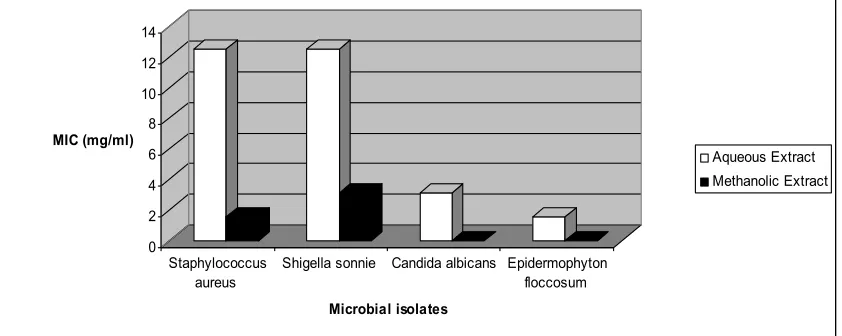
Methanolic extract of T. creticum was more
effective than aqueous one against S. aureus
and S. sonnie. In more detail, growth of S.
aureus and S. sonnie was inhibited by
methanolic extract concentration of 1.56 and 3.125 mg/ml, respectively (Table 1, Fig. 1). On the other hand, higher concentration of aqueous plant extract (MIC= 12.5 mg/ml) was required to stop the growth of both bacterial types. Both fungal types were more susceptible than bacteria to aqueous extract of T. creticum, where MIC for
E. floccosum and C. albicans were 1.56 and
3.125 mg/ml, respectively. The limited solubility
of methanolic T. creticum extract caused
impediment for the determination of MIC due to the antimicrobial activity of solvent DMSO. Where the container (well or tube) showing no growth of fungi and containing plant extract was
also containing an inhibitory concentration of DMSO (determined by MIC value of DMSO alone).
3.1.2 Inhibitory activity against bacteria
isolated from patients with cancer
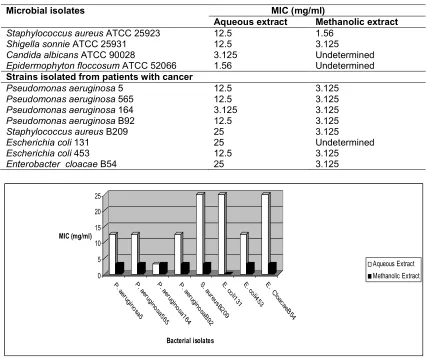
In general, the frequencies of resistance to different antibiotics were higher among isolates collected at oncology ward in comparison to other sources. All the 8 isolates of bacterial strains isolated at the oncology wards were multidrug resistant (resistant to 4 or more antibiotics). Table 1 and Fig. 2 show the
antimicrobial activities of T. creticum extract
against bacteria isolated from patients suffering from cancer. Among the extract for which MIC was determined, both methanolic and aqueous T. creticum extract showed inhibitory activity against all bacteria isolated from cancer patients.
The 4 P. aeruginosa isolates were strongly
inhibited by methanolic extract (MIC=3.125 mg/ml) and inhibited mostly at lower level (3.125-12.5 mg/ml) by aqueous extract. Out of the 2 E.
coli isolates, one was similar to P. aeruginosa
isolates, where the MIC values were 3.125 and 12.5 mg/ml for methanolic and aqueous extracts, respectively. On other hand, the second E. coli isolate was more resistant to activity of T. creticum extract, where the MIC of aqueous extract was 25 mg/ml and MIC of methalonic
extract was not determined. S. aureus and E.
cloacae isolated at oncology wards expressed more resistance to aqueous extract (MIC= 25 mg/ml) and were more susceptible to organic extract, where MIC was 3.125 mg/ml for both.
Fig. 1. Antimicrobial activities of methanolic and aqueous T. creticum extracts against
reference strains
0 2 4 6 8 10 12 14
MIC (mg/ml)
Staphylococcus aureus
Shigella sonnie Candida albicans Epidermophyton floccosum
Microbial isolates
Aqueous Extract
Table 1. Teucrium creticum antmicrobial activities against bacteria isolated from cancer patients and reference microorganism strains
Microbial isolates MIC (mg/ml)
Aqueous extract Methanolic extract
Staphylococcus aureus ATCC 25923 12.5 1.56
Shigella sonnie ATCC 25931 12.5 3.125
Candida albicans ATCC 90028 3.125 Undetermined
Epidermophyton floccosum ATCC 52066 1.56 Undetermined
Strains isolated from patients with cancer
Pseudomonas aeruginosa 5 12.5 3.125
Pseudomonas aeruginosa 565 12.5 3.125
Pseudomonas aeruginosa 164 3.125 3.125
Pseudomonas aeruginosa B92 12.5 3.125
Staphylococcus aureus B209 25 3.125
Escherichia coli 131 25 Undetermined
Escherichia coli 453 12.5 3.125
Enterobacter cloacae B54 25 3.125
Fig. 2. Antimicrobial activities of methanolic and aqueous T. creticum extracts against
multidrug resistant strains isolated at oncology wards
4. DISCUSSION
In the present study, although the number of isolates is limited, the bacteria isolated from patients with cancer were more resistant to the examined antibiotics than that of bacteria isolated from patients without cancer. Cancer patients provide different and new environment for bacteria in compression with other patients without cancer, because cancer patients are exposed to different types of treatments (chemotherapy and radiotherapy). In addition, the immune system of cancer patients is weak, which will give bacteria more time for the
development of resistant. This elevated
frequency of resistance of bacteria isolated from oncology ward provoked us to include antibiotic
resistant bacteria isolated from patient with cancer in the evaluation of antibacterial activities
of T. creticum. This may provide help for
treatment of multidrug resistant bacteria strains isolated from patients with cancer.
In Algeria, Teucrium polium L. essential oil
collected at Beni Aziz region has a high
antibacterial activity against Escherichia coli,
Staphylococcus aureus and the yeast
Saccharomyces cerevisiae. The population of Boutaleb region has significant activity against
Bacillus cereus and no action against S. aureus
and the yeast S. cerevisiae [23].
In a previous research [17], ethanolic T. creticum extract possessed no or very low antimicrobial
0 5 10 15 20 25
MIC (mg/ml)
P . a
erug ino
sa5 P
. a erug
ino sa5
65 P
. a erug
ino sa1
64 P
. a erug
ino saB
92 S
. a ureu
sB2 09 E
. co li1
31 E
. co li4
53 E
. C lo
ac aeB
54
Bacterial isolates
activities against Pseudomonas aeruginosa,
Proteus vulgaris, Klebsiella pneumonia,
Escherichia coli, Salmonella typhi, Candida
albicans, Microsporum canis, and Trichophyton
rubrum. In our study, aqueous plant extract of T. creticum showed antimicrobial activities against Staphylococcus aureus, Shigella sonnie, Pseudomonas aeruginosa, Escherichia coli,
Enterobacter cloacae, Candida albicans and
Epidermophyton floccosum. In addition,
methanolic extract of T. creticum possessed
stronger antimicrobial for most of isolates. The differences of the results may be due to use of different solvents in the extraction procedures.
Husein et al. [17], in the extraction procedure,
used 75% ethanol on the other hand in present study, water and 100% methanol solvents were used. In addition, collection of plants from different regions and differences in extractions methods may attribute to these variations in the results. For our knowledge, we are the first to report T. creticum antimicrobial activities against
Shigella sonnie, Enterobacter cloacae,
Epidermophyton floccosum and multidrug
resistant bacterial strains isolated from patients with cancer. Further work is needed to isolate and identify the active compounds from this plant.
Due to limited number of isolated bacteria from oncology patients no statistical analysis was done. It's recommended to repeat the study on larger number of bacterial isolates to confirm the results of the present study.
5. CONCLUSION
In conclusion, although methanolic extract of T.
creticum possessed stronger antimicrobial
activates both aqueous and methanolic extracts inhibited the growth of most examined microbial isolates including the multidrug resistant ones
isolated from oncology ward, thus T. creticum
may represent a candidate for the development of new antimicrobial agent that will be helpful for the treatment of multidrug resistant bacterial infections.
CONSENT
As per international standard written informed participant consent has been collected and preserved by the authors.
ETHICAL APPROVAL
As per international standard written ethical permission has been collected and preserved by the author(s).
ACKNOWLEDGEMENT
We are grateful to An-Najah National University.
COMPETING INTERESTS
Authors have declared that no competing interests exist.
REFERENCES
1. Prestinaci F, Pezzotti P, Pantosti A.
Antimicrobial resistance: A global
multifaceted phenomenon. Pathogens and Global Health. 2015;109(7):309-318. (Accessed 25 July 2019)
DOI: 10.1179/2047773215Y.0000000030
2. Centres for Disease Control and
Prevention, US Department of Health and Human Services. Antibiotic resistance threats in the United States. USA: Atlanta, CDC; 2013.
(Accessed 25 July 2019)
Available: http://www.cdc.gov/drugresistan ce/pdf/ar-threats-2013-508.pdf
3. Giske CG, Monnet DL, Cars O, Carmeli Y.
Clinical and economic impact of common multidrug-resistant Gram-negative bacilli. Antimicrob Agents Chemother. 2008;52(3): 813–821.
4. Chang HA, Wallis M, Tiralongo E. Use of
complementary and alternative medicine among people with type 2 diabetes in
Taiwan: A cross-sectional survey.
Evidence-Based Complementary and
Alternative Medicine. 2011;1:1-8 (Article ID 983792)
(Accessed 3 August 2019) DOI: 10.1155/2011/983792
5. Ventola CL. Current issues regarding
complementary and alternative medicine
(CAM) in the United States.
Complementary and Alternative Medicine. 2010;35(8):461-468.
6. Bag˘cı Y. Aladag˘lar (Yahyalı, Kayseri) ve
c¸evresinin etnobotanik o¨zellikleri. Ot Sistematik Bot. Dergisi. 2000;7:8994. Turkish
7. O¨ztu¨rk M, Dinc¸ M. Nizip Bo¨lgesi’nin
(Aksaray) etnobotanik o¨zellikleri. Ot Sistematik Bot. Dergisi. 2005;12:93-102. Turkish
8. Arnold N. Ethnobotanique
9. Al Sheikh B, Mahassneh M. Flora of Wadi
Al-Quff Protected Area, Hebron
Governorate, Palestine. Jordan J. of Natur. His. 2017;3:47-57.
10. Shtayeh MS, Jamous RM. Complementary
and alternative medicine use amongst Palestinian diabetic patients. Complent. Ther. Clin. Pract. 2012;18(1):16-21.
11. Saad B, Azaizeh H, Said O. Tradition and
perspectives of Arab herbal medicine: A review. Evid. Based Complement. Alternat. Med. 2005;2(4):475-479.
12. Arnold N, Bellomaria B, Valentini G,
Rafaiani SM. Comparative study on essential oil of some Teucrium species from Cyprus. J. Ethnopharmacol. 1991;35: 105-113.
13. Simmonds MSJ, Blaney WM, Ley SV,
Savona G, Bruno M, Rodriguez B. The
antifedant activity of clerodane
ditetpenoids from Teucrium.
Phyto-chemistry. 1989;28:1067-1071.
14. Savona G, Piozzi F, Bruno M, Dominguez
G, Servettaz O, Teucretol. A
nec-clmdaneditetpenoide from Teucrium
creticum. Phytochemistry. 1987;26:3285.
15. Omar G, Abdallah L, Rahim A, Othman R,
Barakat A. Selected wild plants ethanol extracts bioactivity on the coagulation cascade. J. of Scientif. Resear. Reports. 2017;13(6):1-10.
(Accessed 25 July 2019)
Available:https://doi.org/10.9734/JSRR/201 7/32989
16. Husein AI, Shtayeh MS, Jondi WJ, Zatar
NAA, Abu-Reidah IM, Jamous RM. In vitro
antioxidant and antitumor activities of six selected plants used in the traditional arabic Palestinian herbal medicine. Pharmaceu. Biology. 2014;10:249-1255.
(Accessed 25 July 2019)
DOI: 10.3109/13880209.2014.886274
17. Husein AI, Shtayeh MS, Jamous RM, Abu
Zaitoun SY, Jondi WJ, Zatar NAA. Antimicrobial activities of six plants used in
traditional Arabic Palestinian herbal
medicine. African J. of Microb. Research. 2014;8(38):3501-3507.
18. Clinical and Laboratory Standard Institute.
Performance Standards for Antimicrobial
Susceptibility Testing. Seventeenth
Informational Supplement. M100-S17.
USA: Wayne, PA, CLSI; 2007.
19. Wikler MA. Performance standards for
antimicrobial susceptibility testing; Twenty-First Informational Supplement, Clinical and Laboratory Standards Institute, USA. 2011;1-165.
20. Forbes BA, Sahm DF, Weissfeld AS.
Bailey and scott‘s the diagnostic
microbiology. 12 ed. USA: Elsevier -Mosby; 2007.
21. Klepser ME, Wolfe EJ, Jones RN,
Nightingale CH, Pfaller MA. Antifungal
pharmacodynamic characteristics of
fluconazole and amphotericin B tested
against Candida albicans. Antimicrob.
Agents Chemother. 1997;41(6):1392–
1395.
22. Falahati M, Tabrizib NO, Jahaniani F.
Anti dermatophyte activities of
Eucalyptus camaldulensis in comparison
with griseofulvin. Iranian J. of Pharma.
& Therapeutics (IJPT). 2005;4(2):80-
83.
23. Lograda T, Ramdani M, Chalard P,
Figueredo G, Deghar A. Chemical analysis
and antimicrobial activity of Teucrium
polium L. essential oil from eastern Algeria. American J. of Advanced Drug Delivery. 2014;2:697-710.
(Accessed 3 August 2019)
Available:http://www.ajadd.co.uk/ISSN 2321-547X
_________________________________________________________________________________
© 2019 Al-Masri et al.; This is an Open Access article distributed under the terms of the Creative Commons Attribution License
(http://creativecommons.org/licenses/by/4.0), which permits unrestricted use, distribution, and reproduction in any medium,
provided the original work is properly cited.
Peer-review history: