Reliable and Congestion Control Protocols for Wireless Sensor Networks
Kirti Kharb
*, Bhisham Sharma, Dr. Trilok C. Aseri
Department of Computer Science Engineering, PEC University of Technology, Chandigarh, India
Received 05 November 2015; received in revised form 13 November 2015; accepted 20 November 2015
Abstract
The objective of this paper is to analyze review and different congestion control protocols that are employed
at the transport layer and some of them working at the medium access control layer in wireless sensor networks.
Firstly, a brief introduction is given about wireless sensor networks and how congestion occurs in such networks.
Secondly, the concept of congestion is discussed. Thirdly, the reason of occurrence of congestion in wireless
sensor networks is analyzed. After that, congestion control and why it is needed in the wireless sensor networks is
discussed. Then, a brief review of different congestion control and reliable data transport mechanisms are
discussed. Finally, a comparative analysis of different protocols is made depending on their performance on
various parameters such as - traffic direction, energy conservation characteristic, efficiency etc. and the paper is
concluded.
Keywords: wireless sensor networks,reliability, congestion avoidance, transport layer protocols
1. Introduction
Wireless sensor networks are a group of heterogeneous nodes called sensor nodes, spread over a large field with a
central processing node called as sink. Basically, wireless sensor networks perform two main actions – wireless sensing and
data networking. They provide a bridge between the real physical and virtual worlds. Wireless sensor networks have
diversified arena of applications, some of them being in health care, animal care monitoring and surveillance, logistics &
transportation, soil health maintenance for agriculture, real time security and surveillance, infrastructure etc. However, there
are also some concern issues pertaining to wireless sensor networks. The main concern areas related to wireless sensor
networks are - resources, energy wastage, memory utilization, and computational power. [1] Most discussed issue is that of
energy consumption and battery usage problems. Next issue in wireless sensor networks is the issue of the occurrence of
congestion in the networks. Another issue is that of the security. In this paper, we aim to review and compare different
reliable and congestion control algorithms working at the transport layer in wireless sensor networks. How and why it is
important to address, detect and control the congestion, and the many mechanisms/ algorithms which help us in doing so is
also discussed. Section II provides the study that motivates why it is inadvertent to go for congestion control, the section III
deals with the problem of congestion, congestion avoidance and congestion control. Section IV reviews different schemes
employed to control congestion in wireless sensor networks. A comparative analysis of different congestion control
algorithms is done in the concluding section.
2. Congestion in Wireless Sensor Networks
This section makes a brief explanation about congestion, the congestion process and the different types of congestion
happening in wireless sensor networks.
2.1 Brief Overview
Traffic flows in sensor networks is shaped according to the physical structure of the fields that they work in. Wireless
sensor networks generally operate under light load conditions and become active whenever an event occurs. If the
corresponding application load is high, it may result in the generation of huge continuous data flows leading to disrupted
performance of the network, which may lead to congestion. In such condition, collision occurs in the network, due to which
data packets start getting dropped, buffer overflows start happening at the nodes in the network.
Therefore, we can say that the congestion is said to occur in a network, if the speed of the incoming traffic is larger than
the data processing rate of the network it. Following are some of the probable causes due to which congestion happens in
wireless sensor networks:
processing speed of nodes is low
incoming traffic arrives at faster rate than it can handle
if packet collisions happen on data links, leading to alternate routing of packets & excessive re-transmission of packets
2.2 The Congestion Process
The Congestion happens in a network either due to buffer overflow (when packets are getting stored at the source
because the previous packets have not been delivered) or/and link collisions (which results into packet losses and large
number of re-transmissions) [2]. Depending on physical topology of the network, both types of above situation may occur. In
Buffer overflow situation, data packets get dropped which negatively impacts the application, since the throughput is
restricted to the maximum data sending rate of node. As a result continuously packets get dropped; a lot of power is wasted
in re-transmissions. To counter this, a congestion control algorithm is to be used which either reduces the data rate of the
transmitting nodes or reroutes the excess data packets through alternative paths.
If link collisions occur, all the nodes in the network receive limited number of packets and the reliability of the
application running on the network is badly affected. For mitigating this, a congestion control algorithm that focuses on the
MAC layer may be used, that maintains optimum and collision free access to the medium.
2.3 Different types of Congestion in Wireless Sensor Networks
The congestion in WSNs can be stratified in two major classes depending upon
how data packets are lost, and
where in the network congestion is taking place
2.3.1 How data packets are lost
Due to congestion, packets can be lost in the following two ways in the wireless sensor networks:
1)Packet Collisions in the Medium: At a particular instant of time in a geographical area, many nodes within vicinity of one another attempt to transmit data simultaneously, resulting in data losses due to interference and thereby reduce the
throughput of all nodes in the area. [3] Proper local synchronization among neighbor nodes can reduce this type of loss,
however, we cannot eliminate it completely because non-neighboring nodes may still interfere in the data transmission.
2)Packet Drops Due to Buffer Overflow: Within a particular sensor node, if the queue or buffer used to hold data packets that are to be transmitted, overflows then congestion occurs. In this case, nodes receive packets with a rate higher than
2.3.2 Where in the network packets are lost
After congestion occurs, there are three possible sites for the data packets to get lost. These three sites are:
1) Hotspot Near Source—Source Congestion: The hotspot referred in this paper means the area in the network where congestion occurs and packets start getting dropped. Whenever the sensors are deployed densely, the data packets which
are generated during a crucial event will create hotspots very close to the sources. In this scenario, localized and quick
time-scale mechanisms which are capable of providing backpressure messages from the nodes that cause congestion,
back to the sources would be helpful for immediate traffic controlling until the congestion is removed by other means.
2) Hotspot Near the Sink-Sink Congestion: Even sparsely deployed sensors that generate data at comparatively low data rates may create hotspots in the sensor network, but likely farther away from the sources, near the sink. In such a scenario,
combined use of localized back-pressure and packet dropping methods would be more effective. Another way of
removing the sink congestion is to employ multiple sinks that are uniformly distributed across the sensor network and,
therefore, traffic is balanced among these sinks.
3) Forwarder Congestion: A sensor network usually has more than one flow (sink-source pair), and these flows will intersect with one another. The area around such points of intersection is likely to become a hot spot for congestion. In a
tree-like communication network, every intermediate node may suffer from the problem of forwarder congestion. [4]
Compared to the other congestion scenarios, forwarder congestion is way more challenging because it is very difficult to
predict the intersection points due to the highly dynamic nature of the network. In this case, even sparsely situated sensor
nodes generating data will create both transient as well as persistent hotspots distributed throughout the sensor field.
3. Congestion Control Methods
In this section, firstly the congestion control process is discussed, then the different congestion control schemes are
analyzed and finally the congestion control mechanism is discussed.
3.1 Congestion Control
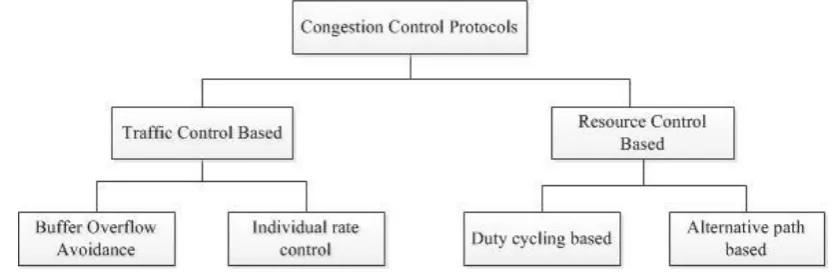
Congestion control is the mechanism through which congestion is prevented from being occurring in a wireless sensor
network, and if congestion has already happened then to detect where it has occurred, to monitor its status and controlling its
aftermath. . In buffer overflow scenario, reduction of data sending rate is done on the nodes whose buffer is overflowing or
re-transmissions are done through some alternative paths. To overcome congestion in link collisions, a congestion control
algorithm that focuses on the MAC layer may be used to help co-ordinate the network access among the nodes.
Fig. 1 Different categories of congestion control protocols
3.2 Congestion Control Schemes
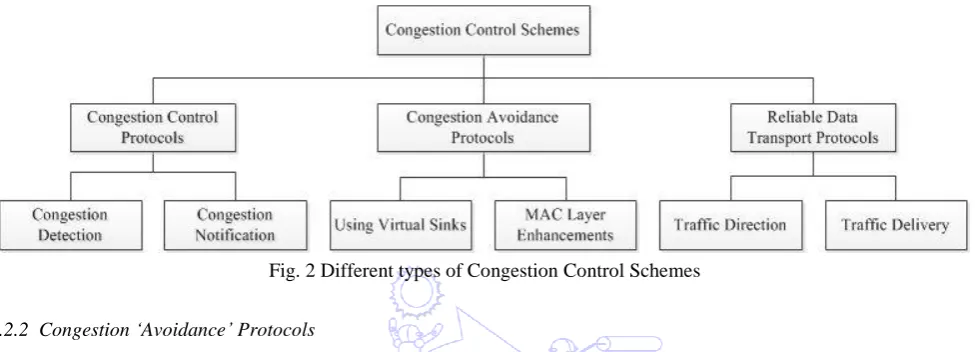
Generally, protocols that deal with congestion control in WSNs can be basically classified in three major categories.
3.2.1 Congestion ‘Control’ Protocols
These protocols can be classified on the way they detect congestion, the way they notify the other nodes for the
occurrence of congestion, as well as how the congestion countering mechanisms are performed. Congestion detection by
these protocols is done by: checking the level of buffer occupancy at the nodes in the network, measuring the load level of
the channel, and by counting the packet service timings and packet inter-arrival time. [5] Congestion notification is done by
either using additional notification packets that are sent across the network or by overhearing the data packets that are being
transmitted across. Congestion counter mechanisms can be performed either through reduction of traffic or through the
creation of alternative paths from the source node(s) to the sink node(s).
Fig. 2 Different types of Congestion Control Schemes
3.2.2 Congestion ‘Avoidance’ Protocols
These protocols are classified on the basis of how congestion is going to occur and on what mechanisms will be used
avoid the congestion from even occurring in a network. Congestion detection is done same as in congestion mitigation
protocols. Congestion can be avoided by using virtual sinks for those sinks which are getting highly congested and by using
MAC layer enhancements.
3.2.3 Reliable Data Transport Protocols
The reliable data transmission protocols are the protocols that, not only put effort to control congestion in a network,
but also attempt to recover all or part of the information which is lost. These are normally employed when all of the
information in network is critical for the application and is using some transport layer mechanisms. These protocols are
divided on the basis of three attributes: their traffic direction (whether downstream or upstream), whether they provide
hop-to-hop or end-to-end delivery, and the parameter on which reliability focuses (packet or event).
4. Different Congestion Control, Avoidance and Reliable Data Transport Protocols
The different protocols employed for congestion control in wireless sensor networks, basically deal with three core
functions- controlling the congestion, avoiding the congestion and providing for reliable data transportation. Following
sections deal with this concept in detail.
4.1 Congestion Control Protocols
These protocols mainly perform three functions - congestion detection, congestion notification (notifying the nodes in
the network that congestion has occurred) and the congestion mitigation strategy.
4.1.1 Adaptive Rate Control (ARC) Algorithm
The ARC scheme was proposed by J. Zhao et al. in 2001 [6]. This algorithm does not involve any congestion detection
or notification mechanisms. It uses an AIMD-like traffic control mechanism for congestion mitigation, which works as
parent node. Otherwise, the intermediate node multiplies its sending rate by a factor b, where 0 < b < 1. In order to guarantee fairness, ARC basically maintains two independent sets of these two factors: a and b, for source and transit traffic
respectively. Studies done by authors have shown that ARC is not only effective in achieving fairness but it also maintains
good bandwidth along with reasonable energy efficiency, especially during low traffic situations that are the common case
in wireless sensor networks.
4.1.2 Congestion Detection and Avoidance algorithm (CODA)
This algorithm [7] deals with both - congestion control and avoidance in wireless sensor networks. Present and past
channel load conditions are used by CODA as the congestion indication parameters. The channel load is listened by each
node before it starts transmitting data i.e. carrier sensing is pro-active here, this is done to avoid congestion. If congestion is
detected, the receiver node broadcasts an explicit back-pressure message to its neighbors signaling that congestion has
happened and correspondingly neighbor nodes reduce their local data sending rates. If congestion persists for a longer time,
this back-pressure is sent all the way to the sink node. A constant feedback in the form of ACK packet is maintained from
the source to the sink nodes. If the source node does not receive ACK, then it reduces its data transmission rate. The CODA
algorithm does not ensure fairness in the network and the bandwidth is not utilized efficiently.
4.1.3 Congestion Control and Fairness (CCF)
Saima Zafar [8] proposed this scalable algorithm for many to-one routing in wireless sensor networks. Here, congestion
detection is performed on the basis of packet servicing time which is the time period taken in sending the data packet form
the transport layer to the network layer and reception of the successful data transmission. Traffic control is used to carry out
congestion mitigation. Congestion control is performed in hop-by-hop fashion and each node uses exact rate adjustment
based on its available packet servicing rate. Each child node divides its data sending rate by the number of children nodes it
has, compares this newly arrived data rate with its parent data rate. If the defined threshold congestion level is reached in the
network, then the algorithm requests the child nodes to reduce their data transmission rate. Since a separate queue is
maintained for every child node, a considerable amount of bandwidth is exhausted in this algorithm.
4.1.4 Fusion Algorithm
Proposed by Mohamed Amine Kafi et al., [9] this scheme is used for mitigating the congestion in wireless networks.
This algorithm uses explicit congestion detection method i.e. a congestion bit in the header of every data packet. Whenever,
congestion occurs it is notified to all the nodes in the neighborhood by setting the value of congestion bit to 1 in every
outgoing packet from a node. Congestion detection can also be done by checking upon the queue size of each sensor node. If
the queue length crosses a specified threshold limit, the congestion bit is set, else it is reset. If congestion lasts for longer,
then hop-by-hop back pressure message is sent to the source notifying it to reduce the data transmission rate. A prioritized
MAC scheme is used to provide access to channel medium when the nodes are congested.
4.1.5 Biased Geographical Routing (BGR) Algorithm
Proposed by Dashkova et al. [10], in this protocol whenever congestion is detected the nodes reactively split traffic.
Detection of congestion is done depending on the level of buffer occupancy and wireless usage of the network. The wireless
usage is calculated by taking periodic samples of wireless medium. An implicit congestion bit added to each data packet is
used for congestion notification. Each node listens to the packets sent by its neighbors to detect the congestion status of the
network. Congestion is resolved using two algorithms: In-Network Packet Scatter (IPS) and End-to-End Packet Scatter
(EPS). IPS removes short term congestion in the network by splitting the traffic immediately before the congested areas.
Whereas, EPS removes long term congestion by splitting the data flow at source node and then performs rate control by the
4.1.6 Hierarchical Tree Alternative Path Algorithm (HTAP)
Hierarchical Tree Alternative Path algorithm is proposed for event-based sensor applications. Propounded by
Charalambos Sergiou et al., [11] it tries ensuring application reliability during overload periods without reducing the source
node’s data rate while sending information during critical events. HTAP works on a combination of two algorithms,
Alternative Path Creation (APC) and Hierarchical Tree Creation (HTC), and it uses the network density to choose between
them. When congestion takes place or a node’s battery is about to draining, APC and HTC form alternative paths to the sink
by unused nodes. APC uses these nodes by randomly exploiting neighboring table, while in HTC these nodes are placed in a
hierarchical levelled tree starting from 0 for the leaves nodes. Every node piggybacks its buffer occupancy, reflecting its
congestion state, when sending packets and the neighbors refresh their neighboring state tables when overhearing packets. A
congested receiver sends a back-pressure packet to the sender in the purpose to remove congestion. The sender stops
transmitting to this node and searches for a less congested receiver which leads to alternative paths creation.
4.2 Congestion Avoidance Protocols
These protocols are more focused on the ‘avoidance part’ of the congestion control process. Basically involve two
strategies- congestion detection methodology and congestion avoidance mechanism.
4.2.1 Siphon
This scheme was proposed by G. Srinivasan et al. [12]. It is a source to-sink congestion control protocol. Congestion detection is done through – buffer occupancy level, sink load level and wireless channel load conditions. Congestion
notification method involved is implicit in nature. Congestion mitigation is performed by traffic redirection through virtual
sinks (VSs). These virtual sinks form a dynamic adhoc network and split traffic when nodes get congested, thereby
preventing the data packets from getting deleted. This algorithm comprises mainly these steps – first being the discovery of
virtual sinks that will be selected for congestion control in particular congested areas. For this every sensor node maintains a
table of VS it has in its vicinity. The second step is to use the service of a VS, a congested node enables a redirection bit
which signals a VS to re-route the traffic out of the congested neighborhood, for this every VS has dual radio interfaces
maintained on it – a long range interface to communicate with other VSs and a short range interface to communicate with the
sensor nodes in the network. Finally, when the VS detect the value of redirection bit as set, it re-routes the packets using a
combination of hop-by-hop and end-to-end transmission.
4.2.2 Buffer and Rate Control Based Congestion Avoidance Algorithm
M. M. Alam et al. [13] proposed the “Buffer and Rate Control Based Congestion Avoidance” protocol. There are three
main steps involved in this algorithm. These are: the Upstream Source Counting, the Buffer Occupancy based rate control,
and the Snoop based MAC level ACK. The first two steps are used to control the rate of upstream nodes. It actually provides
two advantages. The first is that congestion is reduced by media access contention, as the upstream nodes proactively
decrease their data transmission rate, while the second advantage is that the congestion due to buffer overflow is avoided as
the upstream nodes delay the transmission of packets whenever the buffer capacity of the downstream nodes is full. In the
third step, explicit ACK packets are avoided. Instead, each node may overhear its own transmitted packet while forwarded
by its downstream node, hence eliminating the need for ACK packets. To accomplish this overhearing task, the upstream
node MAC address and a sequence number need to be appended into the MAC frame of the node. Many advantages of this
protocol are that this can reduce collision drop Rate, increase delivery ratio and improve the network’s energy efficiency.
4.2.3 Priority Based Medium Access Protocol
The Priority Based Medium Access Protocol for Congestion Avoidance was proposed by Patil et al [14]. This is a MAC
values. For example, a node carrying a higher load of data traffic gets more access time than others. Each sensor node then
calculates its contention window on a provided equation. This contention window has different size for different node data
conditions. Simulation series that have been performed by scholars in MATLAB resulted that there is an optimal contention
window size through which the collision in the MAC layer can be minimized and enables all the sensor nodes to transmit
their data packets without delays.
4.2.4 LACAS
The concept of “Learning Automata-Based Congestion Avoidance Algorithm in Sensor Networks” (LACAS) was
propounded by Vrisha Tickoo et al. [15] which is actually an adaptive learning solution for avoiding the congestion in wireless sensor networks. The target of this algorithm is to control the data rate of intermediate nodes in order to avoid
congestion before it reaches to the sink in the network. To monitor the data rates, automatas are developed at each of the
network’s nodes that are capable of controlling the rate of flow of data at the intermediate nodes. These states are based on
probabilistically how many packets are likely to get dropped if a particular flow rate is maintained. In this case, an
“automaton” “learns” from past behaviors, will increase data rate if packets are not being dropped or else will reduce the data
rate from the previous level of data rate in order to avoid congestion. This algorithm actually works on the reinforcement
learning strategy and keeps on optimizing the data rate depending upon its past performance achieved.
4.3 Reliable Data Transport Protocols
These protocols mainly aim at providing reliable data transmission and traffic control in the wireless sensor networks.
4.3.1 Event to Sink Reliability (ESRT) Protocol
Sankarasubramaniam et al. [16] proposed this protocol. ESRT aims for reliability at the application level and provides
reliable delivery of packets from sensors to the sink. By regulating sensor frequency, this protocol tries to guarantee
end-to-end reliability. However, reliability is maintained for the whole application and not for each single data packet. Congestion
feedback from sensor nodes is broadcasted, notifying to adjust the reporting rate in the network so that the sensor nodes are
able to receive sufficient number of packets but only as much as packets necessary in order to avoid congestion and save
energy. ESRT runs on the sink, with negligible functionality needed at the sensor nodes. The protocol operates by
determining the reliability achieved and congestion condition in the current network state. [17] Firstly, it periodically
computes the reliability r based on how many packets are received successfully in a time interval. In the second step, the protocol deduces the required frequency f of the sensor nodes from r. Finally, ESRT informs all the sensor nodes about f through an assumed channel with high power. ESRT identifies five distinct regions in which it operates: i) No Congestion,
Low reliability, ii) No Congestion, High reliability, iii) Congestion, High Reliability, iv) Congestion, Low Reliability and v)
Optimal Operating Region—which actually is the region with No Congestion, Medium-High Reliability. The aim is to
identify the current operating state of the network and to bring it into Optimal Operating Region. The event-to-sink
reliability is checked, if found lower than required, the reporting frequency of source nodes is adjusted aggressively in order
to still maintain the target reliability level; if the reliability is higher than required, then the reporting frequency is
conservatively reduced so that energy can be conserved while still maintaining the reliability of network. Thus, this
self-configuring nature of ESRT protocol makes it robust even with dynamic changing topologies in the network. The best
benefit resulting from ESRT [18] is its capability of energy-conservation by dynamically controlling the sensor reporting
frequency. A disadvantage associated with ESRT is the fact that all nodes are treated equally due to which in case of
congestion in one region of the network, all the nodes are forced to reduce their data rate, negatively affecting the network’s
throughput. Thus, it is able to provide fairness among the nodes since data rate reduction is applied on all the nodes in the
4.3.2 GARUDA Protocol
S. Brahma et al. [19] have discussed this protocol which is a reliable data transport protocol. This protocol provides
reliable point-to-multipoint data delivery from the sink node to the sensor nodes. It comprises of the following elements
an efficient pulse based solution for reliable short messages delivery;
a virtual infrastructure called the core, that is instantaneously constructed during the course of a single packet flood;
which is used to approximate a near optimal assignment of all the local designated servers,
a two-stage NACK (negative acknowledgment) based recovery process that minimizes the overheads resulting from the
retransmission processes in the network, and performs out-of-sequence forwarding to leverage the significant spatial
re-use possible in a WSN;
The traffic direction flow implemented in GARUDA is downstream and it provides both: packet and destination related
packet reliability.
4.3.3 STCP Protocol
It is a scalable and reliable transport layer protocol where the majority of functionalities are dealt at the sink [20]. It
supports networks with multiple applications and provides additional functionalities such as controlled variable reliability as
well as congestion detection and avoidance. In this protocol, before transmitting any packet, the sensor nodes inform the sink
through a “Session Initiation Packet”. [21] Through this initiation packet, the sink gets to know about the number of flows
initiated from a source node, the type of data that is to be transmitted, the transmission rate, and the required reliability.
When the moment the sink node receives this packet, it sends an ACK packet to the source node, and only then the source
node starts transmitting the packets. Since the sink is aware of the rate of transmission from the source, the expected arrival
time of the next packet can be determined. The sink node maintains a timer and sends a negative acknowledgement packet, if
it does not receive a packet within the expected arrival time. Reliability is measured as the fraction of total packets
successfully received by the network. For controlling the congestion, nodes inform the sink [22] whether they are
experiencing any buffer overflow situation, and by setting their congestion notification bit value equal to 1, while the sink
informs the source node about a congested path by setting the congestion bit on the ACK packet. In this case, a source node
may change its routing path or decrease the data sending rate to mitigate congestion.
4.3.4 RCRT Protocol
Paek et al. proposed this protocol [23], which focuses on reliable delivery of data from the source to sink, while avoiding any intermediate congestion collapse. It works on the transport layer and its traffic management functionality is
implemented on the sink. RCRT attempts to achieve 100% reliable data delivery in the network based on a NACK scheme.
So, in case, there are packet losses, the sink requests the source for retransmission of the missing packets by sending a
NACK with the missing packet numbers. RCRT implements following basic components at the sink:
A congestion detection component which detects congestion in the network by checking upon the round trip time
values, rate adaptation, and rate allocation, which if found more than the expected values means congestion has
The ‘time to recover loss’ [24] is used as an indicator of congestion detection in the wireless sensor network. Therefore,
as long as the network is able to repair the packet losses (within around the Round Trip Time) the network in not
congested.
However, if the packet losses cannot be redeemed by the network then it figures out that there are congested spots in
network.
In case congestion occurs, RCRT applies a rate adaptation mechanism [25] to control it. With the help of the rate
allocation mechanism, specific transmission rates are allocated to each data flow whenever the application on which the
network is running changes.
5. Comparative analysis of the congestion control protocols discussed in the paper
The following table (Table 1) compares the congestion control protocols- ARC, CODA, CCF, Fusion, BGR and HTAP
over the parameters of congestion detection mechanism, congestion notification methodology used [26] (whether it is
implicit or explicit), the direction of traffic flow (whether from source to sink, or from sink to source [27]), whether the
protocol is able to achieve fairness or not and the performance of protocol on the energy conservation [28].
Table 1 Congestion ‘Control’ Protocols Protocol/
Mechanism Congestion Detection
Congestion Notification Congestion Mitigation Traffic Direction Fairness Achieved Energy Conservation ARC
Detected by whether the packets are successfully forwarded
or not
Implicit Traffic Control Source to Sink Yes Medium
CODA
Buffer occupancy level and load level of the
wireless channel
Explicit Traffic Control Source to Sink No High
CCF Packet Service Time Implicit Traffic Control Source to Sink Yes Low
Fusion
Buffer occupancy level and load level of the
wireless channel
Implicit Traffic Control Source to Sink No High
BGR
Buffer occupancy level and load level of the
wireless channel
Implicit Resource and
Traffic Control Source to Sink Yes N/A
HTAP Buffer Occupancy level Implicit Recourse
Control Source to Sink No High
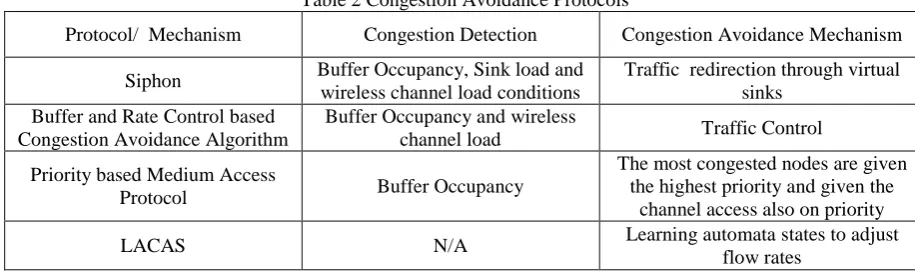
The following table (Table 2) compares the congestion avoidance protocols – Siphon, LACAS, Priority based Medium
Access Protocol and the Buffer and Rate Control based Congestion Avoidance Algorithm on two parameters – the
congestion detection mechanism adopted by the protocols and the congestion avoidance mechanism implemented [29].
Table 2 Congestion Avoidance Protocols
Protocol/ Mechanism Congestion Detection Congestion Avoidance Mechanism
Siphon Buffer Occupancy, Sink load and wireless channel load conditions
Traffic redirection through virtual sinks
Buffer and Rate Control based Congestion Avoidance Algorithm
Buffer Occupancy and wireless
channel load Traffic Control
Priority based Medium Access
Protocol Buffer Occupancy
The most congested nodes are given the highest priority and given the
channel access also on priority
LACAS N/A Learning automata states to adjust
The following table(Table 3) compares ESRT, GARUDA, STCP, and RCRT, the reliable data transport protocols on
three parameters – the reliability mechanism adopted by the protocol(whether it is hop-by-hop or end-to-end), the traffic
direction (whether it is downstream or upstream) and the level at which the reliability is achieved by the protocol [30].
Table 3 Reliable Data Transport Schemes
Protocol/ Mechanism Reliability Mechanism Traffic Direction Reliability level achieved
ESRT Hop-by-Hop Downstream Packet
GARUDA Hop-by-Hop Downstream Packet and Destination Related
STCP End-to-End Upstream Event and packet
RCRT Hop-by-Hop Upstream Packet
6. Conclusion
In this paper, we presented a brief review of reliable and congestion control protocols in wireless sensor networks.
Congestion control protocols are reactive protocols whereas the congestion avoidance protocols work in pro-active manner.
The reliable transport protocols basically ensure that the data to be transmitted through the wireless sensor networks reaches
correctly at its intended destination and, in this process, the data is not getting corrupted, that is the integrity of the data is
maintained. The data reliable transmission protocols are needed in areas having real time and crucial data applications. The
study of different protocols is done and a comparative analysis of the protocols is concluded. Congestion has a deep impact
on the energy consumption, efficiency, packet delivery ratio, delay in data delivery and the lifetime of a wireless sensor
network, hence it is very important to monitor and control the congestion. The review conducted on congestion control
protocols has shown that the type of application and data flow type influence the traffic control deeply. Since reliability is
the crux functional area of the transport layer, it is crucial to ensure the dependability of the applications operating on
wireless sensor networks.
References
[1] B. Sharma and T. C. Aseri, “A comparative analysis of reliable and congestion-aware transport layer protocols for wireless sensor networks,” International journal of Sensor Networks, vol. 2012, 14 pages, Dec. 6, 2012.
[2] B. Sharma and T. C. Aseri, “A hybrid and dynamic reliable transport protocol for wireless sensor networks,” Computer and Electrical Engineering, vol. 48, pp. 298-311, November 2015.
[3] Rahman, Md Obaidur, M. M. Monowar, and C. S. Hong, "A capacity aware data transport protocol for wireless sensor network," Computational Science and Its Applications(ICCSA ’09), Springer Berlin Heidelberg, pp. 491-502. [4] Flora, D. F. Jenolin, V. Kavitha, and M. Muthuselvi, "A survey on congestion control techniques in wireless sensor
networks," International Conference on Emerging Trends in Electrical and Computer Technology (ICETECT ‘11), IEEE press, 2011.
[5] R. Prabha, P. K. Gouda, Manjula S H1, K R Venugopal, and L M Patnaik, “ MTADF : multi hop traffic aware data for warding for congestion control in wireless sensor networks,” International Journal of Wireless & Mobile Networks (IJWMN ‘15), Feb. 2015, vol. 7, no. 1.
[6] J. Zhao, L. Wang, S. Li, X. Liu, Z. Yuan, and Z. Gao, (2010, October). “A survey of congestion control mechanisms in wireless sensor networks,” The Sixth International Conference on Intelligent Information Hiding and Multimedia Signal Processing (IIH-MSP ‘10), IEEE press, 2010, pp. 719-722.
[7] J. Wan, H. Yan, Q. Liu, K. Zhou, R. Lu, and D. Li, “Enabling cyber–physical systems with machine–to–machine technologies,” International Journal of Ad Hoc and Ubiquitous Computing, vol. 13, no. 3-4, pp.187-196.
[8] S. Zafar, “A survey of transport layer protocols for wireless sensor networks,” International journal of Computer applications, vol.33, no.1, pp.44-50, November 2011.
[9] M. A. Kafi, et al., “Congestion control protocols in wireless sensor networks: A survey,” IEEE Communications surveys and tutorials, vol.16, no. 3, pp.1369-1390, March 2014.
[11] C. Sergiou, V. Vassiliou, and A. Paphitis, “Hierarchical tree alternative path (HTAP) algorithm for congestion control in wireless sensor networks,” Journal of Ad-hoc Networks, vol.11, no. 1, pp. 257-272, January 2013.
[12] G. Srinivasan and S. Murugappan, "A survey of congestion control techniques in wireless sensor
networks," International Journal of Information Technology and Knowledge Management, pp. 413-415, 2011. [13] Alam, M. Mahbub, and C. S. Hong, "Buffer and rate control based congestion avoidance in wireless sensor
networks," Proceedings of Korea Information Processing Society, pp. 1291-1293, May 2007.
[14] Patil, Dipti, and S. N. Dhage, "Priority-based congestion control protocol (pccp) for controlling upstream congestion in wireless sensor network," International Conference on Communication, Information & Computing Technology (ICCICT ‘12), IEEE press, 2012.
[15] V. Tickoo and S. Gambhir,"A comparison study of congestion control protocols in WBAN," International Journal of Innovations and Advancement in Computer Science, vol. 4, no. 6, June 2015.
[16] Sankarasubramaniam, Yogesh, Ö . B. Akan, and I. F. Akyildiz, "ESRT: event-to-sink reliable transport in wireless sensor networks," Proc. of the 4th ACM International Symposium on Mobile Ad hoc Networking & Computing, pp. 177-188, 2003.
[17] V. Michopoulos, L. Guan, G. Oikonomou, and I. Phillips, “A comparative study of congestion control algorithms in IPv6 wireless sensor networks,” Proc. IEEE Int. Conf. Distributed Computing in Sensor Systems and Workshops (DCOSS ‘11), June 2011, pp. 1–6.
[18] M. Palattella, N. Accettura, X. Vilajosana, T. Watteyne, L. Grieco, G. Boggia, and M. Dohler, “Standardized protocol stack for the internet of (Important) things,” IEEE Communication Surveys Tutorials, vol. 15, no. 3, pp. 1389–1406, 2013.
[19] Brahma, Swastik, M. Chatterjee, and K. Kwiat, "Congestion control and fairness in wireless sensor networks," The 8th IEEE International Conference on Pervasive Computing and Communications Workshops (PERCOM Workshops), IEEE press, 2010, pp. 413-418.
[20] W. W. Fang, J. M. Chen, L. Shu, T. S. Chu, and D. P. Qian, “Congestion avoidance, detection and alleviation in wireless sensor networks,” J. Zhejiang Univ.—Sci. C, vol. 11, no. 1, pp. 63–73, 2010. Available:
http://dx.doi.org/10.1631/jzus.C0910204
[21] K. Zheng, F. Hu, W. Wang, W. Xiang, and M. Dohler, “Radio resource allocation in LTE-advanced cellular networks with M2M communications,” IEEE Communications Magazine, vol. 50, no. 7, pp. 184–192, 2012.
[22] J. Jin, M. Palaniswami, and B. Krishnamachari, “Rate control for heterogeneous wireless sensor networks:
Characterization, algorithms and performance,” Computer Networks, vol. 56, no. 17, pp. 3783–3794, November 2012. Available: http://www.sciencedirect.com/science/article/pii/S1389128612003131
[23] Paek, Jeongyeup, and R. Govindan, "RCRT: rate-controlled reliable transport for wireless sensor networks," Proc. of the 5th international conference on Embedded networked sensor systems, pp. 305-319, 2007.
[24] Spachos, Petros, P. Chatzimisios, and D. Hatzinakos, "Cognitive networking with opportunistic routing in wireless sensor networks," IEEE International Conference on Communications (ICC ‘13), IEEE press, 2013, pp. 2433-2437. [25] P. Spachos, Petros, P. Chatzimisios, and D. Hatzinakos, "Energy aware opportunistic routing in wireless sensor
networks," Globecom Workshops (GC Wkshps), IEEE press, 2012, pp. 405-409.
[26] C. sergiou et al, "A comprehensive survey of congestion control protocols in wireless sensor networks," IEEE Communications surveys and tutorials, vol.16, no. 4, pp.1839-1859, December 2014.
[27] Ali Ghaffari, "Congestion control mechanisms in wireless sensor networks: A survey," Journal of Network and Computer Applications, vol. 52, pp. 101–115, June 2015.
[28] I. Khan, F. Belqasmi, R. Glitho, N. Crespi, M. Morrow, P. Polakos, "Wireless sensor network virtualization: A survey," Communications Surveys & Tutorials, vol.18, no.1, pp. 553-576, 2016.
[29] Mocanu, D. Constantin, Vega, M. Torres, Liotta, and Antonio, "Redundancy reduction in wireless sensor networks via Centrality Metrics," IEEE International Conference on Data Mining Workshop (ICDMW ‘15), pp. 14-17, November 2015.