ISSN: 2306-9007 Semerádová (2015) 1010
I
www.irmbrjournal.com December 2015I
nternationalR
eview ofM
anagement andB
usinessR
esearchVol. 4 Issue.4
R
M
B
R
Using Online Platforms to Solve Knowledge Transfer
Problems in Projects
TEREZA SEMERÁDOVÁ
Technical University of Liberec, Faculty of Economics, Czech Republic Author Email: [email protected]
Tel: + 420 485 352 280
Abstract
The importance of having a solid knowledge background during projects has already been established. However, making this knowledge circulate still causes many problems, that reflect in all aspects of project teamwork and influence the achievement of the set project goals. This paper presents the findings of a nationwide survey of Czech companies analyzing knowledge transfer practices and frequent issues that appear during projects. Based on the identified breakdowns a set of recommendations is designed. The proposed solution builds upon the creation and implementation of an online platform connecting the properties of a communication channel and knowledge brokering system. Apart from general framework, this paper also provides a case study example illustrating how knowledge transfer can become more effective by implementing a project platform along with simple fill in forms and same basic ground rules. In order to achieve the fullest capture of knowledge (both tacit and explicit) as possible the case study platform also demonstrates the impacts of including social networking tools as an internal communication and knowledge brokering channel.
Key Words: Knowledge Brokering Systems, Breakdowns In Communication, Project Workflow, Lack of Knowledge, Knowledge Transfer Inhibitors.
Introduction
Knowledge sharing in projects has to face some additional challenges compared to regular activities that are being performed in the organization on daily basis. Due to the temporary existence of project setting and the need to organize the work of professionals with specialized knowledge, the demands on fast circulation of information and creation of an integrated learning mechanism are increasing (Lindner & Wald, 2011). As noted in Fong (2003), the unique characteristics of each project require non-routine approaches which even though may be accelerated by enhancing the transfer of experience, tacit and explicit knowledge across teams and various projects in different contexts.
ISSN: 2306-9007 Semerádová (2015) 1011
I
www.irmbrjournal.com December 2015I
nternationalR
eview ofM
anagement andB
usinessR
esearchVol. 4 Issue.4
R
M
B
R
& Niewiem, 2009; Holzmann, 2013). However, nowadays another perspective starts to be frequently mentioned. Relating ICT channels and media with knowledge transfer has been gaining more and more attention since the expansion of the Internet network and online collaborative environments. The pressure on implementing automated software tools that would facilitate the acquisition, storage and deployment of knowledge is growing (Loew, Kuemmel, Ruprecht, Bleimann & Walsh, 2007).
According to Kim, Suh & Jun (2011), an IT-based Brokering System taking into account existing social networks in the organization could help to significantly improve knowledge circulation. This paper aims at identifying the most common issues that appear in project teams, specifying their relation to knowledge transfer and based on the findings suggesting easily applicable solutions using virtual collaborative environments as a main communication channel. The first section of this paper presents a review of knowledge transfer factors found in the literature, followed by a summary of knowledge brokering aspects and characteristics. Main part of the paper focuses on the analysis of qualitative and quantitative data collected in an online survey targeting businesses and institutional entities in the Czech Republic. I believe that despite its geographically specific focus the survey will help illuminate the often breakdowns in knowledge transfer and provide the necessary information for designing a general framework that could be implemented in any project context and even with less advanced ICT tools.
Review of Knowledge Transfer and Brokering Factors
The goal of most of the research done in the area of knowledge transfer lies in indentifying which factors and to what extent influence the success or the failure of this process (Hall, Sapsed, & Williams, 2000). Semantic and linguistic parameters represent one category of these factors. Research organized by (Barner-Rasmussen and Björkman, 2007) in Chinese and Finish subsidiaries proved that establishing a common language has a positive effect on shared vision and trustworthiness of shared information. On the contrary, language barriers slow the knowledge transfer down or even make it impossible (Buckley et al., 2005). Language commonality describes the “extent to which people share common understanding of the shared
language, including skills and knowledge about using the language where applicable” (Peltokorpi, 2015).
Peltokorpi also introduces the concept of media richness thus considering the capacity of each media to transfer the information without ambiguity and noise.
Newell et al. (2006) analyzed cross-project knowledge transfer using the ICT-based approach. They found that the transfer’s success depends on the type of learning, its focus and standardization. In the projects that were the object of their study, some of the standardized procedures seemed to perform rather as inhibitors. Fong and Wong (2009) argue that in order to make knowledge reuse more effective organizations need to emphasize the role of communities of practice and actively support their formation through web-based experience management systems. Scarbrough et al. (2004) came to similar conclusions when trying to illuminate the relationship between knowledge, learning, work practices, social groups and social context.
ISSN: 2306-9007 Semerádová (2015) 1012
I
www.irmbrjournal.com December 2015I
nternationalR
eview ofM
anagement andB
usinessR
esearchVol. 4 Issue.4
R
M
B
R
Their results imply that speed of the knowledge circulation and the power of influence of the individuals who own desired knowledge play an important role as well. Extending the communication beyond formal relationships using information technology may help increase the knowledge transfer (Kim, Suh & Jun, 2011) by facilitating the knowledge exchange or by cataloging the knowledge (people who have it) in the organization. Information systems contribute to higher speed and efficiency of knowledge transfer and help to lower the costs by shortening the distance between knowledge sources (Albino, Garavelli, & Gorgoglione, 2004)
Majority of papers is dedicated to analyzing the factors of knowledge transfer and brokering in architecture, engineering and IT oriented projects. Holzmann (2013) summarizes three approaches to knowledge brokering that are present in the up to date literature.
First of these approaches defines knowledge brokers as experienced managers who know how connect the demand and supply of knowledge. Second approach describes knowledge brokers as experts and professionals who offer solution to complicated problems and share this information with others. Third perspective refers to knowledge that origins from social interactions and community.
Knowledge brokering may appear on different organizational levels and may be done by different entities (individuals, communities, organizations). All these efforts lead to the establishment of a knowledge broker network that may include people along with automated solutions (Loew et al., 2007). Research led by Lindner and Wald (2011) proved that ITC support have a strongly positive effect on knowledge management in temporary organizations. However, lots of the knowledge that is created during projects is not captured due to inconsistent and incorrect elaboration of lessons learned or due to overlooking tacit elements of knowledge (Goffin & Koners, 2008).
Data Collection and Sample Characteristics
Data analyzed further in this article was collected during a national survey that was carried out in the period from January to May 2015 in the Czech Republic. In total, we received 1915 responses to our questionnaire that was distributed electronically to businesses, public institutions and non-profit organizations with the aim to cover all types of subjects that implement project management practices.
Even though we sent over 17 000 e-mails, 62% of them returned with the notice that “delivery failed due to invalid recipient address”. This problem was caused mainly by the outdated e-mail database we were using to extract the contact information from. We successfully distributed 6467 questionnaires reaching thus a response rate of 29.59%.
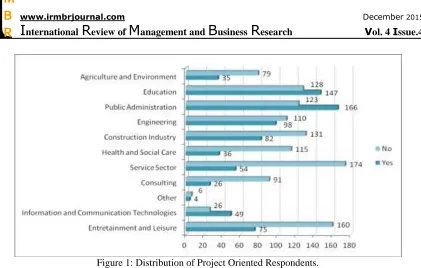
Among the organizations who participated to the survey, those operating in the field of Public Administration were in the sample represented the most (15%), followed by Education (14%), Entertainment and Leisure (12%) and Service sector (12%). Building industry and Engineering were represented equally, both creating 11% of the total of respondents.
ISSN: 2306-9007 Semerádová (2015) 1013
I
www.irmbrjournal.com December 2015I
nternationalR
eview ofM
anagement andB
usinessR
esearchVol. 4 Issue.4
R
M
B
R
Figure 1: Distribution of Project Oriented Respondents.
In the introduction of the questionnaire, the participants were asked whether their organization is project oriented or not. Only the organizations that implemented project management practices were selected for subsequent examination of knowledge management principles. The distribution of project oriented respondents is displayed in Figure 1. Overall, for the purposes of this paper, only 772 questionnaires were judged as relevant to the topic.
Identified Knowledge Management Insufficiencies
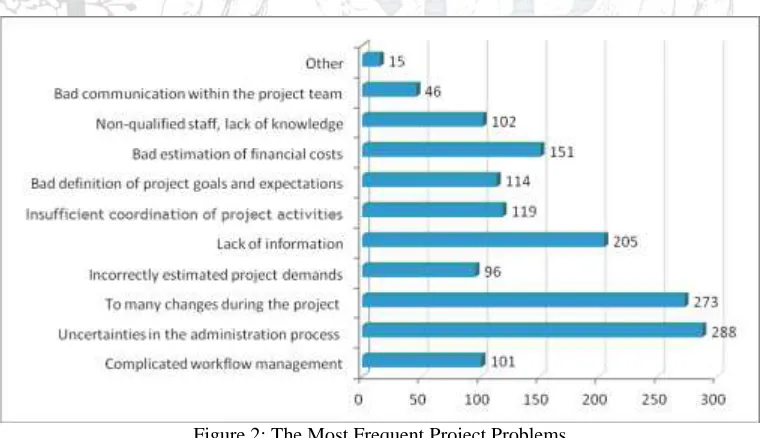
One part of the questionnaire was devoted to the possible issues that may arise during project implementation and project teamwork. The respondents were given a set of multichoice questions as well as the opportunity to freely express their opinion in a serie of open questions. Among the problems that were stated the most frequently by the participants, uncertainties in the administration process figure on the top of our list (288 votes). The respondents often mentionned that they felt confused about the responsibilities and administration steps needed to be taken in order to accomplish some of the goals. Problems connected to the formal procedures seem to be typical especially for projects partially or fully founded by public funds and operational programmes.
To many changes during the project (273 votes) and lack of information (205 votes) appear to be another two major issues in terms of project management. With a relatively high ranking ended up also non-qualified stuff, lack of knowledge (102 votes) and complicated workflow management (101 votes). The remaining problems we came across in our survey are listed in Figure 2 along with the number of votes (occurences in the questionnaires). The afordmentionned findings suggest that there are possibly, at least in Czech environment, some signficant deficiencies in the ways information and knowledge (both explicit and tacit) are managed during projects.
ISSN: 2306-9007 Semerádová (2015) 1014
I
www.irmbrjournal.com December 2015I
nternationalR
eview ofM
anagement andB
usinessR
esearchVol. 4 Issue.4
R
M
B
R
responses indicating no interest to include KD as a standard project instrument (49%) due to lack of faith in its efficiency and the answers of respondents confessing that they do not know what a KD is or how to use it properly (21%).
Insufficient guidance in knowledge and information processes may also be accounted to lack of organizational and methodological frameworks. Merely half (49%) of the organizations follow international project standards such as PRINCE 2, PMBOK, ISO standards or their own formalized project methodologies. The remaining ones (51%) manage projects intuitively i.e. without standardized protocoles.
In addition, the statistics indicate a very low awareness about exsiting project tools and even lower implementation rate. The question in the questionnaire was designed as a multi choice item allowing the respondents selection from a predefined list of tools including the option “I do not know any of the above listed tools”. Feasibility study and cost controlling were the only two variables that were chosen the most by the respondents (30% and 26% respectively). Gantt charts and Communication plans are used by the companies almost equally (11% and 10% respectively), followed by Critical Path Method (8%). Other tools were distributed scarcely raging from 0% to 3%. As regards the awareness, 43% of the participants had no conception of what the tools are or never heard of them. From the KM perspective it should be noted that Lessons learned were not used by any of our respondents.
If we look more closely on the management coverage of various knowledge and information areas organizations usually focus rather on one specific area and neglect the others or do not manage them as profoundly as recommended. This assumption is supported by the number of tools implemented by each respondent. Majority (46%) of studied companies do not use any instruments for the reasons stated above, 23% implement only one tool, 16% use 2 tools, 9% manage their activities with the help of 3 instruments and only 6% actively apply more than 3 tools. As it was already mentioned, scheduling tools along with cost controlling predominate although those selected by the respondents do not provide thorough insight and rather focus on the general project framework without determining any specifics.
Figure 2: The Most Frequent Project Problems
ISSN: 2306-9007 Semerádová (2015) 1015
I
www.irmbrjournal.com December 2015I
nternationalR
eview ofM
anagement andB
usinessR
esearchVol. 4 Issue.4
R
M
B
R
were not introduced in the organizations that took part in our research. Conferencing software (8%), project planning tools (12%), IT solutions for synchronized communication (12%) and online project platforms providing both communication and planning tools (10%) were used only by a small fraction of the respondents. Conversely, internally build communication/project platforms (27%) and external storage solutions (29%) were in the sample represented more than we expected. Higher rate of intranet networks is probably the outcome of lower acquisition and maintenance costs in comparison with commercial solutions.
In order to identify whether major project failures origine from lack of knowledge or from its inadequate distribution we included in our analysis also the variable of education. Althought 36% of the respondents had no experience or education in the area of project management, the overall results indicate a positive trend in project literacy.
In the presented sample, 11% of project managers gradueted form a university programme oriented in mangement, 24% had background project education and longterm experience while 26% of project staff had only longterm experience without any related education. Managers certified according to international standards occured with a very low frequency (2.5%) even in combination with higher education (1%). We may assume that international certification in the Czech Republic is not that common due to elevated certification costs per employee that are inacceptable for small and medium enterprises that were in the sample represented the most.
Although most organizations do not create knowledge databases, they generally establish other types of information storages. Regular controls and their outcomes usually represent processes that are commonly being recorded whether on paper or into an information system. Information obtained during the online survey suggests that the internal processes of data management might be distorted due to inconsistent or false data collection. In our sample, 74% of the respondents make regular controls, 21% do not control at all and 5% make “fictional” controls (they are scheduled but not carried out). However, some of the data is stored and subsequently used in other decision-making processes. Misleading information can be found mainly in the case of fictional controls – 6% admitted to recording artificially created information that is not based on any real results.
Building a Project Knowledge Network – Proposed Solution
Based on the identified knowledge management insufficiencies we propose as a possible solution the implementation of an online project platform as communication and knowledge networking media. Construction of this platform should be based on Knowledge Engineering practices that would help the organizations to review the project knowledge and information requirements and build efficient knowledge database. The requirements include not only specialized knowledge but also information about formal and administrational procedures. Given the frequent complaints about bad communication, knowledge database should additionally comprehend also knowledge about the communication system in use (tutorials, help section, communication plan). The section about formal aspects of the project may as well contain relevant forms and regulations that need to be fallowed.
ISSN: 2306-9007 Semerádová (2015) 1016
I
www.irmbrjournal.com December 2015I
nternationalR
eview ofM
anagement andB
usinessR
esearchVol. 4 Issue.4
R
M
B
R
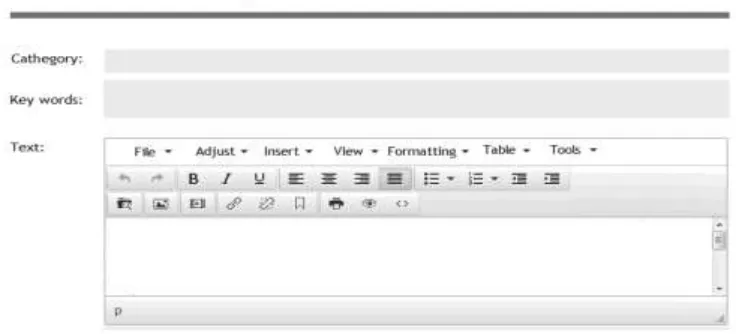
Knowledge base displayed below consisted of 7 categories comprising all necessary information about the bookstore and its business activities. Within each category the team members were allowed to create individual posts by filling out a simple form.
Figure 3: Case Study Project Database
Knowledge presented in the database was available to all project relevant staff (team/task managers) so they could harmonize their efforts all along the innovation process. Thanks to the requirement “add keywords” in the form each post was easily to be found and interrelated with other similar posts.
Platform included as well a newsfeed where all projects changes, progress or inquiries were listed. In addition, the users could subscribe for the option of receiving regular reports from the system on their e-mail. Thanks to this feature better awareness was achieved. Better workflow management was achieved by adding to the wiki form also the “attach file” icon and by creating a document upload form with same key word requirement as for the wiki entry. In the platform interface, a search bar with filters was integrated allowing the users to specify what category of information they searched for, the publication date or the type of the document.
ISSN: 2306-9007 Semerádová (2015) 1017
I
www.irmbrjournal.com December 2015I
nternationalR
eview ofM
anagement andB
usinessR
esearchVol. 4 Issue.4
R
M
B
R
In order to support the transfer of knowledge between team members, a function of creating chat rooms (discussion forums) by all users was enabled. Conversation in the chat rooms was informal enough to allow spontaneous flow of knowledge based on which new knowledge was created. The greatest advantage of these online working environments was the continuous capture of all information that was being shared, although without any filter or categorization making this knowledge very difficult to be found retrospectively. For this reason, for each chat room one facilitator was assigned (usually the one who created the room) and one of his duties was to summarize the discussion held in his room and submit a summary of it as a new knowledge entry if its content was relevant. Same rules were applied to discussions that were set outside the virtual environment.
The users had also the opportunity to reach to their colleagues based on their professional expertise. Each of the team members created them-selves a personal profile containing basic information about their areas of specialization and previous projects they were part of. This internal social network provided a knowledge brokering framework that did not require any other intermediary and that was thus semi-automated. By introducing the social element into the designed system, the platform in use became more sensitive to capturing some of the tacit knowledge that may be sometimes neglected when building a knowledge database.
Conclusion
Results of the locally targeted survey presented in this paper revealed that many temporary organizations (projects) struggle mostly with the transfer of knowledge and information. Uncertainties in the administration process, to many changes during the project, lack of information, non-qualified stuff, lack of
knowledge and complicated workflow management are all problems that may be solved or at least
minimized by introducing effective knowledge brokering system. Despite the fact that lack of knowledge was often noted by the respondents, after analyzing the background education of managers, qualification at the project management level does not seem to be a weighty issue. The managers do have the necessary knowledge but do not know how to transfer and implement it. Specialized qualification of other stuff was not covered by the questionnaire because it is context-centered therefore the lack of qualification should be investigated on the level of professionals hired/employees assigned to fulfill the specifics of each project.
Problems in communication may easily be the consequence of insufficient ICT infrastructure. The findings suggest that in majority of organizations face-to-face, email and phone are the only forms of team communication. The biggest disadvantege of email is its low media richness, lack of clarity and difficult thematic organization when it comes to continous communication concerning one topic. In addition, sharing documents via this instrument may bacome very confusing. Lots of knowledge is thus lost due to insufficient catalogization and storage it can not be found. Even if the organizations use knowledge databases or communication platforms the creation and maintenance of such rather advance tools may become complicated. When creating a knowledge base it is crutial to define the requirements on stored data, rules of conduct and assign roles to the users. It is important to specify what knowledge and how it should be added.
ISSN: 2306-9007 Semerádová (2015) 1018
I
www.irmbrjournal.com December 2015I
nternationalR
eview ofM
anagement andB
usinessR
esearchVol. 4 Issue.4
R
M
B
R
Acknowledgement
This work was supported by the project No. SGS-21073 Analysis of project methodologies implemented by small, medium and large enterprises in the Czech Republic.
References
Albino, V., Garavelli, A. C., & Gorgoglione, M. (2004). Organization and technology in knowledge transfer. Benchmarking: An International Journal, 11(6), 584-600.
Barner-Rasmussen, W., & Björkman, I. (2007). Language Fluency, Socialization and Inter-Unit Relationships in Chinese and Finnish Subsidiaries. Management Organization Review, 3(1), 105-128. doi:10.1111/j.1740-8784.2007.00060.x
Buckley, P. J., Carter, M. J., Clegg, J., & Tan, H. (2005). Language and social knowledge in foreign-knowledge transfer to China. International Studies of Management & Organization, 35(1), 47-65. Easterby‐Smith, M., Lyles, M. A., & Tsang, E. W. (2008). Inter‐organizational knowledge transfer:
Current themes and future prospects. Journal of management studies, 45(4), 677-690.
Fong, P. (2003). Knowledge creation in multidisciplinary project teams: an empirical study of the processes and their dynamic interrelationships. International Journal Of Project Management, 21(7), 479-486. doi:10.1016/s0263-7863(03)00047-4
Fong, P. S., & Wong, K. C. (2009). Knowledge and experience sharing in projects-based building maintenance community of practice. International Journal of Knowledge Management Studies, 3(3-4), 275-294.
Goffin, K., & Koners, U. (2008). Capturing tacit knowledge in New Product Development: a study of Post-Project Reviews. International Journal Of Technology Intelligence And Planning, 4(3), 234. doi:10.1504/ijtip.2008.020096
Goffin, K., & Koners, U. (2011). Tacit Knowledge, Lessons Learnt, and New Product Development.
Journal Of Product Innovation Management, 28(2), 300-318. doi:10.1111/j.1540-5885.2010.00798.x
Hall, J., Sapsed, J., & Williams, K. (2000, February). Barriers and facilitators to knowledge capture and transfer in project-based firms. In 4th International conference on technology policy and innovation, Curitiba, Brazil.
Hargadon, A. B. (2002). Brokering knowledge: Linking learning and innovation. Research in Organizational behavior, 24, 41-85.
Holzmann, V. (2013). A meta-analysis of brokering knowledge in project management. International Journal of Project Management, 31(1), 2-13.
Kim, S., Suh, E., & Jun, Y. (2011). Building a Knowledge Brokering System using social network analysis: A case study of the Korean financial industry. Expert Systems With Applications, 38(12), 14633-14649. doi:10.1016/j.eswa.2011.05.019
Lin, L., Geng, X., & Whinston, A. B. (2005). A sender-receiver framework for knowledge transfer. Mis quarterly, 197-219.
Lindner, F., & Wald, A. (2011). Success factors of knowledge management in temporary organizations.
International Journal Of Project Management, 29(7), 877-888. doi:10.1016/j.ijproman.2010.09.003
Lindner, F., & Wald, A. (2011). Success factors of knowledge management in temporary organizations.
International Journal of project management, 29(7), 877-888.
Loew, R., Kuemmel, K., Ruprecht, J., Bleimann, U., & Walsh, P. (2007). Approaches for personalised knowledge retrieval. Internet Research, 17(1), 49-60. doi:10.1108/10662240710730498.
Loew, R., Kuemmel, K., Ruprecht, J., Bleimann, U., & Walsh, P. (2007). Approaches for personalised knowledge retrieval. Internet Research, 17(1), 49-60. doi:10.1108/10662240710730498
ISSN: 2306-9007 Semerádová (2015) 1019
I
www.irmbrjournal.com December 2015I
nternationalR
eview ofM
anagement andB
usinessR
esearchVol. 4 Issue.4
R
M
B
R
Newell, S., Bresnen, M., Edelman, L., Scarbrough, H., & Swan, J. (2006). Sharing knowledge across projects limits to ICT-led project review practices. Management Learning, 37(2), 167-185.
Oldham, G., & McLean, R. (1997). Approaches to knowledge-brokering. International Institute for Sustainable Development, 23(06).
Peltokorpi, V. (2015). Corporate Language Proficiency and Reverse Knowledge Transfer in Multinational Corporations: Interactive Effects of Communication Media Richness and Commitment to Headquarters. Journal Of International Management, 21(1), 49-62. doi:10.1016/j.intman.2014.11.003 Reagans, R., & McEvily, B. (2003). Network structure and knowledge transfer: The effects of cohesion and
range. Administrative science quarterly, 48(2), 240-267.
Richter, A., & Niewiem, S. (2009). Knowledge transfer across permeable boundaries: An empirical study of clients’ decisions to involve management consultants. Scandinavian Journal of Management, 25(3), 275-288.
Scarbrough, H., Swan, J., Laurent, S., Bresnen, M., Edelman, L., & Newell, S. (2004). Project-based learning and the role of learning boundaries. Organization Studies, 25(9), 1579-1600.
Szulanski, G., Cappetta, R., & Jensen, R. J. (2004). When and how trustworthiness matters: Knowledge transfer and the moderating effect of causal ambiguity. Organization science, 15(5), 600-613.