University of New Orleans University of New Orleans
ScholarWorks@UNO
ScholarWorks@UNO
University of New Orleans Theses and
Dissertations Dissertations and Theses
Spring 5-19-2017
Hostages
Hostages
Dane T. Hansen
University of New Orleans, [email protected]
Follow this and additional works at: https://scholarworks.uno.edu/td
Recommended Citation Recommended Citation
Hansen, Dane T., "Hostages" (2017). University of New Orleans Theses and Dissertations. 2300. https://scholarworks.uno.edu/td/2300
This Thesis is protected by copyright and/or related rights. It has been brought to you by ScholarWorks@UNO with permission from the rights-holder(s). You are free to use this Thesis in any way that is permitted by the copyright and related rights legislation that applies to your use. For other uses you need to obtain permission from the rights-holder(s) directly, unless additional rights are indicated by a Creative Commons license in the record and/or on the work itself.
Hostages
A Thesis
Submitted to the Graduate Faculty of the
University of New Orleans
in partial fulfillment of the
requirements for the degree of
Master of Fine Arts
in
Fine Arts
By
Dane Hansen
B.F.A. University of Montana, 2013
Acknowledgement
Table of Contents
Page
List of Figures………iv
Abstract………..v
Introduction……….1
Living Figurative………...2
I.) Black Square………3
II.) Here Comes the Bogeyman………10
III.) The Horla……….17
IV.) Where There is Law and Order………..25
V.) Nobody Has Blinded Me………...32
VI.) A Hand Over the Face………...41
VII.) Red Robe Backwards………..46
Worse as a Picture………49
I.) Fresh Prints………...49
II.) The Deathless……….51
III.) Going the Distance……….53
IV.) Dog Meets Dog………..58
V.) The Winding Path……….64
VI.) Dog Looks, Dog Listens………...…70
Bibliography……….78
List of Figures
Page
By the Author
Black Square………...7
Here Comes the Bogeyman………16
Horla………..21
Passover………...28
Passover (Detail)………36
Not Me………...38
Christmas Future………...40
Red Robe Backwards………...47
Fresh Prints………...50
Baby………...54
Dog Meets Dog……….62
Devil………...63
Slash Fiction………..66
Slash Fiction (Interior View)………..67
Dog Looks, Dog Listens………...………...73
Mirror………74
Bottle………...75
Let’s Rock………77
By Others Destroyed Room,by Jeff Wall……….7
Black Square, by Kazimir Malevich………...9
Et Sic In Infinitum, by Robert Fludd………...11
Que Viene el Coco, by Francisco Goya………...12
Saturn Devouring One of His Sons, by Francisco Goya……….14
The Trial of St. Anthony, by Martin Schongauer………..23
Illustration for Le Horla,by Julian Damazy………...24
Den of Thieves,by Ted Billings………..26
Apocalypse Miniature, by an Anonymous Author………..………...31
Bust of Polyphemus, by Johann Tischbein………...35
Mimic, by Jeff Wall……….42
Migrant Mother, by Dorothea Lange………..45
Lucifer Torturing Souls (Detail), by the Limbourg Brothers…….……….52
Sallie Gardner Running, by Edweard Muybridge………54
Untitled, by Daido Moriyama………..56
Deer and Wildfowl, by Adolphe Braun……….,57
Dog Looking at and Listening to a Phonograph, by Francis Barraud……….60
Stray Dog, by Daido Moriyama………..60
Hat Rack, by Marcel Duchamp………...65
Serpentine Ramp, by Temple Grandin………...69
Abstract
Hostages contains two interwoven analyses of the author’s visual
investigations. Living Figurative discusses the psychological space in which
figurative and literal may become confused, and the way in which figurative threats
operate beyond their natural boundaries. The result is a cycle of delusion, blame,
and deflection, perpetuated through verbal nonsense, which is then validated
through spectacle. Apocalyptic literature and conspiracy theories function through
this method. While most of society believes Nobody is to blame for cultural conflict,
the extremist uses the force of Not-Me, the ability to make a caricature from oneself
and place it on another. Photojournalism uses this same mode to turn its subjects
into dignified caricatures. Worse as a Picture contends that the artist can help
viewers disarm internalized, figurative threats through exposure to the concept of
death. This should be done through gradual, subliminal means, as there is no way to
fully comprehend finality.
Introduction
I am following a trail of blood, both literal and figurative. This is a definitive
characteristic of all predators, across species: the ability to perceive prey,
shadowing them until a moment of weakness presents itself. It is difficult to imagine
a shark or mountain lion without their sensitive awareness of the creatures whose
flesh will sustain them. My experience is the opposite of these organisms. I am an
unlikely hunter, whose perception is dulled and imprecise, often wandering. My
search is often after the fact, trying to distill a common thread from seemingly
scattered and arbitrary imagery. The uncomfortable truth that has come from this
process has been to consistently see a pattern of threat and deception lying under
the calm surface of exterior awareness.
This is not to say that these agitations are entirely negative: fright and
deflection steer the body and mind away from harm. In their natural state, they are
a healthy, normal part of the human condition. We do not, however, develop in a
state even remotely resembling our ancestral environment. Through the course of
my investigations, I discovered the ways in which unconscious mechanisms that are
meant to guide us to safety and camouflage us from enemies have become
overextended, strained, and broken. I do not believe this is a passing error in our
cultural development, and instead represents a kind of shared, strategic delusion
that helps sustain an environment of implied violence.
My visual explorations use photographs, ready-mades, found documents, and
silkscreens to examine these emotional controls, which have both inner and outer
developed, which thematically overlap in ways I find significant enough to pair them
together. Living Figurative discusses the mental space in which figurative and literal
may become intermixed and confused. This, in turn, gives rise to an inner part of
our being that utilizes abject, traumatic experiences that empower symbolic threats
to become endless, imagined suffering. Further, the way in which this is achieved is
through a specific kind of call and response: the quiet, covert patterning of irrational
material within consciousness, and then emotional validation of it through
spectacle.
Its companion Worse as a Picture, is a discussion of a visual dialogue that may
open the possibility for irrational, visually constructed fears to return to a neutral,
intermediate position. This leaves open the possibility for the viewer to return
metaphorical pain to its proper orientation, as a detached indicator of discomfort,
Living Figurative
I.) Black Square
My father and I are on our annual fall hunt on the Montanan hi-line, where hilly
prairielands seem to expand outward for days. I am about six years old. My brother,
just a few years older, is here too, tired and worn out, as we plod along in a weathered,
old, full size sport utility vehicle. There is so much irony in the name of that automobile:
The Suburban. It seems to call to mind the comforts of a modern home in an idyllic
vision of middle America. This car was far from that place. It had an eight track player,
a dented, rusting, cream-yellow exterior, caked dirt all over the interior, and a
splattered layer of what was identifiably the brown of old blood in the long, cavernous
back. Inside there, gutted deer with hollow, open chests were loaded in so casually, one
after another, sometimes stacked in a pile.
My father has a sort of quiet reaction when he sees a small group of does along
the fence line: he silently stops the car, parks it, and picks up the rifle from the seat
beside him. He steadies himself on top of the hood of the car, and I watch as he fires
several shots, the loud, shocking sound of gunfire reverberating against the car. In the
next minute, I see he is shaking his head. He opens the door and quietly says to stay put,
and not to move. I wrap myself under a blanket, as he and my brother quietly depart to
try and find an animal he has shot, but not killed.
It is twilight, and then quickly, dark outside. He is following droplets of blood
down into the twisting coulees and gutters of the Big Sandy Creek . The first thirty
minutes pass, and I am fine, huddled under a green wool blanket. As forty-five minutes
leave the car is to risk death, not just punishment and scorn. It is too dim to see where
they have gone, but I am also scared that they are hurt or lost.
I will never forget this quiet murmuring, a slow, rising conflict during my two
hours in that lightless void. In the dim, nearly blue light of the evening, I lay flat in the
cold. I was paralyzed, watching images appear and disappear, and people speaking to
me who had presence but no form. I was not dreaming, and yet it seemed as if I was
inside myself, unable to move or act. What remains poignant is the way I seemed to
have little control over my inner voices: it was as if they were someone else, giving a
command or demanding an action. I am nearly crying when my father and brother
come back, empty-handed, dour-faced with deep guilt over the painful, slow, agonizing
death that animal would suffer.
As I reflect back, I realize that this space, and my presence there is not
something I have ever departed from. The voices and images have faded, but often in a
moment of distress, I can feel them aching, casting doubt and uncertainty. This is the
site of subjectivity: a place where memory and sensation are continuously merging. The
friction of these gives rise to emotions, which radiate upward into consciousness. The
way in which this happens is disturbingly reflexive and taboo: to comprehend this area
is to also realize the lack of control one has in relation to it. One perceives external
consciousness as a kind of object controlled by deeper forces.
I represent it as a kind of black square, which is a symbol that has been used to
indicate psychological interior regions by both occult and modern practitioners. Mine is
placed as an entrance to an industrial building at the edge of civilization, in an
abandoned, neglected rock quarry (Fig. 1). It is continuously open, a small section of
obliterates everything around it. Leaving society also means letting go of its inputs, the
ability to seek consensus and reassurance. As thoughts float upward without finding
these calming constructions, the shape of subjectivity becomes more apparent: it is a
liminal doorway that is continually opening, then quickly closing. The black square
does not have the properties of a real world locale, and so it exists as both a screen and
a pathway. It is a sort of conversion zone, where multi-dimensional experience is
compressed into a flattened, reduced form.
Let us imagine a movie theater: looking up at the stream of light exiting the
projector, one sees nothing but a narrow, colored band that is indecipherable. This is
not unlike the electrical currents that the brain produces, in that we cannot directly see
what they contain until they come into contact with the screen, dispersing to create a
two-dimensional form. The difference between this model and the reality of our
sensory processing is that the mind projects forms onto the sights, sounds, smells, and
feelings it is currently experiencing, masking our real sensation. Without these
previously imprinted models, experience remains formless, unable to be referenced and
compartmentalized.
It is tempting to compare this state of inner and outer reality expressed through
the black square with Brian O’Doherty’s discourse on the white cube, Modernism’s
attempt to tame and objectify this zone. This, I have found, is somewhat like defining
cattle by pointing at the corral they are kept in. The white cube may create, as
O’Doherty explained, an alienated setting for the spectator to interrupt and double their
senses, isolating and validating art for the public,1 but the thoughts and experiences
squeezing through the black square often have very little need for any kind of
consensus. They are free range: able to exist in spite of common discourse, taste, or
decency, sometimes far from any kind of shared cultural experience.
One could draw a comparison to Plato’s cave, but I feel like this is limiting,
implying that the lower realms of consciousness are inferior and best disregarded.
Through the course of my visual studies, I have inferred the opposite of Platonic
thought. I find that the way in which forms are constructed in this internal environment
matters much more than to prove the existence of universal, external form.
Over more than a decade, my practice of panoramic photography has drawn me
to scenes which indicate a mental void. These images are of quarries, trash dumps,
industrial zones, car accidents, and abandoned, cluttered rooms. Jeff Wall’s Destroyed
Room has given some clarity to what I was looking for in these images: a way to think
about the digestive process of the mind, utilizing a real world space (Fig. 2). Black
Square is the culmination of this study, to determine how the liminality of a landscape
resonates with similar, inward expressions of betweenness.
Fig. 1. Black Square, 2016, Printed 2017. Archival Pigment Print, 86.4x259.8cm.
I find that Kazimir Malevich’s theories of non-objectivity, and his analysis of
Cubism confirm my result. Malevich took his process of reductivity much deeper
than I ever will, down to pure, unconscious, overlaid and merging geometric forms.
However, pulling back from these so called “pure” works, and to his thoughts on
Cubism and Futurism, I find an expression of subjective space closer to its real
world appearance. Rather than expressing multi-dimensionality, Cubism and
Futurism mirror the reductive, merging nature of mind. According to Malevich, this
process continuously produces new forms at the same time it destroys old ones,
which it first bends and distorts. On Futurism, he states,
I consider that the intuitive in art had to be understood as the aim of of our sense of search for objects. And it followed a purely conscious path, blazing its decisive trail through the artist. (Its form is like two types of consciousness fighting themselves)
But the consciousness, accustomed to utilitarian reasoning, could not agree with the sense that led to the destruction of objectivism.
The artist did not understand this aim, and, submitting to this sense, betrayed reason and distorted form.
The art of utilitarian reason has a definitive purpose. But intuitive creation does not have a utilitarian purpose. 2
When I look at Malevich’s Black Square (Fig. 3), I know that it is meant to be the
first and most supreme form of non-representation. I also cannot help but to think that
this is the closest symbolic approximation of the screen where the two states of mind he
speaks of will meet, the figurative game board and field of their interplay, where
subjectivity dominates, impressing feeling onto form. This is strictly within the realm of
formal aesthetics: returning to higher spheres of identifiable figuration, indexes, and
symbols, there are so many messier variations than the straightforward conflicts of
intuitive and utilitarian, conscious and unconscious, subjective and objective. Here is
where I diverge from Malevich: the work that follows has been an effort to understand
the dirty, inconsistent psychology of threats. This irrational blackmail of the inner mind
has its own logic that is culturally unspeakable and frustratingly intangible.
II.) Here Comes the Bogeyman
Meditating on the many forms of non-objective painting, from Malevich to
Lazlo Moholy-Nagy and John McLaughlin, I see no marks, but the footprints of a
great, lurching beast. It is older than art, civilization, even life. Marks are made on
surfaces throughout known time without the intervention of consciousness or
biological animation. The impact of heavenly bodies on each other leads to the basic
chemistry and components for life, from which we have emerged as complex beings.
It is absurd to think that we do not continue to express those forces instinctively.
There is another black square, engraved centuries earlier, by the English
occultist Robert Fludd, in his 1617 Treatise Utriusque Cosmi (Fig. 4). It has the latin
title, Et sic in Infinitum, This For Infinity. The void going forever: before creation,
nothing. When I look at this vacuum, and see the visibly etched marks that
comprise it, and the title twists for me. If there is an empty perfection before time,
then everything after has been continuous marks, imprints, occurrences, so deep
that they comprise an impenetrable barrier to order and grace.
This is the heart of terror: not the end, but believing in endless life, motion,
pain, that leaves marks again and again. It is not the finality of death that is the most
Fig. 4. Robert Fludd, Et sic in Infinitum, 1617. Engraving. From Utrisque Cosmi Maloris Scillicet Et Minoris Metaphysica (London: Self Published, 1617), 26. Ebook. Accessed March 10, 2016, http://billheidrick.com/Orpd/RFludd/ .
On page three of Francisco Goya’s Los Caprichos, thereis an image that tries
to dispel this superstition. Que Viene El Coco (Fig. 5) shows a mother with her
children, who are terrified of an ill-defined figure that appears to be some clothes
draped over furniture, or a living thing imagined in dim light. (The title translates
Goya’s caption reads, “Lamentable use of early education. To cause children
to fear the bogey-man more than his father and so make it afraid of something that
does not exist.”3
Fig. 5. Francisco Goya, Que Viene El Coco, 1803. Engraving. The Collection of Phillip Hofer. From: Fransico Goya, Los Caprichos, Mineola, NY: Dover Publications, 1969. Plate 3.
This statement is perceptive beyond its time, stating rationally what is now
common, unhappy knowledge. First, that the concept of other issomething we are
mostly taught: at a certain age, we are led to believe that there is a repulsive place
where bad people, monsters, and ghouls will devour or enslave us. This is a
distraction: there is something more tangible that actually can harm if not obeyed: a
father, whose masculine protection of the household also carries with it the
possibility of violence if the members of his family resist his rule. By comparing
these two things, Goya informs us of a thesis to Los Caprichos: that what follows is
an outgrowth of these two irrationalities, an intertwined pattern of fearing and
hiding from figurative, imaginary things, while tolerating the continual, menacing
ultimatum to obey real authority.
The actual bogeyman of the picture is the scared, panicking look of the
children, who clutch for their mother, who seems calm and collected. It is as if the
bogeyman is emanating outward, and coming back to the family unit, a loop of
deflecting threatening elements of the real world onto obscured, half visible things.
This is not unlike balancing cards against each other to make a three-dimensional
surface: two layers of intangibility giving shape and depth where there seemed to be
only flatness. The mother’s face in the dark has a floating, unreal, serene quality, so
opposite of the nebulous, un-faced thing that stands with a concrete posture. They
complete each other; the face of the mother comforts and provides refuge from the
unknown thing which she has authored. El Coco is one of the more frightening
bogeymen, the kind that parents tell their children will murder and eat them for
bogeyman is the parent: like other animals, able to destroy their young and consume
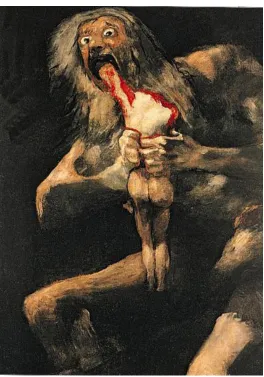
them, if misbehavior and stress warrant it. Goya would later elaborate on this
thought with the horrible Saturn Devouring One of His Children (Fig. 6). Saturn, the
ultimate father, exercises his right to eat his young at the slightest hint that they
might overturn his reign.
In the centuries since this picture was made, modern psychoanalytic thought has
given us insight into this situation: the bogeyman is a modification to the sense of
oneself as other, during the mirror stage of development in infancy and early
childhood.4
Misrecognition matters here: one learns the external form of the body, and how
to control it, giving rise to imagining one’s external form. This is an unreal thing deep in
the unconscious, and not something we are in direct control of; the image of oneself
always carries a painful quality of being a fragment, something which one will learn is
other.
This alone does not make the bogeyman. Extra steps are required: as this
specular I transitions to the social I, parental authority mediates the process of
presenting oneself to the world.4 Punishments, fear, stigma, and abandonment are
attached to one’s sense of other, which is in turn adhered to the feeling of self. As vague,
formless shapes find their way into the zone which I earlier called the Black Square,
otherness floats upward, meeting these impressions. Alone, huddled under a blanket in
faint light, eyes halfway open, the mind’s eye finds shape in the shadows: ghastly, ugly
monstrous faces and non-corporeal, ethereal forms that firmly state that they are
external, despite originating within.
Looking at a mirror, through a window, I momentarily found a form which is my
closest visual approximation of this process. I see the vague, dark shape of myself being
reflected, but I cannot identify it definitively as being me (Fig. 7). The window reflects
4Jacques Lacan, “The Mirror Stage as Formative of the Function of the I as Revealed
the light around it, but my shadow blocks out enough glare to allow me to see the
mirror inside, which repeats this form. The bogeyman, by my best approximation, is a
shadow within a shadow, a crude bit of consciousness inserted into unwanted
feelings ofotherness, always just around the corner, but never fully met. I am the
thing in the dark, stalking myself.
III.) Horla
When threat is paired with form, the result is not unlike some species of
spider: waiting quietly in a hole, they lunge forth to seize their target, carrying it
below, where it will be rendered into a hollow, lifeless shell. The shell is then worn
externally, an armor it quietly lives in. Yet, it is seen as external, something outside
us, a changing configuration of imagined threats. One burns their hand on the stove:
the pain of the real feeds this thing, giving it animation and shape. From the actual
experience, the image of a red hot stove is paired with unpleasant sensations,
guarding and guiding us away from being burned .
Most peril is figurative. Real, threatening, disfiguring pain is only
experienced in small, shocking doses, while the figurative world contains
inexhaustible expressions of potential trauma and pleasure. These are intermixed
signals of punishment to be weighed against reward. As I try and further describe
these conditions, definitions become difficult. These are not what Lacan called the
Gaze. That word describes the belief in objective judgment, the ability to construct
signs, objects, and narratives from the ambiguous features of people, places, and
things. What I am attempting to describe comes out of an older force, moving
underneath and through this system, waiting for the moment when its agents can
assign pleasure or pain to the most raw, indefinable stimulus. I conceive that the
gaze is merely their outstretched hand, reaching into our overt consciousness to
place pleasure upon another’s face or body, and pain onto a fist, an aggressive
This imprecision is further confused by the way these presences present
themselves to the world: externally, outside of the body. In sickness and distress,
one may find them extended beyond the vagaries of a shaded room, increasingly
overlaid into waking life. One feels something is overtly in control of one’s actions
from outside their mind and body, despite originating inside one’s self.
When Guy De Maupassant gave these feelings, thoughts, and impulses a name
near the end of the 19th century, he was suffering from the neurological effects of
late stage syphilis. He called them the Horla, and it is awful to understand that when
De Maupassant wrote a short story of the same name, he may have been
experiencing the same chilling condition as its narrator: the sense that something is
always near, able to take possession of one’s being, but resolutely external. The
word, Horla, is itself a reflection of this power. Translator Charlotte Mandell
suggests that it is a portmanteau of the French words “Out” (Hors), and “There”
(la),5 and likewise the narrator of The Horla never suspects that the horla who is
haunting him is internal, even though the reader knows it to be implicit.
In a crisis between Umwelt and Innenwelt, outer and inner conception of
one’s being, when unconscious material swells upward at a dangerous pace, is it so
far- fetched to conceive that a horla might be partially dislodged into our waking
life? This is not unlike an organ extended past a sphincter, exposed and festering in
a place it should not be. Objective space is an inhospitable environment for them,
5 Guy de Maupassant, The Horla, trans. Charlotte Mandell. (New York: Melville
but the Horla are a magnitude stronger than our rational minds, easily able to upend
reality into whatever narrative will meet their needs. As outer consciousness
becomes their fragmented possession, one slowly feels as if their actions are
unwillingly controlled by someone else, but are blocked from seeing the origin point
within.
My suspicion is that contemporary communication, media, and networking
have made boundaries thinner, and the doorway for their entrance bigger. As we
receive more information through spectacles, it becomes difficult to ascertain
between one’s own thoughts and exterior information, causing internal threats to
seem increasingly real. Guy Debord explains,
The spectacle erases the dividing line between self and world, in that the self, under siege by the presence/absence of the world, is eventually
overwhelmed. It likewise erases the dividing line between true and false, repressing all directly lived truth beneath the falsehood maintained by the organization of appearances. The individual, though condemned to the passive acceptance of alien everyday reality, is thus driven into a form of madness, in which by resorting to magical devices, he entertains the illusion that he is reacting to fate.6
Fate is a word that carries with it the fear of potential estrangement, exile,
abandonment, loss of love and life. Exterior awareness has been re-oriented to meet
fate’s demands, disregarding tangible sensation in favor of poorly understood,
second-hand threat.
6 Guy Debord, Society of the Spectacle, trans. Donald Nicholson-Smith (New York:
Zone Books, 1994), 63. Ebook version.
For many months, I have often found myself staring at a strange image of two
tigers imprinted on a piece of waved, curving fabric, vexingly fake but also a ghastly
menace that feels real enough to attach to deeper feelings of fear.(Fig. 8). The
image is not of Horla: they have no fixed form, and there is no objective way to
represent them. We can only understand their intimidation, what they want us to
see, and feel. The image of the tiger asserts that the danger here is false, a sign
rather than a present, pressing situation. What has kept my eye affixed is the way
the left tiger’s face folds downward into a void, where metaphorical and real hazard
are equal. As I say these words though, I remember there is no comparison
between the two: figurative threat is often so powerful in its present state that it is
not uncommon to go through literal hell in order to avoid a figurative one.
Winding further into the black curve of that angry split, I sense another
thing: that horla are always plural. There is no one unified, single horla; they are
conflicting, contradictory things, mixes of instinct and subconscious thought that
make themselves known through signs, voices, and gazes. Stripped of these things,
and forced to signify without their normal means, one can see their expression as
pure abstractions, freely moving marks, continuously forming paths that intersect
and re-intersect so densely as to become an impenetrable mass.
Re-attaching indexes, signs, voices, and ideas to this movement, their basic
function becomes more clear: they ascertain whether to resort to fight or flight,
whether it is safe to act on a need for hunger, thirst, shelter, or sexual attraction, and
There is something throughout history which is disturbing about this
essential component of the human condition. Rather than acknowledge these
figments as a guiding force, they have become ghosts, demons, ghouls, and all other
manner of convenient bogeymen. With discipline and mental training, it may be
possible to consciously negotiate with the many-faced, inner self. In spite of those
healthy expressions, the person who chooses to live in denial of their fears and
desires is seen as a saint, while healthy bartering is often believed to be conniving,
common, and scandalous.
When I look at Martin Schongauer’s Renaissance engraving, The Trial of St.
Anthony (Fig. 9), I no longer see someone resisting evil, but a person deeply out of
touch with themself. As he floats in the air, alone in the desert, or in a dream,
strange creatures pull him from all sides, making demands and ultimatums, which
St. Anthony patiently ignores. This disavowal of desire is as much a crime in the
reality of the unconscious as the greatest atrocities are in our waking life: in this
picture St. Anthony is a man who is murdering himself through piety, slowly
starving and ignoring the animal components from which he is made. His face
reminds me of the type of person who would say that a wolf is evil and a lamb good,
because a wolf will eat a lamb, without acknowledging that good and evil are human
concepts that have no equivalent in animal behavior. His overall demeanor is the
jaded pose of someone who has determined that it is simply his fate to patiently
suffer having a body and mind, while he waits to be rewarded for denying the
existence of those things.
This mistake of place can be seen in an illustration accompanying an early
edition of DeMaupassant’s The Horla (Fig. 10): as the narrator looks in the mirror,
he sees himself, but does not recognize one part of him submitting to another.
Instead, the whispy, ineffable thing floats away from him. He is sure the source of
Fig 9. Martin Schongauer, The Trial of St. Anthony, 1470-75. Engraving, 30x21.8cm. Collection of the Metropolitan Museum of Art, New York. From: The Met Museum Online. (Accessed March 10, 2017).
IV.) Where There is Law and Order
As I prepared to leave Montana in July of 2014, a curious thing happened: a
pamphlet fell from some old, local magazines and publications a friend had given me
to make collages from. The words at the bottom of the page have permanently
etched themselves into my consciousness. They read:
“SUPPORT YOUR LOCAL POLICE. WHERE THERE IS LAW AND ORDER, THERE IS
NO COMMUNISM.”7
This work, Ted Billings’ 1969 leaflet DEN OF THIEVES, has the same ferocious
kind of lies I know from our interconnected age, but I could not look away from its
much earlier, brutal form. Each letter was typed by hand, overlaid with stamped red
statements that resemble dried blood, like “GOLD MUST GO,” or “THE U.S. WILL BE
BANKRUPT BY 1970 –BANKER ARTHUR UPGREN,” or the uncomfortably underlined
word Moneychangers (Fig. 11). The return mailing address is in Denver, Colorado,
not far from the conceptual territory of my youth. I had never lived outside of
Montana for more than a few scattered months until my relocation to Louisiana. As
I scanned over this document, and considered my recent diagnosis of high
functioning autism, I felt a twinge: here was someone I could have been, unable to
contain continuous thoughts about an evil cabal ruling the world, while patiently
deflecting charges of anti-semitism. It is prophetic how the ignorance, fear, and
hatred of this document has been profoundly distilled into compact, internet-esque,
twitter-like statements.
Here is where I deviate from Debord: I do not come from a place where
spectacle has a monopoly over hearts and minds. When I watch the strange, ugly
political situation currently unfolding in 2017, it is certainly easy to imagine that the
shocking statements, obvious corruption, fake facts, and total disregard for objective
reality are pure expressions of a culture entrenched in spectacle. However, Ted
Billings reached for, and found these things with little care or need for specular
validation. His home has been made inside of the black square, a marginalized, lone
voice directing its foulness outward while hiding its true intention to alienate and
fragment reality.
Rather than a visually reactive route there, his path is was found through an
inability to comprehend modern macroeconomics and a firm belief that, “GOD’S
INDIVIDUAL will again be free to make his own DESTINY.” This is a direct example
of the type of thinking that Debord speaks of: Billings is an individual so removed
from spatial, three-dimensional reality that his logic in this work consists almost
entirely of magical thinking. His ultimate conclusion is that it is his fate to suffer, in
order to return free will to other individuals. This “freedom”, however, is under the
watchful, terrorizing gaze of imagined, divine wrath.
Despite the visual loudness of this document, it is important to remember
that the crackpot frame of mind is not necessarily blaring or obnoxious. Many cults
and radical groups I have studied have leaders whose quiet, insistent presence
confirms deep irrationality for followers. This is the firm hand that holds the door
culture begins to placate its members by validating irrational superstitions and,
those things will eventually become its master.
I have reproduced this document as a large silkscreen that comprises half of
the work Passover (Fig. 12), out of a need to understand how conspiratorial, magical
thinking forms without any kind of specular vantage, but simultaneously leaves the
door open for spectacular madness. Enlarged and pushed from the private sphere
of consumption and into the public realm of the white cube, I feel that its form and
purpose speak volumes about a reality which requires no objective input, only raw
feelings connecting random, misconstrued facts.
One thing that I must elaborate on is that I have an uncomfortable foothold
and vantage in this world. I was not formally diagnosed with a spectrum disorder
until a few years ago, but I can attest to having a quiet rage that comes with being in
discord with others’ body language, and the greater culture. I feel constantly out of
touch with outer voices while simultaneously painfully aware of inner ones which
never fully manifest into coherent narratives. Despite this confusion, I find that they
must be expressed, and no matter how hard I consciously try to restrain myself, they
embarrassingly spill outward. Sometimes this is as word soup, and at others,
confusing, half-formed polemics.
Ted Billings’ writing remains urgent for me, because its logic, rhythm, and
crudeness have the same buried, not quite conscious affect I know is similar to the
words I am constantly attempting to contain. This rambling, monstrous quality is
why I speak so firmly of the horla: it is as if I am not in total control of my voice. It is
a traitor, turned against me, and I nervously acknowledge its ability to embarrass
and isolate.
This combination of blurted, unpolished language and inability to hold back
illogic characterizes work that opens the door for an earth-flattening, mind-altering
type of irrationality. Consider the greatest expression of this in the western
paradigm: The Book of Revelation. In its original Greek, it is full of misspelled, coarse
language;8 and its author is vague: we only know that he was exiled to the island of
Patmos for an unspecified crime, and most likely is not the apostle John. Revelation
is not scholarly by the standards of the period, but unlike the dullness that makes up
the bulk of religious text, it has a definitive form meant to open this gateway between
subjective and objective mind, allowing all manner of phantasmagoria through. One
only needs to casually mention seals, trumpets, and horsemen, and quickly, visions of
murder surface, blood pouring in the streets and fire at every corner.
This could be understood as the result of spectacle: our mass media has pinned
simple, straightforward symbols onto John’s surreal, vague fictions. Still, if this writing
did not invite forth imagery from abject trauma and nightmarish constructions of the
other, these would not have been expressed as spectacle in the first place. Spectacle, by
my approximation, does not appear to be an exclusive, one directional affair, as asserted
by Debord.9 Perhaps for a large section of humanity, spectacle is a constant force to be
imitated, creating the thin grounding for fair cultural play overseen by an inert,
unchanging god. However, for an ever present minority of emotionally maligned,
socially isolated people, this is not the case: our routes to madness are shorter and more
severe.
Reflecting and reproducing socially correct signs of spectacle does not matter
much for a volatile, subjective-minded person. Unplugged from culture in a distant
province, their violent visions run in a reverse direction: signs accumulate into indexes,
and objects return back to indefinable, formless absurdities. One cannot definitively
know what John the Revelator meant by mentioning a red dragon with seven heads and
ten horns with seven crowns, praising a beast from the sea. It remains immeasurable,
suspended over the reader without concrete explanation (Fig. 13).
Fig. 13. Anonymous, Apocalypse Miniature: The Dragon Waging War, The Beast of the Sea,
1295. Tempera on Vellum, 10.5x14.7cm. Collection of the Detroit Art Institute. From: Detroit Art Institute Online, Accessed March 10, 2017. http://www.dia.org/
This is not the easy dialogue of religious validation: it does not invite the reader to
find a sense of spiritual normalcy and institutionally approved action. It is meant to
intentionally undo those relationships, returning power to an irrational, personal place of
disorder and panic. Experience under these premises is shoved out of utilitarian need and
into the grasp of intuitive reasoning.
Similarly, the rude red of Ted Billings’ stern warnings is a simple sign of color to the
conscious mind, but to the inner reality he targets, it occupies a position between figurative
and literal: here is the blood of patriots, spilling forth, to inform us about how freedom is
being threatened by a foreign party. That his statements resemble modern postings from
our electronic world reveals that these templates existed well before the rise of our current
V.) Nobody Has Blinded Me
“Friends, no-man kills me; no-man in the hour of sleep oppresses me with fraudful power”
-Polyphemus, The Odyssey.10
To the right of my enlarged reproduction of Ted Billings’ conspiracy tract, I
have placed a symbolic, odd overlay: a cartoon of a sad clown, on top of which a
surreal, floating halftone illustration of a pirate covers both eyes. The pirate only
has one eye: a patch covers the opposite side of his face. A cyclops emerges for me:
a great, primordial figure of combative, unapproachable masculinity (Fig. 15). There
is a trauma causing agony and terror, that has been overlaid with a misdirected
rage. A streak of red marks this cycle as requiring of bloodshed to sustain it. When
compared to the archaic form of the Polyphemus, as imagined by the 18th century
classicist Johann Heinrich Wilhelm Tischbein (Fig. 14), the mythic and modern
versions combine in my imagination. The cyclops thrusts forward across history to
devour my life, and any potential lives to come.
Homer’s cave is a different arrangement than Plato’s later exercise. It is
inhabited by a great, inhuman expression of hostility, which follows no law. Men
become its food; it keeps them captive to consume them at its leisure. Out of
desperation, the men captured in this cave devise a plan: they will blind the creature
with a searing, hot spear, and use further deception to escape.
This episode momentarily reveals a lubricant in the machinery of civilization,
which has outlasted every god, religion, and institution, while existing continuously
through them. It briefly appears when Odysseus whispers something into the
Cyclop’s ear: that his name is No-man, or in more concise, contemporary terms,
Nobody. This is done to avoid wrath, punishment, and death by divine force for the
sin they will commit: sharpening a pike, they shove it into the eye of the drunken
monster, permanently blinding it. Moving its rock and stumbling out of its cave,
Polyphemus screams, “No-man kills me,” to its one-eyed brothers, who give no aid.
Meanwhile, his father, Poseidon, remains momentary unaware of his misery.
The anarchic system of warlords and their right to express extreme violence
is the cave we have never left. The vicious heart of patriarchy sometimes beats
quietly, but it still lives. Odysseus has long exited the fictional location of his story,
but our barbaric, ancient order remains, sometimes hidden under layers of
refinement, and at others, overtly present. The constant force of men destroying
men, in order to more perfectly own women and make progeny does not leave.11 It
finds a sublimated voice, a soothing ideal, like chivalry or honor, both subtly
indicating male disposability interwoven with a right to make women property.12
Both of these words also contain the intangible presence of Nobody. As long
as a grotesque status quo is presented well and with a coded, friendly, banality of
routine, patriarchy is not believed to exist, even when in plain sight. Within a span
as short as a generation its true form can be germinated and sprouted, enslaving
11 Thorstein Veblen, Theory of the Leisure Class (Oxford: Oxford University Press,
2007), Kindle Edition. 17-20.
and destroying hundreds of millions of lives. Nobody has a kind of nicety about it:
without culpability for prior events, each generation carries its blindness, able to
rebuild and forget about the calamity slowly brewing under the surface.
For someone like Ted Billings or John of Patmos, Nobody is unacceptable.
Their minds contain a kind of masculine fundamentalism which requires blame.
The extremist worships blind aggression and demonizes those they feel are
unaccountable. They favor a society with more coercive features which would
furnish them with powerful protections and influence. Their wish is to regain
permission to satiate their slow, lustful appetite to subjugate others.
Those with a crackpot-perspective believe Nobody’s refined form of
patriarchy can only hold so long. Still, they are groping in the dark, unable to
coherently piece together an objective model of when a collapse, or apocalypse, will
bring their savagery into favor. This passion for the return of “true” patriarchy is
littered with failed predictions and bizarre preparations.
When tensions do begin to mount, the crank-thinker knows how to amplify
their efforts, battering the shell of civility with their preferred deception, Not Me, the
destructive twin of Nobody. While Nobody is a faceless thing content to let injustice
and cruelty disseminate, a person who carries Not-Me is usually ready to punish
somebody. The fanatic is always a friend of Not-Me. In times of unrest, they find
V.) The Great Humorist
Look in the mirror and touch your face. Now harder, and pull it any which way
you like. Make the ugly or the silly one that our mothers told us not to, because it might
stay that way. You have summoned Not-Me, the destructive form of Nobody. It is the
ability to contort and make oneself unrecognizable, to express that one’s face is just
hollow fragment, and that one’s actions are something that this empty figment did, the
result of a temporary change in disposition or attitude. It lends the power of invisibility,
helping us slide away from crimes we commit and others we merely benefit from.
We laugh as it twists atrocity into comedy, and other’s weaknesses into the
worst kind of threats. This is different from Nobody in that we are not completely blind
to our lie: we have a justification for it. When I look at the picture of my good friend
Riley Flynn making his face unrecognizable for the camera, with one side expressing
conscious horror and the other pulled to a total sloth-like, disaffected boredom, I can
perceive this effect (Fig. 16). It deflects gaze so effectively, placing it on others, that I
simply cannot see Riley there: he has momentarily slipped out from my view, from my
memories and knowledge of him, replaced with an irrational, improbable creature
capable of anything. After he returns its face to its original position, I will recognize
him again, as if he quietly exited the room and returned.
While Nobody might have a taste for blinding and confusion, it at least deflects
responsibility out into a diffuse void. Not-Me is a true vector for insanity and suffering,
as it points judgment back at the mass of humanity like a murderous gunman randomly
picking targets in a crowd. This is a hidden force, that, by my approximation, actually
can take nearly complete control of one’s gaze. Its targeting follows the path of least
Fig. 16 Not Me. 2014, Printed 2016. Archival Pigment Print, 86.4x129.5cm.
There are consequences to using this force. Not-Me is cruel to the careless. It
can, and will, choose aliens from outer space, giants under the hollow earth, a racial
minority, conniving women, bankers, a hidden cabal of secret elites, or any number
of government agencies, as being to blame for one’s shortcomings. If it desires to
bend our rationality backwards, shamefully exposing our mental frailty, it can do so,
while others laugh. We are each sure that we are immune, unable to imagine that
Not Me, however, is the one truly cackling underneath our facade. The
companion piece to Passover is titled Christmas Future. It depicts Not-Me, in its
signature hand-over-the-face position, ripped from the Family Circus comic (Fig. 17).
In a lower layer, Tischbein’sPolyphemus seemingly becomes an endless spread of
red, touching a maddeningly scribbled series of circles that seem to indicate that he
is the hidden author, floundering in the dark to find a target. The thing being circled
obsessively is the birth certificate of Barack Obama, a benign subject made
controversial with thinly veiled racism.13 My imaginary conspiracy theorist writes,
“WHERE IS HIS MOTHER’S MAILING ADDRESS?” over and over again, denoting that
there was no mailing address listed for Anne Dunham, Obama’s mother
(presumably because it was the same as his father’s). Not-Me has a kind of
arrogance about it: its user partially knows their own racism, but enjoys the
inexhaustible argument their superficial denial will bring.
When I think of Not-Me, it brings to mind American Soldiers marching
German civilians out to see where the strange smells of sweet burning meat had
come from, the mass graves and piles of bodies at Buchenwald. I can imagine the
smoldering ruins of Berlin, and the cognitive dissonance that there was simply
nothing that could have been done. It is the White American who says their
ancestors didn’t participate in slavery, while benefitting from a system stacked in
their favor. Here is the driving force behind the idea that nuclear weapons should
13 Chauncey Devega, “Trump’s Attack on Black America: Birtherism was Always About More Than
Obama’s Birth Certificate.” Salon.com. September 20, 2016. Accessed April 3rd, 2017.
even be made, let alone stored and pointed at anyone: we will not be the ones who
fire the first shot.
It also happens to be a little boy, pointing and saying it was his sister’s fault a
vase was broken while playing with a ball in the house. It is something so small and
trivial as blaming the dog for passing gas, but also an angel of destruction and
breaker of nations. We rightfully feel paranoia and unease that Not-Me exists.
At the same time, we are sure that it is other people in denial, and not us.
VI.) A Hand Over the Face
Jeff Wall’s piece, Mimic (Fig. 18), shows Not-Me, in what may be its first pure,
concise depiction in visual history. A white man walks down the street, making his eyes
slanted at a man of Asian descent. The perpetrator shows his ability to turn himself into
a caricature, which is then used to flatten the reality of another human being. He is
projecting the fragmentation of Not-Me as a casually hidden cultural weapon, which can
be concealed as quickly as it is brandished. This inability to hold an offensive, crude liar
accountable causes a kind of learned helplessness, a passive acceptance of oneself as a
spectacle, a random collection of external signs instead of a living being.
Returning again to my photograph, Not-Me (Fig. 16), I find the weird, deflective
pose of my close friend has an additional function beyond avoiding judgment. In order
to bring out this phantom this photograph has been extensively manipulated to create
otherworldly contrast and ambience. Not-Me is the ability to make a caricature,
originating with the manipulation of one’s own face and voice, learning to make a fake,
usually rude surface that is not recognized as oneself. This floating thing can then be
placed wherever its holder likes, turning another person who is comprised of
complicated experiences and desires into a crushed, absurd narrative that is easily
Fig. 18 Jeff Wall, “Mimic”, 1982, in Jeff Wall, By Kerry Brougher. (Chicago: Museum of Contemporary Art Press, 1997), Page 63.
I have great difficulty with documentary photography, which I feel makes a
dignified caricature of its subjects, turning them into rigid, symbolic models to be read
as a kind of information which Roland Barthes called Studium.14 The producer often
molds their raw material, other humans and situations, into a form which gives the
removed spectator a sense that they are well informed about people without having
met them, or that they know a place because they have seen pictures of it. This is
because these mass produced-images seem to align into repeating patterns.
This is a kind of Not-Me which the photojournalist eagerly indulges, using
aesthetics and circumstance to manufacture the falsehood of archetypal conditions
based on momentary glances and pose. Not0Me is covertly given a kind of mystical
nobility through aesthetics and narrative, a slick packaging over the vulgar reality that
Not-Me has taken the place of a real person. Dorothea Lange’s Migrant Mother (Fig. 19)
provides a well-known example of this: most viewers will never know that its primary
subject has a unique name, and a history before and after the publication of the
photograph.15 They simply feel that it has come to represent the tenacity and
steadfastness of motherhood in the face of adversity; I find it revolting that her actual
experience has been invalidated, with Not-Me in her stead, again, with a hand,
tantalizingly on her face. Martha Rosler has commented on this situation, how the
document becomes a thing separated from reality to support particular convictions and
ideologies, stating,
A good, reasonably principled photographer I know, who works for an occupational health and safety group and cares about how his images are understood, was annoyed by the articles about Florence Thompson. He thought they were cheap, that the photo Migrant Mother, with its obvious symbolic dimension, stands over and apart from her, is not-her, has an independent life history. (Are photographic images, then, like civilization, made on the backs of the exploited?)16
15Martha Rosler, “In, around, and afterthoughts (on documentary photography)”, in The
Contest of Meaning: Critical Histories of Photography, ed. Richard Bolton. (Massachusetts: The MIT Press, 1981) 314-315.
Florence Thompson, the migrant mother in Migrant Mother, remains an
enigma to such a kind of viewer and producer of photography. For them, the
external fragment that was copied from her real existence is particularly helpful in
making a figurative worldview, the universal condition of motherhood, into a fixed,
literal thing that cannot be extinguished or altered.
The camera in this case may as well be a gun, a thing to kill the subject. Their
shape is skiinned, and tanned like a hide, to cover and protect Not-Me. Rosler has
identified the ugly face of the behavior: making lower classes and marginalized
groups into a kind of prey for both sides of the political spectrum. For the left, this
means an endless supply of oppressed victims used to feed their sense of moral
correctness, while the right uses the same pictures to construct a narrative about
parasitic freeloaders burdening the system.
Rosler explains,
Documentary is a little like horror movies, putting a face on fear and transforming threat into fantasy, into imagery. One can handle imagery by leaving it behind. (It is them, not us.) One may even, as a private person, support causes. 17
VII.) Red Robe Backwards
I am following the color red, again, this time in Houston. It is October 2014: I
have come here for the purpose of obtaining printing equipment, but am momentarily
distracted by the color red drifting down a sidewalk during what photographers call the
“Golden Hour”, the last sixty minutes before twilight. This stark, straight, receding light
striking this fabric made a rich, strange hue that I can only compare to the bleeding red
of an old tube television. I am quickly exiting my vehicle, and within distance to make
an image; there is something about this robe that seems to hang outside of
consciousness, like Goya’s bogeyman, a piece of fabric which has been assigned psychic
presence.
Then I am too close: the person on which this object rests has seen me, glancing
backwards at a moment when I am pressing the shutter. The object I had so sought out
to complete my vision of the colors and situations that define Southern photography, is
suddenly de-objectifying, becoming a person, someone who does not deserve to be
suspiciously followed and made into a photograph. I approach them and profusely
apologize, but they are gentle and confident that when I show the photograph I have
just taken of them. They do not care, and smile and ask where I’m from, whether I work
for a newspaper. I cannot forget their words: there are so many photos in the world,
what difference does it make?
The memory remains as fresh now as it was years ago: as I look at Red Robe
Backwards (Fig. 20), I see the end of the trail of blood, the target that Rosler has so
eloquently described. Where I desired to make an object, there was a person behind it,
and her eyes speak of a reality that I have no factual access or insight into. It is not just
her and me into dust. When her life is extinguished, what she has seen will vanish along
with the pain, sorrow, and joy that accompanied a life. It is easy enough to imagine her
living through segregation and systemic oppression, but the hard reality is that I cannot
accurately express her truth. Even if I conducted long interviews and documented her
entire existence, these things would still be vicarious signs of a life, not the life itself. If
there is a universal element here, it is the condition of impenetrability, the wall of death
which stops the gaze.
I am a fool to think that a photograph can give any kind of accurate depiction of
the place and time she is from. In her eyes, I can only see myself standing there,
threateningly pointing a camera. I understood, for the first time, representation as a
kind of butchery. It is a forced fossilization of reality into a small, distant thing for our
thoughts and feelings to be imposed on. Not-Me finds a concise, unclouded reflection
here, not unlike a mirror amplifying light into a burning heat. As I imagine myself
creating the situation which resulted in this photograph, I feel a brashness and
ignorance, the privileged assumption that photographs constitute a higher expression,
that I accurately can capture the world as it is. Each time I look at this image, I sense
that there is something slowly strangling my empathy, trying to destroy and replace me,
and that I must firmly remove its grip.
I do not wish to make my way in life scraping the exterior form off other
humans, to advance the agenda of Not-Me. Does it matter whether that act has been
assigned a profane or sacred status? Each moment of life is unique and haunting, and
cannot be precisely replicated. As it passes, so do we. The continuous, flowing,
unending path of reality cannot be conscripted to deny death. It constantly asserts
Worse as a Picture
I.) Fresh Prints
There is a photograph my father flinched at when he viewed it in my thesis exhibition.
Fresh Prints depicts a hand, covered in bright crimson, reaching into the entrails of a deer, held in
a position that indicates a firm grasp of something deeper (Fig. 21). It is the grip of my friend
Jenni, who works much of the year as a forester along the Montana-Idaho border. Her hands are
far rougher than the majority of men I have ever known.
My father also has weathered hands again, after resuming his practice as an electrician.
This is mostly to ward off the boredom of retirement in the isolation of eastern Montana. As a
child, though, I remember his hands having the smooth sheen of a bureaucrat. Sometime before I
was born, he had switched away from pulling wire to moving a cursor on a glowing green screen.
His days were filled with connecting vectors that would form precise drawings, to be translated
into roads, boat ramps, and trail heads, and other access points into the wilderness. The hunt was
a connection to his past, before computers and office politics, when he and his father would haul
carcasses together.
As we are looking at this image and he jerks back, I gently remind him that when I was six
years old, his hands guided mine into the remains of a deer to remove intestines and touch the
heart. I did not wince, despite the fact that it was slimy and gross to touch the recently deceased.
It was also a new sensation, and I had little programmed reaction to the sign of death. He believed
it was important to understand that a corpse provided us with food. Before I turned twelve, we
rarely ate red meat that wasn’t wild game.
Looking at a photograph of this, though, my father is taken somewhat off guard, and
which an animal is dressed gives little time for contemplation and an articulated response. Still,
these were only short moments that pale in comparison to the years we spent hanging deer in the
garage, skinning them, sawing off their heads, burning leftover hair, wrapping cuts and grinding
scraps into hamburger. If anything, I might expect him to feel hungry, instead of having squeamish
regrets.
I don’t feel sad, amused, disgusted, or peckish looking at this photograph. I only find some
satisfaction that it has good composition and vibrant color. The reaction it gives to others is
remarkable: I have often heard that it is painful, even traumatizing to look at. Perhaps this is a side
effect of religious manipulation and cinematic depictions of torture. Whatever the case, there is
no pain in the photograph: that has been carried by the viewer, and drawn out by its scenario. The
animal was dead, and the moment has long passed.
II.) The Deathless
Observing the abrupt borders, peculiar angle, and close-up position of Fresh Prints, reality
becomes warped in a fashion that I believe triggers certain internalized spectacles that form the
fictional lake of fire. By that, I mean an imaginary place of boundless suffering. This is
unfortunately a fixed feature for so many minds, including mine. I feel rage at the way it was so
carefully manufactured by John of Patmos, a criminal whose writings I believe have an explicitly
sociopathic bend. As discussed earlier, John’s method was a mixture of precise patterning and
indefinite terror, leading only to perpetual agony or eternal bliss. Death is not considered a
possibility in his paradigm. One cannot simply exit into nothing, outside of punishment or reward.
The long term results of this work are ghastly, lowering the quality of life for those who are
emotionally affected by such brutal hogwash. Consider the horla: in a healthy state, one might
expect them to be expressed as simple, stern reminders not to act carelessly, spoken in the voice
of a parent, inhabiting a quiet corner of shame and injury. Instead I, and many others, have
endured so many unpleasant visions of a dark place where wicked things will pursue and
consume me, severing and reconstituting my body ad nauseam. I sense much contemporary civil
discourse is stuck in the Middle Ages, despite gluttonous amounts of new science, art, and
freedom. I cannot conceive why else depictions of hell remain so emotionally relevant. When I
view images like the Limbourg Brother’s 15th century miniature of Satan sucking the souls from
earth to be excreted into its bowels (Fig. 22), I find cerebral tension rustling awake childhood fear,
when I should simply laugh at its ridiculousness.
I often feel as if I have done great wrong, whether I am aware of it or not. There is a sense
that I owe favors to other people and invisible deities. As these thoughts and feelings bedevil me,
I find it conceivable that deathlessness is not just an element of the social contract, but is the root
the wrath state and god. All of these entities, future, state, and god, are binding expressions of the
deathless: they are constructions that carry indefinite threats of harm and reward, to be avoided
or controlled. Their invisibility is ensured through interpersonal communication: both captor and
captive, every citizen is an agent of deathlessness, ensuring that death is never fully
comprehended. Deathlessness is the thing that keeps our sense of mortality safely sealed away.
The artist and author can reveal that condition, and give our audiences opportunities to
break with its unspoken bargain. This gift was given to me from my parents, who simply wished
me to have a realistic relationship to food. Through the finality somewhere in the glossy, empty
eyes of an eviscerated creature, I became aware of death’s profound, quiet expression, and came
to understand it as a calm, reassuring ally against the emotional bullying and chicanery of culture.
If one wishes to exit from civilization, it can only be through death, in both figurative and literal
ways.
Fig. 22 Limbourg Brothers, “Lucifer Torturing Souls as Well As Being