World Maritime University
The Maritime Commons: Digital Repository of the World
Maritime University
World Maritime University Dissertations Dissertations
2000
Proposal for improving marine environmental
protection management in the Kingdom of
Cambodia
Sith Roath
World Maritime University
Follow this and additional works at:http://commons.wmu.se/all_dissertations Part of theEnvironmental Policy Commons
This Dissertation is brought to you courtesy of Maritime Commons. Open Access items may be downloaded for non-commercial, fair use academic purposes. No items may be hosted on another server or web site without express written permission from the World Maritime University. For more information, please [email protected].
Recommended Citation
Roath, Sith, "Proposal for improving marine environmental protection management in the Kingdom of Cambodia" (2000).World Maritime University Dissertations. 427.
World Maritime University
Malmö, Sweden
PROPOSAL FOR IMPROVING MARINE
ENVIRONMENTAL PROTECTION
MANAGEMENT IN THE KINGDOM OF
CAMBODIA
By
ROATH SITH
Kingdom of Cambodia
A dissertation submitted to the World Maritime University in partial
fulfillment of the requirements for the award of the degree of
MASTER OF SCIENCE
in
MARITIME ADMINISTRATION AND
ENVIRONMENTAL PROTECTION (MAEP)
August, 2000
Page: ii
Declaration
I certify that all the material in this dissertation that is not my own work has been
identified, and that no material is included for which a degree has previously been
conferred on me.
The contents of this dissertation reflect my own personal views, and are not
necessary endorsed by the University.
……….. (Signature)
………. (Date)
Supervised by:
Name: Fernando Pardo
Office: Associate Professor,
World Maritime University
Assessor:
Name: Lt. Cdr. Maximo Quibranza Mejia
Office: Lecturer,
World Maritime University
Co-assessor:
Name: Dr. Gunnar Kullenberg
Office: IOI Executive Director,
Acknowledgements
For the purpose of this dissertation, I would like to express my deep gratitude
and warm regards to those who provide assistance including spiritual, financial and
materials for the successful achievement of my study at World Maritime University.
First of all, the author would like to express my deepest gratitude to parents:
father Mr. Roath Kimseoun and mother Ms. So Kab; and sister and brothers, who
provided invaluable assistance and encouragement as well as sharing the bed and
good time with me.
Secondly, I would like to express the highest gratitude to His Majesty the
King Preahbat Samdech Preah Norodom Sihanouk and Her Majesty the Queen
Samdech Preah Reach Akak-Mohessey Norodom Monyneath Sihanouk; and special
thanks to the Royal Government of Cambodia; the Minster of Environment, Dr. Mok
Mareth; who generously gave me opportunity to be able attended the course at World
Maritime University, Malmö, Sweden for the academic years of 1999 and 2000.
Further thanks also to governmental institutions and other NGOs, who kindly
provide information and materials for the purpose of this dissertation.
Thirdly, I would like to express special thanks to the Denish International
Development Agency (DANIDA), Denmark, who generously provided me with a
scholarship to be able participate in the course on Maritime Administration and
Environmental Protection (MAEP) at WMU.
Finally, I would like to thank the Rector, Vice-Rector, resident professors,
lecturers, visiting professors, WMU staff and colleagues, who shared their
knowledge and experiences with me by many means of work, contributing to this
Page: iv
Abstract
Title of Dissertation: Proposal for Improving Marine Environmental Protection
Management in the Kingdom Cambodia.
Degree: MSc.
This dissertation is a study proposal to enhance marine environmental
management in the Kingdom of Cambodia. The aims of this topic are to elaborate
the current management system, national legislation, and the present and future risks
to the marine environment.
A short view is concentrated on the overall environmental management
system, basically the structure of the Ministry of Environment and other
governmental institutions involved with the management of marine environment.
Economic factors, coastal and offshore development, inadequate legislation
and institutional cooperation, and maritime transport activities cause present and
future degradations to the marine environment. The relevant international
conventions and agreements related to the marine environment have been considered
to integrate the main concept into the national legislation, which is convenient for the
sustainable use of marine resources and development.
Initial ideas for enhancing the marine environment such as the strengthening
of the environmental management system, maritime administration, legal
instruments, and development of a contingency plan for combating oil pollution have
been highlighted. Centers for Environmental Education and for Marine Research
and Development are required to be established for providing marine and
The conclusion analyzes the outcome of the Center for Environmental
Education and the Center for Marine Research and Development after being
established and the essential of a contingency plan for the protection of marine
pollution, particularly oil spills from ships.
KEYWORDS: Contingency Plan, Convention, Environment, Legislation,
Page: vi
Table of Contents
Declaration ... ii
Acknowledgements...iii
Abstract ... iv
Table of Contents ... vi
List of Tables ... x
List of Figures ... x
Abbreviation ... xi
1 Chapter 1: Introduction... 1
1.1 Topic Description ... 1
1.2 Aims of dissertation... 2
1.3 Relevant topics related to the field ... 2
1.4 Research methods and difficulties ... 3
2 Chapter 2: Overview of Environmental Management in Cambodia ... 4
2.1 Background... 4
2.2 Structure of the MOE ... 5
2.3 Overview of environmental management in Cambodia ... 6
2.3.1 Environmental policy and legislation ... 6
2.3.2 Environmental education... 8
2.3.3 Nature conservation and protection... 9
2.3.4 Pollution control management... 12
2.4 Other institutions involved in environmental management... 14
2.4.1 Ministry of Industry, Mines and Energy ... 14
2.4.2 Ministry of Agriculture, Fisheries and Forestry ... 15
2.4.3 Ministry of Public Works and Transport... 15
2.4.4 Municipality... 16
3 Chapter 3: Analyses of Current Marine Environmental Problems ... 18
3.1 Problems due to economic factors... 18
3.1.1 Mariculture ... 18
3.1.2 Charcoal production ... 19
3.1.3 Illegal fishing... 20
3.1.4 Poverty... 22
3.2 Problems from port and offshore developments... 22
3.2.1 Pollution from port rehabilitation ... 23
3.2.2 Pollution from offshore development... 23
3.3 Other problems influence marine environmental management... 26
3.3.1 Human resources ... 26
3.3.2 Problems in implementing environmental legislation ... 28
3.4 Expected on future problems ... 30
3.4.1 Pollution from land based... 30
3.4.2 Pollution from marine activities ... 31
4 Chapter 4: Measures for the Protection of the Marine Environment from Pollution ... 35
4.1 MARPOL Convention... 35
4.1.1 Purpose of the Convention ... 35
4.1.2 Description of the Convention... 36
4.1.3 Status of Cambodia to the Convention ... 37
4.2 LONDON Dumping Convention... 37
4.2.1 Purpose of the Convention ... 38
4.2.2 Description of the Convention... 38
4.2.3 Status of Cambodia to the Convention ... 39
4.3 UNCED (Agenda 21 on the protection of the oceans) ... 39
4.3.1 Purpose of Chapter 17 “the protection of the oceans”... 39
4.3.2 Description of Chapter 17 “the protection of the oceans”... 40
4.3.3 Status of Cambodia to Agenda 21 ... 41
Page: viii
4.4.1 Purpose of the Convention ... 41
4.4.2 Description of the Convention... 41
4.4.3 Status of Cambodia to the Convention ... 42
4.5 OPRC Convention ... 42
4.5.1 Purpose of the convention ... 43
4.5.2 Description of the Convention... 43
4.5.3 Status of Cambodia to the Convention ... 44
4.6 INTERVENTION Convention ... 44
4.6.1 Purpose of the Convention ... 44
4.6.2 Description of the Convention... 44
4.6.3 Status of Cambodia to the Convention ... 45
4.7 CLC 69 Convention... 45
4.7.1 Purpose of the Convention ... 45
4.7.2 Description of the Convention... 46
4.7.3 Status of Cambodia to the Convention ... 47
4.8 FUND Convention... 47
4.8.1 Purpose of the Convention ... 47
4.8.2 Description of the Convention... 47
4.8.3 Status of Cambodia to the Convention ... 48
4.9 HNS Convention... 48
4.9.1 Purpose of the convention ... 48
4.9.2 Description of the convention ... 48
4.9.3 Status of Cambodia to the Convention ... 49
5 Chapter 5: Proposal for improving marine environmental protection management in Cambodia ... 51
5.1 Strengthening environmental management ... 51
5.1.1 Marine natural resources management ... 52
5.1.2 Marine pollution control management ... 52
5.1.3 Establish a Center for Environmental Education ... 53
5.2 Strengthening Cambodia’s maritime administration ... 55
5.2.1 Strengthening the Merchant Marine Department ... 55
5.2.2 Establishment of wastes disposal facilities... 57
5.2.3 Cooperation with other agencies ... 57
5.3 Strengthening legal instruments ... 58
5.3.1 Issuing new legal instruments ... 58
5.3.2 Ratification of international Conventions and agreements... 59
5.3.3 Implementation... 60
5.4 Proposal for developing a contingency plan... 60
5.4.1 Contingency plan regime... 60
5.4.2 Responding organizations ... 62
6 Chapter 6: Recommendations and Conclusion ... 65
6.1 Conclusion ... 65
6.2 Recommendations ... 66
6.2.1 Institutional matters ... 66
6.2.2 Legal matters ... 67
6.2.3 Technical matters... 67
References ... 69
Appendices ... 73
Appendix 01: Map of the Kingdom of Cambodia... 73
Appendix 02: Organization of the Ministry of Environment (Technical Function)... 74
Page: x
List of Tables
Table 1: Statistic of fish catch in metric ton... 15
Table 2: Annual marine fishery catches, 1980 to 1999 ... 21
Table 3: Overlap working areas between governmental institutions ... 29
Table 4: Number of ships calling to Sihanoukville port and import and export
commodities ... 32
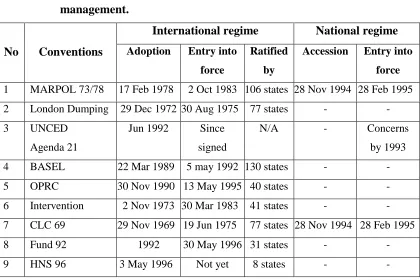
Table 5: Summary of status of international agreements related to marine
management. ... 50
List of Figures
Figure 1: Organizational Structure of the Ministry of Environment, Kingdom of
Cambodia ... 7
Figure 2: Marine and Coastal Protected Areas, Cambodia... 10
Abbreviation
BA Buddhist Association
CEE Center for Environmental Education
CLC International Convention on Civil Liability for Oil Pollution Damage
CMRD Center for Marine Research and Development
CPSC Cambodia Port State Control
CSC & SAR Division of Coastal State Control, and Search and Rescue
CSOR Cambodia Ship Open Registry
DNCP/MOE Department of Nature Conservation and Protection
EE Environmental Education
EEZ Exclusive Economic Zone
EIA Environmental Impact Assessment
ETAP/UNDP Environmental Technical Advisory Program/UNDP
FSC Flag State Control
FUND International Convention on the establishment of an International
Fund for Compensation for Oil Pollution Damage.
HNS International Convention on Liability and Compensation for Damage
in Connection with the Carriage of Hazardous and Noxious
Substances by Sea
IMDG Code International Maritime Dangerous Goods Code.
IMO International Maritime Organization
IMSCEE Inter-Ministerial Steering Committee for Environmental Education
INTEVENTION International Convention relating to Intervention on the High
Seas in case of Oil Pollution Casualties
IOPC Fund International Oil Pollution Compensation Fund
MAFF Ministry of Agriculture, Fisheries and Forestry
Page: xii MCRA Ministry of Cult and Religion Affair
MIME Ministry of Industry Mines and Energy
MMD Merchant Marine Department
MOE Ministry of Environment
MOE/NEAP MOE/National Environmental Action Plan
MOEYS Ministry of Education, Youth and Sport
MPWT Ministry of Public Work and Transport
NGOs Non Governmental Organizations
OPRC International Convention on Oil Pollution Preparedness, Response
and Cooperation
P/FSI Division of Port/Flag States Implementation
PED Provincial Environmental Department
PLA Division of Planning and Legal Affairs
PSC Port State Control
RSC Division of Registration, Seaman and Certificate
SOLAS International Convention on Save of Life at Sea
Tokyo MOU Tokyo Memorandum of Understanding
UNCED United Nations Convention on Environment and Development
(Agenda 21)
UNCLOS 82 United Nations Convention on the Law of the Sea, 1982
UNDP United Nation Development Program
UNEP United Nations Environmental Program
1
Chapter 1
Introduction
1.1 Topic Description
Cambodia does not have a long coastline (see Appendix 1) but has rich fauna
and flora. Destruction of this biodiversity is occurring every day caused by
over-exploitation of marine resources, illegal hunting, negligent management, lack of
regulations and enforcement, and lack of public awareness. A vast number of future
development programs along the coastline such as oil and gas exploration and
exploitation, port development, free trade zone and entertainment resorts have been
considered and accepted by the government. Some development projects will start
their own activities in 2000 (for example port construction), and other projects are
expected to start their business in the near future.
The development of the coastline may generate some risks to the marine
environment including water pollution by sewage and garbage, marine resources
destruction by over exploitation and negligent management, oil spill pollution by
ships and platform operations and by other maritime activities, which may occur at
any time.
To be preventing of and responding to such pollution, in case it occurs, it is
necessary to consider the current marine environmental management regime in
Cambodia. Essential measurements must also be taken into account including the
levels and kind of risks, available resources to be used, strategies to be applied and
public participation in preventing and responding to marine pollution. Therefore,
Page: 2
marine environment, both now and in the future, and propose ideas for improving the
effectiveness of marine environmental management including proposals to
accommodate all relevant international conventions into Cambodia’s national
environmental law.
1.2 Aims of dissertation
The topic of this dissertation is “A Proposal for Improving Marine
Environmental Protection Management in the Kingdom of Cambodia”. The
objectives of this dissertation are the following:
• To highlight the current marine environmental management.
• To identify the major risks to the marine environment and problems facing marine environmental protection management.
• To examine and evaluate the effectiveness of the current environmental protection management structures and procedures.
• To consider all relevant international conventions and to propose new ideas for integrating them into the national environmental law.
• To offer proposals and recommendations for improving marine environmental
protection management.
1.3 Relevant topics related to the field
Six chapters and several subtitles with the support of some appendices, tables,
and figures compose this dissertation. Chapter 1 is introduction. Chapter 2 is
describing the overview of the current environmental management in Cambodia and
other governmental institutions and agencies involved with marine environmental
activities.
Analyses of current marine environmental threats and expected future risks to
the marine environment are highlighted in chapter 3. This chapter will identify the
causes of pollution generated from maritime activities and marine natural resources
exploration and exploitation. Chapter 4 considers some relevant international
laws. The international conventions mentioned in this chapter are Marpol 73/78,
London Dumping Convention, OPRC, CLC, HNS, Fund, Intervention Conventions,
UNCED 92 (Agenda 21) and other international agreements.
Chapter 5 is a proposal for improving marine environmental protection
management in Cambodia. Within this chapter, new ideas or initiatives on the
marine environmental management will be raised. It will discuss the national
regulations and enforcement, a proposal for developing human resources and its
capacity building, and the contingency plan for combating and/or preventing marine
pollution (by oil spill particularly) in case of an incident taking place. Finally,
Chapter 6 consists of conclusion and recommendations to be applied for the
sustainable use of marine resources and to ensure the quality of marine environment.
1.4 Research methods and difficulties
The information for writing this dissertation was based on materials from
Cambodia, lectures delivered by the professors at World Maritime University and
other visiting professors, data derived from various institutions, other sources
retrieved from the Internet and by personal experiences when working for the
government. Other pieces of information are based on personal interviews with
governmental officers.
Collecting data for writing this dissertation faced many obstacles. Firstly,
governmental institutions did not want to provide their documents because they are
afraid of distributing them to public. Secondly, lots of documents were destroyed
during the Pol Pot regime and new statistics were not published due to economic
problems. Finally, environmental issues are a relatively new subject in Cambodia
Page: 4
2
Chapter 2
Overview of Environmental Management in Cambodia
2.1 Background
The Royal Government of Cambodia considered the environmental issues in
mid 1993. The issues of the environment was stated within the national constitution
under article 59, describing that “the State shall protect the environment and balance
of abundant natural resources and establish a precise plan of management of land,
water, air, wind, geology, ecological system, mines, energy, petrol and gas, rocks and
sand, gems, forests and forestry products, wildlife, fish and aquatic resources.”
Therefore, having seen this Constitution the Ministry of Environment (MOE) was
immediately established by the Royal Government of Cambodia in November 1993.
The ministry’s frameworks and its functions were determined under article 3
of the Sub-decree on the Organization and Functioning of the Ministry of
Environment. The MOE is responsible for several functions and activities (listed
under article 3 of the sub-decree on Organization and Functioning of the MOE) as
mentioned in the following point.
• To exercise environmental policy with sustainable development and to propose the National and Regional Environmental Action Plans in cooperation with other
ministries.
• To prepare and implement environmental legal instruments aiming to ensure sustainable development.
• To advise relevant ministries on the conservation, development, and management of natural resources as prescribed in Article 59 of the Constitution.
• To administer the National Project Areas System following the Royal Decree on the “Creation and Designation of Protected Areas” and to propose new areas to
be put in the system.
• To prepare inventories, which describe the source, nature and amount of pollutants, and to take measures to prevent, reduce, and control environmental
pollution.
• To prepare inspection procedures, as mentioned in Article 59 of the Law on Environmental Protection and Natural Resources Management.
• To prepare and conduct environmental educational programmes applying to all levels, including to local communities in cooperation with relevant ministries,
national and international organizations.
• To compile, analyze and manage environmental data.
• To initiate and prepare any proposals to the Government to reach the goals of international agreements, conventions, and memorandum of understandings
related to environmental protection, and to implement such international
instruments.
• To promote incentives to those investments which facilitate environmental protection and nature conservation.
• To cooperate with National Organizations, NGOs, foreign governments and local communities in order to ensure the environmental protection in the Kingdom of
Cambodia.
2.2 Structure of the MOE
The management structure of the MOE is divided into central and provincial
administrations. The central administration is the core ministry, which is composed
of six main technical departments (see Figure 1). These departments are responsible
for the environmental issues including environmental policy and legal affairs,
Page: 6
management, natural resources assessment and environmental data management, and
environmental impact assessment (see Appendix 02 for detailed functions of each
Department). The central environmental administration is responsible for the
country is environmental management as a whole. Furthermore, the provincial
administrations are located within 22 provinces and municipalities. The provincial
and municipal administrations are called Provincial Environmental Department
(PED), and they are responsible for provincial environmental management within
their own territory, in particular.
2.3 Overview of environmental management in Cambodia
It is not an easy job for this new ministry to carry out the environmental
management in Cambodia. Involved with decades of civil war, negligent and poor
management of natural resources, lack of human resources, shortages of legislation
and enforcement, and other negative activities lead the country to facing to many
environmental problems. These problems occur throughout Cambodia’s territory
such as deforestation, pollution, over exploitation of natural resources, flooding, land
desertification, soil erosion and so on. Anyhow, this young ministry has been
successful in the following:
2.3.1 Environmental policy and legislation
The first environmental law in Cambodia is called the Law on Environmental
Protection and Natural Resources Management and the National Assembly adopted it
on 24 December 1996. This law contains 11 chapters and 27 articles. This law is a
fundamental framework for other subsequent laws, sub-decrees, regulations, codes
and standards for environmental protection and natural resources management. It
does not intend to provide specific environmental management systems, codes and
standards. It may leave these issues to other subsequent laws or regulations.
The main purposes of this law are concerned with natural resources
management, the protection of environment from all kinds of pollution, and
socio-economic development of the country. Furthermore, the law on environmental
protection and natural resources management also mentions some points related to
the marine environmental management including coastal resources management.
Based on the Law on Environmental Protection and Natural Resources
Management the MOE introduced other environmental laws concerned with the
environmental impact assessment and pollution control management. These
environmental laws are as follows:
Figure 1: Organizational Structure of the Ministry of Environment, Kingdom
of Cambodia
Source: Ministry of Environment, 1997
Director General
Cabinet Advisors
Inspection Office Department of Administrative, Finance and Staff
Office of Finance Control
Department of Planning and Legal Affairs Department of Nature
Conservation and Protection
Department of Pollution Control
Department of Environmental Impact Assessment Review
Department of Environ-mental Education and Communication
Dept. of Natural Resources Assessment & Environmental
Data Management
Provincial/Municipal Environmental Departments
(PED) Under Secretaries of State
Page: 8
• Sub-decree on water pollution control, issued on 6 April 1999. • Sub-decree on solid waste management, issued on 27 April 1999.
• Sub-decree on environmental impact assessment, issued on 11 August 1999.
2.3.2 Environmental education
Environmental education (EE) is a fundamental issue for protecting and
conserving the Cambodian environment, promoting socio-economic development,
and to improving standard of living of people. EE will provide the necessary skill,
knowledge and values, to the public, officials and decision-makers to be able to
understand the complexities of the environment. The main objectives of
environmental education are providing environmental awareness and skills to the
public and to the officials in order to protect and conserve the environment and use
its natural resources in a sustainable way.
In cooperation with and with support from UNDP, the Ministry of
Environment prepared framework (outline) for integrating environmental education
into all levels of Cambodian societies, since late 1993. This framework contains the
most important issues including natural resources management, wildlife protection
management, biodiversity conservation, pollution prevention management, the
sustainable use of natural resources, public health, and other subjects related to the
environment.
The policies and strategies of environmental education are using all methods
of educational systems within Cambodia such as formal and non-formal schooling
education systems, Buddhist education system, mass media, and professional and
occupational training systems. These elements have to take responsibility for
delivering EE as a legitimate aspect of its activities and accept it as fundamental to
accomplish the objective of achieving a better environment. The target audience
falls into three main groups: students including Buddhist monk students, officials and
2.3.3 Nature conservation and protection
Cambodia has a 435-km long coastline with 55,600-sq. km exclusive
economic zone and shares marine borders with Thailand and Vietnam. In the coastal
zone there are lots of forests particularly mangrove, numerous bays, and beaches.
Cambodia also has several offshore islands; the biggest one is called Koh Kong.
Cambodia’s territorial sea and coastline are recognized as rich in biological
productivity and supported habitats. These habitats include coral reefs, wetland areas
and seagrass beds, adjacent along the coastlines. There are about 435 species of fish
from 97 families and globally endangered marine mammals like dugong and marine
dolphin (Delphinus species) (Tana, 1994) are living in these habitats. With this
environmental value, Cambodia has created some marine national parks and wildlife
sanctuaries, and multiple use management areas, some of which are located along the
coastline (see Figure 2) as the following:
• National Park Kep covers an area of 5,000ha, and is located in the Kampot Province.
• National Park Ream covers an area of 150,000ha, and is located in Sihanoukville. • National Park Botum Sakor covers an area of 171,250ha, and is located in the
Kampot Province and Sihanoukville.
• Dong Peng (multiple use management area) covers an area of 27,700ha, and is located in the Koh Kong Province.
• Peam Krasop wildlife sanctuary covers an area of 23,750ha, and is located in the Koh Kong Province. (Royal decree on creation and designation of protected area,
signed on 1 November 1993.)
The management of these protected areas is under the responsibility of the
Page: 10
Figure 2: Marine and Coastal Protected Areas, Cambodia
Source: Ministry of Environment, GIS Office, 1998. Peam Krasop
Wildlife Sanctuary
Botum Sakor National Park
Ream National Park
Kep National
Park Phnom Bokor National Park
Proposed Koh Tang
2.3.3.1 Mangrove forestry management
Cambodian wetlands are an important habitat and they are dominated by
mangrove forestry. This mangrove consists of 74 species and they are relatively
pristine forests growing in four major species zones from the shoreline to the
landward edge.
The total area of mangrove forestry in Cambodia is 85,100 ha, of which
63,200 ha grows in the Koh Kong province, 13,200 in Sihanoukville, 7,300 ha in
Kampot, and 1,400 ha in Kep Municipality (Forestry Department, personal
communication, and Mekong Remote Sensing Landsat, 1992). Abundant mangrove
forest areas are located in the large estuary of Peam Krasob/Koh Sralao in the Koh
Kong province. These areas are also reputed to be some of the best pristine
mangrove forest lefts in the region. Many other estuaries are also growing
mangrove, on a small scale, such as at Koh Por, Koh Yor, Dong Tong, Andoung
Tuk, and Sre Ambel.
Cambodia does not have enough legislation on marine resources
management, so the enforcement activities are not effective. Furthermore, due to the
government’s lack of resources, including financial, material and human, the
enforcement operations done by the officials very rarely take place. These led the
wrongdoers without being punished to continue to destroy the mangroves.
2.3.3.2 Coral reefs management
Coral reefs are another relatively important habitat for fish and other marine
aquatic organisms. They exist along and around the coastline of the mainland and
islands. There are 24 species of hard coral, 14 of soft coral and sea fans. Some coral
reefs are in poor condition, probably because of sedimentation, particularly around
Polowii Island (Koh Wai). Abundant coral reefs can be found around Koh Karang
located in the Kampot province but very rare at Koh Daung. Most of the Cambodian
islands are reported to be abundant in coral reefs. However, detailed information of
its species and quantities do not exist yet. The government of Cambodia as well as
Page: 12
2.3.3.3 Aquaculture
Since 1993, Cambodia is interested in creating aquaculture along the
coastline particularly shrimp culture. Other cultures including oyster, green mussel
and other marine fishes are not of significant interest for both production and
economy, but shrimp is. Shrimp yield productions are reported to be high up to 7-8
tons per ha for the new starting farms and the profits are relatively attractive for
further investment. Most shrimp farms are located in the Koh Kong province.
However, the shrimp industry has created serious negative side effects
including shrimp diseases and self-pollution of cultural areas. Furthermore, it mostly
generates toxic wastes and effluents discharged into the adjacent areas and the sea,
which causes an impact on other economic activities and marine aquatic organisms
including flora and fauna.
Nevertheless, the shrimp industry is not under responsibility of the Ministry
of Environment. In Cambodia, all aquaculture and agriculture activities are under
the control of the MAFF. These cultures create institutional conflicts, mostly related
to the discharging of waste from farms, between the MOE and MAFF. The MAFF is
looking for economic advantages only, while the MOE is worried about all kinds of
pollution generated from farms including disease distribution. Unfortunately, the
MOE has not been completely successful in discharge banning.
2.3.4 Pollution control management
At present, Cambodia is facing to some kind of pollution related to soil, water
and air. This pollution affects public health, sanitary and beauty of the State. The
most serious pollutants are solid waste and sewage, but other types such as air and
noise pollution are relatively small. All these kinds of pollution can be found within
crowded communities particularly in the capital city, Phnom Penh and other large
cities including Sihanoukville and Siem Reap town. Major pollution that occurs
within these cities are solid waste (garbage), sewage and air pollutant substances
(particle), which are generated from households, hospitals, factories, vehicles, and
2.3.4.1 Solid waste
Solid waste is a one of the major environmental pollutants of concern. Solid
waste in Cambodia is dominant only in the cities and its quantity was about 464 tons
per day in 1996 in the capital city and about 43 tons per day in Sihanoukville, which
is located along the coastline. Based on a waste survey in 1992 by MOE officers, the
components of solid waste were mostly organic matters generated from residential,
commercial (markets) and industrials sources and the rest were generated from
garment factories and medical facilities (from hospitals). The percentage of organic
matters found in solid waste was high, nearly 90% of the waste mass in Phnom Penh.
The vast number of this waste was deposed in open landfills not so far away from the
city or dumped into drainage canal, waterways, lakes and swamps.
2.3.4.2 Sewage or wastewater
Another environmental pollutant is wastewater or sewage and this normally
takes place within urban areas and cities. In Cambodia wastewater is directly
discharged into natural lakes (local name Boeng) or waterways, including streams
and rivers. Phnom Penh and Sihanoukville municipal wastewater is discharged into
lakes and rivers directly through sewage/drainage systems (pipelines).
Since the MOE does not have codes and/or standards on waste disposal, thus
the industrial firms ignore the pollution and discharge their wastes directly into
natural reservoirs or waterways. For example, a Brewery Company located in
Sihanoukville has been discharging its waste directly into the sea through natural
canals. This waste generates unpleasant smell and pollutes the environment along
the way of disposed matter such as soil, water, air, fauna and flora.
The management of wastewater in Cambodia is not very effective, which is
connected to three main factors. The first factor is related to poor/very old sewage
systems and the pumping stations do not operate properly due to the lack of spare
parts, aged equipment, and unreliable supply of power/electricity. The second factor
is lack of cooperation from the public including their bad attitude, which is disposing
Page: 14
the increase in disposed wastewater because of the growing industries and residential
areas, but the sewage systems still remain the same as before, and thus do not
respond to the current demands.
2.3.4.3 Air pollution
Air pollution in Cambodia began to cause problems because many industrial
firms, vehicles (cars and motorcycles) and other machines release emission into the
air. Most factories are using their own generators as a source of power.
Unfortunately, there is no available data related to air pollution. Nevertheless,
knowing that the black smoke (emission) are generated from vehicles, generators
(using for residential, hostels, discotheques, restaurants, and industries), and power
plant stations.
Other categories related to air pollutants are dust/particles, and unpleasant
smell. Yet, there is also no available data (both quantity and its impact) in these
categories that have been notified by the public and officials. The MOE is trying to
identify the sources of air pollution and prepare codes and standards for preventing
and responding to such pollution.
2.4 Other institutions involved in environmental management
It is interesting to note that the Ministry of Environment is a relatively new
ministry. Therefore, most of the environmental management work involved overlaps
some ministries and governmental institutions. These ministries are the Ministry of
Industry Mines and Energy (MIME), Ministry of Agriculture, Fisheries and Forestry
(MAFF), Ministry of Public Work and Transport (MPWT), and town/city
Municipality.
2.4.1 Ministry of Industry, Mines and Energy
The overlapping work between MOE and MIME is related to the natural
resources exploitation and industrial wastes. MIME is just focusing on the final
away nearby land mine exploitation or discharged into the waterways. For example,
Angkor Beer Brewery Company has discharged their wastewater directly into the sea
through pipelines without considering the environment. MIME has the right to
control all industrial firms in terms of their business and the quality of production.
MIME does not take care of any waste generated from these firms.
2.4.2 Ministry of Agriculture, Fisheries and Forestry
Other pieces of overlapping work are related to fisheries and forestry
management (exploitation and conservation). MAFF is responsible for fishing (fresh
water and salt-water fishing) and forestry hunting. MAFF also manages all fishing
lots throughout the country and provides private sectors to do so (by investment).
MAFF just collect fishing fees including taxes from these sectors. In this case, the
private sectors try to catch the fish as much as they can because it is their profits.
MAFF is willing to get more revenues from that fishing too. According to the
Department of Fisheries, the numbers of fish catching are increasing every year (see
Tables 1 and 2).
Table 1: Statistic of fish catch in metric ton.
Year 1994 1995 1996 1997 1998 1999
Marine catch 30,000 30,500 20,600 29,800 32,200 38,000
Marine culture 8,200 9,510 - 11,800 14,100 14,450
Total catch (tons) 38,200 40,010 - 41,600 46,300 52,450
Sources: Fisheries Department: Annual report 1994, 1995, 1996, 1997, and 1998.
Royal Cambodia Embassy: Government report 1999, No.02 RB.K
2.4.3 Ministry of Public Works and Transport
In addition to being responsible for all kinds of transportation and its
infrastructures, the MPWT has another responsibility, which is taking care of
garbage collection, transportation and disposal. This ministry has to provide staff
Page: 16
garbage-separating systems yet. Therefore, all kinds of solid wastes (plastic, glass,
composed matters, paper, construction waste, and others) are put into one garbage
bin, and dumped into one-land fields.
Even now, garbage collection and transportation for disposal is currently
done by MPWT. Like the MOE, MPWT has its own subordinates located in each
province. The system of garbage collection and transport for disposal in each
province is also done by the local (provincial level) MPWT.
Since Cambodia started to operate the opened sky strategy, the economy of
the country is rapidly growing. This economic growth lead to problems for garbage
disposal because of the public demands such as construction materials, vehicles
(including second hand vehicles in high volume), household materials, and lifestyle
materials. These kinds of demands generate high garbage in solid forms because the
imported materials are mostly second hand products. These second hand materials
do not provide high quality in use and nearly half of them (vehicles and clothes) need
to be scrapped. Therefore, these second hand materials become garbage easily and
cause considerable problems to be solved.
2.4.4 Municipality
Municipality is another governmental institution, which is involved with
urban environment; it particularly deals with waste disposal. With cooperation
between MPWT, the municipalities for both the capital (town) and provinces is
responsible for garbage collection and keeping the city clean. The Municipality has
to arrange places for garbage disposal and provide necessary garbage bins to be
installed in those places.
2.5 Other considerations
The environmental issues in Cambodia have become more crucial since 1993
when the new government was established. The opening sky strategy attracts
foreigner investors to run their businesses in Cambodia, mostly light industries, such
transportation, and other fields. These investments have caused the Cambodian
environment to face numerous problems such deforestation, over fishing, water
pollution, wastes disposal, over exploitation of natural resources and so on.
The marine environment has also become a major problem to be considered.
The main environmental problems occurring along the Cambodian coastline are
mangrove destruction, over fishing and illegal fishing activities, coral reef
exploitation, pollution from land based sources, and other serious issues. Coastal
development projects will also affect the marine environment, including tourism
investment, port and waterways development, industrial and residential installations,
and other activities. The following chapter will introduce the risks to the marine
environment, which will happened in the near future during coastal zone
Page: 18
3
Chapter 3
Analyses of Current Marine Environmental Problems
Activities in the Cambodian coastal zone have become more intensive since
1993. Since then the impact on the environment has been noticeable. Currently, the
marine environment in Cambodia is facing many problems caused by economic
reasons, the development of coastal areas, as well as involvement with other factors
mentioned in the following points.
3.1 Problems due to economic factors
Since 1993, the growth of the economy has been booming dramatically.
With this economic growth, many activities in the coastal zones, including
mariculture activities, charcoal production, illegal fishing and poverty are influencing
the marine environmental management. These activities are currently having a
negative impact on the environment on a small scale and will be a serious risk in the
near future, if a marine management system is not introduced.
3.1.1 Mariculture
Most mariculture farms are located in the Koh Kong province, where people
enjoy shrimp farming by clearing the mangrove forest. The number of shrimp farms
within this province is about 2.7% of the total mangrove forests in the Koh Kong,
Shrimp farming generates risks to the marine environment, including
mangrove destruction, marine water pollution, and disease distribution caused by
discharging wastewater from the farms.
At least 400 ha of mangrove forest were destroyed when making shrimp
farms. As a result, not only the mangrove population was affected but also other
species and their biodiversity habitats within the surrounding environment. Without
mangrove, soil erosion processes will be introduced and may continue the following
year.
Discharging wastewater from the farms directly into the seawater causes
damage to the marine environment. This wastewater contains chemical substances
and enzymes, used to increase shrimp productivity (in the farms only), on one hand,
in the short-term period. On the other hand, these chemical substances and enzymes
are harmful to the marine environment and life.
Firstly, the seawater had been polluted. Most of the small organisms were
killed and some even stopped growing. Secondly, this discharging water contained
some elements producing diseases including parasites, which harmed the marine
fauna particularly, affecting mollusk species. Finally, this wastewater had an impact
on the food chain/web within the discharging areas by killing lots of photo-plankton
and zooplankton. Furthermore, these chemical substances and enzymes may affect
the mortality rate of some species.
It is considered that the potential of the multiple use of natural resources has
become worse due to the converting of mangrove forests into mariculture. Intensive
shrimp farms can run only in a short-term period and be privately owned, but in the
long-term run, they will impact on public interest, particularly affecting to people
who live in the coastal areas.
3.1.2 Charcoal production
It is noticeable that charcoal production has also affected the coastal
environment. So far, people have produced charcoal from mangrove trees for
Page: 20
from domestic use to commercial purposes (for export). Fore example, in 1992,
Taiwan had a contract with the government to export 10,000 tons of charcoal
(DNCP/MOE, 1995).
There is no official data on how many mangroves had been cut down for
charcoal production. However, the number of charcoal kiln has been recorded to
more than 200 in 1993 and almost 1,000 kilns in 1994 (DNCP/MOE, 1995). The
capacity of charcoal production is about 60kg per charcoal kiln with a diameter of
5m (average size). Each charcoal kiln can produce charcoal up to 10 times per year.
This means that the quantity of charcoal production has been increasing dramatically
every year.
Therefore, it can be imagined that, huge areas of mangrove have been
destroyed for charcoal production. Large-scale mangrove cutting may cause habitat
destruction, loss of biodiversity (species), sedimentation, soil erosion, and land
marginalization (shortage of fertilizers and dryness).
3.1.3 Illegal fishing
Another factor that generates risks to the marine environment is illegal
exploitation activities of marine resources. These activities are mostly done by
fishermen, who are using unauthorized materials and equipment for fishing including
dynamite, poisonous substances, electricity, and unauthorized fishing nets.
Using dynamite for fishing may kill not only fishes but also destroys the
marine environment and life. The explosive power causes short-term effected on the
other fishes that live nearby the explosion zone. However, it destroyed fish habitats
and exiled those fishes to live in other areas. Furthermore, dynamite explosion may
cause serious damaged to coral reefs. The coral reef that has grown for thousands of
years will immediately be destroyed and will not grow (or take very long time to do
so).
The purpose of using poisonous substances by fishermen is to catch big crabs.
However, this does not only affect big crabs but also kill young crabs and other
particularly killing zooplankton and other food web. This poison will further affect
the mortality rate of new marine fauna.
Electricity devices are very rarely used for fishing at sea. Fishermen use
these devices to catch fish in shallow waters particularly in nesting and feeding
grounds. The impact of electricity is very high because it makes live fishes escape
from their habitats (nesting and/or feeding grounds) and never return to the old
places.
Unauthorized nets are also harmful to the marine fauna because they destroy
marine life habitats. For example, using trawl nets will damage coral reefs, seaweed
and/or seagrass where the habitats, feeding and nesting ground of fishes and other
marine fauna are found.
Over fishing is another impact factor, which causes degradation of marine
resources (fishes). Based on a USSR/Cambodia study between 1983-1986, it was
reported that the amount of fish catch for sustainable use was about 20,000 tons of
fish per year (MOE/NEAP, 1998). However, the amount of fish catch increased
rapidly from 1,200 tons in 1980 to the pick 39,900 tons in 1990. Then the amount of
fish catch declined dramatically to 20,600 tons in 1996 (see Table 2).
Table 2: Annual marine fishery catches, 1980 to 1999
Year Total catch (tons) Year Total catch (tons) Year Total catch (tons)
1980 1,200 1987 17,417 1994 30,00
1981 814 1988 21,000 1995 30,500
1982 3,015 1989 26,050 1996 20,600
1983 9,444 1990 39,900 1997 29,800
1984 7,721 1991 36,400 1998 32,200
1985 11,178 1992 33,700 1999 38,000
1986 7,247 1993 31,100
Sources: Fisheries Department, Annual report: 1994, 1995, 1996, 1997, and 1998.
MOE, 1998: National environmental action plan 1998-2000.
Page: 22
The number of these catches does not include illegal fishing by local
fishermen and fishing invasions by foreign fleets (neighboring countries).
Therefore, if the governmental authority does not consider this matter and
take the necessary implication on those illegal activities, the number of marine fish
stock in Cambodia will dramatically decline in the near future.
3.1.4 Poverty
Another factor that is a dominant marine environmental threat is poverty.
Cambodia is a very poor country, as about 39% of the population are living under the
poverty line. The amount of poverty is relatively high in rural areas (about 40.1%
poor), while the other urban areas also high (about 37% poor) but quite a bit lower in
the capital (about 11.1% poor) (Ministry of Planning, 1997 and Government report
1999, No.02 RB.K).
People in remote areas are living in poor conditions. They are living based on
self-employment by exploiting natural resources and doing agriculture. Since the
agriculture production yields along the coastline are not sufficient, then these people
try to hunt the natural resources such as cutting mangrove and doing illegal fishing as
mentioned above. The poor people occupy huge areas of mangrove, so they start to
cut these trees down to run their businesses for survival. Moreover, when the
mangroves were cleared, they sell this area to the farmers/businessmen who do
mariculture, particularly shrimp farms.
3.2 Problems from port and offshore developments
Cambodia has raised many development projects, which are the key point for
building up the country. A vast number of projects have been considered including
marine and coastal zone development. The biggest project on marine and coastal
zone development is port rehabilitation, oil and gas exploration and exploitation, and
recreational installation. These three issues are the hot points to be considered in
their current impact on the environment and as well as in the near future. The current
3.2.1 Pollution from port rehabilitation
The project on Sihanoukville seaport rehabilitation was considered and
approved by the government in late 1998. This proposal is requested to construct
port facilities including a container cargo berth and its handling equipment
installation. To be constructed this container port, about 1,312,000 m3 of soil will be removed from the berthing place and another 465,000 m3 will be removed from the canal (water way) (MPWT/Port of Sihanoukville report, 1999). This activity is
expected to finish by the year 2003.
There are two main problems to consider when removing this soil from the
sea. Firstly, there are particles that may generate from the removing these huge soils.
If there are lots of particles and debris generated and suspended in the water, the
current will transfer them to other places. In this case, these particles will pollute the
seawater and may affect some places including fishing grounds, sensitive areas and
recreational beaches, which are needed to be protected from any kind of pollution.
Secondly, proper dumping places are required for disposal the removing soil.
Otherwise, it may pollute the subsoil in the ground and underground water.
The risks to the environment (including marine environment) are impossible
to prescribe unless an environmental impact assessment has been made. However,
the impact from removing this soil is not a permanent or long-term effect to the
environment.
3.2.2 Pollution from offshore development
Oil and gas exploration within the Gulf of Thailand is becoming a potential.
There are about 10 exploration blocks, which are located in Cambodian waters, some
of which have drilled, tested and confirmed that there is abundant oil for exploitation
(see Figure 3).
The installations of platforms and oil exploitation have not taken place yet.
Nevertheless, some impacts on the environment have been considered and can be
Page:24
Figure 3: Oil and Gas Activity in the EEZ, Cambodia
3.2.2.1 Physical presence
The exploration process did not affect the marine environment in terms of
installations of drill ship operating and support vessels moving around. However,
the presence of drill ships and their supporting vessels affected fishing activities and
other ships within the area of exploration.
3.2.2.2 Operational discharge effect
Normal operational discharge that may affect the environment can be caused
by disposal of solid and liquid waste. This disposal resulted from drilling operation
stages. The expected appropriate measurements to prevent further pollution are as
follow:
• Solid waste materials would be high, serious and long-term affecting the marine environment, if disposed at sea. The wastes that were generated from the rig had
been collected and segregated according to their natural physical and chemical
characteristics, known as metal, waste oil and chemical materials. All these
wastes must be back-loaded to shore to be reused and/or recycled. Other
remaining materials that can not be reused and/or recycled must be dumped on
shore and/or incinerated properly.
• The liquid waste that may be generated from the rig is sewage and drainage, and residual mud and cutting rocks. The sewage and drainage wastewater is normally
low in volume. They may rapidly dilute in the seawater column and may slightly
affect the marine environment. Cutting rock and its residual mud formed into
muddy solution or water based mud, is composed of natural elements including
clay, salt, mud, and rock. This water-based mud has normally low toxicity and
very limited effects on the marine environment. Based on the Oil Enterprise
Ltd’s study (Brunchard, 1995), the effect of water based mud and cutting
discharges into seawater may reduce species diversity and its richness. However,
the seabeds itself can generally recovery within 6 months or so of cessation of the
Page: 26
3.2.2.3 Accidental loss
Some risks may happen when transferring materials between the rig and
supplying vessels. The accidental loss of materials overboard may cause damage to
the fishing equipment and/or disturbing fishing activities. Moreover, other
accidental losses including chemical substances and toxic materials would bring risks
to the marine environment.
3.2.2.4 Accidental spill
Many experiences of oil exploration related to the drilling process have
confirmed that some accidental spills might happen. The spill may be generated
during fuel transfers, well testing or leakage from the well during drilling. If the spill
happens, it may spread rapidly due to the current and wind forces. Then the spill
may disperse and degrade naturally under its characteristics including type of oil, and
other conditions such as wave energy and water temperature. Consequently, the spill
may cause damage to the marine environment and its scope of affecting the
environment is related to the quantity of oil and weather conditions.
3.3 Other problems influence marine environmental management
3.3.1 Human resources
The risks to the marine environment can be caused by human resources,
depending on the capacity building of the governmental officers and public
awareness. Good understanding of the value of the environment may encourage
people to participate in the management of the environment including the protection,
prevention, and sustaining the quality of the environment. Poor understanding of
environmental issues may bring harm to the environment starting from innocent
3.3.1.1 Official capacity building
The environmental capacity building of governmental officers is very limited.
That is why the management of the environment has not done well so far. Some
problems were generated such as:
• The cause of the risk to the environment can not be identified and the scope of its risks and impact can not be evaluated.
• The officials were unable to perform their duties properly and efficiently.
• Some corruption during inspection may happen when the cause of pollution or
destruction to environment is small in scale.
• The environmental laws are not strictly implemented and enforced.
• The polluters do not pay any attention to the environmental quality and furthermore do not want to cooperate with officials preventing and combating
pollution.
These negative points affected the management of the marine environment.
Some bad activities that may be a risk to the marine environment still exist due to the
incapability of the officials, who are unable to perform their duties on environmental
management.
3.3.1.2 Public awareness
Cambodian people lack environmental awareness, therefore, causing some
threats to the marine environment. Firstly, their daily activities have made some
risks to the marine environment including throwing garbage, doing illegal fishing,
logging mangrove, and discharging wastewater from mariculture farms. Secondly,
misunderstandings of the value of the environment lead them to pay less attention to
protecting the marine environment. Finally, they do not want to cooperate and/or
participate with MOE and other institutions in the prevention and management of the
Page: 28
It should be understood that, the environmental management is not only the
role of the MOE or government but also the obligation of the people. Conserving the
environment, including the marine environment, means taking care of our lives.
3.3.2 Problems in implementing environmental legislation
Other problems of marine environmental management are related to the
implementation of environmental legislation and interference from other countries.
These two points have created a great impact on the marine environment such as
difficulty in implementing and enforcing environmental laws, harmonizing work
with other governmental institutions, and deliberation of dumping waste in
Cambodia by other countries. For example, Taiwan shipped and dumped chemical
wastes (3,000 tons of mercury waste) in December 1998 and the Republic of Korea
(South Korea) shipped and dumped 650 tons of plastic waste in Sihanoukville. With
local and international pressures, the Royal Government of Cambodia completely
sorted out of these chemical wastes and ordered to ship back from Cambodia on
April 2, 1999. Regarding to 650 tons of plastic waste, the government ordered for
shipment to the Korea in September 1999 (Government report 1999).
3.3.2.1 Inadequate legislation
There are some problems related to overlaps in jurisdiction and function
between governmental institutions. Many laws and decrees prescribe the right of
each ministry but do not mention the coherent framework for inter-ministerial
cooperation. When the new framework law on Environmental Protection and
Natural Resource Management was introduced in 1996, the overlapping jurisdictions
had been recognized. Most of them are related to the revenue collection by each
ministry and redundant work in the administrative management systems.
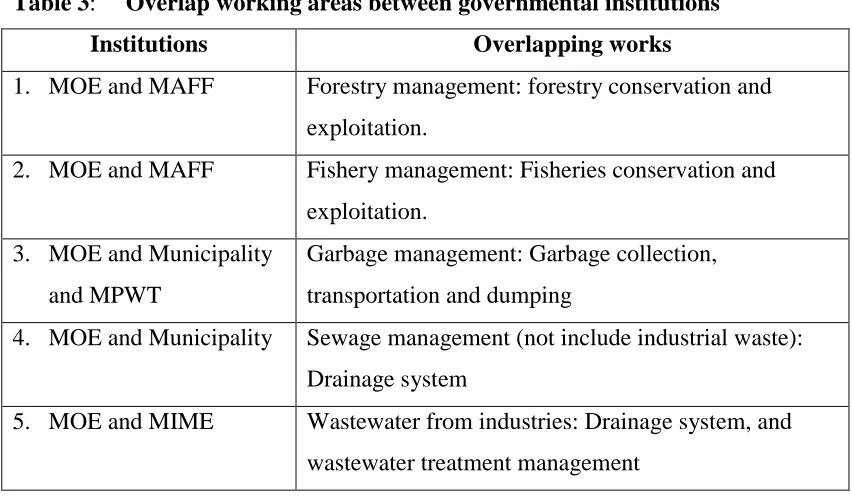
Inadequate guidelines for inter-ministerial cooperation were caused by
overlapping work between MOE and other governmental institutions (see Table 3).
Table 3: Overlap working areas between governmental institutions
Institutions Overlapping works
1. MOE and MAFF Forestry management: forestry conservation and
exploitation.
2. MOE and MAFF Fishery management: Fisheries conservation and
exploitation.
3. MOE and Municipality
and MPWT
Garbage management: Garbage collection,
transportation and dumping
4. MOE and Municipality Sewage management (not include industrial waste):
Drainage system
5. MOE and MIME Wastewater from industries: Drainage system, and
wastewater treatment management
Nowadays, these overlapping problems have not yet been solved and they
have lead to lack of harmonic cooperation between each ministry in regarding
environmental management matters.
3.3.2.2 Institutional problems
As result of power sharing arrangements within the government between
various political parties caused the ministries to rule by different officials nominated
from their parities.
Some of them are not harmony with each other and this causes problems of
lack of cooperation among the governmental agencies. Furthermore, it caused
political instability and priority of internal security. In other words, the attention to
environmental management is very low or little. This problem may be more
essential in the provinces, some of which are in remote areas and inaccessible from
the capital. The provincial authorities still maintain control over local activities and
Page: 30
Therefore, the Ministry of Environment is facing many problems regarding
inadequate environmental infrastructure including shortage of manpower, financial
resources and experiences.
3.4 Expected on future problems
The above discussions are about the current environmental problems that
came across several fields and factors. Most problems on marine environmental
management came from human activities on land and their negligence on the value
of the environment. There are some serious problems, which could affect the marine
environment in the near future, as soon as the development project is completed.
These problems are related to pollution from land based sources, sea born and
maritime activities which may affect the marine environment.
3.4.1 Pollution from land based
3.4.1.1 Waste from residential areas
The government was concerned with rebuilding the economy after a few
decades of the civil war was finished and thus decided to use Sihanoukville as an
economic and industrial zone for development, as a priority. This project has
encouraged people to settle their residence and business there. Increasing the
population will increase the consumption of goods, which in turn influences wastes
disposal matters. Garbage and sewage are the major problems of waste disposal
which have to be taken care of immediately from now on. Poor management and/or
concerning that matter will cause of marine environmental destruction by pollution.
3.4.1.2 Waste from industries
In late 1998, the government signed a memorandum on free trade zone
investment in Sihanoukville. This memorandum concerns port rehabilitation, and
other industrial developing fields including zones for wood production and
processing sectors, electronic sectors, food and non food production sectors, light
The concerns on wastewater treatment have not been taken into account yet
for these industries. Therefore, wastewater released from those industries may
directly be discharges into the sea. If it so, there would be damage to the marine
environment including fauna, flora and the quality of seawater and beaches.
3.4.1.3 Waste from recreational areas
The number of tourists who visit Cambodia is rapidly growing, increased
20% in 1999 (Government report, 1999), compared to last year, 1998. Places
attracting tourists to visit are ancient temples and coastal beaches. The fast growing
tourist rate attracted investors to improve recreational facilities, including hotels,
transportation, food, souvenir items, and others. Lots of hotel projects (big and small
in total 179 hotels) are being under consideration, many of which will be located in
Sihanoukville, which is known for its beautiful beaches.
Tourists always leave behind environmental problems such as garbage,
sewage and disease distribution, if the necessary measurement does not apply. Poor
consideration of environmental management would cause risks to the marine
environment in terms of pollution.
3.4.2 Pollution from marine activities
3.4.2.1 Pollution from maritime transport
The number of ships calling at Sihanoukville Port is increasing ever year. In
the 1980s, there were less than 100 ships calling alone at Cambodia seaport.
However, this number was dramatically increased about five times during the 1990s
(see Table 4). This means that, many goods (not including oil) have been transported
through Sihanoukville Port (import and export cargoes).
The number of ships (shown in Table 4) calling to the Cambodia seaport (or
Sihanoukville port) did not include oil tankers. According to the statistic made by
MPWT, about 635,000 tons of oil was imported in 1995 and may increase to
1,384,000 tons in the year 2000, and 2,018,000 tons in the year 2005 (MPWT’s
Page: 32
Table 4: Number of ships calling to Sihanoukville port and import and export
commodities
Description Unit 1991 1992 1993 1994 1995 1996 1997 1998
No. of ships Ship 144 226 337 411 615 686 785 648
Total cargoes Tons 132,550 283,992 474,387 547,313 707,705 741,002 794,276 864,191
Import cargoes Tons 45,677 206,642 322,194 439,738 554,278 636,581 652,791 726,048
Export cargoes Tons 86,873 77,350 152,193 107,575 153,427 104,421 141,485 138,143
Cargoes in containers
Weight Tons - 30,671 125,697 138,997 228,636 309,991 355,697 398,244
In TEU TEU - 4,194 23,986 21,186 38,942 55,734 60,990 69,237
Source: Report on Sihanoukville port’s activity, MPWT, 1999.
It is interesting to note that the international community is concerned with
new types of marine environmental pollution caused by ballast water discharged
from ships. Ballast water is a global environmental problem that has happened
around the world caused by transporting unwanted organisms and discharging at
port. These organisms may cause damage or destroy local marine life (fauna and
flora). Furthermore, this ballast water may pollute seawater at port if an alien vessel
loads dirty water at departure point.
Other type of marine pollution that may have an impact on Cambodian waters
is ship incidents. An accident may happen within Cambodian waters as well as in
the Gulf of Thailand, where maritime traffic is busy (see Appendix 03). If so, the
major pollutant is oil substance and its products caused by oil spill incident and
normal operational discharge, and other harmful substances (chemical substances)
released from ships. The spill greatly may affect marine life (fauna and flora) and its
biodiversity and food chain. The most serious impact that may occur is if the spill is
spreading and encroaching on the marine sensitive areas and marine parks (see
Figure 2).
Another problem involved is maritime navigation. Sunken vessels, wrecks
and/or abandoned ships are involved with this matter, for at least disturbing maritime