The University of San Francisco
USF Scholarship: a digital repository @ Gleeson Library |
Geschke Center
Master's Theses
Theses, Dissertations, Capstones and Projects
12-11-1996
An Examination of Women's Access to Professional
Positions in Hospital Foundations
Bettina Kohlbrenner
Follow this and additional works at:
https://repository.usfca.edu/thes
This Thesis is brought to you for free and open access by the Theses, Dissertations, Capstones and Projects at USF Scholarship: a digital repository @ Gleeson Library | Geschke Center. It has been accepted for inclusion in Master's Theses by an authorized administrator of USF Scholarship: a digital repository @ Gleeson Library | Geschke Center. For more information, please [email protected].
Recommended Citation
Kohlbrenner, Bettina, "An Examination of Women's Access to Professional Positions in Hospital Foundations" (1996).Master's Theses. 1135.
The author of this thesis has agreed to make available
to the University community and the public a copy of this dissertation project.
Unauthorized reproduction of any portion of this dissertation is prohibited.
The quality of this reproduction is
contingent upon the quality of the original copy submitted
.
University of San Francisco Gleeson Library/Geschke Center
2130 Fulton Street
An Examination of Women's Access to Professional Positions in Hospital Foundations
This Thesis written by
Bettina Kohlbrenner
This Thesis written under the guidelines of the Faculty Advisory Committee, and approved by all its members, has been accepted in partial fulfil1ment of the requirements for the degree of
Master ofNonpro:fit Administration
at the
An Examination ofWomen's Access to Professional Positions in Hospital Foundations
A THESIS SUBMITTED
Jby
Bettina Kohlbrenner
In Partial Fulfillment of the Requirements
for the Degree of
Master of
N onpro:fit Administration
The University of San Francisco
~D
~~<D\
Slb)t?J
Table of Contents
llJo'))
Abstract ... iv
~
' \ Vita Auctoris ... vAcknowledgm.ents ... vi
List ofTables ... vii
List of Figures ... ix
List of Appendices ... x
Chapter One: Introduction ... 1
Chapter Two: Literature Review ... 11
Chapter Three: Methodology ... 44
Chapter Four: Results and Findings ... 50
Chapter Five: Summary and Conclusion ... 81
References ... 92
Abstract
The purpose of this investigation was to determine the extent to which professional
women in hospital foundations perceive career barriers in their organizations-particularly
whether women in mid-level management perceive greater barriers to their career
advancement than do women in senior-level management. The researcher also strove to
identify the barriers identified in the literature review that women felt were the most
significant in their organizations.
A self-administered questionnaire was mailed to 204 women in 113 hospital
foundations in California. The subjects were selected from the membership directory of
the Association ofPhilanthropy. The questionnaire was designed to collect three types of
information: basic demographic data such as employment position, tenure, and marital
status; respondents' perceptions ofbarriers in the workplace, corresponding to kinds of
barriers outlined in the literature review; and additional information elicited from
respondents through open-ended questions.
The study found that women in hospital foundations perceive some barriers to their
career advancement. The most frequently cited barriers to women's advancement were
gender bias and the work/family conflict. The study also found that women in mid-level
management perceived greater barriers to their career advancement than did women in
senior-level management. In particular, women in mid-level management were less
satisfied with the challenges in their current position; felt that there were fewer career
development opportunities in their organization and fewer career paths available for
women who aspired to move into senior-level management; and felt that a lack of mentors
and lack of degrees and certificates prevented them from advancing into senior-level
Name:
Date ofBirth:
High School:
Graduated:
University:
Graduated:
Vita Auctoris
Bettina Claudia Kohlbrenner
November 17, 1962
American International School of Zurich, Switzerland
1981
University of California Berkeley, California
Acknowledgments
It is with deep appreciation that I acknowledge my family and friends for their
inexhaustible encouragement and support of this research project. The individuals who
were paramount to the success of the project are:
My parents and my brother and his wife Jane, for being a constant source of strength
and support; Janet Grogan for her expertise and analytical skills; Pau1a Carrell for her
encouragement and the use ofher thesis as a guideline and standard to aspire to; Rhoda
Rossman and Andrew DeMott for their support, suggestions and willingness to edit, edit
Table I Table 2 Table 3 Table 4 Table 5 Table 6 Table 7 Table 8 Table 9
Table 10
Table 11
Table 12
Table 13
Table 14
Table 15
Table 16
Table 17
Table 18
Table 19
List of Tables
Labor Market Characteristics ofWhite Collar Nonprofit and
For-Profit Employees
Defining Mid-Level and Senior-Level Positions
Response Rate to Questionnaire
Mid-level Versus Senior-Level Management Respondents
Job Titles ofRespondents
Years ofFoundation Incorporation
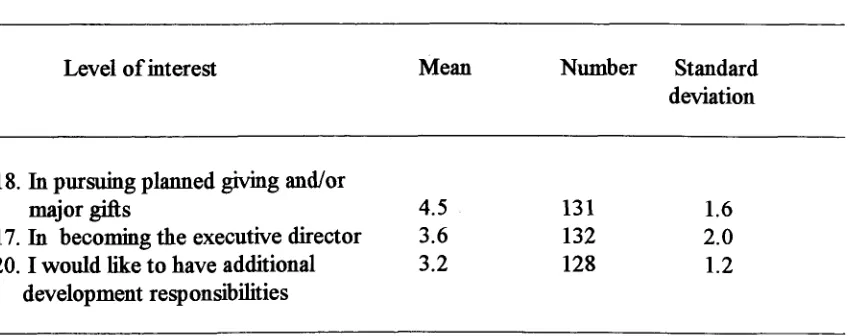
Fundraising Positions Respondents are Most Interested In
Interest in Assuming Increased Job Responsibilities
Gender ofBoss
Number ofY ears in Development
Number ofY ears in Current Position
Promoted to Current Position From Within or Hired From Outside
Organization
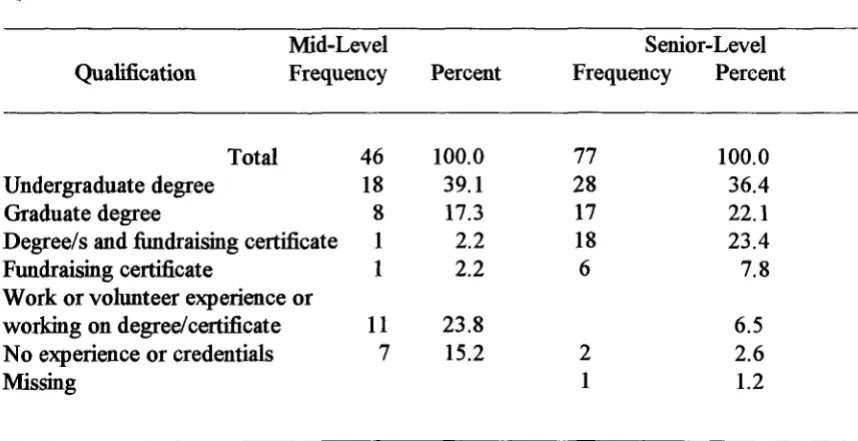
Qualification for Position
Marital Status
Number of Children
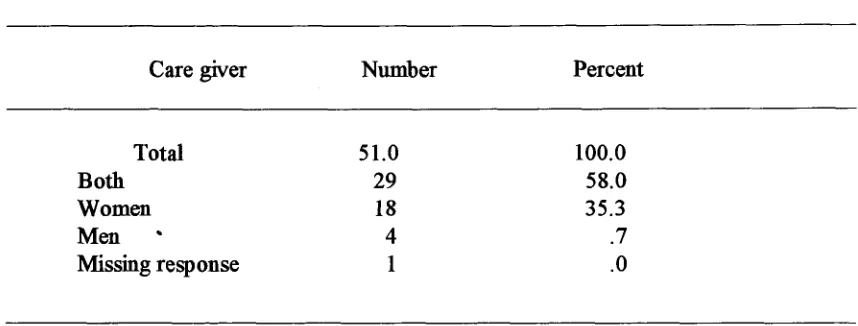
Primary Care Giver
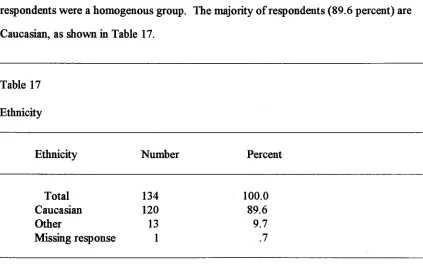
Ethnicity
Mean Responses to Questions 19 Through 29
Table 20
Table 21
Table 22
Table 23
Table 24
Table 25
Table 26
Table 27
List of Tables
Qualification for Position
Number ofYears in Development- Mid-Level Versus Senior-Level
Management
Number ofYears in Current Position- Mid-Level Versus Senior-Level
Management
Mean Responses to Barrier-Related Questions 19 through 29:
Mid-Management Versus Senior-Mid-Management Perceptions
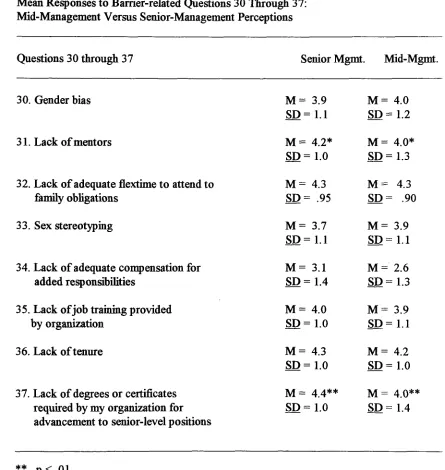
Mean Responses to Barrier-Related Questions 30 through 37:
Mid-Management Versus Senior-Mid-Management Perceptions
Factors Which Impede Women's Advancement
Factors Which Promote Women's Advancement
List ofFigures
List of Appendices
Appendix A ... Letter to Organizations
Appendix B ... Questionnaire Sent to Organizations
Appendix C ... Follow-Up Letter to Nonrespondents
Chapter One: Introduction
Statement oflssue
As
recently as five years ago, fundraising was a male-dominated profession. Today,this is no longer the case, with twice as many women as men entering the field
(Basinger-Burch, 1993, p. 29). The National Society ofFundraising Executives (NSFRE) and the
Council for Advancement and Support ofEducation (CASE}, two of the most prestigious
professional organizations in the field, both report an increase of female members. In
1992, 58 percent ofNSFRE's 13,500 members were women (Tiffi, 1992, p. 66) compared
to 1981 when only 38 percent were women (Conry, 1992, p. 6). Female membership
representation in CASE increased from 48.5 percent in 1986 to 54.7 percent in 1991
(Conry, 1992, p. 6). Out of an estimated 40,000 fund-raisers actively employed in the
profession (Conry, 1992, p. 8), 60 percent were reported to be women in 1991 (Mixer,
1994, p. 224).
Despite the influx of women into fundraising (synonymously called development)
overall women are far from reaching equal representation in specific positions with their
male counterparts. A 1989-90 CASE survey reported that women are clustered in
lower-level fundraising positions such as annual giving, foundation relations, and prospect
research where the salaries are lower and opportunities for advancement are limited
(Basinger-Burch, 1993, p. 30). Out ofthe total number of women who have
memberships in NSFRE, only about 30 percent were reported in 1991 to hold top-level
positions (Mixer, 1994, p. 226}. This percentage is much higher than the for-profit sector.
The United States Department ofLabor's Report on the Glass Ceiling Initiative (1991, p.
6) reports only 6.6 percent of senior-level positions in Fortune 1000 companies were held
by women. Although representation of female managers is much higher in the nonprofit
sector than in the for-profit sector, the disparity is probably attributable to the difference in
composed of female employees who are white-color workers with a higher percentage of
professional workers than in the for-profit sector. Thus, it is reasonable to presume that
the percentage of women represented in senior-level management would be higher in the
nonprofit sector than in the for-profit sector (Preston, 1990, p.l5). However, those
women who do obtain senior-level positions in the nonprofit sector are concentrated
primarily in small- to medium-size organizations where salaries and opportunities for high
levels of responsibilities are limited (Basinger-Burch, 1993, p. 30).
Is There a Glass Ceiling in the Nonprofit Sector?
"Glass ceiling" is a term that describes barriers to women's access to senior-level
positions. The glass ceiling was defined by Rosalie Gaull Siberman, vice chairperson of
the Equal Employment Opportunity Commission, as "an invisible, inpenetrable [sic] barrier
to advancement for women and minorities" in the workplace (Kalish, 1992, p. 64). The
barrier keeps women from access to top-management positions.
Mixer (1994) states that although women make up the majority of employees in the
fundraising profession there is a lack of equal representation of women in senior-level
positions. Like the for-profit sector, a glass ceiling appears to prevent female promotion
in the nonprofit sector (p. 234). Membership directories offundraising associations show
that men still occupy more than two thirds of the top positions in nonprofit organizations.
The jobs held by men are in larger agencies and the differential between the representation
ofwomen and men in senior positions grows with the size of the agen.cy (Mixer, 1994, p.
234).
Fundraising is Becoming "Feminized"
Another limitation that affects women's career progress cited by Conry (1992) is that
the development profession may be becoming "feminized" (p. 6). A field becomes
feminized when a previously male-dominated profession becomes dominated by women.
and respect diminish proportionate to the ratio of women to men (Commission on the
Status ofWomen, 1993, p. 10). The increasing number of women entering the :fundraising
field could have a negative impact on the future standards and pay of the profession.
Amongst some :fundraising professionals, fear is mounting that as more women move into
the field, pay and respect for the profession may begin to be diminished as has happened to
other professions throughout history (Commission on the Status ofWomen, 1993, p. 10).
As women increase their numbers in the :fundraising profession it may be perceived as a
less skilled profession (Mixer, 1994, p. 241). An example of the "feminization" of a
profession happened at the turn of the century when women moved from manufacturing to
office jobs that were previously dominated by men (Goldin, 1990, p. viii). When men
dominated office jobs the field was highly regarded as a skilled field with high pay.
However, when women increased their numbers in the profession, office jobs became
trivialized and undervalued as a vocation. The bias that "women's work" is less valuable
than men's is a barrier which continues to keep women from advancing at the same rate as
men.
The "Female Ghetto"
Conry (1992) cites as women feminize a male-dominated profession, they are more
likely to be employed in the less desirable positions. Even if women have the same years
of experience, women are directed into the less desirable and lower-paid positions within
most industries. Women become trapped in what sociologist Barbara Reskin calls "female
ghettos" (p. 6). Female ghettos are formed as a part of the progression of a field
becoming feminized. Even when women begin to dominate a profession they are slotted
into the less desirable positions (p. 7).
Conry (1992) cites Reskin's definition of female ghettos in organizations as the
"lower-paid enclaves occupied almost exclusively by women within otherwise integrated
organizations and institutions" (Conry, p. 6). Susan Tiffi's (1992) article indicates that
Women are concentrated in the less prestigious and less "glamorous" areas offundraising
such as prospect research and annual giving, where opportunities and pay are less
attractive. Men are dominating the higher-dollar and higher-skilled areas such as major
gifts and planned giving. Further evidence of women being clustered into lower-level
positions was verified in a 1989-90 Council for the Advancement and Support of
Education survey which confirmed the existence of the female ghetto in the nonprofit
sector (Basinger-Burch, 1993, p. 30). Once women enter and are integrated into a
previously male-dominated profession, men continue to occupy the senior positions. The
glass ceiling effectively keeps women from advancing (Basinger-Burch, 1993, p. 30).
Basinger-Burch (1993) states that the three most daunting barriers that comprise the glass
ceiling and keep women from equal access to senior-level positions are: outdated attitudes
and behaviors by both men and women; insufficient access to knowledgeable mentors; and
difficulty balancing family, work, and community (p. 30).
Statement of Issue
There has been a great deal of speculation about why women are not equally
represented in senior-level management in the development field. Whatever the reason,
career barriers exist for women in the workplace in nearly every nonprofit profession
including development (Shea, 1991, p. 38). The purpose of this investigation was to
determine the extent to which professional women in hospital foundations perceive career
barriers in their organizations. In particular, the researcher attempted to determine
whether women in mid-level management in hospital foundations perceive greater barriers
to their career advancement than do women in senior-level management. The researcher
also strove to identify those barriers that women feel have the most significant impact on
career advancement in their organizations.
The Fundraising Pyramid
hospitals tends to fall on the higher end of the "fundraising pyramid" and the dollar
amounts raised by hospital foundations are larger than in most other fields. The
fundraising pyramid is a visual tool used by fund-raisers to help describe the different
levels of fundraising skills. The bottom of the pyramid is considered the area where less
training and time are needed by the fund-raiser in asking for a charitable gift from the
donor. The gifts raised are usually smaller. The top of the pyramid requires more
expertise and time on the part of the fund-raiser to cultivate donors, and the gifts are
larger (Figure 1.1 ).
Figure 1
Fundraising Pyramid
Source: Flanagan, 1993, Successful Fundraising, p. 20.
Hospital Development, Promising Field for Women
In the development profession, medical centers pay the most for development
officers, an average of$62,250
in
1992 (TifR, 1992, p. 67). This amount is much higheraverage salary for a development professional to be $40,000 for women and $52,000 for
men (Mixer, 1994, p. 226). This figure does not factor in tenure. Despite Reskin's female
ghetto theory cited by Conry (1992) that women are concentrated in lower-level
development positions (Conry, p. 6), health care development seems to be one of the best
areas for women to advance in their careers in the 1990s. Health care is one of the fastest
growing fields for development opportunities. Seventy-one percent of the programs are
14 years old or younger (Mixer, 1994, p. 229). With the new opportunities available in
hospital development, women may perceive that there are few career barriers limiting
advancement; thus hospital development is a profession which may continue to attract
more women in the future.
The Health Care Industry for Women
Health care is one ofthe fastest growing industries of the United States economy
and a fertile ground for development opportunities. According to the Occupational
Outlook published by the Bureau of Labor Statistics, the health service industry is
projected to grow from 8,212,800 employees in 1988 to a work force of 11,289,500 by
the year 2000 (Whittingham-Barnes, 1992, p. 62). The influx of women into health care
development is projected to increase with this growth if current trends continue. The
membership of women in the Association ofHealthcare Philanthropy (formerly called the
National Association for Hospital Development) has already soared from 15 percent in
1977 to 42 percent in 1993 and is expected to continue to grow (Basinger-Burch, 1993, p.
30). Working Woman magazine reported that one of the five best employment growth
areas for women is health care (Simurda, 1993, p. 30). Health care institutions
will
havemore opportunities available for women fundraisers than other fields in the nonprofit
sector, states Susan Tiffi: in her article on fundraising, primarily due to the size of these
institutions, their prosperity, and potential for growth as the American population ages
can all give women a better chance of advancing to senior positions in their organizations
(Tiffi, 1992, p. 67).
What Does Growth in Health Care Development Mean for Women?
Shea ( 1991) reports that statistics show that women lag behind men in both salary
and advancement opportunities. Parity between men and women has grown to be a
crucial issue for the Association for Healthcare Philanthropy, whose board in 1990 set up
a standing committee to address the problem (p. 38). The Salary and Benefits Report
-U.S.A. 1993, ofthe Association ofHealth Care Philanthropy, states that male
development professionals typically earn more than their female counterparts and that this
difference is most pronounced among foundation executives. Unfortunately, seniority
does not offset the female financial disadvantage. The report also states that women
foundation executives with eight years of experience earn a lower median salary than their
male counterparts who have been in the same position for two years or less (Association
for Healthcare Philanthropy, 1993, p. 2). Lower compensation for women could be one
ofthe factors which makes higher levels of responsibility less attractive to them
Definition ofTerms
The following terms will be defined to help clarify the issues.
Career barriers. Career barriers are defined as factors that hinder women from access
to advanced positions in organizations. Barriers may include sex stereotyping
(characteristics, attitudes, and temperaments more commonly ascribed to one sex than to
another), company policies regarding parental support (provisions ofbenefits and an
environment that promotes family commitments), and low career aspirations among
women due primarily to conflict with community and family responsibilities or self-esteem
ISSUes.
Hospital foundations. A hospital foundation is defined as an independently
incorporated nonprofit organization that is primarily responsible for the fundraising for a
Senior-level management. This category is comprised of individuals whose
fundraising responsibilities include major gifts, planned-giving, and personal accountability
to the board of directors or the executive director.
Mid-level management. This category is comprised of individuals whose fundraising
responsibilities include annual giving, prospecting, and special events duties. This group
reports to senior-level staff.
Research Hypotheses
The research study
will
test the following hypotheses:1. Women in professional positions in hospital foundations
will
perceive gender relatedbarriers to their career advancement in their organization.
2. Women in mid-level positions
will
perceive that greater gender related barriers toadvancement in their organization exist for them than for women in senior-level
positions.
3. The gender related barrier which
will
be ranked as having the highest impact on theprofessional advancement of women in hospital foundations is balancing work with
family obligations (specifically the lack of adequate maternity leave and flextime) for
both mid-level and senior-level women.
Importance of Study
This study focused on women in professional development positions in hospital
foundations. It sought to determine those factors that women perceive to be barriers to
attaining senior-levels offundraising responsibilities. Hospital development was selected
because hospitals represent the largest segment of the nonprofit sector. In addition,
hospital development departments and foundations employ the second-largest number of
development officers, after educational institutions. Fifteen percent of all development
officers work for hospitals, second only to universities, which employ 25 percent of the
areas of the fundraising profession (Tiffi, 1992, p. 67). Since women are generally
concentrated in small-to medium-size organizations with low- to mid-levels offundraising
responsibilities, it would be interesting to examine whether women are concentrated
predominantly in mid-level positions in hospital foundations. Evidence indicates that
hospital fundraising is probably the most difficult area for women to gain access to, yet
there has been significant growth in this area for women. Examining barriers to women's
advancement in hospital foundations careers may help us understand this dichotomy and
bring further understanding concerning women's access to senior-level positions. What do
women perceive to be barriers to their careers? What do women perceive to be their
opportunities for the future? These questions have been examined to assist professional
women in understanding the potential opportunities and barriers that they may face in
hospital development in order to improve their access to senior-level fundraising positions.
This study was designed to build upon research conducted by Carrell (1993) on
perceived barriers to the career advancement of women in large environmental
organizations. The more information we have on perceived barriers in the nonprofit
sector, the more able we
will
be able to understand and determine patterns that may existfor women in the workplace.
Why is it important for women to be equally represented? Allowing women to have
equal opportunities in hospital development is good business practice. To exclude women
from full participation in employment opportunities limits an organization's ability to
compete in a changing world (Basinger-Burch, 1993, p. 30). Hospitals
will
benefit if theyrecruit without gender bias from their entire pool of candidates, and thus avoid limiting
their options. The U.S. Department ofLabor's (1992) Pipeline ofProgress reports that
recruitment practices have to be proactive outreach efforts (p. 1 ). Not only must hospitals
recruit without gender bias, but they must implement constructive strategies to improve
educational, attitudinal, and organizational policies (Davidson & Cooper, 1992, p. 16) so
Limitations ofthe Study
This study examined perceived barriers to the advancement of women in professional
positions in hospital foundations. This study
will
be limited to professional women already
employed in development positions in hospital foundations, excluding volunteers, board
members, and support staffs. Limiting the study to professional women already employed
in a foundation
will
allow the measurement ofbarriers between mid-level and senior-level
management. Barriers for volunteers, board members, and support staff may include
additional variables which
will
not be discussed. This study may exclude women who felt
barriers were too great and thus may have left the profession.
This study focused primarily on hospital foundations affiliated with community
hospitals that are part ofJ_arge organizations. The results from this study may not reflect
barriers that women may face in development offices associated with small and mid-sized
organizations.
The researcher's census study was limited to professionals in California affiliated
through membership with the Association ofHealthcare Philanthropy. The results of this
study do not necessarily reflect barriers which may exist for women in other states. Using
the AHP membership catalogue limited the study to foundation professionals whose
organizations are willing and able to pay the expensive AHP annual membership fee.
The researcher relied on obtaining a list of subjects by calling the foundations and
asking the receptionists to list the names of
allthe professional women working in their
foundations. Receptionists were very cooperative in providing a list of employees in their
organizations. The researcher was reliant on receptionists to provide accurate and
Chapter Two: Literature Review
Women in the American Work Force
Women have been an integral part of the American work force both in a formal and
informal basis since colonial times (Commission on the Status ofWomen, 1993, p. 1).
On an informal basis, women manufactured most of the necessities for daily life such as
clothing, soap, candles, food, and home medicines. They also worked behind the scenes
and off the record, helping their husbands tend to their daily professions. Women worked
alongside their husbands helping run general stores, tending crops, and healing the sick
(Commission on the Status ofWomen, 1993, p. 1). However, prior to the 20th century,
professional occupations for women were primarily confined to such fields as nursing and
elementary school teaching, which were considered to be "woman's work," and
consequently were undervalued as vocations (Slaughter, 1990, p. 7).
Women have steadily increased their numbers in the labor force since the 1800s. In
1900, less than one in five workers was a woman. Goldin (1990) reports that more than
60 percent of women work, comprising almost 50 percent of the total work force.
Despite the increase of women in the work force, occupational segregation by sex has
remained nearly constant (p. 3). Women have gained access to almost every type of
profession in the United States, yet they are still concentrated primarily in traditionally
female occupations. Consequently, women are not compensated or valued on an equal
basis with their male counterparts (Goldin, 1990, p. 3).
Most of the factors that brought women into the labor force were results of
economic change. The Industrial Revolution, the U.S. Civil War and the two World Wars
played significant roles in altering the economy, by taking men out of the labor force and
creating opportunities for women to fill positions that were previously held by men.
However, when the men returned from war or needed their jobs back, men took
economic need, the majority of women have been segregated by profession into areas of
traditional "woman's work." Goldin (1990) points out that "occupational segregation by
sex has diminished only slightly since 1900, and the ratio of female to male earnings
remained stable from the 1950s to the early 1980s" ( p. 3).
Feminization of the Work Force
The Commission on the Status ofWomen (1993) reported that nine out often
women workers are employed in a female-dominated profession such as nursing,
secretarial work, child care, bookkeeping and clerical work (p.4). These types of
professions are dominated by women and are thus considered "woman's work," which is
viewed by society to have lower status and lower pay compared to "men's work"
(Commission on the Status ofWomen, 1993, p. 4). Conry (1992) reports that although
women have made gains in male dominated professions, this progress has not always
resulted in equal pay and status for women compared to men. As women move from
fedominated professions to dominated ones, the status and pay of the
male-dominated fields
will
diminish
for both sexes as the ratio of women to men increases(p. 7).
This
phenomena, cited by Conry (1992) in a report by the 1987 Census BureauStudy, is called the "feminization" of a profession (p. 7). An example ofthe feminization
of a field occurred among bank tellers following World War II. After returning from the
war, most men declined to return to bank teller positions in favor of more lucrative and
highly skilled jobs. As more women occupied teller positions, tellers experienced a
downward transformation in status and pay (Conry, 1992, p. 7).
As an industry becomes "feminized," the men who continue to stay in the profession
tend to dominate the senior positions.
This
process was defined by B.F. Reskin as thedevelopment of "female ghettos." Reskin cites real estate as an example of an industry
that developed a female ghetto. As more women moved into the real estate industry, men
respect for the occupation diminished as women continued to increase their numbers in
residential realty (Thomas & Reskin, 1990, p. 210).
There are many debatable reasons why the "feminization" of an occupation occurs.
In Conry's (1992) article, she cites economists Strober and Arnold who outline three
reasons which they believe account for occupational segregation and feminization: "( 1)
social rules and customs as well as profit maximizing govern employers' personnel
decisions; (2) male workers as a group decide,
within
race and class constraints, whichjobs will be theirs; and (3) male workers maximize their economic gain in making this
decision" (Conry, p. 7). Feminist theorists believe that a "social control system," including
gender ideology, customs, socialization, institutional structures, and the cultural
devaluation of"traditional" women's work, all conspire to keep female majority
occupations from achieving the status and compensation levels accorded to
male-dominated professions (Conry, 1992, p. 7).
Within the fundraising profession, professionals are concerned that the development
occupation is becoming feminized (Tifft, 1992, p. 7). Feminization would cause pay and
respect for the industry to diminish. Although there has not been any conclusive evidence
reported confirming the feminization of fundraising, evidence is mounting that patterns
leading to feminization are occurring (Conry, 1992, p. 7). Five years ago fundraising was
a male-dominated profession (Basinger-Burch, 1993, p. 29). Today, 60 percent of
fundraising professionals are women (Mixer, 1994, p. 224). Conry (1992) reported that
The Council for Advancement and Support ofEducation (CASE) (1982) conducted a
survey of professional fundraisers which showed that men earned 20 percent more than
women. The primary factor for the differential was gender, not extent of education,
experience, or qualifications (Conry, p. 9). The survey also noted, as was reported by
Basinger-Burch (1993), that men held most ofthe senior positions and that there was a
clear existence of a female ghetto (Basinger-Burch, 1993, p. 30). The 1990
conclusion, reporting that women held only 11.1 percent of senior-level positions such as
executive director, president, or vice president. In contrast, women held 68.9 percent of
mid-level positions. Not only did men hold higher titles, but they also worked in higher
paying and more prestigious institutions (Conry, p. 7).
Tifft (1992) cites further evidence of the feminization ofthe fundraising profession in
a 1992 National Society ofFundraising Executives survey which shows that the average
salary of female fund-raisers is $40,000, compared to that of males in similar positions,
who earn an average of$52,000 (p. 67). Tifft (1992) believes that the discrepancy in
salary between men and women is due to men's longer tenure (p. 70). However, a study
entitled Salacy and Benefits Report-U.S.A 1993 by the Association for Healthcare
Philanthropy confirms that even women with the same tenure as men earn significantly
lower salaries. Female senior development executives who have been in hospital
development for eight years earn only 75 percent of what males with the same tenure earn.
For associate development officers, a mid-level position, the discrepancy is even greater;
women with eight years' experience earn 36 percent ofwhat similarly qualified males earn
(Association for Healthcare Philanthropy, 1993, p. 6). Differences in pay equity is further
confirmed in a 1990 National Association for Hospital Development survey cited by
Basinger-Burch (1993) which documents that women who have been in fundraising more
than eight years earn 70 percent of what similarly qualified men earn. The differential in
salaries between men and women with the same tenure provides further evidence that
barriers exist for women (Basinger-Burch, 1993, p. 30).
Legislation Promoting Gender Equity
Several pieces oflegislation aimed at preventing discriminatory treatment of women
have been introduced during this century. The Equal Pay Act of 1963 and the Civil Rights
Act of 1964 were attempts to prevent discrimination against employees. The Equal Pay
work" when the legislation passed in 1963. The difference in wording was very
significant, since equal work compared salaries between men and women in the same job,
whereas comparable work standards would compare similarly skilled, gender-segregated
occupations. For example, a librarian's salary would be compared to that of a foreman
who had comparable years of education and levels of skill. Unfortunately, the wording of
the Equal Pay Act was changed to "equal pay for equal work," so that little improvement
in equal pay for women resulted, since occupations are highly segregated by gender
(Goldin, 1990, p. 201). Nine out often women work in female-dominated professions
such as secretary, nurse, child care provider, bookkeeper and accounting clerk; thus, the
legislation affected a minimal group ofwomen (Commission on the Status ofWomen,
1993, p. 4). In addition, there was no system set up to enforce the legislation. Critics
justifiably called it a "rather weak doctrine to combat discrimination" (Goldin, 1990, p.
201).
One year after enactment of the Equal Pay Act, the Civil Rights Act was passed.
Some advocates call it the most comprehensive and important piece of federal legislation
prohibiting employee discrimination (Goldin, 1990, p. 201). The act opened up new jobs
for women that were previously considered men's work (Preston, 1994, p. 39). The act
required employers to avoid giving preferential treatment to men or women in the hiring
or promotion process. The legislation provided women with a foundation to become
more vocal about their equal rights and opportunities (Preston, 1994, p. 40).
Although the Civil Rights Act of 1964 provided a stronger basis from which women
could fight for equal pay and rights, women still met resistance to being granted their
rights. Prior to enactment, legislators debated whether to include the word "sex" in Title
Vll of the Civil Rights Act of 1964. The legislation was originally written to "prohibit
discrimination on the basis of race, color, religion, sex, or national origin in hiring,
promotion, and other conditions of employment" (Goldin, 1990, p. 201). Controversy
word "sex" from the legislation to ensure its passage. They felt that granting women more
legal rights would make the bill too controversial to pass. Other legislators wanted to
include the word sex, predicting that it would kill the bill (Goldin, 1990, p. 201 ). Passage
of the legislation prompted proponents of the bill to call it an "accidental breakthrough"
(Steiner, 1985, p. 12). Congressional attendance for the vote was low, with only 40
percent of the House showing up to vote. The remaining 60 percent abstained from
voting or were not present to vote because they were concerned that voting on the
controversial legislation might have a negative impact on their careers (Steiner, 1985, p.
12). The controversy attending inclusion of the word "sex" in the legislation indicated the
reluctance oflegislators to legally guarantee equality between genders.
Further amendments to Title Vll were enacted in 1972, requiring fair employment
practices relative to women. It was made illegal to discriminate on the basis of sex "in
hiring, firing, compensation, terms, conditions, or privileges of employment or on the basis
of sex to limit, segregate, or classifY ... employees or applications ... in any way which
would ... adversely affect his (sic) status as an employee" (Goldin, 1990, p. 201). Critics
of women's rights have argued that women are already secured their rights under the law
and do not need further protection. However, advocates of women's rights found that the
Civil Rights Act of 1964 and the Equal Pay Act of 1963 were ineffective in implementing
equal rights for women in the workplace. For example, it was not until1974 that the first
discriminatory finding was made under Title Vll (Goldin, 1990, p. 201). Title Vll has
further limitations; it only applies to organizations with 15 employees or more. Women's
rights proponents wanted a comprehensive piece oflegislation that would guarantee equal
rights for women in all areas of their lives.
The Equal Rights Amendment, proposed legislation to guarantee equality of the
sexes, failed to pass both in 1923 and in 1972. The legislation simply reads: "Men and
Pay Act, the Civil Rights Act, and the Equal Rights Amendment exemplifies a continuing
lack of agreement about whether women should have equal legal rights with men in
society.
The lack of protective legislation, one could argue, is damaging to women in the
work force in two ways. First, the failure of the federal government to acknowledge
women as equal sends a message to society that women need not be equally regarded.
Second, limiting the avenues by which women can exercise legislative power makes it
easier for women to be discriminated against. Some women may feel that they have
sufficient protection under current laws, and/or that they are regarded as men's equals.
However, statistics show that women have not reached parity with men in the workplace,
either in terms of obtaining senior-level positions or receiving equal compensation.
The United States Department ofLabor reported in 1991 that women earn 74 cents
for every dollar earned by men (Commission on the Status ofWomen, 1993, p. 10). The
Commission on the Status ofWomen estimated female earnings even lower, at 59 cents to
every dollar (p. 10). The disparity in compensation is largely due to the fact that women
tend to work in occupations which pay less. Women who work in male-dominated
professions and earn higher salaries than women in female-dominated professions will
experience diminishing pay increases as their field of employment becomes more feminized
(p. 10). Bank tellers, for example, were predominantly male and relatively well paid
during the first half of this century. However, as women moved into the field, pay for
bank teller positions diminished compared to what the pay was when men dominated the
field. In 1992, 95 percent ofbank tellers were women being paid close to minimum wage;
in comparison, men were paid high salaries before the profession became feminized
(Commission on the Status ofWomen, 1993, p. 10).
There are many arguments about why there is a salary differential between most
women and men. Throughout American history, women have earned far less than men.
p. 83). This ratio increased to about 74 cents to the dollar in 1993 for women compared
to men, according to the U.S. Department ofLabor (Commission on the Status of
Women, 1993, p. 15).
However, using a simple pay ratio as an indicator of discrimination is not sufficient.
Other variables may influence the differential.
Variables which have been associated with the wage gap include: tenure, education,
and occupational choice (Commission on the Status ofWomen, 1993, p. 15). Education
does not always he]p promote pay equity because women in the past have not pursued and
prepared themselves for high-paying occupations such as doctor, lawyer and engineer.
Women take time out for child-bearing, which results in less tenure. Women are steered
into traditional women's work, which is lower paying. Although such arguments may
apply in some cases (Commission on the Status ofWomen, 1993, p. 15), there is an
abundance of evidence which shows that women with the same education and tenure
working in the same occupation are paid less then men. The Commission on the Status of
Women and the National Committee on Pay Equity believe that the disparity in
compensation is due to the fact that women are undervalued in society, and are thus
discriminated against in the workplace (Commission on the Status ofWomen, 1993, p.
15). Golden (1990) states that the difference in pay is primarily due to a long history of
occupational segregation and social acceptance of the bias that women's work is less
valuable (p. l18).
In addition to the wage gap, there is also a disparity in the numbers of women who
hold senior-level positions in the workplace compared to men. Throughout the 1980s,
women increased their numbers in the labor force and continued to break into formerly
male-dominated fields. However, the actual number of women moving into senior-level
positions was very low (U.S. Department ofLabor, 1992, p. 5). There seemed to be a
senior-level positions in the workplace. The barrier which kept the majority of women in
mid-management levels
is
referred to popularly as the glass ceiling.The Glass Ceiling Defined
The term "glass ceiling" was first introduced by Morrison, White and Van Velson in
their 1987 book Breaking the Glass Ceiling. They described the glass ceiling as an
invisible barrier which
is
not penetrable by women and minorities in the workplace. Itkeeps women and minorities from advancing from mid-level management to senior-level
positions. The glass ceiling is a barrier which keeps women out of a position not because
of their lack of ability, but solely because they are women (Morrison, White, & Van
Velson, 1987, p. 13).
In 1991, the term glass ceiling was officially recognized by the federal government.
The United States Department ofLabor issued a Report on the Glass Ceiling Initiative
(1991, p. 6) which confirmed the existence of the phenomena in the for-profit sector.
That report surveyed 94 Fortune 1,000 companies to see how many women held
executive-level positions. The report found that only 6.6 percent of executive-level
positions were held by women. In addition, the report showed that progress integrating
women into senior positions is very slow. In the early 1970s only one percent of
executives were female
(p.
6).The Wall Street Journal reported a finding by the Women's Research and Education
Institute stating that at the current rate of women's movement into executive-level
positions, it will take 75 to 100 years for women to achieve equitable representation
("Crashing the Ceiling," 1993).
Equality for women in the work force remains an issue the federal government
continues to address. The United States Department ofLabor published a report in 1987,
titled Workforce 2000, which showed that although women have made significant gains in
breaking into male-dominated professions, there is ample evidence that they are still
from advancing to senior-level positions. The research was conducted by nonprofit
organizations, universities, executive recruiters and the U.S. Department of Labor. The
report concluded that women in management were experiencing a "glass ceiling." The
report defines the glass ceiling "as those artificial barriers based on attitudinal or
organizational bias that prevent qualified individuals from advancing upward in their
organization into management level positions" (U.S. Department of Labor, 1987, p. 3).
The importance of this finding is that, through the Office ofFederal Contract Compliance
(OFCCP), the U.S. Department ofLabor is responsible for ensuring that in all contracts
between business and the federal government there is no discrimination in employment
decisions based on race, sex, color, religion, national origin, disability or veteran status.
Complying with OFCCP guidelines is especially important to the nonprofit sector, which is
reliant on funding from the government.
The U.S. Department of Labor conducted additional reports on the glass ceiling in
later years. A Report on the Glass Ceiling Initiative ( 1991) further investigated career
barriers in corporate America. This report helped the department propose strategies to
eliminate artificial workplace barriers. Lynn Martin, the secretary of the United States
Department ofLabor during 1991, was quoted in the report explaining the importance of
integrating women and minorities in the work force:
The glass ceiling, where it exists, hinders not only individuals but society as a
whole. It effectively cuts our pool of potential corporate leaders by eliminating
over one-half of our population. It deprives our economy of new leaders, new
sources of creativity - the "would be" pioneers of the business world. If our end
game is to compete successfully in today's global market, then we have to unleash
the full potential of America's work force. The time has come to tear down, to
Barriers
The U.S. Department ofLabor (1991) defines barriers as "attitudinal or
organizational bias that prevent qualified individuals from advancing upward in their
organization into management-level positions." Attitudinal barriers related to women's
advancement include discrimination as a result of sex stereotyping, and/or gender bias.
Institutional barriers include bias "embedded in the formal structure of establishments:
their personnel practices, job descriptions, mobility ladders and the organization of tasks"
(Reskin
&
Hartmann, 1986, p. 51). Facing attitudinal or organizational types ofbarriersresults in unequal opportunities for promotion and compensation (Goldin, 1990, p. 205).
Barriers Which Make up the Glass Ceiling
What are the components that make up the glass ceiling? In their 1987 book,
Breaking the Glass Ceiling Morrison and co-authors White and Van Velson examined the
barriers that women believe are holding them back and outlined the limited progress
women have made obtaining senior-level positions in corporate America. Although more
women are working and are occupying positions in mid-management, few women are
obtaining senior-level positions. In 1986, only 1. 7 percent of senior-level managers were
women (Morrison, White, & Van Velson, 1987, p. 5). What is keeping women from
senior-level positions? This question was the catalyst that prompted the Center for
Creative Leadership to sponsor a three-year study of senior-level executives in Fortune
100 companies. During this same period, Morrison and her colleagues interviewed more
than 100 professionals about what executives need to do in order to excel in a large
corporation. From that study, the researchers were able to identify specific factors and
events which they felt were key ingredients to career success. The weakness of this study
was that, since the majority of executives interviewed were male, the success factors
identified applied predominantly to men.
The question "Do women need the same events and factors as men to promote their
question by creating the Executive Women Project, in which they interviewed 7 6
mid-management women from 25 companies. Morrison, and her colleagues used the same
interview questions as those in their 1987 study of the 100 executives to determine
whether an all-female-respondents group would identif-Y different success factors
(Morrison et al, 1987, p.5).
In addition, Morrison and her colleagues conducted a companion study of22
senior-level executives (sixteen men and six women). The researchers asked these 22 senior
executives to profile women who they considered to be successful and those they
considered to be unsuccessful (Morrison et al., 1987, p.lO).
The researchers concluded from the responses of senior-level executives in these two
studies that successful women executives differed from their male counterparts in three
ways, corresponding to three interactive levels of pressure that they have to cope with
throughout their careers. The three levels of pressures are: family obligations, coping with
employment responSibilities, and the pressures associated with their pioneering role on the
job. The studies revealed that each individual pressure would not be significant as a
restraint for most women. However, the fact that the women studied have to cope with
all three simultaneously is what differentiates these women from their male counterparts.
The pressures of the job for both men and women in management levels can be very
high, with long hours and perpetual responsibility. However, unlike men, women tend to
be the primary care givers for their children (Morrison et al., 1987, p. 17; Eubanks, 1991,
p. 21 ). Women often have to prioritize their careers around children. High levels of
responsibility coupled with family obligations often create a conflict between attending to
family over work and visa versa (Morrison et al., 1987, p. 17; Eubanks, 1991, p. 21).
When women are in the office they
think
about family responsibilities and when they are athome they feel as if they are falling behind in their job responsibilities. It becomes a
Another pressure identified by the studies stems from being a female executive in a
male-dominated sphere. Women have the pressure of setting an example for coworkers
and superiors, since they often are pioneering their way into positions that have been
male-dominated. More attention to performance is focused on a woman if she is the only
female executive in the group. Davidson and Cooper (1992) cite research by Harnett and
Novarra on women in management which reported that being a "token" woman meant
that such women were also responsible for representing their gender, thus creating
enormous psychological pressure for them (p. 86). Women profiled in this study also felt
that they had to work twice as hard as men to prove that they were capable of getting the
job done (p. 86). An article in the October 1986 issue of Working Woman magazine
summed up one woman's fear and perception of job pressures: "Ifi fail, it will be a long
time before they hire another woman for the job. . . . Carrying that burden can lead
women to play it safe, to be ultraconservative, to opt out if a situation looks chancy "
(Kagan, 1986, p. 107).
Barrier: Work and Family Conflict
Family obligations in addition to job responsibilities may make women prioritize their
lives differently then men. Pamela Meyer, an administrator at Edward Hospital in
Naperville,
n.,,
defines success this way: "Balance is success. To be a good CEO is to feelsuccessful, even with tremendous disappointment or people mad at me. It's the feeling of
wanting to come here day after day. If I had career success but my kids were falling apart,
I would feel like a total failure" (Eubanks, 1991, p. 22). A 1992 report by the American
College ofHealthcare Executives (ACHE) cited by Burda (1991) states that women's need
to balance family with career makes it difficult for women to focus as much of their energy
on the job as men do. As a result, men have more free time to dedicate to networking,
which is an important component of career success for high-level executives (Burda, 1991,
p. 24). Although there has not been a direct measurement of the amount of time spent
time than women taking care of children and more time networking (Burda, 1991, p. 24).
The same ACHE survey, "Gender and Careers in Healthcare Management," reported that
more men than women participated in networking activities such as attending cultural
events, playing sports, going to dinner and hosting informal lunches with colleagues or
prospective donors (Burda, 1991, p. 24).
A benefit documented in the ACHE statistics which may reduce the strain of
balancing family and work for women is to be married. A spouse can help share family
and household responsibilities, thus leaving more free time for both partners. More men
than women surveyed were reported to be married; 88 percent of the male executives
surveyed were married or living with a domestic partner, compared to 66 percent of the
females (Eubanks, 1991, p. 20). The report also documented that women executives had
fewer children living in their household than did the male executives. More than half of
the female executives did not have children to care for, compared to 19 percent of male
professionals. For those women who did have children, child care fell primarily on them
Only 6 percent of male spouses took care of their children when they fell sick. The report
concluded that women were twice as likely as men to cite family-related obligations, such
as care giving, as a hindrance to their career advancement. The report also stated that 61
percent of women said they had taken a less desirable job or left their career track to allow
their husbands to advance in their careers (Eubanks, 1991, p. 21).
Easing the Work/Family Conflict
Women take responsibility for 80 percent ofhousework, 70 percent of child care and
90 percent of elder care (Jardim & Hennig, 1990, p. 130). In addition, they often have to
interrupt their employment to take maternity leave. With the influx of women into the
work force during the past decade, some progressive cotporations are beginning to
recognize the need for "family friendly" policies (Thompson, Thomas,
&
Mair, 1992, p.1992, p. 60). Dependent care includes caring for a dependent child, family member, or
relative. Only about 10 percent of corporations with over 100 employees are providing
some form of child care. Although the numbers of corporations providing child care have
increased, the increase has been very incremental. In 1991, approximately 4000
corporations provided some form of child care assistance, compared to 110 in 1978
(Thompson et al., 1992, p. 61).
Parental leave policies are also scarce, and where they exist there are very few
consistent guidelines for implementation. Parental leave is taking time off from work to
take care of a sick family member or other relative, or to take maternity leave. Only 51
percent of corporations provide some type of maternity leave, which usually amounts to
six weeks off to attend to a newborn infant (Thompson et al., 1992, p. 60). The time
allotted
is
minimal compared to that in most industrialized countries. Sweden, forexample, has one of the most generous policies, in which both parents are entitled to 18
months of paid leave. The U.S. had no family leave legislation unti11993 when the Family
Medical Leave Act (FMIA) was passed. The
FMIA
allows workers in companies with50 or more employees to take up to 12 weeks unpaid leave (Murray, 1995, p. 15).
Although this legislation is a step in the right direction, the effectiveness of the law as it is
being applied
is
an issue of debate among critics. Many employees can not afford to takeoff time without pay and the legislation excludes corporations
with
fewer than 50employees.
Other programs offered to employees are the spouse relocation and job locator
programs. These programs are offered to spouses of employees who relocate to a new
residence requiring the "following spouse" to give up their job. Companies try to ease the
transition by helping the employee's spouse locate a new job.
Alternative work schedules such as flextime, part-time work, and job sharing are
other programs which companies implement to help ease the work/family conflict. Having
flexibility to juggle family and work demands. These types of solutions have only been
implemented by about 12 percent ofU.S. corporations (Thompson et al., 1992, p. 60).
Although there are some policies and programs in place to help ease the conflict
between family and work, they do not reach the majority of employees. Thompson and
her co-authors outline four barriers on work/family conflict which prevent organizations
from implementing supportive family policies in the workplace (1992, p. 69).
The first barrier
is
the set of prevailing assumptions about the proper separation ofgender roles. The myth about separate roles for genders throughout history states that the
world of work
is
where men belong and is masculine, and the world of the familyis
wherewomen belong and
is
feminine. Policy makers have failed to acknowledge the influx ofwomen into the work force and their particular needs (1992, p. 70).
The second barrier
is
lack of support from national policy makers. The United Statesis
the only industrialized nation which does not have paid maternity leave. Withoutgovernment mandates to he]p promote policies which are "family friendly"- meaning
policies which make it easier for both parents to attend to family responsibilities in
addition to work responsibilities-few organizations
will
take the lead to provide programsto he]p employees balance family and work (1992, p. 71).
The third barrier
is
the lack of equality for women in the home. Even if companiesimplement policies to he]p ease the conflict between the family and work, women may still
experience inequities at home. Women tend to have the greater burden of child and elder
care and managing the home. Thus until there
is
equity in the home for familyresponsibilities, pro-family company policies
will
be limited in their effectiveness (p. 74).The last barrier
is
the clash between family and corporate culture. Even if companiesprovide family-friendly programs, these policies may not be implemented or encouraged
by managers. Employees may not take advantage of the programs, fearing that their jobs
Barrier: Stereotyping
A stereotype
is
defined by Webster's II New Riverside Dictionary (1984) as: "Aconventional, formulaic, highly simplified opinion, conception or belief" Stereotypical
beliefs about a woman's innate traits persist despite women's proven abilities in the work
force. The Committee on Women's Employment and Related Issues outlined three
stereotypical roles which continue to restrict some women from working in certain
occupations and receiving equal compensation (Reskin & Hartmann, 1986, p. 41). The
first stereotype is the idea that a woman's "natural" place is in the home. Although women
continue to increase their numbers in the work force, the contradiction that women should
remain in the home persists. This stereotype concludes that if women must work, proper
employment consists of those positions which
will
minimize interference with child careand the fulfillment of home duties. These jobs include positions which
will
not takewomen far from home, jobs that are not dangerous, positions that do not require close
attention and that can be easily interrupted (Goldin, 1990, p. 7). These types of
employment include part-time work, flextime jobs, work that can be done at home such as
typing or sewing, and positions which are an extension of their domestic roles, such as
nursing and social work (Reskin & Hartmann, 1986, p. 38). Ironically, the stereotypical
types of flexible employment that women are encouraged to do can both help and hinder
their career advancement. If companies do not extend and enforce flextime policies to all
employees regardless of gender, flextime positions
will
continue to be regarded aspositions for people who may have additional priorities other than work, such as family
obligations. Since women are the primary care givers, alternative work schedules
will
beclassified as "women's work" and thus
will
be undervalued (Reskin & Hartmann, 1986, p.38).
A second stereotype outlined by the Committee on Women's Employment and
Related Issues
is
that women develop different behavioral characteristics relative to men;(Reskin
&
Hartmann, 1986, p. 38). This line of reasoning implies that men shoulddominate in the managerial work force and women should occupy the subordinate jobs.
Men swveyed in the 1960s and 1970s felt that both men and women would be
uncomfortable working under a female boss. In a more recent study, the American
College ofHealthcare Executives (ACHE) swveyed 743 of their members and found that
both women and men felt that men were more likely to possess traits required for good
results on the job, including leadership skills, financial skills, ability to take risks,
promotability, competitiveness, and ability to provide support for superiors, peers, and
subordinates. The only attribute for which women were rated higher than men was
nurturing (Eubanks, 1991, p. 17). However, these findings did not seem to affect
preferences concerning the gender of one's boss. Both sexes preferred to work for a boss
of their own gender. Only 16 percent of women said they would prefer to work for a man
and 1.4 percent of men said they would prefer a female boss (Eubanks, 1991, p. 18).
The third stereotypical belief about women is that there are innate genetic differences
between men and women. Women are considered lacking in aggression, strength,
endurance, and ability for abstract thought, but are thought to possess better manual
dexterity, more patience for tedious tasks, and a stronger sense of morality. Although
these stereotypes are changing, the U.S. Labor Department continues to document
instances of discrimination based on stereotypical views such as women's supposed
physical weakness and intolerance for harsh conditions as reasons for not hiring women as
construction workers (Reskin
&
Hartmann, 1986, p. 41).Arguments about differences between men and women in the work force have posed
disadvantages and advantages to women. Historically, it was common for employers to
use the belief of differences between genders to their advantage. The stereotype that
women were passive and compliant was used by employers to direct women into
that women bring skills to the workplace such as the ability to foster teamwork and
solution-oriented, democratic management styles, and to emphasize mission.
Alternatively, Morrison and her co-authors ( 1987} state that it has become fashionable to
say that women's characteristics bring a healthy balance to the workplace. They argue that
the implication women have different characteristics than men perpetuates gender
stereotyping (p. 48).
The differences between men and women are still an issue of debate. Studies of men
and women in comparable management jobs have found more similarities than differences.
Catalyst, a nonprofit research group, reported that perceptions of gender differences in
management style are inconclusive, and that the tendency to promote women's uniqueness
could result in further stereotypes about what women should be like (Morrison et al.,
1987, p. 49).
Breaking out of a stereotype can be difficult. Women who defY a stereotype are
often considered exceptional When the behavior of a group of women belies a particular
stereotype, a different stereotype may be invented to maintain the separation of genders.
For example, female lawyers in the 1960s were considered too "soft" for the courtroom
When women proved their ability in this area they were re-labeled as being too aggressive
and unfeminine (Reskin & Hartmann, 1986, p. 38).
Stereotypes defining appropriate employment positions can affect a woman's
aspirations and career decisions. The stereotypical view that feminine women would not
consider typical men's work as a viable option continues, even today, to be pervasive in
our society and therefore helps keep men and women segregated by position. The study
by the American College ofHealthcare Executives cited by Eubanks (1991) suggested that
women as a group exhibit lower career aspirations because they do not obtain senior-level
positions at the same rate as men. Of the men surveyed, 65 percent wanted to be CEO
within 15 years, whereas only 24 percent of the women had the same aspiration (Eubanks,