PROGRAM AT BOISE STATE UNIVERSITY
by
Samantha Sturman
A thesis
submitted in partial fulfillment of the requirements for the degree of
Master of Arts in English, Rhetoric and Composition Boise State University
DEFENSE COMMITTEE AND FINAL READING APPROVALS
of the thesis submitted by
Samantha Sturman
Thesis Title: The Write Class: Student Self-Efficacy in a Pilot Placement Program at Boise State University
Date of Final Oral Examination: 18 April 2012
The following individuals read and discussed the thesis submitted by student Samantha Sturman, and they evaluated her presentation and response to questions during the final oral examination. They found that the student passed the final oral examination. Heidi Estrem, Ph.D. Chair, Supervisory Committee Jim Fredricksen, Ph.D. Member, Supervisory Committee Dawn Shepherd, Ph.D. Member, Supervisory Committee
iv
This thesis is dedicated to my sister, Rebecca, for inspiring me, when I’m tired, to take another step. I hope to repay the favor someday.
v
vi
Placement into first-year college writing classes can have great impact on students, but student voices are rarely heard in the debate on which placement methods are best. In this thesis, I work to illuminate the student perspective on the placement process through an examination of a pilot guided self-placement program at Boise State University. Developed from existing directed self-placement models and scholarship on best practices for English placement, The Write Class placement program gives students a voice in how they are placed. With students taking a role as active agents in their English placement decisions, one of the main concepts for my study is self-efficacy. The obvious questions for me are; 1) How were students utilizing the resources provided? 2) Were students who participated in The Write Class placement program exhibiting signs of self-efficacy? The second question became important because of previous studies (Gore, 2006, and Chemers, Hu, and Garcia, 2001) which showed a correlation between self-efficacy and academic achievement.
Using scholarship on self-efficacy and directed self-placement as framework, I conducted a survey of incoming college freshmen during a series of 2011 summer orientation sessions here at Boise State University. The results of the survey provide a fascinating look into how students made their placement decisions, and demonstrate that students who participated in The Write Class exhibited signs of self-efficacy, as
vii
viii
DEDICATION... iv
ACKNOWLEDGEMENTS... v
ABSTRACT... vi
LIST OF TABLES ... x
LIST OF FIGURES ... xi
LIST OF ABBREVIATIONS... xii
CHAPTER ONE ... 1
Introduction... 1
Introduction to Project ... 2
Directed Self-Placement: Origins and Implications for The Write Class... 7
Summer Orientation Sessions: Context for The Write Class... 8
CHAPTER TWO ... 10
Literature Review... 10
Traditional Placement Methods ... 10
Directed Self-Placement ... 14
Drawbacks to DSP ... 17
Self-Efficacy ... 19
Academic Self-Efficacy ... 21
ix
Background ... 26
Method of Study ... 27
Summer Orientation Work... 29
Analysis Methods... 31
Results... 33
CHAPTER FOUR... 49
Discussion ... 49
REFERENCES ... 58
APPENDIX A... 61
Survey ... 61
APPENDIX B ... 68
Coding for Survey Question 7 ... 68
APPENDIX C ... 72
Coding for Survey Question 11 ... 72
APPENDIX D... 76
x
Table 3.1 Positive/Negative Responses for Write Class Materials... 35
Table 3.2 Considerations for Placement Decisions ... 38
Table 3.3 Results for Survey Question 9 ... 39
Table 3.4 Answer Type for Survey Question 7 ... 40
xi
xii
DSP Directed Self-Placement
CHAPTER ONE
Introduction
Introduction to Project
Placement into first-year writing classes has far-reaching effects both for students and administrators, which is why it is a much-debated subject among composition
researchers and instructors. Ideally, placement should reflect the curriculum into which students are being placed; in turn, the curriculum should be informed by placement. Entering students should be made aware of what will be expected of them in their
coursework early in the process. If entering students are well-informed about the courses they will take, they may be able to better design their schedules and have a good chance at success. Likewise, there is much to be learned from placement data in terms of what skills students bring with them and what they should be expected to do in their classes.
website, the English test is divided into two sections: usage/mechanics and rhetorical skills. The ACT information page breaks the English test down into six elements: punctuation, grammar and usage, and sentence structure, which are grouped under the usage/mechanics category, and strategy, organization, and style, which are grouped under the rhetorical skill category.
There has been much debate on the validity of the SAT and ACT as predictors of college success (Sedlacek, Sternberg, Wainer). One major reason for debate is that these tests ignore an important set of factors involved in student performance, including apprehension, testing ability, scheduling issues, and external pressures. It is important to take student perceptions into consideration in terms of placement. If a student knows what lies ahead and feels that they can accomplish the task they are about to embark on, they may be more likely to do it. Standardized tests do not account for factors that could potentially stand in the way of student success, like time allotment, writer apprehension, or feelings of preparedness.
COMPASS are not indicative of the coursework students will undertake, yet the state mandated use of these tests in Idaho sends the opposite message to students. Placing students in classes based solely on a standardized test score implies that the test provides a complete picture of a student’s ability to succeed. However, as I have shown, these tests are incomplete in their assessment of student abilities. In reality, there is much more involved in determining a student’s chance at success than analytical skill.
The quantitative data gathered in terms of student performance is essential to proving the effectiveness of the program and continuing into the future, but as an instructor, I am interested in how this type of program will affect students on a more individualized level. My study is geared toward getting a better look at the student side of the process. It was designed to gain a better understanding of how the Write Class
program functions, how students utilized it, and whether there is evidence of perceived self-efficacy in students who participated. For the purposes of this study, I will be using Albert Bandura’s definition of self-efficacy: “the belief in one’s capabilities to organize and execute courses of action required to produce given attainments” (Self-Efficacy 3). To apply this concept to placement, it seems intuitive that if students knew what to expect going into a course, that they could be better prepared. To take it back further, if students knew what a course looked like before they began, they could make a reasonable
assumption of their ability to succeed in that course. That is the underlying principle behind DSP. This method of placement aims to provide students with more information about their course options and engage them in the decision-making process regarding which course best suits their needs.
how confident they felt in their abilities to achieve their goals. I wanted to see how students utilized the resources available on the Write Class website and whether the resources had any bearing on the decisions they made regarding their placement in English classes. Through my research, I was able to get a sense of what students
experienced in the Write Class placement process, and what factors were most important to them in making their placement decision.
In addition to the research I conducted through readings and surveys, I was able to closely observe the placement process firsthand. I worked as a graduate assistant during the summer of 2011 and through my interactions with students, I learned a lot about how they make their decisions about placement. Assumptions are often made about the level of investment students have in their education. Young students are often labeled as lazy and uninterested. It is assumed that given the opportunity, they will choose the easier path. In terms of DSP, there is a fear that students will opt out of basic writing courses even if they need to be in them, simply to get done faster. I had that same worry going into the summer orientation sessions, but after working with students there and seeing how they responded on my study survey, I have a very different picture in mind. I
Directed Self-Placement: Origins and Implications for The Write Class
The Write Class program at Boise State University was developed from the scholarship on both DSP and portfolio-based placement. There are many versions of DSP throughout the country, but here I describe the program at Grand Valley State University most thoroughly, as it is the most referenced DSP program implemented and serves as the model for most that followed. Though I explore the DSP program at GVSU as it is
represented in the scholarship the literature review chapter, I am outlining it here as a means of understanding the underlying structures in DSP and how The Write Class has been informed by it.
In the DSP model introduced at GVSU in 1996, students are contacted via letter prior to orientation. The letter to students informs them of their option to choose an English course to start with and includes a brochure that outlines the procedure and provides resources on the course offerings. When students arrive at orientation, they are addressed en masse with a speech that outlines the reasons behind the decision to have students self-place, the expectations of them, the process by which they will place, and a reminder of the in-class writing they will be expected to do on the first day of class. The brochure students receive in the mail, and again at orientation, contains vital information for making a placement decision. Students complete questionnaires about their
reading/writing habits, view information about the possible coursework they will
given the option to choose a course, but the first-day writing sample serves as a method of assessment for the decisions they make. I find this model problematic because
impromptu writing samples can carry the same fundamental issues as standardized tests. One of the differences in The Write Class is that at Boise State, students do not do the first day writing.
Summer Orientation Sessions: Context for The Write Class
Students participated in The Write Class program across all 2011 summer orientation sessions. Sessions were broken down into two types: “Broncoventure,” for entering first-time freshmen, and “TNT for transfer and non-traditional students. I was fortunate to have the opportunity to work directly with the pilot placement program as a graduate assistant. Through my involvement in the multiple stages of the orientation sessions, from planning to follow-up, I developed an intimate working knowledge of the orientation process and The Write Class pilot program. Through my work during the summer and my research, I was able to gain a better understanding of what these processes do for entering students.
The Write Class is similar to the GVSU model in that it offers students resources about their options for courses and asks them to consider their reading/writing
experience, but the resources presented on the Write Class website are more
comprehensive. The GVSU model gives short descriptions of each of the course options and lists of descriptors that are common to students in each. The Write Class also offers brief descriptions of each course and a reading writing history survey, and in addition, provides students with resources such as syllabi, course progression, instructor
programs is that Boise State does not require a first-day writing sample. The decision made prior to the semester is not reviewed by faculty after the fact. GVSU allows
students to self-place and then administers an impromptu writing on the first day of class. That writing sample is then assessed and recommendations are made for students to either stay put or move to a different class. Students are given the final say on which class to take, but faculty members do have some influence over where students are placed.
CHAPTER TWO
Literature Review
There is much debate over placement and which methods are best. My study does not aim to answer this question. What I hope to answer in my study is if students
participating in the Write Class pilot program experience self-efficacy, and if so, how it is manifested. In this literature review, I take a closer look at traditional placement
instruments and I focus on the scholarship surrounding directed self-placement because it informs the locally-developed Write Class program at Boise State. Additionally, I explore the self-efficacy literature because my research question aims to make connections
between first-year writing placement and student self-efficacy, particularly in the placement “moment.” I focus on self-efficacy because I feel it is representative of the student role in determining outcomes, an area of study that is easily overlooked in the pursuit of programs that are cost-effective, efficient, and successful in terms of desired outcomes.
Traditional Placement Methods
methods of placement such as ACT and SAT scores. They assert that “writing ability, at least as we conceive of it, is far too complex to measure so quickly and easily” (55). They suggest that measuring writing ability is not just a matter of looking at test scores or writing samples. There are other factors that come into play such as reading and writing habits, and student perceptions of themselves.
In a study conducted at College of the Canyons by Daylene M.Meuschke and Barry C. Gribbons, the researchers looked at whether students and instructors felt
placement using the ACCUPLACER for English and math was accurate. They compared the survey results for placement between the ACCUPLACER, multiple measures,
advanced placement/other, and exempt. The results of their study show that placement using the ACCUPLACER or advanced placement was viewed as less accurate than placement using multiple measures, or exemptions (18). Then, both students and instructors were surveyed about their perceptions of the accuracy of the placement tests for math and English. Though the results in some categories were inconclusive for the researchers, they were able to confidently say that instructors tended to agree with the placement results more than students. Students placed with the ACCUPLACER were the least satisfied with their placement—47% agreed with their placement. The other
methods of placement showed larger numbers of students who agreed with their
different—82% felt that students were correctly placed (16). The discrepancy between student and instructor perception does not surprise me because most instructors would not argue against additional instruction, while students generally do not want to take classes in addition to what they feel they need.
correctly places 62% of students” (4). Their hypothesis was that students placed into a course based on their essay score would perform better than students placed according to a multiple choice test. That seemed to be the case. Students placed using the essay scores had an average group GPA of 2.8, while the students placed using multiple choice test scores had an average group GPA of 2.2 (6). This research shows that when comparing single-measure placement, the timed essay was a more effective measure for accurate placement. Ultimately, though, the researchers advocate using multiple measures for the greatest chance for accurate placement (7).
if they are up for the challenge of their college coursework? (“An Attitude of Orientation” 61).
Though none of these studies examine why the multiple choice tests do not seem to be as accurate a measure as other methods, they do seem to agree that there is a problem with the tests as a stand-alone measure for placement. This assertion is
supported by the Council of Writing Program Administrators. The NCTE-WPA “White Paper on Writing Assessment in Colleges and Universities” outlines some best practices for writing assessment, including placement. In this document, they make the following recommendations: The improvement of teaching and learning should be a priority of writing assessment. In placement, this means that administrators should take into
consideration the “local classroom conditions” students will enter into after being placed, and the places from which they come. In placement testing, student performance should indicate a readiness for the curriculum of the course in which they are being placed. Writing assessment “should use multiple measures and engage multiple perspectives.” Writing assessment should include input from and feedback for students (“White Paper”). These recommendations are in sync with some of the attributes of DSP.
Directed Self-Placement
implemented at Boise State. In their article, “Directed Self-Placement: An Attitude of Orientation,” Royer and Gilles work to establish the legitimacy of this type of program. They discuss the placement methods that were in place prior to the implementation of DSP and outline the major flaw in those prior methods; that they were simply inadequate. Royer and Gilles write,
our decision to give directed self-placement a try originated with wide-spread frustration over our traditional placement method. We knew of the
well-documented limitations of placement tests—the artificiality of direct writing and the questionable reliability and validity of traditional direct assessment. (59) After much work on trying to improve the current placement methods, it was clear a new model had to be built.
Traditional placement methods are centered around administrative concerns, but DSP differs in that it places students at the center. It allows students to construct a well-informed, complete picture of themselves rather than relying on an incomplete picture painted through test scores. Royer and Gilles felt that they needed to know more about students in order to accurately place them. By their estimation, the people who know the most about student performance and habits are the students themselves, so why not let them have a say in which course would suit them best?
makes sense to me as a student. I don’t think many students would be thrilled about paying for a class that is all too often deemed remedial, and having it not count toward their required credits.
One of the major concerns with letting students choose which course to take was that students would opt out of taking basic writing courses altogether. One of the
surprising results of the implementation of DSP for Royer and Gilles was that 22% of students self-placed in English 098 (the not-for-credit basic writing course). This was a drop from the previous 32% of students placed in English 098 before, but it re-affirms the notion that students will not simply refuse to take a basic writing course if they are not forced to. Of the reasons students gave for taking English 098, the highest percentage (59%) was based on self-assessment (62). Though the number of students taking English 098 decreased with self-placement, the reality is that the students who placed themselves there genuinely wanted to be there. They felt that they needed extra help with writing and made the decision to get it. Royer and Gilles assert,
when we place students, we take away from them a critical component in their educational lives. If we choose for them, they may think that the right thing is being done, but it is understandable that many take our choosing for them as an excuse to become either angry or defeated. The sense of the rightness comes to students who make their own decisions in a matter like this and when they vow to affirm through hard work that the right decision has been made. (65)
Drawbacks to DSP
Equally important as the positive results of DSP are some of the studies that have problematized this method of placement. These studies bring up information that directly factors into the idea of efficacy. The first is a study conducted by Cynthia Lewiecki-Wilson, Jeff Sommers, and John Paul Tassoni. These researchers examine the placement model at their institution against DSP. The model they use is called the writer’s profile. It prompts students to think about their prior writing experience and through multiple drafts, compose a profile of themselves as writers (171). Though they do not disapprove of DSP entirely, they have found it problematic for their particular institution. Because of the low persistence rate and the unique backgrounds of their students, they feel that more input from faculty is needed in placement. One of the issues they see with DSP is that it opens up the possibility for students to misplace themselves based on damaged self-image. In their article, they assert, “For a variety of reasons, our students have a history of damaged self-image. Older returning students, for example, may have long histories of regarding themselves as deficient although once in the classroom these same students often become the strongest writers” (168). They continue with a discussion of how the differences in many underrepresented groups can affect their performance as first year writers. Of major concern for these researchers is the retention rate for incoming students. They feel that their students were not prepared to make placement decisions on their own. They say, “. . . at campuses such as ours where a 65% persistence rate is a fact of life, students have a greater, not lesser, need for the considered advice of experienced composition faculty when making self-placement decisions” (180). While these
entirely. They are raising the concern for the level of guidance DSP offers in communities of at-risk students.
In a new study conducted by researchers at Michigan State, concerns for the validity of DSP were raised. The study covers the ten year span in which DSP has been used at the school. What the researchers found was that there were some major
Self-Efficacy
One of the major underpinnings of DSP is self-efficacy. My understanding of the importance of self-efficacy stems from Albert Bandura’s work on the subject, and from a variety of studies in which perceived self-efficacy was measured against various other factors, such as test scores (Gore) , parental influence and personal goal setting
(Zimmerman, Bandura, and Martinez-Pons), and previous performance (Zimmerman, Bandura, and Martinez-Pons; Elias and MacDonald). Then, academic self-efficacy has been studied by Martin Chemers, Li-tze Hu, and Ben Garcia. In their article, they measure the effects of academic self-efficacy and optimism on students’ academic performance, stress, health, and commitment to remain in school. This study will be looked at in more detail in the academic self-efficacy section.
As it is defined by Albert Bandura, “perceived self-efficacy refers to beliefs in one’s capabilities to organize and execute the course of action required to produce given attainments” (Self-Efficacy 3). A person’s self-efficacy doesn’t hinge on the outcome of a situation, but rather, the level of confidence a person has that they will be able to
contingent on quality of performance, the types of outcomes people anticipate depend largely on how well they believe they will be able to perform in given situations” (21). In other words, when considering which route to take, people will consider their abilities to perform certain actions and how well they think they will perform those actions. Bandura explains this in detail. He writes,
It is because people see outcomes as contingent on the adequacy of their
performance, and care about those outcomes, that they rely on efficacy beliefs in deciding which course of action to pursue and how long to pursue it. They avoid pursuits that they believe they cannot perform successfully and that they
anticipate will invite trouble for them, but they actively pursue activities that they judge they can manage successfully and that hold promise of valued rewards. In short, people take action when they hold efficacy beliefs and outcome
look at them as challenges, but are willing to make the effort to complete them. This correlation between level of efficacy and attitude when approaching a challenging task is important. Bandura writes, “these findings offer substantial support for the view that beliefs of personal efficacy are active contributors to, rather than mere inert predictors of, human attainments” (39). If Bandura’s findings are also applicable to the process of course selection and placement, we might predict that students will not willingly register for classes they do not feel they can succeed in. Given the opportunity to choose which classes suit them best, students will be more likely to choose classes they feel they will do well in, or classes in which they feel they can accomplish their goals. The literature on the correlation between self-efficacy and success, when applied to placement, indicates that if students feel confident about their abilities to succeed in a class at the onset, the chances that they will realize that success are greater.
Self-efficacy, then, is an important factor to consider in terms of placement. As a generalization, people consider the expected outcome of a situation and their perceived ability to execute a certain type of performance. If they do not feel that they will be able to successfully execute the performance necessary for success, they can be said to exhibit low self-efficacy. On the other hand, highly efficacious people believe they will be able to perform the tasks necessary to successfully complete an action. Though I am not looking at the long-term outcomes of self-placement in my study, the correlation between self-efficacy and both the effort given in a task, and human attainment cannot be ignored.
Academic Self-Efficacy
much to be gained by looking at the existing studies that build on the theoretical
framework set forth by Bandura. What follows is an overview of four studies conducted on self-efficacy in differing academic settings.
In their study of self-efficacy, Chemers, Hu, and Garcia relied heavily on the challenge-threat model introduced by Blascovich and Tomaka. In this model, according to the authors, “threat occurs when the individual experiences resources as insufficient to meet demands, and challenge occurs when resources are felt to be adequate to demands” (57). The researchers outline three factors of demand evaluations that are present in the first year of college: “perceptions of the amount of required effort, danger, and
uncertainty involved in the particular performance situation” (57). In their study, they hypothesize:
. . . dispositional characteristics related to efficacy and optimism should have a very strong impact on resource perceptions. Students high in academic self-efficacy should see themselves as more able to meet the demands of the situation and should therefore be more likely to regard the 1st year of college as a
challenge rather than a threat. (57)
As predicted, academic self-efficacy was significantly and directly related to academic expectations and academic performance. Also as predicted, academic expectations were related to performance. Students who enter college with confidence in their ability to perform well academically do perform significantly better than do less confident students. Likewise, students who have higher expectations for academic success show higher performance. (61)
These results echo findings from a 1992 study conducted by Zimmerman, Bandura, and Martinez-Pons on high school students, in which researchers look at students’ perceived self-efficacy, personal goals, parental goal setting, and prior grades. The researchers found that personal goals play a major role in grade attainment (673). The students in this study took multiple factors into consideration in setting goals, including their past performance and their parents’ goals for them. Echoing Bandura’s previous research, this study shows that the higher the level of self-efficacy students showed, the higher the goals they set for themselves (673). In addition to having an effect on the types of goals students in the study set for themselves, self-efficacy also
influenced their achievement of those goals (673). These studies show that academic self-efficacy can be positively correlated to academic success.
support both views. They found that high school performance was a significant predictor of college students’ academic self-efficacy beliefs (2527), but that as tasks became more familiar, efficacy beliefs became more important than prior experience (2526). The implication of this connection is important in looking at The Write Class placement at Boise State. It could be assumed that students directly from high school would base their placement decisions largely on their performance in English courses in high school, but there is the possibility that the resources provided through The Write Class website could familiarize them with the coursework enough that efficacy beliefs independent of past performance would be more highly determinant.
semester. It is important to remember, however, that I am looking at a group of students who have at least a beginning understanding of what their composition courses will be like. The very notion of The Write Class program is that students will be able to make an informed decision about their placement because they will have access to a number of resources to help them know what to expect.
CHAPTER THREE
Method of Study and Results
Background
When I first started the work for my thesis, I came at it from a personal stance. I knew that the student perspective was something in the current English placement system at Boise State that had been overlooked. As a student who was unhappy with my own placement experience, I was thrilled to learn about The Write Class pilot placement program and was fortunate enough to get an opportunity to work directly with the
In addition to looking at self-efficacy, I wanted to know how students were using The Write Class website. I hoped to gain more insight into how students made their decisions and if that decision-making process led to more confidence, or in other words, a measurable level of self-efficacy. My instinct was that self-efficacy would be evident in the students I studied. I originally planned to conduct a few small discussion groups to collect data on students’ viewpoints after they had been in their classes for a short time. In the survey, I included a question at the end prompting respondents to provide contact information if they were willing to participate in additional research. Of the survey respondents, 16 students provided contact information. After emailing those 16 students twice, only 3 students responded. I did set up a meeting time for a small focus group, and when the day came, only 2 students showed up. After talking with those two students, I learned that neither of them was enrolled in an English class. Since the purpose of the focus groups was to find out if students were still confident in the placement decisions they had made after they had begun their coursework, it became clear that the focus group portion of my research would not be viable.
Method of Study
self-placement, Erica Reynolds employed a similar Likert scale measure to look at levels of percieved self-efficacy in students who participated in DSP. I looked to Reynolds’s survey as a model for my survey design. My study was conducted using a web-based survey that was distributed to 744 students who attended Broncoventure orientation sessions during the summer of 2011 and participated in The Write Class pilot placement program. I targeted four of the later orientation sessions for my survey so the time that passed between the students completing The Write Class placement and taking the survey would be minimal. The students’ names were aquired from RSVP lists for four
orientation sessions made available through the New Student and Family Programs Office. Initial contact was made with students in the form of an email that explained the study and contained a link to the survey. Based on a low initial response rate, students were sent the same email a second time. The total number of participants in the survey was 90; however, because there were no parameters set that required participants to complete all questions, response rates to different questions varied. Participation was voluntary, and to ensure proper consent, no one under the age of 18 was allowed to participate.
so to accommodate for a multitude of possible factors. (I didn’t think it was possible to provide ample choices for every respondent). The multiple choice questions were related to the Write Class website, so there was a finite number of options. The survey consisted of 14 questions total and took, on average, ten minutes to complete. Students were solicited via email and provided a link to complete the survey (see Appendix A for full survey).
For the survey, I decided it would be best to target students who had recently completed the Write Class website and had been through the orientation session and registered for classes. I decided to target only Broncoventure sessions for traditional incoming freshmen to increase the likelihood that students surveyed would be enrolling in a first-year composition course.
Summer Orientation Work
As the First Year Writing Program (FYWP) geared up for orientation, I was able to sit in on planning meetings for The Write Class pilot. In the meetings, we looked at the data gathered on success rates from the previous summer, and discussed issues that needed to be addressed for the summer of 2011. We addressed logistical issues and decided how the pilot program would be implemented before, during, and after the sessions.
In addition to the interdepartmental planning meetings, I worked with the FYWP director on analyzing the Write Class website. I ran test scenarios on the website and addressed any found issues in its functioning. We talked about the parameters for the English102 portfolio submission and I was given the task of being a reader for the
out to RSVP lists for orientation sessions, attend all orientation sessions to act as representative for the FYWP, and read and assess submitted portfolios for English 102 application.
Two weeks prior to each camp, students received an email drafted by the FYWP and distributed by the New Student Programs office. The following week, I coordinated with the New Student Programs office and sent a reminder email to students who had not yet completed the Write Class website. I also fielded emails from students addressing any questions and concerns they had after initial contact. At the orientation sessions, students attended advising breakout sessions, where they were given the opportunity to sit down with advisors from their respective departments to help them plan their courses. The First-year Writing Program was provided a table in these sessions to address any questions about the Write Class, and I was there to answer questions from students and advisors and provide information on the Write Class placement process. After the breakout sessions, I worked as an advisor in computer labs where students were registering for classes.
These advising sessions gave me the chance to talk with students about their perspectives on the Write Class and on their roles as new students. Though the information I got from students is anecdotal, it is indicative of the experience new students have and what they are faced with as they enter the college setting. Because of logistical issues, my exposure to students during orientation camps was limited, but in the opportunities I had to talk with them, I learned a lot.
talk to them about their experience with the Write Class and help them decide which class was right for them. I had the ability to review their results from the Write Class website and offer advice accordingly. I was both surprised and pleased with the level of thought students put into their course planning. Students who were seeking permission numbers were able to articulate their reasons for requesting courses above where they placed by traditional methods. Most commonly, they looked at the course materials and compared them against their writing experience to determine what level of work they felt prepared for. Students who submitted portfolios for English 102 were very thoughtful in their cover letters. They took the time to look through the resources provided on the Write Class website, and the work they submitted was on par with the work they would be expected to complete in English 102.
Analysis Methods
(see appendix C). Since question nine allowed for multiple selections from a group of options provided on the survey, I broke down the responses based on the combinations of options (see appendix C).
When I initially started analyzing my survey data, I was happy to find that at first glance, it appeared students did exhibit signs of self-efficacy. This was encouraging. As I worked through the data more closely and started looking at how the students made their placement decisions, it became very clear to me that the decision-making process was by no means standard. Students were considering a number of factors in order to make their placement decisions, including input from multiple parties. When it came down to analyzing the data about how students utilized the pilot placement program, the waters got a bit muddied. It was difficult to draw definitive conclusions about the responses students provided. There were times when the responses from one question seemed to be in utter conflict with responses from another. I set out initially to find a generalizable set of responses that would paint a clear picture of how students make placement decisions. What I found was that each student is different. Each student comes from a different background and has different types of support and/or pressures in terms of their college careers. Each student has a unique way of measuring their own abilities. I struggled with this portion of my data until I realized that even if it wasn’t easily categorized, it still told a story. What became clear to me though this data was that students are unique
Class website. The specific ways in which students ultimately made their placement decisions became less important as a generalizable data field. The image that was emerging was one of students who were careful in their decisions, who considered multiple factors, and who felt confident in the decisions they made. This data shows that students can be, and I believe they should be, active agents in their college English placement. Of course, this stance is limited by the scope of this project.
Results
One purpose for doing this study was to find out how the DSP pilot program functioned from a student perspective. I wanted to know if students were carefully considering their options and how they felt about the decisions they made. My study was designed to better understand how students made their placement decisions and if they felt confident in their choices and abilities to succeed. Results gathered from the first few questions show that of the 61 respondents, 35 enrolled in English 101, 24 enrolled in English 102, and 2 enrolled in English 90. What follows is a breakdown of survey questions by type and observations of particular students in summer orientation sessions.
The Write Class Resources
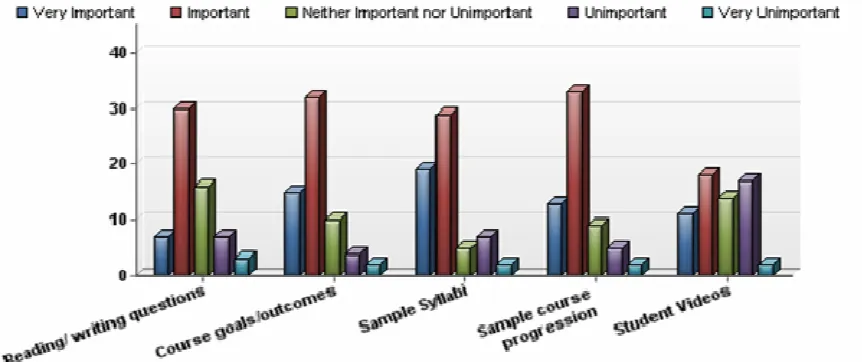
Class resources. Question 4 on the survey was: Did the resources on the Write Class website help you make an informed decision about which English class to take? Of the 64 respondents, 32 replied yes, 19 replied somewhat, and 13 replied no. This means that 79% of respondents reported that the resources on the Write Class site, in at least some capacity, helped them make an informed decision. The resources on the Write Class website were designed to give students the most complete picture of the first-year composition options possible. The numbers show that in large part, the resources provided were influential for students making their placement decisions. In addition to finding out if the resources were used, I felt it was important to look at which of the resources were most heavily relied upon. Question five on the survey (How important were the following resources from the Write Class website?) allowed students to report a level of importance for each of the resources on the website. The table below shows the responses.
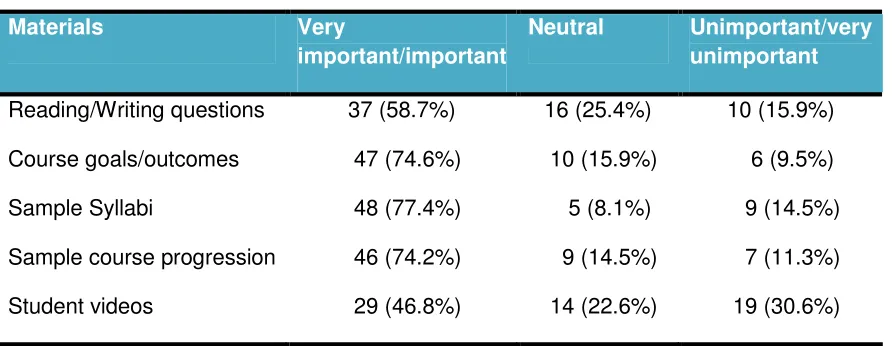
To get at another level of analysis, I categorized the resources by type: recommendations, which include the reading/writing survey and student videos; and course materials, which includes course goals/outcomes, sample syllabi, and sample course progression. In every instance, the majority of respondents reported that the course materials were important to them. When making their decisions, students felt it was necessary to look at the kind of work that would be expected of them in the classes. Though there were no questions to directly address this finding, it could be argued that the respondents made their decisions, at least in part, based on their perceived ability to complete the work required in the class. The category that had the lowest number of positive responses was student videos. This was a bit surprising to me, because I assumed that peer advice held a lot of weight in students’ decision-making processes. Though none of the options show the majority of responses in the very important category, in most cases, they show a higher representation than the responses that show negative importance. The following table shows the responses from table 3.1 grouped by positive or negative response.
Table 3.1 Positive/Negative Responses for Write Class Materials
Materials Very
important/important
Neutral Unimportant/very unimportant
Reading/Writing questions 37 (58.7%) 16 (25.4%) 10 (15.9%) Course goals/outcomes 47 (74.6%) 10 (15.9%) 6 (9.5%)
Sample Syllabi 48 (77.4%) 5 (8.1%) 9 (14.5%)
Sample course progression 46 (74.2%) 9 (14.5%) 7 (11.3%)
For the course goals and the sample syllabi, the important and very important categories account for over 70% of responses, while the neutral category accounts for less than 15% and the unimportant and very unimportant categories account for less than 15%. This shows that the overwhelming majority of the respondents took the Write Class resources into consideration when making their placement decision and the resources that were indicative of coursework were the ones they found most important. What this shows for me is that students placed more emphasis on the resources that gave them real
examples of what to expect. This could indicate that students are evaluating the kinds of work expected of them and projecting ahead based on their perceived abilities to
complete the work.
state-mandated placement methods over the pilot program. It is also possible that students were making a distinction between their past experience and their perceived ability to
accomplish tasks in the future. Perhaps students were looking more toward the products of the courses, rather than the processes involved. The videos of students and the reading and writing questions are based more in how students write, rather than what they will produce, and the course materials, such as syllabi, course progression, and instructor expectations speak more to the products. It is possible that the tangible examples of what students can expect are easier for them to assess than the processes by which they will complete given tasks. There is no definitive answer for why students favored certain resources over others, but this result shows that further research is needed here.
Beyond the Website
Table 3.2 Considerations for Placement Decisions
Answer Number of
responses
Percentage
My writing experience 45 76%
Resources from Write Class website 27 46%
Advice from family 20 34%
Advice from peers 19 32%
Advice from orientation advisor 18 31%
Advice from teacher 15 25%
Other 6 10%
It is interesting that the majority of responses fell in writing experience, but that the reading/writing survey at the beginning of the website was reported as one of the least important aspects of the site. Perhaps there is a difference in how students think about reading and writing experience and how the reading writing history on The Write Class prompted them to think. It could be that if students performed well on writing
teachers, and orientation advisors played in here is not surprising to me considering the conversations I had with students at orientations. Because entering college students occupy more of a novice perspective, opinions of those who may be seen as experts could hold weight. Perhaps that could be a reason why the student advice videos were not as influential. If students are looking for the opinions of so-called experts, fellow students may not be seen as possessing as much knowledge as a teacher or parent.
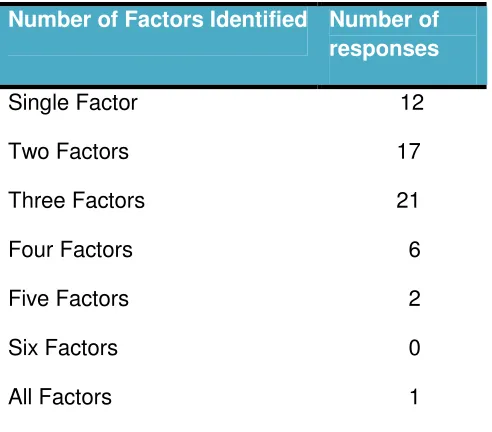
As a snapshot, this shows us that the overwhelming majority of respondents took their writing experience into consideration when making their placement decision, but students are multifaceted and they rely on more than one factor to make important decisions. I thought it would be interesting to see how many factors students were considering when making their placement decisions, so I coded the responses by how many and what combinations of answers students gave. The majority of respondents (21) reported relying on three factors, with a variety of combinations. Respondents relying on two factors showed the next highest response (17). Single answer responses were the next lowest (12) with “writing experience" accounting for five of the twelve responses. These results are shown in the table below. The single highest combination of responses (8) was writing experience and advice from a teacher. The breakdown of the combinations can be found in Appendix D.
Number of Factors Identified Number of responses
Single Factor 12
Two Factors 17
Three Factors 21
Four Factors 6
Five Factors 2
Six Factors 0
All Factors 1
Question 7 on the survey (How did you make your decision about which English class to take for Fall 2011?) provided some insight as to how students came to make their placement decisions. The table below shows a breakdown of the responses.
Table 3.4 Answer Type for Survey Question 7
Answer Type Number of respondents/ percentage of total
Advice from Peers 5 (16.7%)
Test Scores 12 (40%)
Self-evaluation 6 (20%)
Course materials 3 (10%)
For the categorization of these answers, peer advice included the student videos from the write class website, which accounted for two of the five. Expediency/low consideration included the following answers verbatim.
• English 101 seemed to be the 'happy medium' to all the classes offered. • When i found out English 90 gave no credits, I didn't take it.
• Desire for credit in english 101. • It's just what I decided to take. • i chose the class in the middle.
• desire to take the minimal number of unnecessary classes.
The figures in the chart above include combination answers. In cases where students reported a combination of answers, they are represented in multiple categories. A breakdown of all combination answers follows.
• Advice from peers/course material (2) • Advice from peers/self evaluation (1) • Advice from peers/ prior experience (1)
• Advice from peers/write class recommendation and test scores (1) • Test scores/self-evaluation (1)
• Test scores/ teacher recommendation and expediency (1) • Test scores/ prior experience (1)
Confidence
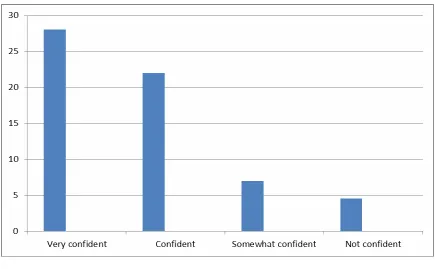
Confidence is something that is important in measuring self-efficacy. An
overwhelming majority of respondents reported that they felt confident in their decision for which class to take.
Figure 2. Confidence Level in Course Decision
achieving self-set goals, I am confident in saying that students who participated in The Write Class program do show signs of self-efficacy. The high level of confidence reported here also corresponds to the level of self-efficacy. Highly efficacious people tend to exhibit higher levels of confidence, so the students represented here could be said to be highly efficacious.
Preparedness
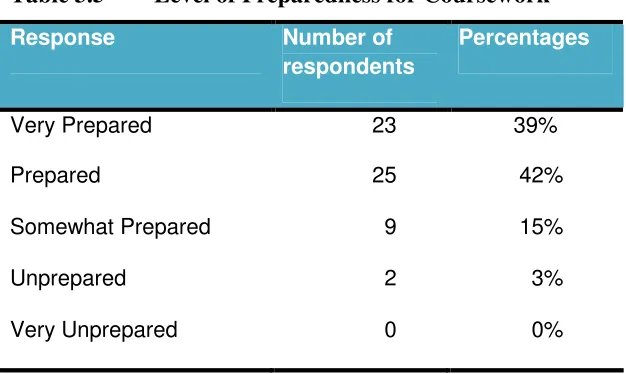
High levels of preparedness also indicate that self-efficacy is present. Referring back to Bandura’s definition of self-efficacy as “beliefs in one’s capabilities to organize and execute the course of action required to produce given attainments,” the connection between preparedness and self-efficacy becomes clear (Self Efficacy 3). As evidenced in the results, a large majority of respondents reported feeling prepared to complete the coursework ahead of them. Responses to question ten on the survey (How prepared do you feel to complete the work in your selected English course?) show that an
overwhelming majority of the respondents felt prepared for the coursework. There was a total of 59 responses and the breakdown is shown below.
Table 3.5 Level of Preparedness for Coursework
Response Number of respondents
Percentages
Very Prepared 23 39%
Prepared 25 42% Somewhat Prepared 9 15%
Unprepared 2 3%
If we break this down into categories of prepared/unprepared, it shows that 81.4% of respondents felt prepared to do the coursework, while only 18.6% felt unprepared. There are a number of possible explanations for these figures, but one likely possibility that is supported by my data is that students were looking at the course materials, but still relying on their test scores for placement. It could also be that the students who reported feeling unprepared did not take the time to look at the resources on the Write Class website. It is also possible that students may not have felt prepared for the coursework, but that they still felt confident that they had chosen the right class to take.
Goals
Another major factor of determining self-efficacy is goal setting. Zimmerman, Bandura, and Martinez-Pons’ study on academic self-efficacy shows a positive
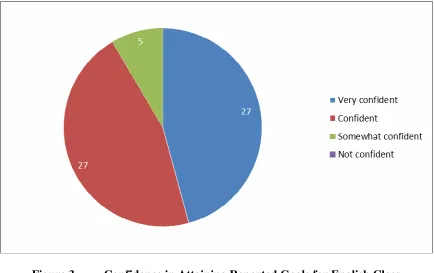
improvement of skills and high grade attainment. This is important in thinking about the level of confidence reported by these students in regard to their goals. The following chart illustrates the high level of confidence reported in regard to ability to accomplish reported goals.
Figure 3. Confidence in Attaining Reported Goals for English Class
Class program may have a better chance at reaching their goals in their English classes. Though the responses here paint a somewhat complicated picture, it is clear through the survey results that students who participated in The Write Class examined numerous factors in making their placement decisions and that they did exhibit signs of
self-efficacy. The considerations students made in their placement decisions are shown in my experiences as an advisor as well.
Student Stories
There were a few instances that stood out to me as I interacted with students during the orientation sessions. In one of the early advising sessions, I was approached by an advisor who asked me to talk to a student she was working with. The student was a traditional college freshman. She was probably around 18-19 years old and looked really nervous. She wanted to make sure she had done everything right on the website and that she wasn’t missing anything. When we sat down, I asked her if she had gone through the entire website, if she had looked at the provided course materials and if she had watched the student videos. She said she had, and I asked what the recommendation from the site was. She said it was English 101 and when I asked if she felt that was an accurate
materials, the reading/writing survey, and the recommendation she received. I suggested that she could use the website as a way to talk to her parents and show them that she was making an informed decision. I also reminded her that if she enrolled in English 102 and did not pass it, she would have to take it again since it is a required class, and her parents would still be paying for an additional course. After we talked, she seemed much more optimistic. She had not considered the Write Class website as a tool she could use to talk to her parents about her choice. She seemed to be more comfortable with her initial decision after we talked.
This student is representative of a lot of incoming freshmen. Parents are paying for college and in many cases, they want to have a part in the decision-making process to ensure that they are getting the most for their money. That is an understandable position, but as evidenced with this student, it puts a lot of pressure of the students. Having a tool like the Write Class website gives students a way to start an informed conversation with their parents about their decisions for coursework.
proximity to campus, her study habits, and her feelings of preparedness. She said she didn’t really want to enroll in more classes than she had, but she was concerned with finishing her core classes, so she could apply to the nursing program. We talked about the reasons she had for wanting to stick to 12 credits, and in the end, she decided that it was better to start the first semester with 12 credits, so she wouldn’t be overwhelmed. She seemed relieved and even happy when she made her decision and printed out her
CHAPTER FOUR
Discussion
Just as students are multifaceted, so should be placement in FYW. The WPA White Paper on Assessment, as outlined in the literature review, suggests that assessment should take into consideration the classroom environment students will enter into and the multiple backgrounds from which they come, that student performance should indicate a readiness to complete the coursework, and that assessment should include multiple measures and take multiple perspectives into consideration (NCTE-WPA White Paper). The state-mandated placement instruments at Boise State (ACT, SAT, COMPASS) do none of these things. Placement into composition courses at Boise State work from one measure: analytical skill as measured through computerized tests. In a somewhat analogous situation, admissions offices work from the idea that to determine how well students will perform in college classroom settings, they must look at students from a variety of angles, including past performance as evidenced through a variety of
application materials, and measures of aptitude through standardized testing. Why then, are students placed in their composition courses using only one measure? The same factors at play in admissions are also at play in placement.
multiple factors. The online process students go through prior to orientation provides them with sample materials from each course option, instructor expectations, and student perspectives, it asks them to consider their reading and writing history, and to report their test scores. Students are given a recommendation from the website based on the
information they provide and are given a chance to decide if the recommendation is right for them. Students are also given the chance to speak with advisers at orientation sessions before making their final decisions. This model prompts students to consider their options from an informed and supported position. I believe this kind of work goes further and offers a more comprehensive view of student abilities than a single test can. The types of thinking students are doing in terms of placement is evident in the results of this study.
sessions and the responses I saw on my survey, I saw evidence that students put thought into their placement decision and that they experienced feelings of confidence and preparedness. Based on these observations, my assertion is that students participating in the Write Class directed self-placement pilot experienced self-efficacy in a way that is especially productive for new college students.
My work with the orientation sessions over the summer allowed me to gain perspective into how students approach registration and course selection. I found that students were doing a lot of forward thinking when they were building their course schedules. They were thinking about how many classes they were taking, what the work load for each of those classes was, what their comfort level with each of the classes was, whether they were working outside of school, and how they needed to structure their course loads in order to finish their degrees in the amount of time they wanted. In
addition to these considerations, however, students were also faced with outside pressures that tended to weigh in their decisions. Students whose parents were paying for their education were thinking about how they could get the most out of their schedules while working toward an efficient and cost-effective route. Students who were entering into competitive programs faced the pressure of finishing core classes quickly while
maintaining a high GPA. The most surprising thing to me was that even those students who were dealing with external pressure to finish quickly were still putting their success at the forefront. They were not willing to risk failure by overloading themselves with too many classes, or by signing up for classes they did not feel they would be able to pass.
clear-cut and difficult to argue. Students are neatly categorized and identified as either proficient or remedial. When given the option to decide for themselves, students paint intricate and sometimes tangled pictures of themselves. The students I surveyed did not have clear-cut or easy answers for how they made their placement decisions. They thought about their pasts, the advice of their peers, their parents, their teachers, and the additional resources they were provided on the Write Class website. As the data chapter shows, students considered multiple factors in different ways depending on their
individual situations. This tells me that placement should not be a one-size-fits-all endeavor. Based on the complicated results of my survey, I would argue that Royer and Gilles are correct in their assertion that students are the best judge of their own abilities and needs. Standardized tests simply cannot account for all the factors that determine a student’s ability to succeed in their classes. Though test scores can be a factor for consideration, they should not be the sole determinant for placement.
high levels of confidence and preparedness in all areas where these factors were measured. In the measures of confidence in their decision and feelings of preparedness for the required coursework, over 80% of the students surveyed reported high levels. Students felt prepared to take on the course work in the classes they chose, and they felt confident in their decisions. This translates to high levels of self-efficacy in the students surveyed. They may not have arrived at their decisions easily, but once the decision was made, they felt good about the probable outcome.
In looking at previous studies on the correlation between academic self-efficacy and performance, Paul Gore found that the relationship between the two was dependent on a number of variables, including when the measures were taken, what aspect of self-efficacy was being measured, and what outcome the researcher hoped to predict (Gore 112). His own study suggested that self-efficacy was a greater predictor of outcomes in second-semester college students than in first semester students. While this could be used as evidence against the assertions I have made here, it is important to note that the study was designed to look at whether self-efficacy was a better predictor of success than ACT scores. The difference in the predictive value of self-efficacy between first and second semester students was attributed to the fact that the second semester students had a better idea of the expectations of them in their college courses. Because my study looks at students who have been provided with multiple resources that create a fairly
is based on a theoretical framework and is not definitive, but it offers an interesting lens through which to view placement at Boise State.
The fact that students in this study reported high levels of confidence in their placement decisions and in their abilities to succeed indicates that the student perspective deserves more attention. As a student who was not given the opportunity to weigh in on my placement decision, I think it is vital. I was told that I was ready to take a course I knew nothing about based on a score that measured my proficiency in grammar. I
performed well on the test, but had I known what I would be expected to do in the class, I would have taken a different route. Based on my study and my experience with students in orientation sessions, I believe they made careful decisions about their placement.
This area of study requires much more research and longitudinal study to confirm whether there is indeed a correlation in the levels of self-efficacy amongst students participating in directed self-placement and their subsequent performance in their classes. Though this study is limited in scope, it does something that is necessary in developing workable strategies for successful placement. It takes the student perspective into
consideration and offers a glimpse of what students are going through in the early stages of their college careers. As I reflect on my work here, a few things become clear. I realize that placement is much more complicated than I originally thought. I also realize that my area of study needs far more attention. While this thesis starts the conversation, there is more work needed to carry it on. As a researcher, I know now how difficult and
surprising data gathering can be, and how just when you think you have gotten
The idea behind the focus groups is something I am still very interested in
pursuing. I feel it will add validity to my study to see if confidence levels at the front-end of the placement process translate to success in the chosen courses. I think it would be interesting to see if confidence levels change as the students become more familiar with their classes and have a better idea of what is expected of them. Having read previous research on academic self-efficacy, I would like to see if, as Paul Gore saw in his study, the time at which students are studied has any effect on their level of self-efficacy. In addition to my personal interest in this study, I believe further research could potentially inform and improve the way students are placed into English classes at Boise State. Though my thesis research offers some insight into the student perspective on English placement, without looking at The Write Class longitudinally, it is hard to establish validity. I would like to move forward from this research and conduct a longitudinal study with students participating in The Write Class program during the 2012 academic year. I have the opportunity to work again with the pilot over the summer of 2012, and plan to continue this research and follow up with students as they move through their English classes.
responded. I think perhaps if my recruitment methods would have been more personal, perhaps soliciting students in person at orientation sessions, I may have gotten a better response rate. Looking back on my study now, I realize it would have been helpful to have an alternative strategy for forming my focus groups. In future research, I will try to make a more personal appeal to possible subjects, and I will have multiple options for contact.
It is clear to me after doing this thesis project that there is a need for more research. My plan for the future is to design additional studies that have a more longitudinal approach. I believe there is a need for more comprehensive placement
mechanisms at Boise State, and my hope is that through continued research, I can have an impact on a policy I feel very strongly about.
REFERENCES
Bandura, Albert. Self-efficacy: The Exercise of Control. New York: W.H. Freeman, 1997. Print.
---. “Social Cognitive Theory: An Agentic Perspective.” Annual Review of Psychology. 52.1 (2001): 1-26. Academic Search Premier. Web. 16 May 2011.
Blascovich, Jim., and Joe Tomaka. “The Biopsychosocial Model of Arousal Regulation.” Advances in Experimental Social Psychology, 28.(1996): 1-51. Print.
Chemers, Martin M., Li-tze Hu, and Ben F. Garcia. "Academic Self-Efficacy and First Year College Student Performance and Adjustment." Journal of Educational Psychology 93.1 (2001): 55-64. PsycARTICLES. Web. 16 May 2011.
Elias, Steven M, and Scott MacDonald. "Using Past Performance, Proxy Efficacy, and Academic Self-Efficacy to Predict College Performance." Journal of Applied Social Psychology. 37.11 (2007): 2518-2531. Wiley Blackwell. Web. 11 May 2011.
Gore, Paul A. "Academic Self-Efficacy As a Predictor of College Outcomes: Two Incremental Validity Studies." Journal of Career Assessment. 14.1 (2006): 92-115. Sage. Web. 9 May 2011.
Lewiecki-Wilson, Cynthia, Jeff Sommers, and John Paul Tassoni. "Rhetoric and the Writer's Profile: Problematizing Directed Self-Placement." Assessing Writing. 7.2 (2000): 165-83. Science Direct. Web. 9 May 2011.
Matzen, Richard N., Jr., and Jeff E. Hoyt. "Basic Writing Placement with Holistically Scored Essays: Research Evidence." Journal of Developmental Education 28.1 (2004): 2-4, Web. 12 Feb. 2011.
Meuschke, Daylene M., and Barry C. Gribbons. English and Math Surveys: Students and Instructors—Fall 2002.” California: College of the Canyons, 2003. Print.
“NCTE-WPA White Paper on Writing Assessment in Colleges and Universities.” Council of Writing Program Administrators. The Council of Writing Program Administrators, 2010. Web. 23 March 2012.
Pascarella, Ernest T, and Patrick T. Terenzini. How College Affects Students: Vol. 2. San Francisco: Jossey-Bass, 2005. Print.
Reynolds, Erica J. “The Role of Self-Efficacy in Directed Self-Placement: An Analysis of Confidence, Apprehension, and Gender Components.” MA Thesis. Southern Illinois University, Carbondale, 1999. Print.
Royer, Daniel, and Roger Gilles. Directed Self-Placement: Principles and Practices. Cresskill: Hampton Press, 2003. Print.
Sedlacek. William E. Beyond the Big Test: Noncognitive Assessment in Higher Education. San Francisco: Jossey-Bass, 2004. Print.
Sternberg, Robert J. College Admissions For The 21st Century. Cambridge: Harvard University Press, 2010. Print.
Wainer, Howard. Uneducated Guesses: Using Evidence to Uncover Misguided Education Policies. Princeton: Princeton University Press, 2011. Print.
“What Does the SAT Test?” College Board. The College Board, 2012. Web. 15 April 2012.
APPENDIX A
Thesis Survey
Greetings! This survey is designed to gather more information about how you arrived at your placement decision for your first-year writing course. Participation in this survey is voluntary, and all results are anonymous and for research purposes only.
Risks and Benefits: If you choose to take this survey, risks are minimal. Responses from all participants will be treated with the utmost respect and will be combined to search for overall patterns. Unless you choose to identify yourself on the last screen, your survey results will be completely anonymous. There are no direct benefits to you as a participant. However, current and future students will benefit greatly from your input. Program directors and instructors on campus are particularly interested in your thoughts and feedback on the pilot placement program.
Confidentiality: The data in this study will be confidential. Any work quoted in research studies will be quoted anonymously. You may also choose to leave questions blank if you believe your answers to them may reveal your identity. The online survey results are password-protected, and will be destroyed within one year. All copies will be destroyed after 10 years or after the data in them becomes irrelevant, whichever comes first.
Participation: Your participation is voluntary, and you may discontinue the survey at any time and for any reason. If you decide not to participate or if you withdraw from the study, there is no penalty and your student status will not be impacted in any way.