12-15-2017
Diffusion of two-dimensional epitaxial clusters on
metal (100) surfaces: Facile versus
nucleation-mediated behavior and their merging for larger sizes
King C. Lai
Iowa State University and Ames Laboratory, [email protected]
Da-Jiang Liu
Ames Laboratory
James W. Evans
Iowa State University, [email protected]
Follow this and additional works at:
http://lib.dr.iastate.edu/ameslab_manuscripts
Part of the
Condensed Matter Physics Commons
,
Materials Science and Engineering Commons
,
and the
Nanoscience and Nanotechnology Commons
This Article is brought to you for free and open access by the Ames Laboratory at Iowa State University Digital Repository. It has been accepted for inclusion in Ames Laboratory Accepted Manuscripts by an authorized administrator of Iowa State University Digital Repository. For more information, please [email protected].
Recommended Citation
Lai, King C.; Liu, Da-Jiang; and Evans, James W., "Diffusion of two-dimensional epitaxial clusters on metal (100) surfaces: Facile versus nucleation-mediated behavior and their merging for larger sizes" (2017).Ames Laboratory Accepted Manuscripts. 65.
Diffusion of two-dimensional epitaxial clusters on metal (100) surfaces:
Facile versus nucleation-mediated behavior and their merging for larger
sizes
Abstract
For diffusion of two-dimensional homoepitaxial clusters of N atoms on metal (100) surfaces mediated by
edge atom hopping, macroscale continuum theory suggests that the diffusion coefficient scales like DN
∼
N−β
with β=3/2. However, we find quite different and diverse behavior in multiple size regimes. These include: (i)
facile diffusion for small sizes N<9; (ii) slow nucleation-mediated diffusion with small β<1 for “perfect” sizes
N=Np=L2 or L(L+1), for L=3,4, ... having unique ground-state shapes, for moderate sizes 9≤N≤O(102); the
same also applies for N=Np+3, Np+4, ...(iii) facile diffusion but with large β>2 for N=Np+1 and Np+2 also
for moderate sizes 9≤N≤O(102); (iv) merging of the above distinct branches and subsequent anomalous
scaling with 1
≲
β<3/2, reflecting the quasifacetted structure of clusters, for larger N=O(102) to N=O(103);
(v) classic scaling with β=3/2 for very large N=O(103) and above. The specified size ranges apply for typical
model parameters. We focus on the moderate size regime where we show that diffusivity cycles
quasiperiodically from the slowest branch for Np+3 (not Np) to the fastest branch for Np+1. Behavior is
quantified by kinetic Monte Carlo simulation of an appropriate stochastic lattice-gas model. However, precise
analysis must account for a strong enhancement of diffusivity for short time increments due to back
correlation in the cluster motion. Further understanding of this enhancement, of anomalous size scaling
behavior, and of the merging of various branches, is facilitated by combinatorial analysis of the number of the
ground-state and low-lying excited state cluster configurations, and also of kink populations.
Disciplines
Condensed Matter Physics | Materials Science and Engineering | Nanoscience and Nanotechnology
Diffusion of two-dimensional epitaxial clusters on metal (100) surfaces:
Facile versus nucleation-mediated behavior and their merging for larger sizes
King C. Lai,1,2Da-Jiang Liu,2and James W. Evans1,2,3
1Department of Physics & Astronomy, Iowa State University, Ames, Iowa 50011, USA 2Ames Laboratory–USDOE, Iowa State University, Ames, Iowa 50011, USA 3Department of Mathematics, Iowa State University, Ames, Iowa 50011, USA
(Received 19 June 2017; published 5 December 2017)
For diffusion of two-dimensional homoepitaxial clusters ofNatoms on metal (100) surfaces mediated by edge atom hopping, macroscale continuum theory suggests that the diffusion coefficient scales likeDN∼N−β with β=3/2. However, we find quite different and diverse behavior in multiple size regimes. These include: (i) facile diffusion for small sizesN <9; (ii) slow nucleation-mediated diffusion with smallβ <1 for “perfect” sizesN= Np=L2orL(L+1), forL=3,4,. . .having unique ground-state shapes, for moderate sizes 9NO(102);
the same also applies forN=Np+3,Np+4,. . .(iii) facile diffusion but with largeβ >2 forN=Np+1
andNp+2 also for moderate sizes 9NO(102); (iv) merging of the above distinct branches and subsequent
anomalous scaling with 1β <3/2, reflecting the quasifacetted structure of clusters, for largerN=O(102) to
N=O(103); (v) classic scaling withβ=3/2 for very largeN=O(103) and above. The specified size ranges
apply for typical model parameters. We focus on the moderate size regime where we show that diffusivity cycles quasiperiodically from the slowest branch forNp+3 (notNp) to the fastest branch forNp+1. Behavior is
quantified by kinetic Monte Carlo simulation of an appropriate stochastic lattice-gas model. However, precise analysis must account for a strong enhancement of diffusivity for short time increments due to back correlation in the cluster motion. Further understanding of this enhancement, of anomalous size scaling behavior, and of the merging of various branches, is facilitated by combinatorial analysis of the number of the ground-state and low-lying excited state cluster configurations, and also of kink populations.
DOI:10.1103/PhysRevB.96.235406
I. INTRODUCTION
Significant long-range diffusion of large two-dimensional (2D) homoepitaxial adatom clusters on single-crystal metal (100) surfaces with sizes on the order of hundreds or even thou-sands of atoms was studied by scanning tunneling microscopy (STM) as early as the mid-1990’s [1,2] and also more recently [3]. It is generally accepted that cluster diffusion is mediated by periphery diffusion (PD), also described as edge diffusion, of adatoms along the steps at the periphery of the cluster. The STM studies prompted extensive atomistic lattice-gas modeling starting in the 1990’s of epitaxial cluster diffusion [4–11] and of related reshaping phenomena [12–19]. This work supplemented limited earlier studies [20–22]. Mesoscale continuum Langevin theory for PD-mediated cluster diffusion has also been applied, and predicts that the diffusion coefficient for clusters ofNatoms satisfiesDN ∼σPDN−βwithβ=3/2,
where σPD denotes the mesoscale mobility for atoms at step
edges [23,24]. Simple mean-field type atomistic-level theory for compact clusters also predicts the same size dependence as the continuum theory [25,26]. However, significantly, the experimentally observed size scaling exponentβfor moderate cluster sizes,N =O(102) to O(103), is below the prediction
of the continuum and mean-field theories [2,3].
Diffusion of smaller 2D clusters with less than∼10 atoms on metal (100) surfaces was also observed but instead by field ion microscopy [27–29], and has been interpreted with appropriate theoretical analyses [30–33]. However, diffusion of small sized clusters exhibits a distinctive irregular size dependence and Arrhenius energetics, which is readily un-derstood, e.g., given the innate stability of 2×2 atom square clusters relative to two-atom dimers and three-atom trimers.
We also mention that there have been multiple studies of 2D cluster diffusion for metal (111) and metal (110) homoepitaxial systems, and also for heteroepitaxial metal systems [34–37]. Theoretical studies, particularly for metal (111) systems, have explored concerted many-atom and off-lattice nonepitaxial mechanisms [38–41]. These latter systems are of less relevance for the current study, so we do not discuss them further.
For 2D cluster diffusion on metal (100) surfaces, there is naturally interest in the effective or overall activation barrierEeff for the process whereDN ∼exp[−Eeff/(kBT)].
Here,kB denotes the Boltzmann constant, andT denotes the
surface temperature.Eeff is related to the kinetic parameters in atomistic-level models including the barrierEeto diffuse
along close-packed110cluster step edges, and any additional barrier δ to round corners or kinks. Eeff also reflects
ther-modynamic parameters determined by adatom interactions, particularly the formation energyEform to create a step edge atom from a kink atom. It was previously suggested that long-range cluster diffusion is limited by creation of edge atoms through their extraction from the core of the cluster or “core breakup” [1,20], so thatEeff =Ee+δ+Eform [19].
This perspective is consistent with the predictions of the mesoscale continuum Langevin theory where the activation energy for cluster diffusion corresponds to that for mobility of edge atoms EPD, where σPD∼exp[−EPD/(kBT)] with
EPD =Ee+δ+Eform [23,24]. The latter result forEPD has
been rigorously demonstrated in the absence of a corner or kink rounding barrier [42], but it is expected to apply more generally [43].
This picture leads to higher values of Eeff than predicted above (see Sec. III), and also to a weaker dependence of DN on N reminiscent of experimental observations. This
facetted regime occurs for linear cluster sizes,L∼N1/2 (in
units of surface lattice constant, a=1), which are below the characteristic separation,Lk≈1/2exp[εk/(kBT)], of kinks
on close-packed 110 edges [44]. Here, εk denotes the
kink creation energy. Another perspective on anomalous size scaling for diffusivity was provided by Pierre-Louis [45] who modified the continuum Langevin theory by introducing an additional diffusion field for edge atoms. This approach also recovered weaker size scaling.
Jensen et al. [15] adopted an analogous nucleation-mediated picture to describe the effective barrier and anoma-lous size scaling for the relaxation to equilibrium of convex nonequilibrium cluster shapes. Regarding the relationship between this shape relaxation process and the long-range diffusion of clusters, it should be noted that both require nucle-ation of new edge layers. Furthermore, a simple relnucle-ationship was proposed between the size scaling exponents for cluster diffusion and relaxation of convex shapes [46]. It was later shown that further refinement to anomalous scaling could be induced in the presence of an additional kink or corner rounding barrier [14,17].
However, we show in this contribution that the above observations, while providing key insight into deviations from standard macroscale and mean-field theories, fall far short of providing a complete characterization of the full diversity of cluster diffusion behavior on the nanoscale. A comprehensive and precise characterization of the dependence of the cluster diffusion coefficientDNon sizeNcan be provided by analysis
utilizing kinetic Monte Carlo (KMC) simulation of a stochastic atomistic-level lattice-gas model for cluster diffusion which incorporates an appropriate description of PD kinetics. Indeed, this approach is a key component of the current study, and reveals various size regimes with distinct behavior: (i) facile diffusion for small sizesN <9; (ii) slow nucleation-mediated diffusion with weak size scaling β <1 for “perfect” sizes N =Np =L2orL(L+1) withL=3,4, . . . having unique
square or near-square ground-state shapes, and also for sizes Np+3,Np+4, . . . , versus facile diffusion with strong size
scalingβ >2 for sizesNp+1 andNp+2 for moderate sizes
9N O(102); (iii) merging of these distinct branches and
subsequent anomalous scaling with 1β <3/2, the latter reflecting the quasifacetted structure of clusters for larger N =O(102) to N =O(103); and (iv) classic scaling with β =3/2 consistent with macroscopic or mean-field theories for very large N =O(103) and above. We mainly focus elucidation of behavior in regime (ii), and to some extent regime (iii). To this end, in addition to KMC analysis, we also develop and utilize results from combinatorial analysis of cluster configurations to provide deeper insight.
In Sec. II, we describe our stochastic lattice-gas model for PD-mediated cluster diffusion, and also various strategies for model analysis. In Sec.III, we discuss different possible types or branches of cluster diffusion, and Sec. IV present KMC results providing an overview of the variation of DN
versus N. A brief report of such behavior was recently provided for just one choice of adatom interactions and no
kink rounding barrier,δ=0 [47]. Here, we consider different interactions, and finiteδ >0 as well asδ=0. We also present a comprehensive analysis and interpretation of diverse aspects of this behavior, as detailed in the following sections. In Sec.V, we describe the variation of the effective diffusivity,DN(δt),
for short time increments,δt, whereDN =limδt→∞DN(δt).
Characterization of the variation of DN(δt) with δt, which
reflects a strong back correlation in cluster motion, is necessary for a reliable extraction of DN. Additional elucidation of
diverse size scaling and cyclic variation of diffusivity in regime (ii), and of intermingling and merging of diffusion branches by regime (iii), is provided in Sec.VIbased on counting the number of ground- state and first-excited-state configurations of key classes of clusters. Conclusions are provided in Sec.VII.
II. ATOMISTIC MODEL FOR CLUSTER DIFFUSION A. Tailored stochastic lattice-gas model
We adopt a tailored model for PD-mediated epitaxial cluster diffusion on metal (100) surfaces, which captures the key features of these systems [16]. In our stochastic lattice-gas model, clusters of adatoms reside on a square lattice of adsorption sites with lattice constant ‘a’ typically set to unity. Adatoms interact with just nearest-neighbor (NN) attractive lateral interactions of strengthφ >0. They can hop to NN sites, and also to 2nd NN (2NN) sites, provided that hopping retains at least one NN adatom in the cluster. Thus this hopping dynamics preserves NN connectivity (and size) of the cluster. All hop rates have the Arrhenius form h= νexp[−Eact/(kBT)], whereνis a common attempt frequency
for both NN and 2NN hops. LetnNN denote the number of
in-plane NN adatoms of the hopping adatom in its initial configuration. Then, the activation barrier Eact, selected to
be consistent with detailed-balance, satisfies
Eact=Ee+(nN N−1)φfor NN hops and
Eact=Ee+(nN N−1)φ+δfor 2NN hops. (1)
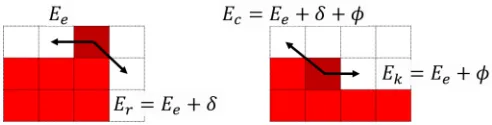
In this model, the edge atom formation energy equals Eform =φ. It also follows that one has activation barriers
of Ee for hopping of isolated adatoms along close-packed
110 edges via NN hops,Er =Ee+δ for hopping around
corners or kinks via 2NN hops,Ek=Ee+φfor kink escape
via NN hops, and Ec=Ee+φ+δ for “core breakup”
via 2NN hops (cf. Sec. 1, see Fig. 1). The corresponding rates are denoted he,hr,hk, and hc, respectively. The
char-acteristic times associated with these various hop rates are denoted τe=1/he, τk=1/hk, etc. An atom can also be
[image:4.608.312.558.648.711.2]extracted from a straight close-packed step edge with barrier
FIG. 2. Trajectory of CM of a diffusing cluster withN=36 for
φ=0.20 eV withδ=0 at 300 K. Start: red square. End: pink square.
Eextract=Ee+2φ+δ, but this process is not prominent, and
thus is not shown in Fig.1.
B. Model analysis
Our focus is on analysis of the diffusion coefficient DN
for clusters of various sizesN (in atoms). To this end, it is appropriate to first define an effective time-dependent diffusion coefficient, DN(δt) = [δr(δt)]2/(4δt), whereδr(δt) is the
displacement in the cluster center of mass (CM) in a time intervalδt, and is an average of data over a long trajectory. Also we set [δr]2=δr·δr. Comprehensive characterization
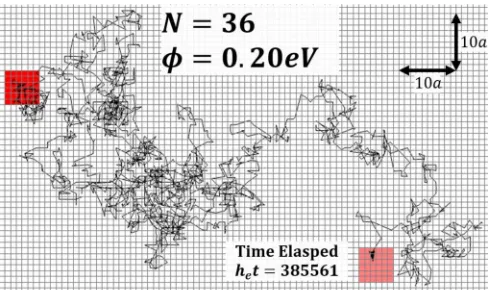
of model behavior is naturally extracted from KMC simulation. (See Fig.2for a typical cluster CM trajectory extracted from such a simulation.) The algorithm used is a standard rejection-free Bortz type algorithm. Note that in contrast to a “pure” random walk,DN(δt) is not in general constant, but can vary
for shorter δt due to correlations in the walk of the cluster CM [1,10,22,32]. However,DN(δt) plateaus for largerδt, and
the conventional diffusion coefficient is obtained fromDN =
limδt→∞DN(δt)=DN(∞). Thus appropriate analysis ofDN
must account for this transient behavior. For our model where DN(δt)∝a2he, one has that DN(δt)/DN versus heδt, and
DN/(a2he) are independent of our choice ofEeandν, and thus
he. For reference, choosingEe=0.29 eV and ν=1012.5s−1
mimicking Ag/Ag(100) yieldshe=107.6s−1at 300 K.
We expectDN(δt) to have converged to its plateau value of
DNforδt > δtc, where[δr(δtc)]2 ∼a2, i.e., when the cluster
of CM has moved about one lattice constant. To obtain precise DN, we need the total length of the trajectory ttot of at least
O(103δt
c). Then,[δr(δtc)]2 can be estimated from O(103)
statistically independent values obtained from nonoverlapping time increments of lengthδtcalong the trajectory. Overlapping
time increments can be used, although then the values of [δr(δtc)]2 are not completely independent. We choose
ttot ∼35000δtc.
It is appropriate to note that DN can in principle be
determined exactly for any cluster sizeN by analysis of the linear master equations for the stochastic lattice-gas model [30,32]. These master equations track the evolution of the probability of various cluster configurations for the infinite possible number of CM positions. Let N denote the total
number of distinct configurations for a cluster of sizeN. Then,
applying a discrete spatial Fourier transform to these master equations with respect to cluster position converts them into a finite-dimensional N× N matrix evolution equation in
transform space. One then extractsDN from analysis of the
“acoustic” eigenmode of this evolution matrix, and specifically from its quadratic variation for small wavenumbers. It should also be noted that the transformed N× N matrix encodes
connectivity between cluster configurations, i.e., indicating which configurations can be directly reached from other configurations by hopping of a single edge atom. Thus the behavior ofDN also reflects this connectivity, although in a
nontrivial indirect way. Finally, we emphasize that an exact analysis utilizing this approach is only viable for relatively small clusters since Nincreases quickly withN. Nonetheless,
it is useful to elucidate behavior in the small cluster size regime (i) (see AppendixA).
The relevance of the total number of cluster configurations
Nis already clear from the above discussion of exact analysis.
However, one anticipates that not all configurations are equally relevant for the cluster diffusion processes, particularly at lowerT. Thus, it is natural to separately analyze the number of ground-state configurations N(0), the number of first
excited state configurations N(1), etc. This analysis involves
nontrivial combinatorics exploiting results related to partitions of integers in number theory. Additional useful analysis will involve estimation of the number of kinks in ground state, etc., configurations. Details are provided in AppendicesB–D. These results will be utilized to elucidate short-time transient behavior, anomalous scaling observed for moderate sizes, and intermingling and merging of different diffusion branches.
III. DISTINCT BRANCHES OF CLUSTER DIFFUSIVITY FOR MODERATE SIZES
First, we characterize of various branches or classes of cluster sizes for which distinct diffusion behavior is observed in regime (ii) of moderate clusters sizesN =9 to O(102).
We close with comments on behavior for small clusters with N <9.
A. Nucleation-mediated (NM) diffusion for “perfect” sizes
“Perfect” sizes N=Np =L2 or L(L+1), with L=
3,4, . . . , have unique nondegenerate ground-state shapes corresponding to perfect squares and near-square rectangles, respectively. This uniqueness does not apply for sizes N = L(L+n) with n 2 where the L×(L+n) rectangular configuration is either one of multiple ground states, or corre-sponds to an excited state. Ifφ/(kBT) is not too small, clusters
with N=Np primarily exist in their unique ground-state
FIG. 3. Nucleation-mediated cluster diffusion for perfect sizesNp=L2: (a) direct and (b) indirect pathways. (c) Direct pathway for perfect
sizesNp=L(L+1).
a new edge layer. Once this dimer is formed on one edge, subsequent atoms can migrate from kink or corner sites to complete that new edge layer.
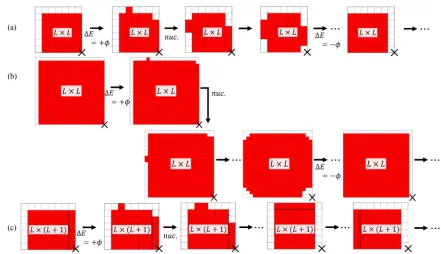
The most direct pathway to facilitate translation of the unique ground state for Np =L2 to a different location, a
key component of long-range diffusion, is shown in Fig.3(a). In this case, two atoms are shifted from one side of the cluster to nucleate a dimer on the opposite side. Thereafter, atoms continue to be shifted from that same side to the opposite side. After each individual atom transfer is completed, the cluster is in a different first excited state configuration with energy E= +φ above the ground state. Only when the last atom is transferred does the energy decrease again byE= −φ. However, we note that there are indirect pathways leading to long-range diffusion as shown in Fig.3(b). Here, atoms shifted from multiple corners of the cluster whose configuration (after each atom transfer) wanders through a large number of first-excited state configurations. However, to achieve the translated ground state, multiple eroded corners must be largely reconstructed, so that, ultimately, atoms are only removed from a single side of the cluster. Significantly, we note that while long-range diffusion accesses many configurations isoenergetic with the first excited state, it requires repeatedly returning to the unique ground-state shape. Figure3(c)shows the direct pathway forNp =L(L+1), which is analogous to
that forNp=L2.
Finally, we comment on the effective barrier for nucleation-mediated diffusion of perfect clusters. An isolated edge atom extracted from the corner of a perfect core exists with low quasiequilibrium density,neq=exp[−φ/(kBT)]. Millset al.
[10] argued thatDN should reflect the nucleation rateknuc∼
neqhcto create a dimer on an outer edge.knucis the product of
the densityneqtimes the ratehcof extracting a second atom at
the core, as the extracted atom must meet the preexisting edge
atom to nucleate a new step edge. Consequently, the effective barrier for cluster diffusion is given byEeff =Ee+2φ+δ
[10,15,17].
B. Facile (FA) cluster diffusion
For clusters of sizeN =Np+1 and N =Np+2, with
either Np=L2 or L(L+1), the edge dimer nucleation
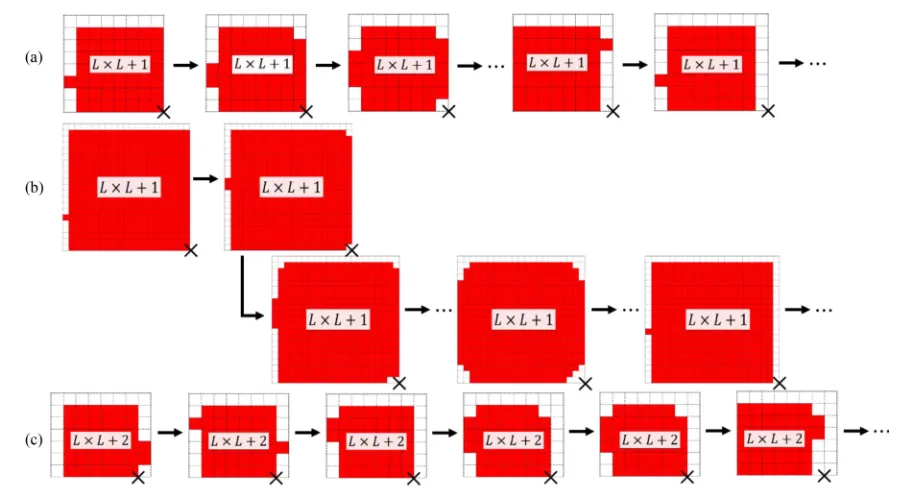
process described above for perfect clusters is not necessary for long-range cluster diffusion. ForN =Np+1, we note the
existence of a “special” ground-state configuration with an isolated adatom on the edge of a perfect square or rectangular core of Np atoms. For these special configurations, the
isolated edge adatom can readily diffuse around the entire cluster perimeter. For N =Np+2, “special” ground-state
configurations involve an NN pair of edge atoms or edge dimer on a perfect core, where this edge dimer can dissociate and readily reform on another edge. Either process results in no net change of energy. After transferring the isolated edge atom or dimer to new edge of the core, atoms can be transferred from another edge to complete the new edge of the core. This again leaves an isolated atom or dimer on the edge of a perfect core with shifted location.
The above scenario forN=Np+1 with atoms transferred
FIG. 4. Facile cluster diffusion for sizesN=L2+1: (a) direct and (b) indirect pathways. (c) Direct pathway for sizesN=L2+2.
that atoms are only shifted from a single side of the cluster. Shifting atoms from one kink to another does not change the energy after reattachment, so as a result for either direct or indirect pathways, after each atom transfer, the system evolves through a set of configurations isoenergetic with the special ground-state configurations. The direct pathway for N =Np+2 is shown in Fig.4(c).
Finally, we emphasize that while the diffusing cluster can wander through many isoenergetic configurations, long-range diffusion (if restricted to these configurations) requires that the cluster repeatedly passes through a special configuration with an isolated atom or dimer at an edge of a perfect core. This is the only way to create a new complete edge on the original perfect core. Also, we note that since diffusion of facile clusters just involves breaking atoms out of kink sites and subsequent edge diffusion, the effective cluster diffusion barrierEeff is simply given byEeff=Ee+φ+δ.
C. Other cases of nucleation-mediated cluster diffusion
Clusters of sizeN =Np+n with 3nL, for either
Np =L2 or L(L+1), also exhibit nucleation-limited
diffu-sion. The ground states for these sizes include the subclass of configurations with a linear triple or longer string of atoms at the edge of a perfect square or rectangular core. For these configurations, adatoms can readily transfer from the opposite complete edge to that on which the string of n adatoms reside (without raising the energy after transfer), thereby completing that edge. However, this leaves behind a triple or longer string of atoms which cannot readily be transferred to another edge. Certainly, the ground states are degenerate, as starting with the above subclass of configurations, atoms can be removed from multiple corners, and added to the above mentioned string with no net change in energy. However, in any case, nucleation of a dimer on a new outer edge (i.e., on an edge outside the rectangle inscribing the ground-state configurations) is always required
to facilitate long-range diffusion of the cluster CM. The same argument as used for perfect clusters indicates that the effective barrier for cluster diffusion equalsEeff =Ee+2φ+δ.
D. Facile behavior for small sizesN<9
Diffusion for all small clusters with N <9 is always facile (i.e., not nucleation-mediated). ForN =2 or 3, cluster diffusion does not even require breaking atoms out of kink sites, so the effective barrier is even lower than described above for facile diffusion of larger clusters. A dimer CM undergoes a pure random walk on a square grid rotated at 45◦ to the adsorption sites with lattice constant a/√2 hopping at rate hr. Thus, one hasD2=D2(δt)=1/2a2hrandEeff =Ee+δ.
For a trimer, D3(δt) generally decreases with increasing δt to its asymptotic value, and diffusion is controlled by corner rounding so that againEeff =Ee+δ [32]. Cases N =5=
2×2+1 and N =7=2×3+1 fit within the category Np+1. CasesN =4=2×1+2,N =6=2×2+2, and
N=8=2×3+2 fit within the categoryNp+2. Thus all
these cases with 4N 8 haveEeff =Ee+φ+δ, and they
all exhibit nonconstantDN(δt). (See AppendixAfor an exact
master equation based analysis for some of these cases.)
IV. CLUSTER DIFFUSIVITY VERSUS SIZE: KMC RESULTS
A. Cluster diffusivity with no kink rounding barrier (δ=0)
We first present an overview of KMC results illustrating various size regimes and branches ofDN behavior focusing
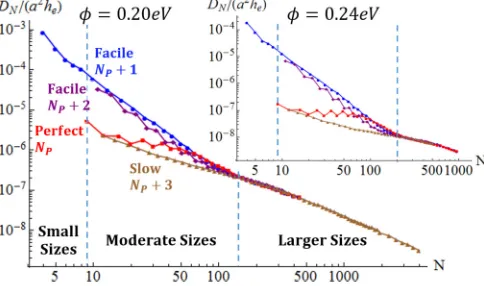
on the case φ=0.20 eV and δ=0 at 300 K. See Fig. 5. For small sizes N =4 to 8, high facile values of DN are
evident. Even higher values forN=1 to 3 are not shown. For moderate sizes,N =9 to O(102), we just show for clarity only four distinctive branches: facileNp+1, facileNp+2, perfect
FIG. 5. KMC results forDN vsN withδ=0 andφ=0.20 eV
(φ=0.24 eV in the inset) at 300 K.
(a) initially high values and rapid decay ofDN ∼N−βf for
facile Np+1 clusters up to N ∼82 with large βf ≈2.3;
similarly high DN, but less regular decay for facile Np+2
clusters; (b) the lowest values and slow decay ofDN ∼N−βs
for sizesNp+3 forN ∼39−103 with smallβs ≈0.83; (c)
very weak size dependence of DN for perfect Np clusters
up toN≈81; perfectNp and slowNp+3 branches merge
for small N =12 (and N =9); (d) intermingling of DN
for perfect Np with facile branches for Nmingle≈43, and
subsequent transition to a rapid decrease of DN for perfect
clusters; (e) near-merging of all branches forN ≈Nmerge≈
150. For larger sizes N > Nmerge, if we writeDN ∼N−βeff,
the effective exponent varies slowly from βeff ≈1.09 forN just above Nmerge, to βeff ≈1.33 for N from 500–1000, to
β =1.50 (the asymptotic value for compact clusters) forN from 2000–3600 (see Fig.6). This latter result is consistent with a kink separation Lk=1/2 exp[1/2φ/(kBT)]≈24 for
φ=0.20 eV, given that the asymptotic regime should apply forN (Lk)2≈570.
[image:8.608.52.294.73.216.2]It is instructive to contrast behavior forφ=0.20 eV with that forφ=0.24 eV retainingδ =0 at 300 K (see the insets for Figs. 5 and 6). All of the features described above are preserved qualitatively for φ=0.24 eV. However, now the deviations between the different branches for moderate sizes are enhanced, which is a natural consequence of larger
[image:8.608.51.295.579.724.2]FIG. 6. Post-merging effective scaling behavior ofDNwith N for φ=0.20 eV (φ=0.24 eV in the inset) andδ=0 at 300 K.
FIG. 7. Cyclical behavior ofDNvsNbetween minima (NP +3)
and maxima (NP+1) forφ=0.20 eV andδ=0 at 300 K. Inset: φ=0.24 eV.
values of φ/(kBT) producing a larger difference between
Eeff for facile and nucleation-mediated branches. Also, the
approach to asymptotic behavior is significantly delayed for larger φ/(kBT), as expected given the larger values of
Lk. Specifically, for φ=0.24 eV, we find thatβf ≈2.6 up
toN ∼101, βs≈0.53 forN ∼67–200, Nmingle≈81, and
Nmerge≈200–250. With regard to scaling for larger sizes,
we find that βeff≈0.75 just above Nmerge, and βeff ≈1.12
for N from 500–1000. Now Lk=52 for φ=0.24 eV, so
we do not access the asymptotic scaling for N (Lk)2 ≈
2700. Naturally, choosingφ <0.20 eV would minimize the difference between different branches for moderate sizes and accelerate the approach to asymptotic behavior. However, if φ/(kBT) is too small, the cluster connectivity constraint
becomes artificial. In the limit asφ/(kBT)→0, the clusters
become “random animals” with perimeter length proportional to size. This also results in deviations fromβ =1.5 [22].
Next, we consider in more detail diffusion behavior in the moderate size regime. Figure 7 reveals a quasiperiodic variation ofDNwithN =Np+nwithin each cyclen=1 to
nmax, where nmax=Lfor Np =L2 or (L–1)L. Specifically,
DN has a local maximum forn=1, drops significantly for
n=2, and again forn=3, where the latter corresponds to the lowest value within each cycle.DNthen increases within each
cycleN =Np+nfor increasingn=3,4,5, . . . ,nmax, where
N=Np+nmaxrecovers the next perfect size aboveNp. For
example, forNp=30 (36),nmax=6, andNp+nmax=36 (42).
Note that the length of these cycles increases for largerN, and thatN =15,24,35, . . .is the smallest value ofN for which one can realizeNp+3,Np+4,Np+5, . . ..
Interestingly, DN values for perfect sizes for n=nmax
within each cycle can be comparable to those for facile clusters forn=nmax+2. On the other hand, they are often well above DNforn=3 (the slowest clusters). This contrasts a possible
perception that perfect sizes should be the slowest. Thus one might question the assignment of nucleation-mediated diffusion forn=nmaxversus facile diffusion forn=nmax+
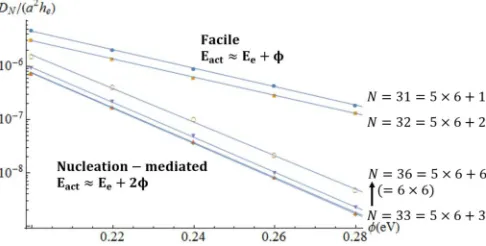
1. However, an Arrhenius plot for DN versus φ/(kBT)
does show clearly the distinction between Eact for these classes. Typically, such Arrhenius plots plot ln[DN] versus
1/(kBT) for fixed φ, the slope corresponding to Eeff. Here,
instead we plot ln[DN/(a2he)] versusφfor fixedT =300 K
FIG. 8. Arrhenius analysis ofDNfor facile (Np+1,Np+2) and
nucleation-mediated (Np+nforn=3,4, . . . ,np) sizes withNp=
30 andnp=6.T =300 K is fixed andφis varied.
(nucleation-mediated) diffusion (see Fig. 8). This format is instructive for showing the extent of variation of DN for
the expected range of φ values for metal (100) homoepi-taxial systems, and for a typical experimental temperature (T =300 K).
B. Cluster diffusivity with a finite kink rounding barrier (δ=0.1)
The introduction of a significant kink rounding barrier, δ >0, reduces the magnitude ofDNas a result of the increased
Eeffdescribed in Sec.III. However, the qualitative features of
the different diffusion branches for moderate sizes, and the variation ofDN versus N are the same as forδ=0. These
features are shown in Fig.9forφ=0.20 eV andδ=0.1 eV at 300 K (and in the inset for φ=0.24 eV). A detailed characterization of the cyclical behavior ofDN versusN in
the moderate size regime is shown in Fig. 10 where again the local maxima (minima) in DN occur for N=Np+1
(N =Np+3). As for δ =0, DN for N =Np+n for the
case of perfect sizes withn=nmaxis not so far below that for facile sizes withn=nmax+2, but well above that forn=3. Again, we have performed an Arrhenius analysis to reveal that Eeffforn=3,4, . . ., andnmax(nucleation-mediated cases) are
all similar, and are clearly above those forn=nmax+1 and
[image:9.608.52.295.72.195.2]n=nmax+2 (facile cases).
FIG. 9. KMC results forDNvsNwithδ=0.10 andφ=0.20 eV
(φ=0.24 eV in the inset) at 300 K.
FIG. 10. Cyclical behavior ofDNvsNbetween maxima (NP+1)
and minima (NP+3) forφ=0.20 eV andδ=0.1 eV at 300 K.
(Inset)φ=0.24 eV andδ=0.1 eV.
A previous study [17] indicated that introduction of a kink rounding barrier reduces the values of effective scaling exponents βeff. Specifically, this should apply for regime
(iii) where facile and nucleation-mediated branches have merged, but prior to the true asymptotic regime of large sizes. For φ=0.20 eV at 300 K, we find that just after merging, βeff ≈0.86 for 144N 325 when δ=0.1 eV (versusβeff ≈1.09 for 121N 327 whenδ=0). We also
find that βeff ≈1.09 for 361N 677 when δ=0.1 eV
(versus βeff ≈1.32 for 364N 2028 when δ=0). For
φ=0.24 eV, data are more limited for δ=0.1 eV as the simulation is more computationally demanding [48]. However, we estimate that just after merging, βeff≈0.71 when δ = 0.1 eV (versusβeff ≈0.75 whenδ=0). These results confirm
the proposal that increasingδdecreasesβeff.
V. TIME-DEPENDENT DIFFUSIVITY AND BACK-CORRELATION
The time-dependent diffusion coefficient, DN(δt)=
[δr(δt)]2/4δt, was introduced in Sec.IIB, whereδr(δt) is the CM displacement in a time intervalδt. The plateau value of DN(δt) corresponds to the conventional diffusion coefficient,
DN=limδt→∞DN(δt)=DN(∞). Thus it is important to
understand the transient behavior in order to reliably assess DN. In fact, this was essential to obtain the smooth cyclical
variation ofDNshown in Sec.IV. Here, we consider behavior
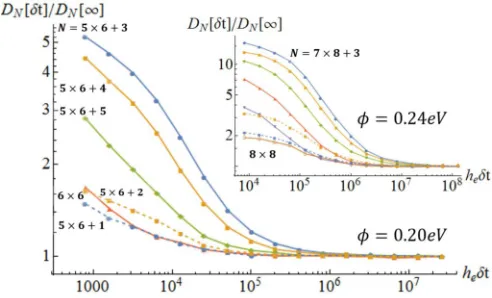
only in the absence of a kink rounding barrier,δ=0, although the basic observations and strategies of analysis apply more generally. In Fig.11, we show KMC simulation results for δ=0 for the behavior of DN(δt)/DN(∞) versus heδt for
sizes within a single cycle N =Np+1 to N=Np+nmax
(cf. Sec.IV). As noted in Sec. IIA, the form of these curves is independent of the choice ofhe. There is a strong decrease
in DN(δt) to its plateau value DN =DN(∞). In Sec. VA,
we estimate the short time-increment values,DN(δt →0), for
[image:9.608.52.294.580.727.2]FIG. 11. Time-dependent diffusion coefficients reflecting back-ward correlation in the CM motion for various cluster sizes within a cycle (see text) withφ=0.20 eV (andφ=0.24 eV in the inset) for
δ=0 at 300 K. HereDN(∞)=limδ→∞DN(δt)=DN.
A. Short-time behavior ofDN(δt)
Our estimate of the value of DN(δt →0) assumes
inde-pendent contributions to the mean-square displacement of the cluster CM from the short-time motion of all isolated (singly coordinated) edge atoms and all doubly coordinated kink atoms. Thus, we sum over these contributions to obtain DN(δt→0). For short-time increments,δt, the mean-square
displacement of isolated edge atoms (called “monomers” below) from their initial position satisfiesδre(δt)2 ≈2heδt,
3heδt, and 4heδt for atoms on straight close-packed steps
that can make two NN hops, atoms at corners that can make one NN and one 2NN hop, and atoms that can make two 2NN hops, respectively. The latter case is rare for larger clusters, so effectively one has 2heδt δre(δt)23heδt.
The mean-squared displacement of kink atoms (just called “kinks” below) from their initial position satisfiesδrk(δt)2 ≈
3hkδt for atoms that can make one NN and one 2NN hop,
andδrk(δt)2 ≈4hkδt for corner atoms that can make two
2NN hops. Thus one has that 3hkδt δrk(δt)24hkδt. To
simplify the analysis below, we will not discriminate between the different categories of monomers and kink atoms, and will interpret δre(δt)2 and δrk(δt)2 as suitable averages
over all categories. Subsequently, we will just obtain upper and lower bounds forDN(δt→0) using the above upper and
lower bounds onδre,k(δt)2.
Before presenting our approximation forDN(δt→0), we
also note that when a periphery atom is shifted by one lattice constant in a certain direction, the CM of the cluster is shifted by 1/N in that direction. This will produce an additional factor of 1/N2=1/L4in our analysis of mean-squared cluster displacement. Thus our expression forDN(δt →0) becomes
DN(δt →0)
≈ 1
4N2
i
nN,e(i)
δre(δt)2
δt +nN,k(i)
δrk(δt)2
δt
×exp[−Ei/(kBT)]
Z , (2)
where nN,e(i) and nN,k(i) are the number of monomers
and kinks in ith state with energy Ei, and Z =
iexp[−Ei/(kBT)] is the relevant partition function. We use
this result to estimateDN(δt →0) focusing on two special
cases. Further details are provided in Ref. [49].
Perfect sizes Np=L2. The ground state is unique, i.e., L2(0)=1, and has a square shape with no monomers and
four kinks. Thus the total contribution toDN(δt →0) from
the ground state is of orderhk/N2, denotedO(hk/N2). There
are 4×(4L−2) first excited states where an atom is shifted from one of the four corners of the ground state and placed as a monomer on an edge, and 2×4Lfirst excited states with a monomer on an edge of a (L−1)×(L+1) rectangle. Thus the total number of first excited states with a monomer is
L2(1)=(24L−8). The total contribution to DN(δt→0)
from these states is dominated by monomer hopping and is O( L2(1)heexp[−φ/(kBT)]/N2)=O(Lhk/N2), which
exceeds the contribution from the ground state.
The great majority of the L2(1) first excited states
have no monomers, but many kinks. If nL2,k(1) denotes
the number of kinks in such states, then one has that 3 nL2,k(1)2(1+
√
2L+1) (see Appendix B). Despite the penalty of a Boltzmann factor of exp [−φ/(kBT)],
the total contribution of kinks in first excited states, O(nL2,k(1) L2(1)hkexp[−φ/(kBT)]/N2), becomes
compara-ble to those above for moderateN due to the large number of first excited states L2(1). Specifically, the contribution
becomes comparable when L2(1)exp[−φ/(kBT)] ∼O(1),
which occurs whenN ∼49 (81) forφ=0.20 eV (0.24 eV) (see AppendixC).
Finally, we find that it is also necessary to consider contributions from the subclass of second excited states, which include a monomer. We note that the number of such states, L2(2)∼4L L2−1(1) (see Appendix D for a
more precise analysis) is somewhat larger than L2(1) for
N∼O(102). The total contribution of such states is of order O( L2(2)heexp[−2φ/(kBT)]/N2), which is of the same order
as the above contributions for moderate cluster sizes if one accounts for this large L2(2) and for the high monomer hop
ratehe. Combining these four types of contributions (of which
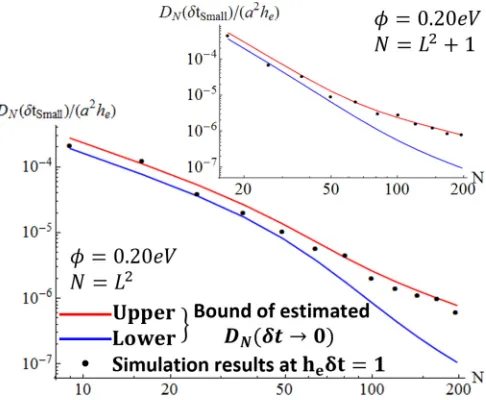
the last one dominates for moderateN) yields estimates for DN(δt →0) close to simulation values as shown in Fig.12
forheδt=1,φ=0.20 eV.
It is appropriate to note that the contributions explicitly included above correspond to exactly the configurations that arise in our picture of nucleation-mediated cluster diffusion for moderate sizes. The cluster primarily exists in the ground state, but must access first excited states in order to initiate motion. However, transitions between the numerous monomer-free first excited states involve second excited states with a monomer. We note that contributions from second excited states without a monomer and higher excited states are of lower order than those above since the number of relevant configurations is not substantially greater than L2(1) or
L2(2).
Facile clusters of sizesN=L2+1. Here, we mimic the
above analysis for perfect clusters. ForN=L2+1, there are 4L ground states with a monomer, i.e., L2+1(0)=4L,
each of which provide a contribution O(he L2+1(0))∼
FIG. 12. Estimated upper and lower bounds ofDN(δt→0) vs
simulation results forheδt=1 (black dots) forN=L2(insetN= L2+1) forφ=0.20 eV andδ=0 at 300 K.
contribute by kink hopping with total contribution of order O(nL2+1,k(0)hk L2+1(0))∼O(he) forN 65(101) withφ=
0.20 eV (0.24 eV), using the feature that L2+1(0) grows far
more quickly than L2+1(0). Note also that nL2+1,k(0)
2(1+√2L−1) (see Appendix B). The third contribu-tion comes from the first excited states with a monomer, where the number of such states satisfies L2+1(1)∼
4L L2(1) (see Appendix D for a more precise
analy-sis). Thus the total contribution of first excited states is O(he L2+1(1)exp[−φ/(kBT)])∼O(he), due to the large
number of states considered,O( L2+1(1)exp[−φ/(kBT)])∼
O(1) forN 65(101) withφ=0.20 eV (0.24 eV). Combin-ing these three contributions yields estimates forDN(δt →0)
close to simulation values [see Fig.12 (inset) forheδt =1,
φ=0.20 eV]. Note that the states explicitly included above are exactly those in our picture of facile diffusion for moderate sized clusters, and other states have a lower order contribution. Other cases and further comparison. The above analysis readily extends to other cases. For the nucleation-mediated cases, N =Np+n with n=3,4, . . . ,nmax, we claim that
DN(δt→0) will decrease from a local maximum forN =
Np+3 to a local minimum forN =Np+np(corresponding
to perfect clusters). Clusters within this class forN=Np+3
have the highest ground-state degeneracy and importantly also the highest number of kinks. Consequently, the contribution from the ground states O(nL2+3,k(0)hk L2+3(0)) for N =
Np+3 will exceed that for perfect clusters due to the
sub-stantial number of kink sites,nL2+3,k(0)2(1+
√
2L−5). The larger factor L2+3(0) versus L2+np(0)=1 does not
in itself boost DN(δt→0), as this factor also appears in
the partition function denominator of (2). ForN =Np+n,
as n increases from 3 towards np, the degeneracy of the
ground-state and importantly the typical number of kinks decreases. Correspondingly,DN(δt→0) also decreases with
increasingn=3,4, . . .. Finally, comparing the above analysis for perfect and facile clusters shows that DN(δt→0) for
perfect clusters is smaller roughly by a Boltzmann factor of exp[−φ/(kBT)] than for facile clusters.
B. Further analysis of back correlation
The substantial characteristic time δtc, associated with
the transient short-time diffusion behavior of DN(δt), is
evident from Fig. 11. These data suggest heδtc∼105–106
(106–107) for φ=0.20 (0.24) eV at 300 K, at least for
nucleation-mediated (NM) cluster diffusion, where the branch with N =Np+3 appears to have a larger δtc than for
N=Np+nwithn >3. This latter feature is confirmed by
a suitably rescaled version of Fig. 11, which is shown in Ref. [49]. It is reasonable to expect that for NM diffusion, δtc should reflect the characteristic time δtnuc=1/knuc to
nucleate a dimer on an outer edge. This implies thatheδtc∼
heδtnuc∼exp[+2φ/(kBT)]∼106.4 (108.0) for φ=0.20 eV
(φ=0.24 eV) at 300 K withδ=0. These crude estimates at least roughly reflect those from Fig.11, and also the feature that δtcincreases withφ. The largerδtcforN=Np+3 plausibly
reflects the larger degeneracy of the ground state and the larger typical number of kinks for that cluster size (see Sec.VII), which can inhibit nucleation of new outer edges.
For facile clusters with N =Np+1 or N =Np+2,
Fig. 11 perhaps suggests a somewhat shorter δtc although
this is not evident in the further rescaled plots in Ref. [49]. One might expect a shorterδtc based upon the feature that
nucleation is not needed so correspondingly Eeff is lower,
and the long-time diffusion coefficient is higher. However, other factors, such as the high degeneracy of the ground state (see Sec.VII), no doubt play a role in determiningδtc.
As noted previously, assessment of transient behavior in DN(δt) is essential for precise determination of DN, where
precise determination becomes more demanding for longer δtc. Thus, accurate treatment of the caseN =Np+3 is most
demanding, failure to do so leads to a distorted representation of the cyclical behavior of DN versus N (see Sec. VII).
Practically, we initially estimate that the plateau inDN(δt)
is achieved forδt > δt∗, where[δr(δt∗)]2is of the order of a2(whereδt∗gives a measure ofδt
c). The total length of the
trajectories used to determineDN istmax∼35 000δt∗ where
data is collected only forδt δt∗. (For reference, choosing Ee=0.29 eV andν=1012.5s−1for Ag/Ag(100) yieldshe=
107.6s−1at 300 K, andt
max∼70 000 s forN =59.)
Finally, we elaborate on the interpretation of the decrease of DN(δt) to a plateau value as corresponding to a back
correlation in the walk of the cluster. Consider the canonical model of a correlated walk with hops to NN sites on a lattice at total rate h. If rj denotes the displacement of the jth hop, then the displacement of the jth hop is correlated to that of previous hops as quantified byA(k)= rj·rj−k/r1·r1, whereA(k)<0 for back correlation. Hererj·rj = r1·r1 for all j. Adapting results for the time-dependent diffusion coefficient D(δt) for this system into a continuous-time framework for a large number of hops yields
D(δt)/D(δt →0)=1+2
0uhδt
du A(u), so that
A(hδt)= 1
TABLE I. Number of isoenergetic ground-state configurations
N(0) and restricted isoenergetic configurations ∗N(0) forN=L2+1.
N=L2+1 10 17 26 37 50 65 82 101
N(0) 28 80 210 504 1148 2480 5160 10 360
∗
N(0) 28 80 202 464 988 1976 3748 6792
Note that the magnitude of cumulative (integrated) corre-lation is strictly bounded by1/
2 in this formulation. Clearly,
the decrease in DN(δt) with increasingδt shown in Fig.11
corresponds to back-correlationA(u)<0. One could extract an effectiveA(u) from the form ofDN(δt) after assigning an
effective total hop rate.
VI. FURTHER ANALYSIS OF DIFFUSIVITY VIA CONFIGURATION COUNTING
Deeper insight into the diverse aspects of cluster diffusion behavior described in Sec.IVfollows from exploiting results of a combinatorial analysis of cluster configurations correspond-ing to ground states and first excited states. This nontrivial analysis utilizes results related to (number theoretic) partitions of integers. Details are relegated to AppendixC.
A. Anomalous scaling for facile clusters
As noted in Sec. IV, for facile Np+1 clusters, one
finds initially high values and rapid decay of DN∼N−βf
with large βf ≈2.3 (βf ≈2.6) up to N ∼82 (101) for
φ=0.20 (0.24) eV at 300 K. These exponent values are far larger than any reported in previous studies. To elucidate this behavior, recall that long-range diffusion requires that the cluster repeatedly passes through a special configuration with one edge atom on a perfect core. We suggest that the behavior ofDNreflects the possibility to wander through a large number
of isoenergetic ground-state configurations far removed from the special configuration, where the number N(0) of these
states increases rapidly with increasingN. After the system leaves the special configuration, lettretdenote the mean-time
for the system to return, where one expects thatDN ∼a2/tret.
A key result of Montroll and Weiss [50] for regular lattices is that this return time is directly proportional to the size of the system, independent of dimension. This in turn suggests that DN ∼a2hc/ N(0). The results presented in TableIindicate
that N(0)∼Nα withα≈2.6 up to N ∼100, reasonably
consistent with the above largeβfvalues (see AppendixC).
For another perspective, note that all isoenergetic states have equal population. Thus the probabilityPretthat the system
is in a ground state, which can directly transition to (or “return to”) the special configuration, scales like Pret∼1/ N(0).
Then, we claim thatDN ∼a2hcPret, which recovers the above
result.
The exact behavior of DN actually depends not just
on the number of isoenergetic configurations, but on their connectivity to the special configuration [30,32]. Presumably, configurations more closely connected to the special config-uration should play a more significant role. This motivates analysis of the number N∗(0) of restricted isoenergetic
[image:12.608.50.296.96.144.2]configurations where starting from the special configuration,
TABLE II. Values of NP(1) forNp=L
2.
N=L2 25 36 49 64 81 100
NP(1) 496 1140 2472 5152 10352 20208
additional atoms are shifted to the edge with the isolated atom from just the outermost layer of the other edges. Analysis of
N∗(0) data also in TableIproduces a modified exponent of
α≈2.4, again reasonably consistent with theβf values.
B. Intermingling of perfect and facile branches
WhileDN for facile clusters decreases strongly with N
for moderate sizes, the variation of DN for perfect clusters
is extremely weak. The latter behavior reflects the feature that diffusion of perfect clusters is largely controlled by the nucleation step, which depends weakly onN, and not so much on the subsequent transfer of atoms to complete the new edge. Thus theDN in the facile branch, which are large for smaller
sizes but rapidly decreasing naturally meet and “intermingle” with theDN of the perfect branch, which are lower for small
sizes but slowly decreasing. SinceDN for theNp+3 branch
are even lower than for perfect clusters and decrease with increasingN, this branch remains separate from the facile and perfect clusters at the point of intermingling.
The distinction between perfect clusters and facile (or other) classes of clusters is predicated on the feature that the former primarily exist in their ground states. However, perfect NP clusters would have a significant probability of being
in the first excited state when NP(1)/ NP(0)≈ NP(1)≈
exp[φ/(kBT)], where again N(n) gives the number of
isoconfigurations for the nth excited state for a cluster of size N, and NP(0)=1. Results for NP(1) determined
from combinatorial analysis in Appendix C are reported in TableII. For φ=0.20 eV (0.24 eV), the Boltzmann factor exp[φ/(kBT)] =2290 (10730), and thus intermingling
per-fect and facile branches should occur aroundN =Nmingle∼
49 (81). This prediction is consistent with the behavior shown in Fig. 13 where Nmingle is indicated by a dashed vertical
line. Note thatDNfor perfect (facile) clusters decreases more
[image:12.608.313.560.579.714.2]quickly (slowly) after intermingling.
FIG. 13. The intermingling sizes of L2 and L2+1 branches
TABLE III. Values for NP+3(0), NP+3(1), and the ratio NP+3(1)/ NP+3(0) forN=L
2+3.
N=L2+3 147 172 199 327 364 403
NP+3(0) 10360 20216 38416 407968 706034 1.20×10
6
NP+3(1) 1.53×10
7 3.95×10⁷ 9.86×10⁷ 2.86×10⁹ 6.25×10⁹ 1.34×10¹⁰ NP+3(1)
NP+3(0) 1475 1955 2565 7002 8847 11116
C. Merging of all branches of cluster diffusivity
As noted above, the feature thatDNfor theNp+3 branch
are lower than those for perfect clusters and also that they decrease slowly withN delays merging with the perfect and facile branches. It is appropriate to note that while bothNp+1
andNp+3 branches have a high ground-state degeneracy, this
only produces strong size dependence ofDN for the former.
Why? Long-range diffusion of clusters for sizes Np+3
does not require repeatedly passing through a single special configuration, unlike forNp+1. Thus the strong increase in
the number of ground states with increasingNdoes not induce a strong reduction inDNforN=Np+3.
Analogous to our assessment of intermingling and perfect branches, here we argue that the distinctive nature ofNp+3
clusters (relative to Np+1) is lost when the ratio of the
number of the first excited states Np+3(1) to the number
of ground states Np+3(0) satisfies Np+3(1)/ Np+3(0)≈
exp[φ/(kBT)]. The method to count the number of isoenergetic
states, NP+3(1), NP+3(0) is the same as that of counting
NP(1). Relevant results are presented in Table III (see
Appendix C for details). The predicted sizes for merging, N =Nmerge≈199 (403) for φ=0.20 eV (0.24 eV), are
indicated by dashed vertical lines in Fig.14.
D. Analysis of the cyclical variation of cluster diffusivity
It is clear from Fig. 5 that DN actually increases
with increasing size N =Np+n, within each cycle n=
3,4,5, . . . ,nmax, where nmax=L for Np=L2 or (L–1)L
recovers a perfect cluster. A local minimum (maximum) in DN occurs for then=3 (n=nmax+1). We suggest that the
key feature controlling this behavior is a strong decrease with increasingnin the degeneracy of the ground state from a max-imum forn=3 to a minimum forn=nmax. The minimum is
FIG. 14. The intermingling sizes ofL2+3 andL× (L+1)+
1 branches predicted with thermodynamics forφ=0.20 eV (inset
φ=0.24 eV) withδ=0 at 300 K.
1 forNp =L2, and 4 forNp=(L–1)L. A larger number of
degenerate ground states means a higher probability that the cluster is in a configuration with multiple atoms removed from the corners and thus many kink sites which can trap diffusing edge atoms. This makes nucleation of a new outer edge more difficult, as the lifetime of isolated atoms is reduced). Many kinks also inhibit transfer atoms to complete that new outer edge. Consequently,DNp+n increases with increasingn. We
remark that “oscillations” inDN versusN were observed in
previous simulation studies [7,9]. However, the analysis was limited [9], e.g., perhaps giving a misimpression that perfect clusters N =Np diffuse slowest, and not recognizing that
N=Np+2 (as well asNp+1) are facile.
Finally, we emphasize the substantial computational chal-lenge in obtaining precise values for DN particularly for
N=Np+3 orNp+4. This is evident from Fig. 11where
one must sample over substantially longer time intervalsδt to obtain the correct asymptotic value ofDN. Lack of precision
in analysis fails to produce the correct trend inDNwithin each
cycle. To illustrate this issue, in Fig.15, we present results obtained forDN(δt) with a smallheδt=811 and with a large
heδt=12970 forφ=0.20 eV andδ=0 at 300 K (both well
belowheδtc=105–106). Even the latter is insufficiently large
to recover the correct asymptotic behavior. Such analysis gives the misimpression that the slowest diffusion occurs not for N=Np+nwithn=3, but for somewhat largern.
VII. CONCLUSIONS
Our precise KMC analysis of a tailored but effective model for cluster diffusion on metal (100) surfaces has revealed extraordinarily diverse behavior particularly for the regime of moderates sizes 9N O(102). Perhaps
[image:13.608.314.558.576.725.2]unex-pectedly, the slowest diffusion does not occur for perfect sizes
[image:13.608.50.296.587.715.2]N =Np =L2orL(L+1) with unique square or near-square
ground-state shapes, but rather forN =Np+3. However, the
slowest short-time diffusivity does occur for perfect sizes. We are able to elucidate the distinct behavior of different branches (facile, perfect, and slow) in this regime, exploiting combinatorial analysis of the number of ground states, first excited states, etc.
Also of interest is the intermingling and merging of these branches for largerN. Combinatorial analysis was also utilized to provide insight into the intermingling and merging points essentially by determining at what cluster size thermal fluctu-ations or excitfluctu-ations smeared the distinction between various branches. As an aside, we note that another way to assess merging is based on the realization that the effective Arrhenius energyEefffor cluster diffusion adopts a higher value,Eeff =
Ee+2φ+δ,for nucleation-mediated diffusion for moderate
sizes than in the asymptotic regime of large sizes whereEeff = Ee+φ+δ. We have checked that for nucleation-mediated
diffusion, the effective value ofEeff decreases with increasing
N and is reduced to aboutEeff=Ee+1.5φ+δat the point
where merging occurs (see Ref. [49]).
We have not presented a comparison with experimental data. However, our results are particularly valuable in revealing the complexity of behavior for moderate sizes and the potential shortcomings in extracting size scaling exponents from data over a limited size range. We plan to apply our modeling to analyze the behavior for Ag clusters on Ag(100) where recent experimental analysis [3] has suggested somewhat lower exponent values from those determined previously [2] (but where in both cases the exponent is significantly below the classic value ofβ =3/2). Also, with regard to experiment, we note that facile clusters of size N =Np+1 should be
susceptible to dissociation of the isolated edge atom in the special ground-state configuration with this atom and a perfect core. However, this is only one of many isoenergetic ground states for largerNreducing this likelihood. ForN =Np+2,
there are no isolated edge atoms in the ground state, so this issue does not arise.
Finally, we note that basic features of results from our mod-eling should be more general than for cluster diffusion on metal (100) surfaces. Similar behavior is expected for metal (111) surfaces. The surprising feature that perfect clusters do not have the lowest diffusivity may even extend to supported 3D clusters. However, there are certainly other fundamental issues that remain to be addressed. For example, the degeneracy of the ground state is important in explaining various basic features of behavior. However, if one includes more lateral adatom interactions, degeneracies can be broken, so how does this change the behavior from that of our basic model?
ACKNOWLEDGMENTS
K.C.L. and J.W.E. were supported for this work by NSF grant CHE-1507223. They performed detailed KMC analysis and developed theoretical interpretations of the data. D.J.L. was supported by the USDOE, Office of Science, Basic Energy Sciences, Division of Chemical Sciences, Geosciences, and Biological Sciences, and his work was performed at Ames Laboratory which is operated by Iowa State University for the USDOE under Contract No. DE-AC02-07CH11358. He
performed the exploratory KMC simulations revealing diverse behavior together with preliminary analysis.
APPENDIX A: EXACT ANALYSIS FOR THE SMALL CLUSTER SIZE REGIMEN<9
Exploiting the exact master equation analysis discussed in the text, for dimers with two linear configurations (rotated by 90°), one finds that [32]
D2=D2(δt)=(a2/2)hrsoEeff =Ee+δ. (A1)
For trimers with six distinct configurations (two linear and four bent),D3(δt) generally decreases with increasingδtto its
asymptotic value [32]
D3=(a2/3)hrhe/(hr+he) so 1/D3=3a−2(1/hr+1/he).
(A2)
The latter expression confirms the obvious feature that both edge diffusion and corner rounding are required for long-range diffusion. In this case, one does not in general have perfect Arrhenius behavior except forδ =0, whereEeff=Ee.
However, in practice, for typical nonzero δ, one has that Eeff =Ee+δ. For tetramers with 19 distinct configurations,
D4(δt) generally decreases with increasingδtto its asymptotic value
D4=hchr[6(he)3+38(he)2hr+35he(hr)2+6(hr)3]/
{(18hc+hr)[(he)3+10(he)2hr+24he(hr)2+9(hr)3]}.
(A3)
As expected, this result shows that core breakup is essential for long-range cluster diffusion. For typical values of parameters with nonzeroδ, the effective barrier is given byEeff =Ee+
φ+δ.
Previous analysis [32] also exploited the possibility of simplified (dimensionally reduced) analysis in the limit as he→ ∞ where various configurations convert infinitely
quickly between each other and may be grouped into a smaller set of quasiconfigurations. For the trimer, there are two quasiconfigurations (two linear and a single quasibent configuration), and the above result reduces toD2=(a2/3)hr.
For tetramers, there are five quasiconfigurations, and the above result reduces to
D4 =6a2hchr/(18hc+hr), so that
1/D4 =(a−2/6)(1/hc+18/hr). (A4)
Results are also available for pentamers.
APPENDIX B: ESTIMATING THE NUMBER OF KINKS
nkIN CLUSTER CONFIGURATIONS
Here, we obtain bounds on the number of kinks nk for
various cluster configurations. The lower bound can readily be determined for specific cases, and is O(1). Thus we focus on estimating the upper bound in this section. First, consider removing m1 atoms from a single corner of an
otherwise perfect rectangular cluster. The number of kinks nk is maximized if the atoms are removed to create a