Stakeholder Frames in the Mapping
of the Lower Kishon River Basin Conflict
DEBORAH F. SHMUELI
MICHAL BEN-GAL
The authors applied a framing approach to a long-standing controversy over the elimination of pollution in the Lower Kishon River basin of northern Israel. Framing was used not only to analyze, map, and evaluate the dispute but also to intervene within the context of a conflict assessment. The experience demonstrates the utility of framing elicita-tion and evaluaelicita-tion for understanding environmental conflicts.
T
he marked increase in the frequency and intensity of environmental dis-putes in Israel is a consequence of the country’s rapidly growing popu-lation and economic development. Continued concentration of popupopu-lation within the national core (the central coastal plain) has already produced extraordinarily high densities as urban expansion swallows up open spaces and agricultural lands, placing heavy strains on the country’s infrastructure. The country’s population of 6.1 million is projected to expand to more than 8 million by the year 2020, within its limited land area of 21,501 square kilometers; this virtually guarantees that environmental disputes will become endemic, thus necessitating more sophisticated applications of dispute resolution.A basic premise of the ongoing research is that when stakeholders frame or interpret disputes differently, the probability of conflict is heightened. Moreover, if stakeholders’ frames diverge widely, disputes are likely to become protracted.
The aim of the research is to gain a better understanding of conflict dynamics—to map the conflict by analyzing how disputes are perpetuated by how they are interpreted, or framed, by stakeholders and media, and to explore how knowledge about differences in framing can contribute to constructive interventions.
This article has two main sections. In the first we offer a comprehensive categorization and classification of frames that characterize environmental conflicts. The categorization is derived from a review of the pertinent liter-ature and our own field research findings. Here we also illuminate some of the factors that influence framing. The second section illustrates the appli-cation of these frame categorizations to the assessment of a specific envi-ronmental conflict: the pollution of the Lower Kishon River in the Haifa bay area in Israel. The assessment spanned a six-month period, during which frames were used to map a serious urban conflict over how best to clean this highly polluted river.
Framing Defined
There is no uniform definition of frames in the literature. We have adopted the definitions of such scholars as Minsky (1975), Tannen (1979) and Gray (1997), using frames as “cognitive structures held in memory and used to guide interpretation of new experience,” where “parties rely on these mental structures to interpret or make sense of ongoing events” (Gray, 1997, p. 171). The actions of involved parties in a conflict are in accor-dance with their overall attitudes, biases, and understandings of the issues.
Each stakeholder or organization uses its own frames, thus reflecting different perceptions of the conflict: what constitutes the agenda, the rele-vance of various issues and their order of priority, the chances and risks involved, and other elements that affect stakeholders’ acts. Putnam and Holmer (1992) hold that framing and reframing are vital to the negotia-tion process and are tied to informanegotia-tion processing, message patterns, lin-guistic cues, and socially constructed meanings.
Framing in the Literature
The concept of frames has been developed as a tool for analysis in various fields of study, including psychology and sociology (for example, Taylor, 2000; Gonos, 1997), business management (Watzlawick, Weakland, and Fisch, 1974; Goldratt, 1990), artificial intelligence (Minsky, 1975), decision making (Kahneman and Tversky, 1979), negotiations (Neale and Bazerman, 1985; Gray, 1989; Pinkley, 1990), and environmental conflict management (Kaufman and Smith, 1999; Vaughan and Seifert, 1992). In most of these applications, the approach is both retrospective and summative.
Putnam and Holmer (1992) present a comprehensive description of the various approaches in the study of frames and framing in negotiation. They identify three approaches: cognitive heuristics, frame categories, and issue development.The cognitive heuristics approach deals with biases and devia-tions from rationality that stem from negotiator judgment and influence their frames. In the frame categoriesapproach, researchers determine what frame types are used by stakeholders in interpreting a conflict. The issue development approach centers on the agenda and how it changes during negotiation; here the assumption is that a dispute is transformed through changes in frames or in how problems are conceptualized.
Our approach to framing in environmental conflict builds upon and contributes to the frame categories and issue development approaches. In terms of frame categories, it merges cognitive views of framing with forms of linguistic and content analysis; it posits some of the same frame cate-gories. Our focus on the priorities that stakeholders accord to various issues in the dispute, and how they sequence these issues when perceiving the dis-pute, is rooted in the issue development approach. Our contribution to this approach is the linkage of sequencing preferences and issue flows with framing.
influencing them that have been generated by others, notably Wish, Deutsch, and Kaplan (1976); Tversky and Kahneman (1981); Neale and Bazerman (1985); Pinkley (1990); and Brunner (1991).
Gray and Donnellon along with Kaufman and Smith (1999) present seven types of “frames relevant to spatial change, which appear to inform parties about issues, other stakeholders, process, options and consequences, the value of information and about the necessity to act” (Kaufman and Smith, pp. 169–170). These frames are:
1. Substantive consequences of change (including complete story and zero sum) as being at the core of the dispute
2. Loss or gain—seeing the half-full or half-empty glass
3. Characterization (including self-characterization)—evaluation, often stereotypical, of others’ behavior, attitudes, motives, or trustworthiness
4. Process—reflection of how views about steps, decision rules, and participation affect the conflict
5. Outcome—description of conflicts in terms of parties’ positions, often expressed as preferred solutions (including zero risk and justice)
6. Aspiration—reflecting disputants’ needs, interests, desires, or concerns
7. Complexity—reflecting the value placed on scientific-based
information, including scientific (science as truth or deception) or technical orientation
Background Research: First Phase
At the outset we developed a tentative typology of issues that typically underlie management of environmental disputes. From this typology, as well as from the framing literature, we then extracted and categorized the frames to establish a coding system for frame and conflict analysis.
During this initial phase, we analyzed raw data from interviews with stakeholders in four prominent protracted conflicts (of fifteen years or more) to pull out stakeholder frames and “map” these conflicts. (These interviews were part of conflict assessments undertaken in preparation for a three-day workshop led by Larry Susskind of the Consensus Building Institute (CBI) on Conflict Resolution in the Areas of Planning and Envi-ronment, which was held in January 1999. The workshop was sponsored by the Israel Center for Negotiation and the Ministries of Environment and Justice. The purpose was to introduce concepts of environmental dis-pute resolution to Israeli decision makers and stakeholders.) Of these four national cases, three involve siting issues: a national waste disposal site, a transnational highway, the national airport expansion, and a resource man-agement issue focusing on the Tel Aviv coast. Some of the stakeholders are leading decision makers at the national and regional government levels (Shmueli and Ben-Gal, 2000, 2002). This analysis was then used proac-tively in the separate conflict assessment of pollution within the Lower Kishon River.
Framing Typology
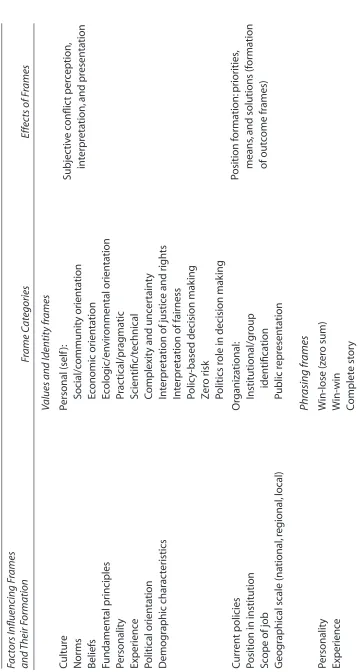
The typology of frames developed in this study (values and identity, phras-ing, substance and process) may shed light on the role of frames in conflict perception and development, as well as serve as a tool for conflict mapping, as is illustrated in Table 1:
Table 1. F raming T ypology :F rames ,W hat Influenc es T hem, and T heir Eff ec
ts on Stak
eholders
Fa
ct
ors Influencing F
rames and Their Formation C ultur e Norms Belief s
Fundamental principles Personalit
y
Experienc
e
P
olitical orientation Demogr
aphic char ac te ristics C urr ent policies P
osition in institution Scope of job Geogr
aphical scale (national,
regional, local) P ersonalit y Experienc e Fr ame C a tegories V
alues and Identit
y fr ames P ersonal (self ): Social/c ommunit y orientation E
conomic orientation Ecologic/en
vir onmental orientation P rac tical/pr agmatic Scientific/t echnical C omplexit
y and unc
er
taint
y
Int
erpr
etation of justic
e and rights
Int
erpr
etation of fairness
P
olic
y-based decision mak
ing Z e ro risk P olitics r
ole in decision mak
ing Or ganizational: Institutional/gr oup identification P ublic r epr esentation Phr asing fr ames Win-lose (z er o sum)
Win-win Complet
e st
or
y
Effec
ts of F
rames Subjec tiv e c onflic t per ception, int erpr etation, and pr esentation P osition f o rmation: priorities means
,and solutions (f
of out
come fr
Needs Desir es C onc erns A d v a ntages
Benefits Fears Positions:
P
riorities
,means
,
and solutions
Understanding other stak
eholders ’ ac tions ,i nt er ests ,and positions
Relationships among stak
eholders Legal struc tur e D ecision-mak ing pr oc ess Alt ernativ e pr oc esses Substanc e fr ames A spir ations Issues Out comes P roc ess fr ames (ex ternal fr amework) P a rticipants: Char ac te
rization of others
S elf-char ac terization Char ac te
rization of r
elationships P ublic/c ommunit y In v olv ement/r epr esentation Bur eaucr atic/pr oc edur al: Suppor
t of pr
oc
ess
Criticism of pr
oc
ess
V
ision of a bett
subframes identified are organizational identification and the “public” the organization sees itself as representing.
• Phrasing frames. These deal with how the parties focus on the con-flict. Are issues formulated on win-lose assumptions, or on mutual gain? Such frames have considerable potential for reframing as a step toward dis-pute management and settlement. In the framing literature, this category is referred to as “decision frames” (Kahneman and Tversky, 1979) or “ref-erence frames” (Schweitzer and DeChurch, 2001).
• Substance frames. These have three subframes: aspirations, issues, and outcomes. Aspirationsare often translated into interests and are derived from factors such as needs, desires, concerns, fears, advantages, and bene-fits. They represent the perception of the “ultimate” reason (why stake-holders hold specific views or positions) as well as desired courses of action.
Issues are the substance of the conflict, the what perceived to be the prob-lems or issues that need addressing. Outcomesare the positions or plausible solutions each stakeholder expresses, the how. These are formulated as stakeholders absorb information while using the other frames. Differenti-ating between aspirations (interests) and outcomes (positions) is not always clear-cut; however, making distinctions and connections among these three subframes—and the connections among the three can help stake-holders better understand their objectives and see the connections between their objectives, positions, and solutions. Setting apart the values from the substance frames can deepen the understanding of the origins of differing perceptions of a conflict. This can also help to identify values and identity-driven conflict, in order to engage them proactively (Rothman, 1997). (Regarding these distinctions being ambiguous, we agree with Provis, 1996, that in some instances it is appropriate to focus on positions or instrumental interests (the how) rather than on ultimate interests (why). As Provis posits, productive negotiation requires use of a variety of concepts— “like moods, motives, interests, values, positions, beliefs, perceptions, etc.—attending to whichever of these factors is most important to the dynamics of the particular negotiation” [p. 306].)
takes place; and various degrees of seeing the general public as a partner in decision making (see Table 1).
Although the frames are represented as discrete entities, some should be viewed as a continuum. An example is the public/community involvement/ representation frame. Some people view the “public” as a major actor in the decision-making process, while others see importance only in informing the public (see Arnstein’s ladder of citizen participation, Arnstein, 1969).
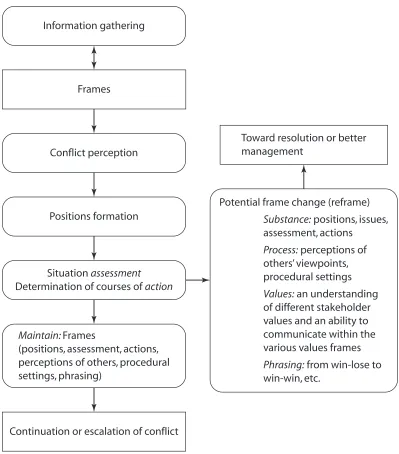
[image:9.612.113.512.266.720.2]Figure 1 illustrates the place of frames and framing in the dynamics of conflict development. It demonstrates how a frame change (or reframing) Stakeholder Frames in Mapping the Lower Kishon River Basin Conflict 219
Figure 1. Frames and Their Role in Conflict Development
Information gathering
Frames
Conflict perception
Positions formation
Situation assessment
Determination of courses of action
Continuation or escalation of conflict
Maintain: Frames
(positions, assessment, actions, perceptions of others, procedural settings, phrasing)
Toward resolution or better management
Potential frame change (reframe)
Substance: positions, issues,
assessment, actions
Process: perceptions of
others’ viewpoints, procedural settings
Values: an understanding
of different stakeholder values and an ability to communicate within the various values frames
Phrasing: from win-lose to
may cause a shift in conflict development, toward conflict management or resolution.
It should be noted that stakeholders often use multiple frames, and that some are salient at particular times during the dispute. Using the different frames as sieves for absorbing and analyzing information may cause a shift in the perception of the conflict and so influence its dynamics, as illustrated in Table 1 and Figure 1.
The Illustrative Case Study: The Kishon River
The Lower Kishon River Basin, which passes through the Haifa metropol-itan region, has been deeply polluted for more than forty years. The main sources of pollution (high acidity, heavy metals, organic waste) are six chemical and petrochemical companies, as well as the Haifa Waste Treat-ment Plant.
In spite of various laws and regulations that are supposed to regulate river contamination in Israel, the authorities have until now failed to arrest the river’s deterioration. The reasons for this failure have varied over the decades: failure to appreciate environmental hazards, absence of a defined authority with adequate enforcement instruments, and lack of cooperation among public authorities.
A series of studies conducted by governmental authorities (Interminis-terial Committee . . ., 2000) led authorities to call for total ecological restoration of the river. The industries argued that new, higher water qual-ity standards exceeded their technological capacities, particularly because of the requirement that the treated waters be salt-free.
The authorities then decided that the treated brackish water should bypass the Kishon by being diverted through a pipeline into the Mediter-ranean Sea at Haifa Bay. Environmental groups, which are not convinced that the brackish water (high salt content from industrial effluents) will con-tain “just salts,” found this decision unacceptable. They claim that past experience has taught them to trust neither the industries to treat the sewage nor the authorities to control and monitor the industries. As a result, the environmentalists have vigorously opposed the diversionary pipeline on the grounds that it will pose a severe hazard to the marine environment (Shmueli and Ben-Gal, 2001).
over the previous situation, but they will not achieve restoration of the river to the extent contemplated by the authorities. The authorities are trying to advance construction of the pipeline to carry the brackish water to the sea, but the environmentalists remain adamant in their opposition. The indus-tries fear that if the pipeline is not constructed the authorities will raise the new standards recently imposed, requiring discharge of such high quality that the treatment costs will be too excessive to bear even in the unlikely event that such treatment becomes technologically feasible.
Methodology
In late December 2000, the Ministry of Environment, in seeking to pro-mote a dialogue among the involved parties about the environmental future of the Kishon and the community, asked the authors of this article to prepare a conflict assessment. The assessment took place between December 2000 and June 2001. We interviewed thirty stakeholders from fourteen organizations.
The assessment adapted the framing into a methodology developed by CBI (Susskind and Thomas-Larmer, 1999). The focus was twofold. First, for data gathering and analysis, the “full picture” is presented in the inter-view data summarized in a report designed to enable the stakeholders to understand how they themselves and others see the conflict; the intent is to recognize points that can build understanding as well as potential oppor-tunities and potential obstacles. The second focus was on process legiti-macy—that is, relationships and trust building, and educating stakeholders about consensus building.
The key questions addressed in the stakeholder interviews are:
• Who are the stakeholders?
• What are their main concerns and interests?
• Where is there a “zone of agreement” among the parties? On what points do they agree?
• On what do they disagree? Why? Could this jeopardize negotiation? • What are the parties’ alternatives to negotiation?
perception of the conflict, and (4) explore how this knowledge about dif-ferences can contribute to constructive intervention.
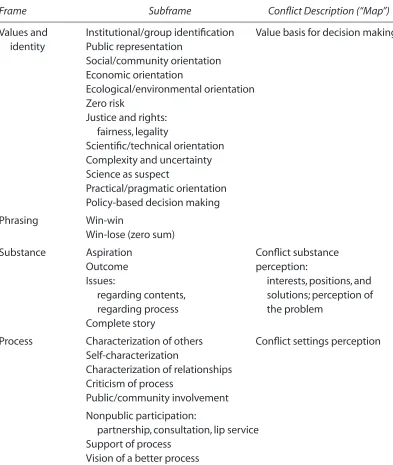
[image:12.612.100.493.90.555.2]The various frames and subframes were identified using text coding (Miles and Huberman, 1994) and grounded theory techniques (Glaser and Strauss, 1967; Strauss and Corbin, 1990). The thirty stakeholders were interviewed from two to four hours each. Statements from the transcription of these interviews were coded according to the frames that were reflected in them.
Table 2. Mapping Environmental Conflicts Using Frames Analysis
Frame Subframe Conflict Description (“Map”)
Values and Institutional/group identification Value basis for decision making identity Public representation
Social/community orientation Economic orientation
Ecological/environmental orientation Zero risk
Justice and rights: fairness, legality
Scientific/technical orientation Complexity and uncertainty Science as suspect
Practical/pragmatic orientation Policy-based decision making Phrasing Win-win
Win-lose (zero sum)
Substance Aspiration Conflict substance Outcome perception:
Issues: interests, positions, and regarding contents, solutions; perception of regarding process the problem
Complete story
Process Characterization of others Conflict settings perception Self-characterization
Characterization of relationships Criticism of process
Public/community involvement Nonpublic participation:
partnership, consultation, lip service Support of process
Values Frame Category
Here are a few examples of values frame category definitions, followed by stakeholder statements, which were coded as belonging to the frame example.
Complexity and Uncertainty. In this category, central factors in environ-mental conflict are seen as uncertain, possibly irreversible, and with unknown outcomes. The complexity of environmental linkages and syner-gies along with underlying ignorance regarding long-term effects suggest to stakeholders holding this frame that the prudent course is safety first. An example is the position of fishermen: “It is impossible to know what the impact of the treated sewage will be on the fish in the sea.”
Justice and Rights. We distinguish between two facets of this frame. One focuses on distributional concerns regarding rights and justice for a spe-cific community or group, local residents or the society at-large. Again, to use fishermen as an example: “There are two hundred families whose income depends on this river. Does anybody think of compensating them? We live in the pollution and they (the industries) make millions of dollars. Nobody considers our needs and those of our families!”
The other facet concentrates on interpretation and implementation of relevant laws, regulations, and standards as a major factor in decision mak-ing. An environmental NGO might say, “There is a need for a strong enforcing authority, with a professional enforcement mechanism. The authorities should take all legal steps against polluters.”
Ecological and Environmental Orientation. The preservation of the earth’s natural habitat is put as a primary goal, with preference for preservation and sustainability as the main factors in decision making. An environmental NGO said, “It’s important that industry exist but not at the cost of the environment.”
Economic Orientation. Monetary profit as the overriding interest, once achieved, leads to other benefits, according to another frame. For example, industry had this to say: “Our objective is to come to an agreement with the governmental authorities on a reasonable solution that is economically feasible—and then to be left to operate in peace.”
judgments are seen as paramount. Delving into technical details is often seen as critical to decision making. In the words of the Ministry of Envi-ronment: “International experts say that the sea can easily overcome the levels of acidity that would be released.”
Phrasing Frame Category
In the phrasing frame, the situation is considered win-win, by seeing the possible joint gains for all stakeholders in conflict resolution. To the fisher-men, for example, “Our objective is not to oppose the proposed solution but to reach an agreement which will satisfy us as well as them.”
Substance Frame Category
The substance frame includes a number of viewpoints.
Aspiration. Aspiration concerns viewing the conflict through interests. The fishermen would say, “We want to live a healthy life with a dignified livelihood.” The Kishon River Authority puts it this way: “Our goal is to revive the river and fully restore it.”
Issues. An issues orientation asks what is perceived to be the problem. The Haifa municipality declared: “The Kishon is polluted. It must be cleaned and restored,” while the Rowing Club had this to say: “Due to the pollu-tion, the club has difficulty functioning and is in a serious crisis, on the brink of closure.”
Outcome. Outcomes orientation explores what is perceived to be the solu-tion in terms of posisolu-tions. The Environmental Defense Fund desired this outcome: “It is necessary to enforce strict regulations by sanctioning and penalizing noncomplying polluters.” To the fishermen, there was another desired outcome: “Haifa Chemicals has to be relocated or closed.”
Process Frame Category
than ours” and “There is a lot of aggression and distrust among the stakeholders.”
Data Collection and Analysis
Two researchers did the interviewing and the coding. A validity test of the coding was conducted by asking five colleagues to code ninety of the Kishon statements. Although this check was context-free, the frame codes were validated.
The analysis of frequency was done by counting the number of state-ments coded in a certain frame for each stakeholder, relative to the overall number of statements from the same stakeholder (omitting repetitions). This number (rate of use for each frame) was checked against a scale in which the maximum was the highest rate for that stakeholder. The scale was divided into three levels of intensity: high (dominant frame), medium or low, and absent. To take a typical example, in one stakeholder group’s interviews a total of 230 statements were counted. In constructing the scale for that group, finding eight to twelve statements characterizing a frame was categorized as high, four to eight as medium, and fewer than four as low. Because twelve statements focused on ecological concerns, the ecolog-ical frame was coded as high intensity (or dominant).
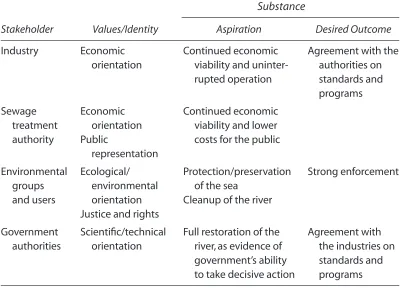
Identifying and analyzing substance frames helped in grouping the interviewees into relatively cohesive stakeholder categories. Comparing the content of the substance subframes enabled us to identify the interviewees who shared—aspirations (grouping by interests) and/or outcomes (group-ing by positions and solutions). This analysis gave us the stakeholder cate-gories, which were agreed to by the stakeholders themselves. Table 3 illustrates how the substance frames follow from the values frames as expressed by the stakeholder groups. In looking at the issue sequencing and flows, we found that potential coalitions surfaced, as can be seen in Figure 3 later in this article. As with the other substance frames (aspirations and outcomes), the sequencing and flows of the issues are also a reflection of stakeholder values frames.
Kishon Frames
The analysis presented here appraises how each stakeholder group frames the conflict: what is most valued, what are perceived to be interests, how the problem is framed, and what is perceived to be the solution.
Values/Identity and Substance Frames
The findings regarding the value frames of stakeholders in the Kishon con-flict are consistent with findings elsewhere. For example, Hunter (1989) distinguishes between deep ecology and fundamentalist frames. Others differentiate environmental- and development-oriented frames. Social the-orists such as Taylor (2000) adopt an environmental justice frame. We compare the two categories of frames values/identity and substance to help advance the analysis.
[image:16.612.98.504.92.380.2]The industries’ economic frame sets economic viability as the main pri-ority, which motivates them to seek a practical agreement with the authori-ties that would reconcile the standards with their needs. The prominence of the enforcement outcome frame of the environmental and user groups is an outgrowth of their justice and rights frame; they view clean water as a right and regard as unfair the polluting of the Kishon by the industries, a position also taken by the Haifa Regional Town Association for Environmental Protection. (One outcome of the examination of the stakeholders’ percep-tions of the values and substance frames was the grouping of the town asso-ciation, a governmental authority, with the environmental groups and users.) The ecological frame might be a factor leading the environmental Table 3. Values/Identity Versus Substance Frames
Substance
Stakeholder Values/Identity Aspiration Desired Outcome
Industry Economic Continued economic Agreement with the orientation viability and uninter- authorities on
rupted operation standards and programs Sewage Economic Continued economic
treatment orientation viability and lower authority Public costs for the public
representation
Environmental Ecological/ Protection/preservation Strong enforcement groups environmental of the sea
and users orientation Cleanup of the river Justice and rights
Government Scientific/technical Full restoration of the Agreement with authorities orientation river, as evidence of the industries on
groups to have wider aspirations than those of the authorities, so as to include both the marine environment and the river. On the face of it, the lack of a strong enforcement outcome frame on the part of the authorities (in this case, mainly the national-level Ministry of Environment) is sur-prising, but their scientific/technical orientation values frame helps one to understand it, since the industries have the funds to hire the best experts and the authorities have a tendency to accept their suggestions for stan-dards and programs.
This mapping shows that most of the conflicts are between the author-ities and the environmental and user groups. The sharpest disputes within the substance frames arise from these differences in aspiration and out-come. The environmental and user groups aspire to having a sea that is clean and protected, which conflicts with the authorities’ goals to have the river fully restored. With respect to the outcome frame, the mapping revealed a consensus between the authorities and industry in terms of the willingness of both bodies to achieve agreement through a give-and-take process. However, for the environmental and user groups, the outcome frame calls for strong enforcement. On the other hand, both the authori-ties and the environmental groups share the aspiration frame—the goal of cleaning up the river—but the environmentalists and users do not want that done at the expense of the sea.
Substance Frames: Issues
An understanding of how stakeholders frame the issues and priorities that they set forth for the Kishon River permits considerable insight into what prevents stakeholders from arriving at a common solution as well as what joint interests might surface.
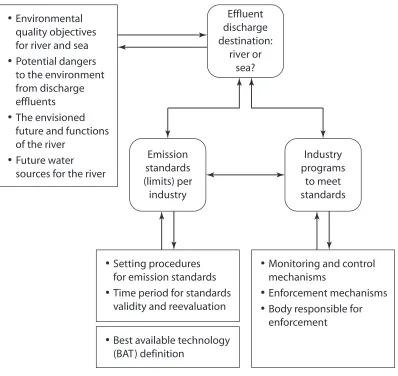
Altogether, thirty-three issues were identified; the thirteen presented in Figure 2 are critical for most stakeholders. Figure 2 identifies their interre-lated nature, illustrating how ten of them feed into the three focal issues:
1. Effluent discharge destination: whether to discharge the effluents to the Mediterranean via a pipeline, or continue to discharge them directly into the Kishon
2. Emission standards: what standards should be imposed on each discharging industry
3. Industry programs: which programs each industry should employ in order to meet those standards (including timetables)
The complexity of these interrelationships that is engendered by stake-holders’ positions is illustrated in the debate over the effluent discharge destination. It entailed (1) environmental quality objectives, (2) potential dangers to the environment, (3) anticipated future functions of the river, (4) future water sources for the river, and (5) sequencing priorities, which matters we discuss next.
[image:18.612.101.499.93.469.2]The environmental quality objectives are lower for the sea than for the river. However, objectives for the river could vary from simple nontoxicity to suitability for swimming. Governmental authorities lean toward the highest fresh-water standards for the river, and these standards lead them to the pipeline-to-sea solution. On the other hand, environmental and user groups think that the environmental quality of the sea should determine the destination for effluents, so they reject the pipeline proposal because of the uncertainty concerning the quality required to keep the marine envi-ronment clean and the toxicity of effluents.
Figure 2. Substance Frames: Key Issues for All Stakeholders
• Environmental quality objectives for river and sea
• Potential dangers to the environment from discharge effluents
• The envisioned future and functions of the river
• Future water sources for the river
• Setting procedures for emission standards
• Time period for standards validity and reevaluation
• Best available technology (BAT) definition
• Monitoring and control mechanisms
• Enforcement mechanisms
• Body responsible for enforcement
Emission standards (limits) per
industry
Effluent discharge destination:
river or sea?
Industry programs
Estimates of potential dangers to both sea and river environments from effluent discharge depend not only upon environmental quality objectives but also upon stakeholder assessment of risk, as well as on the level of trust. Currently some of the stakeholders view the Kishon as ecologically dead— a lost environmental resource. It is seen as a filter catching most of the pol-luted effluents before they reach the sea. The sea is held to be a viable and valuable environmental resource to be preserved.
The values frame of the environmental and user stakeholders gives pri-ority to ecological orientation. For them, the potential danger to the sea takes precedence over their desire for restoration of the river. Governmen-tal authorities, on the other hand, have set river restoration as their highest goal, and they are fearful that accidental industrial spills would endanger restoration prospects. They believe that the sea has the capacity to absorb the outflow of accidental breakdowns of the industrial treatment process for the effluents that would flow into it via the proposed pipeline (the scientific/technical frame) and therefore meet the objectives of their aspira-tion frame (full restoraaspira-tion of the river as confirmaaspira-tion of the ability to take decisive action).
Regarding anticipated future functions of the river, the governmental authorities’ vision of a large central park for Haifa in the Kishon basin would require the highest environmental quality (again, the aspiration frame). In contrast, environmental and recreational users view Haifa’s petrochemical industry, with its noxious odors and unaesthetic skyline, as a totally inappropriate setting for a central park. They would be satisfied with effluent standards that permit boating, rather than the standards needed to allow a variety of recreational and sports activities that would attract a large number of users.
The Sewage Treatment Authority agrees with this latter position. Moreover, unlike industry, it does not consider the sea pipeline as a viable option for an alternative discharge destination. Industry has not weighed in on the central park or on lower-level recreation use options.
plant waters that still flow into the Kishon come from effluents that do not meet irrigation standards, or from accidental spills of untreated sewage.
Unlike the industries, the sewage plant treats 100,000 square meters per day, which would require facilities that take an excessive amount of land. Even if such treatment facilities were available, they would have a profoundly negative environmental impact because of the noxious odors emitted. The sewage treatment plant stakeholder also opposes discharge into the sea via the pipeline on the basis of both cost and public health. Sea discharge would require the plant to construct, with public funding, a pipeline separate from the one to be built by the industries. In addition, because accidents are inevitable no matter how stringent the controls within the treatment plant, plant operators warn of tremendous risk to the relatively clean sea environment. On the other hand, since the Kishon is already a dead stream, they favor the status quo and have little interest in restoring these waters to a level beyond what would permit boating.
The environmentalists and users who oppose the pipeline raise the prospect of the drying up of the Kishon as an argument against the min-istry’s proposal. In the absence of alternative sources of water, they are highly suspicious of government promises of restoring the river to health by diverting the current flow of effluents into the sea.
Sequencing Priorities
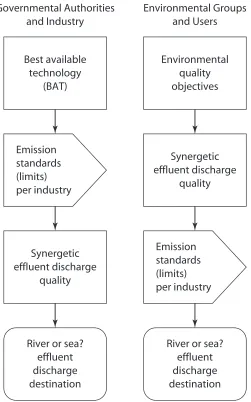
Figure 3 is illustrative of the differences in issues framing, or priority and sequencing, among the stakeholders. The figure highlights the importance of BAT (best available technology) to both governmental authorities and industry in formulating their approaches to the river or sea discharge deci-sion. Each of these bodies started with BAT, from which it then deter-mined the desired emission standards. This leads to a focus on the quality of the effluent discharge, which in turn shapes their position on the discharge destination issue. This sequence fits well with the authorities’ scientific/technical frame, as well as with industry’s economic frame—as industry now refers to best available technology that is economically feasible (BATE).
likely to differ from standards set by environmental groups and users (Figure 3, right sequence).
Process Frames
[image:21.612.193.444.96.498.2]All stakeholders frame the process in highly negative terms. Governmental authorities acknowledge their inability to speak with one voice, the diffu-sion of responsibility over the years, and lack of successful enforcement. Industry’s critique echoes this reality. The mixed messages from various authorities are confusing, even though industry has benefited by not yet having been forced to take action to ameliorate the discharge pollution. Indeed, it was an NGO, the Environmental Defense Fund, whose successful lawsuit against one of the industries—Haifa Chemicals and Fertilizers— brought the first judgment requiring quality standards. This was followed Stakeholder Frames in Mapping the Lower Kishon River Basin Conflict 231
Figure 3. Substance Frames: Sequencing Priorities of Issues, Example One
Best available technology
(BAT)
Synergetic effluent discharge
quality
River or sea? effluent discharge destination Emission standards (limits) per industry
Governmental Authorities and Industry
Environmental quality objectives
Synergetic effluent discharge
quality
River or sea? effluent discharge destination Emission standards (limits) per industry
rapidly by adoption of these standards by the Ministry of Environment as interim measures. All of the environmental and user groups as well as indus-try are highly critical of the lack of transparency of the process.
Relationships across and within the stakeholder groups are framed as “deep mistrust.” The environmental and user stakeholders and the author-ities do not trust the industries to emit effluents according to the set stan-dards, while the environmental and user stakeholders do not trust the authorities to enforce these standards, perceiving the Ministry of Environ-ment and the Kishon Authority as captives of industry. Both authorities and industry mistrust the environmental and user groups’ claims to be true representatives of the “public,” including all possible public groups that might emerge in the future with their own set of demands. Even within these groups there is a high level of mistrust. The fishermen deeply resent the environmentalists over distribution of the revenues generated by fines levied by the courts upon Haifa Chemicals and Fertilizer, which were awarded to the Environmental Defense Fund. The fund used most of the monies for environmental quality research or their own activities, leaving very little for the user victims, especially the fishermen. Within both the industry group and governmental bodies, competition and turf protection as well as considerable mistrust prevail.
Objectives for improving the process vary with the stakeholder group. The environmentalists and users seek participation and transparency. They want a dynamic process that changes with formative evaluation and reflec-tion. Industry presses for clarity and stability, not constant change in regu-lations; it has no desire for transparency in its dealings with the public. The governmental authorities prefer neither transparency nor participation. They grudgingly accept the need to engage the environmentalists and users; however, they view engagement not as a dialogue but as a vehicle for convincing the public of the validity of their position. The authorities focus on the question of how to involve the public in a way that helps lead to the (desired) decision, while public forces are often concerned less with the specific decision and more with a participatory process that has a continuing life to it.
Phrasing Frames
The Impact and Potential for Frame Analysis and Reframing
Frame analysis can be used to promote understanding, which then leads to both more productive process design and more effective interaction. Arriv-ing at an agreement does not necessarily depend on shared stakeholder frames or stakeholders having the same perspectives or interests. One chal-lenge is to clarify these differences in discourse and then seek to ameliorate their impact or modify them. The first phase of the Kishon conflict assess-ment illuminates the potential of framing analysis and reframing as a tool for a change, along a number of fronts:
1. A better understanding of the differences among stakeholders in the intensity (high or dominant, medium, low, absent) of values frames may offer insight into areas that have potential to expand the dialogue. The very absence of a frame may present an opportunity to introduce issues over which there is consensus, or differing priorities, that can be linked to issues that have sparked controversy.
2. Reexamining views in light of this understanding may lead to changes in stakeholder perception of the conflict. This examination was done in the first phase of the Kishon assessment. After each interview, the interviewees were presented with their interview summaries, in which their statements were organized according to interests, issues or problems, and positions or solutions. The interviewees were asked to comment as to whether the summary fit their way of seeing things, and to rate the issues by importance. When a shift was indicated, this resulted in change or adjustment to the assessment and analysis.
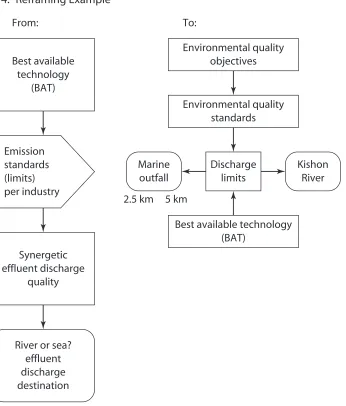
4. During the six months of the Kishon conflict assessment process, which in itself was an initial form of intervention, a modest amount of reframing took place within the values/identity and substance frames. One aspect of reframing took place within the Ministry of Environment toward the end of the assessment. In a presentation to European experts hired by the ministry to evaluate the BAT for each of the polluting industries, the ministry’s presentation of the issue changed in emphasis, with its starting point shifting from BAT to environmental quality.
[image:24.612.131.477.323.729.2]As Figure 4 illustrates, not only did the Ministry of Environment now begin with environmental quality objectives but it no longer used BAT as the only sequential starting point for the discharge location decision. Rather, it added environmental quality standards as the issue leading to the decision regarding the discharge destination issue. What this conveyed to
Figure 4. Reframing Example
Best available technology
(BAT)
Synergetic effluent discharge
quality
River or sea? effluent discharge destination
Kishon River Emission
standards (limits) per industry
From: To:
Environmental quality objectives
Best available technology (BAT)
Environmental quality standards
Discharge limits Marine
the European consulting team was the need for greater sensitivity to envi-ronmental issues.
This restatement of sequencing indicates a change in the ministry’s substance frame as well as a reframing of the values and identity frame. This is reflected in the addition of an ecological/environmental frame to the scientific/technical frame that had dominated the ministry’s earlier approach.
Reframing of the issues frames holds potential for reaching an agree-ment. Such reframing can be in the sequencing or the connections between the issues. For example, one issue that did not play a major role in the sequencing of any stakeholder group was timing: when standards are to be applied, how long they are valid, when the treated brackish water will flow to the Kishon, and when to the sea. This timing issue might hold the key for agreement, if placed in a flowchart with interconnected issues. An agreement on such a flowchart could set the stage for agreements on many connected issues.
Implications for Intervention and Practice
A change in the course of a conflict can be caused by a change in one or more elements of the conflict:
• The makeup of the participants (their conceptions, their points of views, and so on)
• The issues (the degree of importance attributed to each, their sequencing and flow, as well as ways to address them)
• The process itself (including the relationship among stakeholders)
Such changes may pave the way for resolving, or at least better managing, the dispute. Reframing, stemming from stakeholders’ understanding of their own expressed frames as well as others’, holds such potential.
In a future study, we intend to advance use of framing analysis as a tool for intervention in environmental conflicts, both for conflict assessment and in a conflict management and resolution process. These are the main ideas we intend to apply:
and the solutions that lead to fulfillment of those interests can widen the issues spectrum and thus the potential to “enlarge the pie.” In some cases, it can also bring about reframing of issues and solutions.
2. Grouping stakeholders according to how they frame the conflict, rather than by organizational affiliation. This idea was used in the Kishon conflict assessment, as the Haifa Regional Town Association for Environmental Protection (a public authority) presented views of interests and solutions that were quite similar to those of the environmental groups and users but different from those of the other authorities. Representing commonality of views, rather than organizational commonalities, strengthens stakeholder confidence in the validity of the assessment. (This can be done only if views are presented anonymously, so people feel free to speak their mind when they contradict the “organization view”.)
3. Another application of grouping lies in the design of a “frame-oriented process.” Identification of similar frames can be used to con-struct coalitions and arrange group meetings in which there is a reasonable prospect for reaching agreement. These groups can be value-based, interest-based (aspiration frames), or outcome-interest-based (substance frames), as fits the case and the stakeholders.
The discussions (in which stakeholders take part in more than one group) are coordinated by a nonpartisan third party that analyzes the results of each discussion, while looking for similarities and contradictions. Similar-ity can point to resolution, while contradiction is addressed further in group and intergroup discussion. If the contradictions are related to differ-ent frames or priorities, broadening the discussion to include such frames helps manage or resolve the conflict.
References
Arnstein, S. “A Ladder of Citizen Participation.” Journal of the American Institute of Planners, 1969, 35 (4), 216–224.
Bauer, M. W. “Classical Content Analysis: A Review.” In M. W. Bauer and G. Gaskell (eds.), Qualitative Researching with Text, Image and Sound: A Prac-tical Handbook.Thousand Oaks, Calif.: Sage, 2000.
Brunner, R. D. “Global Climate Change: Defining the Policy Problem.” Policy Sciences,1991, 24,291–311.
Glaser, B. G., and Strauss, A. The Discovery of Grounded Theory: Strategies of Qual-itative Research. Hawthorne, N.Y.: Aldine de Gruyter, 1967.
Gonos, G. “‘Situation’ Versus ‘Frame’ The ‘Interactionist’ and the ‘Structuralist’ Analyses of Everyday Life.” American Sociological Review,1997, 42,854–867. Gray, B. Collaborating: Finding Common Ground for Multiparty Problems. San
Francisco: Jossey-Bass, 1989.
Gray, B. “Framing and Reframing of Intractable Environmental Disputes.” In R. Lewicki, R. Bies, and B. Sheppard (eds.), Research on Negotiation in Orga-nizations,vol. 6. Greenwich, Conn.: JAI Press, 1997.
Gray, B., and Donnellon, A. “An Interactive Theory of Reframing in Negotia-tion.” Unpublished report, College of Business Administration, Pennsylvania State University, 1989.
Gray, B., and Kaufman, S. “Using Retrospective and Prospective Frame Elicita-tion to Evaluate Environmental Disputes.” Unpublished draft, 2001.
Hunter, S. “The Roots of Environmental Conflict in the Tahoe Basin.” In L. Kriesberg, T. A. Northrup, and S. J. Thorson (eds.),Intractable Conflicts and Their Transformation.Syracuse, N.Y.: Syracuse University Press, 1989, 25–40. Interministerial Committee for the Preparation for the Environmental Standards for Kishon River Water. “Water Quality Standards for the Kishon.” Haifa, Israel: Kirshon River Authority, 2000. (in Hebrew)
Kahneman, D., and Tversky, A. “Prospect Theory: An Analysis of Decision Under Risk.”Econometrica,1979, 47, 263–289.
Kaufman, S., and Smith, J. “Framing and Reframing in Land Use Change Con-flicts.” Journal of Architecture, Planning and Research,1999, 16 (2), 164–180. Miles, M. B., and Huberman, A. M. Qualitative Data Analysis.Thousand Oaks,
Calif.: Sage, 1994.
Minsky, M. “A Framework for Representing Knowledge.” In P. H. Winston (ed.),
The Psychology of Computer Vision.New York: McGraw Hill, 1975.
Neale, M. A., and Bazerman, M. H. “The Effects of Framing and Negotiator Overconfidence on Bargaining Behaviors and Outcomes.” Academy of Management Journal, 1985, 28,34–49.
Pinkley, R. L. “Dimensions of Conflict Frame: Disputant Interpretations of Conflict.” Journal of Applied Psychology,1990, 75,117–126.
Provis, C. “Interests vs. Positions: A Critique of the Distinction.” Negotiation Journal,1996, 12 (4), 305–323.
Putnam, L., and Holmer, M. “Framing, Reframing, and Issue Development.” In L. Putnam and M. E. Roloff (eds.), Communication and Negotiation.
Thousand Oaks, Calif.: Sage, 1992.
Rothman, J. Resolving Identity-Based Conflict in Nations, Organizations, and Communities.San Francisco: Jossey-Bass, 1997.
Schweitzer, M. E., and DeChurch, L. A. “Linking Frames in Negotiations: Gains, Losses and Conflict Frame Adoption.” International Journal of Conflict Management,2001, 12 (2), 100–113.
Shmueli, D., and Ben-Gal, M. “Reframing of Protracted Environmental Disputes.” Jerusalem, Mar. 2000. (in Hebrew)
and Discharge of Industrial Wastes in the Lower Kishon Basin.” Jerusalem, Israel: Ministry of Environment, June 2001 (draft), Nov. 2001 (final). (in Hebrew)
Shmueli, D., and Ben-Gal, M. “The Potential of Framing in Managing and Resolving Environmental Conflict.” In E. Feitelson, G. de Roo, and D. Miller (eds.), Advancing Sustainability at the Sub-National Level. Jerusalem, Israel: Ministry of Environment, 2002.
Strauss, A., and Corbin, J. Basics of Qualitative Research: Grounded Theory Proce-dures and Techniques.Thousand Oaks, Calif.: Sage, 1990.
Susskind, L., and Thomas-Larmer, J. “Conducting a Conflict Assessment.” In L. Susskind, S. McKearnan, and J. Thomas-Larmer (eds.), The Consensus Building Handbook: A Comprehensive Guide to Reaching Agreement.Thousand Oaks, Calif.: Sage, 1999.
Tannen, D. “What’s in a Frame? Surface Evidence of Underlying Expectations.” In R. Freedle (ed.), New Dimensions in Discourse Processes. Norwood, N.J.: Ablex, 1979.
Taylor, D. E. “The Rise of the Environmental Justice Paradigm: Injustice Fram-ing and the Social Construction of Environmental Discourses.” American Behavioral Scientist,2000, 43 (4), 508–580.
Tversky, A., and Kahneman, D. “The Framing of Decisions and the Psychology of Choice.” Science,1981, 211,453–458.
Vaughan, E., and Seifert, M. “Variability in the Framing of Risk Issues.” Journal of Social Issues,1992, 48 (4), 119–135.
Watzlawick, P., Weakland, J., and Fisch, R. Change, Principles of Problem Forma-tion and Problem ResoluForma-tion.New York: Norton, 1974.
Wish, M., Deutsch, M., and Kaplan, S. J. “Perceived Dimensions of Interpersonal Relations.” Journal of Personality and Social Psychology,1976, 33,409–420.
Deborah F. Shmueliis a senior lecturer in the Department of Geography at the University of Haifa. She is a planner specializing in environmental policy issues related to land use, water, transportation, and solid waste. Her current research efforts focus on environmental and public sector conflict manage-ment as well as community and institutional capacity building.