The potential evolutionary impact of invasive balloon
vines on native soapberry bugs in South Africa
Jarryd D. Foster1,2, Allan G. Ellis2, Llewellyn C. Foxcroft1,2,3,
Scott P. Carroll4, Johannes J. Le Roux1,2,5
1 Centre for Invasion Biology, Department of Botany and Zoology, Stellenbosch University, Matieland 7602, South Africa 2 Department of Botany and Zoology, Stellenbosch University, Matieland 7602, South Africa 3 Scientific Services, Kruger National Park, South African National Parks, Skukuza 1350, South Africa 4 Department of Entomology and Nematology, University of California, Davis, CA 95616, USA 5 Department of Biological Sciences, Macquarie University, Sydney, New South Wales 2109, Australia
Corresponding author:Johannes J. Le Roux ([email protected])
Academic editor:Alain Roques | Received 2 March 2019 | Accepted 5 June 2019 | Published 25 July 2019
Citation: Foster JD, Ellis AG, Foxcroft LC, Carroll SP, Le Roux JJ (2019) The potential evolutionary impact of invasive balloon vines on native soapberry bugs in South Africa. NeoBiota 49: 19–35. https://doi.org/10.3897/neobiota.49.34245
Abstract
Following their establishment in new communities, invasive species may cause evolutionary changes in resident native species. This is clearly true for phytophagous insects, which may adapt rapidly when uti-lising abundant and widespread introduced hosts. The balloon vines Cardiospermum halicacabum and C. grandiflorum were introduced to South Africa approximately 100 years ago and are classified as minor and major weeds, respectively. Here we assess the potential evolutionary impact of these vines on native Leptocoris soapberry bug populations in Kruger National Park (KNP), using phylogenetic and morpho-metric analyses. We found that soapberry bugs associated with C. halicacabum are genetically and mor-phologically distinct from those associated with C. grandiflorum. This suggests that native soapberry bugs in KNP exhibit some degree of host preference, indicating that these vines may have had significant evolu-tionary consequences for these insects. The proboscis length of soapberry bugs feeding on C. halicacabum closely matched fruit size, often being longer than fruit size at the population level. These soapberry bugs are therefore well-suited to feeding on this introduced plant species.
Keywords
Balloon vine, Cardiospermum, invasive species, Kruger National Park, Leptocoris, rapid evolution, soap-berry bug
Copyright Jarryd D. Foster et al. This is an open access article distributed under the terms of the Creative Commons Attribution License (CC BY 4.0), which permits unrestricted use, distribution, and reproduction in any medium, provided the original author and source are credited.
Introduction
Evolved and plastic changes are important not only for the colonization and spread of non-native species but are also prevalent in native species as they respond to the pres-ence of introduced taxa (Mooney and Cleland 2001; Strauss et al. 2006; Ghalambor et al. 2007). Common examples of rapid evolutionary change in native species in re-sponse to non-native species come from herbivores, particularly phytophagous insects, adapting to introduced plants as preferred hosts (Carroll 2007). For example, evidence for this comes from the study of soapberry bugs (Hemiptera: Rhopalidae), which are specialised predators of seed from the Sapindaceae family (Carroll and Loye 1987). Soapberry bugs feed on the seeds of Sapindaceae species using their elongated, needle-like proboscides to pierce fruits and reach the seeds they contain (Carroll and Loye 1987; Carroll and Boyd 1992). Native soapberry bugs in North America and Australia have colonised several introduced Sapindaceae species (Carroll and Loye 2012). These bugs have subsequently undergone significant adaptive changes in the length of their proboscides and other allometries, directly related to the fruit size of the introduced hosts they utilise (Carroll and Boyd 1992; Carroll et al. 2005a). These changes are her-itable and adaptive, facilitating greater feeding efficiency and reproductive success on their new hosts (Carroll et al. 2005a) and have occurred over just 20–50 years (about 40–150 bug generations), indicating the significant selection pressure exerted by these introduced hosts on their newly acquired soapberry predators (Carroll and Boyd 1992; Carroll et al. 2005a). Ultimately, such evolutionary responses in native species could al-ter contemporary community dynamics and the assembly of future communities, even leading to incipient speciation between native subpopulations (Strauss et al. 2006; Car-roll 2007; Andres et al. 2013). Importantly for biological invasions, the rapid evolution of native taxa in response to invaders may impede an invader’s spread (Carroll 2011).
The genus Cardiospermum L. (Sapindaceae), commonly known as balloon vines, consists of 17 mainly Neotropical species (Gildenhuys et al. 2013). Three species, C.
grandiflorum Sw., C. halicacabum L., and C. corindum L., have near-cosmopolitan
dis-tributions, although their provenance as native or introduced species remains unresolved in some regions (Gildenhuys et al. 2013). Gildenhuys et al. (2014) showed that C.
corindum is native to both southern Africa and South America, and confirmed that C.
grandiflorum and C. halicacabum are modern arrivals in southern Africa. Cardiospermum
species are considered invasive in many parts of the world, often as an unplanned re-sult of intentional introductions for ornamental and medicinal purposes (Carroll et al. 2005b; Simelane et al. 2011; Gildenhuys et al. 2013). Invasive Cardiospermum species are commonly classified as ‘transformer’ weeds, as they often cover native vegetation, potentially driving local biodiversity loss (Henderson 2001; Mc Kay et al. 2010).
Car-diospermum grandiflorum and C. halicacabum were introduced to South Africa
dumped in a waterway’. These species are major invaders requiring containment and removal, often with the assistance of government sponsored programs (Alien and In-vasive Species Regulations 2014; https://www.environment.gov.za). Category 3 species may remain in certain areas/provinces, but further propagation or trade is prohibited. In South Africa, C. grandiflorum is found along most of the Kwa-Zulu Natal coast and in the Gauteng, Limpopo and Mpumalanga provinces (Henderson 2001). Cardiospermum
halicacabum is less widely distributed in South Africa, largely restricted to the Limpopo
and Mpumalanga provinces (Henderson 2001). The high level of specialisation and co-occurrence of soapberry bugs with Cardiospermum suggests that soapberry bugs may play an important role in regulating the reproduction of Cardiospermum globally (Gild-enhuys et al. 2013). For example, seed predation levels by soapberry bugs on native C.
corindum in Florida can be as high as 90 % (Carroll 1988; Carroll et al. 2003).
Two soapberry bug genera are native to southern Africa, namely Leptocoris and Boi-sea, the former being more widely distributed (Göllner-Scheiding 1980, 1997; Carroll and Loye 2012). Twenty-one Leptocoris species are endemic to Africa, in association with native Paullinieae and Thouinieae hosts (Carroll and Loye 2012). In South Africa, native Allophylus species are common hosts, but native soapberry bugs have also colo-nised C. grandiflorum and C. halicacabum in many parts of the country (Carroll and Loye 2012; JF pers. obs.). The Cardiospermum-soapberry bug system is well-studied in North America and Australia but remains little-explored in the South African context.
In this study, we used phylogenetic analyses, in combination with morphometric measurements, to investigate the potential evolutionary impact of invasive C.
hali-cacabum and C. grandiflorum on native soapberry bugs (genus Leptocoris) in South
Africa. To examine whether any evolved differentiation might have resulted from con-temporary natural selection, the proboscis lengths of Leptocoris mutilatus Gers. were measured with respect to fruit size variation in invasive C. halicacabum populations. The expectation was that soapberry bug proboscis lengths will closely match fruit size
in C. halicacabum and that any shifts in proboscis lengths will correspond to variation
in seed capsule (balloon) size in C. halicacabum populations.
Methods Sampling
Leptocoris mutilatus is a typical soapberry bug, about 11–16 mm in length, characterised by an overall scarlet red or brownish red colour and a black, bulged head (Göllner-Scheiding 1980). The species has a wide native range distribution, including Madagascar and central, eastern and southern Africa (Göllner-Scheiding 1980).
Leptocoris phylogeny
To confirm the putative Leptocoris mutilatus species assignment of soapberry bugs feed-ing on invasive Cardiospermum in KNP, individuals collected from C. halicacabum and
C. grandiflorum populations were selected for phylogenetic analyses (Suppl. material
1: Table S2). An individual bug from five C. halicacabum populations and five indi-viduals from the C. grandiflorum population were included in these analyses (Suppl. material 1: Table S2). For those bugs associated with C. halicacabum, individuals were selected from populations at different distances from one another to minimise po-tential isolation by distance effects. Reference specimens of six African species and a single Asian Leptocoris species were included in the phylogenetic analyses (Suppl. ma-terial 1: Table S2). Bug specimens were preserved in 70% ethanol at -80 °C. Genomic DNA was extracted from legs or whole bodies using the DNeasy Blood and Tissue Kit (Qiagen, supplied by WhiteHead Scientific, Cape Town, South Africa) following the manufacturer’s instructions. DNA quality and quantity were assessed using Nan-oDrop ND-1000.
The mitochondrial cytochrome c oxidase subunit I (COI) gene was amplified us-ing the universal primers LCOI-1490 (5’-GGT CAA CAA ATC ATA AAG ATA TTG G-3’) and HCOI-2198 (5’-TAA ACT TCA GGG TGA CCA AAA AAT CA-3’) (Fol-mer et al. 1994). Each 30µl reaction contained approximately 100 ng of genomic DNA, 0.2 mM of each dNTP (Fermentas, Thermo Fisher Scientific, Waltham, Massachusetts, United States), 0.5 µM of each primer, 1 U Taq DNA polymerase [Supertherm, Sepa-ration Scientific SA (Pty) Ltd, Roodepoort, South Africa], 1 × PCR reaction buffer, 2 mM MgCl2 and 0.2 mg/ml BSA (Promega). PCR cycles consisted of initial denatura-tion at 95 °C for 5 min, 45 cycles of denaturadenatura-tion at 94 °C for 1 min, annealing at 45 °C for 1 min and elongation at 72 °C for 1 min, and final extension at 72 °C for 30 min.
All PCR products were purified using the QIAquick PCR Purification Kit (Qia-gen, supplied by Whitehead Scientific, Cape Town, South Africa). Purified products were sequenced using an ABI 3730 XL automated machine (Central Analytical Facili-ties, Stellenbosch University, South Africa).
DNA sequence data were aligned using CLUSTALW version 2.1 (Thompson et al. 2003), followed by manual editing in BIOEDIT version 7.0.5.3 (Hall 1999). The final
COI dataset consisted of 26 accessions: 10 putative L. mutilatus from KNP (five from
C. halicacabum and five from C. grandiflorum), two reference specimens of L. mutilatus,
two putative L. amictus, seven putative L. hexophtalmus, one L. productus, two L. aethi-ops and two L. vicinus (Suppl. material 1: Table S2). Two outgroup sequences of Boisea
(Serinethinae), were obtained from GenBank (https://www.ncbi.nlm.nih.gov/genbank/) and used as outgroup taxa. Species identifications were performed with reference to Göllner-Scheiding (1980, 1997).
A phylogeny was reconstructed using Bayesian inference (BI) and maximum likeli-hood (ML) approaches. Bayesian inference was conducted using MRBAYES version 3.2.6 (Ronquist et al. 2012) through the CIPRES Science Gateway version 3.3 (Miller et al. 2010). The best-fit DNA substitution model was identified in JMODELTEST version 2.1.6 (Darriba et al. 2012) using Akaike’s information criterion (AIC) (Akaike 1974). The chosen DNA substitution model for the COI locus was TPM2uf + I + Γ
(-1nL = 1816.41, AIC = 6021.58) (Akaike 1974). The base frequencies were as fol-lows, A = 30.10 %, C = 16.22 %, G = 14.56 % and T = 39.12 %. The rate matrix was R(a) [A-C] = R(c) [A-T] = 1.63, R(b) [A-G] = R(e) [C-T] = 10.96, R(d) [C-G] = R(f) [G-T] = 1.00, and the proportion of invariable sites (I) was 0.6540, and the gamma shaped distribution (Γ) was 1.6170. Each model was run for 10 million generations, sampling every 1000 generations using the default parameters. Consensus trees were built after discarding 20% of trees as burn-in and posterior probabilities (PP) were es-timated based on the percentage of time spent on node recovery. Posterior probability values of < 0.90 were regarded as poor support.
Maximum likelihood analysis was conducted using GARLI version 2.01 (Zwickl 2006) through the CIPRES Science Gateway version 3.3 (Miller et al. 2010). Boot-strap analysis was used to generate branch support values (1000 pseudo-replicates) (Felsenstein 1985). Bootstrap values of < 75% were regarded as indicating poor sup-port. Tree search analysis was performed using a heuristic search algorithm starting at a random tree. Base frequencies were estimated, and four rate categories were included for gamma. Final bootstrap values were discerned via a 50% majority rule tree, gener-ated using PAUP version 4.0 (Swofford 2002).
Allometry of native Leptocoris and trait-matching with invasive Cardiospermum populations
To investigate whether soapberry bug proboscis lengths track fruit size variation in C.
halicacabum populations, a total of 311 full-sized fruit and 154 associated soapberry
bug individuals were measured from 13 C. halicacabum populations in KNP. 20–25 fruit and 5–16 soapberry bugs were measured for each population (Suppl. material 1: Table S3). To compare allometries between bugs found on C. halicacabum and those found on C. grandiflorum, a further 30 soapberry bug individuals from the single C.
grandiflorum population were measured. Following Carroll and Loye (1987), the
Figure 1. Interior of fruiting capsule of balloon vine C. halicacabum. The upper portion of the capsule wall has been trimmed away and shows the central position of the seeds. The ‘fruit size’ variable we meas-ured was the shortest distance from the fruit capsule perimeter to the seed coat for each seed. The second species in this study, Cardiospermum grandiflorum, has larger fruits of similar architecture (Image source: Wikimedia commons: Cardiospermum halicacabum).
the integrity of the membranes holding the seeds in place. Fruit size was measured as the shortest distance from the fruit capsule perimeter to the seed coat and repeated for every seed inside each fruit. A further 14 fruits were measured from the single C.
gran-diflorum population in KNP. Bug and fruit measurements were taken using handheld
digital callipers with a 0.01 mm resolution.
ANCOVA models were used to quantify and compare proboscis-body size al-lometries between bugs found on different Cardiospermum hosts. For those bugs found on C. halicacabum, regression analysis was used to determine whether there was a significant trait-matching relationship between mean population proboscis lengths and mean population fruit sizes. A two-sample t-test was used to determine whether mean proboscis length was significantly different between bugs found on
C. grandiflorum and C. halicacabum. A Kruskal-Wallis rank sum test and post-hoc
Dunn’s test were used to compared proboscis lengths at the population level. Two-sample t-tests were also used to determine whether fruit size was significantly dif-ferent between balloon vine species. Furthermore, two-sample t-tests were used to determine the nature and direction of the morphological fit between the fruit sizes of each Cardiospermum host and the proboscis lengths of their associated soapberry bug predators.
Results
Sequence variation
The aligned COI dataset contained 545 base pairs. All sequences were deposited into the GenBank online repository.
Leptocoris phylogeny
The phylogeny recovered well-supported basal clades for Leptocoris vicinus and L. aethi-ops, and a larger clade containing L. amictus and L. hexophtalmus (Figure 2). All KNP soapberry bugs fell into a monophyletic clade with the representative L. mutilatus spec-imens, sister to L. productus (PP = 0.99; Figure 2). However, while Leptocoris specimens collected from C. grandiflorum in KNP grouped unequivocally with L. mutilatus refer-ence specimens, all the soapberry bugs collected from C. halicacabum fell into a single clade (PP = 0.99) sister to the clade containing specimens from C. grandiflorum and L.
mutilatus reference specimens (Figure 2). This suggests that while those bugs feeding
on C. halicacabum are likely L. mutilatus, they are genetically differentiated from those
feeding on C. grandiflorum. Based on this differentiation, soapberry bugs found on C.
halicacabum in KNP will hereafter be referred to as ‘halicacabum bugs’ and those on
C. grandiflorum as ‘grandiflorum bugs’. The ML analysis produced a near-identical tree
topology to the BI analysis, but nodal support was generally weaker (Figure 2).
Allometry of native Leptocoris mutilatus and trait-matching with invasive Cardio-spermum populations
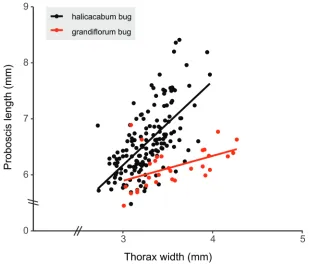
There was a significant positive relationship between proboscis length and thorax width for both halicacabum (p < 0.001; Table 1) and grandiflorum bugs (p < 0.01; Table 1; Fig-ure 3). Likewise, there was a significant positive relationship between proboscis length and body length in halicacabum bugs (p < 0.001; Table 1; Figure 4). No significant rela-tionship was found between proboscis length and body length in grandiflorum bugs(p
> 0.05; Figure 4). Halicacabum bugs had a significantly stronger relationship between proboscis length and thorax width than grandiflorum bugs(F 1,180 = 17.03, p < 0.001; Table 1; Figure 3). Similarly, halicacabum bugs had a significantly stronger relationship between proboscis length and body length than grandiflorum bugs(F1,180 = 15.07, p <
Figure 3. Linear regressions showing the relationship between proboscis length and thorax width for adult Leptocoris mutilatus found in association with Cardiospermum halicacabum and C. grandiflorum. Each point represents an individual.
0.05; Suppl. material 1: Table S4). Four halicacabum bug populations had significantly different relationships for one allometry but not the other compared to the grandi-florum bug population (Suppl. material 1: Table S4). The coefficient of variation for proboscis length was 8.95% in halicacabum bugs and 5.59 % in grandiflorum bugs.
There was no significant relationship between population means of C. halicacabum
fruit size and proboscis lengths of their associated soapberry bug predators (p > 0.05; Table 2; Figure 5). Furthermore, there was no significant relationship between popu-lation means of the halicacabum bug allometry residuals and C. halicacabum fruit size (p > 0.05; Suppl. material 1: Table S5). Mean halicacabum bug proboscis length was significantly longer than grandiflorum bugs (Student’s t-test, t = 4.00, df = 182,
p < 0.001; Table 2). Similarly, proboscis length was significantly different between hali-cacabum bugs and grandiflorum bugs at the population level (Kruskal-Wallis rank sum test, χ2 = 29.09, df = 13, p < 0.01). However, post-hoc analysis showed only one
hali-cacabum bug population had significantly longer proboscides than grandiflorum bugs, namely population Hali7 (Dunn’s test, z = 3.63; p < 0.05). Fruit size of C. halicacabum
was significantly smaller than that of C. grandiflorum (Student’s t-test, t = 6.40, df = 323, p < 0.001; Table 2). However, halicacabum bug proboscis length was significantly
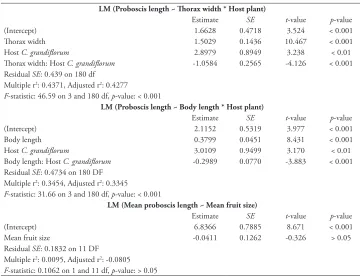
Table 1. Details of the models used to quantify and compare allometries of soapberry bugs in KNP, and to assess the relationship between population means of halicacabum bug proboscis length (in mm) and C. halicacabum fruit size (in mm).
LM (Proboscis length ~ Thorax width * Host plant)
Estimate SE t-value p-value
(Intercept) 1.6628 0.4718 3.524 < 0.001
Thorax width 1.5029 0.1436 10.467 < 0.001
Host C. grandiflorum 2.8979 0.8949 3.238 < 0.01
Thorax width: Host C. grandiflorum -1.0584 0.2565 -4.126 < 0.001 Residual SE: 0.439 on 180 df
Multiple r2: 0.4371, Adjusted r2: 0.4277
F-statistic: 46.59 on 3 and 180 df, p-value: < 0.001
LM (Proboscis length ~ Body length * Host plant)
Estimate SE t-value p-value
(Intercept) 2.1152 0.5319 3.977 < 0.001
Body length 0.3799 0.0451 8.431 < 0.001
Host C. grandiflorum 3.0109 0.9499 3.170 < 0.01
Body length: Host C. grandiflorum -0.2989 0.0770 -3.883 < 0.001 Residual SE: 0.4734 on 180 DF
Multiple r2: 0.3454, Adjusted r2: 0.3345
F-statistic: 31.66 on 3 and 180 df, p-value: < 0.001
LM (Mean proboscis length ~ Mean fruit size)
Estimate SE t-value p-value
(Intercept) 6.8366 0.7885 8.671 < 0.001
Mean fruit size -0.0411 0.1262 -0.326 > 0.05
Residual SE: 0.1832 on 11 DF Multiple r2: 0.0095, Adjusted r2: -0.0805
Figure 4. Linear regressions showing the relationship between proboscis length and body length for adult Leptocoris mutilatus found in association with Cardiospermum halicacabum and C. grandiflorum. Each point represents an individual.
longer than the fruit size of their C. halicacabum hosts (Student’s t-test, t = 4.83, df = 463, p < 0.001; Figure 6, Table 2). In contrast, grandiflorum bug proboscis length was significantly shorter than the fruit size of their C. grandiflorum hosts (Welch’s t-test, t = 7.29, df = 15.81, p < 0.001; Figure 6, Table 2).
Discussion
This study aimed to assess the potential for impacts by invasive balloon vines on mor-phological traits of native soapberry bug (genus Leptocoris) populations in South Af-rica’s flagship protected area, Kruger National Park (KNP). We found L. mutilatus bugs on both invasive host plants and provide some evidence for genetic and morphological differentiation between bugs feeding on different balloon vine species in KNP. Ad-ditionally, the proboscis-fruit size trait-matching patterns differed between the two balloon vines. Halicacabum bugs had proboscis lengths well-suited for feeding on the seeds of intact fruits, but this was not the case for grandiflorum bugs.
Table 2. Grand means (±SD) of proboscis length and body size measures (in mm) of soapberry bugs in KNP, and fruit sizes (in mm) of their Cardiospermum hosts.
Host plant Proboscis length (mm) Thorax width (mm) Body length (mm) Fruit size (mm)
Cardiospermum halicacabum 6.59 ± 0.59 3.28 ± 0.25 11.77 ± 0.85 6.24 ± 0.80 Cardiospermum grandiflorum 6.14 ± 0.34 3.56 ± 0.38 12.54 ± 1.41 7.62 ± 0.72
Genetic differentiation between soapberry bug populations associated with C.
hal-icacabum and C. grandiflorum in KNP (Figure 2) was mirrored by morphological
dif-ferentiation between these populations (Figures 3, 4). More specifically, halicacabum bugs had significantly longer proboscides and stronger proboscis length-body size allometries than grandiflorum bugs. This host-associated morphological differentia-tion agrees with Carroll and Boyd (1992), who found significantly different reladifferentia-tion- relation-ships between proboscis length and body length for another soapberry bug, Jadera
haematoloma, utilising different native and introduced Sapindaceae species in North
America. Similarly, Carroll et al. (2005a) found evidence for a breakdown of proboscis length-body size allometry in an Australian soapberry bug, Leptocoris tagalicus. The proboscis length of L. tagalicus feeding on introduced C. grandiflorum increased rela-tively more than body size in females and without concomitant body size changes in males compared to native host plant-feeding bugs (Carroll et al. 2005a). Importantly, cross-rearing experiments showed that these changes are heritable, with a strong sig-nal of specific genetic differentiation (Carroll et al. 2005a). The moderate host-specific phylogenetic signal we retrieved may point to similar differentiation between halicacabum and grandiflorum bugs in South Africa, i.e. the incipient stages of partial reproductive isolation and therefore ‘host race’ formation. However, the sampling of a single grandiflorum bug population strongly restricts any inferences made here. In addition to the lack of significant morphological differentiation between halicacabum and grandiflorum bugs for all populations, the amount of variation observed between halicacabum populations suggests that further sampling of bugs from C. grandiflorum
populations in KNP may reveal overlapping morphological variation between bugs on each host. Therefore, while the genetic and morphological evidence provides some support for incipient host race formation, our sampling bias does not allow us to con-clusively reject the possibility that a single variable L. mutilatus lineage exploits both invasive balloon vine hosts in KNP. Furthermore, the halicacabum bug populations were geographically distant from the grandiflorum bug population (separated by 21.5 km), suggesting that the genetic differentiation between halicacabum and grandiflo-rum bugs may be partly explained by isolation by distance and not only host-specific genetic differentiation. Alternatively, the allometries of these soapberry bugs may not be driven by their respective novel hosts at all, but derive rather from distinct ancestral populations with inherently different allometries. Future work should include a wider geographic collection of numerous populations from both native and balloon vine host plants in order to gain an improved understanding of these possibilities.
feed on C. halicacabum in KNP. Soapberry bugs may therefore have played a role in impeding the spread of C. halicacabum in KNP. Future studies should aim to quantify seed predation of introduced Sapindaceae species by soapberry bugs to assess their potential as ‘neoclassical’ biocontrol (Carroll 2011).
While the fit between proboscis length and fruit size is likely adaptive (Carroll and Boyd 1992, Carroll et al. 2005a), the mechanism behind it should be considered within the plant community context. There is at least one common native sapinda-ceous species in the immediate study area with fruit sizes that potentially overlap with
C. halicacabum, namely Pappea capensis. This species has large seeds held singly within
fruits of 10–15 mm diameter (Palgrave 1992; LF pers. obs.) with the distance from the fruit exterior to the seed being ~5mm (SPC pers. obs.). In addition, native
Cardiosper-mum corindum (Siebert et al. 2010; Gildenhuys et al. 2014) and Allophylus species have
also been collected from the region (Victor and van Wyk 2005) and could potentially also be sources of colonists. Accordingly, while the fit of halicacabum bug proboscis lengths may result from local adaptation to that host, it could also represent evolution by spatial sorting of migrant genotypes (sensu Shine et al. 2011) from surrounding na-tive sapindaceous species with proboscis lengths suitable for feeding on balloon vines. However, considering the small range of proboscis lengths (coefficient of variation = 8.95%) and evidence for introduced balloon vine host specificity by soapberry bugs in other parts of the world (Carroll et al. 2005a; Andres et al. 2013), it is plausible that the proboscis length of halicacabum bugs is under selection by C. halicacabum fruit size with allometries different from those feeding on native hosts. Further sampling of soapberry bugs from native sapindaceous hosts in the vicinity of our study area is needed to determine the extent of adaptation by halicacabum bugs.
grandiflorum bugs have the more ‘ancestral’ allometry or whether the relative change is greater in either host race.
Not knowing about the potentially illuminating influences of native Sapindaceae fruit size on the allometries of halicacabum and grandiflorum bugs is a key shortcom-ing in this study, and any ongoshortcom-ing local patterns of host-associated differentiation in-ferred here may be changed by plant eradication efforts. Despite these challenges, our findings add support to considerations of the potentially significant evolutionary im-pact of introduced balloon vines on native soapberry bug populations, and that these impacts may be dissimilar for different balloon vine species. More extensive sampling in South Africa of soapberry bugs from both introduced balloon vine species and na-tive sapindaceous species is needed to determine the degree of morphological and ge-netic differentiation between invasive- and native-feeding soapberry bug populations. This will provide a more complete assessment of the potential evolutionary impact of introduced balloon vines on soapberry bug populations, and the potential for these bugs as neoclassical biocontrol of Cardiospermum invasions.
Acknowledgments
Financial support was provided by the DST-NRF Centre of Excellence for Invasion Biology. The authors are grateful for sampling permits from South African National Parks. JF thanks Thembeka Thwala, Annoit Mashele, Martin Sarela and Isaac Sedibe for their protection, assistance and laughs in the field; Megan Mathese for lab assis-tance. LF acknowledges South Africa’s National Research Foundation (Project Num-bers IFR2010041400019 and IFR160215158271).
References
Akaike H (1974) A new look at the statistical model identification. IEEE Transactions on Au-tomatic Control 19: 716–723. https://doi.org/10.1109/TAC.1974.1100705
Andres JA, Thampy PR, Mathieson MT, Loye J, Zalucki MP, Dingle H, Carroll SP (2013) Hybridization and adaptation to introduced balloon vines in an Australian soapberry bug. Molecular Ecology 22: 6116–6130. https://doi.org/10.1111/mec.12553
Carroll SP (1988) Contrasts in reproductive ecology between temperate and tropical
popu-lations of Jadera haematoloma, a mate-guarding hemipteran (Rhopalidae). Annals of the
Entomological Society of America 81: 54–63. https://doi.org/10.1093/aesa/81.1.54 Carroll SP (2007) Natives adapting to invasive species: ecology, genes, and the sustainability of
conservation. Ecological Research 22: 892–901. https://doi.org/10.1007/s11284-007-0352-5 Carroll SP (2011) Conciliation biology: the eco‐evolutionary management of permanently
invaded biotic systems. Evolutionary Applications 4: 184–199. https://doi.org/10.1111/ j.1752-4571.2010.00180.x
Carroll SP, Loye JE (1987) Specialization of Jadera Species (Hemiptera: Rhopalidae) on the seeds of Sapindaceae (Sapindales), and coevolutionary responses of defense and attack. Annals of the Entomological Society of America 80: 373–378. https://doi.org/10.1093/ aesa/80.3.373
Carroll SP, Loye JE (2012) Soapberry bug (Hemiptera: Rhopalidae: Serinethinae) native and introduced host plants: biogeographic background of anthropogenic evolution. Annals of the Entomological Society of America 105: 671–684. https://doi.org/10.1603/AN11173 Carroll SP, Loye JE, Dingle H, Mathieson M, Famula TR, Zalucki MP (2005a) And the beak
shall inherit-evolution in response to invasion. Ecology Letters 8: 944–951. https://doi. org/10.1111/j.1461-0248.2005.00800.x
Carroll SP, Marler M, Winchell R, Dingle H (2003) Evolution of cryptic flight morph and
life history differences during host race radiation in the soapberry bug, Jadera
haemato-loma Herrich-Schaeffer (Hemiptera: Rhopalidae). Annals of the Entomological Society of
America 96: 135–143. https://doi.org/10.1603/0013-8746(2003)096[0135:EOCFMA]2 .0.CO;2
Carroll SP, Mathieson M, Loye JE (2005b) Invasion history and ecology of the
environmen-tal weed balloon vine Cardiospermum grandiflorum Swartz, in Australia. Plant Protection
Quarterly 20: 140–144.
Cenzer ML (2017) Maladaptive plasticity masks the effects of natural selection in the red-shouldered soapberry bug. The American Naturalist 190: 521–533. https://doi. org/10.1086/693456
Darriba D, Taboada GL, Doallo R, Posada D (2012) jModelTest 2: more models, new heuris-tics and parallel computing. Nature Methods 9: 772. https://doi.org/10.1038/nmeth.2109 Felsenstein J (1985) Confidence limits on phylogenies: an approach using the bootstrap.
Evolu-tion 39: 783–791. https://doi.org/10.1111/j.1558-5646.1985.tb00420.x
Folmer O, Black M, Hoeh W, Lutz R, Vrijenhoek R (1994) DNA primers for amplification of mitochondrial cytochrome c oxidase subunit I from diverse metazoan invertebrates. Mo-lecular Marine Biology and Biotechnology 3: 294–299.
Ghalambor CK, McKay JK, Carroll SP, Reznick DN (2007) Adaptive versus non‐adaptive phenotypic plasticity and the potential for contemporary adaptation in new environments. Functional Ecology 21: 394–407. https://doi.org/10.1111/j.1365-2435.2007.01283.x Gildenhuys E, Ellis AG, Carroll SP, Le Roux JJ (2013) The ecology, biogeography, history and
future of two globally important weeds: Cardiospermum halicacabum Linn and C.
grandi-florum Sw. NeoBiota 19: 45–65. https://doi.org/10.3897/neobiota.19.5279
Gildenhuys E, Ellis AG, Carroll SP, Le Roux JJ (2014) Combining natal range distributions and
phylogeny to resolve biogeographic uncertainties in balloon vines (Cardiospermum,
Sapin-daceae). Diversity and Distributions 21: 163–174. https://doi.org/10.1111/ddi.12261 Göllner-Scheiding U (1980) Revision der afrikanischen Arten sowie Bemerkungen zu weiteren
Arten der Gattungen Leptocoris Hahn, 1833, und Boisea Kirkaldy, 1910. Deutsche
Ento-mologische Zeitschrift, N. F. 27: 103–148. https://doi.org/10.1002/mmnd.19800270113 Göllner‐Scheiding U (1997) Die Rhopalidae der afrotropischen Region unter besonderer
Hall TA (1999) BioEdit: a user-friendly biological sequence alignment editor and analysis pro-gram for Windows 95/98/NT. Nucleic Acids Symposium Series 41: 95–98.
Henderson L (2001) Alien weeds and invasive plants: a complete guide to declared weeds and invaders in South Africa. Agricultural Research Council, Pretoria, 1–300.
Mc Kay F, Oleiro M, Fourie A, Simelane D (2010) Natural enemies of balloon vine
Cardiosper-mum grandiflorum (Sapindaceae) in Argentina and their potential use as biological control agents in South Africa. International Journal of Tropical Insect Science 30: 67–76. https:// doi.org/10.1017/S1742758410000135
Miller MA, Pfeiffer W, Schwartz T (2010) Creating the CIPRES Science Gateway for inference of large phylogenetic trees. Gateway computing environments workshop, New Orleans (United States), November 2010. Institute of Electrical and Electronics Engineers (IEEE), New York, 45–52. https://doi.org/10.1109/GCE.2010.5676129
Mooney HA, Cleland EE (2001) The evolutionary impact of invasive species. Proceedings of the National Academy of Sciences 98: 5446–5451. https://doi.org/10.1073/pnas.091093398 Palgrave KC (1992) Trees of Southern Africa. Struik Publishers, Cape Town, 1–959.
R Core Team (2018) R: a language and environment for statistical computing. R Foundation for Statistical Computing (Vienna). https://www.R-project.org/
Ronquist F, Teslenko M, van Der Mark P, Ayres DL, Darling A, Höhna S, Huelsenbeck JP (2012) MrBayes 3.2: efficient Bayesian phylogenetic inference and model choice across a large model space. Systematic Biology 61: 539–542. https://doi.org/10.1093/sysbio/sys029 Shine R, Brown GP, Phillips BL (2011) An evolutionary process that assembles phenotypes
through space rather than through time. Proceedings of the National Academy of Sci-ences 108: 5708–5711. https://doi.org/10.1073/pnas.1018989108
Siebert F, Echkardt HC, Siebert SJ (2010) The vegetation and floristics of the Letaba exclosures, Kruger National Park, South Africa. Koedoe 52: 1–12. https://doi.org/10.4102/koedoe. v52i1.777
Simelane DO, Fourie A, Mawela KV (2011) Prospective agents for the biological control of
Cardiospermum grandiflorum Sw. (Sapindaceae) in South Africa. African Entomology 19: 269–277. https://doi.org/10.4001/003.019.0222
Strauss SY, Lau JA, Carroll SP (2006) Evolutionary responses of natives to introduced species: what do introductions tell us about natural communities? Ecology Letters 9: 357–374. https://doi.org/10.1111/j.1461-0248.2005.00874.x
Swofford DL (2002) PAUP* Phylogenetic analysis using parsimony (*and other methods), Ver-sion 4. Sinauer Associates, Sunderland, 1–142.
Thompson JD, Gibson TJ, Higgins DG (2003) Multiple sequence alignment using ClustalW and ClustalX. Current Protocols in Bioinformatics 1: 2–3. https://doi. org/10.1002/0471250953.bi0203s00
Victor JE, van Wyk AE (2005) Cardiospermum corindum L. National assessment: Red list of
South African plants version 2017.1. http://redlist.sanbi.org/species.php?species=3845-2.
Wikimedia commons (2019) Cardiospermum halicacabum.
https://images.app.goo.gl/tCccc-n9xgQ7TRjhR7
Supplementary material 1
Tables S1–S5.
Authors: Jarryd D. Foster, Allan G. Ellis, Llewellyn C. Foxcroft, Scott P. Carroll, Jo-hannes J. Le Roux
Data type: measurements
Explanation note: Table S1. Sampling localities for Cardiospermum populations in-cluded in this study. Table S2. Locality data for Leptocoris species included in this study. Table S3. Number of fruit and soapberry bugs measured per population.
Table S4. Population-level comparisons of proboscis length-body size allometries between halicacabum and grandiflorum bugs using ANCOVA models. Table S5.
Details of the linear models used to assess the relationship between population means of the halicacabum bug allometry residuals (in mm) and C. halicacabum
fruit size (in mm).
Copyright notice: This dataset is made available under the Open Database License (http://opendatacommons.org/licenses/odbl/1.0/). The Open Database License (ODbL) is a license agreement intended to allow users to freely share, modify, and use this Dataset while maintaining this same freedom for others, provided that the original source and author(s) are credited.