Open Access
Research
Why did soft drink consumption decrease but screen time not?
Mediating mechanisms in a school-based obesity prevention
program
Marijke JM Chin A Paw*
1, Amika S Singh
1, Johannes Brug
2and Willem van
Mechelen
1Address: 1EMGO-Institute and Department of Public and Occupational Health, VU University Medical Center, Amsterdam, The Netherlands and 2EMGO-Institute, VU University Medical Center, Amsterdam, The Netherlands
Email: Marijke JM Chin A Paw* - [email protected]; Amika S Singh - [email protected]; Johannes Brug - [email protected]; Willem van Mechelen - [email protected]
* Corresponding author
Abstract
Objectives: This paper aims to identify the mediating mechanisms of a school-based obesity prevention program (DOiT).
Methods: The DOiT-program was implemented in Dutch prevocational secondary schools and evaluated using a controlled, cluster-randomised trial (September 2003 to May 2004). We examined mediators of effects regarding (1) consumption of sugar containing beverages (SCB); (2) consumption of high caloric snacks; (3) screen-viewing behaviour; and (4) active commuting to school. To improve these behaviours the DOiT-program tried to influence the following potentially mediating variables: attitude, subjective norm, perceived behavioural control, and habit-strength.
Results: Both in boys (n = 418) and girls (n = 436) the DOiT-intervention reduced SCB consumption (between group difference in boys = -303.5 ml/day, 95% CI: -502.4;-104.5, between group difference in girls = -222.3 ml/day, 95% CI: -371.3;-73.2). The intervention did not affect the other examined behaviours. In girls, no intervention effect on hypothetical mediators was found nor evidence of any mediating mechanisms. Boys in intervention schools improved their attitude towards decreasing SCB consumption, while this behaviour became less of a habit. Indeed, attitude and habit strength were significant mediators of the DOiT-intervention's effect (4.5 and 3.8%, respectively) on SCB consumption among boys.
Conclusion: Our findings imply that interventions aimed at EBRB-change should be gender-specific. Future studies aimed at reducing SCB consumption among boys should target attitude and habit strength as mediating mechanisms. Our study did not resolve the mediating mechanisms in girls.
Trial registration: International Standard Randomised Controlled Trial Number Register ISRCTN87127361
Published: 11 August 2008
International Journal of Behavioral Nutrition and Physical Activity 2008, 5:41 doi:10.1186/1479-5868-5-41
Received: 10 January 2008 Accepted: 11 August 2008
This article is available from: http://www.ijbnpa.org/content/5/1/41 © 2008 Paw et al; licensee BioMed Central Ltd.
Background
Soft drinks, fast food, and hours of computer games and television viewing are common features in today's youth. Unhealthy diets and lack of physical activity are the lead-ing causes of avoidable illness and premature death in Europe [1]. Of particular concern is the increasingly unhealthy diet and physical inactivity of children and adolescents. The great Public Health burden of overweight and obesity requires widespread dissemination of effec-tive prevention strategies aimed at improving energy bal-ance related behaviours (EBRBs) (e.g. television viewing, active transport, soft drink and snack consumption) [2].
School-based interventions are promising because of their potential to reach almost all children in the population. To improve the effectiveness of interventions that aim at improving EBRBs, we need to identify how these interven-tions can lead to improvement of EBRB. Mediation analy-sis is a method to assess the processes by which an intervention achieves its intended effects [3]. Mediation analysis identifies which intermediate variables are responsible for an intervention's effects.
Most interventions are designed to change intermediate – or 'mediating'- variables that are hypothesized to be caus-ally related to the outcome of interest. These variables are called mediators when they explain the relationship between exposure to the intervention and the outcome variable. Mediation analysis is useful, because it can be used to separate elements of an intervention that are crit-ical to its success from those that are not. If ineffective and effective intervention elements can be identified and elim-inated or expanded, respectively, an enhanced interven-tion program can be developed that provides greater benefit and costs less [3].
If an intervention is effective, mediation analysis can iden-tify which mediating mechanisms are responsible for this effect. When an intervention is not effective mediation analysis can help to find possible causes of this lack of effect [3]. Maybe the intervention was not effective in influencing the mediating variables. Other competing processes may have a suppression effect – i.e. accomplish a negative intervention effect – diminishing the interven-tion effect caused through the mediating variables. Another possibility would be that the hypothesised medi-ator does not mediate behaviour change.
Improving dietary behaviour and physical activity pat-terns may be achieved by inducing changes in personal and environmental mediators of such EBRBs. The school-based Dutch Obesity Intervention in Teenagers (DOiT) aimed at improving the following EBRBs:
(1) consumption of sugar containing beverages, i.e. con-sumption of soft drinks and fruit juices;
(2) consumption of high caloric snacks, i.e. consumption of savoury and sweet snacks;
(3) screen-viewing behaviour, i.e. time spent on television viewing and computer use; and
(4) active commuting to school.
To improve these behaviours the DOiT-program tried to influence the following potentially mediating variables: attitude, subjective norm, perceived behavioural control and habit-strength. These determinants were chosen based on a combination of an analysis of systematic reviews on determinants of energy balance-related behav-iours [4-6], and personal interviews with teachers, par-ents, experts in the field of physical activity, dietary behaviour, and behavioural change [7]. The Theory of Planned Behaviour suggests that the most proximal deter-minant of behaviour is the intention to perform this spe-cific behaviour, and that three additional determinants predict the intention: attitudes, perceived subjective norms, and perceived behavioural control, or self-efficacy [8]. However, EBRBs are typically a natural part of adoles-cents' everyday lives that do not require much intentional effort to be set in motion [9,10]. Habitual behaviour is considered to be "automatic," triggered by environmental cues instead of conscious evaluations of possible out-comes, the opinion of other people, and confidence about being able to perform the behaviour. The Habit Strength Theory posits that when habits are formed, subsequent behaviour is automatically triggered by specific environ-mental cues that normally precede the action [9]. There-fore, we also included habit strength as a possible mediator of behaviour change. Earlier reports on the DOiT-study indicate that the intervention resulted in lower skin fold thickness among girls and lower con-sumption of sugar containing drinks among both boys and girls [11].
There have been few formal mediational analyses con-ducted for school-based physical activity and nutrition intervention programs. To our knowledge, no studies are available on mediating variables in interventions specifi-cally aimed at reducing time spent in screen-viewing behaviour, or consumption of soft drinks or high-energy snacks.
Methods
Study design and participants
The DOiT-study was a cluster randomised controlled trial, with measurements at baseline, after eight, twelve, and twenty months. We recruited for participation in the trial 18 prevocational secondary schools located at a maxi-mum of 150 kilometres from Amsterdam. We restricted invitation to schools of the lowest educational level, since an inverse relationship exists between educational level/ socio-economic status and prevalence of obesity in many western countries [12]. All participating schools selected three classes of first-year students (aged 12–13 years), who received an informational brochure about the study. The selection of classes was based on practical reasons (e.g. similar timetables for lessons physical education). Randomisation took place at the school level (10 inter-vention and 8 control schools) and was stratified by degree of urbanization, using SPSS statistical software (SPSS Inc, Chicago, Ill). All participating students and their parents gave written informed consent. The Medical Ethics Committee of the VU University Medical Center approved the study protocol.
Intervention
We developed the DOiT-program applying the Interven-tion Mapping protocol, which facilitates a systematic process of designing health promotion interventions. Intervention Mapping is based on theory and empirical evidence [13]. Concisely put, the three key input elements within IM are (1) a careful literature search for empirical findings, (2) the assessment and use of theory, and (3) the collection of new data. The IM protocol consists of five steps: (1) the definition of program objectives, based on a thorough analysis of the health problem, (2) the selection of adequate theories and methods to realize behavioural change, (3) the design of the intervention program, as well as the selection, testing, and production of the inter-vention materials, (4) the development of a plan for the implementation, and (5) evaluation. The development and content of the DOiT-program are described in more detail elsewhere [7]. DOiT was based on the EnRGframe-work [10], an integrative frameEnRGframe-work that applies insights from Dual-Process Theory [14], the ANGELO model [15], the Theory of Planned Behaviour [8], and habit theory [9].
The DOiT-program was hypothesized to change the fol-lowing mediators: attitude, subjective norm, behavioural control, habit strength concerning specific EBRBs. Figure 1 shows an example of intervention materials and strategies used to change each of the hypothesized determinants. In turn these mediators would produce changes in (1) con-sumption of sugar containing beverages, i.e. concon-sumption of soft drinks and fruit juices; (2) consumption of high caloric snacks, i.e. consumption of savoury and sweet snacks; (3) screen-viewing behaviour, i.e. time spent on
television viewing and computer use; and (4) active com-muting to school (see figure 2). The intervention con-sisted of an individual component and an environmental component. The individual component consisted of an educational program covering eleven lessons for the sub-jects biology and physical education. The environmental component involved encouraging additional physical education classes and changes at school cafeterias. Con-trol schools were requested to maintain their regular cur-riculum.
Measurements
A trained research team completed all measurements according to a standardized protocol. The research assist-ants were also involved in the organization of the meas-urements, and were therefore not blinded to group assignment. The current study includes the measurements at baseline and immediately post-intervention (after eight months).
Anthropometrics
Body height was measured and recorded with a portable stadiometer (Seca 225; Seca Deutschland Hamburg, Ger-many) with an accuracy of 1 mm. Body weight was meas-ured and recorded within 0.1 kg using a calibrated electronic flat scale (Seca 888; Seca Deutschland). Body Mass Index was calculated as weight in kilograms divided by the square of height in meters, and using the cutoff val-ues as described by Cole et al [16].
Energy balance related behaviours
Mediators
Behavioural specific questions on personal and social environmental determinants of each of the risk behav-iours included questions on attitude, subjective norm, perceived behavioural control, and habit strength. Most variables were measured on bipolar five-point Likert scales anchored by -2 and +2.
Attitude
Adolescents' attitude about reducing their television view-ing, sugar containing beverage and snack consumption, and increasing their physical activity was assessed by five
items that consisted of beliefs about the consequences of improving the specific EBRB (e.g. "If I watch less television during leisure time, 'I would be much more fit' or 'I would be much more bored'). The responses were summed into a sum-score ranging from -10 to +10, with a higher score indicating a more positive attitude about improving the specific behaviour. The attitude scales showed good inter-nal consistency (Cronbach's α ranging from 0.72–0.94).
Subjective norm
Six items on encouragement and support for improving each EBRB were included: 'My parents think I should Intervention materials and strategies used to change each of the hypothesized determinants in the DOiT-intervention
Figure 1
Intervention materials and strategies used to change each of the hypothesized determinants in the DOiT-intervention. Example: determinants of reduction consumption of sugar-sweetened beverages.
Deter minant Methods fr om theor y Inter vention str ategies Inter vention mater ials
Passive
learning/providing information
Providing written and verbal information
Information in print materials (workbook/worksheets) during school lessons on label reading
health consequences of excessive consumption SSB’s Videotape on clandestine advertising
Posters in school canteen Attitude/Knowledge/
Awareness
Active processing of information
Evaluating understanding Knowledge tests (quizzes: DRINKiT) Cut and paste worksheets regarding SSB Role model stories
Group discussions Questionnaires (TESTiT) Test recipes (workbook/worksheet) Invent own recipes (website)
Self-monitoring and
feedback
Monitoring of own behaviour (social) comparison
Pocket-size diary (CHECKiT, 3 days) Worksheets
Computer-tailored advice Social support Social modelling/peer
modelling/social comparison
Providing information Workbook/worksheets/computer tailored advice (questionnaires, website or CD-rom)
Role play Group discussions Habit Breaking automatic
stimulus-response relations, rising awareness of habitual behaviour
Changing the environment/point-of-decision prompts
Posters near food access points/ changing canteen assortment
Goal setting Formulation of
implementation intentions Individualized feedback
Worksheets to help exact planning goals (How? When? Where? With whom?)
Role model stories
Discussion barriers/difficult situations, possible solutions Computer tailored advice (website or CD-rom)
Reinforcement Providing feedback Evaluation of change
processes Analyses difficult situations
Computer tailored advice (website or CD-rom) Worksheets
Group discussions
Association of attitude object with other positive stimuli
Role model stories Group discussions
Environmental changes Facilitation of healthy behaviours
Changes in school canteen assortment Posters in school canteen
Perceived behavioural control/skills
Guided practice Skills training (label reading and taste) Provide feedback
drink less sugar containing beverages' (yes, certainly...no certainly not), 'Do your friends drink SCB?', 'Do your par-ents encourage you to reduce your sugar containing bev-erage consumption' (yes a lot, no not very often). The responses were summed into a sumscore ranging from -12 to +-12, with a higher score indicating more encourage-ment and support for improving the specific behaviour. The subjective norm scales showed good internal consist-ency (Cronbach's α ranging from 0.79–0.89).
Perceived behavioural control
Perceived behavioural control included five items that pertained to the perceived ability to improve each specific EBRB in a variety of situations (e.g., 'Do you think you could eat less snacks at school?/during television view-ing?/with friends?') with answers ranging from 'No, cer-tainly not' (-2) to 'Yes, cercer-tainly' (+2). The responses were summed into a sum-score ranging from -10 to +10, with a higher score indicating higher perceived behavioural con-trol towards improving the specific behaviour. The per-ceived behavioural control scales showed good internal consistency (Cronbach's α ranging from 0.80–0.91).
Habit strength
Adolescents' were asked to what extent they agreed (+2) or disagreed (-2) to three different statements regarding each specific EBRB: 'Walking/biking somewhere is something I do often; is something I do automatically; is something that fits me.' The responses were summed into a sum-score ranging from -6 to +6, with a higher sum-score indicating stronger habit. The habit scales showed good internal con-sistency (Cronbach's α ranging from 0.82–0.96).
Statistical analyses
Analyses were performed for boys and girls separately, since gender appeared to be an effect modifier or moder-ator. Thus gender-specific mediators were sought. Multi-level linear analysis (MLwiN version 2.02) was performed to determine whether there were baseline differences in EBRBs and hypothetical mediators between the interven-tion and control group. Using this technique, standard errors of regression coefficients can be adjusted for the dependency in observations within one school and/or class. We defined three levels in our multi-level analysis: 1) student, 2) class, and 3) school.
The mediation analysis was also performed using multi-level linear analysis (MLwiN version 2.02). First, we calcu-lated the direct effect of the DOiT-intervention on the behavioural outcome measures (τ). In this regression model the behavioural outcome value at 8 months was adjusted for the baseline value. Second, we calculated the effect of the intervention on the theoretical mediator, adjusted for baseline values (α). We computed the residu-alised change score of the mediators. The residuresidu-alised change score is the post-intervention score, adjusted for the pre-intervention score and therefore represents change adjusted for baseline values. Third, we calculated the effect of the residualised change score of the hypothetical mediator on the outcome, after controlling for the inter-vention and the behavioural baseline scores (β). The mediating effect is the product of the α and β-values (α*β) and provides an estimate of the magnitude of the media-tion effect in the units of the outcome variable. To test for mediation, we used the products of coefficient method Conceptual mediational model: The DOiT program affects energy balance related behaviours indirectly through mediator var-iables
Figure 2
Conceptual mediational model: The DOiT program affects energy balance related behaviours indirectly through mediator variables.
E D
Energy balance related behaviours
W
Attitude Subjective norm
Perceived behavioural control Habit strength
[19]. This method assesses the statistical significance of a mediating effect by dividing the products of the coeffi-cients α and β by its standard error (SEαβ = √(α2*SEβ2 +β2*SEα2). Finally, we calculated the percentage of the program effect that was attributable to each of the media-tional pathways. The numerator represents the value of the mediating effect (α*β). The denominator represents the unadjusted direct effect of the DOiT-intervention on the behavioural outcome measures (τ). Complete media-tion refers to a situamedia-tion where the intervenmedia-tion effect can be totally explained by the mediator. When the interven-tion can be partially explained by the mediator this is par-tial mediation. When statistical removal of a meditational effect increases the magnitude of the relationship between the intervention and the outcome indicates suppression [3].
Results
Baseline characteristics
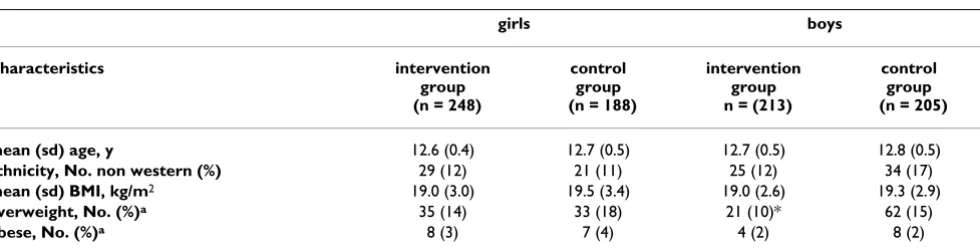
Of 1323 invited adolescents, 1108 (84%) returned both the parental and student informed consent. In total 1053 students were measured at baseline while 1031 (98%) were measured at 8-month follow-up. Table 1 shows the baseline characteristics of the study sample with complete data (n = 854), stratified for gender. In girls, the mean age was 12.6 years and 16% was classified as overweight and 3% as obese. In boys, the mean age was 12.8. In the inter-vention group 10% of the boys was overweight and 2% obese, while in the control group the prevalence of over-weight and obesity was 15 and 2% respectively (between-condition difference p = 0.01).
Intervention effects on EBRBs
Table 2 shows the baseline and post-intervention values of the energy-balance related behaviours. At baseline, the boys and girls in the intervention group reported spend-ing significantly more minutes on active transport (42 and 40 min/wk, respectively) than boys and girls in the con-trol group (34 and 34 min/wk, respectively). At baseline, girls in the control group reported a higher consumption
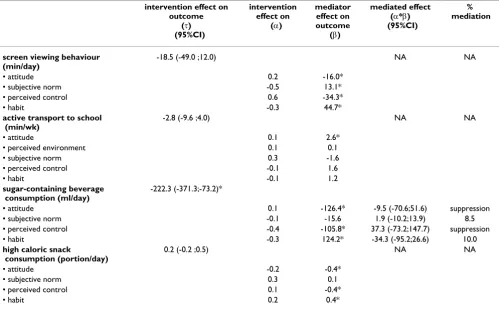
of sugar containing beverages than girls in the interven-tion group (1121 versus 1073 ml/day). Both in boys and girls we observed a significant intervention effect on con-sumption of sugar containing beverages (between group difference in boys = -303.5 ml/day, 95% CI: -502.4;-104.5, between group difference in girls = -222.3 ml/day, 95% CI: -371.3;-73.2) (Tables 5 and 6). The intervention did not significantly affect the other EBRBs. Therefore, a mediation analysis was only performed for the effect on consumption of sugar containing beverages.
Intervention effects on mediators
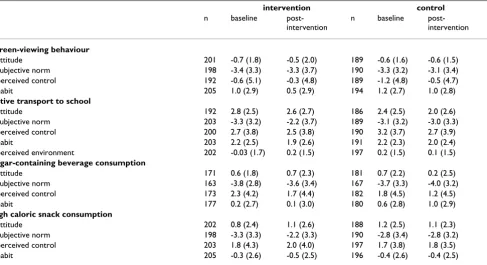
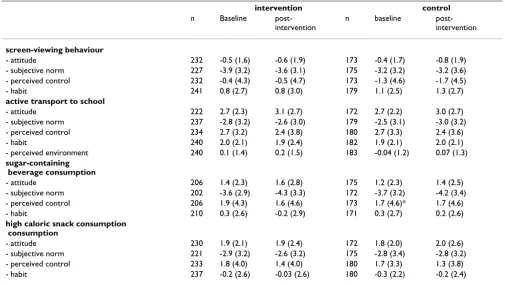
Tables 3 and 4 show the baseline and post-intervention values of the hypothesized mediators for boys and girls, respectively. At baseline, the intervention and control schools were comparable regarding the hypothetical mediator variables. Except for perceived behavioural con-trol regarding decreasing the amount of sugar containing beverages, which was higher in girls from the intervention schools. In girls the DOiT-program was not effective in influencing the hypothesized mediators (Table 6). In boys, the DOiT-program significantly improved the sub-jective norm regarding increasing active transport and decreasing snack consumption. Furthermore, the DOiT-intervention improved attitude and decreased habit strength regarding sugar containing beverage consump-tion (Table 5).
Mediation
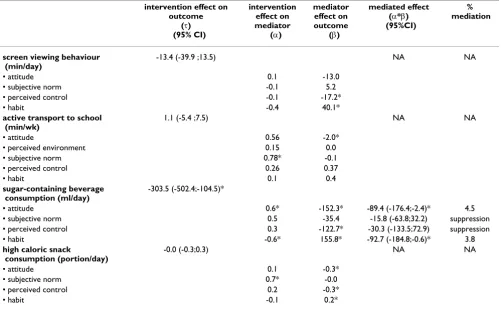
In Table 5 and Table 6 we present the intervention effects on the outcomes (τ) and hypothetical mediators (α), and the effect of the mediator on the outcome (β) for all four EBRBs for boys and girls, respectively. Since we only found a significant intervention-effect on sugar contain-ing beverage consumption we only computed the medi-ated effect (α*β) and the percentage mediation for sugar containing beverage consumption.
In boys, a small but significant mediation effect of attitude towards decreasing sugar containing beverage
consump-Table 1: Demographic and anthropometric characteristics at baseline in intervention and control schools.
girls boys
Characteristics intervention
group (n = 248)
control group (n = 188)
intervention group n = (213)
control group (n = 205)
mean (sd) age, y 12.6 (0.4) 12.7 (0.5) 12.7 (0.5) 12.8 (0.5)
ethnicity, No. non western (%) 29 (12) 21 (11) 25 (12) 34 (17)
mean (sd) BMI, kg/m2 19.0 (3.0) 19.5 (3.4) 19.0 (2.6) 19.3 (2.9)
overweight, No. (%)a 35 (14) 33 (18) 21 (10)* 62 (15)
obese, No. (%)a 8 (3) 7 (4) 4 (2) 8 (2)
a using cut-off values described by Cole et al. [16].
tion (4.5%) and habit strength regarding sugar containing beverage consumption (3.8%) was found. This mediation effect was partial. Changes in some potential mediators were significantly predictive of behaviour change, irre-spective of whether participants were exposed or not to the intervention including:
- perceived control and habit strength regarding reducing screen viewing behaviour;
- subjective norm regarding active transport; Table 2: Energy balance-related behaviours at baseline and post-intervention in intervention and control schools, means (SD)
girls boys
baseline post-intervention
baseline post-intervention
screen-viewing behaviour (min/day)
control (n = 181) 247 (136) 247 (149) (n = 196) 288 (145) 263 (140)
intervention (n = 238) 215 (119) 206 (135) (n = 206) 271(159) 244 (150)
active transport to school (min/wk)
control (n = 179) 34 (27) 42 (27) (n = 188) 34 (27) 38 (26)
intervention (n = 185) 40 (29)* 46(29) (n = 185) 42 (30)* 45 (29)
sugar-containing beverage consumption (ml/day)
control (n = 165) 1121 (807) 1010 (693) (n = 180) 1186 (933) 1184 (856)
intervention (n = 218) 1073 (777)* 739 (564) (n = 190) 1107 (919) 826 (749) high caloric snack
consumption (portion/day)
control (n = 180) 1.9 (1.3) 1.9 (1.3) (n = 184) 2.1 (1.5) 2.1 (1.3)
intervention (n = 238) 1.9 (1.3) 2.0 (1.5) (n = 191) 2.0 (1.4) 2.0 (1.5)
* significantly different from the control group (p ≤ 0.02)
Table 3: Determinants of energy balance-related behaviours at baseline and post-intervention among boys from intervention and control schools, means (SD)
intervention control
n baseline post-intervention
n baseline post-intervention
screen-viewing behaviour
- attitude 201 -0.7 (1.8) -0.5 (2.0) 189 -0.6 (1.6) -0.6 (1.5)
- subjective norm 198 -3.4 (3.3) -3.3 (3.7) 190 -3.3 (3.2) -3.1 (3.4)
- perceived control 192 -0.6 (5.1) -0.3 (4.8) 189 -1.2 (4.8) -0.5 (4.7)
- habit 205 1.0 (2.9) 0.5 (2.9) 194 1.2 (2.7) 1.0 (2.8)
active transport to school
- attitude 192 2.8 (2.5) 2.6 (2.7) 186 2.4 (2.5) 2.0 (2.6)
- subjective norm 203 -3.3 (3.2) -2.2 (3.7) 189 -3.1 (3.2) -3.0 (3.3)
- perceived control 200 2.7 (3.8) 2.5 (3.8) 190 3.2 (3.7) 2.7 (3.9)
- habit 203 2.2 (2.5) 1.9 (2.6) 191 2.2 (2.3) 2.0 (2.4)
- perceived environment 202 -0.03 (1.7) 0.2 (1.5) 197 0.2 (1.5) 0.1 (1.5) sugar-containing beverage consumption
- attitude 171 0.6 (1.8) 0.7 (2.3) 181 0.7 (2.2) 0.2 (2.5)
- subjective norm 163 -3.8 (2.8) -3.6 (3.4) 167 -3.7 (3.3) -4.0 (3.2)
- perceived control 173 2.3 (4.2) 1.7 (4.4) 182 1.8 (4.5) 1.2 (4.5)
- habit 177 0.2 (2.7) 0.1 (3.0) 180 0.6 (2.8) 1.0 (2.9)
high caloric snack consumption
- attitude 202 0.8 (2.4) 1.1 (2.6) 188 1.2 (2.5) 1.1 (2.3)
- subjective norm 198 -3.3 (3.3) -2.2 (3.3) 190 -2.8 (3.4) -2.8 (3.2)
- perceived control 203 1.8 (4.3) 2.0 (4.0) 197 1.7 (3.8) 1.8 (3.5)
- habit 205 -0.3 (2.6) -0.5 (2.5) 196 -0.4 (2.6) -0.4 (2.5)
- attitude, perceived behavioural control and habit strength regarding reducing sugar containing beverage consumption and high caloric snack consumption.
In girls, none of the hypothetical mediators appeared to mediate the intervention effect. Changes in some poten-tial mediators were significantly predictive of behaviour change, irrespective of whether participants were exposed or not to the intervention including:
- attitude, subjective norm, perceived control and habit strength regarding reducing screen viewing behaviour;
- attitude regarding active transport;
- attitude, perceived behavioural control and habit strength regarding reducing sugar containing beverage consumption and high caloric snack consumption.
Discussion
The purpose of this paper was to examine whether the DOiT- program was effective in improving the targeted mediators – i.e. attitude, subjective norm, perceived behavioural control, and habit strength – and to identify the mediating mechanisms targeted by the DOiT-pro-gram. In girls, the DOiT-program was ineffective in
chang-ing the hypothesized mediators, while in boys the DOiT-program improved some mediators. Although changes in many of the hypothesized mediators were significantly related to behaviour change, only attitude towards decreasing sugar containing beverage consumption (4.5%) and habit strength regarding sugar containing bev-erage consumption (3.8%) partially mediated the inter-vention effect in boys.
The DOiT-intervention was effective only in decreasing sugar containing beverage consumption, and not in improving the other targeted EBRBs. Sugar containing beverage may be easier to change, since there are relatively easy available alternatives such as light versions of soft drinks, and water. Furthermore, since baseline consump-tion was quite high there was substantial room for improvement. This was not the case for the other EBRBs: Participants reported to eat two high caloric snacks per day, leaving only two change options a day; the majority of the children already cycled to school, leaving little room for improvement. Unfortunately, we have no infor-mation on active transport to other locations.
Our findings imply another explanation for the lack of effect on active transport, screen time and snack consump-tion: the DOiT-program was ineffective in changing the Table 4: Determinants of energy balance-related behaviours at baseline and post-intervention among girls from intervention and control schools, means (SD)
intervention control
n Baseline post-intervention
n baseline
post-intervention
screen-viewing behaviour
- attitude 232 -0.5 (1.6) -0.6 (1.9) 173 -0.4 (1.7) -0.8 (1.9)
- subjective norm 227 -3.9 (3.2) -3.6 (3.1) 175 -3.2 (3.2) -3.2 (3.6)
- perceived control 232 -0.4 (4.3) -0.5 (4.7) 173 -1.3 (4.6) -1.7 (4.5)
- habit 241 0.8 (2.7) 0.8 (3.0) 179 1.1 (2.5) 1.3 (2.7)
active transport to school
- attitude 222 2.7 (2.3) 3.1 (2.7) 172 2.7 (2.2) 3.0 (2.7)
- subjective norm 237 -2.8 (3.2) -2.6 (3.0) 179 -2.5 (3.1) -3.0 (3.2)
- perceived control 234 2.7 (3.2) 2.4 (3.8) 180 2.7 (3.3) 2.4 (3.6)
- habit 240 2.0 (2.1) 1.9 (2.4) 182 1.9 (2.1) 2.0 (2.1)
- perceived environment 240 0.1 (1.4) 0.2 (1.5) 183 -0.04 (1.2) 0.07 (1.3) sugar-containing
beverage consumption
- attitude 206 1.4 (2.3) 1.6 (2.8) 175 1.2 (2.3) 1.4 (2.5)
- subjective norm 202 -3.6 (2.9) -4.3 (3.3) 172 -3.7 (3.2) -4.2 (3.4)
- perceived control 206 1.9 (4.3) 1.6 (4.6) 173 1.7 (4.6)* 1.7 (4.6)
- habit 210 0.3 (2.6) -0.2 (2.9) 171 0.3 (2.7) 0.2 (2.6)
high caloric snack consumption consumption
- attitude 230 1.9 (2.1) 1.9 (2.4) 172 1.8 (2.0) 2.0 (2.6)
- subjective norm 221 -2.9 (3.2) -2.6 (3.2) 175 -2.8 (3.4) -2.8 (3.2)
- perceived control 233 1.8 (4.0) 1.4 (4.0) 180 1.7 (3.3) 1.3 (3.8)
- habit 237 -0.2 (2.6) -0.03 (2.6) 180 -0.3 (2.2) -0.2 (2.4)
hypothesized mediators of these EBRBs. The DOiT-pro-gram was only effective in changing some of the media-tors and only among boys. Another possibility is that the questionnaire was not sufficiently sensitive to detect changes in these mediator variables. Due to the multi-component nature of the intervention we cannot con-clude which components of the DOiT-program were effective and which were not. An explanation for the small mediating effect on sugar containing beverages may be that other variables – such as environmental change options – were partly responsible for this intervention effect.
Comparison with other studies
Our finding that intervention effects were different for boys and girls is in line with previous school-based inter-ventions from Gortmaker et al. [20] and Flores et al. [21].
There have been few formal mediational analyses con-ducted for school-based physical activity and nutrition intervention programs. Haerens et al [22] found that self-efficacy was a partial mediator in changing total and school-related physical activity among adolescents in a
school-based intervention in middle schools with paren-tal support. However, the suppressor effect on attitude decreased this effect. Dishman et al. [23,24] found that self-efficacy and enjoyment partially mediated the posi-tive effect on physical activity of a school-based interven-tion to increase physical activity and fitness among adolescent black and white girls. To our knowledge, no studies are available on mediating variables in interven-tions aimed at reducing time spent in screen-viewing behaviour, or consumption of soft drinks or high energy snacks. Haerens et al. [25] investigated the mechanisms through which a school-based fat intake intervention in adolescent girls was effective. They concluded that none of the examined hypothesized mediating variables of low fat intake were identified as mediators of changes in fat intake.
Limitations
Study limitations include the measurement of the media-tors and EBRBs. The data collection of both relied exclu-sively on self-report. Social desirability bias and over- and underreporting biases may have influenced the measure-ment of EBRBs. Since there are no validated Dutch ques-Table 5: Intervention effects on energy balance related behaviours, mediators, mediator effects, 95% confidence intervals and percent mediation among boys
intervention effect on outcome
(τ) (95% CI)
intervention effect on mediator (α)
mediator effect on outcome (β)
mediated effect (α*β) (95%CI)
% mediation
screen viewing behaviour (min/day)
-13.4 (-39.9 ;13.5) NA NA
• attitude 0.1 -13.0
• subjective norm -0.1 5.2
• perceived control -0.1 -17.2*
• habit -0.4 40.1*
active transport to school (min/wk)
1.1 (-5.4 ;7.5) NA NA
• attitude 0.56 -2.0*
• perceived environment 0.15 0.0
• subjective norm 0.78* -0.1
• perceived control 0.26 0.37
• habit 0.1 0.4
sugar-containing beverage consumption (ml/day)
-303.5 (-502.4;-104.5)*
• attitude 0.6* -152.3* -89.4 (-176.4;-2.4)* 4.5
• subjective norm 0.5 -35.4 -15.8 (-63.8;32.2) suppression
• perceived control 0.3 -122.7* -30.3 (-133.5;72.9) suppression
• habit -0.6* 155.8* -92.7 (-184.8;-0.6)* 3.8
high caloric snack
consumption (portion/day)
-0.0 (-0.3;0.3) NA NA
• attitude 0.1 -0.3*
• subjective norm 0.7* -0.0
• perceived control 0.2 -0.3*
• habit -0.1 0.2*
* (p < 0.05).
tionnaires focussing on the mediators and EBRBs that we measured in our trial, we adapted existing validated ques-tionnaires. Our questionnaire was not tested on validity, reliability or responsiveness. The questions aimed to assess attitude, subjective norm, perceived behavioural control and habit strength regarding changing four specific EBRBs. Change in behaviour may be a more difficult con-struct than the behaviour itself. Furthermore, if the stu-dents had changed their behaviour as a result of the intervention, asking the same question again post inter-vention would be a different question, namely attitude regarding changing a different behaviour. This compli-cates finding a change in the mediators.
Another limitation is the simultaneous measurement of hypothetical mediators and behavioural outcomes. Logi-cally, any change in a mediator must precede a change in the outcome. As in many randomised control trials we assessed the hypothetical mediators at the same time points as the behavioural outcomes. Therefore, our statis-tical analysis of mediating mechanisms is correlational and cannot establish causality. To establish definitively that improved attitude towards behaviour change and
reductions in habit strength are causal mechanisms in reducing SCB consumption would require a subsequent intervention study in which both are directly manipu-lated. Nonetheless, our results suggest that in boys the DOiT-program may have achieved its effect on sugar con-taining beverage consumption in part by changing atti-tude and habit strength.
Strengths
Strengths of our study are the high compliance rate among adolescents and the focus on adolescents from a lower educational level. Moreover, this is one of the few studies on mediation in school-based obesity prevention inter-ventions and to our knowledge the first study looking at a potential mediating effect of habit strength.
Conclusion
Our findings imply that interventions aimed at reducing sugar containing beverage consumption that are devel-oped gender-specific may be more effective. Interventions aimed at reducing sugar containing beverage consump-tion among boys may be more effective when focussing on modification of attitude and habit strength. For girls, Table 6: Intervention effects on energy balance related behaviours, mediators, mediator effects, 95% confidence intervals and percent mediation among girls
intervention effect on outcome
(τ) (95%CI)
intervention effect on
(α)
mediator effect on outcome
(β)
mediated effect (α*β) (95%CI)
% mediation
screen viewing behaviour (min/day)
-18.5 (-49.0 ;12.0) NA NA
• attitude 0.2 -16.0*
• subjective norm -0.5 13.1*
• perceived control 0.6 -34.3*
• habit -0.3 44.7*
active transport to school (min/wk)
-2.8 (-9.6 ;4.0) NA NA
• attitude 0.1 2.6*
• perceived environment 0.1 0.1
• subjective norm 0.3 -1.6
• perceived control -0.1 1.6
• habit -0.1 1.2
sugar-containing beverage consumption (ml/day)
-222.3 (-371.3;-73.2)*
• attitude 0.1 -126.4* -9.5 (-70.6;51.6) suppression
• subjective norm -0.1 -15.6 1.9 (-10.2;13.9) 8.5
• perceived control -0.4 -105.8* 37.3 (-73.2;147.7) suppression
• habit -0.3 124.2* -34.3 (-95.2;26.6) 10.0
high caloric snack
consumption (portion/day)
0.2 (-0.2 ;0.5) NA NA
• attitude -0.2 -0.4*
• subjective norm 0.3 0.1
• perceived control 0.1 -0.4*
• habit 0.2 0.4*
*p < 0.05).
Publish with BioMed Central and every scientist can read your work free of charge "BioMed Central will be the most significant development for disseminating the results of biomedical researc h in our lifetime."
Sir Paul Nurse, Cancer Research UK
Your research papers will be:
available free of charge to the entire biomedical community
peer reviewed and published immediately upon acceptance
cited in PubMed and archived on PubMed Central
yours — you keep the copyright
Submit your manuscript here:
http://www.biomedcentral.com/info/publishing_adv.asp
BioMedcentral apparently other mediating mechanisms were responsible
for the reduction in sugar containing beverage consump-tion.
Competing interests
The authors declare that they have no competing interests.
Authors' contributions
MC, AS, JB, and WvM participated in the design of the study and contributed intellectual input into the main ideas of this paper. MC performed the statistical analysis and drafted the manuscript. AS coordinated the imple-mentation of the intervention and supervised the data-collection. All authors read and approved the final manu-script.
Acknowledgements
This study is part of NHF-NRG and is funded by the Netherlands Heart Foundation (No: 2000Z002), the Dutch Ministry of Health, Welfare, and Sports, and the Royal Association of Teachers of Physical Education.
References
1. World Health Organization: The world health report 2002: Reducing Risks, Promoting Healthy Life. Geneva, Switzerland
2002.
2. Rennie KL, Johnson L, Jebb SA: Behavioural determinants of obesity. Best Pract Res Clin Endocrinol Metab 2005, 19:343-358. 3. MacKinnon DP, Krull JL, Lockwood CM: Equivalence of the
Medi-ation, Confounding and Suppression Effect. Preventive Science
2000, 1:173-182.
4. Sallis JF, Prochaska JJ, Taylor WC: A review of correlates of phys-ical activity of children and adolescents. Med Sci Sports Exerc
2000, 32:963-975.
5. Gordon-Larsen P, Mcmurray RG, Popkin BM: Determinants of adolescent physical activity and inactivity patterns. Pediatrics
2000, 105:E83.
6. Baranowski T, Cullen KW, Baranowski J: Psychosocial correlates of dietary intake: advancing dietary intervention. Annu Rev Nutr 1999, 19:17-40.
7. Singh AS, Chin A Paw JM, Kremers SP, Visscher TL, Brug J, Van Mechelen W: Design of the Dutch Obesity Intervention in Teenagers (NRG-DOiT): Systematic development, imple-mentation and evaluation of a school-based intervention aimed at the prevention of excessive weight gain in adoles-cents. BMC Public Health 2006, 6:304.
8. Ajzen I: The theory of planned behavior. Org Behav Hum Decis
1991, 50:179-211.
9. Aarts H, Paulussen T, Schaalma H: Physical exercise habit: on the conceptualization and formation of habitual health behav-iours. Health Educ Res 1997, 12:363-374.
10. Kremers SP, de Bruijn GJ, Visscher TL, van Mechelen W, De Vries NK, Brug J: Environmental influences on energy balance-related behaviors: A dual-process view. Int J Behav Nutr Phys Act
2006, 3:9.
11. Singh AS, Chin A Paw MJ, Brug J, Van Mechelen W: Short-term Effects of School-Based Weight Gain Prevention Among Adolescents. Arch Pediatr Adolesc Med 2007, 161:565-571. 12. Wang Y: Cross-national comparison of childhood obesity: the
epidemic and the relationship between obesity and socioe-conomic status. Int J Epidemiol 2001, 30:1129-1136.
13. Bartholomew LK, Parcel GS, Kok G, Gottlieb NH: Intervention Mapping: designing theory and evidence-based health pro-motion programs. MountainView, CA: Mayfield; 2001.
14. Chaiken S, Trope Y: Dual-Process Theory in Social Psychology.
New York: Guilford Press; 1999.
15. Swinburn B, Egger G, Raza F: Dissecting obesogenic environ-ments: the development and application of a framework for identifying and prioritizing environmental interventions for obesity. Prev Med 1999, 29:563-570.
16. Cole TJ, Bellizzi MC, Flegal KM, Dietz WH: Establishing a standard definition for child overweight and obesity worldwide: inter-national survey. BMJ 2000, 320:1240-1243.
17. van Assema P, Brug J, Ronda G, Steenhuis I: The relative validity of a short Dutch questionnaire as a means to categorize adults and adolescents to total and saturated fat intake. J Hum Nutr Diet 2001, 14:377-390.
18. van Assema P, Brug J, Ronda G, Steenhuis I, Oenema A: A short dutch questionnaire to measure fruit and vegetable intake: relative validity among adults and adolescents. Nutr Health
2002, 16:85-106.
19. Krull JL, MacKinnon DP: Multilevel mediation modeling in group-based intervention studies. Eval Rev 1999, 23:418-444. 20. Gortmaker SL, Peterson K, Wiecha J, Sobol AM, Dixit S, Fox MK,
Laird N: Reducing obesity via a school-based interdisciplinary intervention among youth: Planet Health. Arch Pediatr Adolesc Med 1999, 153:409-418.
21. Flores R: Dance for health: improving fitness in African Amer-ican and Hispanic adolescents. Public Health Rep 1995,
110:189-193.
22. Haerens L, Cerin E, Maes L, Cardon G, Deforche B, De Bourdeaud-huij I: Explaining the effect of a 1-year intervention promoting physical activity in middle schools: a mediation analysis. Pub-lic Health Nutr 2007, 11(5):501-12.
23. Dishman RK, Motl RW, Saunders R, Felton G, Ward DS, Dowda M, Pate RR: Enjoyment mediates effects of a school-based physi-cal-activity intervention. Med Sci Sports Exerc 2005, 37:478-487. 24. Dishman RK, Motl RW, Saunders R, Felton G, Ward DS, Dowda M,
Pate RR: Self-efficacy partially mediates the effect of a school-based physical-activity intervention among adolescent girls. Prev Med 2004, 38:628-636.
25. Haerens L, Cerin E, Deforche B, Maes L, De Bourdeaudhuij I: