Recircumscription of
Bredia
and resurrection of
Tashiroea
(Sonerileae, Melastomataceae) with
description of a new species
T. villosa
Qiu-Jie Zhou1, Jin-Hong Dai1, Che-Wei Lin2,
Tetsuo Denda3, Ren-Chao Zhou1, Ying Liu1
1 State Key Laboratory of Biocontrol and Guangdong Key Laboratory of Plant Resources, School of Life Sciences, Sun Yat-sen University, No. 135, Xin-Gang-Xi Road, Guangzhou 510275, China 2 Herbarium of Taiwan Fo-restry Research Institute, No. 53, Nan-Hai Road, Taipei 100, Taiwan 3 Laboratory of Ecology and Systematics, Faculty of Science, University of the Ryukyus, Senbaru 1, Nishihara, Okinawa 903-0213, Japan
Corresponding author: Ren-Chao Zhou ([email protected]); Ying Liu ([email protected])
Academic editor:Ricardo Kriebel | Received 29 May 2019 | Accepted 25 June 2019 | Published 19 July 2019
Citation: Zhou Q-J, Dai J-H, Lin C-W, Denda T, Zhou R-C, Liu Y (2019) Recircumscription of Bredia and resurrection of Tashiroea (Sonerileae, Melastomataceae) with description of a new species T. villosa. PhytoKeys 127: 121–150. https:// doi.org/10.3897/phytokeys.127.36608
Abstract
Bredia (Melastomataceae) is an Asian genus that extends from central and southern mainland China to Taiwan and the Ryukyu islands. Molecular phylogenetic analyses reveal that the type of Bredia is nested in a clade of 20 species, while Tashiroea, a genus previously synonymized in Bredia, falls in another distantly related clade of 10 species. Our morphological survey shows that the two clades can be distinguished by several diagnostic features including leaf indumentum, texture, leaf surface sculpture under SEM, presence/absence of yellowish uniseriate trichomes, and capsule morphology. Based on molecular and morphological evidence, Bredia is recircumscribed and Tashiroea is resurrected. Description and a list of species are provided for the two genera with the description of a new species, T. villosa.
Keywords
Bredia, Tashiroea, Sonerileae, Melastomataceae, morphology, taxonomy
Introduction
Bredia Blume (Sonerileae, Melastomataceae) was originally described based on B. hir-suta Blume (Blume 1849), a species in Taiwan and the Ryukyu islands. Later, Ito and Matsumura (1899) established another genus, Tashiroea Matsumura, to accommodate two new species, T. yaeyamensis Matsum. and T. okinawensis Matsum., also discovered
Qiu-Jie Zhou et al. / PhytoKeys 127: 121–150 (2019) 122
in the Ryukyus. Diels (1924, 1932) recognized both genera. He added one Chinese spe-cies to Tashiroea and expanded Bredia by describing new species and transferring species from Blastus Lour., Otanthera Blume and Fordiophyton Stapf into Bredia. Li (1944) fol-lowed Diels’s concept of Bredia but considered Tashiroea to be included within the limits of Bredia. He therefore synonymized Tashiroea, accommodating its three species with-in Bredia section Tashiroea (Li 1944). With additional descriptions of new species and transfers of other species (Hooker 1871; Cogniaux 1891; Diels 1924, 1932; Ohwi 1936; Li 1944, 1945; Lauener 1972; Chen 1984a; Yeh et al. 2008; Zhao et al. 2017; Zhou et al. 2018), Bredia as currently circumscribed comprises 18–22 species according to differ-ent species delimitations (e.g. Chen 1984b; Chen and Renner 2007), and occurs from northern Vietnam and southern mainland China to Taiwan and the Ryukyu islands.
roea clades in search of possible diagnostic characters. The results are presented below. Based on molecular and morphological evidence, Bredia is recircumscribed and Tashi-roea is resurrected. Descriptions and a list of species are provided for the two genera with the description of a new species T. villosa. Thirteen new combinations are made.
Methods
Molecular experiments and phylogenetic analysis
Eight newly sequenced species were added to the combined dataset (nrITS and chlo-roplast trnV-trnM) published in Zhou et al. (2019), including Driessenia glanduligera Stapf, D. phasmolacuna C.W. Lin, Phyllagathis hispidissima (C. Chen) C. Chen, P. ten-taculifera C. Hansen, Scorpiothyrsus shangszeensis C. Chen, Bredia okinawensis (= Tashi-roea okinawensis), B. yunnanensis (H. Lév.) Diels, and a new species T. villosa. All mo-lecular experiments and phylogenetic analysis using bayesian inference and maximum likelihood methods followed Zhou et al. (2019). A complete list of the taxa sampled in this study, their collection localities, voucher information, and GenBank accession numbers are provided in Suppl. material 1: Table S1.
Morphological comparison
Qiu-Jie Zhou et al. / PhytoKeys 127: 121–150 (2019) 124
WU) were examined. Habit, shape and texture of the leaves, and inflorescence type were obtained via visual observation. Stamen morphology and capsule morphology were determined by stereomicroscopic (Leica S8APO) examination, leaf epidermal features by desktop SEM (Phenom Pro), and indumentum by both equipment. Dur-ing observation usDur-ing Phenom Pro, fresh or dried tissues were directly mounted on stubs and examined without further processing. We failed to obtain the materials of two species recorded in Bredia, namely B. laisherana C.L. Yeh & C.R. Yeh and B. vio-lacea H.L. Li, which were therefore not included in our molecular phylogenetic study. For the two species, we examined their protologue, images of herbarium specimens and color photos from the author of B. laisherana. Species circumscriptions basically follow Chen (1984b). Description of the capsule morphology mainly follows Hansen (1992), while the description of one type of trichomes (sessile glands with thin-walled heads) was taken from Wurdack (1986).
Taxonomy
Diels published several names in Melastomataceae in 1924 and 1932. Although he designated type specimens, he did not specify the place of deposition for them in the protologue. Even if we assume the holotypes existed in the Berlin herbarium (where Diels worked), they were probably destroyed during the Second World War. There-fore, we follow McNeill (2014) and designate lectotypes for those taxa according to the stipulations of Art. 9.12, 9.22 and 9.23 of the Code (Turland et al. 2018). Diels (1932) also lectotypified two names, Barthea cavaleriei H. Lév. and Fordiophyton tuber-culatum Guillaumin, without citing the herbaria where they were housed. For Barthea cavaleriei, only one specimen of the gathering designated by Diels is known and is in the Royal Botanic Garden Edinburgh herbarium (E). We accept it as the lectotype of this name and cite the page number of Diels’s lectotypification. For Fordiophyton tuberculatum, multiple specimens of the gathering designated by Diels (1932) are mix-tures of more than one taxon. Based on Art. 9.17 (Turland et al. 2018), a lectotype corresponding most closely with the original description is designated for this name. Tashiroea, T. yaeyamensis and T. okinawensis were described simultaneously without designation of a type (Ito and Matsumura 1899). We also lectotypify these names here according to Art. 8.1, 8.2, 10.1, and 10.2 (Turland et al. 2018). In general, we select the herbarium sheet with the best-preserved leaves and flowers for lectotypification. Detailed reasoning where the choice may not be obvious is provided at the end of the taxon being discussed.
Results
Qiu-Jie Zhou et al. / PhytoKeys 127: 121–150 (2019) 126
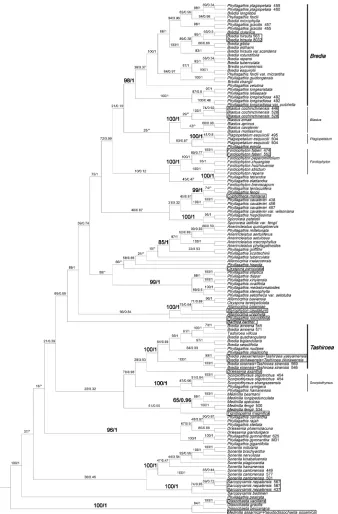
ly identical to those reported in Zhou et al. (2019). Both Tashiroea clade (PP=1.00; BS=100%) and Bredia clade (PP=1.00; BS=98%) are well resolved. Among the newly sequenced species, B. okinawensis (= T. okinawensis) and the new species T. villosa are nested in the Tashiroea clade, while B. yunnanensis is grouped in the Bredia clade.
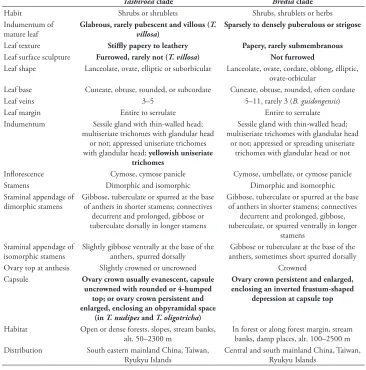
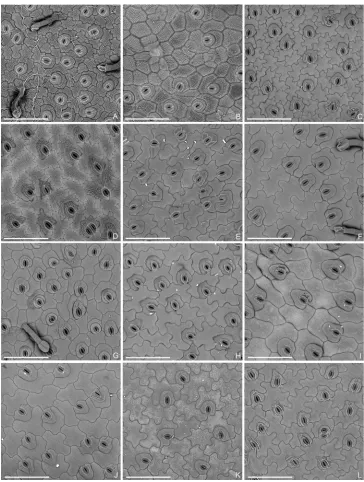
Characters of the Tashiroea clade (10 species) and the Bredia clade (20 species) are summarized in Table 1. Species of the two clades are shrubs or shrublets, except that the latter clade includes some herbs. The mature leaves of species in Tashiroea clade are usually glabrous, stiffly papery to leathery and exhibit furrowed surface sculpture un-der SEM (Figs 2, 4 A–B, D), except that those of the new species T. villosa are densely pubescent and villous and without furrowed surface sculpture (Fig. 4C). The mature leaves of species in the Bredia clade are usually puberulous and papery and without fur-rowed surface sculpture (Figs 3, 4 E–L). Species in both clades have sessile glands and Table 1. Comparison of the Tashiroea clade and the Bredia clade. Potential diagnostic characteristics are indicted in bold.
Tashiroeaclade Brediaclade
Habit Shrubs or shrublets Shrubs, shrublets or herbs Indumentum of
mature leaf
Glabrous, rarely pubescent and villous (T. villosa)
Sparsely to densely puberulous or strigose
Leaf texture Stiffly papery to leathery Papery, rarely submembranous
Leaf surface sculpture Furrowed, rarely not (T. villosa) Not furrowed
Leaf shape Lanceolate, ovate, elliptic or suborbicular Lanceolate, ovate, cordate, oblong, elliptic, ovate-orbicular
Leaf base Cuneate, obtuse, rounded, or subcordate Cuneate, obtuse, rounded, often cordate Leaf veins 3–5 5–11, rarely 3 (B. guidongensis) Leaf margin Entire to serrulate Entire to serrulate Indumentum Sessile gland with thin-walled head;
multiseriate trichomes with glandular head or not; appressed uniseriate trichomes with glandular head; yellowish uniseriate
trichomes
Sessile gland with thin-walled head; multiseriate trichomes with glandular head
or not; appressed or spreading uniseriate trichomes with glandular head or not
Inflorescence Cymose, cymose panicle Cymose, umbellate, or cymose panicle Stamens Dimorphic and isomorphic Dimorphic and isomorphic Staminal appendage of
dimorphic stamens Gibbose, tuberculate or spurred at the base of anthers in shorter stamens; connectives decurrent and prolonged, gibbose or tuberculate dorsally in longer stamens
Gibbose, tuberculate or spurred at the base of anthers in shorter stamens; connectives
decurrent and prolonged, gibbose, tuberculate, or spurred ventrally in longer
stamens Staminal appendage of
isomorphic stamens Slightly gibbose ventrally at the base of the anthers, spurred dorsally anthers, sometimes short spurred dorsallyGibbose or tuberculate at the base of the Ovary top at anthesis Slightly crowned or uncrowned Crowned
Capsule Ovary crown usually evanescent, capsule uncrowned with rounded or 4-humped
top; or ovary crown persistent and enlarged, enclosing an obpyramidal space
(in T. nudipes and T. oligotricha)
Ovary crown persistent and enlarged, enclosing an inverted frustum-shaped
depression at capsule top
Habitat Open or dense forests, slopes, stream banks,
alt. 50–2300 m In forest or along forest margin, stream banks, damp places, alt. 100–2500 m Distribution South eastern mainland China, Taiwan,
Qiu-Jie Zhou et al. / PhytoKeys 127: 121–150 (2019) 128
Qiu-Jie Zhou et al. / PhytoKeys 127: 121–150 (2019) 130
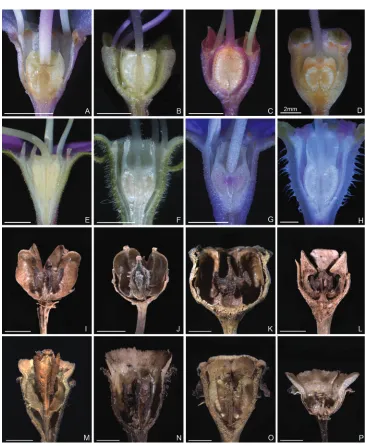
(cymose to cymose paniculate), stamen morphology (dimorphic to isomorphic), and staminal appendages (gibbose, tuberculate, or spurred) (Figs 2–3, 6–7). An ovary crown is present in most species of the Tashiroea clade at anthesis (Fig. 8A–D), but is usually evanescent, resulting in uncrowned capsules (Fig. 8I–K). Exceptions are two species traditionally placed in Phyllagathis. Their crowns are persistent and enlarged, forming crowned capsules with an obpyramidal depression at the top (Fig. 8L). In species of the Bredia clade, an ovary crown is present at anthesis (Fig. 8E–H), and persistent and enlarged in old capsule, enclosing an inverted frustum-shaped depression (Fig. 8M–P).
Field and literature surveys revealed that species of both Tashiroea clade and Bredia clade prefer shaded or moist habitats in forests or along forest margin, often along stream banks, from 50 m to 2500 m alt. The Tashiroea clade occurs in southeastern mainland China and the Ryukyu islands, while the Bredia clade, aside from the above areas, also extends to the central and southwestern Chinese provinces of Guizhou, Hubei, Chongqing, Sichuan and Yunnan.
Of the two species without molecular data, B. laisherana is endemic to Taiwan and B. violacea occurs in northern Vietnam. The former species has glabrous stems and leaves, and uncrowned ovaries and capsules (Yeh et al. 2008), occurring in dense forests, while the latter has puberulous stems, leaves and inflorescences but no habitat record is available.
Discussion
Morphological comparison
Species of the Tashiroea clade and Bredia clade are similar in habit, habitat preference, most indumentum types, and in having lanceolate, ovate to suborbicular leaves, a cu-neate to cordate leaf base, cymose to cymose panicles, dimorphic or isomorphic sta-mens, and gibbose, tuberculate, or spurred staminal appendages (Figs 2–3, 5–7). Ad-ditionally, their range of distribution partly overlaps in southeastern mainland China, and the Ryukyu islands. Therefore, it is quite understandable that Li (1944) considered Tashiroea to be congeneric with Bredia, where he placed it in synonymy.
Qiu-Jie Zhou et al. / PhytoKeys 127: 121–150 (2019) 132
Figure 6. Stamen morphology in the Tashiroea clade. A–D Dimorphic stamens: A T. amoena (Y. Liu 571) B T. quadrangularis (Y. Liu 585) C T. biglandularis (Y. Liu 553) D T. sinensis (Y. Liu 569). E–F Iso-morphic stamens: E T. nudipes (Y. Liu 435) F T. oligotricha (Y. Liu 468). Scale bar: 5 mm.
nevertheless has yellowish uniseriate trichomes on buds and uncrowned capsules with a 4-humped apex characteristic of this clade. At least some of the above differences, such as indumentum and capsule morphology, had long been noticed by previous authors. Li (1944) established section Tashiroea in Bredia, whereas Hansen (1992) divided Bredia into four groups of species, placing Tashiroea in a separate group.
The two clades are also morphologically distinguishable from their close relatives. Phylogenetic analyses showed that the Tashiroea clade is most closely related to Scorpio-thyrsus and Driessenia axantha while Bredia clade is closest to Blastus, Fordiophyton, and Plagiopetalum (Fig. 1). Species in the Tashiroea clade differ from Scorpiothyrsus in the 3–5-veined leaves (vs. 7–9-veined), from Driessenia axantha in inflorescence terminal (vs. axillary), and from both in inflorescence cymose to cymose panicles (vs. often scor-pioid cymose panicles), and ventrally gibbose or tuberculate anthers (vs. 2-setose or 2 band-shaped ventral appendages). The Brediaclade is easily distinguished from Blastus by having two whorls of stamens (vs. one), from Fordiophytonby ventrally appendaged anthers (vs. unappendaged) and the capsule crown usually exserted from the calyx (vs. not exserted), and from Plagiopetalum by appendaged anthers and crowned capsules (vs. unappendaged and uncrowned).
Species without molecular data
vio-lacea has puberulous stems, leaves and inflorescences (Li 1945). Li (1945) noted that the general appearance and inflorescence characters of B. violacea closely resembled those of B. hirsuta (type of Bredia). Morphological characters therefore suggest that B. laisherana belongs to the Tashiroea clade, and B. violacea to the Bredia clade.
Qiu-Jie Zhou et al. / PhytoKeys 127: 121–150 (2019) 134
Morphological evidence and molecular phylogenetic data confirmed that the Tashiroea clade and the Bredia clade represent two distantly related lineages morphologically well differentiated from each other and from their possible relatives. We therefore resurrect the generic name Tashiroea Matsum for the former clade and redefine Bredia Blume to include the latter. For the species lack of molecular data, we place B. laisherana and B. violacea in Tashiroea and Bredia respectively based on morphology. Species circumscriptions basically follow Chen (1984b). A revision at the species level will be dealt with in another study.
Taxonomy
Tashiroea Matsum., J. Coll. Sci. Imp. Univ. Tokyo 12: 489. 1899, emend. R.C.
Zhou & Ying Liu
Lectotype. Tashiroea yaeyamensis Matsum., J. Coll. Sci. Imp. Univ. Tokyo 12: 489. 1899. (Designated here)
Description. Shrubs or shrublets, erect, rarely creeping in the lower parts. Stems terete or slightly 4-sided, glabrous or glabrescent, rarely densely hairy (in T. villosa), terminal and axillary buds pubescent with yellowish uniseriate branched trichomes. Leaves petiolate; leaf blade lanceolate, ovate, elliptic, rarely suborbicular, stiffly papery to leathery, glabrescent when mature, rarely hairy (in T. villosa), secondary veins 1 or 2 on each side of midvein, margin remotely serrulate, or almost entire. Inflorescences ter-minal, few-flowered cymes to cymose panicles; bract minute, rarely to 1–2 cm long (in T. villosa), usually caducous. Flowers 4-merous. Hypanthium campanulate, rarely fun-nel shaped. Calyx lobes repand, crenate or triangular. Petals pink or purplish red, ovate, oblong to suborbicular, more or less oblique, apex acute or acuminate. Stamens 8, unequal or subequal; filaments filiform; anthers dimorphic or isomorphic, subulate to oblong-linear, gibbose, tuberculate or spurred at base, sometime unappendaged adaxi-ally. Ovary half inferior, slightly crowned or uncrowned, ovoid-globular or turbinate, 4-celled. Style filiform; stigma apiculate. Capsule cup-shaped or subglobular, more or less 4-sided, woody, uncrowned, apex rounded or 4-humped, or crown persistent and enlarged, enclosing an obpyramidal space (in T. nudipes and T. oligotricha). Seeds nu-merous, minute, cuneate, densely granulate. (Figs 2, 6, 5A–D, I–L, 8A–D, I–L)
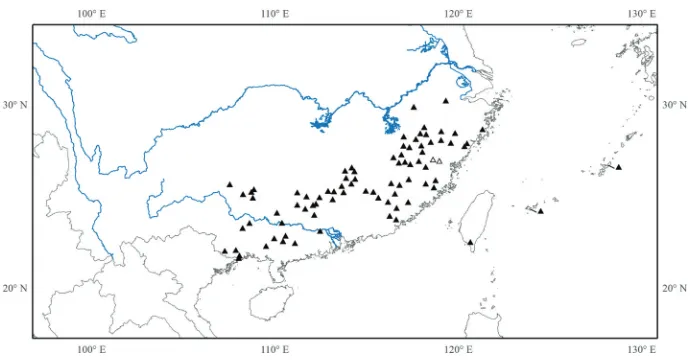
Distribution. Eleven species, eight in southeastern mainland China (Anhui, Fu-jian, Guangdong, Guangxi, Guizhou, Hunan, Jiangxi, Zhejiang), one in Taiwan, and two in the Ryukyus (Fig. 9).
Qiu-Jie Zhou et al. / PhytoKeys 127: 121–150 (2019) 136
Figure 9. Distribution of Tashiroea. Hollow triangles indicate the locations of Tashiroea villosa.
Species included in Tashiroea:
Tashiroea amoena (Diels) R.C.Zhou & Ying Liu, comb. nov.
urn:lsid:ipni.org:names:77199697-1
Bredia amoena Diels, Notizbl. Bot. Gart. Berlin-Dahlem 9(83): 197–198. 1924 (Ba-sionym). Type: China. Zhejiang: Yentang, 16 Aug 1920, H.H. Hu 30 (lectotype, designated here: A! [A00071979]; isolectotype: UC! [UC231837]).
Bredia chinensis Merr., J. Arnold Arbor. 8(1): 11–12. 1927. Type: China. Zhejiang: Yentang, 16 Aug 1920, H.H. Hu 30 (holotype: UC! [UC231837]; isotype: A! [A00071979]). Bredia pricei F.P. Metcalf, Lingnan Sci. J. 12: 153–154. 1933. Type: China. W.R. Price
1200A (K! [K001325176]).
Tashiroea biglandularis (C. Chen) R.C.Zhou & Ying Liu, comb. nov.
urn:lsid:ipni.org:names:77199698-1
Bredia biglandularis C. Chen, Bull. Bot. Res., Harbin 4(3): 39. 1984 (Basionym). Type: China. Guangxi: Dongxing, Lu-bao-shan, 2 Oct 1976, T. Fang 1519 (holo-type: GXMI! [GXMI050232]).
Tashiroea laisherana (C.L. Yeh & C.R. Yeh) R.C.Zhou & Ying Liu, comb. nov.
urn:lsid:ipni.org:names:77199699-1
urn:lsid:ipni.org:names:77199700-1
Phyllagathis nudipes C. Chen, Bull. Bot. Res., Harbin 4(3): 47. 1984 (Basionym). Type: China. Guangdong: Ruyuan, Wuzhi Shan, 21 May 1973, Guangdong73-101 (holotype: IBSC! [IBSC0003997]).
Tashiroea okinawensisMatsum., J. Coll. Sci. Imp. Univ. Tokyo 12: 490. 1899.
Bredia okinawensis (Matsum.) H.L. Li, J. Arnold Arbor. 25: 21. 1944.
Type. Japan. Okinawa: in montosis tractus Kunchan, Apr 1887, Y. Tashiro (5) (lec-totype, designated here: TI! [TI00002346]). Additional syntypes: Japan. Okinawa: S. Tanaka 216 (TI! [TI00002347]), Matsumura (TI! [TI00002348]).
Tashiroea oligotricha (Merr.) R.C.Zhou & Ying Liu, comb. nov.
urn:lsid:ipni.org:names:77199701-1
Phyllagathis oligotricha Merr. Sunyatsenia 1: 74. 1930 (Basionym). Type: China. Guangdong: Lok Chang, 8 Jun 1929, Tso 21016 (holotype: NY! [NY00273007]; isotypes: IBSC! [IBSC0003939, IBSC0003940]).
Phyllagathis anisophylla Diels, Bot. Jahrb. Syst. 65(2–3): 115. 1932. Type: Chi-na. Hunan, no precise location, 1926, Hunan Museum 60 (lectotype, des-ignated here: IBSC! [IBSC0003938]; isolectotypes: IBSC! [IBSC0003936, IBSC0003937]).
Tashiroea quadrangularis (Cogn.) R.C.Zhou & Ying Liu, comb. nov.
urn:lsid:ipni.org:names:77199702-1
Bredia quadrangularis Cogn. Monogr. Phan. 7: 473–474. 1891 (Basionym). Type: South China. Seemann s.n. (LE).
Tashiroea sessilifolia (H.L. Li) R.C.Zhou & Ying Liu, comb. nov.
urn:lsid:ipni.org:names:77199703-1
Qiu-Jie Zhou et al. / PhytoKeys 127: 121–150 (2019) 138
Tashiroea sinensis Diels, Notizbl. Bot. Gart. Berlin-Dahlem 9: 198. 1924.
Bredia sinensis (Diels) H.L. Li, J. Arnold Arbor. 25: 22. 1944.
Bredia glabra Merr., J. Arnold Arbor. 8: 12. 1927. Type: China. Zhejiang: Pinyong Xian, 11 Jul 1924, Ling Kan 7333 (holotype UC! [UC252284]).
Type. China. Fujian: Chung-an District, 27 Jul 1921, H.H. Hu 1343 (lectotype, des-ignated here: A! [A00073233]).
Tashiroea yaeyamensisMatsum., J. Coll. Sci. Imp. Univ. Tokyo 12: 489. 1899.
Bredia yaeyamensis (Matsum.) H.L. Li, J. Arnold Arbor. 25: 21. 1944.
Tashiroea yaeyamensisvar. tanakaeaMatsum., J. Coll. Sci. Imp. Univ. Tokyo 12: 490. 1899. Type: Okinawa: Yaeyama archipelago, Jul 1890, S. Tanaka 344 (holotype: TI! [TI00002345]).
Type. Japan. Okinawa: Iriomote 1890, S. Tanaka 345 (lectotype, designated here: TI! [TI00002344]). Additional syntype: Japan. Okinawa: in Yaeyama, Aug 1887, Tashiro (TI! [TI00002343]).
Tashiroea villosa X.X.Su, sp. nov.
urn:lsid:ipni.org:names:77199704-1 Figures 10, 11, 12A–B
Type. China. Fujian: Pingnan County, Lingxia Town, 1000 m, 16 Jul 2017, Y. Liu 568 (holotype: A!; isotype: SYS!).
Diagnosis. Resembles T. amoena in height, leaf size and shape, inflorescence and stamen morphology, while differing from the latter in the dense indumentum covering the whole plant and much larger bracts.
Qiu-Jie Zhou et al. / PhytoKeys 127: 121–150 (2019) 140
Figure 11. Y. Liu 568 (A) collected from Lingxia, Pingnan County, Fujian, China, holotype of Tashi-roea villosa.
locules 4, apex slightly 4-lobed, margin ciliate with glandular trichomes. Style ca. 0.6 cm long, puberulous with glandular trichomes basally. Capsule cup-shaped; hypanthium ca. 4 × 3.5 mm long; placental column distally entire, placentas non-thready. Seeds numer-ous, minute, cuneate, granulate. Flowering July-August, fruiting August-October.
Etymology. The specific epithet refers to the dense pubescent and villous indu-mentum.
Distribution and ecology. Tashiroea villosa is currently known from Pingnan, Jianou and Jianyang, northern Fujian, China (Fig. 9). It often grows in grasses and bushes along streamside at elevations of 900–1400 m.
Qiu-Jie Zhou et al. / PhytoKeys 127: 121–150 (2019) 142
inflorescences pubescent or sometimes glabrescent) and much larger bracts (9–19 × 5–8 mm vs. 1–2 × 1 mm) in the florescence (Fig. 12). Geographically, T. amoena is widely distributed in southeastern China (Anhui, Fujian, Zhejiang, Jiangxi, Guangxi), whereas T. villosa occurs in northern Fujian where both species occur. Nevertheless, they have not been found to co-occur within the same habitat.
Bredia Blume, Mus. Bot. 1: 25. 1849, emend. R.C. Zhou & Ying Liu
Type. Bredia hirsuta Blume, Mus. Bot. 1(2): 25. f. 4. 1849.
Description. Shrubs, shrublets or herbs, erect, ascending or creeping. Stems terete or more or less 4-sided, sparsely to densely puberulous, rarely glabrescent. Leaves petiolate; leaf blade ovate, cordate, oblong, elliptic, ovate-orbicular, rare-ly lanceolate, papery, rarerare-ly submembranous, sparserare-ly to denserare-ly puberulous or strigose, secondary veins 2–5 on each side of midvein, margin serrulate or entire. Inflorescences terminal, umbellate, cymes or cymose panicles. Flowers 4-merous. Hypanthium funnel shaped to campanulate. Calyx lobes conspicuous, linear-lanceo-late to triangular. Petals pink or purplish red, ovate to oblong, more or less oblique, apex acute or acuminate. Stamens 8, unequal or subequal; filaments filiform; an-thers dimorphic or isomorphic, subulate to oblong-linear, gibbose, tuberculate or spurred at base, rarely unappendaged abaxially. Ovary half inferior, crowned, ovoid, 4-celled. Style filiform; stigma apiculate. Capsule turbinate to cup-shaped, more or less 4-sided, crown persistent and enlarged, enclosing an inverted frustum-shaped depression at capsule apex. Seed numerous, minute, cuneate, densely granulate. (Figs 3, 7, 5E–H, M–P, 8E–H, M–P)
Distribution. Twenty-one species: 15 in central and southern mainland China (Fujian, Guangdong, Guangxi, Guizhou, Hubei, Hunan, Jiangxi, Sichuan, Chong-qing, Yunnan, Zhejiang), one in north Vietnam, five in Taiwan and one extending to the Ryukyu islands (Fig. 13).
Species included in Bredia:
Bredia changii W.Y. Zhao, X.H. Zhan & W.B. Liao, Phytotaxa 307(1): 36–42.
Type. China. Jiangxi: Chongyi County, Niedu Town, 579 m, 1 Aug 2016, W. Y. Zhao et al. LXP-13-22114 (holotype: SYS!; isotype: IBSC!).
Bredia dulanica C.L. Yeh, S.W. Chung & T.C. Hsu, Edinburgh J. Bot. 65(3): 395,
Figure 13. Distribution of Bredia.
Type. Taiwan, Taitung, Mt Dulan, on the ridge of a mountain, 1000–1200 m, 14 Oct 2007, S.W. Chung, T.C. Hsu & C.R. Yeh 16 (holotype: TAIF! [TAIF348619]; isotypes: TAIF! [TAIF348620, TAIF348621, TAIF348622]).
Bredia esquirolii (H. Lév.) Lauener, Notes Roy. Bot. Gard. Edinburgh 31(3): 398–
399. 1972.
Barthea esquirolii H. Lév., Repert. Spec. Nov. Regni Veg. 11(301–303): 494. 1913 (Basionym). Type: China. Guizhou: Tchai-choui-ho, July 1909, Esquirol 1581 (holotype: E! [E00090793]).
Bredia cordata H.L. Li, J. Arnold Arbor. 25(1): 24–25. 1944. Type: China. Sichuan: Ya-an, dense forest shade, 686 m, 30 Jul 1939. C. Y. Chiao 1205 (holotype: A! [A00071982]).
Bredia esquirolii var. cordata (H.L. Li) C. Chen, Bull. Bot. Res., Harbin 4(3): 40. 1984.
Bredia fordii (Hance) Diels, Bot. Jahrb. Syst. 65(2–3): 110. 1932.
Otanthera fordii Hance, J. Bot. 19: 47. 1881 (Basionym). Type: China. Hong Kong, Jul 1880, C. Ford. herb no. 21099 (lectotype, designated here: BM! [BM000629024]; isolectotype BM! [BM000629025]).
Phyllagathis fordii (Hance) C. Chen, Bull. Bot. Res., Harbin 4(3): 50. 1984.
Qiu-Jie Zhou et al. / PhytoKeys 127: 121–150 (2019) 144
Bredia fordii var. micrantha (C. Chen) R.C.Zhou & Ying Liu, comb. nov.
urn:lsid:ipni.org:names:77199705-1
Phyllagathis fordii var. micrantha C. Chen, Bull. Bot. Res., Harbin 4(3): 50–51. 1984 (Basionym). Type: China. Guizhou: Dushan, in convallibus montanis, 600 m, 22 Aug 1930, Y. Tsiang 6563 (holotype: IBSC! [IBSC0003995]; isotypes: NAS! [NAS00052126] PE! [PE00782806, PE00782810]).
Bredia gibba Ohwi, J. Jap. Bot. 12(6): 385–386. 1936.
Bredia penduliflora S.S. Ying, Quart. J. Chin. Forest. 6(1): 167. 1972. Type: Taiwan, Sa-kanyalan-Tawu, 10 Oct 1972, S.S. Ying 1517 (lectotype, designated here: NTUF! [F00004987]; isolectotypes: NTUF! [F00004986, F00004989, F00004990, F00004991, F00004992, F00004993]).
Type. Taiwan. Pingtung, Sungshan, J. Ohwi s.n. (holotype: KYO! [KYO00022400]).
Bredia gracilis (Hand.-Mazz.) Diels, Bot. Jahrb. Syst. 65(2–3): 110. 1932.
Fordiophyton gracile Hand.-Mazz., Akad. Wiss. Wien, Math.-Naturwiss. Kl., Anz. 63: 3, 10. 1926 (Basionym). Type: China. Hunan: Heng Shan, Wukang, 1150–1300 m, 4–8 Aug 1918, Hand.-Mazz. 12380 (holotype: WU! [WU0059491]; isotypes: A! [A00055337] E! [E00090795]).
Phyllagathis gracilis (Hand.-Mazz.) C. Chen, Bull. Bot. Res., Harbin 4(3): 51. 1984.
Bredia guidongensis (K.M. Liu & J. Tian) R.C.Zhou & Ying Liu, comb. nov.
urn:lsid:ipni.org:names:77199706-1
Phyllagathis guidongensis K.M. Liu & J. Tian, Phytotaxa 263(1): 58–62 (Basionym). Type: China. Hunan: Guidong County, Pule Town, 970 m, 3 Jul 2013, K.M. Liu, R.Y. Yi & L. Peng 24147 (holotype: HNNU; isotypes: HNNU CSFI).
Bredia hirsuta Blume, Mus. Bot. 1(2): 25. f. 4. 1849.
Type. Japan. K. Ito s.n. (lectotype, designated here: L! [L0170980]).
col-branches on the middle and lower part. According to Ohba (pers. comm.), the epithet “hasikan” comes from the Japanese name of B. hirsuta, viz. “Hashikan-boku”. This sheet is regarded as the type material of B. hirsuta. We here designate the larger collec-tion on the sheet as the lectotype of B. hirsuta.
Bredia hirsuta var. scandens Ito & Matsum., J. Coll. Sci. Imp. Univ. Tokyo 12:
487. 1898.
Bredia scandens (Ito & Matsum.) Hayata. J. Coll. Sci. Imp. Univ. Tokyo 30(1): 114. 1911.
Type. Taiwan, inter Suiteiryō et Niki, C. Owatari, Jan 1898 (the date “1896” cited in the protologue is probably erroneous) (lectotype, designated here: TI! [TI00002337]; isolectotype: TI!, [TI00002339]).
Bredia latisepala (C. Chen) R.C.Zhou & Ying Liu, comb. nov.
urn:lsid:ipni.org:names:77199707-1
Phyllagathis latisepala C. Chen, Bull. Bot. Res., Harbin 4(3): 53–54. 1984 (Basionym). Type: China. Hubei: Hefeng, ad pedes montis calcareo, 18 Sept 1958, H.J. Li 6451 (holotype: IBSC! [IBSC0003996]; isotype: PE! [PE00025692]).
Bredia longearistata (C. Chen) R.C.Zhou & Ying Liu, comb. nov.
urn:lsid:ipni.org:names:77199708-1
Phyllagathis longearistata C. Chen, Bull. Bot. Res., Harbin 4(3): 52–53. 1984 (Ba-sionym). Type: China. Guangxi: Hechi, prope rivulos in convallibus montanis, 19 May 1928, L.H. Chun 91861 (holotype: IBK! [IBK00190677]; isotype: IBK! [IBK00190678]).
Bredia longiloba (Hand.-Mazz.) Diels, Bot. Jahrb. Syst. 65(2–3): 111. 1933.
Fordiophyton gracile var. longilobum Hand.-Mazz., Akad. Wiss. Wien, Math.-Natur-wiss. Kl., Anz. 63: 3, 10. 1926 (Basionym). Type: China. Jiangxi: between Ningdu and Ki-an, T.H. Wang 493 (holotype: WU! [WU0059490]).
Qiu-Jie Zhou et al. / PhytoKeys 127: 121–150 (2019) 146
Phyllagathis longiradiosa C. Chen, Bull. Bot. Res., Harbin 4(3): 51. 1984 (Basionym). Type: Based on Barthea cavaleriei H. Lév.
Barthea cavaleriei H. Lév., Repert. Spec. Nov. Regni Veg. 8(160–162): 61. 1910. Type: China. Guizhou: near Mou-you-sé, J. Cavalerie 1552 (lectotype, designated by Diels 1932, pg. 110: E! [E00090789]).
Fordiophyton cavaleriei (H. Lév.) Guillaumin, Bull. Soc. Bot. France 60: 275. 1913. Bredia cavaleriei (H. Lév.) Diels, Bot. Jahrb. Syst. 65(2–3): 110. 1932.
Bredia longiradiosaC. Chen, Fl. Yunnan 2: 105, f. 27, 1–5. 1979. nom. inval. (refer-ence to place of publication of basionym not provided).
Bredia longiradiosa var. pulchella (C. Chen) R.C.Zhou & Ying Liu, comb. nov.
urn:lsid:ipni.org:names:77199709-1
Phyllagathis longiradiosa var. pulchella C. Chen, Bull. Bot. Res., Harbin 4(3): 52. 1984 (Basionym). Type: China. Guangxi: Daxin, Longjin, 4 May 1959, F.F. Huang 3596 (holotype: GXMI! [GXMI050237]).
Notes. Three gatherings were cited in the protologue of Barthea cavaleriei, viz. Cavalerie 1552, Esquirol 1581 and Esquirol 215, without designation of a type. Two of the syntypes, Esquirol 1581 and 215 were later cited as the types of Bar-thea esquirolii H. Lév. (1913) and Barthea blinii H. Lév. (1913), respectively. Guil-laumin (1913) transferred Barthea cavaleriei to Fordiophyton citing only Cavalerie 1552 under the new combination F. cavaleriei (H. Lév.) Guillaumin. Diels (1932) formally designated Cavalerie 1552 as the lectotype and published a new combina-tion Bredia cavaleriei (H. Lév.) Diels. However, this name is an illegitimate later homonym of B. cavaleriei H. Lév. & Vaniot (see Art. 53.1). Chen (1979) published the replacement name B. longiradiosa C. Chen for this species, but he did not pro-vide a full reference of the basionym, which makes the name invalid (see Art. 41.1). Chen (1984b) subsequently transferred the species to Phyllagathis. As the epithet cavaleriei is also not available in Phyllagathis, a new name P. longiradiosa C. Chen was published together with the description of a new variety, P. longiradiosa var. pulchella C. Chen. There are three effectively published names for this species in Bredia. With B. cavaleriei (H. Lév.) Diels illegitimate and B. longiradiosa C. Chen invalid, the only legitimate name, B. longiradiosa C. Chen ex Govaerts is adopted as the correct name for this species.
Bredia microphylla H.L. Li, J. Arnold Arbor. 25(1): 23. 1944.
Bredia oldhamii var. ovata Ohwi, J. Jap. Bot. 12(9): 661–662. 1936. Type: Taiwan, Tai-tung, in open forest, forest margin, 100–1200 m, J. Ohwi 425 (holotype: KYO).
Type. Taiwan, near Tamsuy, Jan 1864, R. Oldham 118 (holotype: K! [K000978944]; isotype: GH! [GH00071989] P! [P02274733] US! [US00120439]).
Bredia plagiopetala (C. Chen) R.C.Zhou & Ying Liu, comb. nov.
urn:lsid:ipni.org:names:77199710-1
Phyllagathis plagiopetala C. Chen, Bull. Bot. Res., Harbin 4(3): 44–45. 1984 (Basio-nym). Type: China. Hunan: Xinning, Ziyun Shan, in dense silvis apice montium, 800 m, 11 Jul 1959, P.C. Tam 63423 (holotype: IBK! [IBK00127587]).
Bredia repens R.C. Zhou, Q.J. Zhou & Ying Liu, Syst. Bot. 43(2): 549. 2018.
Type. China. Hunan: Sangzhi County, from Shayuan to Nanmuping village, 430– 470 m, 11 Nov 2016, Y. Liu 558 (holotype: SYS!; isotypes: A! SYS!).
Bredia rotundifolia Yan Liu & C.H. Ou, Quart. J. Chin. Forest. 9(2): 118, f. 1. 1976.
Type. Taiwan, Chiayi, Juili, Ou 2869 (holotype: NCUF).
Bredia tuberculata (Guillaumin) Diels, Bot. Jahrb. Syst. 65(2–3): 111. 1932.
Fordiophyton tuberculatum Guillaumin, Notul. Syst. (Paris) 2(11): 326. 1913 (Bas-ionym). Type: China. Yunnan: Tchen fong chan, Delavay 5053 (lectotype, des-ignated here: E! [E00285959]; isolectotypes: P! [P02274731], P! [P02274729] individual on the right side of the sheet).
Bredia omeiensis H.L. Li, J. Arnold Arbor. 25(1): 24. 1944.Type: China. Sichuan: Emei Shan, 1100 m, 21 Aug 1937, Y.S. Liu 1080 (holotype: A! [A00071990]; isotype: LBG! [LBG00089612]).
Qiu-Jie Zhou et al. / PhytoKeys 127: 121–150 (2019) 148
conform to the protologue of B. tuberculata in the adaxially white punctate leaves and unequal and dimorphic stamens. The remaining four individuals (three on P02274730 and one on the left side of P02274729) conform to the holotype of B. yunnanensis in the absence of white spots on their leaves and the subequal and isomorphic stamens. Accord-ing to Art. 9.11, 9.12, 9.14, and 9.17 (Turland et al. 2018), the lectotypification by Diels should be accepted and further narrowed to a single specimen that corresponds most closely with the original description. We therefore designate E00285959 as the lectotype as it conforms to the description and contains many well-preserved leaves and flowers.
Bredia violacea H.L. Li, J. Arnold Arbor. 26(1): 120. 1945.
Type. Vietnam. Tonkin: Tian-yen, Ho Yung Shan & vicinity, 13 Oct–22 Nov 1940, W.T. Tsang 30751 (holotype: A! [A00071992]).
Bredia velutina Diels, Bot. Jahrb. Syst. 65(2–3): 109. 1932.
Phyllagathis velutina (Diels) C. Chen, Bull. Bot. Res., Harbin 4(3): 51. 1984.
Type. China. Yunnan: Mengzi, 1000–2300 m, A. Henry 13479 (lectotype, designated here: K! [K000867582]; isolectotypes: A! [A00055334] NY! [NY00221472]).
Bredia yunnanensis (H. Lév.) Diels, Bot. Jahrb. Syst. 65(2–3): 111. 1932.
Blastus yunnanensis H. Lév., Repert. Spec. Nov. Regni Veg. 11(286–290): 300–301. 1912 (Basionym). Type: China. Yunnan: Vallée de Long-Ky, pied des rochers hu-mides, 700 m, Aug 1911, Maire s.n. (holotype: E! [E00285956]).
Blastus mairei H. Lév., Repert. Spec. Nov. Regni Veg. 11(286–290): 300. 1912. Type: China. Yunnan: Bord des eaux, Vallée de Long-Ky, 700 m, Jul 1911, Maire s.n. (holotype: E! [00285957]).
Acknowledgements
the Science, Technology Planning Project of Guangdong Province (2015A030302011) and Chang Hungda Science Foundation of Sun Yat-sen University.
References
Blume CL (1849) Melastomataceae. Museum Botanicum Lugduno-Batavum 1: 1–25.
Chen C (1979) Melastomataceae. In: Wu ZY (Ed.) Flora Yunnanica, vol. 2. Science Press, Beijing, 77–137.
Chen C (1984a) Materia ad flora Melastomataceae sinensium. Bulletin of Botanical Research 4: 33–68.
Chen C (1984b) Melastomataceae. Flora Reipublicae Popularis Sinicae. Science Press, Beijing, 53: 135–293.
Chen C, Renner SS (2007) Melastomataceae. In: Wu ZY, Raven PH, Hong DY (Eds) Flora of China, vol. 13. Science Press, Beijing, Missouri Botanical Garden Press, St. Louis, 360–399. Cogniaux A (1891) Melastomataceae. In: Candolle A, Candolle C (Eds) Monographiae
Phan-erogamarum 7. Sumptibus G. Masoon, Paris, 1–1256.
Diels L (1924) Miscellanea sinensia I. Notizblatt des Botanischen Gartens und Museums zu Berlin-Dahlem 9(83): 197–199. https://doi.org/10.2307/3994336
Diels L (1932) Beiträge zur Kenntnis der Melastomataceen Ostasiens. Botanische Jahrbücher für Systematik, Pflanzengeschichte und Pflanzengeographie 65: 97–119.
Govaerts R (1996) World checklist of seed plants. Continental Publishing (Antwerp) 2(1–2): 13. Guillaumin A (1913) Melastomataceae. In: Lecomte MH, Gagnepain F (Eds) Flore Generale
de l’Indo-Chine. 2. G. Masson, Paris, 864–936.
Hansen C (1992) The genus Phyllagathis (Melastomataceae): Characteristics; delimitation; the species in Indo-China and China. Bulletin du Museum National d’Histoire Naturelle. Sec-tion B, Adansonia, Botanique. Phytochimie 14: 355–428.
Hooker JD (1871) Bredia oldhamii. Hooker’s Icones Plantarum 11: 68.
Ito T, Matsumura J (1899) Melastomataceae. In: Ito T, Matsumura J (Eds) Tentamen florae lutchuensis: Plantae dicotyledoneae polypetalae. Sectio prima. Tokyo Imperial University, College of Science, 484–491.
Kokubugata G, Nakamura K, Kuo WH, Qi ZC, Chung KF, Fu CX, Suzuki Y, Yokota M (2019) Reappraisal of Tashiroea as a genus independent of Bredia (Melastomataceae) based on molecular data. Phytotaxa 392(1): 75–83. https://doi.org/10.11646/phytotaxa.392.1.8
Lauener LA (1972) Catalogue of the names published by Hector Léveillé: VII. Notes from the Royal Botanic Garden Edinburgh 31: 397–435.
Li HL (1944) Studies in the Melastomataceae of China. Journal of the Arnold Arboretum 25: 1–42. https://www.jstor.org/stable/43781108
Li HL (1945) Further notes on the flora of Indo-china. Journal of the Arnold Arboretum 26: 119–121. http://www.jstor.org/stable/43781150
Qiu-Jie Zhou et al. / PhytoKeys 127: 121–150 (2019) 150
Merrill ED, Chun WY (1940) Additions to our knowledge of the Hainan flora. Sunyatsenia 5: 45–200.
Ohwi J (1936) Plantae novae Japonicae (II). Shokubutsu Kenkyu Zasshi 12: 379–390. Turland NJ, Wiersema JH, Barrie FR, Greuter W, Hawksworth DL, Herendeen PS, Knapp
S, Kusber WH, Li DZ, Marhold K, May TW, McNeill J, Monro AM, Prado J, Price MJ, Smith GF (2018) International Code of Nomenclature for algae, fungi, and plants (Shen-zhen Code). Regnum Vegetabile 159. Koeltz Botanical Books, Glashütten. https://doi. org/10.12705/Code.2018
Wurdack JJ (1986) Atlas of hairs for Neotropical Melastomataceae. Smithsonian Contributions to Botany 63(63): 1–80. https://doi.org/10.5479/si.0081024X.63
Yeh CL, Yeh CR (2006) Bredia quadrangularis Cogn. (Melastomataceae), a newly record-ed plant in Taiwan. Taiwan Linye Kexue 21(1): 119–123. https://doi.org/10.7075/ TJFS.200603.0119
Yeh CL, Chung SW, Hsu TC, Yeh CR (2008) Two new species of Bredia (Melastomataceae) from Taiwan. Edinburgh Journal of Botany 65(3): 393–405. https://doi.org/10.1017/ S0960428608005064
Zeng SJ, Zou LH, Wang P, Hong WJ, Zhang GQ, Chen LJ, Zhuang XY (2016) Preliminary phylogeny of Fordiophyton (Melastomataceae), with the description of two new species. Phytotaxa 247(1): 45–61. https://doi.org/10.11646/phytotaxa.247.1.3
Zhao WY, Fan Q, Ye H, Zhan XH, Liao WB (2017) Bredia changii, a new species of Mel-astomataceae from Jiangxi, China. Phytotaxa 307(1): 36–42. https://doi.org/10.11646/ phytotaxa.307.1.3
Zhou RC, Zhou QJ, Liu Y (2018) Bredia repens, a new species from Hunan, China. Systematic Botany 43(2): 544–551. https://doi.org/10.1600/036364418X697265
Zhou QJ, Lin CW, Dai JH, Zhou RC, Liu Y (2019) Exploring the generic delimitation of Phyl-lagathis and Bredia (Melastomataceae): A combined nuclear and chloroplast DNA analysis. Journal of Systematics and Evolution 57(3): 256–267. https://doi.org/10.1111/jse.12451
Supplementary material 1
Table S1. Source of materials studied and GenBank accession numbers for nrITS and chloroplast intergenic spacer trnV-trnM
Authors: Qiu-Jie Zhou, Jin-Hong Dai, Che-Wei Lin, Tetsuo Denda, Ren-Chao Zhou, Ying Liu
Data type: molecular data
Copyright notice: This dataset is made available under the Open Database License (http://opendatacommons.org/licenses/odbl/1.0/). The Open Database License (ODbL) is a license agreement intended to allow users to freely share, modify, and use this Dataset while maintaining this same freedom for others, provided that the original source and author(s) are credited.