49 IMPACT OF INFORMATION COMMUNICATION TECHNOLOGY (ICTS) IN THE PROVISION OF REFERENCE SERVICES IN THE ACADEMIC LIBRARIES IN NIGERIA:
A STUDY OF COOU LIBRARY
IKEAGWUANI, JOVITA AMARACHI Head E-Library Services,
Chukwuemeka Odumegwu Ojukwu University, Uli, Anambra State
[email protected]; +2348064694418
&
ANOKA, SCHOLASTICA NGOZI [email protected] /08183013526
&
UGOCHUKWU, KELECHI MARYANN Imo State University, Owerri [email protected]; +2348139266998
Abstract
Reference service has traditionally played a crucial role in the delivery services especially in Academic libraries. The development of ICT has brought about a Revolution in the concept of Reference Services in Nigeria. This paper examined the Impact of ICT in the Provision of Reference Services in the Academic Libraries in Nigeria, and also examined the Present State of ICT facilities and its application in the provision of reference services in the libraries by the library staff both professionals and Para-professionals. Academic Libraries and Information centers plays a very important role as sources of valuable records, which helps to meet the information needs of the library users and society at large. A total population of twenty six (26) librarians comprising of professional and Para-professionals were used, the design used for the study was Survey, questionnaire was used as the instrument for data collection and for the analysis of data, raw figures were converted to percentages and tabulated. The study reveals that libraries provides ICT facilities such as computer, servers, UPS, internet to some an extent but some library staff do not always have interest in using them to provide the necessary reference services to the library patrons. Suggestions have been given to make the service more beneficial by providing trainings and seminars to the library staff.
Keywords: Academic Library, Reference Services, Automation, ICT, Computer peripheral
Introduction
Now-a-days, collection of library is not confined to physical boundaries that require the patrons to visit the library often. Printed collections/materials have become more expensive and not easily accessible to the users of the library due to lack of time and distance. The influence of information and communication technologies (ICT) is now manifested in every sphere of human endeavor including the LIS field which is considered as pervasive (Kumar, 2014).
50 (ICT) have significantly changed the way information is acquired, processed, stored, retrieved, and communicated. This has invariably influenced the ways the library, which is conspicuously and significantly placed in the profession of information provision and delivery operates. Hence, ICTs have become essential or indispensable tools in library operations (Emenike et al, 2015). Also, information technology has offered better solutions to achieve greater level of efficiency, productivity and excellence services in libraries (Sahu et.al, 2011).
Today, people use the internet as a primary source of information. The internet can be used for efficient retrieval and meeting information needs. ICT based resources are now considered as being of great importance to all types of libraries especially academic libraries and they reduce a large share of library budgets. They are used in abundance; these resources have solved the problem of space. Information plays a very important role in every human life, since the mid-21st century, the role of information has increased immeasurably as a result of social progress and the vigorous development in science and technology, Hussain A, & Lavanya N.(2014).
Information has become the commodity in today’s context of information explosion where we are living in the Information society. Information has emerged as the vital and indispensable tool of the 21st century. ICT has exerted a profound influence on traditional academic libraries.
The prime objectives of the library is pooling information resources and information resources and information related infrastructure and sharing them. In this process, many libraries have upgraded their libraries from traditional method and services to overcome inadequacies through automation and computerization. Rapid developments in information and communication Technologies (ICT) and their wide applications in all aspects of everyday life have led to dramatic changes which have been observed before. These changes are so forcible that it is not realistic to expect stability of the mankind life conditions (Webster, 2001).
The acquisition and application of ICT in the provision of Reference services has really taken the Academic Library to the next level in this digital era. With the introduction and use of ICT facilities in the academic libraries in Nigeria, the library services is moving on smoothly without much delay unlike in the days of traditional library. ICT has become an important field for all information professionals; this is because of perceived relevance, and practical applications to tasks in libraries and information centers.
Information and communication Technology (ICT) plays a very important role in bringing about changes in our contemporary society most especially in the Academic library. It has been essential changes in the agricultural, industrial to information society for people to communicate, locate, retrieve and use information for every walk of life. In this present age, Information is wealth commodities and raw materials.
(Elisha 2006), pointed out that academic libraries play a very important role in providing information services in various forms to researchers, scientists, policy makers, planners etc. He went further to state that a well – organized academic library should have ICT to assist both patrons and thus, today’s library information system is comprised of software system capable of capturing, transmitting, storing, retrieving, manipulating, and displaying of information, that support the personnel, organizations, or other software systems. This system are referred in the library setting as automated system consisting of software that has been developed to handle basic housekeeping functions of the library that are majorly Acquisition processes, cataloguing and classification, circulation, reference services, and serials control and/or management, all of which are still complemented with manual operations.
Objectives of the Study;
The general objective of the study is to study the impact of ICT in the provision of reference services in the Academic libraries; the following are the specific objectives:
1. To determine the level of automation in the library.
51
3. To establish the working condition of these facilities.
4. To identify the level of ICT skills and competence of the library staff.
5. To determine the extent of use of these facilities.
Literature Review
The shift from print to digital information has a high impact on all components of library system in Nigeria especially the users, services and the staff, (Partap, 2019). Information and Communication Technologies (ICTs) are often associated with the most sophisticated and expensive computer-based technologies. ICTs are basically information-handling tools- a varied set of goods, applications and services that are used to produce, store, process, distribute and exchange information. Eventually, library and information professionals need to update their knowledge and skills in information and communication technology (ICT) as they play the role of key success factor in enabling the library to perform its role as information support system for society (Susan, 2011).
ICT-Information and Communication Technology is a varied collection technological gear and resources which can be made use of to communicate. They make use of to generate, distribute, collect & administer information. Osawaru and Krubu (2011), opines that ICT has brought unprecedented changes and transformation to academic library and information services, conventional LIS such OPAC, users services, reference services, bibliographic services, current awareness services, document delivery, interlibrary loan, audio visual services and customer relations can be provided more efficiently and effectively using ICT, as they offer convenient time, place, cost effectiveness, faster and most-up-date dissemination and end users involvement in the library and information services process. Researchers have identified ICT skills expected to be possessed by ICTs-skilled person, and hence, ICT-skilled librarian. These skills are very essential for
managing and operating libraries in this 21stCentury. These skills according to Mazumda, (2007) cited in
Anyoku, (2012) can be compartmentalized into two broad classes:
First are skills required to use computer and information technological tools, These include skills for using software application programmes e.g. word processing tools, graphic design tools, presentation software, web development, scanning techniques, database creation and maintenance, software installation skills and knowledge of hardware basics and troubleshooting. The second category includes skills for using the internet and computer communication networks such as skills to search and retrieve data effectively on the web environment, networking skills, and web 2.0 skills. (Mazunda, 2007; Anyoku, 2012 p.1).
Impact of Information and Communication Technology on Library Environment:
Rapid advances in ICT have brought revolutionary changes in the concepts, organization, functioning and management of libraries. The impact of these changes is affecting all the aspects of library operations, information resources and services, staff skills requirement and users expectations. Some of the notable impacts on libraries, staff, and users are:
1. Impact on Library Collection: Library collection goes beyond the print materials and includes the CDs/DVDs, audio & video cassettes, e-books e-journals and e-databases. The traditional paper as a medium of storage is getting replaced with electronic media.
2. Impact on Library Staff: Information and communication technology has changed the duties, responsibility, and functions of the library professionals. The changing environment forces the librarian to become ICT skilled, dynamic, and ready to accept the changes and challenges and outfit the requirements of library users, because, without change, library management cannot survive. 3. Impact on Library Users: Library users can have remote access to the worldwide information
non-52 commercial information service providers. As a result, the library is not the only source of information provided for users.
Advantages of ICT in Library Services
Introduction of ICT in Library has enormous advantages. According to Igbeka (2008), and Adeleke (2014), they enumerated the benefits of ICT to library services as follows:
Help researchers for effective review search needs.
To utilize the staff for providing better information services.
To retrieve and disseminate the information in user-defined format.
Placing orders, checking to avoid duplication of books, price, ordering etc. are done
very effectively using ICT technique.
To capture, store, manipulate and distribute information.
To improve the efficiency of Library functions.
Universal access to information due to the use of internet.
Library automation has been of tremendous help to the library workers.
To encourage networking and resource sharing at local level.
Computers have aided libraries with digital library which occupies little space but large storage capacity.
To develop /upgrade the abilities of the professionals, etc.
Also, technology core competencies library professional should possess, as identified and adopted by the California Library Association – CLA (2005) and cited in Nkamnebe et al (2015) are presented as follows:
Hardware
Parts of your computer
Identify Computer, Monitor and drives (floppy drive, CD drive, USB port)
Start-up a workstation (power buttons, logins passwords)
Shut-down a workstation (power buttons, sequence, what equipment needs to be shut down or left
on)
Use the mouse (left-click, right-click, double-click, drag), keyboard (function keys and necessary
shortcuts), and other peripheral devices attached to your computer (like a monitor, scanner, or speakers).
Printers
Start-up and shut-down the printer (power buttons, sequence)
Load paper and cartridges
Clear a paper jam
Photocopiers, telephones, fax machines
Operate and perform basic troubleshooting for these machines
Software
Word Processing
Create, format, save, open, and print a document.
Change font style and size, cut and paste, bold, italicize, underline, and center text Understand print preview.
Web Browsers
Understand web browser functions such as back, forward, home, print, and print preview
53 E-mail
Compose address, send, receive, open, reply, forward, delete
Send and receive attachments
Re-send bounced messages
File messages in a folder system
Operating System
Find and launch applications from the desktop or menu
Toggle between different windows using the taskbar
Resize, minimize, and maximize windows
Files and Folders
Understand the differences between files and folders Make a new folder, delete a folder
Copy and paste, drag and drop within files and whole files/folders.
Open, save, or delete files or folders.
Store/back-up files on floppy disks, CDs, flash drives, and similar removable media
Knowledge of file extensions and how they are used by the computer
Security
Know what security software is used on staff and public computers and how it protects the computers
Identify spam
Be aware of the potential security and privacy threats while using email and the Internet
(including cookies, downloading malicious files, unsecured communications, viruses, e-mail hoaxes, spyware, adware, and phishing)
Troubleshooting
End non-responsive programs
Reboot the workstation
Understand cables, power cords, and switches on all equipment
Know where to get help or technical support
Library Resources
Be familiar with and able to locate the library’s technology-related policies & procedures Be familiar with the library’s intranet, if applicable
Be familiar with the library’s e-resources
Know the webpage address for your library
Know what resources can be found on your library homepage
Know the webpage address for the library’s catalog
Know how to search by author, title, keyword, and subject in the catalog
In addition to these, the California Library Association (CLA) identified Additional Targeted Competencies for Reference, Instructional, and Management staff. They include:
Software
Word Processing
Control layout using tables and columns
Spreadsheet
54 Multimedia
Create a multimedia presentation
Web Browsers
Understand different web browsers (Internet Explorer, Safari, and Firefox)
Add, use, and edit bookmarks in web browser
Change the default homepage in web browser
Clear temporary internet files and clear history in web browser Print all or part of a webpage Understand media players & other plug-ins encountered online
Search Skills
Search the internet using two or three different search engines or directories
Understand and use Boolean and proximity searching
Evaluate availability, authority, credibility, and currency of online resources •
Understand copyright and fair use rules as related to electronic resources Public Computers
Understand the set-up, limitations, and security on the public computers
Understand use of filtering software on public computers, if applicable
Library Resources
Understand what online resources (e.g. databases) your library subscribes to, where they are available from outside the library, and how to use each of them
Instruct library users in the effective use of the library’s online Resources.
Librarians should therefore be competent in operations relating to basic computing, file management and information storage, word processing, electronic mail, internet and World Wide Web (WWW), database creation and management, creation of multimedia presentation using Microsoft Power Point, information searching and retrieval, use of OPAC, library automation, systems troubleshooting and maintenance, security issues relating the Internet and social media. Efficiency, versatility, and competency in these skills, is fundamental to the continued relevance and significance of the information professionals and the library in the university environment in this 21st Century.
It is established fact that information and communication technology (ICT) has brought the revolution in the field of library and information science, as we have already mentioned that all library house-keeping activities like acquisition, procurement, processing, organization and dissemination of information services are based on computer, communication, reprographic and digital technologies, which has facilitated the following ICT based library services being provided to the users more effectively viz.
o Reference Service
o Bibliographic Service
o Referral Service
o New Arrivals alert service
o Online reservation service
o Online Public Access Catalogue- OPAC
o Current Awareness Service (CAS)
o Selective Dissemination of information (SDI)
Such facilities, being extended to the academicians, researchers and library users to find their required information without any barriers, are possible only because of information and communication technology (ICT) use in library and information centers or libraries.
Empirical Studies
55 Ansari (2013) studied ICT Skills Proficiency of Library Professionals in Universities in Karachi, Pakistan. The objectives of the study were to investigate the proficiency of ICT skills of library professionals at the universities in Karachi, Pakistan, and to find out the areas in which library professionals need to acquire ICT skills among others. Findings revealed that the library professionals in universities in Karachi, Pakistan are not equally proficient in all areas of ICT skills. The majority are moderately proficient.
Methodology
Keeping in view the objectives of the study, a sincere effort was made to evolve a suitable methodology for this research. The methodology was data obtained from questionnaire. The data collection is supplemented by interview technique wherever it was felt necessary. The various published and unpublished primary and secondary sources along with the sources available through internet was studied. The observation method was also adopted and used to supplement the data collected through questionnaire to enhance the reliability and relevance. The copies of the questionnaire were administered at the reference section of the selected library.
The results obtained on the analysis of data are presented as follows:
Professionals Para-professionals Total
12 14 26
The table shows the library used for this study. It comprises of twelve professional and fourteen Para-professional staff.
Analysis of the study
Questionnaire distribution pattern
56 Table 1. Response on the level of provision and availability of ICT peripherals and security system in the library.
ICT facilities
Not at all Sometimes Regular Very regular
No response
Total
Laptop 24
92.3%
- - - 2
7.7%
26 100%
UPS - 10
38.5%
6 23.0%
10 38.5%
- 26
100%
Servers - 2
7.7%
10 38.5%
14 53.8%
- 26
100%
Photocopier - - 5
19.2%
21 80.8%
- 26
100%
Monitor - - 3
11.5%
23 88.5%
- 26
100%
CPU - - 5
19.2%
21 80.8%
- 26
100%
Internet - 15
57.8%
5 19.2%
6 23.0%
- 26
100%
Printer - - - 26
100%
- 26
100% Telephone 16
61.5%
3 11.5%
- - 7
27.9%
26 100% Scanner 3
11.5%
- - - 23
88.5%
26 100%
Table 2 – Response on whether the available ICT facilities are in good condition.
Yes No Total
24 2 26
92.3 7.7 100%
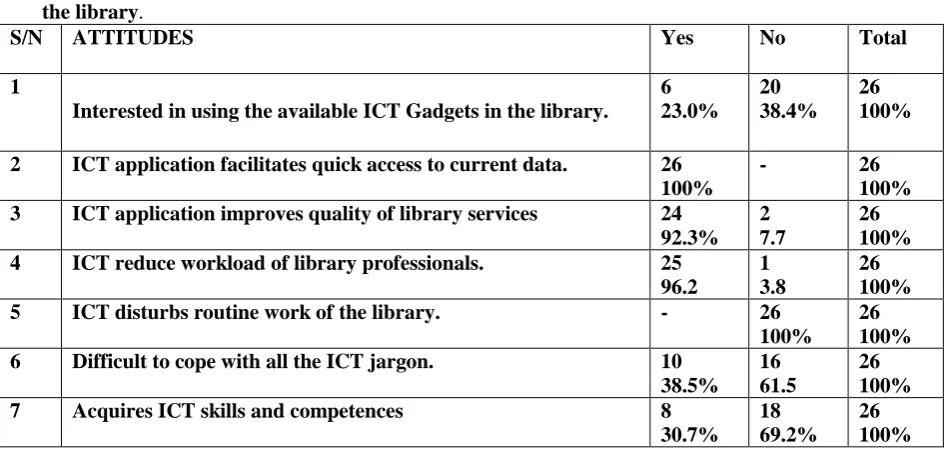
Table 3- response on the attitude of library staff towards the implementation/use of ICT facilities in the library.
S/N ATTITUDES
Yes No Total
1
Interested in using the available ICT Gadgets in the library. 6 23.0% 20 38.4% 26 100%
2 ICT application facilitates quick access to current data. 26 100%
- 26
100% 3 ICT application improves quality of library services 24
92.3% 2 7.7
26 100% 4 ICT reduce workload of library professionals. 25
96.2
1 3.8
26 100%
5 ICT disturbs routine work of the library. - 26
100%
26 100%
6 Difficult to cope with all the ICT jargon. 10
38.5% 16 61.5
26 100%
7 Acquires ICT skills and competences 8
30.7% 18 69.2%
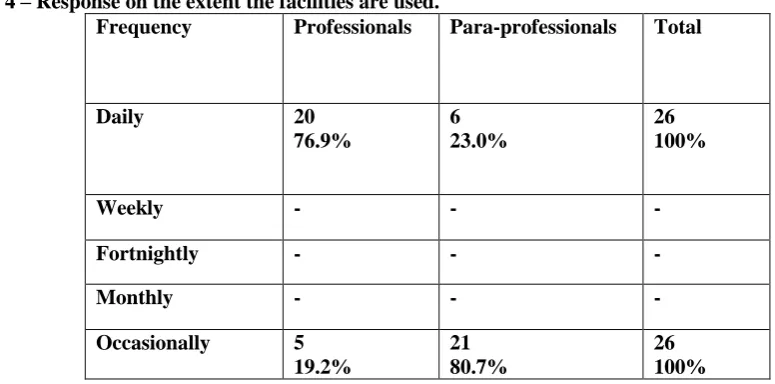
57 Table 4 – Response on the extent the facilities are used.
Frequency Professionals Para-professionals Total
Daily 20
76.9%
6 23.0%
26 100%
Weekly - - -
Fortnightly - - -
Monthly - - -
Occasionally 5 19.2%
21 80.7%
26 100%
Discussion of Findings
The findings of the study shows that the library is automated, but indicates that automation is still partial, this was in line of the response from the data collected and analyzed in research question one. It also revealed the number of ICT facilities available in the library as: Computers 482, printers -6, UPS – 6, Scanner – 1, power Surge – 9 but denied the availability of Digital camera. In item 1.3 the respondents accepted the presence and use of Alexandria, Resource mate and E-Grenary software and denied the use and availability of Koha, Greenstone, CDS/ISIS/WINISIS in the library. In item 1.4, the respondents disclosed the numbers of trained staff involved in carrying out automation in their library as 15 out of 26 staff of the library. In item 1.5, the respondents accepted that automation is used in the following areas of the library services thus: cataloguing, circulation (phase 1), reference and registration of books and other information carrying materials in their database, but denied automation in the areas of General administration, classification, OPAC, Acquisition and serial control. In item 1.6, the respondents accepted that services are rendered using ICT in the following areas: Reference, CAS, preservation of books, digitization, internet access, but denied using ICT in SDI services, the respondents finally agreed there is future automation plans in the sense, the University librarian is working towards fully automated library system.
On the other hand, it revealed that ICT peripherals are provided in the library such as Server, UPS, Photocopier, Monitor, CPU and Printer with 100% provision respectively, but pointed out that internet; Telephone and scanner are not always provided. Not only that, those facilities are made available for use in the library, they are all in good working condition.
It also revealed that some library staff are not always interested in using the available ICT gadgets in the library with the percentage of 23.0% response as (Yes) option and 38.4% response as (No) option in item 1, items 2,3,4 revealed that ICT application facilitates quick access to current information with 100% Yes option, ICT application improves the quality of library services with the highest percentage of 92.3, ICT reduce workload of library professionals with the percentage of 96.2. While item 5 disagree that ICT does not disturb routine work of the library with 100% of (No) Option percent as against 0% of (yes) option. Item 6 agree that some library staff find it difficult to cope with ICT jargons with the percentage of 38.5% yes option and 61% of No option respectively. item 7 revealed that majority of library staff do not acquire the necessary ICT skills which made them to be incompetent in the use of ICT facilities, this was revealed in the percentage of 30.7% (yes) options as against 69.2 (No) option.
58 the ICT facilities but some of them occasionally make use of it with the percentage of 80.7 and 23.0 daily either to watch movie or to play games but do not use it for what it is made for, that is provision of reference services to the library users.
Conclusion and recommendation
There is no doubt that reference sections of the libraries are the power generating house of the academic libraries without which the library will remain irrelevant in today’s information age. The study examines the impact of ICTs in the provision of reference services in academic libraries in Nigeria; Most of the objectives of the study are met within the results. Majority of the respondents are aware and use ICT application in computer, such as internet surfing. Majority of the respondents which are experienced user frequently use ICT facilities, most common ICT activities of the respondents are surfing internet, chat, email and preparing presentations etc, main purpose of using ICT in the library is to look up for information for the library patrons, electronic communication and prepare better informed and stay ahead. Therefore, the attitude of library professional has very much importance in the context of ICT application in the library.
We are living in the digital age, where information explosion and customer care are one of the major challenges. In this context, it is inevitable for academic library to provide richer information to their patrons fulfilling their information needs. The statement also, that ICT application to reference services improves quality library services and facilitates quick access to information is unquestionable. At that same time, it is not also surprising that a lot of things hinder the effective use of ICT gadgets such as inability to acquire ICT skills by the Library staff, difficulty in understanding ICT jargons and lack of interest to make use of ICT facilities by the library staff. In the light of these, if the libraries must live to continually fulfill their primary goal which is the satisfaction of information needs of users, it should be giving a deep priority.
The attitude and skills of the library staff can be developed positively by providing training for them and conducting seminars and conference on the ICT application in the library. Trained professionals with ICT having positive attitude will ensure the development of libraries and information centers.
References
Abubakar, B. M. (2010). Incorporating information technology in library and information science
curriculum in Nigeria: a strategy for survival in the 21st century.
Adeleke, I. T., Lawal, A. H., Adio, R. A., & Adebisi, A. A. (2014). Information technology
skills and training needs of health information management professionals in Nigeria: a
nationwide study. Health Information Management Journal.
Ansari, M. N. (2013). ICT Skills Proficiency of Library Professionals: A Case Study of Universities in Karachi, Pakistan. Chinese Librarianship: an International Electronic Journal, 36. 72 – 84. URL: http://www.iclc.us/cliej/cl36ansari.pdf
Anyoku, E. N. (2012). Computer skills set of librarians in Nigeria: confronting the stereotype. Annals of
Library and information Studies. 59, 128 – 134. Accessed online on February 12, 2013 at http://nopr.niscair.res.in/bitstream/123456789/14441/1/ALIS%205 9%282%29%20128-134.pdf . Hussain A. & Lavanya N. (2014), the impact of ICTS in library and information Services at Indus Business
Academy, Bangalore. IJKM vol1, no.3
Nkamnebe et al (2015), Extent of information and communication Technology skills possessed by
Librarians in University Libraries in Anambra State, Nigeria… Information and knowledge
Management vol 5 No 9.
Osawaru, E. E & Krubu, D.E (2011), The impact of information and communication technology (ICT) in Nigeria University libraries. Library philosophy and practice. Retrieved September 26, 2019 from, digitalcommons.unl.edu/cgi/viewcontent.cgi?article=1602…
59
Sahu, A. K. & Rasul, G., (2011). Use of IT and its impact on service quality in an academic
library
Susan Mathew K. (2011). Impact of information communication technology (ICT) on aprofessional
development and educational needs of library professionals in the University of Kerala.