Trollius austrosibiricus (Ranunculaceae), a new species
from South Siberia
Andrey Erst1,2, Alexander Luferov3, Victoria Troshkina1, Dmitry Shaulo1,
Alexander Kuznetsov2, Kunli Xiang4,5, Wei Wang4,5
1 Laboratory Herbarium (NS), Central Siberian Botanical Garden, Russian Academy of Sciences, Zolotodo-linskaya st. 101, 630090, Novosibirsk, Russia 2 Laboratory Herbarium (TK), Tomsk State University, Lenin st. 36, 634050, Tomsk, Russia 3 I.M. Sechenov First Moscow State Medical University, Izmailovsky Boulevard, 8, 105043, Moscow, Russia 4 State Key Laboratory of Systematic and Evolutionary Botany, Institute of Botany, Chinese Academy of Sciences, 100093, Beijing, China 5 University of Chinese Academy of Sciences, 19 Yuquan Road, Beijing 100049, China
Corresponding author:Andrey Erst ([email protected])
Academic editor:M. Pellegrini | Received 26 October 2018 | Accepted 3 January 2019 | Published 28 January 2019
Citation: Erst A, Luferov A, Troshkina V, Shaulo D, Kuznetsov A, Xiang K, Wang W (2019) Trollius austrosibiricus (Ranunculaceae), a new species from South Siberia. PhytoKeys 115: 83–92. https://doi.org/10.3897/phytokeys.115.30863
Abstract
Trollius austrosibiricus Erst & Luferov, sp. nov., a new species from Russian South Siberia is described and illustrated. This new species is endemic to Western and Central Siberia. Morphologically, it is close to the East Asian species T. chinensis and T. macropetalus. However, it differs from the aforementioned species due to the morphology of the rhizomes, aerial shoots, sepals and petals. This species is also distinguished from T. asiaticus, which is widespread in Russia (Western and Eastern Siberia), Mongolia, China, north-eastern Kazakhstan and in the northeast of the European part of Russia, in having a smaller number of sepals, longer persistent styles and petals longer than sepals. In addition, an identification key for all Rus-sian species is given and all species have been discussed.
Keywords
Ranunculaceae, Trollius, new species, South Siberia, Russia
Andrey Erst et al. / PhytoKeys 820: 83–92 (2019)
84
Introduction
Trollius L. (Ranunculaceae) is distributed in temperate to arctic regions of the Northern
Hemisphere and has two centres of diversity in SW China and the area ranging from Siberia, the Pamirs and Kashmir (Doroczewska 1974). The genus is characterised by conspicuous orange- or yellow-coloured flowers, similarly coloured petals, subscapose habit and ternate or deeply 3-lobed leaves (Kadota 1987). Trollius is distinguished by an unusual floral structure with petals divided into blade, pit (nectarostigma) and claw (Wang et al. 2010). Length ratio of nectaries to stamens has been considered to be one of the most important morphological characters for species delimitation (Schipczinsky 1937, Siplivinsky 1972, Kadota 1987, Tamura 1995, Luferov et al. 2018). Species be-longing to the T. sect. Longipetala Dorosz. are characterised by linear, flat, thin petals, which are longer than the sepals or nearly equal to them. All representatives belonging to this group, except T. asiaticus, are common to the Far East part of Asia. All Siberian species are characterised by petals shorter or equal to sepals. When carrying out a revi-sion of the genus for Russia, we focused on specimens whose petals are much longer than the sepals. Further revision of the herbarium material allowed us to describe a new species of Trollius from South Siberia.
Methods
The revision of herbarium material was undertaken in the herbaria LE, MHA, ALTB, NS and NSK (Thiers 2017). The drawings of Trollius austrosibiricus are based on the images of the type specimens (NS-0013097). The photographs in the field were taken by a Nikon D90 camera. The morphological characters were measured using AxioVi-sion 4.8. The flowering and fruiting periods and habitats are given as cited on the collector’s labels. The IUCN Red List Categories and Criteria (IUCN 2016) were ap-plied to assess the conservation status. All revised localities of Trollius austrosibiricus
mentioned in the paper are shown on a map (Fig. 1) made with SimpleMappr (http:// www.simplemappr.net).
Taxonomy
Trollius austrosibiricus Erst & Luferov, sp. nov.
urn:lsid:ipni.org:names:77194177-1
Figs 2, 3
Figure 1. Distribution map of Trollius austrosibiricus.
V. Khanminchun, M. Danilov & P. Enns without collector number (holotype: NS
barcode 0013097!).
Diagnosis. Trollius austrosibiricus is morphologically close to T. chinensis Bunge
and T. macropetalus (Regel) Fr.Schmidt. It differs from these species in simple
rhi-zomes, shorter aerial shoots, smaller flowers and shorter persistent styles. The new spe-cies is distinguished from T. asiaticus L. by a smaller number of sepals, longer persistent styles and petals longer than sepals.
Description. Herbs perennial, (20–)40–70 cm high. Rhizomes simple or slightly branching, short, erect or arched, with a bundle of adventitious roots. Stems straight, simple, less often weakly branched, slightly grooved. Basal leaves (1–)2–4, spirally-alternate, congested in a basal rosette; petioles 10–25(–35) cm long; blades 4–7 × 5–8 cm, rhomboid, 3–5(–7)-lobed, segments dissected almost to the midrib into lobes, ending sharply with edges dentate. Cauline leaves 2–5(–7), opposite, with short petioles or sessile, gradually smaller towards the apex. Inflorescence terminal, 1(–2)-flowered.
Flowers 3.5–4.5(–5.5) cm diam.; pedicels 5–12 cm long, elongating in fruit up to 8–15
cm long; sepals 8–10(–14), 1.3–2.4 × 0.8–1.5 cm, rhombic-ovate or broadly elliptic, reddish-orange or yellow-orange; petals 9–18, 2–2.8 × 0.2–0.3 cm, oblong-lanceolate, slightly wider at middle, base narrow cuneate, apex acute, orange- or reddish-orange coloured, nectarostigma 2.5–3 mm from base; stamens more than (9)10, filaments 7-11mm long, anthers 1.5–2(–2.5) mm long, linear; Fruits aggregate, with 9–14(17) follicles, 10–15 mm long, persistent style 1.5–3.0 mm long, slightly incurved.
Andrey Erst et al. / PhytoKeys 820: 83–92 (2019)
86
Jul 1980, M. Danilov & A. Krytsin 932 (NS barcode 0013096!); the northern slope of the East Tannu-Ola ridge, the average flow of Elegest river, floodplain, No., 22 Jul 1973, V. Khanminchun & V. Dyukov 2270 (NS barcode 0013095!); Kemerovo Oblast: Tash-tagol region, the village of Ust-Kabyrza 4 km above Pysas river, 52º48’N, 88º28’E, 450 m alt., grass meadow, haymaking, 11 Sep 2000, I. M. Krasnoborov, A. I. Shmakov, D. Germann, S. Kostyukov, E. Antonuk, P. Kosachev & A. Vashchenko 207 (NS barcode 0013094!); Krasnoyarsk Krai: Abansky region, near Ustyanskoye village, the upper part of the eastern slope, upland meadow, 6 Jul 1956 T. Vagina (NS barcode 0013093!); Ermakovsky district, valley of the US river, elevation 852 m alt., 52.2847°N, 93.2517°E, 03 Jul 2010, I.V. Khan & E.A. Balde 152 (NSK barcode 0028601!); Khakassia Repub-lic: Abansky ridge, near Biskamzha station, southern slope, burning, 53.25 N, 089.30E, 700 m alt., 4 Jun 1991, E. Ankipovich (NS barcode 0013092!).
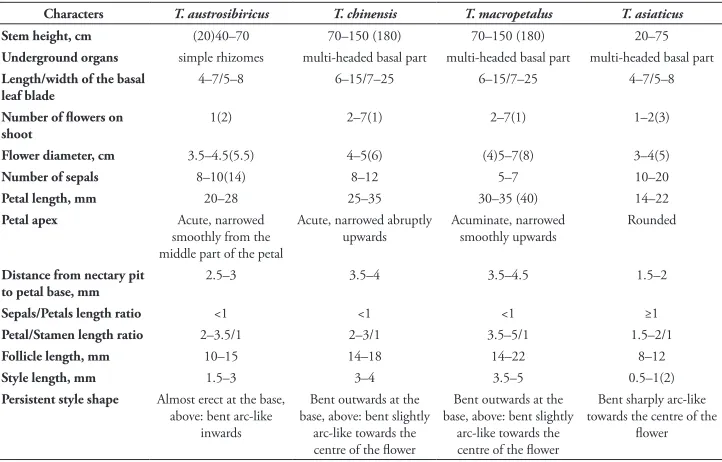
Affinities. Trollius austrosibiricus is morphologically close to T. chinensis Bunge
and T. macropetalus (Regel) Fr.Schmidt. It is well distinguished by simple rhizomes
(rather than by the multi-headed basal part of the plant, as in T. chinensis and T.
macropetalus), shorter aerial shoots, smaller flowers and shorter persistent styles
(Table 1). Trollius chinensis is an East Asian species occurring in Russia (Primorsky
Andrey Erst et al. / PhytoKeys 820: 83–92 (2019)
88
and Khabarovsk territories, Sakhalin), in the north and northeast of China and on the Korean peninsula (Schipczinsky 1937, Siplivinsky 1972, Doroczewska 1974, Kitagawa 1979, Woroshilov 1982, Luferov 1991, 2004).
This new species is distinguished from T. asiaticus L. by a smaller number of sepals, longer persistent styles and petals longer than sepals (Table 1). Trollius asiaticus grows mainly in extra-tropical Asia (Western and Eastern Siberia, Mongolia, northeast Ka-zakhstan and China), as well as in the northeast of European Russia (Schipczinsky 1937, Siplivinsky 1972, Doroczewska 1974, Borodina-Grabovskaya 2001, Friesen 2003).
Phenology. Flowering from April–early May; fruiting in May.
Distribution. Trollius austrosibiricus is endemic to mountainous areas of the southern part of Western and Central Siberia. Russia: Tuva Republic, Kemerovo dis-trict, Krasnoyarsk territory, Khakassia (Figure 1).
Habitat and ecology. Trollius austrosibiricus grows in subalpine and forest zones, in moist valleys at 350–2400 m elevation. It occurs in forest glades and fringes, in mixed-grass and mixed-grass-cereal dry and swampy meadows, along the banks of riv-ers, streams and small ponds with fresh water.
Etymology. The specific epithet of the new species is derived from the type local-ity, South Siberia, Russia.
Preliminary conservation assessment. No appropriate data on abundance and/ or distribution of the taxon are available. It can be included in the Not Evaluated (NE) category of IUCN Red List Categories (IUCN 2016) as it lacks adequate information
Table 1. Morphological comparison between Trollius austrosibiricus and related species.
Characters T. austrosibiricus T. chinensis T. macropetalus T. asiaticus
Stem height, cm (20)40–70 70–150 (180) 70–150 (180) 20–75
Underground organs simple rhizomes multi-headed basal part multi-headed basal part multi-headed basal part
Length/width of the basal
leaf blade 4–7/5–8 6–15/7–25 6–15/7–25 4–7/5–8
Number of flowers on
shoot 1(2) 2–7(1) 2–7(1) 1–2(3)
Flower diameter, cm 3.5–4.5(5.5) 4–5(6) (4)5–7(8) 3–4(5)
Number of sepals 8–10(14) 8–12 5–7 10–20
Petal length, mm 20–28 25–35 30–35 (40) 14–22
Petal apex Acute, narrowed
smoothly from the middle part of the petal
Acute, narrowed abruptly
upwards Acuminate, narrowed smoothly upwards Rounded
Distance from nectary pit
to petal base, mm 2.5–3 3.5–4 3.5–4.5 1.5–2
Sepals/Petals length ratio <1 <1 <1 ≥1
Petal/Stamen length ratio 2–3.5/1 2–3/1 3.5–5/1 1.5–2/1
Follicle length, mm 10–15 14–18 14–22 8–12
Style length, mm 1.5–3 3–4 3.5–5 0.5–1(2)
Persistent style shape Almost erect at the base, above: bent arc-like
inwards
Bent outwards at the base, above: bent slightly
arc-like towards the centre of the flower
Bent outwards at the base, above: bent slightly
arc-like towards the centre of the flower
Bent sharply arc-like towards the centre of the
to make a direct or indirect assessment of its risk of extinction based on its distribution and/or population status.
Discussion
According to our data, 16 species of Trollius occur in Russia. The “Flora of the USSR” includes 11 species of Trollius, one of which is not found in Russia: T. dschungaricus Regel is confined to the east of Central Asia and China (Schipczinsky 1937). The greatest spe-cies diversity is observed in Siberia (12 spespe-cies: our data); 11 spespe-cies of Trollius (Friesen 2003) were previously indicated for this region, of which we recognise 9 and T. sayanensis
(Malyschev) Sipl. and T. vicarius Sipl. are synonyms to T. asiaticus L and T. uniflorus Sipliv. Nine species grow in the Far East (Luferov et al. 2018), 5 species of Trollius are found in the European part of Russia (Tzvelev 2001) and 1 species occurs in the Caucasus (Boro-dina-Grabovskaya 2012). Many species that have been described recently from Russia require more detailed investigation and evidence of species independence (Luferov et al. 2018). Many taxa of the genus have intermediate characteristics of the groups described by A. Doroczewska (1974) as sections. The groups considered in this monograph require verification, since many species exhibit intermediate features between sections. Molecu-lar phylogeny has not yet been developed, but there are some works related to a small number of species that do not consider the classification of groups (Despres et al. 2003, Wang et al. 2010). Representatives of the Trollius section occur in Russia (petals 6–14 mm long, linear, apex rounded or spatulate, with no groove at the base; plants of Asia, Europe and the Caucasus): T. europaeus, T.altaicus and T. ranunculinus; the Longipetala
sections (petals 7–40 mm long, oblong, narrow, flat, thin, not thickened and dull, similar to sepals and usually orange): T. macropetalus, T. ledebourii, T. austrosibiricus, T. asiaticus,
T. kytmanovii and T. apertus; the Insulaetrollius sections: (petals 2–12 mm long, linear,
ex-tended or pyriform, grooved at the base; plants of the Okhotsk-Japan-Kamchatka region):
T. riederianus, T. sibiricus, T. uniflorus, T. japonicus, T. miyabei, T. membranostylis and T.
chartosepalus. It should be noted that many morphological characters used to distinguish
between species and groups of species are not fully developed, do not cover the entire morphological diversity of the genus Trollius and are very variable (many hybridogenic taxa have not yet been described, many species ecomorphs are not yet known). For proper identification, classification and understanding of groups in the genus Trollius, complex studies are needed, including micro- and macro-morphological, molecular phylogenetic, cytogenetic etc. This paper presents the results of taxonomic studies that enabled develop-ment of the key to identification of the Trollius species, based on the novel morphological and rhythmological features: for example, indication of the falling (in T. chartosepalus) and non-falling sepals (in other species), shape, the size of sepals, petals, persistent styles, their size ratio, the colour of the flower elements, leaflets and stigmas.
Andrey Erst et al. / PhytoKeys 820: 83–92 (2019)
90
Key to identification species of the genus Trollius from Russia
1 Flowers globular, closed due to overlapping sepal edges; petals, stamens and pistils not visible during flowering ...T. europaeus – Flowers bowl-shaped, saucer-shaped or, if globular, always open: sepal edges
do not overlap; petals, stamens and pistils visible during flowering...2
2 Petals longer than sepals and protrude from the flower ...3
– Petals equal to sepals or shorter ...4
3 Sepals 5–7. Petals 30–40 mm long, 1.5–2 times longer than sepals. Persistent styles 3.5–5 mm long ...T. macropetalus – Sepals 8–14. Petals 20–28 mm long, 1.2–1.5 times longer than sepals. Persis-tent styles 1.5–3 mm long ...T. austrosibiricus 4 Petals 1.5–2 times longer than stamens ...5
– Petals shorter ...8
5 Persistent styles and stigmas purplish-black or often blackening. Persistent styles 2.5–3 mm long (Plants from the Altai Republic) ...T. altaicus – Persistent styles and stigmas light green or yellow-green. Persistent styles less than 2 mm long ...6
6 Plants 80–100 cm high. Sepals 5–9 (12) ...T. ledebourii – Plants 20–75 cm high. Sepals 10–20 ...7
7 Sepals reddish-orange. Persistent styles 0.5–1 mm long ...T. asiaticus – Sepals yellow-orange or yellow. Persistent styles 1.5–2 mm long ... ...T. kytmanovii 8 Plants bloom prior to leaf expansion. Sepals white or pale cream, finely den-tate along the edge, do not fall long after flowering. Leaflets up to 25 mm long. Persistent styles 8–18 mm long, equal to or longer than the ovary, thin, straight or slightly curved ...T. chartosepalus – Plants bloom with leaves developed. Sepals from pale yellow to orange, typi-cally smooth-edged, fall at the end of flowering. Leaflets up to 15 (18) mm long. Persistent styles not more than 5 mm long, several times shorter than the ovary, more or less thickened, incurved ...9
9 Persistent styles 4–5 mm long, 3 times shorter than leaflets. Sepals golden-yellow ...T. ranunculinus – Persistent styles less than 3 mm long, 5–7 times shorter than leaflets ...10
10 Petals equal to stamens, 1–3 mm longer or shorter ...11
– Petals 2–2.5 times shorter than stamens ...15
11 Sepals 5–7 ...12
– Sepals 9–12 ...14
13 Leaf blades round-pentagonal, 4–8 cm long, 5–10 cm wide, dentate with triangular acute and sharp teeth. Flowers 3–4 cm in diameter. Sepals yellow-orange or yellow. Petals are reddish-yellow-orange, equal to stamens or 1–3 mm longer. Leaflets with arcuate, unbreakable persistent styles 2–3 mm long ... ...T. riederianus – Leaf blades are rounded- reniform, 8–14 cm long, 10–24 cm wide, dentate
with narrow-triangular acute and sharp teeth. Flowers 2.5–3.5 cm in diam-eter. Sepals pale yellow or yellow-orange. Petals orange, 1–3 mm shorter than stamens. Leaflets straight or slightly arcuate, with longer (3–4.5 mm long), thin, brittle persistent style ...T. japonicus 14 Plants up to 40 cm high. Stem simple, with 1 flower. Sepals grey-yellow. Pet-als narrow-linear, acute, yellow-orange, 1–3 mm longer than stamens. Pedi-cels up to 10 cm long with fruits up to 20 cm. Leaflets are light green. (Plants from Siberia and the mainland of the Far East) ...T. sibiricus – Plants 70–120 cm high. Stems branched, with 2–5 flowers, less often simple.
Sepals yellow-orange or golden-yellow. Petals obovate or spatulate, blunt, or-ange, equal to stamens in length. Pedicles 2–5 cm long with fruits up to 10 cm. Leaflets reddish-brown later blackening. (Plants from Sakhalin Island) .. ...T. miyabei 15 Sepals 5–6. Persistent styles up to 1.4 mm long, subulate, straight or slightly
curved ...T. uniflorus – Sepals 9–12. Persistent styles about 2 mm long, with flattened edges, webbed,
arched ...T. membranostylis
Acknowledgements
We thank the staff of the Herbaria visited, I. Khan and E. Balde for the images of Trollius
flowers and Iuzhakova Maria for text correction. The research was supported by the Scien-tific Programme АААА-А17-117012610055-3 of the Central Siberian Botanical Garden, of SB RAS (revision in the herbarium NSK) and the Tomsk State University competitive-ness improvement programme (revision in the herbarium NS) and the Russian Founda-tion for Basic Research, grant 18-04-0653 A (field work in South Siberia and DNA work). We would like to thank the reviewers for their valuable comments and suggestions.
References
Borodina-Grabovskaya AE (2001) Trollius L. In: Plantae Asiae Centralis, Vol. 12. Publ. SPKH-FA, 17–21. [In Russian]
Andrey Erst et al. / PhytoKeys 820: 83–92 (2019)
92
Despres L, Gielly L, Redoutet B, Taberlet P (2003) Using AFLP to resolve phylogenetic rela-tionships in a morphologically diversified plant species complex when nuclear and chlo-roplast sequences fail to reveal variability. Molecular Phylogenetics and Evolution 27(2): 185–196. https://doi.org/10.1016/S1055-7903(02)00445-1
Doroczewska A (1974) The genus Trollius L. A taxonomical study. Monographiae botanicae. Panstwowe wydawnictwo naukowe, Warszawa, 184 pp.
Friesen NV (2003) Trollius L. – Flora of Siberia (Vol. 6). Science Publ., Inc., Enfield and Plym-outh, 98–103.
IUCN (2016) The IUCN Red List of threatened species: Version 2013.2. IUCN Red List Unit, Cambridge. http://www.iucnredlist.org [Accessed: 17 May 2017]
Kadota Y (1987) Genus Trollius L. (Ranunculaceae) in Japan. Bulletin of the National Science Museum, Tokyo Ser. B 13(3): 107–121.
Kitagawa M (1979) Neo-Lineamenta Florae Manshuricae – Flora et vegetatio mundi. Gantner, Vaduz, 717 pp.
Luferov AN (1991) New nomenclatural combinations in taxonomy of Far Eastern species of the family Ranunculaceae Juss. Bulletin of Moscow Society of Naturalists, Biological series, 96(5): 74–76. [In Russian]
Luferov AN (2004) A taxonomic synopsis of Ranunculaceae of the Far East of Russia. Turcza-ninowia 7(1): 1–85. [In Russian]
Luferov AN, Erst AS, Luferov DN, Shmakov AI, Wang W (2018) The genus Trollius (Ranuncu-laceae) in the Russian Far East. Turczaninowia 21(2): 110–116. https://doi.org/10.14258/ turczaninowia.21.2 [In Russian]
Schipczinsky NV (1937) Genus globe-flower – Trollius L. Flora of the USSR. Publishing House of the Academy of Sciences of the USSR, Moscow, Leningrad 7: 42–53. [In Russian] Siplivinsky VN (1972) The genus Trollius L. on the North and East of Asia. Novitates
system-aticae plantarum vascularium. Leningrad. 9: 163–182. [In Russian with Latin description] Tamura M (1995) Trollius L. In: Hiepko P (Ed.) Die Natürlichen Pflanzenfamilien. Duncker
und Humblot, Berlin, Vol. 17(4), 238–244.
Thiers B (2017) Index Herbariorum: A global directory of public herbaria and associated staff. New York Botanical Garden’s Virtual Herbarium. http://sweetgum.nybg.org/ih/ [Accessed 1 July 2017]
Tzvelev N (2001) Globe-flower – Trollius L. Flora Europae Orientalis. T. 10. Mir i Semia. Petropoli 2001: 40–43.
Wang W, Hu H, Xiang X-G, Yu S-X, Chen Z-D (2010) Phylogenetic placements of Calathodes and Megaleranthis (Ranunculaceae): Evidence from molecular and morphological data. Taxon 59(6): 1712–1720. https://doi.org/10.2307/41059868