Open Access
Research
Comparing a single-stage geocoding method to a multi-stage
geocoding method: how much and where do they disagree?
Gina S Lovasi*
1, Jeremy C Weiss
2, Richard Hoskins
3, Eric A Whitsel
4,
Kenneth Rice
5, Craig F Erickson
3and Bruce M Psaty
6Address: 1Columbia University, Institute of Social and Economic Research and Policy, New York, NY, USA, 2University of Washington, Cardiovascular Health Research Unit, Seattle, WA, USA, 3Washington State Department of Health, Olympia, WA, USA, 4University of North Carolina, Departments of Epidemiology and Medicine, Chapel Hill, NC, USA, 5University of Washington, Department of Biostatistics, Seattle, WA, USA and 6University of Washington, Departments of Epidemiology, Medicine, and Health Services, Seattle, WA, USA
Email: Gina S Lovasi* - [email protected]; Jeremy C Weiss - [email protected]; Richard Hoskins - [email protected]; Eric A Whitsel - [email protected]; Kenneth Rice - [email protected]; Craig F Erickson - [email protected]; Bruce M Psaty - [email protected]
* Corresponding author
Abstract
Background: Geocoding methods vary among spatial epidemiology studies. Errors in the geocoding process and differential match rates may reduce study validity. We compared two geocoding methods using 8,157 Washington State addresses. The multi-stage geocoding method implemented by the state health department used a sequence of local and national reference files. The single-stage method used a single national reference file. For each address geocoded by both methods, we measured the distance between the locations assigned by each method. Area-level characteristics were collected from census data, and modeled as predictors of the discordance between geocoded address coordinates.
Results: The multi-stage method had a higher match rate than the single-stage method: 99% versus 95%. Of 7,686 addresses were geocoded by both methods, 96% were geocoded to the same census tract by both methods and 98% were geocoded to locations within 1 km of each other by the two methods. The distance between geocoded coordinates for the same address was higher in sparsely populated and low poverty areas, and counties with local reference files.
Conclusion: The multi-stage geocoding method had a higher match rate than the single-stage method. An examination of differences in the location assigned to the same address suggested that study results may be most sensitive to the choice of geocoding method in sparsely populated or low-poverty areas.
Background
Spatial epidemiology studies often begin with address geocoding, allowing residences, facilities, or other struc-tures to be geographically located and placed in the con-text of their surroundings. Errors in the geocoding process
lead to incorrect location assignment and misclassifica-tion of the corresponding data [1]. Often, however, there is a trade off between minimizing positional error and maximizing the geocoding match rate (percentage of addresses located) [2]. That is, a process or setting may
Published: 16 March 2007
International Journal of Health Geographics 2007, 6:12 doi:10.1186/1476-072X-6-12
Received: 28 November 2006 Accepted: 16 March 2007
This article is available from: http://www.ij-healthgeographics.com/content/6/1/12
© 2007 Lovasi et al; licensee BioMed Central Ltd.
have a higher match rate at the expense of placing the address far from its location, or a higher confidence in the assigned locations at the expense of the match rate. Krieger [3] has encouraged public health researchers to evaluate and report on their geocoding methods, and a number of recent papers have done so [2-10]. In this paper, we compared two geocoding methods: an auto-mated, single-stage method and a multi-stage method used by the Washington State Department of Health (WA DOH).
MacDorman [11] found that 21 (43%) of the 49 surveyed state vital statistics departments reported some automated geocoding of address data from vital records. Software tools used varied widely, including in-house software, Matchmaker, Dynamap, Code 1, ArcInfo/ArcView, Final-ist/Final Focus, and others. Also, several states subcon-tracted their geocoding to outside agencies. The WA DOH has an established multi-stage geocoding protocol (described in detail on their website [16]), which is made available to local health departments and spatially-ori-ented public health projects throughout the state. The WA DOH uses proprietary address standardization software, local reference data where available, and Topologically Integrated Geographic Encoding and Referencing system (TIGER)-based street files from up to four different years [12]. This method required investment in software, pro-prietary geographic reference data, and programming time. We evaluated how much is gained through a multi-stage process like that of WA DOH, compared to a sim-pler, single-stage process, by looking at how and where these two methods disagreed.
Using a sample of 8,157 Washington State addresses, we compared the WA DOH multi-stage geocoding method to a single-stage geocoding method based on a single street reference file. We expected to find a higher geocoding match rate with the WA DOH multi-stage process. For addresses geocoded by both methods, we measured the distance between multi-stage and single-stage geocoded coordinates for the same address; we use this "discrep-ancy-distance" to quantify disagreement between the two methods. We expected that the multi-stage and single-stage geocoded address coordinates would be more simi-lar, and discrepancy-distances smaller, in more densely populated areas and areas where national street files were used as a reference for both geocoding methods. Further, we hypothesized that the two geocoding methods would disagree less, as indicated by smaller discrepancy-dis-tances, in low poverty areas.
Results
Of the 8,157 Washington State addresses, we were able to geocode 8,098 (99%) by at least one method and 7,686 (95%) addresses by both methods. The multi-stage
geoc-oding process matched 8,058 (99%) of the addresses, and the single-stage geocoding method matched 7,726 (95%).
While we included addresses in each of the 39 counties in Washington State, more of the geocoded addresses were in the densely populated counties. According to Census data from the year 2000, Washington State had an overall density of 34 residents per square kilometer; 68% of our geocoded addresses were in the 8 counties with densities higher than 34 residents per square kilometer. In the state, 10% of the population was below the federal poverty line; 51% of our geocoded addresses were in counties with less than 10% poverty.
While local reference data (tax parcels or street files from local government agencies) have been recommended for greater geocoding accuracy [9,13,14], these data are not uniformly available. Of all Washington State residents in the year 2000, 61% lived in counties with local street data and 68% lived in counties with parcel data; 59% and 63% of the geocoded addresses in our study were in counties with local street data and parcel data, respectively.
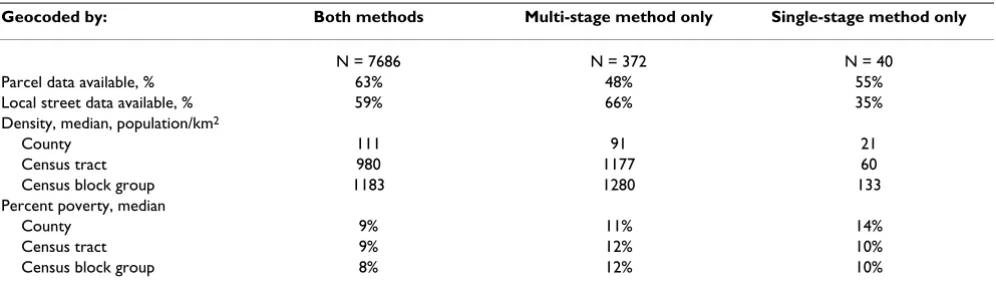
Compared to addresses geocoded by both methods, those geocoded by only the multi-stage method were less likely to be in counties with parcel data (Table 1); addresses geocoded only by the single-stage method were less likely to be in counties with local street data and tended to be in sparsely populated areas. Addresses geocoded by only one method, rather than both methods, also tended to be in areas with higher poverty rates.
For those addresses matched by both methods, 96% (7,374) were geocoded to the same census tract by each method; of addresses in the same census tract, 93% (6,859) were geocoded to the same census block group by both methods. The density and percent poverty based on the two geocoding results generally agreed as well: for density, intraclass correlation coefficients were 0.97, and 0.93 at the census tract and census block group levels, respectively; for percent poverty, intraclass correlation coefficients were 0.97 and 0.89 at the census tract, and census block group levels.
geoco-ding. We confirmed this "plus" pattern in a repeat analysis using identical offsets for both geocoding methods.
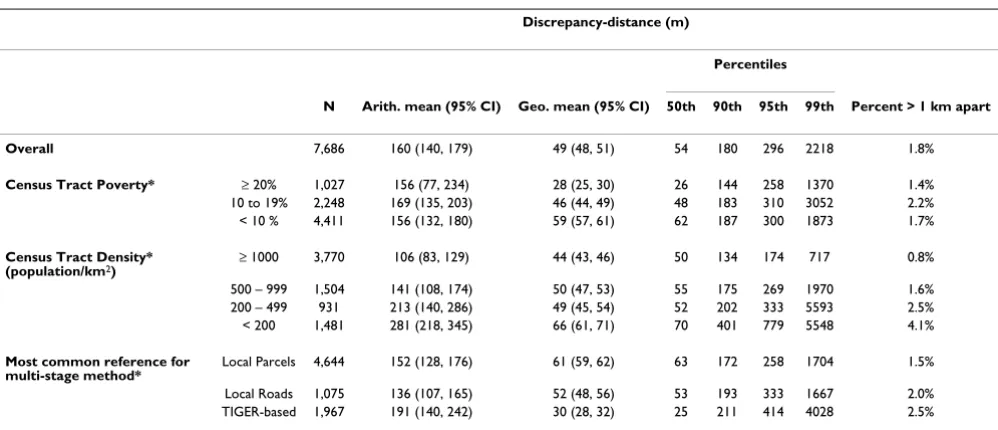
The median discrepancy-distance between locations assigned by the two methods was 54 meters, and the 90th
and 95th percentiles were 180 and 296 meters (Table 2).
The discrepancy-distance was less than 1 km for 98% of the addresses. Discrepancy-distances were largest in low-density census tracts (Figure 3a). The associations of dis-crepancy-distance with census tract poverty and multi-stage data source were not consistent. Medians and 90th
percentiles suggested that discrepancy-distances were larger in areas with less poverty, but the means and pro-portion larger than 1 km suggested the largest discrepancy distances were for areas with between 10 and 20% poverty (Table 2, Figure 3b). Areas where the WA DOH multi-stage process used local parcel data had a higher median discrepancy-distance, but fewer discrepancy-distances were greater than 1 km in these counties.
In multiple regression, accounting for poverty, density, and multi-stage reference file simultaneously, we found larger discrepancy-distances for (1) areas with lower den-sity, (2) areas with a lower percent poverty, and (3) coun-ties with local parcel data or local roads (Table 3). As density doubled, the median discrepancy-distance decreased by approximately 10%, indicating closer agree-ment in densely populated areas for the two geocoding methods. As poverty doubled, the median discrepancy-distance decreased by approximately 13%, indicating closer agreement between geocoding methods in high poverty areas. Where the multi-stage geocoding method used mainly TIGER-based street files, median discrep-ancy-distance was halved compared to counties where local parcel files were the most common reference. When corresponding models were run at the county and census block group levels, estimates for density and poverty
remained significant and estimates were in the same direc-tion.
In stratified analyses, the effects of poverty and density were in the same direction, but were most pronounced where both geocoding methods used TIGER-based street files: median ratio was 0.81 (95% CI: 0.75 – 0.86) for doubling poverty in this subgroup (likelihood ratio test p for interaction: < 0.001) for a doubling of density and the ratio was 0.86 (95% CI: 0.83 – 0.88).
Discussion
We found that a multi-stage geocoding method imple-mented by the WA DOH achieved a match rate 4% higher than that achieved by a single-stage method. Most addresses were matched by both methods, but they were not geocoded to exactly the same coordinates by each method: 10% of addresses were assigned locations at least 180 meters apart by the multi-stage and single-stage meth-ods, and 2% of addresses were assigned locations at least one kilometer apart. Locations assigned by the two meth-ods were closer together in high density and high poverty areas, and in areas where reference data sources were most similar for the two methods. The results for area-level pov-erty, which were contrary to our hypothesis, were not explained by density or availability of local reference files. The associations of area-level poverty and density with discrepancy-distance were strongest where the two meth-ods used similar reference files.
Previous studies have evaluated different single-stage geocoding methods [9] or geocoding vendors [2-4], auto-mated versus interactive geocoding methods [5], or com-pared a single-stage geocoding method with a gold standard [7,8]. Also, McElroy described and recom-mended the use of a multi-stage geocoding process, despite added costs [10]. Our study contributes to this
lit-Table 1: Area characteristics for geocoded addresses
Geocoded by: Both methods Multi-stage method only Single-stage method only
N = 7686 N = 372 N = 40
Parcel data available, % 63% 48% 55%
Local street data available, % 59% 66% 35%
Density, median, population/km2
County 111 91 21
Census tract 980 1177 60
Census block group 1183 1280 133
Percent poverty, median
County 9% 11% 14%
Census tract 9% 12% 10%
Census block group 8% 12% 10%
Distance and directional bias between geocoded address coordinates for multi-stage and single-stage geocoding methods Figure 1
Distance and directional bias between geocoded address coordinates for multi-stage and single-stage geocod-ing methods: This figure shows one dot for each address geocoded by both methods, with reference circles at 0.5 and 1.0 km. The multi-stage geocoded address coordinates was centered as a reference, and the dots used to show the relative posi-tion of the single-stage address coordinates for the same address. Dots close to the middle (0,0) represent small discrepancy-distances and high concordance between the two methods. Dots directly above the center had single-stage geocoded address coordinates further north than their multi-stage coordinates. Dots randomly scattered in all directions would indicate no directional bias, whereas an off-center cluster of dots would indicate systematic bias between the two methods. Addresses with discrepancy distances greater than 2 km were not included in this figure (N = 78).
-2
-1
0
1
2
D
ist
an
ce
i
n
k
m
-2
-1
0
1
2
erature by (1) providing further information on geocod-ing results of a multi-stage process as compared to a single-stage process, (2) confirming previous findings that geocoding methods may have better agreement in densely populated areas [4,7-9], and (3) suggesting that geocod-ing methods may also have better agreement in high
pov-erty areas, after controlling for population density. Geocoding discrepancies in low poverty areas could be due to differences in address quality, reference file quality, or other determinants of geocoding error (such as recent redevelopment, street length, or lot size). If this associa-Directional bias between geocoding methods
Figure 2
Directional bias between geocoding methods: This figure shows an angular histogram with radial lengths proportional to frequencies of shifts in each direction between the single-stage and multi-stage geocoded address coordinates. A light circle is drawn at the mean frequency for reference.
N
S
tion is confirmed, further research will be needed to dis-tinguish among these possibilities.
Our study investigated whether single-stage geocoded address coordinates were systematically shifted relative to the multi-stage address coordinates. We found that the single-stage coordinates were shifted north-south and east-west relative to the multi-stage coordinates more often than would be expected by chance alone. This may have been due to different assumptions about how addresses are spaced along a street [14], since WA streets are more likely to be oriented in the cardinal directions than would be expected by chance. In Washington State, we estimated that 42 percent of street segments are within five degrees of being oriented directly north-south or east-west (only 11 percent expected by chance). This direc-tional shift finding may be most relevant to areas where urban planners played an active role in establishing N-S and E-W roadway grids.
Since the accuracy of address geocoding depends on address quality, preprocessing, program settings and refer-ence maps [15], further research is needed to understand the effects of each component. While our study and others have controlled for address quality by using the same addresses for both methods, we simultaneously examined differences in preprocessing, geocoding software, and ref-erence maps. A limitation of our study is that we did not discern which elements contributed most to the difference between the two geocoding methods under investigation,
and cannot use these data to project differences between other approaches. We considered only one of many possi-ble contrasts between geocoding methods, by comparing one multi-stage process to one single-stage process. Given that these two methods were implemented independ-ently, using different software packages and reference files, this contrast may provide an upper bound for how much geocoding methods in large research studies would be expected to differ for a state-wide administrative data set. Also, we had no gold standard with which to evaluate the relative accuracy of the two geocoding methods; how-ever, a third geocoding method using satellite images (implemented using Google Earth Pro, as described below in the Methods section on Supplemental geocoding) agreed more closely with the multi-stage geocoding method. Rather than focusing on comparisons with a gold stand-ard, we evaluated which area characteristics predicted larger discrepancies between two geocoding methods.
Another limitation was that there may have been unmeas-ured or residual confounding by address or area character-istics in this study, interfering with our ability to assess which characteristics predicted geocoding discrepancies. Finally, the geographic scope and distribution of our study addresses limits the generalizability of this Wash-ington-based study [4]. These data were statewide and may be similar to other health department address data; however, the geocoded addresses were all numbered street addresses with ZIP codes and did not include Post Office boxes.
Table 2: Distance between locations for the same address assigned by two geocoding methods, by area characteristics
Discrepancy-distance (m)
Percentiles
N Arith. mean (95% CI) Geo. mean (95% CI) 50th 90th 95th 99th Percent > 1 km apart Overall 7,686 160 (140, 179) 49 (48, 51) 54 180 296 2218 1.8%
Census Tract Poverty* ≥ 20% 1,027 156 (77, 234) 28 (25, 30) 26 144 258 1370 1.4% 10 to 19% 2,248 169 (135, 203) 46 (44, 49) 48 183 310 3052 2.2% < 10 % 4,411 156 (132, 180) 59 (57, 61) 62 187 300 1873 1.7%
Census Tract Density*
(population/km2) ≥ 1000 3,770 106 (83, 129) 44 (43, 46) 50 134 174 717 0.8%
500 – 999 1,504 141 (108, 174) 50 (47, 53) 55 175 269 1970 1.6% 200 – 499 931 213 (140, 286) 49 (45, 54) 52 202 333 5593 2.5% < 200 1,481 281 (218, 345) 66 (61, 71) 70 401 779 5548 4.1%
Most common reference for
multi-stage method* Local Parcels 4,644 152 (128, 176) 61 (59, 62) 63 172 258 1704 1.5%
Local Roads 1,075 136 (107, 165) 52 (48, 56) 53 193 333 1667 2.0% TIGER-based 1,967 191 (140, 242) 30 (28, 32) 25 211 414 4028 2.5%
Discrepancy-distance indicates distance between multi-stage and single-stage geocoded address coordinates for the same address; p50, p90, p95, and p99 indicate the 50th, 90th, 95th, and 99th percentiles; TIGER indicates Topologically Integrated Geographic Encoding and Referencing system line
files, this includes NAVTEQ and Dynamap reference files
Discrepancy-distance distributions by category of (a) density and (b) poverty Figure 3
Discrepancy-distance distributions by category of (a) density and (b) poverty: This figure shows a smoothed kernel density (similar to a histogram) for discrepancy-distances by category. Large discrepancy-distances indicate disagreement between the single-stage and multi-stage geocoding methods. Density is categorized using the number of residents per square kilometer in the census tract. Poverty is categorized using the percent of residents below the poverty line in the census tract.
Prob
ab
ility
d
ensity
fu
n
ction
0
100
200
300
400
500
600
700
800
Density:
≥
1000
Density: 500 - 999
Density: 200 - 499
Density: < 200
a
Discrepancy-distance (m)
0
100
200
300
400500
600
700
800
Poverty:
≥
20%
Poverty: 10 - 19%
Poverty: < 10%
b
Discrepancy-distance (m)
Prob
ab
ility
d
ensity
fu
n
The importance of the differences between any two meth-ods depends on the context and purpose of geocoding. Both the level of analysis and hypothesized exposure effects will influence the cost of geocoding errors. The available data or confidentiality protections may con-strain some researchers to work with data at the zip code or census tract level, or even "jittered" address locations with deliberately introduced error. Some researchers might find our 96% concordance at the census tract level encouraging. Single-stage geocoding using street addresses may be adequate for some research purposes. However, for a study of small-scale environmental expo-sures, such as radiation, the ability to detect or replicate an association may depend on the geocoding method selected, and even multi-stage geocoding may place addresses far from their actual locations. The importance of relative geocoding precision may also vary across areas. For example, the commonly observed pattern of decreased geocoding accuracy in sparsely populated areas may be of little concern if an exposure, such as air pollu-tion, is less variable across small distances in a rural con-text. Geocoding match rates which vary among geocoding methods can also affect the power and external validity [6] of spatial epidemiology studies; subjects with unmatched addresses may not be representative and are generally excluded from further analyses.
We refer those choosing a geocoding method for a partic-ular study, research group or health department to previ-ously published reviews and recommendations [1,3,6,14]. Based on our experience, even a group with limited resources and time can incorporate geocoding through a low-cost, single-stage method, like the one described here. This is likely to be adequate when (1) the addresses are relatively free of spelling and formatting errors, as may be the case with billing addresses; (2) the addresses of interest are mainly in high density or high poverty areas; and (3) the exposure of interest varies only gradually with distance. For organizations like the Wash-ington State DOH, initial costs for setting and validating a multi-stage system may facilitate a variety of projects by
improving match rates and utilizing local geographic files when available. Another option, not evaluated here, would be using a commercial geocoding vendor [2,4,7].
Conclusion
The multi-stage geocoding method examined in our study had the advantage of a higher match rate, but without a gold standard with which to gauge the accuracy of the two geocoding methods we could only guess the relative valid-ity of the two methods. Our findings and those of previ-ous studies suggest that the choice of geocoding method may be especially influential in areas with low density or low poverty.
Methods
Address dataA sample of addresses throughout Washington State was geocoded using the multi-stage WA DOH method and a single-stage method within a GIS software package. This convenience sample included 8,753 addresses of licensed daycare providers in Washington State, collected from 2003–2005 by the Children's Administration of the Washington State Department of Social and Health Serv-ices.
All addresses had an accompanying ZIP code, but two were street intersections and 156 others had no street number. The addresses without street numbers were not geocoded by either method. There were also 475 Post Office boxes and two Mail Stop numbers. After intersec-tions, addresses without a street number, Post Office boxes and Mail Stops were excluded, 8,157 addresses remained in our analyses.
Multi-stage geocoding
The multi-stage geocoding method used by the WA DOH is documented online [16]. This method began with auto-mated preprocessing: autoauto-mated address correction, standardization to United States Postal Service (USPS) format, and parsing. Preprocessing was done using Cen-trus software [17].
Table 3: Multi-variable regression model of discrepancy-distance
Ratio of discrepancy-distance medians* (95% CI)
Poverty in census tract Two-fold increase 0.87 (0.85 – 0.91)
Density of census tract Two-fold increase 0.90 (0.88 – 0.91)
Multi-stage reference file Local Parcels 1.00 (reference)
Local Roads 0.89 (0.82–0.96)
TIGER-based 0.47 (0.44–0.51)
Discrepancy-distance indicates distance between multi-stage and single-stage coordinates for the same address; TIGER indicates Topologically Integrated Geographic Encoding and Referencing system line files, this includes NAVTEQ and Dynamap reference files
After preprocessing, addresses were geocoded in stages by matching them to different reference maps of tax parcels or streets using ArcView 3.2 [18]. At each stage, the remaining unmatched addresses were geocoded using a different reference file. Tax parcel data linking addresses to geographic coordinates were used first, accounting for 45% of the address matches, but were used in only 8 of 39 counties. For those addresses not matched to parcels, the following street reference files were used, in this order: local street reference files (available for 14 counties in Washington State, 21% of address matches); enhanced TIGER-based NAVTEQ GPS Streets (from Navigation Technologies [19], 25% of address matches); and TIGER-based line files (including the Geographic Data Technol-ogy Dynamap, provided with ArcView [18]). In addition to year 2000 TIGER-based line files (accounting for 8% of address matches), TIGER-based line files from three other years were used (1998, 1995, 1992); these earlier years were used to match only one percent of the study addresses. Geocoding was attempted for each reference file using strict criteria to identify a match, and these stages were repeated for addresses that had not yet been matched using less stringent match criteria. This geocod-ing sequence was executed usgeocod-ing custom-written program scripts in the language Avenue [18].
To assess data accuracy/availability at the county level, we recorded the type of reference file (local parcel, local street, or TIGER-based street file) most commonly used for the multi-stage geocoding process for each county. We also categorized counties according to whether local par-cel and street data, collected from 2000 to 2003, were available to WA DOH at the time of multi-stage geocod-ing.
Single-stage geocoding
Single-stage geocoding for this project was done using Maptitude GIS software, version 4.7 [20]. This software was selected as representative of GIS software products that include street files (value-added TIGER files), and because address standardization to USPS format is done as part the geocoding process. Directional prefixes (e.g. the "N" in "N 123 Fourth St") in 68 addresses prevented the single-stage method from finding a match, but 97% of these addresses were matched by the multi-stage method.
We used the default geocoding setting to identify exact or approximate ("normal") street address matches within the provided postal code. In a sensitivity analysis, a very strict match criterion reduced the single-stage match rate to 67 percent, and reduced the proportion of discrepancy-distances above one kilometer to 0.5 percent (mean dis-crepancy-distance was reduced from 160 meters to 91 meters). Another sensitivity analysis showed that chang-ing the offset from 25 to 30 feet in order to match the
off-set of the multi-stage method did not change any of the results substantially.
Supplemental geocoding
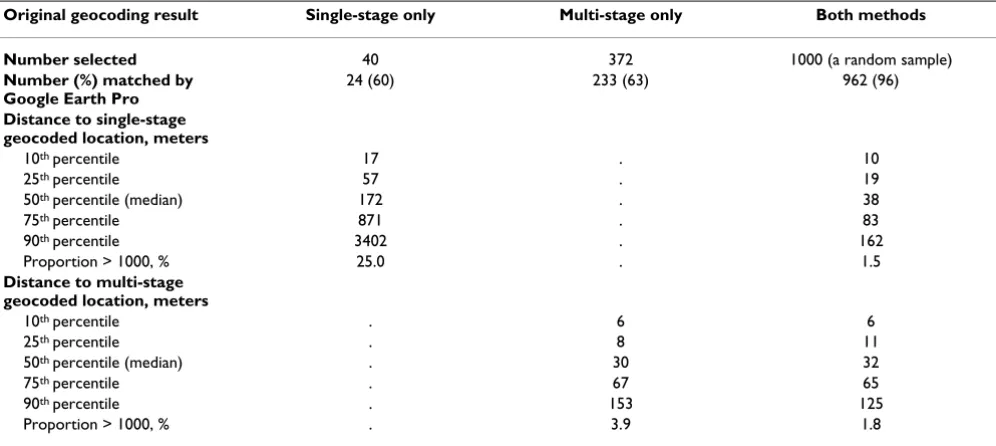
In order to explore the accuracy of the multi-stage and sin-gle-stage geocoding methods, we used Google Earth Pro (version 3.0, released November 17, 2005) to geocode a sample of the study addresses. This sample included all of the addresses matched by only one method and a random sample of 1000 addresses matched by both the single-stage and multi-single-stage geocoding methods. While not a perfect gold standard, Google Earth Pro incorporates information from satellite images during the relevant time period, 2003 to 2005. Supplemental geocoding results were similar to both multi-stage and single-stage geocod-ing results for addresses matched by both of these meth-ods (Table 4). For the small number of addresses originally geocoded by the single-stage method but not the multi-stage method, supplemental geocoding did not correspond as closely to the single-stage result.
Area characteristics
For both the multi-stage and single-stage address coordi-nates we collected information on characteristics of the surrounding county, census tract, and census block group using a point-in-polygon process. A point-in-polygon process was used, despite the limitations of this method [14], for consistency across geocoding reference files. Per-cent of poverty was selected as a measure of neighbor-hood socioeconomic status [21]. Density (population/ area) and poverty (percent of individuals below the fed-eral poverty line) were based on the 2000 Census. These data are included with the Maptitude software for the county and census tract levels [20], and were obtained for census block groups through the Washington State Geospatial Data Archive [22].
Intra-class correlation coefficients for census tract density (0.24, 95% CI: 0.08 to 0.41) and poverty (0.31, 95% CI: 12 to 51) by county indicated that census tracts in the same county tend to be similar. Likewise, intra-class corre-lation coefficients for census block group density (0.69, 95% CI: 0.66 to 0.71) and poverty (0.68, 95% CI: 0.65 to 0.71) by census tract indicated that census block groups in the same census tract tend to be similar. The correlation between poverty and density in our Washington State sample varied by level of measurement: -0.66, 0.16 and 0.21 for county, census tract, and census block group lev-els, respectively.
geocoding method (N = 42), we used areas surrounding the single-stage coordinates.
Location comparisons
Distance between the multi-stage and single-stage geoco-ded address coordinates (discrepancy-distance) was used to describe how these two geocoding methods would dif-fer for spatial epidemiology studies. To calculate distance from longitudes and latitudes we used the Haversine for-mula [23]. A greater discrepancy-distance would indicate more difference between the results of the two methods. The degree of difference may result from lower precision for one or both methods, or from a shift between the ref-erence files used by the two methods. The distribution of discrepancy-distances across categories was shown using smoothed kernel density plots.
We used a bulls-eye plot [4,8] to show the directional bias of single-stage geocoded address coordinates with respect to the corresponding multi-stage coordinates. Each dot on this plot represents one address that was geocoded by both methods. The multi-stage geocoded address coordi-nates were placed at the origin for each address, and the relative position of the single-stage coordinates was shown as a dot. Dots close to the center (0,0) had small discrepancy-distances. A dot directly above the center had a single-stage geocoded address coordinates further north than the corresponding multi-stage coordinates, and a discrepancy-distance equal to the distance away from the center. Dots randomly scattered in each direction would indicate no directional bias, whereas an off-center cloud would indicate systematic bias. An angular histogram was also used to explore the direction of displacement. In this
angular histogram, frequencies were proportional to the radial length of each slice.
Statistical analyses
Concordance of area-based characteristics for locations assigned by the two geocoding methods was examined using intraclass correlation coefficients which incorpo-rated information on bias as well as association [24].
Hypotheses regarding differences in discrepancy-distance by area-level characteristics were tested using linear regres-sion models with robust variance estimation in Stata 8.2 [24]. We fit regression models with log-transformed dis-crepancy-distance as the outcome; predictors were log-transformed population density, log-log-transformed percent below poverty line, and the most common reference file used for the multi-stage method in that county (three cat-egories). Log-transformations were used to moderate skewness and heteroscedasticity.
We present model results as ratios of geometric means, which are approximately equivalent to ratios of medians. Geometric means or medians are used as measures of cen-tral tendency because of the skewed distribution of dis-crepancy-distances: many discrepancy-distances are quite close to zero, and only a few are above one kilometer, so that the mean is consistently higher than the median (for a normal distribution, the mean and median are approxi-mately equal). A 10% decrease in the median discrepancy-distance can be interpreted as a shift in the distribution such that the midpoint decreases by 10%, even though the skewed shape remains. More generally, this decrease in discrepancy-distances indicates that the two methods are
Table 4: Supplemental geocoding results using satellite images
Original geocoding result Single-stage only Multi-stage only Both methods
Number selected 40 372 1000 (a random sample)
Number (%) matched by Google Earth Pro
24 (60) 233 (63) 962 (96)
Distance to single-stage geocoded location, meters
10th percentile 17 . 10
25th percentile 57 . 19
50th percentile (median) 172 . 38
75th percentile 871 . 83
90th percentile 3402 . 162
Proportion > 1000, % 25.0 . 1.5
Distance to multi-stage geocoded location, meters
10th percentile . 6 6
25th percentile . 8 11
50th percentile (median) . 30 32
75th percentile . 67 65
90th percentile . 153 125
Publish with BioMed Central and every scientist can read your work free of charge
"BioMed Central will be the most significant development for disseminating the results of biomedical researc h in our lifetime."
Sir Paul Nurse, Cancer Research UK
Your research papers will be:
available free of charge to the entire biomedical community
peer reviewed and published immediately upon acceptance
cited in PubMed and archived on PubMed Central
yours — you keep the copyright
Submit your manuscript here:
http://www.biomedcentral.com/info/publishing_adv.asp
BioMedcentral
in closer agreement, geocoding the same address to longi-tudes and latilongi-tudes that are closer together.
Competing interests
The author(s) declare that they have no competing inter-ests.
Authors' contributions
GSL, RH, EAW, KR, and BMP contributed to the concep-tion, study design, and presentation of the results. GSL and JCW carried out the single-stage geocoding method and comparisons of the geocoded address coordinates from the two geocoding methods. CFE carried out the multi-stage geocoding method and provided descriptions of the multi-stage geocoding process and project addresses. KR provided biostatistical guidance and assisted with the preparation of figures. GSL conducted data analyses and prepared the manuscript. All authors critically reviewed manuscript drafts and approved the final manuscript.
Acknowledgements
This research was supported by contracts R01-HL043201, R01-HL068639, and T32-HL07902 from the National Heart, Lung, and Blood Institute, by grant R01-AG09556 from the National Institute on Aging, and by a Univer-sity of Washington Royalty Research Fund Award. GSL, a Health and Soci-ety Scholar at Columbia University, thanks the Robert Wood Johnson Foundation's Health & Society Scholars Program for its financial support.
References
1. Nuckols JR, Ward MH, Jarup L: Using geographic information systems for exposure assessment in environmental epidemi-ology studies. Environ Health Perspect 2004, 112(9):1007-1015. 2. Whitsel EA, Rose KM, Wood JL, Henley AC, Liao D, Heiss G:
Accu-racy and repeatability of commercial geocoding. American journal of epidemiology 2004, 160(10):1023-1029.
3. Krieger N, Waterman P, Lemieux K, Zierler S, Hogan JW: On the wrong side of the tracts? Evaluating the accuracy of geocod-ing in public health research. American journal of public health 2001, 91(7):1114-1116.
4. Whitsel EA, Quibrera PM, Smith RL, Catellier DJ, Liao D, Henley AC, Heiss G: Accuracy of commercial geocoding: assessment and implications. Epidemiol Perspect Innov 2006, 3:8.
5. Gilboa SM, Mendola P, Olshan AF, Harness C, Loomis D, Langlois PH, Savitz DA, Herring AH: Comparison of residential geocoding methods in population-based study of air quality and birth defects. Environ Res 2006, 101(2):256-262.
6. Oliver MN, Matthews KA, Siadaty MS, Hauck FR, Pickle LW: Geo-graphic bias related to geocoding in epidemiologic studies.
International journal of health geographics [electronic resource] 2005,
4(1):29.
7. Bonner MR, Han D, Nie J, Rogerson P, Vena JE, Freudenheim JL: Posi-tional accuracy of geocoded addresses in epidemiologic research. Epidemiology (Cambridge, Mass 2003, 14(4):408-412. 8. Cayo MR, Talbot TO: Positional error in automated geocoding
of residential addresses. International journal of health geographics [electronic resource] 2003, 2(1):10.
9. Yang DH, Bilaver LM, Hayes O, Goerge R: Improving geocoding practices: evaluation of geocoding tools. J Med Syst 2004,
28(4):361-370.
10. McElroy JA, Remington PL, Trentham-Dietz A, Robert SA, Newcomb PA: Geocoding addresses from a large population-based study: lessons learned. Epidemiology (Cambridge, Mass 2003,
14(4):399-407.
11. MacDorman MF, Gay GA: State initiatives in geocoding vital statistics data. J Public Health Manag Pract 1999, 5(2):91-93.
12. US Census Bureau: [http://www.census.gov/popest/topics/terms/ housing_unit.html].
13. Wieczorek WF, Hanson CE: New modeling methods: geo-graphic information systems and spatial analysis. Alcohol Health Res World 1997, 21(4):331-339.
14. Rushton G, Armstrong MP, Gittler J, Greene BR, Pavlik CE, West MM, Zimmerman DL: Geocoding in cancer research: a review.
American journal of preventive medicine 2006, 30(2 Suppl):S16-24. 15. Kravets N, Hadden WC: The accuracy of address coding and
the effects of coding errors. Health Place 2005.
16. Erickson C: [http://www.doh.wa.gov/Data/Guidelines/Geoco deguide.htm].
17. Group 1 Software I: Centrus. 2005 [http://www.centrus.com]. 18. ESRI: ArcView. 3.2th edition. Redlands, California ; 1999. 19. Navigation Technologies: NavTeq GPS Streets. Chicago, Illinois ;
2001.
20. Caliper Corporation: Maptitude. 4.7th edition. Newton, Massachu-setts ; 2004.
21. Krieger N, Chen JT, Waterman PD, Rehkopf DH, Subramanian SV:
Race/ethnicity, gender, and monitoring socioeconomic gra-dients in health: a comparison of area-based socioeconomic measures--the public health disparities geocoding project.
American journal of public health 2003, 93(10):1655-1671.
22. University of Washington: Washington State Geospatial Data Archive. 2005 [http://wagda.lib.washington.edu].
23. Weisstein EW: Great Circle. [http://mathworld.wolfram.com/ GreatCircle.html].