R E S E A R C H
Open Access
Effects of person-vocation fit and core
self-evaluation on career commitment of medical
university students: the mediator roles of anxiety
and career satisfaction
Wei Xiao
1†, Liang Zhou
1†, Qing Wu
2, Yan Zhang
1, Danmin Miao
1, Jiaxi Zhang
1*and Jiaxi Peng
1*Abstract
Background:How the career commitment of medical university students can be improved is an underinvestigated topic.
Aim:This experimental study aims to explore the factors that influence career commitment of medical university students.
Methods:One hundred eighty-two medical university students completed the vocational value questionnaire, state anxiety scale, core self-evaluation scale, Minnesota satisfaction questionnaire, and the Chinese career commitment questionnaire.
Results:(1) A mismatch was found between the vocational value and the medical career of medical university students, primarily in their self-development; (2) Core self-evaluation can significantly predict the continued commitment of medical university students; (3) Vocational value, career fit, and core self-evaluation can significantly predict the affective commitment and normative commitment of medical university students, while state anxiety and vocational satisfaction play significant mediating roles.
Conclusions:Both person–vocation fit and core self-evaluation can affect the career commitment of medical university students, while job satisfaction and state anxiety play mediating roles.
Keywords:Medical university student, Person-vocation fit, Core self-evaluation, Career commitment
Background
Medical university students in China are the future doc-tors and nurses of the country. The adherence of docdoc-tors and nurses to their difficult, dangerous professions depends on their commitment to their organizations and
careers. Previous studies have proven that person–
organization fit can significantly predict organizational commitment and career satisfaction, and other studies
have begun to search for similar ties among person–
vocation fit, career commitment, and career satisfaction.
Both person–organization fit and person–vocation fit
represent different levels of person–environment fit.
Kristoff and Cable identified three aspects of person–
environment fit, namely, consistency fit, which could be observed when two parties bear similar basic features;
supply–demand fit, which refer to satisfaction of personal
demands by the environment; and requirement–capacity
fit, which could be observed when individuals have the cap-acities required by the environment [1,2]. Previous studies
on person–vocation fit have mainly focused on career
selec-tion theories and have encouraged individuals to choose their careers based on their interests. For instance, Holland found that both individuals and their careers possess unique
characteristics and argued that person–vocation fit aims to
ensure a match between the career of an individual and his or her characteristics. However, the fit between the charac-teristics and the career of an individual actually refers to
* Correspondence:[email protected];[email protected]
†Equal contributors
1
Department of Psychology, Fourth Military Medical University, Chang Le Western Street No.169, Xi’an, Shanxi Co. 710032, China
Full list of author information is available at the end of the article
consistency fit, which is merely a part of person–vocation
fit. The concept of“vocational value–career fit”that is
in-troduced in this study is also a part of the person–vocation
fit. Vocational values represent the expectation of indivi-duals as well as the importance of evaluating the results of their work. Gaps exist between the expectations and rea-lities of individuals. The expected work results, such as the development of opportunities and favorable working envi-ronments, are usually not satisfied by the careers of indi-viduals. Therefore, absence of fit between expectation and vocation is commonly observed. Extant studies indicate
that vocational value–career fit can significantly predict the
career satisfaction of individuals [3]. Core self-evaluation (CSE) represents the stable personality trait that encom-passes the subconscious of individuals as well as their fun-damental evaluations about themselves, their abilities, and their control. CSE was introduced by Judge, Locke, and Durham, who defined such concept as the higher-order factor of four personality dimensions, namely, locus of con-trol, neuroticism, generalized self-efficacy, and self-esteem [4,5]. Subsequent studies found that CSE is positively related to the salary, career commitment, and capacity of individuals to cope with organizational changes [5].
The relationship among satisfaction, pressure, and com-mitment has always been a hot topic among scholars. However, extant studies have failed to determine if pres-sure and work satisfaction affect commitment or if com-mitment affects work satisfaction and pressure. In 1989, Mathieu found that satisfaction preceded commitment [6], whereas Amy and Chockalingam found that career commitment preceded career satisfaction [7]. Glazer and Kruse conducted a survey on 506 Israeli nurses in 2008 and found that job-targeted anxiety could predict resig-ning trends, whereas organizational commitment played a significant mediating role during the process [8].
Objectives
Based on previous studies, we have identified several rela-tionships among five variables, namely, fitness, satisfac-tion, CSE, pressure, and commitment. Fitness affects satisfaction and pressure, CSE can predict satisfaction and commitment, and satisfaction and pressure may affect commitment. Similar relationships may exist among
person–vocation fit, career satisfaction, career pressure,
career commitment, and CSE at the career level. This
research will replace person–vocation fit with vocational–
value fit and will replace career pressure with career-targeted anxiety to investigate and verify the relationship mechanism among the five abovementioned variables.
Materials and methods
Participants
The survey selected 182 university students from three
medical universities in Xi’an. Out of the 182 distributed
questionnaires, 180 were returned by the respondents, 167 of which were valid, which indicates a response rate of 92.4%. Of these 167 valid responses, 107 participants were men and 60 participants were women. The propor-tions of first year, second year, third year, and fourth year medical university students were 29.9%, 24.4%, 27.5%, and 22.2%, respectively.
The survey data were collected in Xi’an, China from
July 17th to July 18th. All participants provided written
informed consent before participating in the survey. This research satisfied the ethical guidelines of the Northwest University and was approved by the university ethics committee (No. 20130221). The research also adhered to
the legal requirements of the People’s Republic of China.
Material
Vocational value questionnaire
The 22-item vocational value questionnaire covered three dimensions [9], namely, reputation and status, basic secur-ity, and self-development. The participants were required
to evaluate the importance of each item, including“
repu-tation” and “life with family,” as well as to evaluate the
possibilities for their careers to satisfy these items. Their evaluations were then used to calculate two variables, namely, the vocational values of these individuals and the possibility for their medical careers to satisfy such values. Previous studies that used exploratory and confirmatory factor analyses showed that the scale was composed of three dimensions. The half reliability was 0.810, the loa-ding of the items was between 0.38 and 0.65, and the fit-ting precisions of cross validity and convergent validity are both at acceptable levels [9]. In the current study, the
Cronbach’s alpha coefficient for the whole scale was 0.738.
State anxiety scale
The state anxiety scale was introduced by Spiel in 1997 [10]. This study mainly examines the state anxiety that is caused by careers. The following instruction was given at
the beginning of the state anxiety questionnaire: “Please
focus on your future career and choose the answers that are most in line with your current experience. Your answers are neither correct nor incorrect. Therefore,
please don’t think too much about the questions. Just
select the answers that are most in line with your current
Table 1 Vocational value-career fit (n= 167)
Demands Possibility t
Reputation and status 3.179 ± 0.63 2.91 ± 0.79 4.659***
Self development 3.805 ± 0.60 3.10 ± 0.70 12.181***
Basic security 3.80 ± 0.71 3.41 ± 0.56 6.500***
feelings.”In this study, the Cronbach’s alpha coefficient for the state anxiety scale was 0.850.
Core self-evaluation scale
The core self-evaluation scale (CSES) of Judge et al. [11] is a 12-item self-report measure of CSE. These items are rated from 1 (strongly disagree) to 5 (strongly agree).
Examples of items include “I am confident that I will
achieve the success that I deserve in this life”’and “I feel
worthless sometimes when I fail.” The scores are the
sum of items that were reverse coded from the relevant items. Previous studies that used exploratory and con-firmatory factor analyses found that the scale was com-posed of a single dimension. The half reliability was 0.769, the loading of the items was between 0.42 and 0.70, and high fitting precisions of cross validity and convergent validity were found [11]. In the current
study, the Cronbach’s alpha coefficient for CSES was
0.774.
Minnesota satisfaction questionnaire
The Minnesota satisfaction questionnaire (MSQ) of Weiss et al. [12] is a 20-item self-report measure of job satisfac-tion. The items are rated from 1 (strongly dissatisfied) to 5 (strongly satisfied). The total scores range from 20 (low job satisfaction) to 100 (high job satisfaction). The items
include“the chance to try out some of my own ideas.”In
this study, the Cronbach’s alpha coefficient for MSQ is
0.893.
Chinese career commitment questionnaire
The Chinese career commitment scale comprises 16 items that are rated from 1 (strongly disagree) to 5
(strongly agree). These items include“I am proud of my
occupation” and “Everyone must be loyal to his or her
occupation, so I must not change my job easily.” This
scale has been widely used among Chinese populations for its acceptable validity and reliability. Previous studies that used exploratory and confirmatory factor analyses showed that the scale was composed of three dimensions [13]. The re-test reliability was 0.74, the loading of the items was between 0.37 and 0.74, and the fitting preci-sions of both cross validity and convergent validity are
high. In this study, the Cronbach’s alpha coefficients
were 0.923, 0.703, and 0.798 for the three sub-scales. Data analyses were performed by using the SPSS statistical software package. Paired t-test, correlation analysis, one-way ANOVA, and regression analysis were conducted in the analyses. A P-value < 0.05 was con-sidered statistically significant. The path analysis was performed by using AMOS 17.0.
Result
Vocational value–career fit of medical university students
Table 1 shows the vocational value–career fit of the
par-ticipants. The personal demands of the participants were significantly higher than the possibilities that were pro-vided by their careers, which reflected the unfitness of
their vocational value–career. Following the general
ap-proach for indirect test of fitness, the demands of the individuals were subtracted from the possibilities that were provided by their careers.
Table 2 Three dimensions of demands-supplies differ-ences (n= 167)
Reputation unfitness
Basic security unfitness
Development
unfitness F
0.27 ± 0.745 0.387 ± 0.76 0.72 ± 0.77 24.416***
Note: ***,p< 0.001.
Table 3 Descriptive statistics and correlation analysis of variables (n= 167)
1 2 3 4 5 6 7 8 9
1. Reputation unfitness 0.227** 0.175* 0.179* −0.015 −0.07 −0.155* 0 −0.143
2. Basic security unfitness 0.575*** 0.351*** −0.357*** −0.227** −0.402*** 0.005 −0.408***
3. Development unfitness 0.385*** −0.404*** −0.181* −0.527*** −0.082 −0.495***
4. State anxiety −0.629*** −0.518*** −0.583*** 0.148 −0.465***
5. Career satisfaction 0.424*** 0.672** −0.001 0.543**
6. Core self evaluations 0.381*** −0.312*** 0.337**
7. Affective commitment 0.037 0.740***
8. Cost commitment 0.118
9. Normative commitment
Mean 0.27 0.38 0.72 2.50 3.54 3.11 3.65 2.91 3.80
SD 0.74 0.76 0.77 0.44 0.46 0.50 0.80 0.67 0.67
Table 2 shows the differences between the demands of individuals and the possibilities that their careers offer in different dimensions. Tables 1 and 2 show unfitness bet-ween the demands and the supplies of medical university students. Such unfitness was mainly manifested in the individual development dimension.
Correlative analysis
Table 3 shows close, positive correlations among the three
dimensions of vocational value–career fit. These three
di-mensions are positively related to state anxiety and affective commitment. Correlations were also found among CSE and all other variables, except for reputation unfitness. CSE was the only variable that was correlated with cost commit-ment. State anxiety was negatively correlated with satisfac-tion, affective commitment, and nominative commitment, whereas satisfaction was closely correlated with all variables except for reputation unfitness and cost commitment.
Mediation test of state anxiety and career satisfaction
By following the mediation test rules that were intro-duced by Baron and Kenny in 1986 [14], we tested the intermediary roles of state anxiety and career satisfaction
among CSE, vocational value–career fit, and career
commitment.
Table 4 shows that all regression models are significant. From models 2, 6, and 7, the regression coefficient of
de-velopment unfitness to affective commitment was −0.424
when the former was used as an independent variable. The
regression coefficient decreased to −0.307 and −0.249
when state anxiety and career satisfaction were introduced, respectively. Therefore, both state anxiety and career
satis-faction partly mediated the effect of person–vocation fit to
emotional career. From models 3, 8, and 9, the regres-sion coefficient of CSE to affective commitment was 0.277 (p < 0.001) when the former was used as the independent variable. The regression coefficient became insignificant after state anxiety and career satisfaction were introduced, which indicates that the prediction of affective commit-ment by CSE was completely mediated by state anxiety and career satisfaction.
We tested the mediating effects of both state anxiety
and career satisfaction among person–vocation fit, CSE,
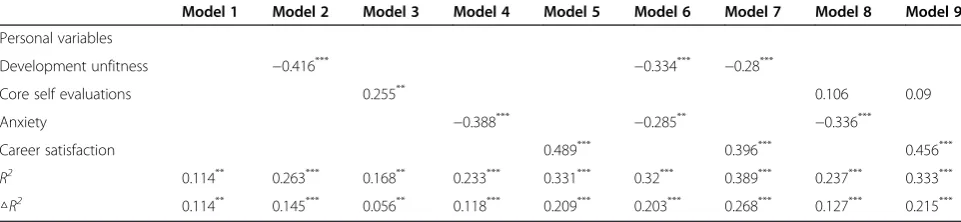
and normative commitment by using the same approach; the results are shown in Table 5. All the regression models were significant. From models 2, 6 and 7, the regression coefficient of development unfitness to normative
com-mitment was−0.416 when the former was used as the
in-dependent variable. The regression coefficient decreased
to−0.334 and−0.28 after state anxiety and career
satisfac-tion were introduced, respectively. Therefore, both state anxiety and career satisfaction acted as mediating factors
for person–vocation fit and nominative commitment.
From models 3, 8, and 9, the regression coefficient of CSE to normative commitment was 0.255 (p < 0.001) when the former was used as the independent variable. The
Table 4 Stepwise regression of affective commitment
Model 1 Model 2 Model 3 Model 4 Model 5 Model 6 Model 7 Model 8 Model 9
Personal variables
Development unfitness −0.424*** −0.307*** −0.249***
Core self evaluations 0.277*** 0.069 1.137
Anxiety −0.503*** −0.408*** −0.469***
Career satisfaction 0.591*** 0.509*** 8.958***
R2 0.174*** 0.37*** 0.24*** 0.379*** 0.495*** 0.452*** 0.541*** 0.378*** 0.496***
△R2 0.174*** 0.151*** 0.066*** 0.197*** 0.306*** 0.269*** 0.352*** 0.200*** 0.310***
Note: ***,p< 0.001.
Table 5 Stepwise regression of normative commitment
Model 1 Model 2 Model 3 Model 4 Model 5 Model 6 Model 7 Model 8 Model 9
Personal variables
Development unfitness −0.416*** −0.334*** −0.28***
Core self evaluations 0.255** 0.106 0.09
Anxiety −0.388*** −0.285** −0.336***
Career satisfaction 0.489*** 0.396*** 0.456***
R2 0.114** 0.263*** 0.168** 0.233*** 0.331*** 0.32*** 0.389*** 0.237*** 0.333***
△R2 0.114** 0.145*** 0.056** 0.118*** 0.209*** 0.203*** 0.268*** 0.127*** 0.215***
regression coefficient became insignificant after state anxiety and career satisfaction was introduced, which indi-cates that the prediction of normative commitment by CSE was completely intermediated by state anxiety and career satisfaction.
Based on above, we made a path analysis on the whole model, and the results were shown on Figure 1. The fol-lowing four indices were used to evaluate the goodness
of fit of the model: (a) Chi-square statistic (χ2),χ2/df, (b)
the Standardized Root Mean Square Residual (SRMR), (c) the Root Mean Square Error of Approximation (RMSEA), and (d) the Comparative Fit Index (CFI). In this study, a model was considered to have a good fit if all the path coefficients were significant at the level of 0.05, SRMR was below 0.08, RMSEA was below 0.08, and CFI was 0.95 or more.
The results revealed the results showed that the model
very good fit to the data,χ2(8, N = 167) = 18.315, P = 0.019;
RMSEA = 0.07; SRMR = 0.062; and CFI = 0.978. Hoelter Index was used to reinforce the overall fit provided by CFI. HOELTER (0.01) =182, revealed the largest sample size for
which one would accept at 0.01 significance that the model is correct.
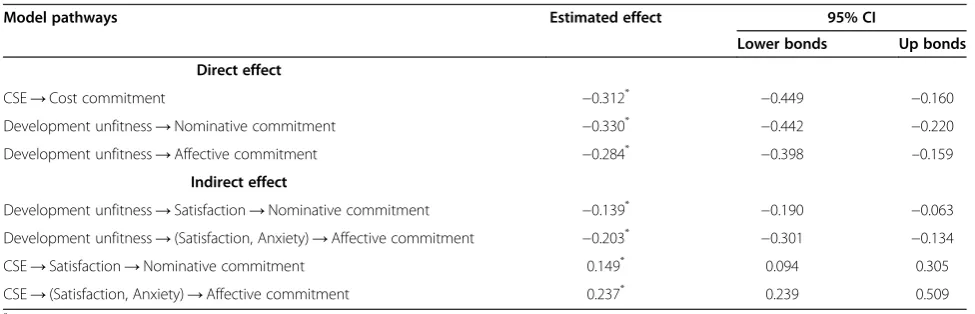
The mediating effect of job satisfaction and anxiety between CSE, DU and the three dimensions of career commitment was tested for a significance by adopted the Bootstrap estimation procedure in AMOS (a boot-strap sample of 1200 was specified). Table 6 shows the indirect effects and their associated 95% confidence intervals.
Discussion
This research confirmed that the vocational values of me-dical university students did not fit their careers to some extent. Gaps between personal demands and job supply exist in all three dimensions, namely, self-development, basic security, and reputation and status. The unfitness was most prominent in the self-development dimension.
According to the three-factor theory on person–
environ-ment fit [1,2], person–vocation fit also requires fits between
similarities, personal demands, and career provisions, as well as vocational demands and personal capacity. Previous
Figure 1The whole model representation.Note: Factor loadings are standardized.
Table 6 Direct and indirect effects and 95% confidence intervals for the final model
Model pathways Estimated effect 95% CI
Lower bonds Up bonds
Direct effect
CSE→Cost commitment −0.312* −0.449 −0.160
Development unfitness→Nominative commitment −0.330* −0.442 −0.220
Development unfitness→Affective commitment −0.284* −0.398 –0.159
Indirect effect
Development unfitness→Satisfaction→Nominative commitment −0.139* −0.190 −0.063
Development unfitness→(Satisfaction, Anxiety)→Affective commitment −0.203* −0.301 −0.134
CSE→Satisfaction→Nominative commitment 0.149* 0.094 0.305
CSE→(Satisfaction, Anxiety)→Affective commitment 0.237* 0.239 0.509
*
studies on person–vocation fit determined the suitability of individuals for their jobs by comparing their knowledge, skills, capacity, interests, working features, and perso-nalities, which can reflect only the consistency or fitness between career requirements and personal capacities. Voca-tional values show the fitness between personal demands and career provisions, and to a certain degree, they reflect the values of individuals in choosing their careers.
Voca-tional value–career fit shows the fitness between the
per-sonal demands of individuals and career provisions, and it reflects the consistency between the values of individuals and their careers to some extent. This study also somewhat
expands the connotation of person–vocation fit.
This research proves that development unfitness in
vo-cational value–career fit can predict the career
commit-ment of individuals, which may be mediated by state anxiety and career satisfaction. Due to limited information and time, medical university students are not fully aware about the requirements and duties of doctors or nurses when they apply for medical universities and choosing medical careers. These students will only learn about the responsibilities they must shoulder as healthcare pro-fessionals upon entering medical universities. A medical career cannot completely satisfy medical university stu-dents in terms of their self-development, health care ele-ments, reputation, and social status, which makes them highly concerned about their career and future. The career commitment of these students is reduced when their re-quirements are not satisfied by the medical field. There-fore, a wider gap between vocational values and medical careers intensifies the state anxiety of medical students, which will further reduce their satisfaction with and com-mitment to their selected careers.
CSE can significantly predict career commitment and career satisfaction, which is in line with the findings of Judge [4,5]. Both state anxiety and career satisfaction have mediating effects on core self-evaluation and career com-mitment. Medical university students who have low CSE usually develop a negative primary evaluation about their capacities and values, underestimate their own capacities, and amplify their present difficulties. These students may become highly anxious when they are faced with unfamil-iar medical careers. As a result, their career satisfaction decreases. However, underestimations of their capacities and values will encourage these students to evaluate the costs that they have to bear when they leave their medical careers. In other words, these students must bear ad-ditional cost commitment upon leaving their chosen profession. Therefore, CSE is positively correlated with normative commitment and affective commitment, but is negatively correlated with cost commitment.
Competing interests
The authors declare that they have no competing interests.
Authors’contributions
Conceived and designed the experiments: WX LZ JZ JP. Performed the experiments: WX LZ DM JZ JP. Analyzed the data: JZ JP. Contributed reagents/materials/analysis tools: WX QU YZ DM. Wrote the paper: WX LZ JZ JP. All authors read and approved the final manuscript.
Author details 1
Department of Psychology, Fourth Military Medical University, Chang Le Western Street No.169, Xi’an, Shanxi Co. 710032, China.2Foreign Language
Teaching and Researching Office of Basic Education Department, Chongqing Communication Institute, Chongqing, China.
Received: 18 January 2014 Accepted: 16 February 2014 Published: 20 February 2014
Reference
1. Gardner WL, Reithel BJ, Cogliser CC,et al:Matching Personality and Organizational Culture Effects of Recruitment Strategy and the Five-Factor Model on Subjective Person-Organization Fit.Manag Commun Q2012, 26(4):585–622.
2. Seong JY, Hong DS, Park W:Work status, gender, and organizational commitment among Korean workers: the mediating role of person-organization fit.Asia Pac J Manag2012,29(4):1105–1129.
3. Porfeli EJ, Mortimer JT:Intrinsic work value-reward dissonance and work satisfaction during young adulthood.J Voc Behav2010,76:507–519. 4. Duffy R, Diemer M, Perry J,et al:The construction and initial validation of
the Work Volition Scale.J Voc Behav2012,80(2):400–411.
5. Judge TA, Bono JE:Relationship of core self-evaluation traits-self-esteem, generalized self-efficacy, locus of control, and emotional stability with job satisfaction and job performance: a meta-analysis.J Appl Psycho2001, 86(1):80–92.
6. Bull A, Green S, Saxena M,et al:Crossover of Organizational Commitment.
Hum Performance2013,26(4):261–274.
7. Amy CH, Chockalingam V:The construct of work commitment: testing an integrative framework.Psycho B2005,131(2):241–259.
8. Guldal G, Semra G, Eren MA:The mediating effect of job satisfaction between emotional intelligence and organizational commitment of nurses: a questionnaire survey.Int J Nurs Stud2008,45:1625–1635. 9. Duman T, Mattila AS:The role of affective factors on perceived cruise
vacation value.Tourism Manag2005,26(3):311–323.
10. Bieling PJ, Antony MM, Swinson RP:The State-Trait Anxiety Inventory, Trait version: structure and content re-examined.Behav R ther1998, 36(7–8):777–788.
11. Judge TA, Erez A, Bono JE,et al:The core self‐evaluations scale: development of a measure.Pers Psychol2003,56(2):303–331. 12. Gillet B, Schwab DP:Convergent and discriminant validities of
corresponding Job Descriptive Index and Minnesota Satisfaction Questionnaire scales.J Appl Psycho1975,60(3):313–317.
13. Zhou H, Long LR, Wang YQ:What is the most important predictor of employees' turnover intention in Chinese call centre: job satisfaction, organisational commitment or career commitment?Int J Serv Technol Manage2009,12(2):129–145.
14. Teo S, Pick D, Newton C,et al:Organizational change stressors and nursing job satisfaction: the mediating effect of coping strategies.
J Nurs Manag2013,21(6):878–887.
doi:10.1186/1752-4458-8-8