A study of the improvement of foam
material sealing technology for wetsuits
Heekyoung Oh
1, Kyung Wha Oh
2and Soonjee Park
3*Introduction
The sea occupies three quarters of the earth upon which we live, and many creatures live in harmony in its environment. With the improvement of living standards today, a large proportion of the population participates in marine sports. The popularity of scuba div-ing is steadily increasdiv-ing every year (Ministry of Culture, Sports and Tourism 2016).
The sea is a completely different environment for humans. It is difficult to perform any activity without special equipment for diving. Human beings live and breathe on land, and when they enter the water, there are many differences in terms of the (high) pres-sure level, (low) temperature, and the movement of the human body. Even in summer, the water temperature in the sea is much cooler than that of the water on the surface. In addition, layers called thermocline form where warm surface water and cold water
Abstract
The purpose of this study is to propose the most suitable sewing method to produce wetsuits using neoprene fabric. To construct a sewing method sample using neoprene fabric, the samples were prepared using two thicknesses (1.5 t and 3 t) of neoprene fabric. Sewing techniques comprised 10 different methods. The respective seam strengths (KSK 0530) and water resistance (KSK ISO 811) of each sample were meas‑ ured. The results from the tests conducted using 10 sewing methods revealed that the seam strength of 466.7 N was the highest in the prototype constructed using zigzag and flatlock stitches on 1.5 t. The other samples had seam strengths of approximately 400 N, except for that sewn with straight stitch (113.3 N). For 3 t, the sample sewn using zigzag and flatlock stitches with seam sealing (653.3 N) had the highest strength, and the remaining samples had seam strengths of approximately 630 N, except the sample sewn with straight stitch (164.6 N). Significant factors affecting the seam strength were fabric thickness and the sewing method. Meanwhile, glue and blind stitch with seam sealing had the highest value for water resistance: 414.4 mH2O for 1.5 t and 987.6 mH2O for 3 t. The lowest values were revealed in samples sewn with zigzag and flatlock stitch 14.4 mH2O for 1.5 t and overlock stitch 13.3 mH2O for 3 t. Significant fac‑ tors affecting water resistance were whether seam sealing was attached and the sew‑ ing method used. The expected result of this study, which tests the properties of two neoprene fabric thicknesses with 10 sewing methods, is the suggestion of the most appropriate sewing method for use in the production of a wet suit.
Keywords: Neoprene fabric, Sewing method, Seam strength, Water resistance, Wetsuit
Open Access
© The Author(s) 2019. This article is distributed under the terms of the Creative Commons Attribution 4.0 International License (http://creat iveco mmons .org/licen ses/by/4.0/), which permits unrestricted use, distribution, and reproduction in any medium, provided you give appropriate credit to the original author(s) and the source, provide a link to the Creative Commons license, and indicate if changes were made.
RESEARCH
*Correspondence: [email protected]
meet and suddenly become cold during a diver’s descent. Therefore, to ensure the
stabil-ity of the diver’s body temperature, a proper wetsuit is necessary (Jung 2005). Among
the active equipment of a diver, clothing is that which is used closest to the human body and cannot be overlooked. When a diver is wearing a wetsuit, the suit is in close contact with the water, and a small amount is absorbed through the neck, wrists, and the zipper; because the diver is wearing the wetsuit, the extent to which the water comes into con-tact with the skin is minimized. Therefore, even if a certain amount of water enters the wetsuit, it warms to match the diver’s body temperature, helps maintain the body tem-perature to some extent, and prevents the rapid loss of heat. However, when the wetsuit is large and loose, a large amount of water seeps into the wetsuit during the diving activ-ity, and the diver’s body warmth decreases. Conversely, a wetsuit that is too small may be uncomfortable during movement or respiration. Also, in severe cases, compression or carotid compression may occur (Jung 1999; Kim 2012).
To date, research on wetsuits has been carried out by Kim and Kwon (2000), who have
focused on the thermal insulation performance of skin scuba clothing materials; they reported that the thicker neoprene most commonly used as the fabric for wetsuits can main-tain warmth during diving activities due to its superior insulation. Choi and Jeong (2009) analyzed the actual state of production and consumer satisfaction with men’s skin scuba suits and found that the level of satisfaction with the warmth and elasticity of the material was high but in terms of pattern design, satisfaction was low. Green sportswear users are expected to purchase more green products, which means that apparel retailers that can meet customers’ values and desire for more satisfying sportswear products should be established (Nam et al. 2017). Choi (2011a) developed a scuba pattern for men using 3D scan data, and also studied the pattern reduction rate of wetsuits for men in their 30 s (Choi 2011b). Wet-suits are constructed with neoprene fabrics that can stretch and are thick enough to prevent tearing due to contact with rocks or shells during use. However, no research has been con-ducted on the proper sewing methods for these special types of apparel.
Neoprene fabric comprises soft synthetic rubber foam that can be manufactured to be thicker than other plain fabrics, so it can provide protection from natural injury while also providing heat insulation and buoyancy. In order to sew neoprene fabric to make wetsuit with strong seam strength, it need to special sewing methods. Seam strength is increase as stitch density is increase but up to some extent, after that the strength of seam decrease (Nazakat et al. 2014). A wetsuit is composed of several panels in one garment that cling to the body during dynamic activity. Neoprene fabrics provide good stretch in all four directions. Therefore, the sewing methods required for wetsuits are
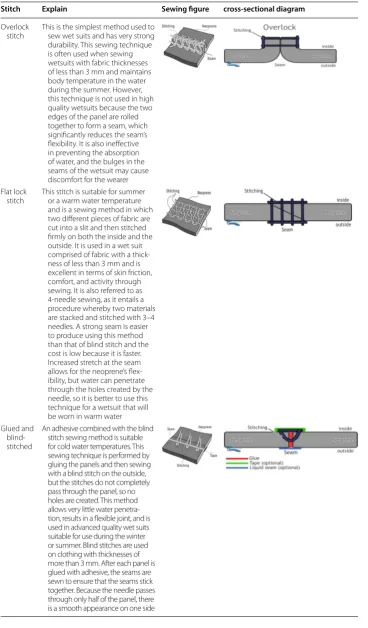
different than those used in conventional garment construction. As shown in Table 1,
overlock stitching, flatlock stitching, and glue and blind stitching methods are generally used for fabric that is less than 3 mm thick; for fabric that is more than 3 mm thick, the
glue and blind stitching method is used (Wetsuit Buying Guide 2018). However, until
Table 1 General sewing method for wetsuits (Wetsuit Buying Guide 2018)
Stitch Explain Sewing figure cross-sectional diagram
Overlock
stitch This is the simplest method used to sew wet suits and has very strong durability. This sewing technique is often used when sewing wetsuits with fabric thicknesses of less than 3 mm and maintains body temperature in the water during the summer. However, this technique is not used in high quality wetsuits because the two edges of the panel are rolled together to form a seam, which significantly reduces the seam’s flexibility. It is also ineffective in preventing the absorption of water, and the bulges in the seams of the wetsuit may cause discomfort for the wearer Flat lock
stitch This stitch is suitable for summer or a warm water temperature and is a sewing method in which two different pieces of fabric are cut into a slit and then stitched firmly on both the inside and the outside. It is used in a wet suit comprised of fabric with a thick‑ ness of less than 3 mm and is excellent in terms of skin friction, comfort, and activity through sewing. It is also referred to as 4‑needle sewing, as it entails a procedure whereby two materials are stacked and stitched with 3–4 needles. A strong seam is easier to produce using this method than that of blind stitch and the cost is low because it is faster. Increased stretch at the seam allows for the neoprene’s flex‑ ibility, but water can penetrate through the holes created by the needle, so it is better to use this technique for a wetsuit that will be worn in warm water Glued and
blind‑ stitched
Therefore, to propose a proper sewing method based on the thickness of the neoprene fabric used in the wetsuit, two thick and thin neoprene fabrics were prepared as sam-ples based on the general sewing method used with neoprene fabric described above. In addition, a straight stitch and overlock stitch et ac., the basic sewing method in garment construction, was used.
To determine the proper sewing method for neoprene fabric used in wetsuits, sewn specimens were fabricated using an additional special sewing method with seam seal-ing on two different thicknesses of neoprene fabric, and then the data are presented. The purpose of this study is to propose the most suitable sewing method for producing wetsuits by comparing the physical properties of the neoprene fabric, according to the respective sewing methods.
Methods
Sample preparation and analysis
Two thicknesses of neoprene fabric of 1.5 mm and 3 mm (abbreviated as 1.5 t and 3 t, respectively), which are used as materials for wetsuits, were purchased directly from the manufacturing plant. The sewing construction with neoprene fabrics was performed at a specialized sewing factory for wetsuits in April 2018. In response to a request for experi-mental sewing samples from a professional institution, samples were cut to 11 × 30 cm to create the A4 size (21 × 30), and two panels were overlapped and sewn. To measure seam strength and waterproofing, two sewing tests were performed five times using 10 sewing methods with both the 1.5 and the 3 t fabrics. Also, to examine the tensile strength and tensile elongation in the thread and in the warp and weft of the fabric, cuts were made at 50 cm * 50 cm for each of the 1.5 t and 3 t ends. Four experiments were conducted and a 100% polyester filament yarn commonly used in general wetsuit sewing operations was prepared. The data were obtained by subtracting the minimum and maximum values from the five samples of each sewing method on the 1.5 t and 3 t neoprene fabric. All quantita-tive data related to seam strength and water resistance were expressed as the mean and standard deviations (Mean ± S. D.). To analyze the sewing methods for the wetsuit using two thicknesses of neoprene fabric between 1.5 t and 3 t, a Wilcoxon signed rank t-test was performed. Also, to identify the effect of the seam sealing, a Wilcoxon signed rank t-test was performed between the sewing method that included attached seam sealing and that which did not. Thereafter, Spearman’s rank correlation for sewing strength, water resist-ance, fabric thickness, ventricular ringing, and the sewing method was calculated and mul-tiple regression equations were obtained through regression analysis.
Sewing method
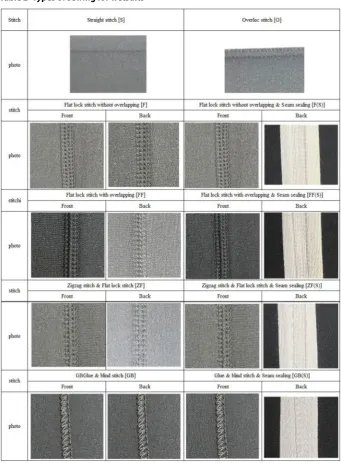
Table 2 shows the 10 sewing methods used in the sewing experiment to determine the
seam strength and water resistance that are the most suitable for the wetsuits. They are as follows:
stitch with seam sealing (abbreviated as [ZF(S)]), (9) glue and blind stitch (abbreviated as [GB]), (10) glue and blind stitch with seam sealing (abbreviated as [GB(S)]).
1. Straight stitch
The Straight stitch is used on the main machine in a sewing factory, but the neoprene fabric’s stretch is very good, so this sample was constructed with the manual application of gentle tension during sewing. In this study, a stitch count of eleven stitches per 1 inch was used.
2. Overlock stitching
The overlock stitch is used on the industrial sewing machines with which most gen-eral sewing factories are equipped. Therefore, if overlock stitches are used in wetsuits, they can be constructed in any sewing factory. However, a twofold portion of the seam remains; when wetsuits constructed with overlock stitch are worn, the portion con-structed with the overlock stitch has the disadvantage of applying pressure to the skin.
3. Zigzag stitching
Zigzag stitches should be sewn flat on both sides of the panel without overlapping. The needle passes through the fabric and is sewn in the same zigzag pattern on both the front and back sides. When sewing with neoprene, the sewing surface has the appear-ance of having been embroidered on a single panel rather than on two panels. In this study, a STAGER SZ-21-5WN machine was used to create a seam allowance of 4 mm and a stitch count of five stitches per 1 inch. After the panel is sewn, it stretches when pulled in the direction parallel to the seam formed by the zigzag stitches, but when pulled in the direction that is perpendicular to the seam, the panel does not stretch. Zig-zag stitches can vary in width and stitch count; thus, various zigZig-zag stitches are possible depending on a particular panel pattern.
4. Flatlock stitch
however, the method used to sew the overlapping portion of the flatlock stitch was con-vex. When wetsuits are produced using such a sewing method, pressure is exerted on point of contact with the skin more than in wetsuits created by other sewing methods, which may cause the skin to stick to the stitching. Pressure may be applied to the area in contact with the body, which may cause the wearer’s skin to stick to the fabric. In addi-tion, this method has another disadvantage as it is difficult to use small, detailed sewing panels because of the significant width required for construction, in comparison with other sewing methods. However, this method is advantageous when a sensible design such as embroidery is used, consisting of a thread count of four to six stitches and using threads of various colors.
5. Bond adhesive and blind stitch
To make a blind stitch for the exclusive use of neoprene, a loctite bondace 8800B bond, which can increase the adhesiveness of neoprene fabric, was used. Bonding is performed two or three times to ensure that the fabric absorbs enough of the bond. For the first bond, a large amount of bond is applied, then the second bond is applied using about 50% less bond than that used in the initial bond. Just before the bond is dry, the panels are attached to each side and painted by hand with the bond; the two sheets are gen-tly glued together to form a single panel. In this study, we performed straight line sew-ing to fabricate the sewsew-ing test samples; however, in the actual production of wetsuits, the sewing should be contoured according to the surface of the human body. Therefore, it is considered that the bonding process required for each of these contoured sources is incompatible with the mass production process as it requires significant time and is physically taxing.
After the bond is dry, the seam is sewn with a blind stitch machine. Blind stitch sew-ing is affected by the thickness of the fabric. This means that very thin fabric is difficult to sew (Matsunashi and Shimazaki 2001). The 1.5 t fabric was relatively thin, so a more precise technique was needed. Since the blind stitch was sewn on only one side of the panel rather than by passing the needle through the fabric from the front to the back,
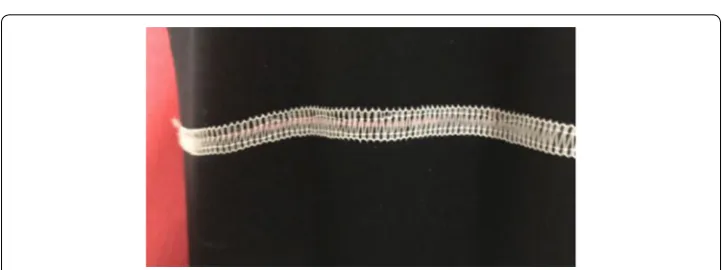
Fig. 1 Prepare two panels of neoprene fabric for flatlock stitch. a No overlap between the two panels, b
2 mm overlap between the two panels, c no overlap and zigzag stitch between the two panels
it was necessary to sew a seam on both sides. This is disadvantageous in that it requires twice as much time and effort, as compared with other sewing methods. However, in the case of the blind stitch, since the needle does not pass from the face of the fabric to the back like other typical sewing methods, after sewing, one side of the fabric has no nee-dle holes. In this study, a TREASURE BS-140 machine was used to create a 4 mm seam allowance and a stitch count of nine stitches per 1 inch.
6. Attachment of seam seal
The seam sealing tape has a width of 0.9–0.10 mm and is made of polyurethane; it is
resistant to hot air 450–480 °C and pressure 0.8 kg/cm2 (Sealon and Seam sealing tape
2016). However, when the sealing tape is attached to the neoprene fabric, the air temper-ature must be lower than 300 °C and may not come into direct contact with the thread; otherwise, it may melt.
Sewing test method
1. Tensile strength
Tensile strength refers to the load applied to a fabric or thread when pulled in one axial direction and the extent to which it has been stretched. The tensile strength of the fabric and thread in this study was measured using the KSK 0520 method. In the tensile test, the sample was stretched at a constant speed of 50 mm/min (constant speed). A con-stant rate of load (C.R.E) type of tensile strength machine was used. The tensile speed of this experiment was 50 mm/min. The test was performed in a direction parallel to the sewing direction, and the grip distance was taken as 100 mm.
2. Seam strength
The seam strength is the maximum amount of tension l applied until the test piece tears following the application of a load in the perpendicular direction. The strength of the sewn seam was measured in the horizontal direction using the KSK 0530 method.
3. Water resistance (cmH2O)
Water resistance was measured using the KSK ISO 811 method; in this method, the resist-ance to leakage or immersion in water are examined to identify the point at which the water does not leak through to the other side, even when water pressure is applied to one side of the sample. The lab temperature was 20 ± 2 °C, the humidity was 65 ± 4% RH, the water tem-perature was 20 ± 2 °C, and the water pressure was increased at a rate of 60 cmH2O/min.
Result and discussion
Tensile strength of fabric and thread
Seam strength
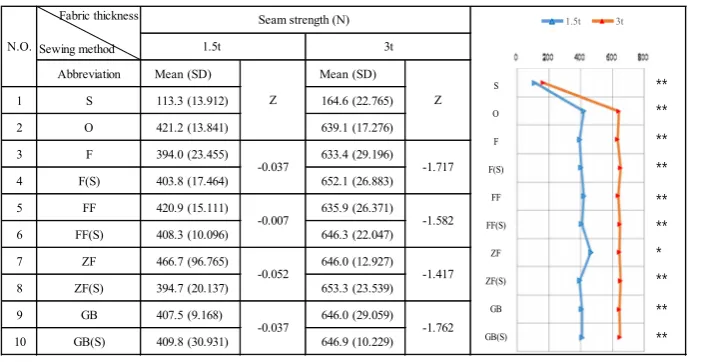
Table 4 shows the average and standard deviation with Z following the results of the
Wilcoxon signed rank t-test between F and F(S), FF and FF(S), ZF and ZZF(S), and GB and GB(S) related to attaching seam sealing and the samples of 1.5 t and 3 t sewn using each method. The test provides the results of five seam strength tests on samples constructed using 10 different sewing methods with each kind of fabric. For all sewing methods, the seam strength of samples constructed using 3 t was remarkably higher than that of those using 1.5 t. The highest mean value of the 1.5 t samples was 466.7 N in [ZF], and the lowest mean value was 113.3 N in [S]. The seam strength was high for samples of 1.5 t as follows: [O], [FF], [GB(S)], [FF(S)], [GB], [F(S)], [ZF(S)], and [S]. Except [S], all seam strengths were more than 390–430 N for all sewing methods using 1.5 t neoprene. However, the highest mean value of samples constructed using 3 t was 653.3 N in [ZF(S)] and the lowest mean value was 164.6 N in [S]. The seam strength was high for samples of 3 t as follows: [F(S)], [GB(S)], [FF(S)], [ZF], [GB], [O], [FF], [F], and [S]. Except [S], all seam strengths were more than 630 N for all sewing methods using 3 t neoprene. Meanwhile, there was no significant difference between F and F(S), FF and FF(S), ZF and ZZF(S), and GB and GB(S) in seam strength. This means that the strength was not affected by the attachment of the seam sealing tape. However, sig-nificant differences exist between the fabric thicknesses of 1.5 t and 3 t in terms of the
sewing methods that should be used. Uh (2013) study shows the seam strength of the
cotton fabric in the bias/bias direction (100′s plain weave: 219 N, twill weave: 220 N) Table 3 Results from the testing of fabric tensile strength
Neoprene fabric 1.5 t 3 t
Warp direction Weft direction Warp direction Weft direction
Tensile strength (N) 737.0 452.3 818.7 626.2 Tensil elongation (%) 164.4 345.2 201.7 266.1
Table 4 Test results of Wilcoxon signed rank t-test for seam strength
Abbreviation Mean (SD) Mean (SD)
1 S 113.3 (13.912) 164.6 (22.765)
2 O 421.2 (13.841) 639.1 (17.276)
3 F 394.0 (23.455) 633.4 (29.196)
4 F(S) 403.8 (17.464) 652.1 (26.883)
5 FF 420.9 (15.111) 635.9 (26.371)
6 FF(S) 408.3 (10.096) 646.3 (22.047)
7 ZF 466.7 (96.765) 646.0 (12.927)
8 ZF(S) 394.7 (20.137) 653.3 (23.539)
9 GB 407.5 (9.168) 646.0 (29.059)
10 GB(S) 409.8 (30.931) -0.037 646.9 (10.229) -1.762
-0.037 -1.717 -0.007 -1.582 -0.052 -1.417 N.O. Fabric thickness Sewing method
Seam strength (N)
1.5t 3t Z Z S O F F(S) FF FF(S) ZF ZF(S) GB GB(S) 1.5t 3t
was higher than in the warp direction (100′s plain weave: 208 N, twill weave: 148 N)
and weft direction (100′s plain weave: 179 N, twill weave: 167 N). This study has
shown that the same fabric can show an improvement in seam strength if the texture and cutting direction are changed. However, the neoprene fabric used in this study is a four-way stretch fabric that is not significantly affected by the cutting directions, such as the warp, weft, and bias. For each of the sewing methods used in this study, with the exception of the straight stitch sewing method, the seam strength of 1.5 t was 390 N and that of 3 t was more than 630 N. To identify the factors affecting seam strength, multiple regression was used to produce the equation as in (Eq. 1). As a result of the analysis, the total variance explained by the model as a whole was 50.5%, F = 51.475, p < 0.000. In the final model, only two factors were statistically significant; the thick-ness of the fabric revealed a higher beta value (beta =+ 212.320, p < 0.000) than the sewing method (beta =+ 17.178, p < 0.000). However, the attachment of seam sealing (beta =+ 0.067) and water resistance (beta =− 0.072) did not affect seam strength.
Water resistance
Table 5 shows the average and standard deviation with Z after the Wilcoxon signed
rank t-test was conducted between F and F(S), FF and FF(S), ZF and ZF(S), and GB and GB(S) regarding the attachment of seam sealing as well as 1.5 t and 3 t using each sewing method. In the results from the five tests of water resistance performed on samples sewn using each of the 10 sewing methods on both thicknesses of fab-ric, the difference in water resistance was significantly higher depending on whether
the seam sealing was attached. The highest value for 1.5 t samples was 414.4 cmH2O
from a [GB(S)] sample, while the lowest value was 14.4 cmH2O from a [ZF] sample.
(1)
Seam strength =77.227+212.320∗ thickness of fabric +17.178∗sewing method
Table 5 Test results of the Wilcoxon signed rank t-test for water resistance
Abbreviation Mean (SD) Mean (SD)
1 S 20.3 (1.151) 22.2 (1.095)
2 O 15.0 (0.935) 13.3 (1.095)
3 F 18.6 (0.822) 17.5 (1.768)
4 F(S) 153.3 (116.579) 130.1 (57.800)
5 FF 21.4 (2.329) 24.6 (2.434)
6 FF(S) 247.4 (54.054) 135.8 (42.281)
7 ZF 14.4 (1.294) 15.8 (1.351)
8 ZF(S) 326.7 (146.245) 88.9 (26.095)
9 GB 35.7 (5.619) 595.6 (413.666)
10 GB(S) 414.4 (102.473) 987.6 (27.727)
-6.562*** -5.289***
-5.334*** -5.319*** -6.562*** -5.274***
-6.561*** -5.274*** N.O.
Fabric thickness
Sewing method
Water resistance (cmH2O)
1.5t 3t Z Z S O F F(S) FF FF(S) ZF ZF(S) GB GB(S) 1.5t 3t
In addition, when the seam sealing was attached, all samples revealed water
resist-ance of more than 150 cmH2O. Similar to the 1.5 t results, the highest water
resist-ance value for 3 t was 987.6 cmH2O in a [GB(S)] sample; meanwhile, the lowest value
of 13.3 cmH2O was revealed in the sample sewn with [O]. Second, the higher water
resistance for 3 t was 595.6 cmH2O in a sample sewn with [GB]; the water resistance
was higher even though seam sealing was not attached. Among the sewing methods
performed on 3 t, the water resistance was higher than 100 cmH2O in samples
con-structed using [F(S)] and [FF(S)] with seam sealing attached. Meanwhile, significant differences were revealed depending on the presence or absence of seam sealing in samples constructed using [F] and [F(S)], [FF] and [FF(S)], [ZF] and [ZZF(S)], and [GB] and [GB(S)] for both fabric thicknesses.
Also, between the fabric thicknesses of 1.5 t and 3 t, there are significant differences for [S], [O], [FF (S)], [ZF (S)], [GB], and [GB(S)]. [GB(S)] has the highest water resist-ance because it is constructed by sewing blind stitches on both sides of the fabric after a bond is applied on the sewing surface, thus sealing the seam on one side. For this method, the sample is not sewn from the face of the fabric to the back. There-fore, [GB] has no needle holes passing through from the outside to the inside of the fabric; because there are no holes, less water passes through than that which may pass through samples constructed using other sewing techniques. Even [GB] has a very high water resistance when 3 t fabric is used, but the sample using 1.5 t had a
low water resistance (as low as 50 cmH2O or less) due to the blind stitching
tech-nique. Blind stitch is used to sew thick fabric, but 1.5 t is thin, so the needle passed all the way through the fabric during sewing, leaving holes that resulted in low water resistance. The water resistance results of F(S), FF(S), and ZF(S) with attached seam sealing for 3 t were lower than those for 1.5 t. As is already known, when thick fab-ric is sewn, the shape of the core created by the tension of the sewing thread causes gaps in the seams of the thick fabric. Meanwhile, the [ZF] method entails the appli-cation of zigzag stitching followed by flatlock stitching, which results in the largest number of needle holes in the neoprene fabric following sample construction. There-fore, it is concluded that the water resistance of this sample is the lowest. Meanwhile, significant findings were revealed between [F] and [F(S)], [FF] and [FF(S)], [ZF] and [ZF(S)], and [GB] and [GB(S)] regarding water resistance. The water resistance of the sample using the sewing method combined with attached seam sealing was signifi-cantly higher than samples that did not have attached seam sealing. To identify the factors affecting water resistance, multiple regression was used to produce the
equa-tion (Eq. 2). Based on the analysis, the total variance explained by the model as a
However, fabric thickness (beta =+ 0.146) and seam strength (beta =+ 0.040) were not affected by water resistance.
Relationship between seam strength and water resistance
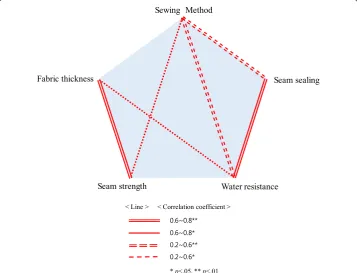
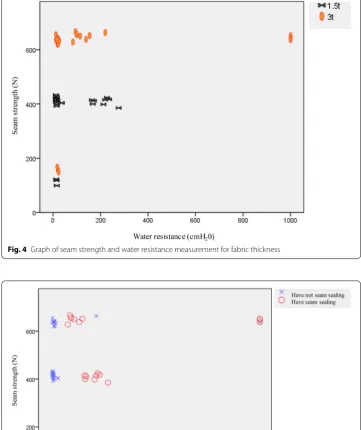
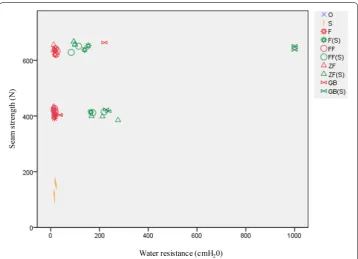
The results of the Spearman rank correlation coefficient are shown in Fig. 3, which pro-vides the relationship between the sewing strength and the water resistance of the sew-ing methods, fabric thickness, and the presence of a seam sealsew-ing. Figures 4, 5 and 6
show the scatter data between the seam strength and water resistance according to the fabric thickness, seam sealing attachment, and sewing method, respectively. The seam strength was positively correlated with fabric thickness (r = 0.710, p = 0.000) and sewing method (r = 0.268, p = 0.000). Water resistance was positively correlated with the attach-ment of seam sealing (r = 0.753, p = 0.000), the sewing method (r = 0.544, p = 0.000), and fabric thickness (r = 0.273, p = 0.014). From this result, seam strength is strongly affected by the fabric thickness, water resistance is strongly affected by the seam sealing, and both are affected by the sewing method. Also, the presence of a seam sealing was posi-tively correlated with the sewing method (r = 0.426, p = 0.037). Therefore, it can be con-cluded that the seam strength, the water resistance, and presence of a seam sealing are affected by the sewing method; meanwhile, water resistance is affected by the presence of a seam sealing, the sewing method, and fabric thickness. In addition, seam strength is affected by the fabric thickness and the sewing method.
(2)
Water resistance = −264.689+130.286∗ whether seam sealing was attached +44.949∗ sewing method
< Line > < Correlation coefficient >
* p<.05, ** p<.01 Sewing Method
Fabric thickness
Seam strength Water resistance
Seam sealing
Fig. 3 Results of correlation coefficients among sewing method, seam strength, water resistance, fabric
Conclusion
The result for the seam strength of ZF (466.7 N) was the highest in 1.5 t fabric while all other sewing methods showed seam strengths of approximately 400 N, except for 113.3 N in [S]. In addition, [ZF(S)] was the highest with 653.3 N in 3 t fabric, and other sewing methods were approximately 630 N, except [S], which revealed a result of 164.6 N. Seam strength was significantly different for the fabric thickness; the thicker
Fig. 4 Graph of seam strength and water resistance measurement for fabric thickness
the fabric, the greater the seam strength. The results of the regression analysis on seam strength showed that the fabric thickness and the sewing method were the sig-nificant factors. Conversely, results showed that the water resistance was the highest in samples constructed using [GB(S)] for both thicknesses of neoprene and revealed
the following values: 1.5 t (414.4 mH2O) and 3 t (987.6 mH2O). The result showing
the lowest water resistance was a sample constructed using [ZF] (14.4 mH2O) for 1.5 t
and [O] (13.3 mH2O) for 3 t. There was a significant difference based on whether seam
sealing was attached. If seam sealing was attached to the fabric, the water resistance was higher. The results of the regression analysis for water resistance showed that seam sealing and the sewing method were significant factors. However, in the sam-ples with seam sealing, the 3 t samsam-ples had significantly lower values than those con-structed with 1.5 t when the methods [F(S)], [FF(S)], and [ZF(S)] were used, except [GB(S)]. This is because the stitch does not pass through the face of the fabric to the back in the blind stitching process used for [GB] and [GB(S)]. However, even if seam sealing is attached to thicker fabric like that of 3 t, when the sewing thread is pulled and pressed, the shape of the seam becomes deformed; therefore, water leaks between the layers of fabric or through the holes made by the needle. Meanwhile, to increase the water resistance in a wetsuit, a seam sealing may be attached to prevent the suit from filling with water. Wetsuits with seam sealing prevent water from penetrating during use through the holes created by the needle. When a sewing surface with a seam sealing touches the skin, its texture is as smooth as that of a non-sewn surface. For example, in the case of [GB (S)], the sewing seam is hardened by the coat of bond, and its direct with the skin is an irritant. The seam sealing on such a bond can prevent irritation. In addition, when sewing [FF], a 2 mm overlapping seam is created, leaving
behind a thick core, which may apply pressure to the skin that is different from that applied by the non-sewn side. At this point, the seam sealing can prevent irritation due to pressure from the thickness of the other side.
In the future, the results of this study on sewing methods for wetsuits will contrib-ute to knowledge on seam strength and water resistance and the development of a new sewing method for these two variables. And I suggest further research projects about physical activities in wet suits that are wet and skin irritations that exist when wearing a wet suit that is wet.
Authors’ contributions
HKO and SJP designed and carried out the experiments, analyzed the data as well as drafted the manuscript. KWO guided and helped experiment. Also, they commented in feedback and final format of the paper. All authors read and approved the final manuscript.
Author details
1 Researcher, Fashionoid R & D Center, Industry‑Academia Collaboration Foundation, Soongsil University, Seoul 06978, Republic of Korea. 2 Professor, Dept. of Fashion Design, Chung‑Ang University, Seoul 06974, Republic of Korea. 3 Professor, Dept. of Clothing and Fashion, Yeungnam University, 280 Daehak‑Ro, Gyeongsan, Gyeongbuk 38541, Republic of Korea.
Acknowledgements
This research was supported by the National Research Foundation (NRF)of Korea funded by the Ministry of Science, ICT & Future Planning (NRF‑2017R1A2B4005315).
Competing interests
The authors declare that they have no competing interests.
Availability of data and materials
The data sets used and analyzed during the current study are available from the corresponding author on reasonable request.
Funding
This work was supported by the National Research Foundation of Korea (NRF) granted funded by the Korea government (MSIP) (No. NRF‑2017R1A2B4005315).
Publisher’s Note
Springer Nature remains neutral with regard to jurisdictional claims in published maps and institutional affiliations.
Received: 24 January 2019 Accepted: 18 March 2019
References
Choi, J. H. (2011a). Development of the Men’s Scuba diving suit pattern by using 3D body‑scanned data. Family and Environment Research.,49(4), 105–113.
Choi, J. H. (2011b). A study about reduction rate of wetsuit patterns for men in their 30’s. The Korean Society of Clothing and Textiles.,35(9), 1039–1048.
Choi, J. H., & Jeong, J. A. (2009). Transactions: the production conditions and consumer satisfaction of men`s scuba diving suits. Journal of the Korean Society of Clothing and Textiles,33(11), 1683–1695.
Jung, I. W. (2005). SDI 오픈워터 다이버 매뉴얼 [SDI Open Water Diver Manual]. Seoul: ChungPung Munwasa. Jung, J. K. (1999). 스킨 스쿠버 다이빙[Skin scuba diving]. Seoul: HungSul.
Kim, C. S., & Kwon, Y. H. (2000). Thermal resistance values of skin scuba clothing material. Design Research Institute of KyoungHee University,3, 119–125.
Kim, J. M. (2012). A study on the visual image of windsurfing suits. Fashion & Textile Research Journal,14(5), 713–719. Matsunashi, K., & Shimazaki, K. (2001). A Study on the Amount of Needle Penetration in Blind Stitch Sewing (Stitch Type
103). Journal of the Japan research association for textile end-uses,42(7), 461–468.
Ministry of Culture, Sports and Tourism. (2016). Retrieved 1 March 2018. http://www.mcst.go.kr/main.jsp.
Nam, C., Dong, H., & Lee, Y. (2017). Factors influencing costumers’ purchase intention of green sportswear. Fashion and Textiles international journal of interdisciplinary Research.,4, 2. https ://doi.org/10.1186/s4069 1‑017‑0091‑3. Nazakat, A., et al. (2014). Effect of different types of seam, stitch class and stitch density on seam performance. Journal of
applied and emerging sciences,5(1), 32–43.
Sealon, Seam sealing tape. (2016). Retrieved December 1, 2017. http://i‑sealo n.com/bbs/board .php?bo_table =produ ct&wr_id=1&lang=en.
Uh, M. K. (2013). Seam strength depending on the change of cutting direction of fine cotton fabrics. Journal of the Korean Fashion & Costume Design Association,15(3), 33–40.