Architecture for Automated Sentiment Detection
Stefan Gindl, Johannes Liegl, Arno Scharl, and Albert Weichselbraun
AbstractAnalysts are often interested in how sentiment towards an organization, a product or a particular technology changes over time. Popular methods that pro-cess unstructured textual material to automatically detect sentiment based on tagged dictionaries are not capable of fulfilling this task, even when coupled with part-of-speech tagging, a standard component of most text processing toolkits that distin-guishes grammatical categories such as article, noun, verb, and adverb. Small corpus size, ambiguity and subtle incremental change of tonal expressions between differ-ent versions of a documdiffer-ent complicate sdiffer-entimdiffer-ent detection. Parsing grammatical structures, by contrast, outperforms dictionary-based approaches in terms of relia-bility, but usually suffers from poor scalability due to its computational complexity. This work provides an overview of different dictionary- and machine-learning-based sentiment detection methods and evaluates them on several Web corpora. After iden-tifying the shortcomings of these methods, the paper proposes an approach based on automatically building Tagged Linguistic Unit (TLU) databases to overcome the re-strictions of dictionaries with a limited set of tagged tokens.
Key words: sentiment detection, tagged linguistic unit, opinion mining, spreading activation network
Stefan Gindl, Johannes Liegl, and Arno Scharl
MODUL University Vienna, Department of New Media Technology, Austria, e-mail:{stefan.gindl, johannes.liegl, arno.scharl}@modul.ac.at
Albert Weichselbraun
Vienna University of Economics and Business Administration, Research Institute for Computational Methods, Austria, e-mail: [email protected]
1 Introduction
Sentiment Detection (SD) is the part of Natural Language Processing (NLP) that deals with the automated extraction of opinions (the ’sentiment’) of unstructured text. The goal is to automatically decide whether an author expresses positive or negative sentiment towards a certain topic. The appeal of this research area lies in its wide range of possible applications, since reliable automated SD methods allow the analysis of large texts corpora beyond the limits of manual approaches.
The information obtained by this process may be used for several purposes. Ap-plications include monitoring the launch and performance of commercial products, analyzing the electoral behavior of the public to guide political campaigns, or re-fining search engines to consider opinions. Yet, SD is a very ambitious problem to solve. NLP is one of the most challenging research areas in computer science, since natural languages are not as restrictive as formal languages. Natural language allows authors to express concepts in many different ways, which complicates automated analyses. Consider the following sentence:
The plot of the movie was banal and the actors were really clumsy.
This sentence expresses a viewer’s displeasure with a particular movie. Now con-sider the same sentence in the following context:
The plot of the movie was banal and the actors were really clumsy. However, I enjoyed it more than any other movie I have seen in the last few months!
In this example, both sentences describe the same item (a particular movie), but differ in regards to the expressed sentiment. For an automated system, such con-structs are very hard to evaluate. A human reader, by contrast, easily recognizes that the viewer liked the movie. Linguistic notions such as sarcasm or irony are even harder to spot by an algorithm.
This paper evaluates and compares several well-known SD techniques, such as the bag-of-words approach and maximum entropy modeling. Based on this analysis, we develop an alternative approach based on Tagged Linguistic Units (TLUs), an-notating tokens and phrases with additional features such as part-of-speech (POS), context and topic.
2 Related Work
The field of SD reveals emotional aspects of a written text, hinting at the opinion and intention of the author. This information can be used for several reasons: search engines can augment their results, marketing managers can find out why their prod-uct failed in a certain market, and political analysts can predict electoral behavior. The challenge of detecting sentiment in unstructured text leads to a vast amount of different approaches to tackle this task. Some of these only use binary decisions (a positive or negative sentiment), others use more sophisticated classifications.
The context of a sentiment term influences its meaning - e.g., in ’the president of the National Environment Trust’, the term ’trust’ refers to a large enterprise and not to ’confidence’. Wilson et al. [24] acknowledge the importance of context infor-mation by using a set of 28 features such as modifiers or adjacent terms, which are input to the AdaBoost machine learning approach.
Lexical units can also be distinguished from each other by using so called ‘ap-praisal taxonomies’ [22]. These contain information on the ’attitude’ (e.g., ‘appre-ciation’ or ‘affect’), the ‘orientation’ (positive vs. negative), the ‘force’ (can be in-creased by modifiers like ‘very’), or the ‘polarity’ (a binary decision depending on the existence of a negation trigger) of words.
Hatzivassiloglou and McKeown [4] base predicting the sentiment of adjectives on the hypothesis that conjoined adjectives may carry the same sentiment charge. Based on this hypothesis, their proposed system assigns an adjective with unknown sentiment the same sentiment value as its conjoined adjective.
Pang et al. [12] apply machine learning methods (Naive Bayes, Maximum En-tropy Model, Support Vector Machines) in combination with a bag-of-features (i.e., a collection of terms with certain characteristics such as a sentiment) framework to a data set containing reviews from the ‘Internet Movie Database’. Pang and Lee present a refinement of this approach in their later work [11], where they involve a previous subjectivity classification (i.e., a method capable of discriminating sen-tences into subjective and objective ones). As compared to objective sensen-tences that are only used to describe facts, subjective sentences are supposed to reflect the opin-ion an author intends to express. Kushal et al. [7] also apply three machine learning methods to product reviews, comparing their results to a simple baseline algorithm. Mullen and Collier [10] work with Support Vector Machines, where a list of terms and their sentiment values (i.e., a value corresponding to the general affinity of the term to express positive or negative opinion) represents the features. A generic pro-cess using Pointwise Mutual Information then determines the sentiment values of these terms.
in order to adapt a sentiment classifier to a new domain. Ding et al. [3] determine the sentiment of a sentence in regards to a specific object within this sentence (in this case, objects refer to products like cameras). Conjunction rules help accomplish this task for both the usage within a sentence as well as multiple sentences. Another feature is a distance function, which determines the correlation of sentiment terms considering their absolute distance to a specific object.
3 Lexical Approaches versus Full Parsing
Capturing the evolution of information spaces calls for a new generation of robust, language-independent and distributed natural language processing techniques op-timized for throughput and scalability. From a stakeholder perspective, sentiment expressed in textual material (e.g., news media coverage) is of particular interest [17]. Automated methods to compute sentiment, however, usually belong to one of the following two categories: (i) low-overhead approaches that focus on the lexis of text, and (ii) full parsing of grammatical structures, which improves the accuracy of results but suffers from poor scalability. This paper presents a new method that falls into the first category but aims to improve the quality of results by building an adap-tive databases of tagged linguistic units. Such a database helps ensure scalability, preserve context information and process heterogeneous data sources.
Most research projects that apply automated sentiment detection techniques such as theUS Election 2008 Web Monitor(www.ecoresearch.net/election2008) or the
Media Watch on Climate Change(www.ecoresearch.net/climate) typically gather a
large corpus of text compiled from many sources and sampled in regular intervals. Using POS tagged and partially parsed corpora to identify relevant sketches (= co-occurrence lists for grammatical patterns provided by a grammar rule engine) im-proves the performance of existing SD-techniques [5, 6], but processing arbitrarily long blocks of text still requires a fundamentally new strategy. The ability to work with very short textual segments is paramount when trying to analyze theevolution
of knowledge reflected in corpora. Longitudinal studies of specific topics or events often yield few additional occurrences of a term in a given interval, as incremental changes to existing documents are common. This complicates the analysis, because the validity of many text processing methods depends on corpus size and frequency of target terms.
4 Algorithm Description
This section focuses on the most common SD methods (arithmetic, machine learn-ing based and combined), and describes a framework for evaluatlearn-ing them based on three different corpora compiled from Web resources available to the public:
• Amazon(www.amazon.com) provides customer reviews ranging from “one-star”
(low recommendation) to “five-star” (high recommendation) ratings. The Ama-zon data set consists of 165,746 book reviews and contains 1,539,058 sentences.
• TheInternet Movie Database (IMDb)(www.imdb.com) contains 2000 reviews
comprising 69,207 sentences. The IMDb data set was also used in [12], thus the reviews already carry information on positive and negative sentiment.
• TripAdvisor(www.tripadvisor.com) provides reviews of holiday destinations. It
contains 7554 reviews with ratings from one to five stars, where one star indicates a very low recommendation and five stars a high recommendation. This data set comprises 62,818 sentences.
Amazon and TripAdvisor rate each review on a scale from one to five stars. We generalize these ratings and consider all reviews with a rating lower than three as negative, all reviews with a rating greater than three as positive, and ratings of three as neutral. In order to avoid adulterated results, we use balanced versions of the data sets - i.e., subsets of the original data containing exactly the same number of positive and negative reviews. The Amazon data set contains 21,458 negative, 130,061 positive and 14,227 neutral reviews. The TripAdvisor data set consists of 1105 negative, 5673 positive and 776 neutral reviews. The balancing filter yields a total of 420,840 sentences from Amazon and 17,768 sentences for TripAdvisor (IMDb provides an already balanced data set).
4.1 Arithmetic Methods
• Simple SD (SSD)counts the values of sentiment terms in a sentence. If the sum of these values is positive (negative), the sentence is considered to have a positive (negative) sentiment. If a negation trigger such as ‘not’ and ‘never’ occurs di-rectly before a sentiment term (e.g., ‘The proposal was not approved’), the value of this term is multiplied by ‘-1’, resulting in an inverted sentiment value. We used this method as a simple baseline approach towards SD.
• Extended SD (ESD). This method incorporates other semantic components
af-fecting the results. We extended the former detection method by so called modi-fier terms (e.g., ‘very’, ‘rather’). If such a term occurs before a sentiment word, the value of the sentiment word is either increased or decreased, depending on the orientation of the modifier. The term ‘very’ increases a sentiment value (e.g., ‘The candidate is very charming.’); we, therefore, multiply the original value by ‘1.5’. In the case of the decreasing term ‘little’, we multiply the term’s sentiment by ‘0.5’ (e.g., ‘The patient felt little pain.’).
• Adjective Detection (AD). Adjectives are often used to express sentiment. For
that reason, we investigated the outcome of a SD method using only adjectives. In order to limit the method to adjectives, we applied the POS tagger of the OpenNLP project (opennlp.sourceforge.net).
• Detailed Part-Of-Speech Detection (DetPOSD). This method applies POS
tag-ging to determine the scope of a negation trigger. For each occurrence of a term with a semantic value, the method tries to identify a negation trigger that instructs the algorithm to multiply the sentiment value by ‘-1’. Certain constituents help refine this procedure and avoid negation triggers from impacting the complete sentence (although they were not meant to do so). If a noun phrases respectively a verb phrase is positioned between the sentiment word and the negation trig-ger, this term is regarded as negated and the original sentiment word will remain unaffected. Figure 4.1 shows an illustration of this procedure: a negation trigger occurs at the beginning of the sentence (NT) and a sentiment token at the end (SentT). Between these are placed a number of arbitrary tokens (AT; this can be determiners, adjectives etc.) that do not influence the negation. Yet, the stop token (ST; this can be either verbs or nouns) decides that the trigger does not influence the sentiment token, and thus, the sentiment token remains as being not negated.
4.2 Machine Learning Methods
In the following, we compare three different methods: a language model, a Naive Bayes classifier and a Maximum Entropy Model (Section 5). These methods do not use a tagged dictionary but build their knowledge base in a training step. The exist-ing classification of the data sets suggests usexist-ing supervised learnexist-ing. Performexist-ing ex-periments with a generic training set and evaluating the results on a domain-specific test set sheds light on the methods’ universality.
The experiments ongeneric knowledge basestrained the Language Model and Naive Bayes algorithm on the IMDb data set, using the TripAdvisor and Amazon sets for testing purposes. In a follow-up step, a model on the TripAdvisor data set was trained to be tested on the IMDb set. While this procedure allows training and testing on the complete datasets (avoiding the need to split into training and test sets), it faces domain-dependent constraints (since machine learning methods tend to strongly fit to the domain they were trained on). Training the Maximum Entropy Model with a part of each data set as a training set and the other part as a test set yields thedomain specific knowledge base.
The LingPipe libraries1and OpenNLP MaxEnt Package2helped streamline the implementation of the different learning methods. The following itemization pro-vides a detailed explanation of the three methods.
• Language Model (LM). The evaluation uses an implementation of a LingPipe
lan-guage model classifier to create a lanlan-guage model. A lanlan-guage model is a proba-bilistic representation of a sequence of words. We trained the language model by separately providing the classifier with positive and negative reviews (thus, the classifierknewthe sentiment class of the presented review). In the next step, the created model had to predict the sentiment class of reviews of unknown senti-ment.
• Naive Bayes (NB). A Naive Bayes classifier proceeds on the conditional
inde-pendence assumption, which expects the attributes allowing a classification to be independent from each other [11]. Although most real-world applications violate this assumption, the algorithm yields surprisingly good results. Zhang [26] ex-plains this good performance by suggesting that two attributes may depend on each other in a given data set, but the dependence may be distributed evenly in each class.
• Maximum Entropy Model (MaxEnt). Maximum Entropy Models can integrate
features from heterogeneous information sources without posing strong indepen-dence assumptions like the Naive Bayes approach. Features correspond to con-straints in the model, and the Generalized Iterative Scaling algorithm [13] out-puts the model, which maximizes the entropy among the constraints. The method yields the model preserving the most uncertainty. This is desired, because every other model would add information that is not justified by empirical evidence (i.e. the training data) [1, 9].
Each data set required a unique Maximum Entropy Model, using only unigrams as features given their good performance in previous studies [12]. One-third of the reviews of the corresponding dataset were used to train the model, leaving the remaining two thirds of the dataset for evaluation purposes.
Generic approaches to sentiment detection represent a challenging problem. Domain-specific methods are generally assumed to deliver superior results. The evaluation of NB and LM across domains allowed investigating whether these meth-ods could be used for multiple domains without having access to domain-specific training corpora. Alternatively, the Maximum Entropy Model was trained on a sub-set of a corpus and tested on another subsub-set of the same corpus, yielding a model specifically fitted to the domain.
4.3 System Architecture
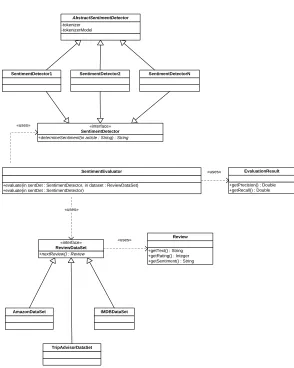
The evaluation framework presented in the following allows comparing the results of the various SD methods through the SentimentDetector interface. New data is integrated by implementing the ReviewDataSet interface. To evaluate an SD method on a data set, implementations of both have to be passed to the evaluation method of the SentimentEvaluator. This component iterates the reviews in the specified data set and applies the specified SentimentDetector on each of them. The results of the SD for each review is then compared with the review’s original rating and the outcome is classified as true positive, true negative, false positive or false negative for the calculation of statistical measures (see Subsection 5.2 for details on the used statistical measures). Figure 4.3 shows a UML diagram of the evaluation framework.
5 Evaluation
The evaluation focuses on the SD method’s ability to put a review into the right po-larity class (positive or negative). The IMDb data set is already divided into positive and negative classes. For the Amazon and TripAdvisor data sets, a pre-processing module maps user ratings between ‘one star’ and ‘five stars’ to the classes ‘nega-tive’, ‘neutral’, and ‘positive’ as outlined in Section 4.
5.1 Statistical Properties of the Corpora and Implications
SentimentDetector1
+determineSentiment(in article : String) : String
«interface»
SentimentDetector SentimentDetector2
-tokenizer -tokenizerModel
AbstractSentimentDetector
SentimentDetectorN
«uses»
AmazonDataSet
+getText() : String +getRating() : Integer +getSentiment() : String
Review
«uses» «uses»
+nextReview() : Review
«interface»
ReviewDataSet
TripAdvisorDataSet
IMDBDataSet
+getPrecision() : Double +getRecall() : Double
EvaluationResult
«uses»
+evaluate(in sentDet : SentimentDetector, in dataset : ReviewDataSet) +evaluate(in sentDet : SentimentDetector)
SentimentEvaluator
Fig. 2 UML diagram of the evaluation framework
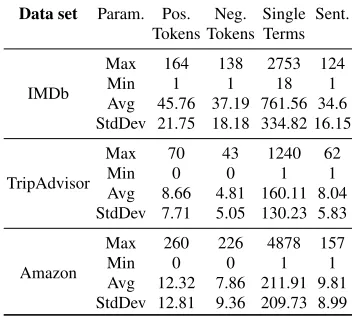
Table 1 Statistical characteristics of the review data sets
Data set Param. Pos. Neg. Single Sent. Tokens Tokens Terms
IMDb
Max 164 138 2753 124
Min 1 1 18 1
Avg 45.76 37.19 761.56 34.6 StdDev 21.75 18.18 334.82 16.15
TripAdvisor
Max 70 43 1240 62
Min 0 0 1 1
Avg 8.66 4.81 160.11 8.04 StdDev 7.71 5.05 130.23 5.83
Amazon
Max 260 226 4878 157
Min 0 0 1 1
Avg 12.32 7.86 211.91 9.81 StdDev 12.81 9.36 209.73 8.99
5.2 Detailed Results
The evaluation considers five statistical parameters: recall, precision, accuracy, F measure, and Cohen’s kappa coefficient. Recall is a measure for the completeness of a detection method - i.e., it shows how many of the requested objects could ac-tually be found. On the other hand, precision provides a measure for the number of objects that have been identified correctly. The accuracy is the ratio of all correctly identified objects and the (either correctly or incorrectly) classified objects. The F measure combines recall and precision. Cohen’s kappa coefficient is normally used to measure the inter-rater-reliability, that is, how strongly different raters classifying a number of objects agree on the classification of these objects.
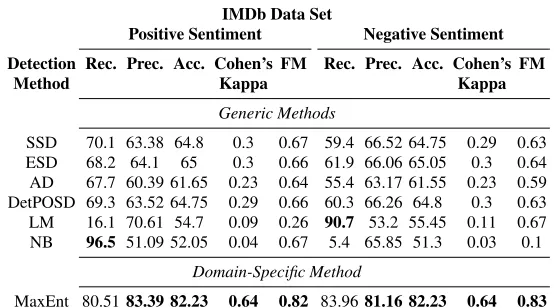
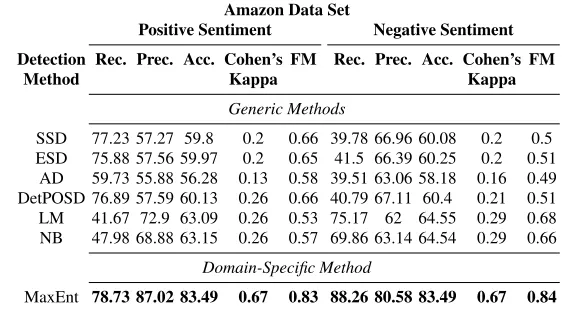
We calculate recall and precision for the positive and negative class separately. Separate precision and recall results for the positive and negative class are required because the classifiers we use can also return a neutral result (namely when no sentiment token occurs in a review). Therefore, a document that is not negative is not automatically positive. This procedure also leads to separate results for Cohen’s kappa value as well as the F measure. Tables 2 to 4 show the detailed evaluation results of each data set.
Using the IMDb data set resulted in fairly balanced results. The arithmetic meth-ods achieve good results for the detection of positive as well as negative reviews (considering the usage of a domain-independent tagged dictionary). The TripAd-visor data set yields the best results for the detection of positive reviews. Yet, this outstanding performance is accompanied by quite poor results in the detection of negative sentences. The Amazon data set also satisfyingly identifies positive reviews at the cost of an inferior precision for negative reviews.
in 5.1 shows that in all data sets, a larger number of positive tokens occurred. This fact leads to the assumption that customers use positive tokens more frequently than negative ones and that positive words might also be used in order to express a nega-tive opinion towards a movie, book or holiday destination (e.g., in the case of humor or sarcasm). Additional context information would help resolve some of these cases and determine sentiment more accurately.
The Maximum Entropy Model, which entails domain-specific knowledge, out-performs the other methods. It produces results with the highest precision, recall and kappa value in the negative classification task as well as in the positive. These findings do not suggest that arithmetic SD generally provides inferior results, but that the knowledge base and the application domain play an important role in the identification of negative sentiment. Methods that consider the domain context (see Section 6) therefore have the potential to yield much better results.
Table 2 Evaluation of the SD methods applied to the IMDb data set (FM=F measure)
IMDb Data Set
Positive Sentiment Negative Sentiment Detection Rec. Prec. Acc. Cohen’s FM Rec. Prec. Acc. Cohen’s FM
Method Kappa Kappa
Generic Methods
SSD 70.1 63.38 64.8 0.3 0.67 59.4 66.52 64.75 0.29 0.63 ESD 68.2 64.1 65 0.3 0.66 61.9 66.06 65.05 0.3 0.64 AD 67.7 60.39 61.65 0.23 0.64 55.4 63.17 61.55 0.23 0.59 DetPOSD 69.3 63.52 64.75 0.29 0.66 60.3 66.26 64.8 0.3 0.63 LM 16.1 70.61 54.7 0.09 0.26 90.7 53.2 55.45 0.11 0.67 NB 96.5 51.09 52.05 0.04 0.67 5.4 65.85 51.3 0.03 0.1
Domain-Specific Method
MaxEnt 80.5183.39 82.23 0.64 0.82 83.9681.16 82.23 0.64 0.83
5.3 Discussion
The evaluation results show that the presented SD methods have their strength in the identification of reviews with positive sentiment (high recall). Only a relatively small number was overlooked by the algorithms. On the other hand, the method’s precision is less satisfactory. A rather high amount of items has been incorrectly identified as having a positive sentiment.
Table 3 Evaluation of the SD methods applied to the TripAdvisor data set (FM=F Measure)
TripAdvisor Data Set
Positive Sentiment Negative Sentiment Detection Rec. Prec. Acc. Cohen’s FM Rec. Prec. Acc. Cohen’s FM
Method Kappa Kappa
Generic Methods
SSD 93.39 65.61 72.22 0.44 0.77 30.41 86.6 62.85 0.26 0.45 ESD 92.76 66.13 72.62 0.45 0.77 32.04 85.71 63.35 0.27 0.47 AD 83.62 65.67 69.95 0.4 0.74 26.52 76.1 59.1 0.18 0.39 DetPOSD 93.21 66.15 72.76 0.46 0.77 31.67 86.63 63.39 0.27 0.46 LM 40.09 57.53 55.25 0.1 0.47 63.44 58.91 59.59 0.19 0.61 NB 49.7776.9267.42 0.35 0.6 77.0167.86 70.27 0.41 0.72
Domain-Specific Method
MaxEnt 93.8967.7174.56 0.49 0.79 55.2290.04 74.56 0.49 0.68
Table 4 Evaluation of the SD methods applied to the Amazon data set (FM=F Measure)
Amazon Data Set
Positive Sentiment Negative Sentiment Detection Rec. Prec. Acc. Cohen’s FM Rec. Prec. Acc. Cohen’s FM
Method Kappa Kappa
Generic Methods
SSD 77.23 57.27 59.8 0.2 0.66 39.78 66.96 60.08 0.2 0.5 ESD 75.88 57.56 59.97 0.2 0.65 41.5 66.39 60.25 0.2 0.51
AD 59.73 55.88 56.28 0.13 0.58 39.51 63.06 58.18 0.16 0.49 DetPOSD 76.89 57.59 60.13 0.26 0.66 40.79 67.11 60.4 0.21 0.51 LM 41.67 72.9 63.09 0.26 0.53 75.17 62 64.55 0.29 0.68 NB 47.98 68.88 63.15 0.26 0.57 69.86 63.14 64.54 0.29 0.66
Domain-Specific Method
MaxEnt 78.73 87.02 83.49 0.67 0.83 88.26 80.58 83.49 0.67 0.84
correctly extract reviews with negative sentiment (very low recall). Yet, precision does not decrease to the same extent. As for precision, the SD on the TripAdvisor data set again outperforms the results obtained with the other data set.
We assume that the structure of the reviews in the IMDb and Amazon data set strongly influences the outcomes. Reviews of movies and books often integrate plot summaries into the evaluation. In the case of love films, for example, a notable number of words carrying positive sentiment like ‘love’, or ‘happy’ (if the film has a happy end) will occur, even when the reviewer dislikes the product. The same consideration applies to horror films or thrillers that contain negative vocabulary in the plot summary.
and favors domain-specific components whenever the required context informa-tion is available. Building on this insight, the following secinforma-tion proposes to build databases of Tagged Linguistic Units (TLU). Such a repository contains a com-prehensive list of terms of a certain language together with their significance for emotional speech (i.e., their sentiment value) and additional metadata.
6 Tagged Linguistic Units
Tagged Linguistic Units (TLUs) comprise units of linguistic content such as terms and phrases, coupled with a set of annotations (e.g., POS tags, topic or prevalent context). They combine the advantages of methods that go beyond lexis without inheriting the full complexity of grammar parsing. The following sections outline the generation of TLU databases and their application to sentiment detection.
6.1 Database Creation
As already mentioned in section 4, simple SD methods that do not use machine learning algorithms on narrowly defined domains rely on a tagged dictionary that distinguishes between positive- and negative-valued sentiment words [16]. Such dictionaries typically contain a few thousand mappings from words to their asso-ciated sentiment values - e.g., the General Inquirer [18]). They can be subjected to a reverse lemmatization procedure, adding inflections to the initial list of senti-ment words. Even assuming such an extended tagged dictionary, dictionary-based approaches do not take the context of sentiment words into account, which limits their usefulness in corporate knowledge architectures.
The rest of this paper addresses this shortcoming by proposing a hybrid method based on spreading activation networks coupled with machine learning algorithms for assigning sentiment values to linguistic units. For this purpose, the following lin-guistic units for computing sentiment will be distinguished:unigram(single word),
n-gram(multiple-word units of meaning), andconcepts(units of meaning not tied
to a particular lexical form and represented via rules or regular expressions, e.g.
climate change⇔global warming).
A sentiment value and a context (e.g., part-of-speech, geographic location and named entity) are assigned to each linguistic unit. For a given amount of text, these mappings taken together are the building blocks of aTagged Linguistic Unit (TLU)
andprison cellthrough the consideration of contextual information like POS tags, geo tags and named entity tags.
Work by Scharl et al. [15] has demonstrated the usefulness of assigning sentiment values to geographic locations and also shows how heavily these values depend on other context dimensions. Future research will address these dependencies by com-bining tags with more sophisticated context information as for instance hierarchical classifications [20] or topic tags. This approach (i) is language-independent in the sense that only a small set of seed terms (e.g., 100 positive and 100 negative terms) and grammar patterns would be required to initialize the machine learning algorithm and fine-tune sentiment values to any language that is decomposable into unigrams, n-grams and concepts, (ii) is not restricted to the sentiment categories ‘positive’ and ‘negative’, but supports an arbitrary number of linguistic categorizations such as weak←→strong, passive←→active, etc., (iii) ensures that every sentence or docu-ment can be annotated; traditional approaches often encounter sentences that do not contain any of the words listed in the tagged dictionary.
Figure 3 illustrates sentiment scoring based on linguistic units. The phrase engine identifies the linguist units.
Phrase Engine Tagging
Engine
Part-of-Speech
Gazetteer Named Entities
Sentiment Engine
Tagged Linguistic Unit (TLU) Database Input
Text
Sentiment
Score
Tagged Text
Tagged Linguistic Units
Fig. 3 Sentiment scoring based on linguistic units
6.2 Iterative Extension and Optimization
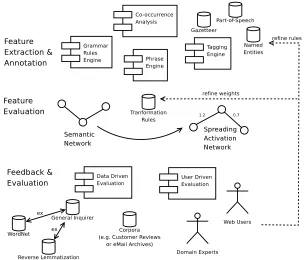
As outlined in the previous section, TLU databases can be easily customized to specific domains and use cases. A domain-specific corpus, language-specific gram-mar rules and a set of seed terms with “known” sentiment values (e.g., from con-ventional tagged dictionaries such as the General Inquirer repository) initialize the TLU database. The architecture identifies unknown linguistic units in the corpus and determines their sentiment value as illustrated in Figure 4.
Fig. 4 Iterative fine-tuning of the Tagged Linguistic Unit (TLU) database
The tagging component marks sentences with part-of-speech tags and identifies named entities such as people, organizations, and geographic locations. Combin-ing co-occurrence analysis with a grammar rule engine yields candidate terms for extending the TLU database. Annotating these terms with named entity tags and encoding characteristic grammatical patterns and known phrases creates a complex semantic network, which describes the relations between linguistic units.
between the units based on the features and annotations generated during the anno-tation step. Activation of concepts with known sentiment charges in accordance to sign and strength of the charge leads to the propagation of energy pulses through the network, eventually distributing charges to all linguistic units. Analyzing the senti-ment values’ variance allows estimating confidence levels and identifying synonym
↔antonym relationships.
Feedback gathered in the evaluation step adjusts and optimizes the transforma-tion rules for a given domain and corpus, improving the quality of the TLU database with every subsequent step. Automatic data-driven evaluation on a TLU level will help assess overall performance. Using the evaluation framework outlined in Section 5 on various publicly available Web corpora will provide test cases for TLU-based sentiment detection. Automated methods will be complemented by user-driven eval-uations from domain experts and Web users. The feedback gathered by the data- and user-driven evaluations will be utilized to refine the transformation rules of the fea-ture evaluation, and to identify candidate patterns for the inclusion into the databases of the grammar rule engine and the phrase engine.
Automatically generating TLU databases faces the problem of determining the correct charge (+0.4 vs. -0.4, for example) of the sentiment value to be assigned to the linguistics unit. The problem arises from the fact that synonyms and antonyms have very similar (co-)occurrence patterns in a given corpus. Advanced relation dis-covery techniques developed within the AVALON project [21] will help overcome this challenge and facilitate the automation of this classification process. The ma-chine learning algorithms will be trained and evaluated on augmented tagged dic-tionaries (created through reverse lemmatization and adding WordNet synonym and antonym pairs), as well as on public pre-tagged corpora.
7 Conclusion and Outlook
Simple approaches to sentiment detection based on patterns of co-occurrence with terms from tagged dictionaries scale well but provide less accurate results compared to complex methods that require a full parsing of sentence structures. The sheer vol-ume of textual data and economic considerations, however, frequently rule out the most sophisticated approaches. Continuously updated databases of tagged linguistic units aim to balance accuracy and throughput. They add an adaptive layer to static sentiment detection approaches based on tagged dictionaries, which still tend to be compiled manually.
Text mining projects have to process hundreds of thousands or millions of doc-uments in short intervals. Thus they significantly benefit from accurate methods of determining sentiment with minimal computational requirements at run time. While the creation of tagged linguistic unit databases is computationally intense, the overhead of applying them within annotation components remains small. Im-proved sentiment detection algorithms will encourage their use in both academic and commercial applications. Refined versions of the sentiment detection methods presented in this paper will generate a richer set of context information (e.g., on-tology concepts or explicit references to other types of structured knowledge), and consider this information in the scoring process.
Acknowledgment
This work was developed as a part of the RAVEN (Relation Analysis and Vi-sualization for Evolving Networks; www.modul.ac.at/nmt/raven) research project funded by the Austrian Ministry of Transport, Innovation & Technology (BMVIT) and the Austrian Research Promotion Agency (FFG) within the strategic objective FIT-IT (www.fit-it.at). The authors wish to thank Arinya Eller for proof-reading the manuscript and Ivo Ponocny for his valuable feedback and suggestions.
References
1. A. L. Berger, S. D. Pietra, and V. J. D. Pietra. A maximum entropy approach to natural language processing.Computational Linguistics, 22(1):39–71, 1996.
2. J. Blitzer, M. Dredze, and F. Pereira. Biographies, bollywood, boom-boxes and blenders: Domain adaptation for sentiment classification. InProceedings of the 45th Annual Meeting of the Association of Computational Linguistics, pages 440–447, Prague, Czech Republic, June 2007.
3. X. Ding, B. Liu, and P. S. Yu. A holistic lexicon-based approach to opinion mining. InWSDM ’08: Proceedings of the international conference on Web search and web data mining, pages 231–240, New York, NY, USA, 2008. ACM.
4. V. Hatzivassiloglou and K. R. McKeown. Predicting the semantic orientation of adjectives. InProceedings of the eighth conference on European chapter of the Association for Compu-tational Linguistics, pages 174–181, Morristown, NJ, USA, 1997. Association for Computa-tional Linguistics.
5. A. Kilgarriff, R. Evans, R. Koeling, M. Rundell, and D. Tugwell. Waspbench: A lexicogra-pher’s workbench supporting state-of-the-art word sense disambiguation. In10th Conference on European Chapter of the Association For Computational Linguistics, Morristown, USA, 2003. Association for Computational Linguistics.
6. A. Kilgarriff, P. Rychl, P. Smrz, and D. Tugwell. The Sketch engine. In11th Euralex interna-tional Congress, Lorient, France, 2004.
8. W. Liu, A. Weichselbraun, A. Scharl, and E. Chang. Semi-automatic ontology extension using spreading activation.Journal of Universal Knowledge Management, 0(1):50–58, 2005. http://www.jukm.org/jukm 0 1/semi automatic ontology extension.
9. C. D. Manning and H. Sch¨utze.Foundations of Statistical Natural Language Processing. The MIT Press, Cambridge, Massachusetts, 1999.
10. T. Mullen and N. Collier. Sentiment analysis using support vector machines with diverse information sources, 2004.
11. B. Pang and L. Lee. A Sentimental Education: Sentiment Analysis Using Subjectivity Sum-marization Based on Minimum Cuts, September 2004.
12. B. Pang, L. Lee, and S. Vaithyanathan. Thumbs up? Sentiment Classification using Machine Learning Techniques. InProceedings of the 2002 Conference on Empirical Methods in Natu-ral Language Processing (EMNLP), 2002.
13. A. Ratnaparkhi. Maximum entropy models for natural language ambiguity resolution, 1998. 14. E. Riloff and J. Wiebe. Learning extraction patterns for subjective expressions. InProceedings
of the 2003 Conference on Empirical Methods in Natural Language Processing (EMNLP-03), 2003.
15. A. Scharl, A. Dickinger, and A. Weichselbraun. Analyzing news media coverage to acquire and structure tourism knowledge.Information Technology and Tourism, 10(1):3–17, 2008. 16. A. Scharl, I. Pollach, and C. Bauer. Determining the semantic orientation of web-based
cor-pora. In J. Liu, Y. Cheung, and H. Yin, editors,Intelligent Data Engineering and Automated Learning, 4th International Conference, IDEAL-2003, Hong Kong (Lecture Notes in Com-puter Science, Vol. 2690), pages 840–849, Berlin, 2003. Springer.
17. A. Scharl and A. Weichselbraun. An automated approach to investigating the online media coverage of us presidential elections.Journal of Information Technology & Politics, 5(1):121– 132, 2008.
18. P. J. Stone.The General Inquirer: A Computer Approach to Content Analysis. The MIT Press, 1966.
19. P. Subasic and A. Huettner. Affect analysis of text using fuzzy semantic typing.IEEE Trans-action on Fuzzy Systems, 9(4):483–496, 2001.
20. A. Weichselbraun. Ontologiebasierende Textklassifikation mittels mathematischer Verfahren. PhD thesis, Vienna University of Economics and Business Administration, 2004.
21. A. Weichselbraun, G. Wohlgenannt, A. Scharl, M. Granitzer, T. Neidhart, and A. Juffinger. Applying vector space models to ontology link type suggestion. In4th International Confer-ence on Innovations in Information Technology, pages 566–570, Dubai, United Arab Emirates, 2007. IEEE Press.
22. C. Whitelaw, N. Garg, and S. Argamon. Using Appraisal Taxonomies for Sentiment Anal-ysis. InProceedings of MCLC-05, the 2nd Midwest Computational Linguistic Colloquium, Columbus, US, 2005.
23. J. Wiebe and E. Riloff. Creating subjective and objective sentence classifiers from unannotated texts. InProceeding of CICLing-05, International Conference on Intelligent Text Processing and Computational Linguistics., volume 3406 ofLecture Notes in Computer Science, pages 475–486, Mexico City, MX, 2005. Springer-Verlag.
24. T. Wilson, J. Wiebe, and P. Hoffmann. Recognizing contextual polarity in phrase-level sen-timent analysis. InProceedings of Human Language Technologies Conference/Conference on Empirical Methods in Natural Language Processing (HLT/EMNLP 2005), Vancouver, CA, 2005.
25. H. Yu and V. Hatzivassiloglou. Towards answering opinion questions: Separating facts from opinions and identifying the polarity of opinion sentences. In M. Collins and M. Steedman, ed-itors,Proceedings of EMNLP-03, 8th Conference on Empirical Methods in Natural Language Processing, pages 129–136, Sapporo, JP, 2003.