The Thirty-Third AAAI Conference on Artificial Intelligence (AAAI-19)
Outlier Aware Network Embedding for Attributed Networks
Sambaran Bandyopadhyay
∗IBM Research, India [email protected]
Lokesh N.
Indian Institute of Science, Bangalore [email protected]
M. N. Murty
Indian Institute of Science, Bangalore [email protected]
Abstract
Attributed network embedding has received much interest from the research community as most of the networks come with some content in each node, which is also known as node attributes. Existing attributed network approaches work well when the network is consistent in structure and attributes, and nodes behave as expected. But real world networks often have anomalous nodes. Typically these outliers, being rela-tively unexplainable, affect the embeddings of other nodes in the network. Thus all the downstream network mining tasks fail miserably in the presence of such outliers. Hence an inte-grated approach to detect anomalies and reduce their overall effect on the network embedding is required.
Towards this end, we propose an unsupervised outlier aware network embedding algorithm (ONE) for attributed networks, which minimizes the effect of the outlier nodes, and hence generates robust network embeddings. We align and jointly optimize the loss functions coming from structure and at-tributes of the network. To the best of our knowledge, this is the first generic network embedding approach which incor-porates the effect of outliers for an attributed network with-out any supervision. We experimented on publicly available real networks and manually planted different types of out-liers to check the performance of the proposed algorithm. Re-sults demonstrate the superiority of our approach to detect the network outliers compared to the state-of-the-art approaches. We also consider different downstream machine learning ap-plications on networks to show the efficiency of ONE as a generic network embedding technique. The source code is made available at https://github.com/sambaranban/ONE.
1
Introduction
Network embedding (a.k.a. network representation learning) has gained a tremendous amount of interest among the re-searchers in the last few years (Perozzi, Al-Rfou, and Skiena 2014; Grover and Leskovec 2016). Most of the real life networks have some extra information within each node. For example, users in social networks such as Facebook have texts, images and other types of content. Research pa-pers (nodes) in a citation network have scientific content in it. Typically this type of extra information is captured
∗
Also affiliated with Indian Institute of Science, Bangalore Copyright c⃝2019, Association for the Advancement of Artificial Intelligence (www.aaai.org). All rights reserved.
using attribute vectors associated with each node. The at-tributes and the link structure of the network are highly correlated according to the sociological theories like ho-mophily (McPherson, Smith-Lovin, and Cook 2001). But embedding attributed networks is challenging as combining attributes to generate node embeddings is not easy. Towards this end, different attributed network representation tech-niques such as (Yang et al. 2015; Huang, Li, and Hu 2017a; Gao and Huang 2018) have been proposed in literature. They perform reasonably well when the network is consistent in its structure and content, and nodes behave as expected.
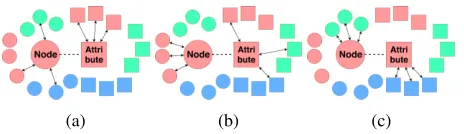
Unfortunately real world networks are noisy and there are different outliers which even affect the embeddings of nor-mal nodes (Liu, Huang, and Hu 2017). For example, there can be research papers in a citation network with few spuri-ous references (i.e., edges) which do not comply with the content of the papers. There are celebrities in social net-works who are connected to too many other users, and gener-ally properties like homophily are not applicable to this type of relationships. So they can also act like potential outliers in the system. Normal nodes are consistent in their respective communities both in terms of link structure and attributes. We categorize outliers in an attributed network into three categories and explain them as shown in Figure 1.
One way to detect outliers in the network is to use some network embedding approach and then use algorithms like isolation forest (Liu, Ting, and Zhou 2008) on the generated embeddings. But this type of decoupled approach is not op-timal as outliers adversely affect the embeddings of the nor-mal nodes. So an integrated approach to detect outliers and minimize their effect while generating the network embed-ding is needed. Recently (Liang et al. 2018) proposes a semi supervised approach for detecting outliers while generating network embedding for an attributed network. But in prin-ciple, it needs some supervision to work efficiently. For real world networks, it is difficult to get such supervision or node labels. So there is a need to develop a completely unsuper-vised integrated approach for graph embedding and outlier detection which can be applicable to any attributed network.
Contributions: Following are the contributions we make.
(a) (b) (c)
Figure 1: This shows different types of outliers that we con-sider in an attributed network. We highlight the outlier node and its associated attribute by larger circle and rectangle re-spectively. Different colors represent different communities. Arrows between the two nodes represent network edges and arrows between two attributes represent similarity (in some metric) between them. (a)Structural Outlier: The node has edges to nodes from different communities, i.e., its structural neighborhood is inconsistent. (b)Attribute Outlier: The at-tributes of the node is similar to atat-tributes of the nodes from different communities, i.e., its attribute neighborhood is in-consistent. (c)Combined Outlier: Node belongs to a com-munity structurally but it has a different comcom-munity in terms of attribute similarity.
that the outliers contribute less to the overall cost function.
• This is the first work to propose a completely unsuper-vised algorithm for attributed network embedding inte-grated with outlier detection. Also we propose a novel method to combine structure and attributes efficiently.
• We conduct a thorough experimentation on the outlier seeded versions of popularly used and publicly available network datasets to show the efficiency of our approach to detect outliers. At the same time by comparing with the state-of-the-art network embedding algorithms, we demonstrate the power of ONE as a generic embedding method which can work with different downstream ma-chine learning tasks such as node clustering and node classification.
2
Related Work
This section briefs the existing literature on attributed net-work embedding, and some outlier detection techniques in the context of networks. Network embedding has been a hot research topic in the last few years and a detailed sur-vey can be found in (Hamilton, Ying, and Leskovec 2017b). Word embedding in natural language processing literature, such as (Mikolov et al. 2013) inspired the development of node embedding in network analysis. DeepWalk (Perozzi, Al-Rfou, and Skiena 2014), node2vec (Grover and Leskovec 2016) and Line (Tang et al. 2015) gained popularity for net-work representation just by using the link structure of the network. DeepWalk and node2vec use random walk on the network to generate node sequences and feed them to lan-guage models to get the embedding of the nodes. In Line, two different objective functions have been used to capture the first and second order proximities respectively and an edge sampling strategy is proposed to solve the joint op-timization for node embedding. In (Ribeiro, Saverese, and Figueiredo 2017), authors propose struc2vec where nodes
having similar substructure are close in their embeddings. All the papers citeed above only consider link structure of the network for generating embeddings. Research has been conducted on attributed network representation also. TADW (Yang et al. 2015) is arguably the first attempt to successfully use text associated with nodes in the network embedding via joint matrix factorization. But their frame-work directly learns one embedding from content and ture together. In case when there is noise or outliers in struc-ture or content, such a direct approach is prone to be af-fected more. Another attributed network embedding tech-nique (AANE) is proposed in (Huang, Li, and Hu 2017a). The authors have used symmetric matrix factorization to get embeddings from the similarity matrix over the attributes, and use link structure of the network to ensure that the em-beddings of the two connected nodes are similar. A semi-supervised attributed embedding is proposed in (Huang, Li, and Hu 2017b) where the label information of some nodes are used along with structure and attributes. The idea of using convolutional neural networks for graph embedding has been proposed in (Niepert, Ahmed, and Kutzkov 2016; Kipf and Welling 2016). An extension of GCN with node attributes (GraphSage) has been proposed in (Hamilton, Ying, and Leskovec 2017a) with an inductive learning setup. These methods do not manage outliers directly, and hence are often prone to be affected heavily by them.
Recently a semi-supervised deep learning based approach SEANO (Liang et al. 2018) has been proposed for outlier de-tection and network embedding for attributed networks. For each node, they collect its attribute and the attributes from the neighbors, and smooth out the outliers by predicting the class labels (on the supervised set) and node context. But getting labeled nodes for real world network is expensive. So we aim to design an unsupervised attributed network em-bedding algorithm which can detect and minimize the effect of outliers while generating the node embeddings.
3
Problem Formulation
An information network is typically represented by a graph asG = (V, E, C), whereV = {v1, v2,· · ·, vN} is the set of nodes (a.k.a. vertexes), each representing a data object. E ⊂ {(vi, vj)|vi, vj ∈ V}is the set of edges between the vertexes. Each edge e ∈ Eis an ordered paire = (vi, vj) and is associated with a weight wvi,vj > 0, which
indi-cates the strength of the relation. IfGis undirected, we have
(vi, vj)≡(vj, vi)andwvi,vj ≡wvj,vi; ifGis unweighted,
wvi,vj = 1,∀(vi, vj)∈E.
Let us denote theN×Ndimensional adjacency matrix of the graphGbyA= (ai,j), whereai,j=wvi,vj if(vi, vj)∈
E, and ai,j = 0otherwise. So ith row of Acontains the immediate neighborhood information for nodei. Clearly for a large network, the matrixAis highly sparse in nature.C is aN ×D matrix withCi· as rows, whereCi· ∈ RD is the attribute vector associated with the nodevi ∈V.Cidis the value of the attributedfor the nodevi. For example, if there is only textual content in each node,cican be the tf-idf vector for the content of the nodevi.
Our goal is to find a low dimensional representation ofG
and the content of the nodes. More formally, for a given network G, network embedding is a technique to learn a function f : vi ↦→ yi ∈ RK, i.e., it maps every vertex to aK dimensional vector, whereK < min(N, D). The representations should preserve the underlying semantics of the network. Hence the nodes which are close to each other in terms of their topographical distance or similarity in at-tributes should have similar representations. We also need to reduce the effect of outliers, so that the representations for the other nodes in the network are robust.
4
Solution Approach: ONE
We describe the whole algorithm in different parts.
4.1
Learning from the Link Structure
Given graphG, each nodeviby default can be represented by theith row Ai· of the adjacency matrix. Let us assume
the matrix G ∈ RN×K be the network embedding of G, only by considering the link structure. Hence row vectorGi·
is theK dimensional (K < min(N, D)) compact vector representation of nodevi,∀vi ∈ V. Also let us introduce a K ×N matrix H to minimize the reconstruction loss:
N
∑
i=1 N
∑
j=1
(Aij−Gi··H·j)2, whereH·j is thejth column of
H, andGi··H·jis the dot product between these two vec-tors1.kth row ofHcan be interpreted as theN dimensional description ofkth feature, wherek = 1,2,· · ·, K. This re-construction loss tends to preserve the original distances in the lower dimensional spaces as shown by (Cunningham and Ghahramani 2015). But if the graph has anomalous nodes, they generally affect the embedding of the other (normal) nodes. To minimize the effect of such outliers while learning embeddings from the structure, we introduce the structural outlier scoreO1ifor nodevi∈V, where0< O1i ≤1. The bigger the value ofO1i, the more likely it is that nodevi is an outlier, and lesser should be its contribution to the total loss. Hence we seek to minimize the following cost function w.r.t. the variablesO1(set of all structural outlier scores),G andH.
Lstr= N
∑
i=1 N
∑
j=1
log( 1 O1i
)
(Aij−Gi··H·j)2 (1)
We also assume N
∑
i=1
O1i=µ,µbeing the total outlier score
of the network. Otherwise minimizing Eq. 1 amounts to as-signing 1 to all the outlier scores, which makes the loss value 0. It can be readily seen that, whenO1i is very high (close to 1) for a node vi, the contribution of this node
N
∑
j=1
log(O1 1i
)
(Aij −Gi.·H.j)2 becomes negligible, and
whenO1iis small (close to 0), the corresponding contribu-tion is high. So naturally, the optimizacontribu-tion would concen-trate more on minimizing the contributions of the outlier
1
We treat both row vector and column vector as vectors of same dimension, and hence use the dot product instead of transpose to avoid cluttering of notation
(w.r.t. the link structure) nodes, to the overall objective, as desired.
4.2
Learning from the Attributes
Similar to the case of structure, here we try to learn a K dimensional vectorial representationUi·from the given
at-tribute matrixC, whereCi·is the attribute vector of nodevi. Let us consider the matricesU ∈RN×K andV ∈ RK×D, Ubeing the network embedding just respecting the set of at-tributes. In the absence of outliers, one can just minimize
the reconstruction loss N
∑
i=1 D
∑
d=1
(Cid −Ui· ·V·d)2 with
re-spect to the matrices U and V. But as mentioned before, outliers even affect the embeddings of the normal nodes. Hence to reduce the effect of outliers while learning from the attributes, we introduce the attribute outlier scoreO2ifor nodevi∈V, where0< O2i ≤1. Larger the value ofO2i, higher the chance that nodeviis an attribute outlier. Hence we minimize the following cost function w.r.t. the variables O2,UandV.
Lattr= N
∑
i=1 C
∑
d=1
log( 1 O2i
)
(Cid−Ui··V·d)2 (2)
We again assign the constraint that N
∑
i=1
O2i =µfor the
rea-son mentioned before. Hence contributions from the non-outlier (w.r.t. attributes) nodes would be bigger while mini-mizing Eq. 2.
4.3
Connecting Structure and Attributes
So far, we have considered the link structure and the attribute values of the network separately. Also the optimization vari-ables of Eq. 1 and that in Eq. 2 are completely disjoint. But optimizing them independently is not desirable as, our ulti-mate goal is to get a joint low dimensional representation of each node in the network. Also we intend to regularize struc-ture with respect to attributes and vice versa. As discussed before, link structure and attributes in a network are highly correlated and they can be often noisy individually.
One can see that,Gi·andUi·are the representation of the
same nodeviwith respect to structure and attributes respec-tively. So one can easily act as a regularizer of the other. Also as they contribute to the embedding of the same node,
it makes sense to minimize N
∑
i=1 K
∑
k=1
(Gik−Uik)2. But it is
important to note that, there is no explicit guarantee that the features inGi·and features inUi·are aligned, i.e.,kth
fea-ture of the strucfea-ture embeddings can be very different from thekth feature of attribute embeddings. Hence before min-imizing the distance ofGi·andUi·, it is important to align
the features of the two embedding spaces.
Embedding Transformation and Procrustes problem
This type of transformation has been used in the NLP lit-erature, particularly for machine translation (Lample et al. 2018). If we further restrictW to be an orthogonal matrix, then a closed form solution can be obtained from the solu-tion concept of Procrustes problem (Sch¨onemann 1966) as follows:
W∗=argmin W∈OK
||G−U WT||F (3)
whereW∗ = XYT withXΣYT = SVD(GTU),O K is the set of all orthogonal matrices of dimensionK×K. Re-strictingW to be an orthogonal matrix has also several other advantages as shown in the NLP literature (Xing et al. 2015). But we cannot directly use the solution of Procrustes problem, as we have anomalies in the network. As before, we again reduce the effect of anomalies to minimize the dis-agreement between the structural embeddings and attribute embeddings. Let us introduce the disagreement anomaly scoreO3ifor a nodevi ∈V, where0< O3i≤1. Disagree-ment anomalies are required to manage the anomalous nodes which are not anomalies in either of structure or attributes in-dividually, but they are inconsistent when considering them together. Following is the cost function we minimize.
Ldis= N ∑ i=1 K ∑ k=1
log( 1 O3i
)(
Gik−Ui··(WT)·k
)2 (4)
N
∑
i=1
O3i=µ. We will use the solution of Procrustes problem
after applying a simple trick to the cost function above, as shown in the derivation of the update rule ofW later.
4.4
Joint Loss Function
Here we combine the three cost functions mentioned before, and minimize the following with respect toG,H,U,V,W andO(Ocontains all the variables fromO1,O2andO3).
L=Lstr+αLattr+βLdis (5) The full set of constrains are:
0< O1i, O2i, O3i≤1, ∀vi∈V N
∑
i=1 O1i=
N
∑
i=1 O2i=
N
∑
i=1
O3i=µ
W ∈ OK ⇐⇒ WTW =I
Here α, β > 0 are weight factors. We will discuss a method to set them in the experimental evaluation. It is to be noted that, the three anomaly scoresO1i,O2iandO3ifor any node vi are actually connected by the cost function 5. For example, if a node is anomalous in structure,O1iwould be high and its embeddingGi·may not be optimized well.
So this in turn affects its matching with transformedUi·, and
henceO3i would be given a higher value to minimize the disagreement loss.
4.5
Derivations of the Update Rules
We will derive the necessary update rules which can be used iteratively to minimize Eq. 5. We use the alternating mini-mization technique, where we derive the update rule for one variable at a time, keeping all others fixed.
4.6
Updating
G
,
H
,
U
,
V
We need to take the partial derivative of L (Eq. 5) w.r.t one variable at a time and equate that to zero. For
exam-ple, ∂G∂L
ik = 0⇒
N
∑
j=1
log( 1 O1i
)
(Aij−Gi··H·j)(−Hkj) +
log( 1 O3i
)
(Gik−Ui··(WT)·k) = 0. Solving it forGik,
Gik=
Gnumik 1+βlog(O1 3i
)
(Wk··Ui·)
log(O1 1i
)
(Hk··Hk·) +βlog (
1 O3i
)
Gnumik 1= log( 1 O1i
)∑N
j=1
(Aij−
∑
k′̸=k
Gik′Hk′j)Hkj
(6) Similarly we can get the following update rules.
Hkj=
∑N
i=1log (
1 O1i
)
(Aij−∑k′̸=kGik′Hk′j)Gik
∑N
i=1log (
1 O1i
)
G2 ik
(7)
Uik=
Unum1
ik +Uiknum2
βlog(O1 2i
)
(Vk··Vk·) +γlog (
1 O3i
)
W·k·W·k
Uiknum1=βlog( 1 O2i
)∑D
d=1
(Cid−
∑
k′̸=k Uik′V
k′d)Vkd
Uiknum2=γlog( 1 O3i
)(
Gi·−(Ui·W)−(Uik·W·k)
)
(8)
Vkd=
∑N
i=1log (
1 O2i
)
(Cid−∑k′̸=kUik′Vk′d)Uik
∑N
i=1log (
1 O2i
)
U2 ik
(9)
4.7
Updating
W
We use a small trick to directly apply the closed form solu-tion of Procrustes problem as follows.
Ldis= N ∑ i=1 K ∑ k=1
log( 1 O3i
)(
Gik−Ui··(WT)·k
)2 = N ∑ i=1 K ∑ k=1 ( ¯
Gik−U¯i··(WT)·k
)2
(10)
Here the new matrices are defined as, ( ¯G)i,k =
√
log( 1 O3i
)
GikandU¯ik=
√
log( 1 O3i
)
Uik. Say,XΣYT =
SVD( ¯GTU¯), thenW can be obtained as:
4.8
Updating
O
We derive the update rule forO1first. Taking the Lagrangian
of Eq. 1 with respect to the constraint N
∑
i=1
O1i=µ, we get,
∂ ∂O1i
∑
i,j
log( 1 O1i
)
(Aij−Gi··H·j)2+λ(
∑
i
O1i−µ)
λ ∈ R is the Lagrangian constant. Equating the partial derivative w.r.t.O1ito 0:
−(Aij−Gi··H·j)
2
O1i
+λ= 0,⇒O1i=
(Aij−Gi··H·j)2
λ
So, N
∑
i=1
O1i =µimplies N
∑
i=1
(Aij−Gi··H·j)2
λ =µ. Hence,
O1i=
(
∑N
j=1(Aij−Gi··H·j)2
)
·µ
∑N
i=1
∑N
j=1(Aij−Gi··H·j)2
(12)
It is to be noted that, if we set µ = 1, the constraints
0 < Oi1 ≤ 1,∀vi ∈ V, are automatically satisfied. Even it is possible to increase the value ofµby a trick similar to (Gupta et al. 2012), but experimentally we have not seen any advantage in increasing the value ofµ. Hence, we setµ= 1
for all the reported experiments. A similar procedure can be followed to derive the update rules forO2andO3.
O2i=
(
∑D
d=1(Cid−Ui··V·d) 2)·µ
∑N
i=1
∑D
j=1(Cid−Ui··V·d)2
(13)
O3i=
(
∑K
k=1(Gik−Wi··U·k)2
)
·µ
∑N
i=1
∑K
k=1(Gik−Wi··U·k)2
(14)
4.9
Algorithm: ONE
With the update rules derived above, we summarize ONE in Algorithm 1. variablesG,H,U andV can be initialized by any standard matrix factorization technique (A ≈ GH andC ≈ U V) such as (Lee and Seung 2001). As our al-gorithm is completely unsupervised, we assume not to have any prior information about the outliers. So initially we set equal outlier scores to all the nodes in the network and nor-malize them accordingly. At the end of the algorithm, one can take the final embedding of a node as the average of the structural and the transformed attribute embeddings. Simi-larly the final outlier score of a node can be obtained as the weighted average of three outlier scores.
Lemma 1 The joint cost function in Eq. 5 decreases after each iteration (steps 4 to 6) of the for loop of Algorithm 1.
Proof 1 It is easy to check that the joint loss functionLis convex in each of the variablesG, H, U, V andO, when all other variables are fixed. Also from the Procrustes solution, update ofW also minimizes the cost function. So alternat-ing minimization guarantees decrease of cost function after every update till convergence.
The computational complexity of each iteration (Steps 4 to 6 in Algo. 1) takes O(N2) time (assuming K is a constant) without using any parallel computation, as updat-ing each variableGik, Hkj, Vkd, O1i, O2i, O3iandW takes O(N)time. But we observe that ONE converges very fast on any of the datasets, as updating one variables amounts to reaching the global minima of the corresponding loss func-tion when all other variables are fixed. The run time can be improved significantly by parallelizing the computation as done in (Huang, Li, and Hu 2017a).
Algorithm 1 ONE
Input: The networkG = (V, E, C),K: Dimension of the embedding space whereK < min(n, d), ratio pa-rameterθ
Output: The node embeddings of the networkG, Out-lier score of each nodevinV
1: InitializeGandH by standard matrix factorization on A, andUandV by that onC.
2: Initialize the outlier scoresO1,O2andO3uniformly.
3: foruntil stopping condition satisfieddo 4: UpdateW by Eq. 11.
5: UpdateG,H,U andV by Eq. from 6 to 9.
6: Update outlier scores by Eq. from 12 to 14.
7: end for
8: Embedding for the nodeviis Gi·+Ui·(W
T)
2 ,∀vi∈V.
9: Final outlier score for the nodeviis a weighted average ofO1i,O2iandO3i,∀vi∈V.
5
Experimental Evaluation
In this section, we evaluate the performance of the proposed algorithm on multiple attributed network datasets and com-pare the results with several state-of-the-art algorithms.
5.1
Datasets Used and Seeding Outliers
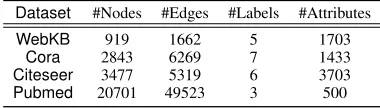
To the best of our knowledge, there is no publicly avail-able attributed networks with ground truth outliers availavail-able. So we take four publicly available attributed networks with ground truth community membership information available for each node. The datasets are WebKB, Cora, Citeseer and Pubmed2. To check the performance of the algorithms in the presence of outliers, we manually planted a total of 5% out-liers (with equal numbers for each type as shown in Figure 1) in each dataset. The seeding process involves: (1) comput-ing the probability distribution of number of nodes in each class, (2) selecting a class using these probabilities. For a structural outlier: (3) plant an outlier node in the selected class such that the node has (m±10%) of edges connecting nodes from the remaining (unselected) classes where mis the average degree of a node in the selected class and (4) the content of the structural outlier node is made semantically consistent with the keywords sampled from the nodes of the selected class. A similar approach is employed for seeding the other two types of outliers. The statistics of these seeded datasets are given in Table 1. Outlier nodes apparently have
2
Table 1: Summary of the datasets (after planting outliers).
Dataset #Nodes #Edges #Labels #Attributes
WebKB 919 1662 5 1703
Cora 2843 6269 7 1433
Citeseer 3477 5319 6 3703
Pubmed 20701 49523 3 500
similar characteristics in terms of degree, number of nonzero attributes, etc., and thus we ensured that they cannot be de-tected trivially.
5.2
Baseline Algorithms and Experimental Setup
We use DeepWalk (Perozzi, Al-Rfou, and Skiena 2014), node2vec (Grover and Leskovec 2016), Line (Tang et al. 2015), TADW (Yang et al. 2015), AANE (Huang, Li, and Hu 2017a), GraphSage (Hamilton, Ying, and Leskovec 2017a) and SEANO (Liang et al. 2018) as the baseline algorithms to be compared with. The first three algorithms consider only structure of the network, the last four consider both structure and node attributes. We mostly use the default settings of the parameters values in the publicly available implementations of the respective baseline algorithms. As SEANO is semi-supervised, we include 20% of the data with their true labels in the training set of SEANO to produce the embeddings.
For ONE, we set the values ofαandβin such a way that three components in the joint losss function in Eq. 5 con-tribute equally before the first iteration of the for loop in Al-gorithm 1. For all the experiments we keep embedding space dimension to be three times the number of ground truth com-munities. For each of the datasets, we run the for loop (Steps 4 to 6 in Alg. 1) of ONE only 5 times. We observe that ONE converges very fast on all the datasets. Convergence rate has been shown experimentally in Fig. 2.
Figure 2: Values of Loss function over different iterations of ONE for Citeseer and Pubmed (seeded) datasets
5.3
Outlier Detection
A very important goal of our work is to detect outliers while generating the network embedding. In this section, we see the performance of all the algorithms in detecting outliers that we planted in each dataset. SEANO and ONE give out-lier scores directly as the output. For ONE, we rank the nodes in order of the higher values of a weighted average of three outlier scores (more the value of this average outlier score, more likely the vertex is an outlier). We have observed
experimentally thatO2is more important to determine out-liers. For SEANO, we rank the nodes in order of the lower values of the weight parameterλ(lower the value ofλmore likely the vertex is an outlier). For other embedding algo-rithms, as they do not explicitly output any outlier score, we use isolation forest to detect outliers from the node embed-dings generated by them.
We use recall to check the performance of each embed-ding algorithm to find outliers. As the total number of out-liers in each dataset is 5%, we start with the top 5% of the nodes in the ranked list (L) of outliers, and continue till 25% of the nodes, and calculate the recall for each set with respect to the artificially planted outliers. Figure 3 shows that ONE, though completely unsupervised in nature, is able to outper-form SEANO mostly on all the datasets. SEANO considers the role of predicting the class label or context of a node based on only its attributes, or the set of attributes from its neighbors, and accordingly fix the outlierness of the node. Whereas, ONE explicitly compares structure, attribute and their combination to detect outliers and then reduces their effect iteratively in the optimization process. So discrimi-nating outliers from the normal nodes becomes somewhat easier for ONE. As expected, all the other embedding algo-rithms (by running isolation forest on the embedding gen-erated by them) perform poorly on all the datasets to detect outliers, except on Cora where AANE performs good.
5.4
Node Classification
Node classification is an important application when label-ing information is available only for a small subset of nodes in the network. This information can be used to enhance the accuracy of the label prediction task on the remain-ing/unlabeled nodes. For this task, firstly we get the em-bedding representations of the nodes and take them as the features to train a random forest classifier (Liaw, Wiener, and others 2002). We split the set of nodes of the graph into training set and testing set. The training set size is varied from 10% to 50% of the entire data. The remaining (test) data is used to compare the performance of different algo-rithms. We use two popular evaluation criteria based on F1-score, i.e., Macro-F1 and Micro-F1 to measure the perfor-mance of the multi-class classification algorithms. Micro-F1 is a weighted average of F1-score over all different class la-bels. Macro-F1 is an arithmetic average of F1-scores of all output class labels. Normally, the higher these values are, the better the classification performance is. We repeat each experiment 10 times and report the average results.
Figure 3: Outlier Recall at top L% from the ranked list of outliers for all the datasets. ONE, though it is an unsupervised algorithm, outperforms all the baseline algorithms in most of the cases. SEANO uses 20% labeled data for training.
Figure 4: Performance of different embedding algorithms for Classification with Random Forest
5.5
Node Clustering
Node Clustering is an unsupervised method of grouping the nodes into multiple communities or clusters. First we run all the embedding algorithms to generate the embeddings of the nodes. We use the node’s embedding as the features for the node and then apply KMeans++ (Arthur and Vas-silvitskii 2007). KMeans++ just divides the data into dif-ferent groups. To find the test accuracy we need to assign the clusters with an appropriate label and compare with the ground truth community labels. For finding the test accuracy we use unsupervised clustering accuracy (Xie, Girshick, and Farhadi 2016) which uses different permutations of the la-bels and chooses the label ordering which gives best
possi-ble accuracyAcc( ˆC,C) = maxP
N
∑
i=1
1(P( ˆCi)=Ci)
N . HereC is the ground truth labeling of the dataset such thatCigives the ground truth label ofith data point. SimilarlyCˆis the clus-tering assignments discovered by some algorithm, andP is a permutation of the set of labels. We assume1to be a logi-cal operator which returns 1 when the argument is true, oth-erwise returns 0. Clustering performance is shown and
ex-plained in Fig. 5. It can be observed that except for ONE, all the conventional embedding algorithms fail in the presence of outliers. Our proposed unsupervised algorithm is able to outperform or remain close to SEANO, though SEANO is semi supervised in nature, on all the datasets.
Figure 5: Clustering Accuracy of KMeans++ on the em-beddings generated by different algorithms. ONE is always close to the best of the baseline algorithms. AANE works best for Citeseer. Though SEANO uses 20% labeled data as the extra supervision to generate the embeddings, its accu-racy is always close (or less) to ONE which is completely unsupervised in nature.
6
Discussion and Future Work
We propose ONE, an unsupervised attributed network em-bedding approach that jointly learns and minimizes the ef-fect of outliers in the network. We derive the details of the algorithm to optimize the associated cost function of ONE. Through experiments on seeded real world datasets, we show the superiority of ONE for outlier detection and other downstream network mining applications.
updating most of the variables in this framework takesO(N)
time, which leads toO(N2)runtime for ONE without any parallel processing. So, one can come up with some intelli-gent sampling or greedy method, perhaps based on random walks, to replace the expensive sums in various update rules.
References
Arthur, D., and Vassilvitskii, S. 2007. k-means++: The ad-vantages of careful seeding. In Proceedings of the eigh-teenth annual ACM-SIAM symposium on Discrete algo-rithms, 1027–1035. Society for Industrial and Applied Mathematics.
Cunningham, J. P., and Ghahramani, Z. 2015. Linear dimen-sionality reduction: Survey, insights, and generalizations. Journal of Machine Learning Research16:2859–2900.
Gao, H., and Huang, H. 2018. Deep attributed network embedding. InIJCAI, 3364–3370.
Grover, A., and Leskovec, J. 2016. node2vec: Scalable fea-ture learning for networks. InProceedings of the 22nd ACM SIGKDD international conference on Knowledge discovery and data mining, 855–864. ACM.
Gupta, M.; Gao, J.; Sun, Y.; and Han, J. 2012. Integrating community matching and outlier detection for mining evolu-tionary community outliers. InProceedings of the 18th ACM SIGKDD international conference on Knowledge discovery and data mining, 859–867. ACM.
Hamilton, W.; Ying, Z.; and Leskovec, J. 2017a. Induc-tive representation learning on large graphs. InAdvances in Neural Information Processing Systems, 1025–1035.
Hamilton, W. L.; Ying, R.; and Leskovec, J. 2017b. Rep-resentation learning on graphs: Methods and applications. arXiv preprint arXiv:1709.05584.
Huang, X.; Li, J.; and Hu, X. 2017a. Accelerated attributed network embedding. InProceedings of the 2017 SIAM In-ternational Conference on Data Mining, 633–641. SIAM. Huang, X.; Li, J.; and Hu, X. 2017b. Label informed at-tributed network embedding. In Proceedings of the Tenth ACM International Conference on Web Search and Data Mining, 731–739. ACM.
Kipf, T. N., and Welling, M. 2016. Semi-supervised classi-fication with graph convolutional networks. arXiv preprint arXiv:1609.02907.
Lample, G.; Conneau, A.; Ranzato, M.; Denoyer, L.; and J´egou, H. 2018. Word translation without parallel data. In International Conference on Learning Representations.
Lee, D. D., and Seung, H. S. 2001. Algorithms for non-negative matrix factorization. InAdvances in neural infor-mation processing systems, 556–562.
Liang, J.; Jacobs, P.; Sun, J.; and Parthasarathy, S. 2018. Semi-supervised embedding in attributed networks with out-liers. InProceedings of the 2018 SIAM International Con-ference on Data Mining, 153–161. SIAM.
Liaw, A.; Wiener, M.; et al. 2002. Classification and regres-sion by randomforest.R news2(3):18–22.
Liu, N.; Huang, X.; and Hu, X. 2017. Accelerated local anomaly detection via resolving attributed networks. In Pro-ceedings of the 26th International Joint Conference on Arti-ficial Intelligence, 2337–2343. AAAI Press.
Liu, F. T.; Ting, K. M.; and Zhou, Z.-H. 2008. Isolation forest. In 2008 Eighth IEEE International Conference on Data Mining, 413–422. IEEE.
McPherson, M.; Smith-Lovin, L.; and Cook, J. M. 2001. Birds of a feather: Homophily in social networks. Annual review of sociology27(1):415–444.
Mikolov, T.; Chen, K.; Corrado, G.; and Dean, J. 2013. Ef-ficient estimation of word representations in vector space. arXiv preprint arXiv:1301.3781.
Niepert, M.; Ahmed, M.; and Kutzkov, K. 2016. Learning convolutional neural networks for graphs. InInternational conference on machine learning, 2014–2023.
Perozzi, B.; Al-Rfou, R.; and Skiena, S. 2014. Deepwalk: Online learning of social representations. InProceedings of the 20th ACM SIGKDD international conference on Knowl-edge discovery and data mining, 701–710. ACM.
Ribeiro, L. F.; Saverese, P. H.; and Figueiredo, D. R. 2017. struc2vec: Learning node representations from structural identity. InProceedings of the 23rd ACM SIGKDD Interna-tional Conference on Knowledge Discovery and Data Min-ing, 385–394. ACM.
Sch¨onemann, P. H. 1966. A generalized solution of the orthogonal procrustes problem. Psychometrika31(1):1–10. Tang, J.; Qu, M.; Wang, M.; Zhang, M.; Yan, J.; and Mei, Q. 2015. Line: Large-scale information network embed-ding. InProceedings of the 24th International Conference on World Wide Web, 1067–1077. International World Wide Web Conferences Steering Committee.
Xie, J.; Girshick, R.; and Farhadi, A. 2016. Unsupervised deep embedding for clustering analysis. In International conference on machine learning, 478–487.
Xing, C.; Wang, D.; Liu, C.; and Lin, Y. 2015. Normal-ized word embedding and orthogonal transform for bilingual word translation. InProceedings of the 2015 Conference of the North American Chapter of the Association for Compu-tational Linguistics: Human Language Technologies, 1006– 1011.