R E S E A R C H
Open Access
System of generalized mixed equilibrium
problems, variational inequality, and fixed
point problems
Morad Ali Payvand and Sedigheh Jahedi
**Correspondence:
Department of Mathematics, Shiraz University of Technology, Shiraz, 71555-313, Iran
Abstract
The purpose of this paper is to introduce a new iterative algorithm for finding a common element of the set of solutions of a system of generalized mixed equilibrium problems, the set of common fixed points of a finite family of pseudo contraction mappings, and the set of solutions of the variational inequality for an inverse strongly monotone mapping in a real Hilbert space. We establish results on the strong convergence of the sequence by the proposed scheme to a common element of the above three solution sets. These results extend and improve some corresponding results in this area. Finally, we give a numerical example which supports our main theorem.
MSC: 47H10; 47H09; 65K10
Keywords: generalized mixed equilibrium problem; variational inequality problem; strictly pseudo contraction mapping
1 Introduction
Letbe a bifunction fromK×Kinto the set of real numbers,R, whereKis a nonempty closed convex subset of a real Hilbert spaceH. The equilibrium problem is to find a point x∈Ksuch that
(x,y)≥, ∀y∈K. (.)
We denote the set of solutions of (.) by EP(). The equilibrium problem includes the fixed point problem, the variational inequality problem, the optimization problem, the saddle point problem, the Nash equilibrium problem and so on, as its special cases [, ].
The generalized mixed equilibrium problem is to find a pointx∈Ksuch that
(x,y) +Ax,y–x+ϕ(y) –ϕ(x)≥, ∀y∈K, (.)
whereϕis a function onKintoRandAis a nonlinear mapping fromKtoH. The set of solutions of a generalized mixed equilibrium problem is denoted byGMEP(,A,ϕ).
If we consider= andϕ= in (.), then we have the classical variational inequality problem which is to find a pointx∈Ksuch that
Ax,y–x ≥, ∀y∈K. (.)
The solution set of (.) is denoted byVI(K,A).
To proceed we need to recall some definitions and concepts.
Definition . LetKbe a nonempty closed convex subset of a real Hilbert spaceH.
(i) A mappingS:K→Kis called nonexpansive ifSx–Sy ≤ x–y, for allx,y∈K. (ii) A mappingT:K→Kis calledk-strict pseudo contractive mapping, if for all
x,y∈Kthere exists a constant≤k< such that
Tx–Ty≤ x–y+k(I–T)x– (I–T)y, ∀x,y∈K, (.)
whereIis the identity mapping onK.
(iii) A mappingA:H→His called monotone if for eachx,y∈H,
Ax–Ay,x–y ≥.
(iv) A mappingA:H→His calledβ-inverse strongly monotone if there existsβ>
such that
Ax–Ay,x–y ≥βAx–Ay, ∀x,y∈H.
(v) The mappingA:K→HisL-Lipschitz continuous if there exists a positive real numberLsuch thatAx–Ay ≤Lx–yfor allx,y∈H. If <L< , then the mappingAis a contraction with constantL.
Clearly a nonexpansive mapping is a -strict pseudo contractive mapping []. Note that in a Hilbert space, (.) is equivalent to the following inequality:
Tx–Ty,x–y ≤ x–y– –k
(x–y) – (Tx–Ty)
, ∀x,y∈K. (.)
We denoteF(T) ={x∈K:Tx=x}, the set of fixed points ofT. It can be shown that, for ak-strict pseudo contractive mappingT:K→K, the mappingI–T is demiclosed,i.e., if{xn}is a sequence inKwithxnqandxn–Txn→, thenq∈F(T) (refer to []). The
symbolsand→denote weak and strong convergence, respectively.
A set valued mappingQ:H→His called monotone if for allx,y∈H,f ∈Q(x) and g ∈Q(y) implyx–y,f –g ≥. A monotone mappingQ:H→H is maximal if the graphG(Q) ofQis not properly contained in the graph of any other monotone mapping. It is well known that a monotone mappingQis maximal if and only if for (x,f)∈H×H,
x–y,f –g ≥ for every (y,g)∈G(Q) impliesf∈Q(x) [].
For anyx∈Hthere exists a unique point inKdenoted byPKxsuch thatx–PKx ≤
PKx∈Kandx–PKx,PKx–y ≥, for ally∈K. It is also known thatPKx–PKy≤
x–y,PKx–PKy, for allx,y∈K[]. In the context of the variational inequality problem, we obtain
q∈VI(K,A) if and only if q=PK(q–λAq), ∀λ> . (.)
LetIbe an index set. For eachi∈I, letibe a real valued bifunction onK×K,Aia nonlinear mapping, andϕi:K→Ra function. The system of generalized mixed equilib-rium problems as an extension of problems (.), (.), and (.) is to find a pointx∈K such that
i(x,y) +Aix,y–x+ϕi(y) –ϕi(x)≥, ∀y∈K,∀i∈I. (.)
Note thati∈IGMEP(i,Ai,ϕi) is the solution set of (.).
Vast range of problems which arise in economics, finance, image reconstruction, trans-portation, network and so on, appear as a special case of problem (.); see for example [– ]. This problem also covers various forms of feasibility problems. So, it seems reasonable to study the system of generalized mixed equilibrium problems. There are many authors who introduced some iterative processes for finding the solution set of these problems or common solution of someone with others, for instance see [, –] and the references therein. In , Penget al.[] introduced the following iterative algorithm for finding a common element of fixed points of a family of infinite nonexpansive mappings and the set of solutions of a system of finite family of equilibrium problems:
⎧ ⎪ ⎪ ⎪ ⎨ ⎪ ⎪ ⎪ ⎩
z=z∈H,
un=TβFnmT
Fm–
βn · · ·T
F
βnT
F
βnzn,
vn=PK(I–snA)un,
zn+=αnγf(Wnzn) + (I–αnB)WnPK(I–rnA)vn.
Under suitable conditions, they presented and proved a strong convergence theorem for finding an element of =∞i=F(Ti)∩VI(K,A)∩
m
k=EP(Fk). In , Cai and Bu [] proposed an iterative method as follows:
⎧ ⎪ ⎪ ⎪ ⎨ ⎪ ⎪ ⎪ ⎩
x=x∈K,
zn=Tr(MFM,n,ϕM)(I–rM,nBM)T
(FM–,ϕM–)
rM–,n (I–rM–,nBM–)· · ·T (F,ϕ)
r,n (I–rB)xn,
un=PK(I–λN,nAN)PK(I–λN–,nAN–)· · ·PK(I–λ,nA)zn, xn+=αnf(Snxn) +βnxn+ (I–βn–αn)W(τn)Sun.
They proved that under appropriate conditions, the sequences{xn},{zn}, and{un} con-verge strongly to z=P f(z), where =F(W)∩∞i=F(Ti)∩
m
k=GMEP(Fk,ϕk,Bk)∩
N
family of nonexpansive mappings, and the set of solutions of the variational inequality of anα-inverse strongly monotone mapping in a real Hilbert space:
⎧ ⎪ ⎪ ⎪ ⎨ ⎪ ⎪ ⎪ ⎩
φ(un,y) +rny–un,un–xn ≥, wn=αnxn+ ( –αn)WnPK(un–λnAun), Kn+={z∈Kn:wn–z ≤ xn–z}, xn+=PKn+(x).
He showed that under suitable conditions, the above algorithm strongly converges to
N
i=F(Ti)∩EP(φ)∩VI(K,A), where for eachi= , . . . ,N,Tiis a nonexpansive mapping andAis anα-inverse strongly monotone mapping.
In this paper, we present an iterative algorithm for finding a common solution of a sys-tem of finite generalized mixed equilibrium problems, a variational inequality problem for an inverse strongly monotone mapping and common fixed points of a finite family of strictly pseudo contractive mappings. We show that the algorithm strongly converges to a solution of the problem under certain conditions. Our results modify, improve and extend corresponding results of Takahashi and Takahashi [], Zhanget al.[], Shehu [], Thianwan [], and others. The rest of the paper is organized as follows. Section briefly explains the necessary mathematical background. Section presents the main re-sults. A numerical example is provided in the final section.
2 Preliminaries
It is well known that in a (real) Hilbert spaceH
x+y≤ x+ y,x+y, (.)
for allx,y∈H[]. Furthermore, it is easy to see that
m
i=
xi
= m
i,j=
xi,xj. (.)
Lemma .([]) Let{an},{bn},and{cn}be three nonnegative real sequences satisfying
an+≤( –tn)an+bn+cn
with{tn} ⊂[, ], ∞n=tn=∞,bn=o(tn),and ∞n=cn<∞.Thenlimn→∞an= .
Lemma .([]) Let H be a(real)Hilbert space and{xn}Nn=be a bounded sequence in H.
Let{an}Nn=be a sequence of real numbers such that Nn=an= .Then
N
i=
aixi
≤
N
i=
aixi.
Lemma .([]) Let{xn}and{zn}be bounded sequences in a Banach space andβnbe a sequence of real numbers such that <lim infn→∞βn<lim supn→∞βn< for all n≥. Suppose that xn+= ( –βn)zn+βnxnfor all n≥andlim supn→∞(zn+–zn–xn+–
Let us assume that the bifunctionsatisfies the following conditions:
(A) (x,x) = ,∀x∈K;
(A) is monotone onK,i.e.,(x,y) +(y,x)≤,∀x,y∈K; (A) for allx,y,z∈K,limt→+(tz+ ( –t)x,y)≤(x,y);
(A) for allx∈K,y→(x,y)is convex and lower semicontinuous.
Lemma .([]) Let K be a nonempty closed convex subset of Hilbert space H andbe a real valued bifunction on K×K satisfying(A)-(A).Let r> and x∈H,then there exists z∈K such that
(z,y) +
ry–z,z–x ≥, ∀y∈K.
Lemma .([]) Suppose all conditions in Lemma.are satisfied.For any given r> , define a mapping Tr:H→K as
Trx=
z∈K:(z,y) +
ry–z,z–x ≥,∀y∈K
,
for all x∈H.Then the following conditions hold:
. Tris single valued;
. Tris firmly nonexpansive,i.e.,
Trx–Try≤ Trx–Try,x–y, ∀x,y∈H;
. F(Tr) =EP();
. EP()is a closed and convex set.
Remark . For the generalized mixed equilibrium problem (.), if the nonlinear opera-torAis a monotone, Lipschitz continuous mapping,ϕis a convex and lower semicontin-uous function, and the real valued bifunctionadmits the conditions (A)-(A), then it is easy to show thatG(x,y) =(x,y) +Ax,y–x+ϕ(y) –ϕ(x) also satisfies the conditions (A)-(A), and the generalized mixed equilibrium (.) is still the following equilibrium problem:
find x∈K such that G(x,y)≥, ∀y∈K.
3 Main results
As is well known, the strict pseudo contraction mappings have more useful applications than nonexpansive mappings like in solving inverse problems []. In addition, various problems reduced to find the common element of the fixed point set of a family of nonlin-ear mappings such as image restoration (see for example []). For construction an algo-rithm which can used to obtain the fixed point set of a family of strictly pseudo contractive mappings we need to introduce the following proposition.
In the sequel,I={, , . . . ,m}andJ={, , . . . ,l}are two index sets.
l
j=γj= .Ifγ∈[k, )such that k=max{k, . . . ,kl},then S is a nonexpansive mapping and F(S) =j∈JF(Tj).
Proof By the definition of the mappingS, we have
Sx–Sy=γx–y+ j∈J
γj(Tjx–Tjy)
+ γ
j∈J
γjx–y,Tjx–Tjy. (.)
On the other hand, from (.) and (.) we have
j∈J
γj(Tjx–Tjy)
=
j,i∈J
γjγiTjx–Tjy,Tix–Tiy
≤
j,i∈J
γjγiTjx–TjyTix–Tiy
≤
j,i∈J
γjγi
Tjx–Tjy+Tix–Tiy
≤
j,i∈J
γjγi
x–y+kj(x–y) – (Tjx–Tjy)
+x–y+ki(x–y) – (Tix–Tiy)
=
j,i∈J
γjγix–y
+
j∈J
γj
i∈J
γikj(x–y) – (Tjx–Tjy). (.)
Furthermore, (.) implies that, for eachj∈J,
x–y,Tjx–Tjy ≤ x–y– –kj
(x–y) – (Tjx–Tjy)
. (.)
By substituting (.) and (.) in (.), we have
Sx–Sy≤
γ+ j,i∈J
γjγi+
j∈J
γγj
x–y
+
j∈J
γj
i∈J
γikj(x–y) – (Tjx–Tjy)
–
j∈J
γγj( –kj)(x–y) – (Tjx–Tjy)
=x–y–
j∈J
γj
γ( –kj) –
i∈J
γikj
(x–y) – (Tjx–Tjy)
=x–y–
j∈J
γj
γ( –kj) – ( –γ)kj(x–y) – (Tjx–Tjy)
=x–y– j∈J
γj(γ–kj)(x–y) – (Tjx–Tjy)
≤ x–y– j∈J
γj(γ–k)(x–y) – (Tjx–Tjy)
≤ x–y. (.)
ThenSis a nonexpansive mapping. Now, by the definition ofSwe obtainI–S= j∈Jγj(I– Tj) and clearlyF(S) =
j∈JF(Tj).
Theorem . Leti:K×K→R,i∈I,be bifunctions satisfying(A)-(A).Suppose that, for each i∈I,the Biareθi-inverse strongly monotone mappings,the Ciare monotone and Lipschitz continuous mappings from K into H,and theϕiare convex and lower semicon-tinuous functions from K into R.Let Tj:K→K,j∈J,be kj-strict pseudo contractive map-pings and A:K→H be a σ-inverse strongly monotone mapping. Let f :K→K be an
ε-contraction mapping and{vn}be a convergent sequence in K with limit point v.Suppose that =i∈IGMEP(i,Bi,Ci,ϕi)∩
j∈JF(Tj)∩VI(A,K)is nonempty.For any initial guess x∈K,define the sequence{xn}by
⎧ ⎪ ⎪ ⎪ ⎪ ⎨ ⎪ ⎪ ⎪ ⎪ ⎩
i(un,i,y) +Ciun,i+Bixn,y–un,i+ϕi(y) –ϕi(un,i) +r
n,iy–un,i,un,i–xn ≥, ∀y∈K,∀i∈I,
yn=αnvn+ (I–αn(I–f))PK( i∈Iδn,iun,i–λnA i∈Iδn,iun,i), xn+=βnxn+ ( –βn)(γI+ j∈JγjTj)PK(yn–λnAyn),
(.)
where for all n∈N,{λn},{rn,i}i∈I ⊆(,∞), and{αn},{βn},{δn,i}i∈I,{γj}j∈J ⊆(, ) are se-quences satisfying the following control conditions:
. limn→∞αn= , ∞n=αn=∞;
. <lim infn→∞βn≤lim supn→∞βn< ;
. for somea,b∈(, σ),λn∈[a,b]andlimn→∞|λn+–λn|= ;
. for somed> , <d≤δn,i≤, i∈Iδn,i= and ∞n=|δn+,i–δn,i|<∞;
. for somec> ,k≤γ≤c< such thatk=maxj∈J{kj}and j∈Jγj= ;
. for someτi,ρi∈(, θi),rn,i∈[τi,ρi]and ∞n=|rn+,i–rn,i|<∞,i∈I. Then the sequences{xn}converges strongly to z∈ ,where z=P (v+f(z)).
Proof Forx,y∈Kandi∈I, putGi(x,y) =i(x,y)+Cix,y–x+ϕi(y)–ϕi(x). By Remark ., Gisatisfies the conditions (A)-(A) and so the algorithm (.) can be rewritten as fol-lows:
⎧ ⎪ ⎨ ⎪ ⎩
Gi(un,i,y) +Bixn,y–un,i+rn,iy–un,i,un,i–xn ≥, ∀y∈K,i∈I, yn=αnvn+ (I–αn(I–f))PK( i∈Iδn,iun,i–λnA i∈Iδn,iun,i),
xn+=βnxn+ ( –βn)(γI+ j∈JγjTj)PK(yn–λnAyn).
(.)
Claim The sequences{xn},{yn},{un},{tn},and{kn}are bounded where,for each n∈N, un= i∈Iδn,iun,i,tn=PK(yn–λnAyn),and kn=PK(un–λnAun).
To prove the claim from (.) we have
Gi(un,i,y) + rn,i
y–un,i,un,i– (I–rn,iBi)xn
Then, by using Lemma ., for eachi∈I, we haveun,i=Trn,i(xn–rn,iBixn), and, for any
q∈ ,q=Trn,i(q–rn,iBiq). Thus
un,i–q=Trn,i(xn–rn,iBixn) –Trn,i(q–rn,iBiq)
≤(xn–rn,iBixn) – (q–rn,iBiq)
≤ xn–q+rn,iBixn–Biq– rn,ixn–q,Bixn–Biq
≤ xn–q+rn,iBixn–Biq– rn,iθiBixn–Biq
=xn–q+rn,i(rn,i– θi)Bixn–Biq
≤ xn–q. (.)
So, we have
un–q≤
i∈I
δn,iun,i–q≤
i∈I
δn,ixn–q=xn–q. (.)
By the definition oftnandknwe have
tn–q ≤(yn–λnAyn) – (q–λnAq)
≤ yn–q (.)
and
kn–q ≤(un–λnAun) – (q–λnAq)
≤ un–q. (.)
Sincelimn→∞vn=v,{vn}is bounded,
yn–q ≤αnvn–q+αnf(kn) –q+ ( –αn)kn–q
≤αnM+αnεkn–q+αnf(q) –q+ ( –αn)xn–q
= –αn( –ε)
xn–q+αn
M+f(q) –q
≤max
xn–q, –ε
M+f(q) +q
, (.)
whereM=supn≥{vn–q}. PuttingS=γI+ j∈JγjTj, by Proposition .,Sis nonex-pansive. On the other hand, for alln∈N, we have
xn+–q ≤βnxn–q+ ( –βn)Stn–q
≤βnxn–q+ ( –βn)tn–q
≤βnxn–q+ ( –βn)yn–q
≤max
xn–q, –ε
M+f(q) +q
By induction, we deduce that
xn+–q ≤max
x–q,
–ε
M+f(q) +q
, ∀n∈N. (.)
Therefore,{xn}is bounded, and so are{yn},{un},{un,i},{tn}, and{kn}.
Claim xn+–xn →as n→ ∞.
Letzn=–βnxn+–
βn
–βnxn. Hence
zn+–zn=
–βn+(xn+–βn+xn+) –
–βn
(xn+–βnxn)
=Stn+–Stn
≤ tn+–tn. (.)
Now, by the definition oftnwe have
tn+–tn ≤(yn+–λn+Ayn+) – (yn–λnAyn)
≤ yn+–yn+|λn+–λn|Ayn. (.)
Similarly,
kn+–kn ≤ un+–un+|λn+–λn|Aun. (.)
By (.) and the definition ofynwe obtain
yn+–yn ≤αn+μvn+–vn+|αn+–αn|vn+|αn+–αn|f(kn)
+|αn+–αn|kn+I–αn+(I–f)
(kn+) –
I–αn+(I–f)
(kn)
≤αn+vn+–vn+|αn+–αn|
vn+f(kn)+kn
+ –αn+( –ε)
kn+–kn
≤αn+vn+–vn+|αn+–αn|
vn+f(kn)+kn
+ –αn+( –ε)
un+–un+|λn+–λn|Aun
. (.)
Furthermore, by the definition ofun,
un+–un=
i∈I
(δn+,iun+,i–δn,iun,i)
≤
i∈I
δn+,i(un+,i–un,i)
+
i∈I
(δn+,i–δn,i)un,i
≤
i∈I
δn+,iun+,i–un,i+
i∈I
From (.), since for eachi∈I,un,i,un+,i∈K,
Gi(un+,i,un,i) + rn+,i
un,i–un+,i,un+,i– (I–rn+,iBi)xn+
≥ (.)
and
Gi(un,i,un+,i) + rn,i
un+,i–un,i,un,i– (I–rn,iBi)xn
≥. (.)
By adding the two inequalities (.), (.), and the monotonicity ofGiwe have
un+,i–un,i,
un,i– (I–rn,iBi)xn rn,i
–un+,i– (I–rn+,iBi)xn+ rn+,i
≥, ∀i∈I.
So
un+,i–un,i,un,i– (I–rn,iBi)xn–rn,iBixn+–
rn,i rn+,i
(un+,i–xn+)
≥, ∀i∈I.
Thus, for eachi∈I,
un+,i–un,i, (I–rn,iBi)xn+– (I–rn,iBi)xn+ (un,i–un+,i) +
– rn,i rn+,i
(un+,i–xn+)
≥.
This yields
un+,i–un,i≤
un+,i–un,i, (I–rn,iBi)xn+– (I–rn,iBi)xn
+
– rn,i rn+,i
(un+,i–xn+)
≤ un+,i–un,i
(I–rn,iBi)xn+– (I–rn,iBi)xn
+ – rn,i rn+,i
un+,i–xn+
≤ un+,i–un,i
xn+–xn+
– rn,i
rn+,i
un+,i–xn+
, ∀i∈I,
or
un+,i–un,i ≤ xn+–xn+ rn+,i|
rn+,i–rn,i|un+,i–xn+
≤ xn+–xn+
τ|rn+,i–rn,i|M, ∀i∈I, (.)
whereτ=infn≥{rn,i}andM=supn≥{un,i–xn}. Thus, from (.), (.), (.), (.), and (.) we obtain
zn+–zn ≤ xn+–xn+αn+vn+–vn
+|αn+–αn|
+|λn+–λn|Ayn+
–αn+( –ε)
i∈I
δn+,i
τ|rn+,i–rn,i|M
+|λn+–λn|Aun+
i∈I
|δn+,i–δn,i|un,i
.
So, by assumptions - of the theorem
lim sup
n→∞
zn+–zn–xn+–xn
≤,
and by Lemma ., we have
lim
n→∞zn–xn= .
But, sincexn+–xn= ( –βn)(zn–xn), we have
lim
n→∞xn+–xn= . (.)
Claim limn→∞xn–Sxn= .
Note that
xn–Sxn ≤ xn+–xn+xn+–Stn+Stn–Sxn
≤ xn+–xn+xn+–Stn+tn–xn. (.)
First we show thatlimn→∞xn+–Stn= . From (.)
xn+–Stn ≤βnxn–Stn
≤βnxn–xn++βnxn+–Stn.
Hence
xn+–Stn ≤
βn –βn
xn–xn+.
This implies that
lim
n→∞xn+–Stn= . (.)
Now, we prove thatlimn→∞tn–xn= . To do this, it suffices to show thatlimn→∞xn– un= andlimn→∞un–tn= . By the definition oftnwe have
tn–q≤(yn–λnAyn) – (q–λnAq)
≤ yn–q+λn(λn– σ)Ayn–Aq
So, by (.) and the convexity of · , we have
xn+–q≤βnxn–q+ ( –βn)Stn–q
≤βnxn–q+ ( –βn)tn–q
≤βnxn–q+ ( –βn)
xn–q+λn(λn– σ)Ayn–Aq
=xn–q+ ( –βn)λn(λn– σ)Ayn–Aq.
Hence
( –βn)λn(σ–λn)Ayn–Aq≤ xn–q–xn+–q ≤ xn–xn+
xn–q+xn+–q
,
and then
lim
n→∞Ayn–Aq= . (.)
Using the projection properties gives us
tn–q =PK(yn–λnAyn) –PK(q–λnAq)
≤(yn–λnAyn) – (q–λnAq),tn–q
=
(yn–λnAyn) – (q–λnAq)
+tn–q
–(yn–λnAyn) – (q–λnAq) – (tn–q)
≤
yn–q+tn–q–yn–tn–λn(Ayn–Aq)
≤
yn–q+tn–q–yn–tn–λnAyn–Aq
+ λnyn–tn,Ayn–Aq
.
This implies that
tn–q≤ yn–q–yn–tn–λnAyn–Aq
+ λnyn–tn,Ayn–Aq
≤ yn–q–yn–tn+ λnyn–tn,Ayn–Aq. (.)
From (.) and the convexity of · , one can see that, forq∈ ,
xn+–q≤βnxn–q+ ( –βn)Stn–q
≤βnxn–q+ ( –βn)tn–q
≤βnxn–q+ ( –βn)
yn–q–yn–tn
+ λnyn–tn,Ayn–Aq
≤βnxn–q+ ( –βn)
αnvn–q+αnf(kn) –q
+ ( –αn)kn–q–yn–tn+ λnyn–tn,Ayn–Aq
≤βnxn–q+ ( –βn)
αnvn–q+αnf(kn) –q
+ ( –αn)xn–q–yn–tn+ λnyn–tn,Ayn–Aq
.
Hence
( –βn)yn–tn≤( –βn)
αnvn–q+αnf(kn) –q
+ λnyn–tn,Ayn–Aq
+xn–q–xn+–q ≤( –βn)
αnvn–q+αnf(kn) –q
+ λnyn–tnAyn–Aq
+xn–xn+
xn–q+xn+–q
,
and so by (.)
lim
n→∞yn–tn= . (.)
Next, we show thatlimn→∞yn–un= . The definition ofknand a similar argument to (.) give us
kn–q≤ xn–q+λn(λn– σ)Aun–Aq. (.)
Then
xn+–q≤βnxn–q+ ( –βn)Stn–q
≤βnxn–q+ ( –βn)tn–q
≤βnxn–q+ ( –βn)yn–q
≤βnxn–q+ ( –βn)
αnvn–q
+αnf(kn) –q
+ ( –αn)kn–q
≤ xn–q+ ( –βn)
αnvn–q+αnf(kn) –q
+ ( –βn)( –αn)λn(λn– σ)Aun–Aq.
Hence
( –βn)( –αn)λn(σ–λn)Aun–Aq≤ xn–q–xn+–q ≤ xn–xn+
xn–q+xn+–q
,
and therefore
lim
Similar to (.) we can see that
kn–q ≤ un–q–un–kn+ λnun–kn,Aun–Aq
≤ xn–q–un–kn+ λnun–kn,Aun–Aq. (.)
From (.) and the convexity of · , we have
xn+–q≤βnxn–q+ ( –βn)Stn–q
≤βnxn–q+ ( –βn)tn–q
≤βnxn–q+ ( –βn)yn–q
≤βnxn–q+ ( –βn)
αnvn–q
+αnf(kn) –q
+ ( –αn)kn–q
≤βnxn–q+ ( –βn)
αnvn–q+αnf(kn) –q
+ ( –αn)
xn–q–un–kn+ λnun–kn,Aun–Aq
≤ xn–q+ ( –βn)
αnvn–q+αnf(kn) –q
+ ( –αn)λnun–kn,Aun–Aq
– ( –βn)( –αn)un–kn.
So
( –βn)( –αn)un–kn≤( –βn)
αnvn–q+αnf(kn) –q
+ ( –βn)( –αn)λnun–kn,Aun–Aq
+xn–q–xn+–q ≤( –βn)
αnvn–q+αnf(kn) –q
+ ( –βn)( –αn)λnun–knAun–Aq
+xn–xn+
xn–q+xn+–q
.
Then the above inequality and (.) imply that
lim
n→∞un–kn= . (.)
But from (.),
yn–un ≤αnvn–un+αnf(kn) –un+ ( –αn)kn–un.
So, from (.) we have
lim
n→∞yn–un= . (.)
Then by (.) and (.) we have
lim
Now, we show thatlimn→∞xn–un= . To do this, note that, for anyi∈I,
un,i–q =Trn,i(xn–rn,iBixn) –Trn,i(q–rn,iBiq)
≤Trn,i(xn–rn,iBixn) –Trn,i(q–rn,iBiq), (xn–q) –rn,i(Bixn–Biq)
=un,i–q,xn–q–rn,iun,i–q,Bixn–Biq
≤ un,i–q,xn–q–rn,iθiBixn–Biq
≤ un,i–q,xn–q. (.)
So, from (.) and the definition ofun, we obtain
un–q≤
i∈I
δn,iun,i–q
≤
i∈I
δn,iun,i–q,xn–q
=
i∈I
δn,iun,i–q,xn–q
=un–q,xn–q
≤
un–q+xn–q–un–xn
.
Thus,
un–q≤ xn–q–un–xn. (.)
SinceSis nonexpansive, we have
xn+–q≤βnxn–q+ ( –βn)Stn–q
≤βnxn–q+ ( –βn)tn–q
≤βnxn–q+ ( –βn)yn–q
≤βnxn–q+ ( –βn)
αnvn–q+αnf(kn) –q
+ ( –βn)( –αn)kn–q
≤βnxn–q+ ( –βn)
αnvn–q+αnf(kn) –q
+ ( –βn)( –αn)un–q
≤βnxn–q+ ( –βn)
αnvn–q+αnf(kn) –q
+ ( –βn)( –αn)
xn–q–xn–un
.
Hence
( –βn)( –αn)xn–un≤( –βn)
αnvn–q+αnf(kn) –q
≤( –βn)
αnvn–q+αnf(kn) –q
+xn–q–xn+–q
xn–q+xn+–q
≤( –βn)
αnvn–q+αnf(kn) –q
+xn–q+xn+–q
xn–xn+,
which yields
lim
n→∞xn–un= . (.)
Sincetn–xn ≤ tn–un+un–xn, from (.) and (.) we obtain
lim
n→∞tn–xn= . (.)
Inequality (.) and equations (.), (.), andxn–xn+ → imply that
lim
n→∞xn–Sxn= . (.)
Claim lim supn→∞v+f(z) –z,yn–z ≤,where z=P (v+f(z)).
To prove the claim, let{ynk}be a subsequence of{yn}such that
lim sup
n→∞
v+f(z) –z,yn–z
=lim sup
n→∞
v+f(z) –z,ynk–z
. (.)
By boundedness of{ynk}, there exists a subsequence of{ynk}which is weakly convergent
toz∈K. Without loss of generality, we can assume thatynkz. So, (.) reduces to
lim sup
n→∞
v+f(z) –z,yn–z
=v+f(z) –z,z–z
. (.)
Therefore, by projection properties, to provev+f(z) –z,z–z ≥, it suffices to show
thatz∈ .
(a) First we prove thatz∈ m
j∈JF(Tj). From (.) and the demiclosedness property of Swe obtainz∈F(S). So, by Proposition .,z∈
m j∈JF(Tj).
(b) Next we show thatz∈VI(A,K). Note that from boundedneess of{xn},{un}, and equation (.), there exist subsequences{xnk}and{unk} of{xn} and{un}, respectively,
which converge weakly toz. Suppose thatNKxis a normal cone toK atxandQis a mapping defined by
Q(x) =
Ax+NKx, x∈K,
∅, x∈/K. (.)
It is well known that Q is a maximal monotone mapping and ∈Q(x) if and only if
x∈VI(A,K). For details see []. If (x,u)∈G(Q), thenu–Ax∈NKx. Sincekn=PK(un–
λnAun)∈K, we have
In addition, from projection properties we havex–kn,kn– (un–λnAun) ≥. Thenx– kn,knλ–nun+Aun ≥. Hence, from (.) we have
x–knk,u ≥ x–knk,Ax
≥ x–knk,Ax–
x–knk,
knk–unk λnk
+Aunk
=x–knk,Ax–Aknk+x–knk,Aknk–Aunk
–
x–knk,
knk–unk λnk
≥ x–knk,Aknk–Aunk–
x–knk,
knk–unk λnk
. (.)
SinceAis a continuous mapping, from (.) and (.) we deduce that
x–z,u ≥, ask→ ∞.
Therefore, from maximal monotonicity ofQ, we obtain ∈Q(z) and hencez∈VI(A,K).
(c) Now we prove thatz∈i∈IGEP(Gi,Bi). For alli∈I, by (.),
un,i–q≤ un,i–q,xn–q
≤
un,i–q+xn–q–un,i–xn
and then
un,i–q≤ xn–q–un,i–xn.
This implies that
un–q≤
i∈I
δn,iun,i–q
≤ xn–q–
i∈I
δn,iun,i–xn.
Therefore, for anyi∈I,
un,i–xn≤
i∈I
δn,iun,i–xn≤ xn–q–un–q
≤ xn–un
xn–q+un–q
.
So by (.),
lim
n→∞un,i–xn= , ∀i∈I. (.)
Since{un,i}i∈I is bounded, by (.), there exists a weakly convergent subsequence{unk,i}
un,i=Trn,i(xn–rn,iBixn), for ally∈Kwe have
Gi(un,i,y) +Bixn,y–un,i+ rn,i
y–un,i,un,i–xn ≥, ∀i∈I.
From (A) we obtain
Bixn,y–un,i+ rn,i
y–un,i,un,i–xn ≥Gi(y,un,i), ∀y∈K,∀i∈I.
Hence, for ally∈K,
Bixnk,y–unk,i+
y–unk,i,
unk,i–xnk
rnk,i
≥Gi(y,unk,i), ∀i∈I. (.)
Letyt=ty+ ( –t)z, wheret∈(, ] andy∈K. Thenyt∈Kand by (.),
yt–unk,i,Biyt ≥ yt–unk,i,Biyt–yt–unk,i,Bixnk
–
yt–unk,i,
unk,i–xnk
rnk,i
+Gi(yt,unk,i)
=yt–unk,i,Biyt–Biunk,i+yt–unk,i,Biunk,i–Bixnk
–
yt–unk,i,
unk,i–xnk
rnk,i
+Gi(yt,unk,i), ∀i∈I.
ButBi is aθi-inverse strongly monotone mapping andunk,i–xnk →, so Biunk,i–
Bixnk → and yt –unk,i,Biyt –Biunk,i ≥ , for all i∈I. As k → ∞, the relations
unk,i–xnk
rnk,i →,unk,i, and condition (A) imply that
yt–z,Biyt ≥Gi(yt,z), ∀i∈I. (.)
From (A), (A), and (.) we have
=Gi(yt,yt)≤tGi(yt,y) + ( –t)Gi(yt,z) ≤tGi(yt,y) + ( –t)yt–z,Biyt
=tGi(yt,y) + ( –t)ty–z,Biyt
≤Gi(yt,y) + ( –t)y–z,Biyt, ∀i∈I.
Lettingt→, so for eachy∈K,
Gi(z,y) +y–z,Biz ≥, ∀i∈I.
That is,z∈GEP(Gi,Bi), for alli∈I. Now by parts (a), (b) and (c),z∈ . Therefore, from
(.) we obtain
lim sup
n→∞
v+f(z) –z,yn–z
=v+f(z) –z,z–z
Claim The sequence{xn}converges to z,where z=P (v+f(z)).
From the convexity of · and (.) we deduce that
xn+–z≤βnxn–z+ ( –βn)Stn–z
≤βnxn–z+ ( –βn)tn–z
≤βnxn–z+ ( –βn)yn–z
≤βnxn–z+ ( –βn)αn
vn+f(kn) –z
+ ( –αn)(kn–z)
≤βnxn–z+ ( –βn)( –αn)kn–z
+ αn( –βn)
vn+f(kn) –z,yn–z
≤βnxn–z+ ( –βn)( –αn)xn–z (.)
+ αn( –βn)
vn+f(kn) –z,yn–z
= –αn( –βn)
xn–z+γn, (.)
whereγn= αn( –βn)vn+f(xn) –z,yn–z. On the other hand
γn= αn( –βn)
vn+f(kn) –z,yn–z
= αn( –βn)
(vn–v) +
f(kn) –f(z)
,yn–z
+ αn( –βn)
v+f(z) –z,yn–z
≤αn( –βn)
vn–v+εkn–z
yn–z
+ αn( –βn)
v+f(z) –z,yn–z
≤αn( –βn)
vn–v+yn–z
+αn( –βn)ε
kn–z+yn–z
+ αn( –βn)
v+f(z) –z,yn–z
.
Suppose thatM=supn∈N{yn–z}. So
γn≤αn( –βn)εxn–z+αn( –βn)
M+ ( +ε)M
+ αn( –βn)
v+f(z) –z,yn–z
. (.)
Substitute (.) in (.), then
xn+–z≤
–αn( –βn)
xn–z+αn( –βn)εxn–z
+αn( –βn)
( +ε)M+M+ αn( –βn)
v+f(z) –z,yn–z
≤ –αn( –βn)( –ε)
xn–z+αn( –βn)M
+ αn( –βn)
v+f(z) –z,yn–z
where M= ( +ε)M
+M. Therefore from (.) and Lemma ., we conclude that
limn→∞xn–z= . Also from (.) and (.) we can see thatyn→zandun→z.
This completes the proof.
Letm= in the index setIand takeδn,= , so (.) becomes the following algorithm: ⎧
⎪ ⎪ ⎪ ⎨ ⎪ ⎪ ⎪ ⎩
(un,y) +Cun+Bxn,y–un+ϕ(y) –ϕ(un) +r
ny–un,un–xn ≥, ∀y∈K,
yn=αnvn+ (I–αn(I–f))PK(un–λnAun), xn+=βnxn+ ( –βn)SPK(yn–λnAyn).
(.)
Putϕ= ,C= , and{vn}={}in (.). IfA= , then by the projection properties,kn= P un. Sinceun∈C, we havekn=un. So, we get the following corollary which is the so-called viscosity approximation method.
Corollary . Let:K×K→R be a bifunction satisfying(A)-(A)and B aθ-inverse strongly monotone.Let S:K→K be a nonexpansive and f :K→K be anε-contraction mapping.Suppose that =GEP(,B)∩F(S)is nonempty.For any initial guess x∈K,
define the sequence{xn}by
⎧ ⎪ ⎨ ⎪ ⎩
(un,y) +Bxn,y–un+rny–un,un–xn ≥, ∀y∈K, yn=αnf(xn) + ( –αn)un,
xn+=βnxn+ ( –βn)Syn,
(.)
where{rn}is a positive real sequence,{αn}and{βn}are sequences in(, )satisfying the following conditions:
. limn→∞αn= , ∞n=αn=∞;
. <lim infn→∞βn≤lim supn→∞βn< ;
. for someτ,ρ∈(, θ),rn∈[τ,ρ]andlimn→∞(rn+–rn) = . Then the sequence{xn}converges strongly to z∈ ,where z=P fz.
4 Numerical example
In this section, we present a numerical example which supports our algorithm.
Example SupposeH=RandK= [–, ]. A system of generalized mixed equilib-rium problem is to find a pointx∈Ksuch that, for eachi∈I,
i(x,y) +Aix,y–x+ϕi(y) –ϕi(x)≥, ∀y∈K. (.)
For anyi∈I, defineϕi= ,i(x,y) = (y+ix)(y–x) andAix=ix. It is easy to see that, for each i∈I,i(x,y) satisfies the conditions (A)-(A) andAiis i+ -inverse strongly monotone mapping. We know that, for eachi∈I,Triis single valued. Thus for anyy∈kandri> ,
we have
i(ui,y) +Aix,y–ui+ ri
y–ui,ui–x ≥
⇐⇒ i(ui,y) + ri
y–ui,ui– (I–Ai)x
≥
⇐⇒ riy+
+ri(i– )
ui– ( –iri)x
y+( –iri)uix– ( +iri)ui
LetQi(y) =riy+ [( +ri(i– ))ui– ( –iri)x]y+ [( –iri)uix– ( +iri)ui]. SinceQi is a quadratic function relative toy,Qi(y)≥ for ally∈K, if and only if the coefficient ofyis positive and the discriminanti≤. But
i=
+ri(i– )
ui– ( –iri)x
– ri
( –iri)uix– ( +iri)ui
= +ri(i+ )
ui– ( –iri)x
,
so we obtain
ui=
( –iri) +ri(i+ )
x
and then
Tri(x) =
( –iri) +ri(i+ )
x.
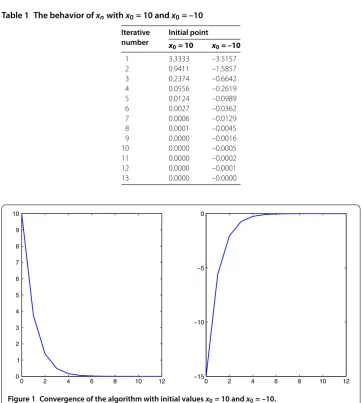
Table 1 The behavior ofxnwithx0= 10 andx0= –10
Iterative number
Initial point
x0= 10 x0= –10
1 3.3333 –3.5157
2 0.9411 –1.5857
3 0.2374 –0.6642
4 0.0556 –0.2619
5 0.0124 –0.0989
6 0.0027 –0.0362
7 0.0006 –0.0129
8 0.0001 –0.0045
9 0.0000 –0.0016
10 0.0000 –0.0005
11 0.0000 –0.0002
12 0.0000 –0.0001
13 0.0000 –0.0000
From Lemma ., we haveF(Tri) =GEP(,Ai) = . DefineS:K→KbyS(x) =sin(x). Then
Sis nonexpansive andF(sin(x)) ={}. So, ={}. Assume thatI={, },A= ,{vn}={}, f(x) =x,rn,i=(n+)(ni+),αn=n,βn=andδn,i=,Ci= ,i∈I. Hence,
⎧ ⎪ ⎪ ⎪ ⎪ ⎪ ⎨ ⎪ ⎪ ⎪ ⎪ ⎪ ⎩
un,=n+xn, un,=–nn++xn, yn=–n
+n–n– n+n+nxn, xn+=xn+sin(–n
+n–n– n+n+nxn).
Then, by Theorem ., the sequence{xn}converges strongly to ∈ . Table and Figure indicate the behavior ofxnfor algorithm (.) withx= andx= –. We have used
MATLAB withε= –.
Competing interests
The authors declare that they have no competing interests.
Authors’ contributions
All authors contributed equally, and they also read and finalized manuscript.
Received: 2 August 2016 Accepted: 12 September 2016
References
1. Blum, E, Oettli, W: From optimization and variational inequalities to equilibrium problems. Math. Stud.63, 123-145 (1994)
2. Combettes, PL, Histoaga, SA: Equilibrium programming using proximal like algorithms. Math. Program.78, 29-41 (1997)
3. Browder, FE, Petryshyn, WV: Construction of fixed points on nonlinear mappings in Hilbert spaces. J. Math. Anal. Appl. 20, 197-228 (1967)
4. Acedo, GL, Xu, HK: Iterative methods for strict pseudo-contraction in Hilbert spaces. Nonlinear Anal.67, 2258-2271 (2007)
5. Rockafeller, RT: On maximality of sums of nonlinear operators. Trans. Am. Math. Soc.149, 75-88 (1970) 6. Cegielski, A: Iterative Methods for Fixed Point Problems in Hilbert Spaces. Springer, London (2011)
7. Ansari, QH, Schaible, S, Yao, JC: The system of generalized vector equilibrium problems with applications. J. Glob. Optim.22, 3-16 (2002)
8. Barbagallo, A: On the regularity of retarded equilibria in time-dependent traffic equilibrium problems. Nonlinear Anal.71, 2406-2417 (2009)
9. Barbagallo, A, Daniele, P, Maugeri, A: Variational formulation for a general dynamic financial equilibrium problem: balance law and liability formula. Nonlinear Anal.75, 1104-1123 (2012)
10. Huang, NJ, Fang, YP: Strong vectorF-complementary problem and least element problem of feasible set. Nonlinear Anal.61, 901-918 (2005)
11. Cai, G, Bu, S: A viscosity scheme for mixed equilibrium problems, variational inequality problems and fixed point problems. Math. Comput. Model.57, 1212-1226 (2013)
12. Chang, SS, Joseph Lee, HW, Chan, CK: A new method for solving equilibrium problem fixed point problem and variational inequality problem with application to optimization. Nonlinear Anal.70, 3307-3319 (2009)
13. Liu, LS: Ishikawa and Mann iterative process with errors for nonlinear strongly accretive mappings in Banach space. J. Math. Anal. Appl.194, 114-125 (1995)
14. Peng, JW, Wu, SY, Yao, JC: A new iterative method for finding common solutions of a system of equilibrium problems, fixed-point problems, and variational inequalities. Abstr. Appl. Anal. (2010). doi:10.1155/2010/428293
15. He, Z, Du, WS: Strong convergence theorems for equilibrium problems and fixed point problems: a new iterative method, some comments and applications. Fixed Point Theory Appl. (2011). doi:10.1186/1687-1812-2011-33 16. Thianwan, S: Strong convergence theorems by hybrid methods for a finite family of nonexpansive mappings and
inverse-strongly monotone mappings. Nonlinear Anal. Hybrid Syst.3, 605-614 (2009)
17. Zhao, J, He, S: A new iterative method for equilibrium problems and fixed point problems of infinitely nonexpansive mappings and monotone mappings. Appl. Math. Comput.215, 670-680 (2009)
18. Takahashi, S, Takahashi, W: Strong convergence theorem for a generalized equilibrium problem and a nonexpansive mapping in a Hilbert space. Nonlinear Anal.69, 1025-1033 (2008)
19. Zhang, SS, Rao, RF, Huang, JL: Strong convergence theorem for a generalized equilibrium problem and ak-strict pseudocontraction in Hilbert spaces. Appl. Math. Mech.30(6), 685-694 (2009)
20. Shehu, Y: Iterative method for fixed point problem, variational inequality and generalized mixed equilibrium problems with applications. J. Glob. Optim.52, 57-77 (2012)
21. Hao, Y, Cho, SY, Qin, X: Some weak convergence theorems for a family of asymptotically nonexpansive nonself mappings. Fixed Point Theory Appl.2010, Article ID 218573 (2010)
23. Scherzer, O: Convergence criteria of iterative methods based on Landweber iteration for solving nonlinear problems. J. Math. Anal. Appl.194, 911-933 (1991)