A multicentre randomised, 1-year
comparative effectiveness,
parallel-group trial protocol of a physical
therapy approach compared to
corticosteroid injections
Gail D Deyle,1Norman W Gill,1Daniel I Rhon,2Chris S Allen,1Stephen C Allison,1 Ben R Hando,3Evan J Petersen,4Douglas I Dusenberry,1Nicholas Bellamy5
To cite:Deyle GD, Gill NW,
Rhon DI,et al. A multicentre
randomised, 1-year comparative effectiveness, parallel-group trial protocol of a physical therapy approach compared to corticosteroid
injections.BMJ Open2016;6:
e010528. doi:10.1136/ bmjopen-2015-010528
▸ Prepublication history and
additional material is available. To view please visit the journal (http://dx.doi.org/ 10.1136/bmjopen-2015-010528).
GDD, NWG, DIR, SCA and BRH contributed equally to this work.
Received 23 November 2015 Revised 9 February 2016 Accepted 1 March 2016
For numbered affiliations see end of article.
Correspondence to Dr Gail D Deyle; [email protected]
ABSTRACT
Introduction:Corticosteroid injections (CSIs) are
commonly used as an initial or a primary intervention for knee osteoarthritis (OA). Consistent evidence indicates CSIs offer symptom relief with conflicting reports regarding long-term efficacy. Physical therapy (PT) offers a non-invasive alternative. There is moderate evidence suggesting short-term and long-term symptom relief and functional improvement with PT interventions. Patients with knee OA are more commonly prescribed CSI than PT prior to total joint replacement. UnitedHealthcare and Military Health System data show substantially more total knee replacement patients receive preoperative CSI than PT. There are no studies comparing CSI to a PT approach in individuals with knee OA. The primary objective of this study is to compare the effectiveness of CSI to PT in individuals with knee OA at 1, 2 and 12 months.
Methods and analysis:We plan to recruit 156
participants meeting established knee OA criteria. Following informed consent, participants will be randomised to receive either CSI or PT. All participants will receive instruction on recommended exercise and weight control strategies plus usual medical care. The CSI intervention consisting of 3 injections and the PT intervention consisting of 8–12 sessions will be spaced over 12 months. Measures of the dependent variables (DVs) will occur at baseline, 4 weeks, 8 weeks, 6 months and 12 months post enrolment. This pragmatic, randomised clinical trial will be a mixed-model 2×5 factorial design. The independent variables are treatment (CSI and PT) and time with five levels from baseline to 1 year. The primary DV is the Western Ontario & McMaster Universities Arthritis Index (WOMAC). We will also compare healthcare utilisation between the 2 groups.
Ethics and Dissemination:The protocol was
approved by the Madigan Army Medical Center Institutional Review Board. The authors intend to publish the results in a peer-reviewed source.
Trial Registration Number:NCT01427153.
INTRODUCTION
Osteoarthritis (OA) of the knee is an increas-ingly prevalent disorder utilising substantial healthcare resources.1 2 Management strat-egies vary greatly according to how patients are routed through the healthcare system and the number and type of providers consulted. Patient presentations are also vari-able because knee OA can be linked with
Strengths and limitations of this study
▪ This study compares two currently prescribed interventions for knee osteoarthritis (OA). The more commonly prescribed corticosteroid injec-tion (CSI) is more expedient, requiring little patient participation. A CSI may have a limited period of benefit and entails the risk of an inva-sive procedure. The physical therapy (PT) inter-vention may offer more durable relief and greater functional improvement. It involves virtually no risk while requiring greater patient participation.
▪ The PT approach requires tailoring of the exam-ination and treatment to the individual patient with knee OA. While this is typical of pragmatic clinical care, it complicates descriptions of the intervention used for this arm of the trial. Careful recording of delivered treatments, precise writing and appropriate use of figures and tables will be required to accurately communicate the interven-tion details.
▪ Little is currently known about the utilisation of healthcare resources after either of these two interventions for patients with knee OA. This study will help meet recent calls for patient-focused pragmatic management strategies for this complex and debilitating disorder. It may also help initiate additional research comparing pharmacological and non-pharmacological and invasive versus non-invasive approaches.
on September 22, 2020 by guest. Protected by copyright.
http://bmjopen.bmj.com/
on September 22, 2020 by guest. Protected by copyright.
http://bmjopen.bmj.com/
on September 22, 2020 by guest. Protected by copyright.
athletic injury,3–5knee trauma,6obesity,1 7 8occupational or sport overuse,9 10 female gender,11 axial malalign-ment12 13 and advanced age.13 Knee OA is increasingly viewed as a continuum with early articular cartilage changes found in younger patients predicting progres-sion to degenerative arthritis.13 14 The presence of early radiographic knee OA predicts progression to more advanced grades of arthritis.11 15 16 Impairments to movement, strength and flexibility starting early in the degenerative process may accelerate arthritic changes and contribute to the disability associated with knee OA.17 18 Rheumatologists, orthopaedic surgeons and family practice physicians commonly treat knee OA with corticosteroid injection (CSI).19 20 An epidemiological analysis of interventions delivered to patients with knee OA in the USA21revealed that of the 11 million patients in the database, 12 806 had total knee arthroplasty (TKA) in 2009. Over the 5-year period (2004–2009), 43.5% of the patients eventually receiving TKA were pre-scribed preoperative intra-articular steroid injections. Conversely, only 10% of TKA recipients received physical therapy (PT) intervention of any kind for their knee OA prior to knee replacement.21 A recent retrospective review of Military Health System (MHS) data similarly shows that only 8% of participants received PT prior to total joint arthroplasty.22 There is substantial evidence for CSI providing short-term pain relief23 24 and limited evidence for more durable benefit up to 12 months.23 24 A recent systematic review and meta-analysis found intra-articular injections, including CSI, to be superior to oral non-steroidal anti-inflammatory drug (NSAID) medications at reducing pain in individuals with knee
OA.25 The American Academy of Orthopaedic
Surgeons,26 the American College of Rheumatology27
and the 2014 Orthopaedic Research Society
International Guidelines recommend the use of CSI as an initial management strategy for treating individuals with knee OA.28 Longer term relief may be derived by the pragmatic practice of providing injections in a series, spaced a few months apart. Although CSI is frequently administered prior to PT referrals, a recently published study on patients with knee OA found no additional benefit from CSI compared to placebo injection before a course of supervised exercise at 2,14 or 26 weeks.29 While CSIs are generally considered to be standard of care and low risk, there are reports of septic arthritis28 30
and other systemic complications linked to
intra-articular injections.31 32Preoperative, intra-articular CSI links to deep wound infections post-TKA are contro-versial.28 32 One group of authors attempted to find factors predicting success with CSI. Their preliminary findings identified factors such as the presence of an effusion and the absence of synovitis at the time of the injection, which may help define patients likely to respond.33
PT interventions for knee OA provide symptomatic and functional improvement with low risk.34–39 On the basis of previous clinical trials, eight PT sessions
consisting of manual PT (MPT) (see Definitions section) with reinforcing clinical and home exercise for patients with knee OA resulted in symptomatic relief and functional improvement up to 1 year and reduced the incidence of total joint replacement, intra-articular injection and medication use.35 36 A single session of MPT improves terminal knee extension,40 reduces hyperalgesia and improves Timed Up and Go (TUG) performance in patients with knee OA.41 Composite data from two clinical trials revealed that 80% of patients receiving MPT as a primary intervention for their knee OA sustained greater than the minimal clinically import-ant difference (MCID) level of benefit and 60% of patients derived greater than 50% improvement in their baseline Western Ontario & McMaster Universities Arthritis Index (WOMAC) scores at 4 weeks.35 36 42 These patients remained improved over baseline at 1 year with no further contact after the initial 4 weeks of treatment.
No studies have compared the intervention strategies of CSI and PT. Therefore, the purpose of this rando-mised clinical trial will be to directly compare the short-term and long-short-term effects of these interventions for patients with knee OA. Our hypothesis is that PT will provide similar symptomatic relief to CSI in the short term with greater functional improvement and more durable symptom relief as evidenced by WOMAC scores at 12 months. A secondary purpose is to compare the knee-related healthcare utilisation in both groups for the 12 months post the final measure of the dependent variables (DVs).
Specific aims
Aim 1: Compare 1-year self-reported outcomes of pain, function and disability between patients that received CSI and those that received PT.
Aim 2: Compare knee-related healthcare utilisation in both groups during the 1-year follow-up period.
TRIAL DESIGN AND METHODS
The study was designed using the Standard Protocol Items: Recommendations for Interventional Trials (SPIRIT) guidelines for planning interventional clinical trials, and the results will be reported in accordance with the CONsolidated Standards of Reporting Trials
(CONSORT) guidelines for pragmatic trials.43
Independent variables are treatment (CSI and PT) and time withfive levels from baseline to 1 year. The primary DV is the WOMAC. The secondary DVs are the Global Rating of Change (GROC) and the TUG.
Participants
We will recruit 156 participants, male and female, aged 38 years or older with a diagnosis of knee OA. These participants will be drawn from patients referred to the PT and orthopaedic services at two teaching medical centres within the US MHS. Training will be given to
on September 22, 2020 by guest. Protected by copyright.
providers in primary care clinics at these centres to inform them of the study and facilitate the flow of patients. Beneficiaries of the MHS include active duty and retired service members and their non-military family members, thereby reflecting the spectrum of patients likely to be seen in a civilian setting. Providers will have a copy of the study screening form and screen interested patients against the inclusion and exclusion criteria (boxes 1 and2). Once it is determined that an interested patient meets the criteria for inclusion, the site study coordinator will perform the informed consent process. If recruitment targets are not met despite these efforts, flyers with information about the study will be distributed at key locations so that eligible interested participants may inquire. Plans to promote participant retention include informing potential partici-pants that although it is their right to withdraw at any time, simply dropping out without reason weakens the study and reduces the ability to answer this important research question. If participants encounter difficulty attending any appointments or complying with the inter-vention, they are encouraged to discuss these challenges with the site study coordinator. Potential participants will be additionally guided that if they are uncertain whether they can commit to the study procedures for the entire
12-month period, we will gladly provide care for their disorder and not enrol them. When enrolled partici-pants miss scheduled appointments, they will be
con-tacted by the appointment coordinators for
rescheduling at a suitable time.
Randomisation
A random number generator will be used to establish randomisation lists prior to the initiation of the study. Separate randomisation lists will be generated for each participating site. Individual randomised assignments will be concealed according to the following procedure. The group assignment will be recorded on an opaque label that is folded in half such that the label with the participant’s group assignment will be on the inside of the fold. The folded opaque label will then be placed inside an opaque sequentially numbered envelope, and the envelope will be sealed. This will prevent the possi-bility of visualising the treatment group assignment through the sealed envelope. After determining that the inclusion and exclusion criteria are met and the partici-pant provides informed consent, demographic informa-tion and the baseline measures of the DVs will be recorded. On completing these processes, an investiga-tor who will not perform assessments of the DVs or other measures will open the next in sequence random-isation envelope indicating the patient’s treatment group assignment that will be linked to the patient’s unique study identification number.
Blinding
Investigators blind to the group of assignment and working in areas remote to where the CSI or PT inter-ventions are performed, thereby making it unlikely that they would observe any provider–participant interaction, will perform the measurements and outcome assess-ments. Participants will be initially instructed and reminded when scheduled for each measurement appointment not to discuss their intervention or group
of assignment during the measurement session.
Incidents of unmasking will be recorded in the
Box 2 Altman’s clinical criteria for knee OA: One of the three categories below (sensitivity of 89% and specificity of 88%).44
A. Knee pain for most days of the prior month and 1. Crepitus with active motion (and)
2. Morning stiffness in knee≤30 min (and) 3. Age≥38
B. Knee pain for most days of the prior month and 4. Crepitus with active motion (and)
5. Morning stiffness in knee >30 min (and) 6. Bony enlargement
C. Knee pain for most days of the prior month and 7. No crepitus (and)
8. Bony enlargement
Box 1 Inclusion and exclusion criteria
Inclusion criteria
▸ Have radiographic evidence of knee OA
▸ Meet Altman’s clinical criteria for knee OA (box 2)
▸ Be 38 years of age or older as per Altman’s clinical criteria
▸ Have English language skills sufficient to complete the WOMAC and GROC outcome instruments
▸ All participants must be eligible for care in the military health system
Exclusion criteria
▸ Unable to give informed consent to participate in the study
▸ Steroid injections or physical therapy treatment for their knee in the past 12 months
▸ Current or history of gout of the knee
▸ Active infection in the knee within the past 12 months
▸ Other physical ailment or condition that is typically more limit-ing or painful than their knee OA durlimit-ing activities such as sitting, standing, walking or stair climbing
▸ Current or history of rheumatoid arthritis or similar rheumatic condition
▸ Cannot speak/read English adequately to understand and provide consent to participate in the study
▸ Pregnant or intending to become pregnant
▸ Military service members in a Warrior Transition Unit (WTU) or service equivalent or pending a medical evaluation board/ discharge process. For non-military personnel, anyone that is pending or undergoing any litigation related to their functional status
▸ Contraindication to receiving a corticosteroid injection (history of allergic or adverse reaction to steroids or steroid injection, history of multiple corticosteroid injections in that area even if not within last year, uncontrolled diabetes mellitus, etc)
on September 22, 2020 by guest. Protected by copyright.
participant research folder by measurement session and will be reported as part of the research findings. The statistician will be blinded to the group origin of the analysed data. Participants are accurately informed during the informed consent process that both interven-tions are standard of care with evidence supporting both. Participants are also informed that it is not known which intervention is better over a short or longer term. Participant outcome expectations for each treatment will be assessed prior to randomisation. Unblinding will occur only in exceptional circumstances when knowl-edge of treatment group is essential for further manage-ment of the patient.
Interventions
Prior to the randomised assignment, all participants will receive formal 1:1 interactive instruction on the benefits of weight reduction, low-impact, well-tolerated physical activity, and strengthening and flexibility exercises. Participants are then randomised to either the CSI or
PT group. The two treatment options are
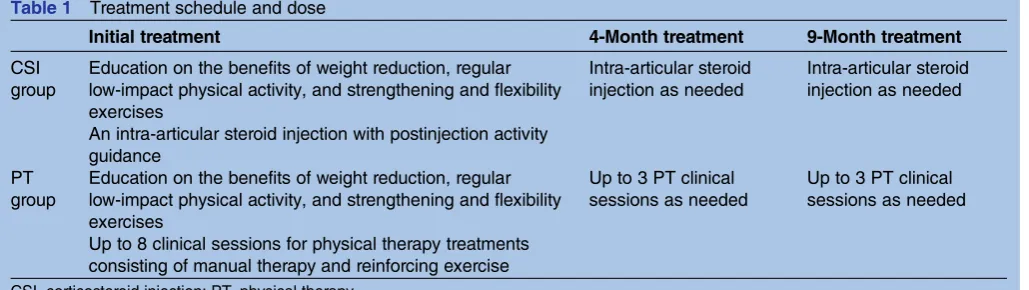
standard-of-care interventions. Both treatments are sum-marised in table 1. The flow of participants through both arms of the trial is illustrated infigure 1. If partici-pants in either group request to stop treatment or are demonstrating marked worsening of symptoms, they will be re-evaluated and the treatment may be modified to meet their needs. Patients are not prohibited from con-tinuing with existing medications or from seeking add-itional care; however, the addadd-itional treatments will be documented and reported. Continued care after the end of the study will be offered to all participants.
CSI procedures
The goal of the CSI is to decrease intra-articular infl am-mation and pain, thereby improving function and activ-ity tolerance.23 45 46 The CSI will be given by orthopaedic surgeons, orthopaedic physician assistants or rheumatologists consistent with current standards for intra-articular injections. These specialty-trained provi-ders routinely treat patients with chronic musculoskel-etal conditions including knee OA. The provider will
interview the patient and perform the appropriate clin-ical examination and health screening to confirm the presence of OA and the absence of any contraindica-tions to CSI. If the patient meets all inclusion criteria, verbal consent for the procedure will be obtained after educating the patient about the current evidence sup-porting CSI and possible adverse effects. One or both knees will be injected with 1 cc of 40 mg/mL of triamci-nolone acetonide47 and 7 cc of 1% of lidocaine using sterile technique. Patients will be observed for 15 min post the procedure with documentation of their physio-logical and symptom response. As per standard proced-ure, patients are also guided that they may use ice, heat or anti-inflammatory agent to reduce any post-injection increase in symptoms. They will be advised to avoid strenuous activity or exercise for 72 h and resume normal activities as tolerated thereafter. Participants in the CSI group receiving the initial injection without any complication will have the option, similar to the option for additional therapy sessions in the PT group, of receiving additional treatment in the form of an add-itional CSI at the 4-month and 9-month follow-up visits for a maximum total of three injections.
PT procedures
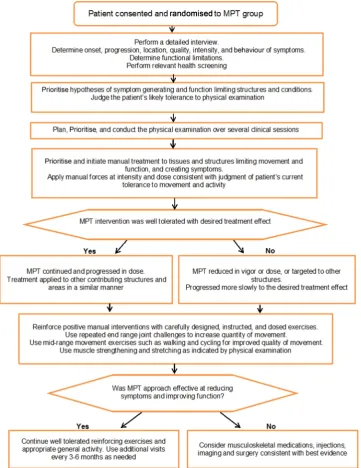
The PT interventions in this trial will be pragmatic, indi-vidualised and patient centered35 36 48 49 using MPT interventions with reinforcing exercises. The interven-tions will be guided by clinical reasoning (see Definitions section)50 51 to appropriately select, dose and progress them (figure 2). At the first session, the physical therapist will perform a detailed interview and physical examination to determine symptom location and behaviour; impaired tissues, structures and move-ment; and functional limitations. This information will determine the appropriate focus, scope and vigour of applied PT interventions. The PT interventions includ-ing the manual therapy techniques and reinforcinclud-ing exer-cises will be directed primarily to the arthritic knee(s) and secondarily to the hip, lumbar spine and foot and ankle regions if they are judged to be contributing to the overall symptoms, limited movement and disability
Table 1 Treatment schedule and dose
Initial treatment 4-Month treatment 9-Month treatment
CSI group
Education on the benefits of weight reduction, regular low-impact physical activity, and strengthening and flexibility exercises
An intra-articular steroid injection with postinjection activity guidance
Intra-articular steroid injection as needed
Intra-articular steroid injection as needed
PT group
Education on the benefits of weight reduction, regular low-impact physical activity, and strengthening and flexibility exercises
Up to 8 clinical sessions for physical therapy treatments consisting of manual therapy and reinforcing exercise
Up to 3 PT clinical sessions as needed
Up to 3 PT clinical sessions as needed
CSI, corticosteroid injection; PT, physical therapy.
on September 22, 2020 by guest. Protected by copyright.
the patient attributes to their knee OA. The manual techniques, reinforcing exercises and any other selected exercises will be targeted to impairments in movement, strength, flexibility and motor control identified during the examination.34–36 48 The priority, dosing and pro-gression of all treatment will be determined by the treat-ing physical therapist. Accordtreat-ingly, interventions will not be predetermined or artificially constrained by a proto-col that assumes identical treatment is appropriate for all participants despite typically wide variance in clinical presentation.48 49 In this pragmatic patient-centred approach, clinical decision-making50 or clinical
reasoning51 will be employed to tailor PT interventions according to the information gleaned from the interview and physical examination and from the patient’s ongoing response to treatment.48 The core set of exer-cises (see online supplementary appendix 1) that reinforce the effects of manual interventions (see online supplementary appendix 2) or any additionally pre-scribed exercises will be instructed and made part of the home exercise programme at the appropriate points. Participants will have home exercise folders with pictures and instructions for each exercise, compliance logs to document exercise performance and videos of the core Figure 1 Proposed recruitment and flow of the study. CSI, corticosteroid injection; GROC, Global Rating of Change; MPT, manual physical therapy; OA, osteoarthritis; PT, physical therapy; TUG, Timed Up and Go; WOMAC, Western Ontario & McMaster Universities Arthritis Index.
on September 22, 2020 by guest. Protected by copyright.
set of exercises to enhance compliance and accurate performance of the exercises. PT patients in this setting routinely receive similar home exercise folders as stand-ard of care. Participants are assessed before, during and after treatment sessions to determine the effects of manual techniques and exercises on symptoms and function. Each participant will initially receive a maximum of eight PT sessions over a 4–6-week period. Frequency and duration of treatment is at the discretion of the treating PT. Additional 2–3 PT sessions may be used at the 4-month and 9-month rechecks. Each treat-ment session will last approximately 60 min. A physical therapist will perform all treatments including exercise instruction and supervision. Treatments will be pro-gressed according to the patient’s response to the prior
session(s). At the beginning of each session, patients who are cycling tolerant will warm up on an appropri-ately fitted stationary bicycle for 10–12 min prior to receiving manual examination and treatment. Bicycle sessions will include a progressive number of strengthen-ing or higher intensity power intervals laststrengthen-ing 20 s fol-lowed by 40 s of recovery spinning. The primary exercises used in this study (see online supplementary appendix 1) address typical strength and movement impairments commonly found in patients with knee OA and reinforce the effects of the clinically applied MPT.36 48 One or two exercises will be added at each session consistent with the priority of identified impair-ments and the corresponding manual treatment techni-ques used. This progressive layering approach is useful Figure 2 PT approach algorithm. MPT, manual physical therapy; PT, physical therapy. on September 22, 2020 by guest. Protected by copyright.
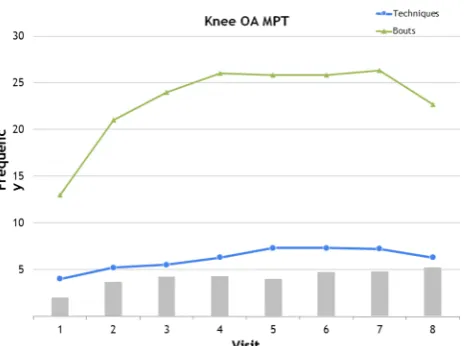
to determine the effects of new techniques and exer-cises. Each manual technique or exercise will be pro-gressed, modified or eliminated as needed to keep the programme well tolerated48 by the patient. Additional exercises targeted to specific impairments such as hip muscle weakness or spine hypomobility may be used depending on examination findings. This approach is consistent with previous MPT trials on participants with knee OA34–36 and chronic conditions in other body regions.52–56 A typical progression of manual techniques and reinforcing exercises is illustrated in figure 3. Each patient is evaluated at 4 and 9 months post initiating treatment to determine if there are questions on the home exercises or if additional manual therapy is indi-cated. The physical therapists providing treatment are board certified in orthopaedic PT and fellowship trained in orthopaedic manual PT. They routinely treat patients with chronic musculoskeletal conditions including knee OA.
Outcome measures
The primary DV is the WOMAC and the secondary DVs are the GROC and the TUG.
The DVs and other examination data such as height, weight, knee active range of motion, presence of joint line tenderness, ligamentous stability tests and symptoms with patellofemoral passive movement are recorded
onto forms within the participant data folder.
Participant folders are labelled with participant numbers corresponding to the number from the randomisation lists. Folders are filed sequentially by number and main-tained in a lockedfiling cabinet in a locked room.
The WOMAC
The WOMAC is a self-report questionnaire requiring patients to rate their pain, stiffness and functional limita-tion associated with their condilimita-tion. This instrument will provide important information about the self-reported pain and disability level of the patients in this study. The WOMAC is a recommended primary outcome measure in therapy trials of arthritic conditions57 and is consid-ered one of the most appropriate scales for trials evaluat-ing knee OA.58 It is a reliable, valid and responsive instrument widely used in clinical trials evaluating therapy for hip and knee OA.59
GROC questionnaire
The GROC questionnaire is an instrument that mea-sures overall changes in the quality of life of the partici-pant.60 The GROC is a common, feasible and useful method for assessing outcome61 and is a valid measure-ment of change in patient status in other pain popula-tions.62 A change in score of three rating points (+3) is clinically significant in the patient’s perception of quality of life.61 The GROC has 15 possible choices, with 0 being equal to no change, −1 to −7 indicating a nega-tive change and +1 to +7 indicating a posinega-tive change.
TUG test
The TUG test is a functional performance measure spe-cifically studied in persons with OA of the hip and knee, which directly evaluates an individual’s ability to transfer, ambulate and maintain balance during transitions.63–65 Individuals are timed on how quickly they can stand, walk 3 m, turn around return to the chair and sit down. The TUG has good inter-rater and intrarater reliability and validity for functional testing in older adults.66–68 It also correlates well with the Berg Balance Scale (r=
−0.81), gait speed (r=−0.61) and the Barthel Index of Activities of Daily Living (r=−0.78).66 According to Podsiadloet al,66the TUG is a reliable and valid test for quantifying functional mobility, and it is a good pre-dictor of a patient’s ability to go outside safely. It has content validity, evaluating a series of manoeuvers used in daily life, and concurrent validity in that it correlates well with more extensive measures of balance, gait speed and functional abilities. The TUG was used as a func-tional outcome in a previous MPT trial for knee OA34 and is a currently recommended knee OA functional outcome measure.65 The test is easy to administer and can be completed in 2–3 min.
We will also monitor for and report any adverse effects associated with either treatment. In this study, an adverse event will be defined as a persistent worsening of symptoms requiring additional treatment outside of the study.
Figure 3 Manual therapy techniques and exercise dose progression. This figure represents a typical MPT and exercise dose progression by visit. Bouts of manual therapy are reported as a single bout of joint or soft tissue mobilisation for 30 s. Techniques are the number of different joint or soft tissue mobilisation techniques used during the visit. Manual therapy dosage and exercise prescription typically increase throughout the course of care as the patient demonstrates tolerance. At the last visits, the dosage of manual therapy typically decreases as the focus shifts towards reinforcing the importance of the patient’s long-term performance of the home exercise programme. MPT, manual physical therapy; OA, osteoarthritis.
on September 22, 2020 by guest. Protected by copyright.
Justification of sample size
A total of 69 participants per group, or a total of 138 participants, are needed for 80% power to detect a sig-nificant group × time interaction effect using anα level of 0.05 and assuming a 12% difference69 between groups in mean post-treatment total WOMAC scores— corresponding to a partialη2of 0.006 and an effect size
f of 0.078. This assumes two groups measured over five points in time, a common SD of 46.8 points, a between-repeated-measures correlation of r=0.681, and a non-sphericity correction factor of (Greenhouse-Geisser) epsilon=0.890—consistent with data collected in previous trials.35 36Assuming an 11% dropout rate,8we will need to enrol 156 (approximately 80 from each of the 2 ticipating centres) participants in order to have 138 par-ticipants completing the study. A sensitivity analysis was performed to compute magnitudes of statistical power reduction given varying scenarios with dropout rates greater than the assumed rate of 11%. If the dropout rate should be 15% (132 participants retained), with all other power determinants remaining unchanged, statis-tical power would be reduced to 78%; with a 20% dropout rate (125 participants retained), statistical power would be 75%; with a 25% dropout rate (117 par-ticipants retained), statistical power would be 72%. Sample size estimation was performed with G*Power software, V.3.1.2.70 Recruitment will not go over a total of 156 participants without prior Institutional Review Board (IRB) approval, but a site may have more than their proportionate share depending on clinical flow and available participant pool. In this case, the other site will under-recruit.
Data entry
Data entered into the research folder will be periodically transferred into the master data spreadsheet by a research assistant. Accuracy of data recording is facili-tated by secondary review of data by coauthors. Intervention groups are coded as 1 or 2 to prevent unmasking of datasets during analysis as the statistician will remain blind to the group of assignment. Data from individual participants are recorded by research numbers. The spreadsheet containing the research data is stored on a portable drive and locked in the same room and cabinet as the research folders.
Data analysis
Data analysis will be performed with IBM SPSS Statistics software, V.22. The statistician performing the analyses will be blinded to the intervention associated with the group of assignment. Descriptive statistics will be com-puted to characterise and compare the two treatment groups for assessment of baseline heterogeneity. Distributions of measured variables will be examined visually with frequency histograms and formally assessed with Kolmogorov-Smirnov and Shapiro-Wilk statistics to test the normality assumption. Levene’s test will be used to assess for violations of the homogeneity of variance
assumption. All statistical tests will all be performed at anαlevel of 0.05.
The primary analysis of relative effectiveness between the two treatments will be tested using a linear mixed-effects model which isflexible in accommodating data assumed to be missing at random. There will be two levels of treatment and five levels of time if ran-domisation produces reasonably equivalent groups as measured by important prognostic factors (Kellgren-Lawrence scores, duration of symptoms, baseline WOMAC scores, etc). Otherwise, variables for which non-equivalence is detected at baseline will be entered as covariates into the linear mixed-effects model. A similar approach will be used to analyse the GROC data. An αlevel of 0.05 will be used to establish significance. The primary analysis will include data from patients according to the group they were assigned. If one treat-ment is shown to be superior to the other, suppletreat-mental analyses will be performed by dichotomising groups based on MCIDs of 12% for WOMAC69 and +3 points for GROC scores.61This will allow computation of abso-lute risk reduction, relative risk reduction and number needed to treat (with associated 95% CIs) using failure to obtain clinically meaningful benefit as the event of interest. Every effort will be made to recruit 156 partici-pants. No interim analysis or alternative analysis is planned. If factors beyond the control of the investiga-tors, such as military reassignment of members of the research team, or other emerging research studies at the same centres on the same population prolong enrol-ment beyond a reasonable period, enrolenrol-ment may be terminated and the specified blind analysis performed at that point. Owing to the low risk associated with the interventions, a data monitoring committee will not be used.
Trial organisation and monitoring
The investigative team consists of the authors listed in this protocol, in addition to physical therapists who will measure the DVs and administrative research staff at each site who will assist with appointment scheduling and data entry. The principal investigator will manage data flow and perform audits of the procedures, enrol-ment and treatenrol-ment throughout the entire process of the study. The associate investigators will monitor data collection processes and data integrity with periodic evaluation performed continually during the course of the data collection phase.
DISCUSSION
This randomised clinical trial will be the first study that directly compares the short-term and long-term effects of CSI and PT for patients with knee OA. This question is important because analysis of civilian and military healthcare databases indicates frequent deviation from clinical practice guidelines and patients with knee OA routinely receive CSI as either an initial or a primary
on September 22, 2020 by guest. Protected by copyright.
intervention. Smaller percentages of patients with knee OA receive PT compared to CSI prior to total joint replacement.21 22 Injections are often easier, less expen-sive and more convenient for patients. However, the con-venience and short-term savings may be offset by the associated risks and downstream healthcare utilisation associated with the development of chronically impaired movement, and progressing arthritis leading to increas-ing symptoms, medication use, imagincreas-ing and invasive
pro-cedures. All described PT treatment procedures
including MPT are part of entry-level physical therapist education and training. The results of this study may aid in establishing best clinical practice guidelines for this patient population. A challenge with reporting the methods of this pragmatic study will be to communicate the details of the PT interventions including the MPT in a succinct and clear manner that facilitates understand-ing for further study by other researchers and integra-tion into clinical practice. In particular, clinical reasoning which individualises the type, progression and dose of the PT intervention is not easily described in limited space. Therefore, accurate tracking and report-ing of all interventions as applied in this study through the use of graphs andfigures derived from data entered
onto the treatment recording form (see online
supplementary appendix 3) will provide valuable insight into typical treatment progression. The PT treatment algorithm (figure 2) should be helpful to communicate the decision points in pragmatic PT treatment.
ETHICAL CONSIDERATIONS AND DISSEMINATION
An ethics review has been provided by the Institutional Review Board at Madigan Army Medical Center and mon-itored by the US Army Medical Department Clinical Investigation Regulatory Office (CIRO) to ensure compli-ance with federal regulations for protection of human medical research participants. Any significant modifi ca-tions to the protocol which may impact the conduct of the study, treatment parameters, study objectives or study procedures will require a formal amendment to the protocol and approval by the Institutional Review Board. This clinical trial was registered with ClinicalTrials.gov with a registration number NCT01427153. All interven-tions provided in this study are considered standard of care and could be given to patients as part of their treat-ment plan even if they were not a part of this study. Unfortunately, knee OA patients in some practice settings may not receive PT that is similarly comprehensive.
Publication policy
The results of the trial will be published in a relevant sci-entific journal regardless of the outcome. We will report the results following the CONSORT statement with the recommended extension for pragmatic trials.43
Projected timetable for trial:
May 2012—Protocol approved by the Western Regional Medical Command Institutional Review Board.
Oct 2012—Participant enrolment begins
Jul 2016—Participant enrolment completes
Oct 2013—First participant completes 1-year follow-up Jul 2017—Last participant completes 1-year follow-up Dec 2017—Data entry and analysis complete
May 2018—Publication with study results submitted for publication
Definitions
Clinical reasoning: Clinical reasoning is an ongoing decision-making process used in the evaluation and man-agement of a patient throughout the episode of care.50 51
MPT: ‘Orthopaedic Manual Therapy is a specialised area of Physiotherapy/Physical Therapy for the manage-ment of neuromusculoskeletal conditions, based on clin-ical reasoning, using highly specific treatment approaches including manual techniques and thera-peutic exercises’.71
Author affiliations
1Brooke Army Medical Center, San Antonio, Texas, USA
2Madigan Army Medical Center, Tacoma, Washington, USA
3National Defense University, Washington, DC, USA
4University of the Incarnate Word, San Antonio, Texas, USA
5University of Queensland, Brisbane, Queensland, Australia
Twitter Follow Ben Hando at @benhando
Contributors All the authors collectively conceived the idea for the project. GDD is the site principal investigator (PI) at Brooke Army Medical Center and DIR is the site PI at Madigan Army Medical Center. All authors contributed to the scientific derivation of the protocol, as well as reviewing and submitting the protocol for publication. SCA provided advice with statistical and methods design. GDD, CSA, EJP and DIR will provide all the interventions for the physical therapy (PT) group. NB is the developer of the Western Ontario & McMaster Universities Arthritis Index (WOMAC) and consultant for the research design and question. Authors NWG and BRH will coordinate appointments for treatment and blinded follow-up testing over the course of the study.
Funding This study is funded in part by the Orthopaedic Physical Therapy Products Grant through the American Academy of Orthopaedic Manual Physical Therapists.
Disclaimer The views expressed are those of the authors and do not reflect the official policy of the Department of the Army, the Department of Defense or the US Government.
Competing interests None declared.
Ethics approval Western Regional Medical Command Institutional Review Board.
Provenance and peer review Not commissioned; externally peer reviewed.
Data sharing statement Data from the study are available by email request to the lead author for the purpose of systematic review and meta-analysis.
Open Access This is an Open Access article distributed in accordance with the Creative Commons Attribution Non Commercial (CC BY-NC 4.0) license, which permits others to distribute, remix, adapt, build upon this work non-commercially, and license their derivative works on different terms, provided the original work is properly cited and the use is non-commercial. See: http:// creativecommons.org/licenses/by-nc/4.0/
REFERENCES
1. Murphy LB, Moss S, Do BT,et al. Annual incidence of knee symptoms and four knee osteoarthritis outcomes in the Johnston County Osteoarthritis Project.Arthritis Care Res (Hoboken)
2016;68:55–65.
2. Losina E, Thornhill TS, Rome BN,et al. The dramatic increase in total knee replacement utilization rates in the United States cannot
on September 22, 2020 by guest. Protected by copyright.
be fully explained by growth in population size and the obesity epidemic.J Bone Joint Surg Am2012;94:201–7.
3. Fitzgerald GK, Piva SR, Irrgang JJ. Reports of joint instability in knee osteoarthritis: its prevalence and relationship to physical function.Arthritis Rheum2004;51:941–6.
4. Struewer J, Frangen TM, Ishaque B,et al. Knee function and prevalence of osteoarthritis after isolated anterior cruciate ligament reconstruction using bone-patellar tendon-bone graft: long-term follow-up.Int Orthop2012;36:171–7.
5. Blalock D, Miller A, Tilley M,et al. Joint instability and osteoarthritis. Clin Med Insights Arthritis Musculoskelet Disord2015;8:15–23. 6. Emery CA, Roos EM, Verhagen E,et al. OARSI Clinical Trials
Recommendations: design and conduct of clinical trials for primary prevention of osteoarthritis by joint injury prevention in sport and recreation.Osteoarthr Cartil2015;23:815–25.
7. Lohmander LS, Gerhardsson de Verdier M, Rollof J,et al. Incidence of severe knee and hip osteoarthritis in relation to different measures of body mass: a population-based prospective cohort study.Ann Rheum Dis2009;68:490–6.
8. Losina E, Weinstein AM, Reichmann WM,et al. Lifetime risk and age at diagnosis of symptomatic knee osteoarthritis in the US. Arthritis Care Res (Hoboken)2013;65:703–11.
9. Sandmark H, Hogstedt C, Vingard E. Primary osteoarthrosis of the knee in men and women as a result of lifelong physical load from work.Scand J Work Environ Health2000;26:20–5.
10. Jarvholm B, From C, Lewold S,et al. Incidence of surgically treated osteoarthritis in the hip and knee in Male construction workers. Occup Environ Med2008;65:275–8.
11. Kerkhof HJ, Bierma-Zeinstra SM, Arden NK,et al. Prediction model for knee osteoarthritis incidence, including clinical, genetic and biochemical risk factors.Ann Rheum Dis2014;73:2116–21. 12. Cerejo R, Dunlop DD, Cahue S,et al. The influence of alignment on
risk of knee osteoarthritis progression according to baseline stage of disease.Arthritis Rheum2002;46:2632–6.
13. Madry H, Luyten FP, Facchini A. Biological aspects of early osteoarthritis.Knee Surg Sports Traumatol Arthrosc 2012;20:407–22.
14. Ryd L, Brittberg M, Eriksson K,et al. Pre-osteoarthritis: definition and diagnosis of an elusive clinical entity.Cartilage2015;6:156–65. 15. Riddle DL, Makowski M, Kong X. Knee osteoarthritis worsening
across the disease spectrum and future knee pain, symptoms and functioning: a multisite prospective cohort study.Arthritis Care Res (Hoboken)2015;67:1722–9.
16. Wolfe F, Lane NE. The longterm outcome of osteoarthritis: rates and predictors of joint space narrowing in symptomatic patients with knee osteoarthritis.J Rheumatol2002;29:139–46.
17. Hodges PW, van den Hoorn W, Wrigley TV,et al. Increased duration of co-contraction of medial knee muscles is associated with greater progression of knee osteoarthritis.Man Ther2016;21:151–8. 18. Zeni JA, Rudolph K, Higginson JS. Alterations in quadriceps and
hamstrings coordination in persons with medial compartment knee osteoarthritis.J Electromyogr Kinesiol2010;20:148–54.
19. Hochberg MC, Perlmutter DL, Hudson JI,et al. Preferences in the management of osteoarthritis of the hip and knee: results of a survey of community-based rheumatologists in the United States. Arthritis Care Res1996;9:170–6.
20. Horne G, Devane P, Davidson A,et al. The influence of steroid injections on the incidence of infection following total knee arthroplasty.N Z Med J2008;121:U2896.
21. Dhawan A, Mather RC III, Karas V,et al. An epidemiologic analysis of clinical practice guidelines for non-arthroplasty treatment of osteoarthritis of the knee.Arthroscopy2014;30:65–71.
22. Rhon D. Army Medical Command, 1-Year Knee-Related Utilization of Patients with Knee Osteoarthritis within the Military Health System from 2008-2013. Available from the Military Health System Data Repository (MDR). http://www.health.mil/Military-Health-Topics/ Technology/Clinical-Support/Military-Health-System-Data-Repository, 2015.
23. Bellamy N, Campbell J, Robinson V,et al. Intraarticular
corticosteroid for treatment of osteoarthritis of the knee.Cochrane Database Syst Rev2006;(2):CD005328.
24. Cheng OT, Souzdalnitski D, Vrooman B,et al. Evidence-based knee injections for the management of arthritis.Pain Med
2012;13:740–53.
25. Bannuru RR, Schmid CH, Kent DM,et al. Comparative effectiveness of pharmacologic interventions for knee osteoarthritis: a systematic review and network meta-analysis.Ann Intern Med2015;162:46–54. 26. Surgeons AAoO. Appropriate use criteria for non-arthroplasty
treatment of osteoarthritis of the knee. 6 December 2013. 27. Hochberg MC, Altman RD, April KT,et al. American College of
Rheumatology 2012 recommendations for the use of
nonpharmacologic and pharmacologic therapies in osteoarthritis of the hand, hip, and knee.Arthritis Care Res (Hoboken)
2012;64:465–74.
28. Marsland D, Mumith A, Barlow IW. Systematic review: the safety of intra-articular corticosteroid injection prior to total knee arthroplasty. Knee2014;21:6–11.
29. Henriksen M, Christensen R, Klokker L,et al. Evaluation of the benefit of corticosteroid injection before exercise therapy in patients with osteoarthritis of the knee: a randomized clinical trial.JAMA Intern Med2015;175:923–30.
30. Shemesh S, Heller S, Salai M,et al. Septic arthritis of the knee following intraarticular injections in elderly patients: report of six patients.Isr Med Assoc J2011;13:757–60.
31. Ungprasert P, Permpalung N, Summachiwakij S,et al. A case of recurrent acute pancreatitis due to intra-articular corticosteroid injection.JOP2014;15:208–9.
32. Berthelot JM, Le Goff B, Maugars Y. Side effects of corticosteroid injections: what’s new?Joint Bone Spine2013;80:363–7.
33. Maricar N, Callaghan MJ, Felson DT,et al. Predictors of response to intra-articular steroid injections in knee osteoarthritis--a systematic review.Rheumatology (Oxford)2013;52:1022–32.
34. Abbott JH, Robertson MC, Chapple C,et al. Manual therapy, exercise therapy, or both, in addition to usual care, for osteoarthritis of the hip or knee: a randomized controlled trial. 1: clinical effectiveness.Osteoarthritis Cartilage2013;21:525–34.
35. Deyle GD, Allison SC, Matekel RL,et al. Physical therapy treatment effectiveness for osteoarthritis of the knee: a randomized
comparison of supervised clinical exercise and manual therapy procedures versus a home exercise program.Phys Ther
2005;85:1301–17.
36. Deyle GD, Henderson NE, Matekel RL,et al. Effectiveness of manual physical therapy and exercise in osteoarthritis of the knee. A randomized, controlled trial.Ann Intern Med
2000;132:173–81.
37. Katz JN, Losina E. Surgery versus physical therapy for meniscal tear and osteoarthritis.N Engl J Med2013;369:677–8. 38. Jansen MJ, Viechtbauer W, Lenssen AF,et al. Strength training
alone, exercise therapy alone, and exercise therapy with passive manual mobilisation each reduce pain and disability in people with knee osteoarthritis: a systematic review.J Physiother
2011;57:11–20.
39. Page CJ, Hinman RS, Bennell KL. Physiotherapy management of knee osteoarthritis.Int J Rheum Dis2011;14:145–51.
40. Taylor AL, Wilken JM, Deyle GD,et al. Knee extension and stiffness in osteoarthritic and normal knees: a videofluoroscopic analysis of the effect of a single session of manual therapy.J Orthop Sports Phys Ther2014;44:273–82.
41. Moss P, Sluka K, Wright A. The initial effects of knee joint mobilization on osteoarthritic hyperalgesia.Man Ther 2007;12:109–18.
42. Deyle GD, Gill NW, Allison SC,et al. Manual physical therapy and exercise improves knee OA: Who are the minority unlikely to benefit? A preliminary clinical prediction rule.J Fam Pract2012;61: E1–8.
43. Zwarenstein M, Treweek S, Gagnier JJ,et al. Improving the reporting of pragmatic trials: an extension of the CONSORT statement.BMJ2008;337:a2390.
44. Altman RD. Criteria for the classification of osteoarthritis of the knee and hip.Scand J Rheumatol Suppl1987;65:31–9.
45. Leopold SS, Redd BB, Warme WJ,et al. Corticosteroid compared with hyaluronic acid injections for the treatment of osteoarthritis of the knee. A prospective, randomized trial.J Bone Joint Surg Am
2003;85-A:1197–203.
46. Arroll B, Goodyear-Smith F. Corticosteroid injections for osteoarthritis of the knee: meta-analysis.BMJ2004;328:869.
47. Hepper CT, Halvorson JJ, Duncan ST,et al. The efficacy and duration of intra-articular corticosteroid injection for knee osteoarthritis: a systematic review of level I studies.J Am Acad Orthop Surg2009;17:638–46.
48. Deyle GD, Gill NW. Well-tolerated strategies for managing knee osteoarthritis: a manual physical therapist approach to activity, exercise, and advice.Phys Sportsmed 2012;40:12–25.
49. Bennell KL, Dobson F, Hinman RS. Exercise in osteoarthritis: moving from prescription to adherence.Best Pract Res Clin Rheumatol2014;28:93–117.
50. Wainwright SF, Shepard KF, Harman LB,et al. Factors that influence the clinical decision making of novice and experienced physical therapists.Phys Ther2011;91:87–101.
51. Edwards I, Jones M, Carr J,et al. Clinical reasoning strategies in physical therapy.Phys Ther2004;84:312–30; discussion 31-5.
on September 22, 2020 by guest. Protected by copyright.
52. Walker MJ, Boyles RE, Young BA,et al. The effectiveness of manual physical therapy and exercise for mechanical neck pain: a randomized clinical trial.Spine2008;33:2371–8.
53. Whitman JM, Flynn TW, Childs JD,et al. A comparison between two physical therapy treatment programs for patients with lumbar spinal stenosis: a randomized clinical trial.Spine2006;31: 2541–9.
54. Cleland JA, Abbott JH, Kidd MO,et al. Manual physical therapy and exercise versus electrophysical agents and exercise in the management of plantar heel pain: a multicenter randomized clinical trial.J Orthop Sports Phys Ther2009;39:573–85.
55. Cleland JA, Mintken PE, McDevitt A,et al. Manual physical therapy and exercise versus supervised home exercise in the
management of patients with inversion ankle sprain: a multicenter randomized clinical trial.J Orthop Sports Phys Ther
2013;43:443–55.
56. Rhon DI, Boyles RB, Cleland JA. One-year outcome of subacromial corticosteroid injection compared with manual physical therapy for the management of the unilateral shoulder impingement syndrome: a pragmatic randomized trial.Ann Intern Med 2014;161:161–9.
57. Sun Y, Sturmer T, Gunther KP,et al. Reliability and validity of clinical outcome measurements of osteoarthritis of the hip and knee--a review of the literature.Clin Rheumatol1997;16:185–98. 58. Veenhof C, Bijlsma JW, van den Ende CH,et al. Psychometric
evaluation of osteoarthritis questionnaires: a systematic review of the literature.Arthritis Rheum2006;55:480–92.
59. Bellamy N, Buchanan WW, Goldsmith CH,et al. Validation study of WOMAC: a health status instrument for measuring clinically important patient relevant outcomes to antirheumatic drug therapy in patients with osteoarthritis of the hip or knee.J Rheumatol
1988;15:1833–40.
60. Juniper EF, Guyatt GH, Willan A,et al. Determining a minimal important change in a disease-specific Quality of Life Questionnaire. J Clin Epidemiol1994;47:81–7.
61. Jaeschke R, Singer J, Guyatt GH. Measurement of health status. Ascertaining the minimal clinically important difference.Control Clin Trials1989;10:407–15.
62. Fritz JM, Irrgang JJ. A comparison of a modified Oswestry Low Back Pain Disability Questionnaire and the Quebec Back Pain Disability Scale.Phys Ther2001;81:776–88.
63. Dobson F, Hinman RS, Hall M,et al. Measurement properties of performance-based measures to assess physical function in hip and knee osteoarthritis: a systematic review.Osteoarthr Cartil
2012;20:1548–62.
64. Stratford PW, Kennedy DM, Woodhouse LJ. Performance measures provide assessments of pain and function in people with advanced osteoarthritis of the hip or knee.Phys Ther2006;86:1489–96. 65. Dobson F, Hinman RS, Roos EM,et al. OARSI recommended
performance-based tests to assess physical function in people diagnosed with hip or knee osteoarthritis.Osteoarthr Cartil 2013;21:1042–52.
66. Podsiadlo D, Richardson S. The timed“Up & Go": a test of basic functional mobility for frail elderly persons.J Am Geriatr Soc
1991;39:142–8.
67. Shumway-Cook A, Brauer S, Woollacott M. Predicting the probability for falls in community-dwelling older adults using the Timed Up & Go Test.Phys Ther2000;80:896–903.
68. Steffen TM, Hacker TA, Mollinger L. Age- and gender-related test performance in community-dwelling elderly people: Six-Minute Walk Test, Berg Balance Scale, Timed Up & Go Test, and gait speeds.
Phys Ther2002;82:128–37.
69. Angst F, Aeschlimann A, Stucki G. Smallest detectable and minimal clinically important differences of rehabilitation intervention with their implications for required sample sizes using WOMAC and SF-36 quality of life measurement instruments in patients with osteoarthritis of the lower extremities.Arthritis Rheum2001;45:384–91.
70. Faul F LA-G, Buchner A. G* Power.
71. Beeton KL, Maffey J, Pool L,et al. Educational standards in orthopaedic manipulative therapy, 2013.
on September 22, 2020 by guest. Protected by copyright.
Correction
Deyle GD, Gill NW, Rhon DI, et al. A multicentre randomised, 1-year comparative effectiveness, parallel-group trial protocol of a physical therapy approach compared to corticosteroid injections.BMJ Open2016;6:e010528. The title of this paper is incor-rect and should be: A multicenter randomised, 1-year comparative effectiveness, parallel-group trial protocol of a physical therapy approach compared to corticoster-oid injection on pain and function related to knee osteoarthritis (PTA Trial).