DOI: 10.5958/2230-732X.2016.00116.9
©2016 New Delhi Publishers. All rights reserved
Study on quality of white bread enriched with finger millet
flour
Bansee. M. Devani
1*, Bhavesh. L. Jani
1, Mansukhlal. B. Kapopara
2, Devendra. M. Vyas
3and Manda Devi Ningthoujam
11College of Food Processing Technology and Bioenergy, Anand Agricultural University, Food Processing Technology, Anand, Gujarat, India
2School of Baking, Junagadh Agricultural University, Junagadh, Gujarat, India
3College of Agricultural Engineering and Technology, Junagadh Agricultural University, Department of Processing and Food Engineering, Junagadh, Gujarat, India
*Correspondingauthor: [email protected]
Paper No. 519 Received: 15-2-2016 Accepted: 2-10-2016
Abstract
White bread prepared from white flour is a rich source of carbohydrate, protein and energy. But it has poor nutritional qualities in terms of quality protein, vitamins, minerals and fiber as germ and bran are removed while preparing white flour. Finger Millet is a rich source of calcium, fiber, minerals and good quality protein. White bread was fortified with Finger Millet Flour (FMF) by blending in the proportion of 10, 20, 30, 40 and 50% with the white flour. The enriched bread was evaluated for its physical, nutritional and rheological properties viz. loaf weight, loaf volume, specific loaf volume, carbohydrate, protein, fat, crude fiber, ash, calcium, physiological energy and crumb hardness and were found to be 431 to 470 g, 1166.37 to 1166.37 cc, 2.02 to 2.71 cc/g, 59.92 to 60.08 %, 5.10 to 6.22 %, 4.42 to 4.64%, 0.52 to 1.57 %, 0.70 to 1.50 %, 32.52 to 110.6 %mg, 299.80 to 306.90 kcal/g and 124.5 to 150g. Sensory score based on appearance, crust colour, crumb colour, taste, texture and overall acceptability was highest in the white bread fortified with 20 % FMF. Based on the physical acceptance, superior nutritional quality with the acceptable physical properties and rheological property, significant fortification was found by incorporating the FMF up to 20% to the white flour.
Highlights
• With a view to improve the quality of white bread, Finger Millet Flour was added with different blending ratio.
• Based on acceptable physical, nutritional and rheological properties as well as sensory score of the FMF enriched white bread, the significant blending ratio of FMF is found best up to 20%.
Keywords: Composite bread, finger millet flour, quality, fortification of bread
Bread is a food consumed all over the world by all age people. It is prepared from white flour, yeast, sugar, fat, salt, water, etc., by a series of operations like mixing, kneading, fermentation, proofing and baking (Dewettinck et al., 2008). White flour is obtained from wheat kernel by removing
bran and germ and only extracting the starchy endosperm. Starchy endosperm is white in color therefore, flour obtained is known as white flour/ refined flour and the bread prepared from that is known as white bread. White flour is rich source of carbohydrate, protein and physiological energy
but on the contrary poor source of fiber, vitamins, minerals and quality protein due to removal of bran and germ of the outer seed coat. Thus, the white flour is nutritionally poor and it must be enriched with the fiber, vitamins and minerals to overcome the malnutrition problem which is spread worldwide. Millets are small seeded grains used for food, feed and forage. They are widely cultivated in the tropics and consumed by all age groups in several forms. With respect to other cereals, millets are nutritionally comparable and even superior to some major cereals (Anonymous 2009; Gopalan et al. 2010; Balasubramanian et al. 2007). Finger Millet (Eleusinecoracana, Ragi) is a type of small millets. It is rich in protein, iron, calcium, phosphorus, fibre and vitamin content. The calcium content is higher than that of the all cereals. Finger Millet has best quality protein along with the presence of essential amino acids, vitamin A, vitamin B and phosphorus (Gopalan et al., 1987). So, the Finger Millet can be a good source of diet for growing children, women, old age people and patients. The bakery sector is also focusing on the use of minor millets as a source of dietary fiber and bioactive compounds (Hugo et al., 2009; Singh et al., 2012; Ballolli et al., 2014; Bhol and John Don Bosco 2014).
With the changing perception toward health and taste, people are demanding functional food, composite flour food which provides the health benefits as well as appealing sensory characteristics. Wheat-Finger Millet composite flour can be converted into variety of new food products such as noodles, vermicelli, pasta products, papads, roller dried finger millet-based soup mixes, bakery products such as bread and biscuits (Gull et al., 2016). Dietary fibre is the contributing factor for its low glycemic index and thus it is useful to control blood glucose levels in diabetic patients very efficiently and considered to be ideal food for diabetic individuals due toits low sugar content and slow release of glucose/sugar in the body (Lakshmi
et al., 2002). The present study is undertaken to
evaluate possibility of increasing the nutritional quality of bread by incorporating Finger Millet flour and its effect on quality of bread.
Materials and Methods
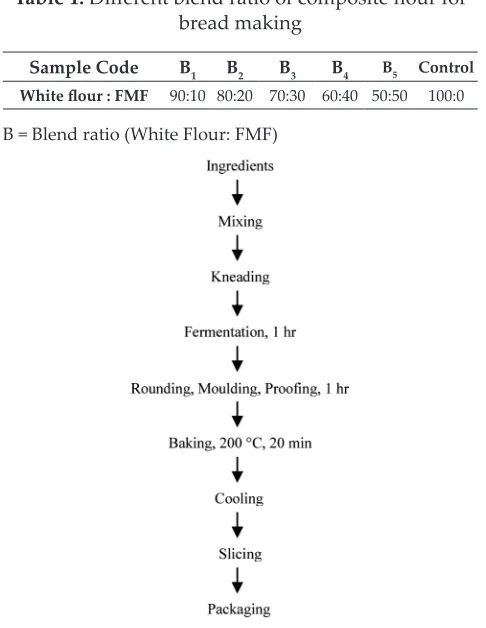
The Finger Millet seeds were ground in domestic mixer and sieved in 35 mesh sieve to prepare Finger Millet Flour (FMF) and the five different treatments were decided as shown in the Table 1. The bread making formulations of white bread enriched with FMF is given in Table 2. The process flow chart of bread making is given in Fig. 1. The bread containing 100% white flour served as control. The HPMC was added to the bread formation as it works as a bread improver in the composite bread.
Table 1: Different blend ratio of composite flour for bread making
Sample Code B1 B2 B3 B4 B5 Control White flour : FMF 90:10 80:20 70:30 60:40 50:50 100:0
B = Blend ratio (White Flour: FMF)
Fig. 1: Process flow chart for preparation of white bread fortified with FMF
Table 2: Bread making formulation
Ingredient Compo-site Flour* Sugar Fat (Vanash-pati ghee) Baker’s Yeast (Wet form) Salt HPMC Water (ml) Total
Weight on flour basis(g) 250.00 45.00 17.50 8.00 5.00 3.75 150-165 495
Baker’s Percentage 100.00 18.00 7.00 3.00 2.00 1.50 60-65
Quality evaluation of the prepared bread
The physical property of bread like loaf weight was measured by electronic weight balance, loaf volume was measured by Rapseed Displacement method as described by Giami et al. (2004) and specific loaf volume was calculated by dividing the loaf volume by loaf weight. The bread samples were subjected to the proximate analysis such as carbohydrate, protein, fat, crude fiber and ash according to the standard methods given by Sadasivam and Mannikam (1991) and calcium content by Versenate EDTA method. Physiological energy obtained from the bread was calculated by multiplying the Atwater’s Constants which are 4, 4 and 9 kcal/g for carbohydrate, protein and fat, respectively. Rheological property of bread i.e. crumb hardness was measured by Texture analyzer. Different sensory attributes like appearance, crust color, crumb color, taste, texture, flavor and overall acceptability of the bread were evaluated using 9 point Hedonic scale as described by Ranganna (1986). The bread samples were statistically analyzed by One-way ANOVA method using Completely Randomized Design (CRD) for physical, nutritional and rheological properties. The sensory scores were analyzed using Duncan’s New Multiple-Range Test (DNMRT) to find out significant difference among the bread samples.
Results and Discussion
Physical quality
The data of loaf weight, loaf volume and specific loaf volume of the bread containing FMF are tabulated in Table 3. While the loaf weight, loaf volume and specific loaf volume of the control bread was found to be 425.5g, 1183.47g and 2.79cc/g.
Table 3: Effect of blend ratio of FMF on loaf weight, loaf volume and specific loaf volume of prepared
bread
Bread prepared with FMF
B1 B2 B3 B4 B5 S.Em.±
Loaf weight,
g 431 436 445 455.5 470 1.4405
Loaf
volume, cc 1166.37 1148.15 1031.10 1041.42 951.18 2.7859 Sp. loaf
volume,
cc/g 2.71 2.63 2.32 2.29 2.02 0.0050
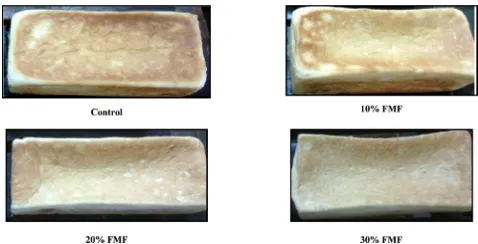
Fig. 2: Bread loaf incorporated with different proportion of FMF
In the present study, a significant decrease in the physical characteristics of the bread was observed with increased incorporation of finger millet flour (p>0.05 %). It might be due to a decrease in the proportion of the gluten content which is an important protein responsible for maintaining the viscoelastic property of bread dough which ensures the increased volume of bread. However there was no significant difference (p≥0.05) between control and 10% FMF incorporated bread for loaf weight, volume and specific volume. From the observations, it can be seen that as the substitution level of FMF increased, the loaf weight of the bread was found to be increased. This might be due to less retention of carbon dioxide gas in the blended dough resulting in dense bread texture. Rai et al. (2011) and Ballolli
et al. (2014) also reported a decrease in loaf volume
Nutritional quality
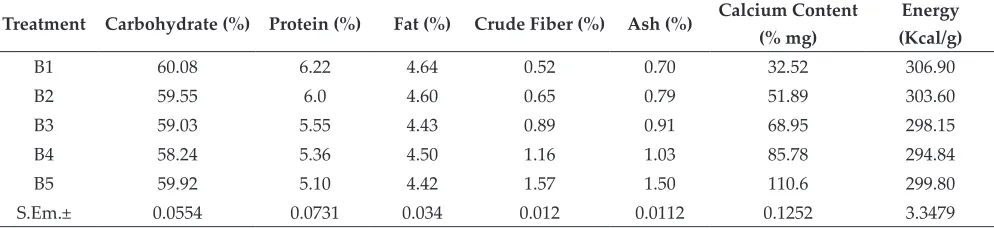
The results of nutritional parameters of the FMF bread are shown in Table 4.Carbohydrate, protein, fat, ash, crude fiber, calcium and physiological energy for the control bread were found to be 60.46%, 6.36%, 4.70%, 0.52%, 0.20%, 13.63%mg and 309.59 kcal/g, respectively.
The nutritional content of the 20% incorporated FMF bread was comparatively higher than that of the control bread. The comparison among FMF incorporated bread and control bread is shown in Table 4.
The carbohydrate content of the FMF incorporated bread has shown decreasing trend with the increase proportion of FMF in comparison to the control bread. It was found due to the less amount of carbohydrate in Finger Milletseed than that of the wheat kernel which is in line with the results found by Chhavi and Sarita (2012). The protein content of the bread was found to be decreased with the increased level of FMF in comparison to the control bread and the results is in agreement with the study done by Malomo et al. (2011).
Similar results were also observed by Rajiv et al. (2011) where addition of finger millet flour increased the ash content and lowered protein content in muffins. The fat content was also found to be decreased with the increased substitution level of FMF as compared to the control bread. The crude fiber content of the FMF incorporated bread was increased than that of the control bread due to higher crude fiber in the FMF than that of the white flour which is also similar to the result found by Desai et al. (2010) and Chhavi and Sarita (2012). The ash content of the FMF incorporated bread was increased than that of the control bread due higher amount of minerals in Finger Millet.
The calcium content of the FMF incorporated bread was found to be increased than that of the control bread with the increased proportion of FMF. This is in the agreement with the results documented by Desai et al. (2010) and Chhavi and Sarita, (2012). As the bread prepared from FMF have shown less carbohydrate, less protein and less fat than that of the control bread, the physiological energy was also found to be decreased than that of the control bread and this result is matching with the result found by Chhavi and Sarita (2012).
Rheological quality
Under the rheological property,the crumb hardness was measured and is shown in Table 5.For control bread the crumb hardness was recorded as 122g. The crumb hardness of the FMF bread was higher than that of the control bread. This might be due to the change in ingredient such as non-wheat flour i.e. FMF, having no gluten and this result is also in agreement with the result found by Das et al. (2013).
Table 5: Effect of blend ratio of FMF on rheological property of prepared bread
Treatment B1 B2 B3 B4 B5 S.Em.±
Crumb hardness 124.5 128.5 135 145.5 150 0.9152
Sensory quality
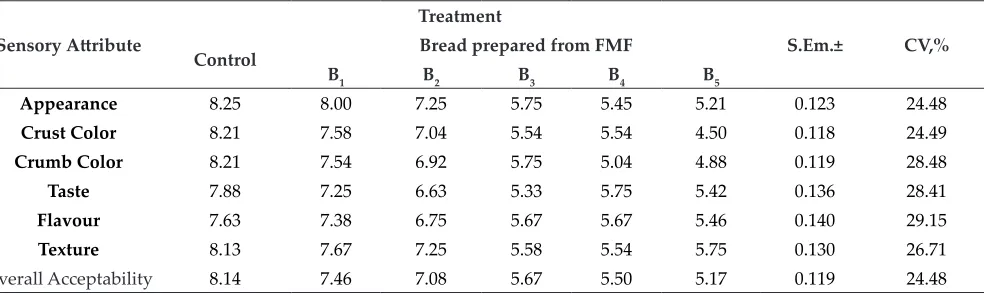
The mean scores of the sensory attributes of the FMF bread were reduced in comparison to the control bread due to the change in ingredients. The white flour is mainly responsible for the good sensory qualities of the bread due to presence of gluten which is not present in the FMF.
The mean sensory scores for different attributes of FMF bread having different treatments are shown Table 6.
Table 4: Effect of blend ratio of FMF on nutritional properties and rheological property of prepared bread
Treatment Carbohydrate (%) Protein (%) Fat (%) Crude Fiber (%) Ash (%) Calcium Content (% mg)
Energy
(Kcal/g)
B1 60.08 6.22 4.64 0.52 0.70 32.52 306.90
B2 59.55 6.0 4.60 0.65 0.79 51.89 303.60
B3 59.03 5.55 4.43 0.89 0.91 68.95 298.15
B4 58.24 5.36 4.50 1.16 1.03 85.78 294.84
B5 59.92 5.10 4.42 1.57 1.50 110.6 299.80
Conclusion
Due to absence of gluten protein in FMF, use of FMF in white bread was limited to 20% considering acceptable physical, rheological and sensory quality however the FMF fortified bread was far superior to control bread. The composition of the bread prepared with 20% FMF was found to have carbohydrate 59.55, protein 6.0, fat 4.60, crude fiber 0.65 and ash 0.79 %. The white bread enriched with the Finger Millet had higher crude fiber and calcium control bread and thus can be a healthy option for the people doing weight management and for the prevention of constipation and colon cancer.
References
Anonymous, 2009. Millet Network of India. Deccan Development Society, FIAN, India.
Balasubramanian, S., Vishwanathan, R. and Sharma, R. 2007. Post harvest processing of millets: An appraisal.
Agriculture Engineering Today31(2): 18–23.
Ballolli, U., Malagi, U., Yenagi, N., Orsat, V. and Gariepy, Y. 2014. Development and quality evaluation of foxtail millet [Setariaitalica (L.)] incorporated breads. Journal of
Agricultural Science 27(1): 52–54.
Bhol, S. and John Don Bosco, S. 2014. Influence of malted finger millet andred kidney bean flour on quality characteristics of developed bread. LWT- Food Science and
Technology55(1): 294–300.
Gopalan, C., Ramasastri, B.V. and Balaubramanian, S.C. 2010. Nutritive value of Indian foods. National Institute of Nutrition, ICMR, Hyderabad.
Gull Amir, Gulzar Ahmad, N., Kamlesh Prasad and Pradyuman Kumar. 2016. Technological, Processing and Nutritional approach of Finger Millet (Eleusinecoracana) - A Mini Review. Journal of Food Processing & Technology
7(6): 593. doi: 10.4172/2157-7110.1000593
Chhavi, A. and Sarita, S. 2012. Evaluation of Composite Millet Breads for Sensory and Nutritional Qualities and
Glycemic Response. Malaysian Journal of Nutrition18(1): 89-101, 112.
Das, Lipi, Utpal, Raychaudhuri and Chakraborty, Runu 2013. Herbal Fortification of Bread with Fennel Seeds. Food
Technology and Biotechnology 51(3): 434–440.
Desai, A.D., Kulkarni, S.S., Sahoo, A.K., Ranveer, R.C. and Dandge, P.B. 2010. Effect of supplementation of malted ragi flour on the nutritional and sensorial quality characteristics of cake. Advance Journal of Food Science and
Technology2(1): 67-71.
Dewettinck, K., Van Bockstaele, F., Kuhne, B., Van de Walle, D., Courtens, T.M. and Gellynck, X. 2008. Nutritional value of bread: Influence of processing, food interaction and consumer perception. Journal of Cereal Science 48: 243-257. Giami, S.Y., Amasisi, T. and Ekiyor, G. 2004. Comparison of
bread making properties of composite flour from kernels of roasted and boiled African breadfruit (Treculia Africana decne) seeds. Journal of Raw Material Research 1:16-25. Gopalan, C., Rama Sastri, B.V. and Balasubramanian, S.C.
1987. Nutritive value of Indian foods. National Institute of Nutrition, Indian Council of Medical Research. Hyderabad, India.
Hugo, L.F., Rooney, L.W. and Taylor, J.R.N. 2009. Bread making with malted and fermented sorghum. [2009–06-17]. http://www.afripro.org.uk/ papers/Paper19Hugo.pdf Lakshmi, K.P. and Sumathi, S. 2002. Effect of consumption of
Finger Millet on hyperglycemia in non-insulin dependent diabetes mellitus (NIDDM) subjects. Food and Nutrition
Bulletin 23(3): 241-245.
Malomo, S.A., Eleyinmi, A.F. and Fashakin, J.B. 2011. Chemical composition, rheological properties and Bread making potentials of composite flours from breadfruit, breadnut and wheat. African Journal of Food Science5(7):
400 – 410.
Rai, S., Amarjeet, K., Singh, B. and Minhas, K.S. 2011. Quality characteristics of bread produced from wheat, rice and maize flours. Journal of Food Science49: 786–789.
Rajiv, J., Soumya, C., Indrani, D. and Venkateswararao, G. 2011. Effect of replacement of wheat flour with finger millet flour (Eleusinecoracana) on the batter microscopy, Table 6: Mean sensory score for different attributes of the bread prepared with FMF
Sensory Attribute
Treatment
S.Em.± CV,% Control Bread prepared from FMF
B1 B2 B3 B4 B5
Appearance 8.25 8.00 7.25 5.75 5.45 5.21 0.123 24.48
Crust Color 8.21 7.58 7.04 5.54 5.54 4.50 0.118 24.49
Crumb Color 8.21 7.54 6.92 5.75 5.04 4.88 0.119 28.48
Taste 7.88 7.25 6.63 5.33 5.75 5.42 0.136 28.41
Flavour 7.63 7.38 6.75 5.67 5.67 5.46 0.140 29.15
Texture 8.13 7.67 7.25 5.58 5.54 5.75 0.130 26.71
rheology and quality characteristics of muffins. Journal
of Texture Studies42: 478–489.
Ranganna, S. 1986. Handbook of Analysis and Quality Control for Fruit and Vegetable Products. 2nd edn. Tata-McGraw
Hill Publishing Co. Ltd, New Delhi, India.
Sadasivam, S. and Mannikam, A. 1991. Biochemical Methods for Agricultural Sciences, pp. 178-180.
Singh, K.P., Mishra, A. and Mishra, H.N. 2012. Fuzzy analysis of sensory attributes of bread prepared from millet-based composite flours. LWT- Food Science and Technology48(2): 276–282.
Shittu, T.A., Raji, A.O. and Sanni, L.O. 2007. Bread from composite cassava-wheat flour: I. Effect of baking time and temperature on some physical properties of bread