C A S E S T U D Y
Open Access
A conceptual study of immigrant born globals
and their multinationalization process
Ranfeng Qiu
*and Vipin Gupta
* Correspondence:[email protected] Department of Management, College of Business and Public Administration, California State University San Bernardino, 550 University Parkway, San Bernardino 92407, USA
Abstract
We build on the growing interest in born globals by examining the multinational growth pattern of immigrant new ventures, as opposed to that of native entrepreneurial new ventures. The multinational growth pattern of native new ventures, especially those originating from small home markets and/or lacking international market experience or networks, has been explained in the international business (IB) research using the Uppsala stage model. The Uppsala model postulates that the new ventures build their international absorptive capacity for discovering and accessing external knowledge by focusing on the psychically proximate nations and using low committed entry and growth modes, and then taking calculated risks to escalate their distance and commitment in a linear mode to reap positive rewards. We draw on the immigrant entrepreneur, social network, and related literatures to postulate that new immigrant ventures are more likely to be able to enter host markets that are psychically distant from their home markets and using higher committed entry and growth modes. Moreover, their founders are more likely to be cognitively and emotionally comfortable in pursuing non-linear approaches to sequential market entry and commitment mode choices. We discuss the implications of the varying balance of home vs. host market forces on the multinationalization process of alternative types of firms discussed in the literature.
Keywords:Immigrant entrepreneurship; Born globals; Internationalization process
Background
One facet of the technology-enabled corporate globalization is the growth in the num-ber of companies that operate internationally from an early stage in their development. The early internationalized firms leverage their capabilities to achieve foreign market success early in their evolution, notwithstanding scarce financial, human, and other tangible resources. Such ‘international new ventures’ (INV) are also referred as ‘born global firms’ (BG) (Knight and Cavusgil 2004; Rennie 1993). “Born global firms” are
“firms that from their inception discover, enact, evaluate, and exploit opportunities across national borders to create future goods and services”(McDougall and Oviatt, 2000). Traditional “stage” (e.g., Stopford and Wells 1972) and“scale” models (e.g., Chandler 1986) in international business (IB) research explain why established firms initiate internationalization processes later in their development. Uppsala model (Johanson and Vahlne 1977; Johanson and Wiedersheim-Paul 1975) has been frequently adopted to ex-plain how those that originate from small home markets, and lack international market
experience or networks expand globally. International entrepreneurship (IE) researchers have also looked at international new ventures. They have examined differences in the motivations for internationalization of entrepreneurial businesses from those of the estab-lished firms (Zahra et al. 2000). Process and outcome issues, such as speed (Autio et al. 2000) entry modes (Burgel and Murray 2000), and performance (Knight and Cavusgil 2004) of international new ventures have also been examined.
Our interest is in the international new ventures established by immigrant entre-preneurs. Firms founded by foreign immigrants represent a substantial economic force in the U.S. Many of these businesses are located in east and west coast of the U.S, especially near the seaports or borders, such as in California and New York area, where companies benefit from location advantages. For instance, Mainland China and Taiwan are the largest trading partners in Southern California with total two-way trade valued at $260 billion in 2010. Together, firms founded by the Chinese American and Taiwanese American community in Southern California employ more than 440,000 people and generate $70 billion in taxable revenues (A survey of L.A. Customs District’s Largest Trading Partners 2011). These businesses cover a broad range of industrial sectors from high-tech (such as computer and electronics) to non-durable consumer products (such as toys and apparel). Immigrants in the U.S. show higher rates of patenting, commercializing patents and publishing than natives (Hunt 2011). The process framework of immigrant new venture internationalization that we construct in this study is distinct from the Uppsala “stage” model. Internationalization of immigrant new ventures occurs as a result of multilateral externalization through business and social networks. Empirical evidence has suggested that such network rela-tionships positively influence initial market entry (Bell, 1995; Coviello and Martin 1999). The accumulation and exploitation of social capital is not only limited to local-ized interaction, but can be extended to a broad concept of ethnicity connections (Yeung 2002). Immigrants rely heavily on social capitals in both the origin and their new host countries, and therefore social capital is likely to play an important ongoing role in the entrepreneurial ventures in both locations.
Extensive research has discussed how networks ethnic ties facilitate corporate internationalization and FDI (Bell 1995; Ellis 2011; Chung 2004; Iyer and Shapiro 1999 Rauch and Trindade 2002). Integrating research on immigrant entrepreneurs can help to deepen our understanding of network-effects. For instance, one of the important findings from the immigrant entrepreneurship research is that firm-level social capital if based on predominantly co-ethnic network ties may constrain the growth of an entrepreneur, by limiting the diversity of resources and opportunities accessed and by imposing undue obligations for reciprocating to and serving the co-ethnics (Woolcock 1998).
This theoretical paper is focused on the conceptualization of the “growth
process” pattern of immigrant entrepreneurial businesses. The paper is organized
in five sections. We will review literature on immigrant entrepreneurs and the internationalization of new ventures in next section. Section three is devoted to
discussing various factors that drive new ventures’ internationalization and how
these factors may shape the growth pattern of immigrant entrepreneurial busi-nesses, following by our propositions. We will discuss specific cases in section four. Conclusions will be addressed in the last section.
Literature review and conceptual framework
There are two streams of literature studying immigrant entrepreneurs and the estab-lishment and growth of their businesses. One has been focused on examining the driving forces of the establishment of immigrant new ventures and on what enables im-migrants to become entrepreneurs and to succeed as entrepreneurs. The other, primarily based upon expatriate and returnees literature, studies how strong ties of expatriates and immigrants with their countries of origin facilitate the establishment and internationalization of their businesses.
Immigrant entrepreneur and their host nations
Literature in immigrant entrepreneurship has highlighted the role of social capital in entrepreneurial entry as well as growth patterns (Aldrich and Zimmer 1986). Access to a cohesive social network spurs entrepreneurship. Groups that continue to maintain their social capital tend to be more successful in entrepreneurial ventures (Putnam 2000). Social networks have been known to enhance business relationships and encour-age trade (Sanderson and Kentor 2009; Ruzzier et al. 2007; Ellis 2011).
Immigrant entrepreneurship is culturally oriented, culturally derived, and reliant on the specific community and relationships within which the immigrant is embedded. Immigrants tend to form tight social networks with fellow nationals (Portes 1998). New ventures founded by immigrant entrepreneurs, especially new immigrants, often rely heavily on their group’s local social capital in their new home market to establish and grow their businesses (Portes and Sensenbrenner 1993). These networks facilitate entrepreneurial activity by providing capital, support, knowledge and a supply or cus-tomer base (Bell 1995). Mentoring, access to sufficient capital and a reliable supply and customer base are often key factors in the decision to undertake an entrepreneurial en-deavor (Sanderson and Kentor 2009; Ruzzier et al. 2007; Ellis 2011). These networks can also make up for the fact that migrants often do not have the contacts and local understanding of regulations and culture that natives often do (Saxenian 2002).
The social capital is usually accumulated locally, so immigrant businesses are likely to grow in certain clusters (Kalnins and Chung 2006; Saxenian 2002) to
benefit from local interactions, such as Gujarati “Cornershops” in Great Britain by
Immigrant entrepreneurs and their nation of origins
Although previous immigrant business studies have discussed the possibility of
immi-grant entrepreneurship, the focus has been on the “forces” derived from the location
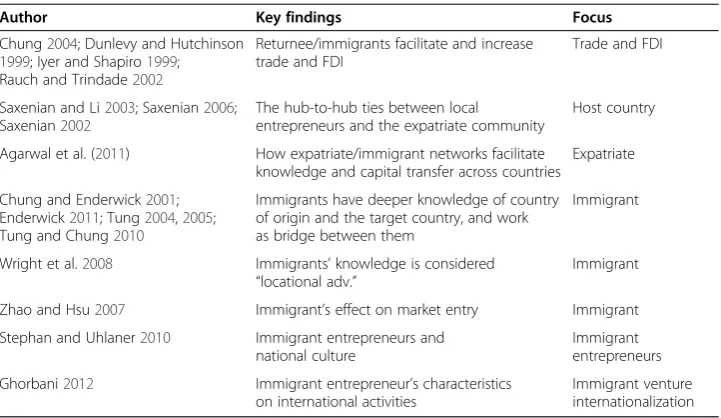
where immigrants are hosted. Only recently, attention has shifted from the nations that host the immigrants to the countries of origin of these entrepreneurs. Research shows that expatriates and immigrants have deeper knowledge of both country of origin and the destination country (Enderwick 2011; Tung 2004, 2005), and thus facilitate know-ledge and capital transfer between the two countries (Agarwal et al. 2011). Many of these immigrant entrepreneurs maintain strong ties with their nations of origin. Migra-tion increases the volume of trade between home and host countries (Chung and Enderwick 2001; Murat and Pistoresi 2009; Iyer and Shapiro 1999 Rauch and Trindade 2002). Immigrant managers are likely to commit more resources when doing business with their country of origin (Tung and Chung 2010). Immigrant entrepreneurs tend to choose slightly riskier modes of entry and move into market much faster. (Zhao and Hsu 2007). Table 2 summarizes some representative literature on immigrant entrepre-neurs and their countries of origin.
Table 1 Representative literature on immigrant entrepreneurs and adopted nations
Author Key findings Focus
Hunt2011 New ventures established by skilled
immigrants with advanced degrees
Initial entry
Ryder, et al.2000 Immigrants’entrepreneurship due to constraints
Initial entry
Nanda2010; Aldrich and Zimmer1986; Portes and Sensenbrenner1993; Portes1998
Group social capital of immigrant entrepreneurs and the establishment and growth of their businesses
Initial entry and domestic growth
Kalnins and Chung2006; Saxenian2002
Immigrant businesses’cluster effect Initial entry and domestic growth
Sanderson and Kentor2009; Ruzzier et al.2007; Ellis2011
Immigrant entrepreneur’s community and its benefits
Initial entry and domestic growth
Table 2 Representative literature on immigrant entrepreneurs and the nations of origin
Author Key findings Focus
Chung2004; Dunlevy and Hutchinson 1999; Iyer and Shapiro1999; Rauch and Trindade2002
Returnee/immigrants facilitate and increase trade and FDI
Trade and FDI
Saxenian and Li2003; Saxenian2006; Saxenian2002
The hub-to-hub ties between local entrepreneurs and the expatriate community
Host country
Agarwal et al. (2011) How expatriate/immigrant networks facilitate knowledge and capital transfer across countries
Expatriate
Chung and Enderwick2001; Enderwick2011; Tung2004,2005; Tung and Chung2010
Immigrants have deeper knowledge of country of origin and the target country, and work as bridge between them
Immigrant
Wright et al.2008 Immigrants’knowledge is considered “locational adv.”
Immigrant
Zhao and Hsu2007 Immigrant’s effect on market entry Immigrant Stephan and Uhlaner2010 Immigrant entrepreneurs and
national culture
Immigrant entrepreneurs
Ghorbani2012 Immigrant entrepreneur’s characteristics on international activities
Internationalization process of new ventures
Two factors that drive firm internationalization process have been widely discussed in IB literature - firm-specific (ownership) and location-specific advantage (Dunning 1980;
Porter 1996). The “ownership effect” is the embedded-to-generic firm-specific
know-how, whereas the “locational advantage” is the embedded-to-generic market-specific
knowledge (Madhok 1997). In the case of born global business, the establishment and growth of the firm is primarily driven by the “push” force that is derived from the new venture’s home country, and on the other hand, is also driven from the “pull” force which instead, is from the born global’s host country. For immigrant born globals, the host country is indeed the entrepreneur’s country of origin, whereas the home country is the entrepreneur’s new destination country.
The home country factors
Domain knowledge Both IB (Dunning 1973; Hymer 1976) and IE research (Almeida
and Bloodgood 1996; Bloodgood et al. 1996) recognize the importance of a firm’s
do-main knowledge on internationalization. Evolutionary economists view the superior ability of some first movers as being rooted in innovation and new knowledge (Nelson and Winter 1982) that helps sustain a firm’s advantage in highly competitive environ-ment. Factors such as unique advantage (Cavusgil and Naor 1987), innovation (Kimura 1989; Lecraw 1989), R&D and knowledge intensity (Autio et al. 2000; Zahra et al. 2000;
Buckley and Casson 1976) not only drive the new venture’s domestic growth, but
are also positively related to the firm internationalization. McDougall et al. (1994) indicated that born globals use innovation as a means of avoiding head to head competition with indigenous firms. Born globals that own unique domain know-ledge and capabilities are not only able to develop differentiated offerings and target them at niche market overseas, they also have flexibility to assimilate new know-ledge more easily (Cohen and Levinthal 1990; Grant 1996), especially under the uncer-tainty–in foreign markets.
Entrepreneurial mindset Not all scholars are convinced that the born global firms have sufficiently deep knowledge-based resources that could help offset liabilities of newness, smallness, and foreignness while internationalizing. Some scholars put em-phasis on the fact that born global firms are inherently entrepreneurial firms (Simon 1996) that possess proactiveness in the pursuit of international markets. This entrepre-neurial orientation may be the basis for the firm-specific advantage of the born global firms. The entrepreneurial mindset of the founders’that allows them to see and exploit windows of opportunity in foreign markets is more critical than that in the global ex-pansion of well established firms. The lack of superior firm-specific unique knowledge might be compensated by innovative resourcefulness and discovery-oriented alertness, and that allows some firms develop and apply a strong market prowess abroad.
Host country factors
entrepreneurial traits (Cooper 1981; Feeser and Willard 1990), vision (Birley and
Norburn 1987; McMullan and Long 1990), and the entrepreneur’s own experience in
certain industries or locations (Oviatt and McDougall 1994; Bloodgood et al. 1996; Knight and Cavusgil 1996) work along with, and may even substitute the deficiencies in the resources and the experience of the organization. New ventures do not need to own resources in order to internationalize their operations (Stevenson and Gumpert 1985). Instead, opportunities are the driving force of entrepreneurial activities (Shane and Venkataraman 2000). Consequently, new ventures tend to bypass the staged pro-gression for foreign market entry (Zahra et al. 2000).
Immigrant literature has extensively discussed the network effect and social capital, especially that of expatriates and returnees (Iyer and Shapiro 1999), on international market entry. Empirical evidence has been analyzed for the cases in China, India, Taiwan, and Australia (Iyer and Shapiro 1999; Zhao and Hsu 2007; Tung and Chung 2010; etc.). The establishment and growth of immigrant born globals, as distinct from other inter-national new ventures, are primarily driven by the firm’s“host country”(or in the entre-preneur’s case, their countries of origin) factors, rather than by the “home country” factors (in the immigrant entrepreneur’s case, their new destination countries).
Theory of new venture internationalization
Some IE scholars have inquired why some new ventures opt to go international, while many others opt to (or are forced to) focus on the domestic market (Oviatt and McDougall 1994; Zahra 2005; Gamboa and Brouthers 2008). They have found that prior domain knowledge and international experiences of the founders and their pro-fessional hires, and the level of industry’s global integration, positively influence early internationalization (McDougall et al. 2003). Many entrepreneurs are able to create value beyond their established and resource-rich competitors, mainly through innova-tiveness. They innovatively access and combine relevant resources, without necessarily owning them (Oviatt and McDougall 1994). International new ventures have height-ened proactiveness in learning about technology trends while operating in foreign markets, and leveraging that for profit-enhancing innovations through knowledge integration (Zahra et al. 2000). Another characteristic of international entrepreneurs is their proactive discovery (Kirzner 1973; Covin and Slevin 1989; Miller 1983), the cognitive and psychological orientation to quickly spot different types of opportunities, to calculate risks and returns using a different approach, and to develop different ways of exploiting them (Zahra et al. 2004).
Immigrant entrepreneurs appear to be more motivated by externalizing advantages based on spotting opportunities for arbitrage and innovation by linking with the resources owned by various network partners. The cultural orientation of the new ventures may be expected to influence the type of their externalization initiatives, and the opportunities, benefits, and costs of knowledge absorption and innovation. Having family, ethnic, or other kind of network ties–that are beyond what has been discussed
in the traditional IB literature – can help to shorten and expedite new venture’s
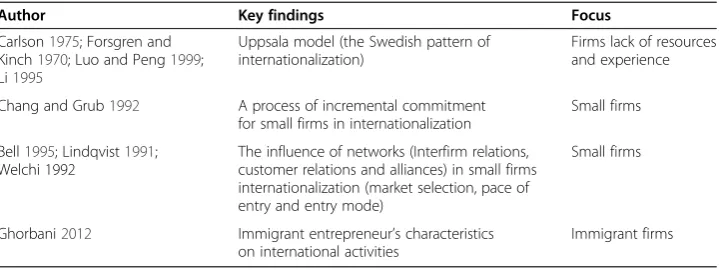
learning (Zahra 2005). Factors such as the ethnocentric views held by founders and em-ployees about local cultures and markets and psychological distance from entered mar-kets inhibit comprehensive international growth that encompasses a broader range of value chain and greater number of nations (Zahra 2005). Towards this end, one can gain valuable insights by focusing on the experiences of the internationalization of immigrant entrepreneurs. Table 3 illustrates representative literature on the internationalization of new and small ventures.
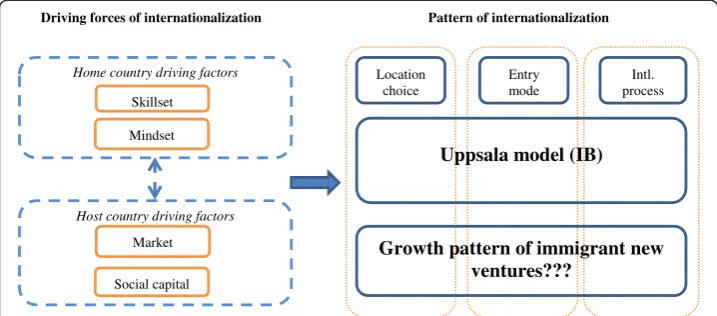
In this paper, we propose a conceptual framework that distinguishes the globalization pattern of immigrant new ventures from that of the other new ventures. As illustrated in Figure 1, both intrinsic (home country) and extrinsic (host country) factors impact a firm’s international growth. The intrinsic force is firm-specific advantages (a firm’s unique knowledge or skillset, and the entrepreneurial mindset of the firm leaders) that
are derived from a firm’s home country. The extrinsic force is derived from the host
countries (market opportunities and networking resources and social capitals of the firm leaders). Among them, network resources and social capital help immigrant entre-preneurs diminish the uncertainty risks of investing back in the country of origin and explore more opportunities in that market.
Theoretical development and propositions
The driving force of immigrant born globals
International experience plays an important role in widening the sphere of potential opportunities. Entrepreneurs may recognize the absence of familiar products or services in the host country and the potential of new products or services in the home country (Ray 1989). Kuemmerle (2002) also found that the idea for an international venture was often conceived during or immediately after exposure to a foreign environment. Given that immigrant entrepreneurs have been largely exposed to certain environ-ments, the internationalization may be motivated by factors derived from those
Table 3 Representative literature on the process of internationalization
Author Key findings Focus
Carlson1975; Forsgren and Kinch1970; Luo and Peng1999; Li1995
Uppsala model (the Swedish pattern of internationalization)
Firms lack of resources and experience
Chang and Grub1992 A process of incremental commitment for small firms in internationalization
Small firms
Bell1995; Lindqvist1991; Welchi 1992
The influence of networks (Interfirm relations, customer relations and alliances) in small firms internationalization (market selection, pace of entry and entry mode)
Small firms
Ghorbani2012 Immigrant entrepreneur’s characteristics on international activities
countries (or the entrepreneur’s country of origin). Furthermore, it is very likely that
the immigrant entrepreneur’s country of origin becomes the target market for new
venture’s international move.
Certain markets might be particularly attractive to immigrant entrepreneurs, regard-less of their firm-specific characteristics. Although it is believed that large firms enjoy resource advantages in the internationalization process, SMEs can overcome these con-straints through network relationships (Coviello and Martin 1999). Interfirm networks of alliances, personal relationships, and experiences are influential in explaining the internationalization process (Bell 1995; Coviello and Munro 1994). However, growth of the new ventures may be facilitated through the access to not only direct firm-level but also ethnic and other network-level indirect social capital. As demonstrated by the research on the returnee entrepreneurship, born global firms often rely on their local as well as indirect social capital to discover, access, and integrate diverse knowledge sources innovatively. This is true for the case of many high-tech firms. The founder or entrepre-neur’s social capital, i.e., personal networking resources and ties in foreign countries, can be considered a distinct force leading to the firm’s early internationalization.
Immigrant entrepreneurs have had extensive ties in foreign countries –especially in
the country that they lived before moving to the new host country. Many immigrant entrepreneurs may still maintain personal ties with the country of origin even after they move to the new host country. Such connections will help entrepreneurs keep up with newly opened opportunities in their country of origin. Depending on the cultural dis-tance, different entrepreneurs and ethnic groups are likely to have different propensity to breakout from the ethnic boundaries, and to connect with other groups.
Proposition1: The internationalization of immigrant new ventures, compared with that of native new ventures is more likely to be driven by the host country factors, not home country factors.
The growth pattern of immigrant born globals
Location choice
A firm’s location choice of its internationalization is not based on random selection. The initial internationalization activities of many firms are targeted to proximate markets before venturing to more distant ones (Johanson and Vahlne 1992). Proximity
is understood not necessarily in terms of geographical vicinity, but instead psychic distance (Johanson and Vahlne 1990). The attributes of psychic distance have been discussed from various aspects, including language, culture, political system, level of education and level of industrial development. For instance, while Canada is physically and psychically close to the U.S., and China is distant from the U.S in both perspec-tives, Australia is an example that is physically distant but psychically close to the U.S.
Firms tend to operate in the vicinity of existing knowledge and remain domestic unless provoked or forced by an event. Once initiated, internationalization proceeds
incrementally, based on the accumulation of “foreign knowledge” and experience.
According to Benito and Gripsrud (1992: 464): “Firms are predicted to start their
internationalization by moving into those markets they can most easily understand,
entering more distant market only at a later stage”. In order to overcome the
li-ability of foreignness and reduce uncertainty, they are also likely to select the location which is psychically close to the firm’s country of origin (Johanson and Vahlne 1977).
Born global entrepreneurs often have more international work/living experience than the entrepreneurs in firms that choose to internationalize more gradually (Harveston
et al. 1997). The founders’ international experience or networks help them improve
opportunity identification, market knowledge, and network building capabilities (Kuemmerle 2002), and serve as a substitute to organizational experience in foreign market.
With unique experience of in their country of origin, foreign immigrants in their country of origin, they will have exposure to that market, and thus will be more likely to choose that location as the target market, even if the target market is
psychically distant from the firm’s home country. In that case, personal exposure
with host countries in which entrepreneurs’ have lived previously are a “pulling”
force from the target market and that may help the firm initiate cross-border activities more easily. Therefore, the host country of the born global’s international
expansion is not necessarily psychically close to the firm’s home country, and very
often, the host market is or is proximate to the entrepreneur’s country of origin. There-fore, we postulate that:
Proposition2: The internationalization of native new ventures is more likely to be in a country or region that is psychically closer tothe entrepreneur’s home country.
Proposition3: The internationalization of immigrant new ventures, is more likely to be in a country or region that is psychically closer tothe entrepreneur’s country of origin.
Entry modes
market and leverage such firm-specific advantage to foreign markets and this is critical to its success in the target market (Porter 1996, Buckley and Casson 1976). Since the transfer of knowledge base adapted to the home market conditions to other markets is subject to risks, the firms are expected to start their initial internationalization process with a lower commitment entry mode.
Furthermore, location risk is the perceived difference between home and host envi-ronments in terms of culture, business, and economic practices. When there is a high degree of perceived distance, firms favor entry modes with a high degree of local par-ticipation or a low degree of resource commitment (Kim and Hwang 1992). Different entry modes represent different degrees of resources commitment and therefore risks of the firm. The less the experience that a firm gains before it enters a foreign market, the more likely it would select a less risky entry mode to reduce its uncertainty. In the IB theory, younger entrepreneurial firms are considered poor in resources and likely to favor less risky entry mode in their international moves. For instance, the absence of market-specific knowledge has led the Swedish manufacturing firms to develop their international operations in small steps, undertaking incremental and sequentially building commitment decisions (Johanson and Vahlne 1977). These firms are there-fore likely to perceive low risks in pursuing high commitment modes of entry in the host regions.
Proposition4: The internationalization of native new ventures is more likely to use a
lower committedentry mode.
The firms that are founded by foreign immigrants have particular advantages in access to social capital in foreign markets to facilitate and deal with the range of com-plexities and uncertainty. Immigrant new ventures, in which the internationalization opportunity is to a greater extent derived from the host country market, leverage the already established networks and connections to the target markets. Organizational learning theory suggests that firms that internationalize after they are established domestically must overcome a domestic orientation, internal domestic political ties, and domestic decision making inertia in order to enter foreign markets. There
exists a “learning advantage of newness” rather than “the liability of newness”
(Stinchcombe 1965) of young firms. Born globals that are driven by the “extrinsic”
force from the foreign country, may be less influenced by obstacles derived from social and cultural inertia from the home country, and therefore might enjoy to a greater extent the“learning advantages”of newness. Kogut and Singh (1988) showed that entry mode choice varied depending upon the perceived or psychic distance between the home and the host country.
Proposition5: The internationalization of immigrant new ventures is more likely to use ahigher committedentry mode.
Mutlinationalization process
Another key strategic issue faced by a young born global firm is whether it should continue the internationalization process, soon after it makes the first jump, or postpone the subsequent international market entries until it has accumulated significant resources. Process models (Johanson and Vahlne 1977, 1990) consider internationalization a function of experiential knowledge of foreign markets. Since
(Cohen and Levinthal 1990), as well as the efficiency by which knowledge is learned, are important determinants of international growth (Penrose 1959), know-ledge accumulation in the target market forces a firm to pursue a staged process of multinationalization - in what has been called“the establishment chain”(Johanson and Wiedersheim-Paul 1975).
Unlike their well-established counterparts, proactive discovery largely impacts the speed by which international entrepreneurs and their new ventures learn and adapt in foreign markets (Zahra 2005). Using resourcefulness (innovativeness) and alertness (proactive discovery), an international entrepreneur is more likely to draw on a wide range of resources and opportunities that are embedded in the domestic or foreign markets that they have already entered. The breath, depth and speed of technological learning from varied international environments are significantly enhanced by formal organizational efforts to integrate knowledge throughout a firm through a variety of means (Zahra et al. 2000). In this process, firms continuously improve their innovative organizational structure and leverage that for expansion in multiple nations. In other words, firms not only leverage and exploit the core competencies from home to foreign market, they also transfer the experience and knowledge that they accumulate in existing oversea markets to new target markets. The international move thus becomes a virtuous circle, supporting a linear multi-nationalization pattern. Therefore, we postu-late that:
Proposition6: The internationalization of native new ventures is more likely to follow an incremental international strategy (i.e. it isa linear process).
Exceptions to the staged theory of internationalization (a) firms having large resources to help them skip intermediate stages; (b) the stable and homogeneous market conditions that allows market knowledge to be acquired in ways other than through experience; (c) firms having considerable experience from markets similar to the one they wish to enter (Johanson and Vahlne 1977; 1990).“Insidership”in networks (Coviello, 2006), developed before entry into a new market, even before the foundation of the firm, may facilitate rapid internationalization of firms (Loane and Bell 2006).
However, research has also found that the younger the age at which a firm enters the international market, the slower the subsequent growth will be in international sales
(Autio et al. 2000). Coviello and Munro (1997)’s study on small software firms
sug-gested that while network relationships can drive market expansion and development activities, they can also inhibit market diversification activities because of the stalling efforts by initial partners. This theory may apply to immigrant born globals. Those firms that enter international market in their infant stage very easily may now face significant challenges and constraints when they intend to further move to other foreign markets in a linear fashion. This is because these firms lack necessary operational experience that could be linearly leveraged in other nations. In addition, the constraining cohesion effects of the host-specific social capital (Burt 2000) may also impede further linear global expansion. In other words, the “insidership” of im-migrant entrepreneurs may not only help accelerate the international market entry (Loane and Bell 2006), but also impede the subsequent linear growth of firms into other markets (Coviello’s 2006).
in their previous home country, and are able to reach beyond their ethnic ties to ex-pand to other markets. By involving other immigrants of various ethnicities and locals they become active in product or service innovation, and are actively able to use their innovative capacity to new strategic markets, without being unduly constrained by experience or resource capacity (Vissak and Zhang 2014). Immigrant entrepreneurs are bicultural, and may as such be cognitively and mentally more comfortable in taking a non-linear approach in the choice of markets to enter and of entry and growth com-mitment modes. Therefore, we propose that:
Porposition7: The internationalization of immigrant new ventures is less likely to follow an incremental international strategy (i.e. it is anon-linear process).
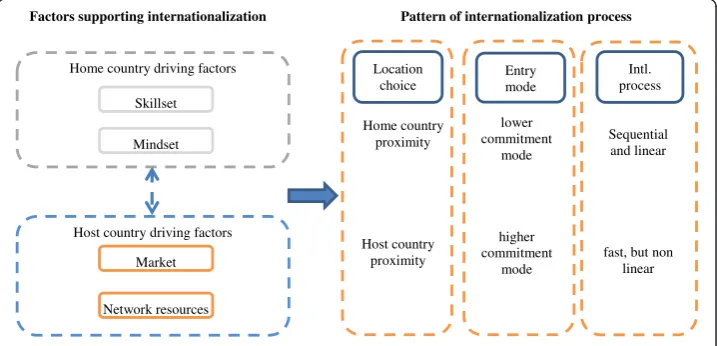
Research model in Figure 2 illustrates how the country of origin forces may shape the pattern of the internationalization of immigrant new ventures in a different way.
Discussion and implications
Given different industry circumstances, home and host country characteristics and firm heterogeneities, the combined effect of the “intrinsic” (home country) and “extrinsic” (host country) forces on new venture expansion may vary across individual firms. As we discussed in previous section, the home country and host country factors play inter-actively in shaping the pattern of corporate internationalization. We now discuss how a dual-force construct may help explain the emergence of different types of born globals that have been discussed in recent research.
High-tech start-ups (skillset-intrinsic)
There has been extensive literature discussing why and how new businesses in some high-tech industries move into foreign markets in their early stage. In international market, knowledge provides particular advantages that facilitate foreign market entry and operations (Kogut and Zander 1993). Knight and Cavusgil (2004) identify two
fac-tors – global technological competence and unique product development – that
characterize the unique skillset of resource-derived capabilities. A new firm’s distinctive skillset, including the organizational knowledge that is embedded and accumulated
within the new business (quality focus and leveraging foreign distributor competence), lead to the international market success.
The firms in knowledge or technology-intensive industries (Oviatt and McDougall 1994, 1995; Burgel and Murray 2000; Zahra et al. 2000) may adopt a multinationaliza-tion process as they grow up. In these industries, organizamultinationaliza-tional learning, particularly from the domain knowledge perspective, becomes even more critical in helping firms overcome their liabilities of foreignness (Hymer 1976; Inkpen and Beamish 1997; Zaheer 1995). Jolly et al. (1992) found that“techno-commercial”insight was one of the most important factors in the successful multinationalization of new ventures. Mean-while, in such high technology industries, new ventures are frequently established to bring new technologies to market in a nonlinear fashion. As international new ventures attempt to distribute their product in multiple countries, they will need to employ mul-tiple channels of distribution (Coviello and Munro 1992).
Firms from small domestic markets (skillset- intrinsic, mindset-intrinsic)
Born global firms have a high propensity to emerge in countries with small domestic markets, such as Sweden (Bell 1995; Lindqvist 1991), Finland (Autio et al. 2000) and U.K (Burgel and Murray 2000). Limited market opportunities in many small countries may not justify the development for certain specialized niche technologies. These ven-tures are thus forced to seek new market opportunities in foreign countries. This type of international new ventures is primarily driven by the leaders’entrepreneurial mind-set of exploring growth alternatives in international markets, alongside the pull of overseas market opportunities (that is often augmented through the home country government policies). The internationalization of these firms is following the typical
“stage” model (Johanson and Vahlne 1977). By entering countries with lower
psy-chic distance, firms can gain experience, and as firms become more familiar with the new environment, they will move to countries with more psychic distance, and eventually become global.
Emerging market returnee entrepreneurship (skillset and mindset-intrinsic, market and network- extrinsic)
The importance of ethnic as well as supra-ethnic social capital is seen from the cases of returnee international entrepreneurs. Some studies have investigated international start-ups established by returnees who go back to their home countries after working in the host countries (Saxenian 2002, 2006). Specifically, in certain high-tech industries, such as software and pharmaceuticals, immigrants that have been studying and working in the U.S were sent back to their home countries as expatriates. Subsequently, these skilled workers established their own businesses, taking sub-contracted projects from their prior employers. Such outsourcing-based emigrant businesses were international from the outset. In these cases, social capital–links both with the U.S. MNC as well as the local constituents –might be an important basis for the absorptive capacity of the entrepreneur. Recent studies focus on born globals from the emerging markets, such as India, who adopt international strategy early in their inception. Many of these busi-nesses are based on international subcontracting projects and are founded by leaders who have studied and/or lived abroad. These emigrant entrepreneurs may play a
These emigrants usually rely on an entrepreneurial mindset, alongside awareness of market opportunity and having network resources back in the host country. Returnee businesses are able to overcome the cultural barriers and have rapid market entry through higher committed entry modes. However, the globalization of returnee businesses is less likely to be constrained to the countries that they lived, given that
“skillset”or domain knowledge is also playing a critical role in the internationalization.
Product life cycle based spinoff globals (skillset-intrinsic, and market-extrinsic)
Based on the international product life cycle theory, some established firms may create a standalone international division based in their domestic market, with intent to estab-lish operations internationally from the outset. These born global international subsid-iaries inherit unique firm-specific advantages, such as technology, patents, and brands and human resource, from their parent company. The very rationale for these born global international subsidiaries is to exploit the international market opportunities – both in terms of lowering costs as well as expanded revenues.
Spinoff globals may also enjoy the benefits of both intrinsic and extrinsic factors, so that their growth pattern does not necessarily follow the “stage” model. The inter-firm relationship with parent firm may facilitate fast move and offset the“liability of
foreign-ess”. On the other hand, having unique ownership advantage allows spinoff globals to
expand their markets to a greater extent.
Immigrant born globals (market opportunity and network - extrinsic)
Some immigrant born globals rely on co-ethnic networks that allow them to exploit their ethnic knowledge based on the market opportunity in the adopted host market. The possibility of support from the co-ethnic networks and of market opportunity often situated in the co-ethnic networks encourages the born globals that rely on sour-cing in their ethnic home country and marketing in their adopted host country. Other immigrant born globals rely on non-ethnic networks in the adopted host market and firm-specific knowledge about the overseas market, to cater to the market opportunity back in their ethnic home country market. Entrepreneurial mindset helps break out of the ethnic networks, by exploring beyond the ethnic linkages, and distinctive firm-specific knowledge helps convince non-ethnic networks to associate for factors other than ethnic solidarity or sympathy. Such immigrant born globals tend to have con-strained growth, unless they break out from their ethnic networks.
Conclusions
In this study, we highlight the internationalization process of born global firms that are established by immigrants. Such born globals, as distinct from other types of inter-national new ventures, rely primarily on the entrepreneur’s personal network resources, as well as their knowledge about the host country (their country of origin) markets and the linkages between the home and host countries. Such understanding endows distinctive types of advantages compared with other businesses that are predominantly rooted in the home or the host country. Recognizing such businesses helps to broaden our understanding of the born global firms.
entrepreneurs build on their biculturalism to reach out to other ethnic ties and to drive product or service innovation. Many immigrant start-ups jump into foreign
mar-kets very quickly at their infant stage, but stay “small” over years. Although, the
initial internationalization may be to a greater extent driven by either “internal” or
“external” factors, but the home-based and host-based forces are interdependent
one with another. Therefore, effective and successful international expansion needs a balance of both forces. One of the practical implications for the managers of international new ventures is to re-balance the forces in a later stage of firm development. Those in which the early international moves are driven by entrepreneurial mindset or new venture skillset need to accumulate network resources and explore more market op-portunities in foreign markets, while those in which the first moves are primarily moti-vated by the “external” opportunities and resources should further develop competitive
advantages that are embedded in the firms’tacit knowledge. Unique knowledge on both
home and host country makes immigrant new ventures“the bridge”, connecting different parts of the international supply chain, through internal growth or strategic alliances, both domestically or internationally.
Our focus has been limited to the identification and description of two distinct mo-tives and processes of the internationalization of new ventures. There is an additional need to examine the theoretical factors that enable assessment of firm performance and return on investment in foreign markets. Further research could examine if immi-grant firms that initiate the internationalization earlier perform better over a longer period of time compared with traditional MNCs in international market. A deeper understanding of the driving forces embedded in home and host markets will allow new ventures not only to take upstream businesses activities, but also to forge links with foreign partners, and explore market opportunities.
Lastly, given that the focus of this paper is the conceptualization of the internationalization process of new ventures that are established by immigrant entre-preneurs, lack of empirical tests is a major limitation of the study. Furthermore, the theoretical construct has been built upon the distinction between immigrant new ven-tures and other new venven-tures. There is a need to examine if our propositions are generalizable to all immigrant ethnicities, generations, age, gender, and sectors.
Competing interests
The authors declare that they have no competing interests.
Authors’contributions
RQ conducted review of the literature and drafted the manuscript, based on extensive joint conversations about the study outline with VG, who edited and improved upon the draft.
Received: 6 October 2014 Accepted: 27 February 2015
References
A survey of L.A. Customs District’s Largest Trading Partners, 2011 International Trade Report. The Kyser Center for Economic Research.
Agarwal, A, Kapur, D, McHale, J, & Oettl, A. (2011). Brain Drain or Brain Bank? The Impact of Skilled Emigration on Poor-Country Innovation.Journal of Urban Economics, 69, 43–55.
Aldrich, H, Jones, T, & McEvoy, D. (1984). Ethnic advange and minority business development. In R Ward & R Jenkins (Eds.),Ethnic Communities in Business(pp. 189–210). New York: Cambridge University Press.
Aldrich, H, & Zimmer, C. (1986). Entrepreneurship through social networks. In D Sexton & R Smelser (Eds.),The Art and
Science of Entrepreneurship(pp. 3–23). Ballinger: Cambridge, MA.
Autio, E, Sapienza, HJ, & Almeida, JG. (2000). Effects of age at entry, knowledge intensity and imitability on international growth.Academy of Management Journal, 43, 909–924.
Bell, JD. (1995). The Internationalization of Small Computer Software Firms.European Journal of Marketing., 29(8), 893–921. Benito, G, & Gripsrud, G. (1992). The expansion of foreign direct investments: Discrete rational location choices or a
cultural learning process?Journal of International Business Studies, 23, 461–476.
Birley, S, & Norburn, D. (1987). Owners and Managers: The Venture 100 Vs The Fortune 500.Journal of Business
Venturing, 2(4), pp351–pp363.
Bloodgood, J, Sapienza, HJ, & Almeida, JG. (1996). The internationalization of new high-potential U.S. ventures: Antecedents and outcomes.Entrepreneurship Theory and Practice, 20, 61–76.
Bonacich, E, & Jung, TH. (1982). A portrait of Korean small business in Los Angeles: 1977. In EY Yu, E Phillips, & ES Yang (Eds.),Koreans in Los Angeles. Los Angeles: Koryo Research Institute and Center for Korean- American and Korean Studies, California State University.
Bonacich, E, & Modell, J. (1980).The Economic Basis of Group Solidarity: Small Business in the Japanese American
Community. Berkeley, CA: University of California Press.
Buckley, PJ, & Casson, M. (1976).The future of the multinational enterprise. London: Macmillan.
Burgel, O, & Murray, G. (2000). The international market entry choices of start-up companies in high-technology industries.Journal of International Marketing, 8(2), 33–62.
Burt, R. (2000). The network structure of social capital. In R Sutton & B Staw (Eds.),Research in Organizational Behavior
(pp. 345–423). Greenwich, CT: JAI Press.
Carlson, S. (1975). How foreign is foreign trade? A problem in international business research. Uppsala: Acta Universitatis Upsaliensis. Studia Oeconomiae Negotiorum 11.
Cavusgil, ST, & Naor, J. (1987). Firm and management characteristics as discriminators as export marketing activity.
Journal of Business Research., 15(1), 221–235.
Chand, MS, & Tung, RL. (2011). Global competitiveness, consumer choice and 'country of origin' effect: An exploratory east-west study.Asia Pacific Business Review, 17(3), 265–280.
Chandler, AD. (1986). The evolution of modern global competition in Porter, M.E. InCompetition in global industries. Boston: Harvard Business School Press.
Chang, T, & Grub, PD. (1992). Competitive strategies ofTaiwanese PC firms in their internationalization process Journal of
Global Marketing, 6(3), 5–27.
Chung, HF. (2004). An empirical investigation of immigrant effects: the experience of firms operating in the emerging markets.International Business Review, 13(6), 705–728.
Chung, HF, & Enderwick, P. (2001). An investigation of market entry strategy selection: exporting vs. foreign direct investment.Asia Pacific Journal of Management, 18(4), 443.
Cohen, W, & Levinthal, D. (1990). Absorptive capacity: A new perspective on learning and innovation.Administrative
Science Quarterly, 35, 128–152.
Cooper, AC. (1981). Strategic management: New ventures and small businesses.Long range planning., 14(5), 39–45. Coviello, NE. (2006). The network dynamics of international new ventures.Journal of International Business Studies, 37(5), 713–731. Coviello, NE, & Martin, KA. (1999). Internationalization of Service SMEs: An Integrated Perspective from the Engineering
Consulting Sector.Journal of International Marketing, 7(4), 42–66.
Coviello, N, & Munro, H. (1992). Internationalizing the Entrepreneurial Technology-Intensive Firm: Growth Linkage Development. In N Churchill et al. (eds.),Frontiers of Entrepreneurship(pp. 430–443). Babson Park, MA: Center for Entrepreneurial Studies.
Coviello, N, & Munro, H. (1994). International Market Development and Growth of Entrepreneurial Firms: A Network Perspective. In G Hills & S Mohan-Neill (Eds.),Research at the Marketing, Entrepreneurship Interface(pp. 217–228). Chicago: UIC Press.
Coviello, NE, & Munro, HJ. (1997). Network Relationships and the Internationalization Process of Small Software Firms.
International Business Review, 6(4), 361–386.
Covin, JG, & Slevin, D. (1989). Strategic management of small firms in hostile and benign environment.Strategic
Management Journal, 10, 75–87.
Dunlevy, JA, & Hutchinson, WK. (1999). The Impact of Immigration on American Import Trade in the Late Nineteenth and early Twentieth Century.The Journal of Economic History, 59(4), 1043–62.
Dunning, JH. (1973). The determinants of international production.Oxford Economic Papers, 11, 289–336. Dunning, JH. (1980). Toward an Eclectic theory of international production: empirical tests.Journal of International
Business Studies., 11(1), 9–31.
Ellis, PD. (2011). Social ties and international entrepreneurship: opportunities and constraints affecting firm internationalization.Journal of International business studies, 42(1), 99–127.
Enderwick, P. (2011). Acquiring overseas market knowledge: a comparison of strategies of expatriate and immigrant employees.Journal of Asia Business Studies, 5(1), 77–97.
Feeser, HR, & Willard, GE. (1990). Founding Strategy and Performance: A Comparison of High and Low Growth Firms.
Strategic Management Journal, 11, 87–98.
Forsgren, M, & Kinch, N. (1970).The adaptation of the firm to changes in surrounding systems. Uppsala: Department of Business Studies.
Gamboa, EC, & Brouthers, LE. (2008). How international is entrepreneurship?Entrepreneurship Theory and Practices, 32(2), 551–558.
Ghorbani, M. (2012).Do immigrant entrepreneurs do business with their country of origin? The effect of personality traits,
perception of institutions, and network usage. Doctoral Dissertation: Simon Fraser University.
Grant, RM. (1996). Toward a knowledge-based theory of the firm.Strategic Management Journal, 17(December), 109–122. Harveston, PD, Davis, PS, & Lynden, JA. (1997). Succession planning in family business: the impact of owner of gender.
Family Business Review., 10(4), 373–396.
Hymer, S. (1976).The international Operation of National Firms. Cambridge, MA: MIT Press.
Inkpen, AC, & Beamish, PW. (1997). Knowledge bargaining power and the instability of international joint ventures.
Academy of Management Review, 22, 177–202.
Iyer, GR, & Shapiro, JM. (1999). Ethnic entrepreneurial and marketing systems: implications for the global economy.
Journal of International Marketing, 7(4), 83–110.
Johanson, J, & Vahlne, JE. (1977). The internationalization process of the firm–A model of knowledge development and increasing foreign market commitments.Journal of International Business Studies, 8, 23–32.
Johanson, J, & Vahlne, JE. (1990). The mechanism of internationalization.International Marketing Review, 7(4), 11–24. Johanson, J, & Vahlne, J. (1992). Management of foreign market entry.Scandinavian International Business Review, 1(3), 9–27. Johanson, J, & Wiedersheim-Paul, F. (1975). The internationalization of the firm: four Swedish cases.Journal of
International Business Studies., 12(3), 36–64.
Jolly, VK, Alahuhta, M, & Jeannet, J. (1992). Challenging the incumbent: how high-technology start-ups compete globally.Journal of strategic change, 1, 71–82.
Kalnins, A, & Chung, W. (2006). Social capital, geography and survival: Gujarati immigrant entrepreneurs in U.S. lodging industry.Management Science, 52(2), 233–247.
Kim, WC, & Hwang, P. (1992). Global strategy and multinationals entry mode choice.Journal of International Business Studies, 1, 29–53.
Kimura, Y. (1989). Firm-specific competitive advantages and foreign direct investment behavior of firms: The case of Japanese semiconductor firms.Journal of International Business Studies., 20(2), 296–314.
Kirzner, IM. (1973). Competition and Entrepreneurial Personality: a person at the crossroads.The Journal of Management
Studies, 14(1), 34–57.
Knight, GA, & Cavusgil, ST. (1996). The born global firm: A challenge to traditional internationalization theory.Advances
in International Marketing, 8, 11–26.
Knight, GA, & Cavusgil, ST. (2004). Innovation, organizational capabilities, and the born-global firm.Journal of
International Business Studies, 35(2), 124–141.
Kogut, B, & Singh, H. (1988). The Effect of National Culture on the Choice of Entry Mode.Journal of International
Business Studies, 19(3), 411–432.
Kogut, B, & Zander, U. (1993). Knowledge of the firm and the evolutionary theory of the multinational corporation.
Journal of International Business Studies, 24(4), 625–645.
Kuemmerle, W. (2002). Home base and knowledge management in international ventures.Journal of Business Venturing, 17, 99–122.
Lecraw, DJ. (1989). The Management of Countertrade: Factor Influencing Success.Journal of International Business
Studies, 20(1), 41–59.
Li, J. (1995). Foreign entry and survival: Effects of strategic choices on performance in international markets.Strategic
Management Journal, 19(3), 333–352.
Light, I. (1972).Ethnic Enterprise in America. Berkeley, CA: University of California Press.
Lindqvist, M. (1991).Doctoral dissertation, Stockholm school of economics. Institute of International: Business. Infant multinationals: the internationalization of young, technology-based Swedish firms.
Loane, S, & Bell, J. (2006). Rapid internationalisation among entrepreneurial firms in Australia, Canada, Ireland and New Zealand: An extension to the network approach.International Marketing Review, 23(5), 467–485.
Luo, Y, & Peng, M. (1999). Learning to compete in a transition economy: Experience, environment and performance.
Journal of International Business Studies, 30(2), 269–295.
Madhok, A. (1997). Cost, value and foreign market entry mode: the transaction and the firm.Strategic Management
Journal, 18(1), 39–61.
McDougall, PP, & Oviatt, BM. (2000). International entrepreneurship: The intersection of two research paths.Academy of
Management Journal, 43, 902–908.
McDougall, PP, Oviatt, BM, & Shrader, R. (2003). A comparison of international and domestic new ventures.Journal of
International Entrepreneurship, 1, 59–82.
McDougall, PP, Shane, S, & Oviatt, BM. (1994). Explaining the formation of international new ventures: The limits of theories from international business research.Journal of Business Venturing, 9(6), 469–487.
McMullan, WE, & Long, WA. (1990).Developing New Ventures: The Entrepreneurial Option. CA, Harcourt Brace Jovanovich: San Diego.
Miller, D. (1983). The correlates of entrepreneurship in three types of firms.Management Science, 29, 770–791. Murat, M, & Pistoresi, B. (2009). Emigrant and immigrant networks in FDI.Applied Economics Letters, 16(12), 1261–1264. Nanda, R, & Khanna, T. (2010). Diasporas and domestic entrepreneurs: Evidence from the Indian software industry.
Journal of Economics and Management Strategy, 19(issue 4), 991–1012.
Nelson, R, & Winter, S. (1982).An evolutionary theory of economic change. Cambridge, MA: Belknap. Ong, P. (1981). An ethnic trade: Chinese laundries in early California.Journal of Ethnic Study., 8, 95–113.
Oviatt, BM, & McDougall, PP. (1994). Toward a theory of international new ventures.Journal of International Business
Studies, 25(1), 45–64.
Oviatt, BM, Shrader, RC, & McDougall, PP. (2004). The internationalization of new ventures: A risk management model. In MA Hitt & JLC Cheng (Eds.),Theories of the multinational enterprise: Diversity complexity, and relevance(Advances in international management, Vol. 16, pp. 165–185). Amsterdam: Elsevier.
Penrose, E. (1959).The theory of the growth of the firm. London: Basil Blackwell. Porter, M. (1996). What is strategy?Harvard Business Review, 74(6), 61–78.
Portes, A. (1998). Social capital: its origins and applications in modern sociology.Annual Review of Sociology, 24(1), 1. Portes, A, & Sensenbrenner, J. (1993). Embeddedness of immigration: notes on the social determinants of economic
action.American Journal of Sociology, 98, 1320–1350.
Putnam, R. (2000).Bowling Alone: the collapse and revival of American community. New York: Touchstone. Rauch, JE, & Trindade, V. (2002). Ethnic Chinese networks in international trade.Review of Economics and Statistics,
Ray, DM. (1989).Strategic implications of entrepreneurial ventures‘born’international: four case studies. 1989 Babson Conference: Frontiers of entrepreneurship research, Ed. R.H. Brockhaus, N.C. Churchill, J. Katz, BA. Kirchoff, K.H. Vesper, W.e.
Welzel. Wellesley, MA: Babson College.
Rennie, M.W. (1993), Born global.The McKinsey Quarterly, No. 4 (3)
Ruzzier, M, Antocic, B, Hisrich, RD, & Konecnik, M. (2007). Human capital and SME internationalization: a structural equation modeling study.Canadian Journal of Administrative Sciences, 24(1), 15–29.
Ryder, AG, Alden, LE, & Paulhus, DL. (2000). Is acculturation unidimensional or bidimensional? A head-to-head comparison in the prediction of personality, self-identity, and adjustment.Journal of Personality and Social
Psychology, 79, 49–65.
Sanderson, MR, & Kentor, JD. (2009). Globalization, development and international migration: a cross-national analysis of less-developed countries, 1970-2000.Social Forces, 88(1), 301–336.
Saxenian, A. (2002). Brain Circulation: How High-Skill Immigration Makes Everyone Better Off.The Brookings Review., 20(1), 28–31. Saxenian, A. (2006).The New Argonauts. Cambridge, MA: Harvard University Press.
Saxenian, A, & Li, CY. (2003). Bay-to-bay strategic alliances: the network linkages between Taiwan and the US venture capital industries.International Journal of Technology Management, 25(1–2), 136–150.
Shane, S, & Venkataraman, S. (2000). The promises of entrepreneurship as a field of research.Academy of Management
Review, 25, 217–226.
Simon, H. (1996).Hidden champions: Lessons from 500 of the world’s best unknown companies. Boston: Harvard Business School Press, January.
Stephan, U, & Uhlaner, LM. (2010). Performance-based vs socially supportive culture: a cross-national study of descriptive norms and entrepreneurship.Journal of International Business Studies, 41(8), 1347–1364. Stevenson, HH, & Gumpert, D. (1985). The heart of entrepreneurship.Harvard Business Review, 85, 85–94.
Stinchcombe, AL. (1965). Social structure and organizations. In JG March (Ed.),Handbook of organizations(pp. 142–193). Chicago: Rand McNally.
Stopford, JM, & Wells, LT, Jr. (1972).Managing the Multinational Enterprise: Organization of the Firm and Ownership of the
Subsidiary. NY: Basic Books, French.
Tung, RL. (2004). China leading internet guru Charles Zhang, chairman of Sohu.com Inc., on how the internet has changed the world’s most populous nation.Academy of Management Executive, 18(4), 143–150.
Tung, RL. (2005). Perspectives–New era, new realities: musings on a new research agenda, from an old timer.Asia
Pacific Journal of Management, 22(2), 143–157.
Tung, RL, & Chung, HF. (2010). Diaspora and trade facilitation: the case of ethnic Chinese in Australia.Asia Pacific
Journal of Management, 27(3), 371–392.
Vissak, T, & Zhang, X. (2014). Chinese immigrant entrepreneurs’involvement in internationalization and innovation: Three Canadian cases.Journal of International Entrepreneurship, 12(3), 183–201.
Wong, LL, & Ng, M. (2002). The emergence of small transnational enterprise in Vancouver, the case of Chinese entrepreneur immigrants.International Journal of Urban and Regional Research, 26, 508–530.
Woolcock, M. (1998). Social Capital and Economic Development: Toward a Theoretical Synthesis and Policy Framework.
Theory and Society, 27(2), 151–208.
Wright, M, Liu, X, Buck, T, & Filatotchev, I. (2008). Returnee entrepreneurs, science park location choice and performance: an analysis of high-technology SMEs in China.Entrepreneurship Theory and Practices, 32(1), 131–155. Yeung, HWC. (2002).Entrepreneurship and the Internationalisation of Asian Firms: An Institutional Perspective. Cheltenham:
UK and Northampton, MA, USA.
Zaheer, S. (1995). Overcoming the liabilities of foreignness.Academy of Management Journal., 38, 341–363. Zahra, SA. (2005). Entrepreneurial risk taking in family firms.Family Business Review, 18(1), 23–40.
Zahra, SA, Hayton, JC, & Salvato, C. (2004). Entrepreneurship in family vs. non-family firms: A resource-based analysis of the effect of organizational culture.Entrepreneurship Theory and Practice, 28(4), 363–381.
Zahra, SA, Ireland, RD, & Hitt, MA. (2000). International expansion by new venture firms: International diversity, mode of market entry, technological learning and performance.Academy of Management Journal, 43, 925–950.
Zhao, H, & Hsu, C-C. (2007). Local ties and foreign market entry: An empirical inquiry.Management International Review, 47(6), 815–830.
Submit your manuscript to a
journal and benefi t from:
7Convenient online submission
7Rigorous peer review
7Immediate publication on acceptance
7Open access: articles freely available online
7High visibility within the fi eld
7Retaining the copyright to your article