The Journal of Threatened Taxa is dedicated to building evidence for conservation globally by publishing peer-reviewed articles online every month at a reasonably rapid rate at www.threatenedtaxa.org. All articles published in JoTT are registered under Creative Commons Attribution 4.0 International License unless otherwise mentioned. JoTT allows unrestricted use of articles in any medium, reproduction, and distribution by providing adequate credit to the authors and the source of publication.
OPEN ACCESS
www.threatenedtaxa.org
ISSN 0974-7907 (Online) | ISSN 0974-7893 (Print) Building evidence for conservation globally
Journal of Threatened Taxa
For Focus, Scope, Aims, Policies and Guidelines visit http://threatenedtaxa.org/index.php/JoTT/about/editorialPolicies#custom-0
For Article Submission Guidelines visit http://threatenedtaxa.org/index.php/JoTT/about/submissions#onlineSubmissions
For Policies against Scientific Misconduct visit http://threatenedtaxa.org/index.php/JoTT/about/editorialPolicies#custom-2 For reprints contact <[email protected]>
Short Communication
Inventory of prong-gilled mayflies (Ephemeroptera:
Leptophlebiidae) of India with records of endemic taxa
C. Selvakumar, Kailash Chandra & K.G. Sivaramakrishnan
26 September 2018 | Vol. 10 | No. 10 | Pages: 12389–12406 10.11609/jott.3873.10.10.12389-12406
Member
Partners
Shor
t C
ommunica
tion
DOI: https://doi.org/10.11609/jott.3873.10.10.12389-12406 | ZooBank: urn:lsid:zoobank.org:pub:ABF419E6-8E26-4A89-A539-78D3EAD200C5
Editor: Tomas Ditrich, University of South Bohemia in Ceske Budejovice, Czech Republic. Date of publication: 26 September 2018 (online & print)
Manuscript details: Ms # 3873 | Received 13 November 2017 | Final received 24 August 2018 | Finally accepted 14 September 2018
Citation: Selvakumar, C., K. Chandra & K.G. Sivaramakrishnan (2018). Inventory of prong-gilled mayflies (Ephemeroptera: Leptophlebiidae) of India with records of endemic taxa. Journal of Threatened Taxa 10(10): 12389–12406; https://doi.org/10.11609/jott.3873.10.10.12389-12406
Copyright: © Selvakumar et al. 2018. Creative Commons Attribution 4.0 International License. JoTT allows unrestricted use of this article in any medium, reproduc-tion and distribureproduc-tion by providing adequate credit to the authors and the source of publicareproduc-tion.
Funding: None.
Competing interests: The authors declare no competing interests.
Acknowledgements: First author is grateful to the Director, Zoological Survey of India, Ministry of Environment, Forest and Climate Change, Government of India for award of Post Doctoral Fellowship which enabled him to carry out this present investigation. The first author also thanks Head, Department of Zoology and Principal, The Madura College (Autonomous), Madurai for the support.
Inventory of prong-gilled mayflies (Ephemeroptera:
Leptophlebiidae) of India with records of endemic taxa
C. Selvakumar 1 , Kailash Chandra 2 & K.G. Sivaramakrishnan 31 Department of Zoology, The Madura College (Autonomous), Madurai, Tamil Nadu 625011, India
2 Zoological Survey of India, Prani Vigyan Bhawan, M-Block, New Alipore, Kolkata, West Bengal 700053, India 3 Flat 3, Gokulam Apartments, No.7, Gokulam Colony, West Mambalam, Chennai, Tamil Nadu 600033, India 1[email protected] (corresponding author), 2 [email protected], 3 [email protected]
ISSN 0974-7907 (Online) ISSN 0974-7893 (Print)
OPEN ACCESS Journal of Threatened Taxa | www.threatenedtaxa.org | 26 September 2018 | 10(10): 12389–12406
The Leptophlebiidae Banks, 1900 or ‘prong-gilled′ mayflies are a cosmopolitan, specious and morphologically diverse family. The oldest identified leptophlebiid fossil is Aureophlebia sinitshenkovae
Peters and Peters from the Upper Cretaceous, dated to about 90 million years ago (Peters & Peters 2000), and representatives of the modern subfamilies are documented from Baltic Amber, dated to about 50 million years ago (Hubbard & Savage 1981). The Leptophlebiidae consists of approximately 110 genera and more than 600 described species, roughly a quarter of all currently Abstract: The present study investigated leptophlebiid mayfly in 48 sampling sites from 11 states and one union territory of India including earlier report. It deals with diagnostic characters, diversity, distribution and status of 26 species belonging to 12 genera under two subfamilies of Leptophlebiidae from India. Twenty-three of them are endemic to India inclusive of 15 species and six genera are endemic to the Western Ghats and four species are endemic to the Himalaya. Due to this high percentage of endemism, conservation of habitats and microhabitats harbouring this ancient gondwanan lineage gains priority.
Keywords: Endemic taxa, Eastern Ghats, Himalaya, identification, Western Ghats.
recognized species of mayflies. In understudied regions like Madagascar, taxonomic work on leptophlebiids is expected to yield upwards of 15 genera and 100 species new to science (Benstead et al. 2003). Leptophlebiid mayflies are considered to have undergone extensive adaptive radiation resulting in their present occupation of different aquatic microhabitats (Tsui & Peters 1975) and highly diverse gill morphologies. Previously, gill morphology has been linked to ecological factors (Peters et al. 1964; Riek 1973; Towns & Peters 1996). Leptophlebiid has maximum diversity in the Southern Hemisphere (Edmunds, 1972). It represents one of the major stem groups within the Ephemeroptera consisting of relatively ancestral and highly derived components (McCafferty & Edmunds 1979). Leptophlebiidae is a basal lineage and a sister group to a relatively derived clade that includes a pair of sister groups, Scapphodonta and Pannota (McCafferty & Wang 2000), in addition to a more basal lineage represented by the Behningiidae (McCafferty 2004).
Leptophlebiidae were conducted in Himalayan streams by Dubey in the early 1970s and two species viz.,
Atalophlebia chialhnia (Dubey, 1971) and Thraulodes marhienus (Dubey, 1970) were described from imagoes. The genus Atalophlebia Eaton, l881 is known only from Australia, and the genus Thraulodes Ulmer, 1920 is known only from the New World and hence the species are probably misplaced at the generic level (Hubbard & Peters 1978). Detailed studies using standardized generic delineations of Eastern Hemisphere Leptophlebiidae (Peters & Edmunds 1970) have resulted in the discovery of several new species belonging to ten genera, from India. Two genera viz., Choroterpes Eaton, l881 and
Thraulus Eaton, 1881 are widely distributed, two genera viz., Gilliesia Peters and Edmunds, 1970 and Isca Gillies, 1951 have an Oriental distribution and six genera viz., Edmundsula Sivaramakrishnan, 1985, Indialis
Peters & Edmunds, 1970, Klugephlebia Selvakumar, Subramanian & Sivaramakrishnan, 2016, Nathanella
Demoulin, 1955, Notophlebia Peters & Edmunds, 1970
and Petersula Sivaramakrishnan, 1984 are endemic to the Western Ghats and probably many of them are of a Gondwanan in origin. Presently, 26 species belonging to 12 genera under this family are reported in India (Sivaramakrishnan 2016; Selvakumar et al. 2016, 2017a, b). The aim of the present study is to provide diagnostic characters, extension of distribution, endemic status and comprehensive knowledge of Leptophlebiidae species from India.
Material and Methods
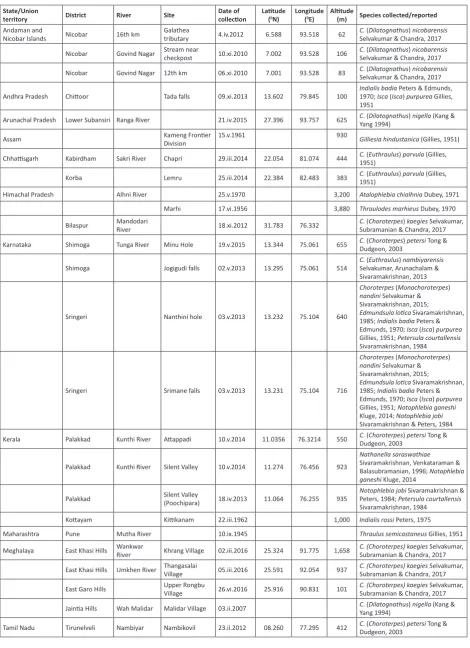
Collections were made in streams and river basins of the all over India during 2009 to 2015. The present study investigated leptophlebiid mayfly in 48 sampling sites from 11 states and one union territory of India including earlier report (Table 1). Sampling area is mountainous with waterfalls and streams, and holds promise as harboring taxa. Collecting was conducted with an aquatic D-frame net. In streams, the substrate was kick-sampled, allowing the current to carry organic debris, including insects, into the net. Waterfalls were sampled by scouring the rock surfaces by hand, allowing the current to carry insects into the net. Along stream margins and in ponds, vegetation was swept with the aquatic D-frame net. All insects were preserved into 70% ethyl alcohol. Mayfly nymphs are particularly fragile because the gills and terminal filaments detach from the body very easily. Therefore, when possible, series of specimens were collected to maximize the likelihood of obtaining intact specimens and accurate determinations. To minimize damage to specimens,
mayflies were collected in containers separate from other aquatic insects. Collected samples were brought to laboratory and were examined using a Leica M205A microscope and identified using published taxonomic literature and type specimens in the Zoological Survey of India (ZSI) and Southern Regional Centre (ZSI/SRC), Chennai. Identified specimens were deposited in ZSI, Kolkata, ZSI, SRC, Chennai and Department of Zoology (DZ), The Madura College (MC), Madurai.
Results
Systematic account
Twenty six species belonging to 12 genera under two subfamilies of Leptophlebiidae from India are documented. All genera and species are presented alphabetically for convenience. This order should in no way be regarded indicating phylogeny.
Order: Ephemeroptera Suborder: Rectracheata Superfamily: Leptophlebioidea Family: LEPTOPHLEBIIDAE Subfamily: Atalophlebiinae
1. Atalophlebiachialhnia Dubey, 1971
2. Choroterpes (Choroterpes) kaegies Selvakumar, Subramanian & Chandra, 2017
3. Choroterpes (Choroterpes) petersi Tong & Dudgeon, 2003
4. Choroterpes (Dilatognathus) nicobarensis
Selvakumar & Chandra, 2017
5. Choroterpes (Dilatognathus) nigella (Kang & Yang, 1994)
6. Choroterpes (Euthraulus) alagarensis
Dinakaran, Balachandran & Anbalagan, 2009
7. Choroterpes (Euthraulus) nambiyarensis Selva-Kumar, Arunachalam & Sivaramakrishnan, 2013
8. Choroterpes (Euthraulus) parvula (Gillies, 1951)
9. Choroterpes (Monochoroterpes) nandini
Selvakumar & Sivaramakrishnan, 2015
10. Edmundsula lotica Sivaramakrishnan, 1985
11. Indialis badia Peters & Edmunds, 1970
12. Indialis rossi Peters, 1975
13. Isca (Isca) purpurea Gillies, 1951
14. Klugephlebia kodai Selvakumar, Subramanian & Sivaramakrishnan, 2016
15. Nathanella indica Demoulin, 1955
16. Nathanella saraswathiae Sivaramakrishnan, Venkataraman & Balasubramanian, 1996
17. Notophlebia ganeshi Kluge, 2014
18. Notophlebiahyalina Peters & Edmunds, 1970
19. Notophlebia jobi Sivaramakrishnan & Peters,
20. Petersula courtallensis Sivaramakrishnan, 1984
21. Petersula nathani Sivaramakrishnan & Hubbard, 1984
22. Thraulodes marhieus Dubey, 1970
23. Thraulus gopalani Grant & Sivaramakrishnan, 1985
24. Thraulus mudumalaiensis Arumuga-Soman,
1991
25. Thraulus semicastaneus (Gillies, 1951)
Subfamily: Leptophlebiinae
26. Gilliesia hindustanica (Gillies, 1951)
Subfamily: Atalophlebiinae
Diagnosis: Atalophlebiinae can be differentiated from Leptophlebiinae by the possession of square facets in the dorsal portion of the eyes of adult males (Peters & Gillies, 1995), a trait unique among hexapods, as well as by leg and styliger plate characters (Peters 1980; Kluge 1994) and a suite of nymphal mouthpart characters [e.g., patterning and arrangement of hairs and setae and shape/emargination of the labrum (Peters 1980)].
Genus: Atalophlebia Eaton, 1881
Remarks: The genus Atalophlebia Eaton, l881 is known only from Australia and hence the species,
Atalophlebiachialhnia Dubey, 1971probably misplaced at the generic level (Hubbard & Peters 1978).
1. Atalophlebiachialhnia Dubey, 1971
Material reported: 1 female imago, 25.v.1970, Himachal Pradesh, Alhni River, 3200m, coll. O.P. Dubey.
Diagnosis: Atalophlebia chialhnia can be differentiated by the following characters: In the subimago (i) forewing 9mm in length, 3.5mm in width, translucent brown, venation pale white; and (ii) tarsal claws similar, slender, hooked (Dubey 1971).
Distribution: Known only from type locality Alhni River (Himachal Pradesh).
Status: Endemic to the Himalaya.
Remarks: Diagnostic characters are provided based on original description. Larva and imago are unknown. Further detailed study is required to assign this species to suitable genus.
Genus: Choroterpes Eaton, 1881
Type species: Choroterpes lusitanica Eaton, 1881 Diagnosis: The Choroterpes complex is recognised by the following characters: in the larvae (i) a pair of slender filaments of first abdominal gill different from gills 2–6; (ii) apex of glossae provided with broad spatulate setae
and (iii) posterior row of setae on the labrum arises close to its middle (except in some Neochoroterpes). In the adults (i) in forewing, MP (Media Posterior) symmetrical fork while in MP2 asymmetrical; (ii) cubital area broad with four (sometimes three) intercalaries; (iii) forceps in the male abruptly widened in its basal and (iv) penes as two simple lobes, very short to elongate and lacking spines or accessory lobes (Selvakumar et al. 2013).
Distribution: Oriental, Paleartic, Afrotropical, Nearctic and Neotropical.
Status: Wide distribution.
Remarks: The genus encompasses the six subgenera viz., Choroterpes s.s. Eaton, 1881, cosmopolitan in distribution, Euthraulus Barnard, 1932 restricted to the Old World, Neochoroterpes Allen, 1974 restricted to the New World and Cryptopenella Gillies, 1951,
Dilatognathus Kluge, 2012 and Monochoroterpes Kluge, 2012 restricted to the Oriental region.
Subgenus: Choroterpes s. s. Eaton, 1881
Diagnosis: This subgenus Choroterpes can be differentiated from other subgenera by the following combination of characters: In the larvae (i) a broad, terminal lobe on the lamina of gills 2–6 and indistinguishable characters in the adults between subgenera.
2. Choroterpes (Choroterpes) kaegies Selvakumar, Subramanian & Chandra, 2017 (Image 1)
Material examined: 5144/H13, 1 larva, 02.iii.2016, Meghalaya, East Khasi Hills, Khrang Village, Wankwar River, 25.3240N & 91.7750E, 1,658m, coll. E. Eyarin
Jehamalar; 5147/H13, 2 larvae, 05.iii.2016, Meghalaya, East Khasi Hills, Thangasalai Village, Umkhen River, 25.5910N & 92.0540E, 937m, coll. E. Eyarin Jehamalar;
5147/H13, 1 larva, 26.vi.2016, Meghalaya, East Garo Hills, Upper Rongbu Village, 25.9160N & 90.8310E, 101m,
coll. E. Eyarin Jehamalar; MCDZ/E-1, 1 larva, 18.xi.2012, Himachal Pradesh, Bilaspur District, Mandodari, River stream, 31.7830N, 76.3320E, coll. K.A. Subramanian.
Diagnosis: This species can be distinguished from all known species of Choroterpes (C.) by the following characters: In the larva (i) anteromedian emargination of labrum broad; (ii) each femur with a dark brown spot at middle and near apex; (iii) gill 1 single and slender and (iv) upper and lower lamellae of gills 2–7 with three apical processes, median process relatively slender and longer than laterals (Selvakumar et al. 2017b).
Distribution: Himachal Pradesh and Meghalaya. Status: Endemic to the Himalaya.
3. Choroterpes (Choroterpes) petersi Tong & Dudgeon, 2003 (Image 2)
Material examined: MCDZ/E-2, 2 larvae, 23.ii.2012, Tamil Nadu, Tirunelveli, Nambiyar River, Nambikovil,
08.2600N & 77.2950E, 412m, colls. C. Selvakumar & K. G.
Sivaramakrishnan; MCDZ/E-3, 1 larva, 10.v.2014, Kerala, Silent Valley-Kunthi River at Attappadi, 11.0350N &
76.3210E, 550m, coll. C. Selvakumar; MCDZ/E-4, 9 larvae,
19.v.2015, Karnataka, Someshwara Wildlife Sanctuary, Tunga River, Minu Hole, 13.3440N & 75.0610E, 665m,
coll. S. Ramya Roopa.
Diagnosis: This species can be differentiated from other species by the following combination of characters: In the larvae (i) abdominal gill 1 slender with dorsal and ventral portions;(ii) median projection of gills 2–7 plate-like and markedly larger and longer than laterals and (iii) labrum with three transverse rows of setae on dorsal surface, middle row without setae medially; anteromedian margin of labrum with a deep U-shaped ventral incision. In the adults (i) male genital penes each with a finger-like process on the top, acute costal projection of the hindwings and (ii) apex located approximately 2/3 distance from base (Tong & Dudgeon 2003).
Distribution: India (Karnataka, Kerala and Tamil Nadu) and China: Hong Kong.
Himachal Pradesh
Status: Oriental distribution.
Remarks: This species was originally described
from Hong Kong based on reared larvae and adults in the laboratory (Tong & Dudgeon 2003). Larvae of this species from southern Western Ghats is extension of its distributional range down south to 8–110 north of
equator by Selvakumar et al. (2015).
Subgenus: Dilatognathus Kluge, 2012
Diagnosis: This subgenus can be differentiated from other subgenera by the following combination of characters: In the larvae (i) abdominal gills 2–7; (ii) labrum widened with median incision; (iii) maxilla with inner-apical projection stretched or not stretched to a tusk-like process with ventro-apical flange, palp elongated and bears long filtering setae; (iv) labial palp elongated and bears long filtering setae which form regular longitudinal rows.
4. Choroterpes (Dilatognathus) nicobarensis Selvakumar & Chandra, 2017 (Image 3)
Material examined: 5154-5155/H13, 3 larvae, 4.iv.2012, Andaman and Nicobar Islands, Nicobar District, Great Nicobar Biosphere Reserve (GNBR), East West Road, 16th km, Galathea tributary, 6.5880N
& 93.5180E, 62m, coll. E. Eyarin Jehamalar; 5156/H13,
4 larvae, 10.xi.2010, GNBR, East West Road, Govind Nagar, a stream on nature trail ½ km away from forest check post, 7.0020N & 93.5280E, 106m, coll. E. Eyarin
Jehamalar; 5157/H13, 1 larva, 06.xi.2010, GNBR, East West Road, Govind Nagar, 12th km, 7.0010N & 93.5280E,
83 m, coll. E. Eyarin Jehamalar.
Diagnosis: This species can be distinguished from all other species by the structure of the maxillary apex which lacks a tusk, with well-developed ventro-apical flange and dentiseta directed distally (Selvakumar et al. 2017a).
Distribution: Andaman and Nicobar Islands. Status: Endemic to Andaman and Nicobar Islands. Remarks: Adult stage is unknown.
5. Choroterpes (Dilatognathus) nigella (Kang & Yang, 1994) (Image 4)
Material examined: 7367/H13, 3 larvae, 21.iv.2015, Arunachal Pradesh, Lower Subansiri District, Ranga River,
27.3960N, 93.7570E, 625 m, colls. K.A. Subramanian & B.
Sinha; 7372/H13, 10 larvae, 23.iii.2013, West Bengal, Darjeeling (Sikkim border), Rishikhola, Rishi River,
27.1690N, 88.6350E, 554m, coll. Srimoyee Basu; 7368/
H13, 5 larvae, 3.ii.2007, Meghalaya, Jaintia Hills district, Wah Malidar, Malidar Village, colls. J. Lyngdoh & Party.
Diagnosis: This species can be distinguished from all other species by (i) the labrum with deep median emargination and (ii) sharp semicircular impression on the dorsal surface (Kang & Yang 1994).
Distribution: India, Thailand, Hainan and Taiwan Islands.
Status: Oriental distribution.
Remarks: Larva and adult are known.
Subgenus: Euthraulus Barnard, 1932
Diagnosis: This subgenus Choroterpes can be differentiated from other subgenera by the following combination of characters: in the larvae (i) gills 2–6 bear three narrow filaments on the apex of each lamina and indistinguishable characters in the adults between subgenera.
6. Choroterpes (Euthraulus) alagarensis Dinakaran, Balachandran & Anbalagan, 2009 (Image 5)
Material examined: MCDZ/E-5, 6 larvae, 11.viii.2013, Tamilnadu, Tirunelveli, Alwarkurichi, Ramanathi river, 08.4700N & 77.2400E, 109 m, coll. C.
Selvakumar; MCDZ/E-6, 18 larvae, 12.vii.2009, Gadana river at Alwarkurichi, 08.4610N & 77.2350E, 69m,
coll. C. Selvakumar; MCDZ/E-7, 8 larvae, 04.vii.2009, Tamiraparani River, Papanasam, 08.4230N, 77.2200E,
108m, coll. C. Selvakumar; MCDZ/E-8, 4 larvae, 04.vii.2009, Tamiraparani River at Kallidaikurichi,
08.4130N, 77.2730E, 105m, coll. C. Selvakumar;
MCDZ/E-9, 5 larvae, 28.iii.2015, Virudhunagar, Srivilliputhur, Shenpagathoppu stream, 08.3620N &
77.1450E, 1,435m, coll. C. Selvakumar; MCDZ/E-10, 3
larvae, 29.vii.2012, Dindigul, Kodaikanal, Manjalaru river, Moolaiyaru, 10.1410N & 77.2910E, 1,216m, coll. C.
Selvakumar.
Diagnosis: This species can be distinguished from other species by the following combination of characters. In the larvae: (i) labrum anteromedian emargination well broad and ‘U′ shaped; (ii) mandibles with outer margin slightly angled a tuft of setae at angle; and (3) apical, median and basal part of femora with dark brown spots. In the imagoes: (i) hind wing dark brown marking on nodus; (ii) forceps and penes yellow and (iii) penis lobes short (Dinakaran et al. 2009).
Distribution: Eastern and Western Ghats.
Status: Endemic to the Eastern and Western Ghats. Remarks: Larva and adult are known.
7. Choroterpes (Euthraulus) nambiyarensis Selvakumar, Arunachalam & Sivaramakrishnan, 2013 (Image 6)
Material examined: MCDZ/E-11, 4 larvae, 22.ii.2010, Tamil Nadu, Tirunelveli, Nambiyar river at Checkpost,
08.2620N & 77.3130E, 227m, coll. C. Selvakumar;
MCDZ/E-12, 6 larvae, 11.vii.2009, Tamil Nadu, Tirunelveli, Ramanathi, above dam, 08.8480N & 77.3140E, 237m,
coll. C. Selvakumar; MCDZ/E-13, 8 larvae, 20.vii.2013, Tamil Nadu, Tirunelveli, Gadana River, above dam (Kallar), 08.4800N & 77.1800E, 144m, coll. C. Selvakumar;
MCDZ/E-14, 5 larvae, 17.vii.2013, Tamil Nadu, Tirunelveli, Gundar, Kannupullimettu, 08.5620N & 77.1220E, 164m,
coll. C. Selvakumar; MCDZ/E-15, 7 larvae, 28.ix.2013, Tamil Nadu, Dindigul, Kodaikanal, Moolaiyar, 10.0500N
& 77.1450E, 1,216m, coll. C. Selvakumar; MCDZ/E-16,
5 larvae, 02.v.2013, Karnataka, Agumbe, Jogigudi falls, 13.2950N & 75.0610E, 514 m, coll. C. Selvakumar.
Diagnosis: This species can be identified by the following combination of characters: In the larvae (i) anteromedian emargination of labrum comparatively narrow and deeply cleft (‘V′ shaped), lateral margin broadly acute; (ii) mandibles with outer margin comparatively deeply angled with a tuft of setae at angle; apical and median dark brown dark brown maculae at femora and (iii) dorsal and ventral lamellae plate-like narrow and terminated in three slender subequal process, tracheae unbranched (Selvakumar et al. 2013).
Distribution: Karnataka, Kerala and Tamil Nadu. Status: Endemic to the Western Ghats.
Remarks: Adult stage is unknown.
Chhattisgarh, Kabirdham District, Bhoramdeo Wildlife Sanctuary, Sakri River, Chapri, 22.0540N & 81.0740E,
444m, colls. E. E. Jehamalar & Party; 5470/H13, 10 male subimagoes, 6 female subimagoes, 25.iii.2014, Chhattisgarh, Korba District, Lemru, 22.3840N &
82.4830E, 383m, colls. E. E. Jehamalar & Party.
Diagnosis: Choroterpes (Euthraulus) parvula (Gillies, 1951) can be distinguished from other species by the following combination of characters: In imago (i) foreceps base not divided, but extended to cover base of penes in a gently rounded curve; forceps stout, four segmented, jointed, basal broad and rounded, second long and curved, arising from the outer half of the basal, third segment incompletely divided from preceding, fourth segment thick and elongate; (ii) penes simple, without appendages, skittle-shaped, continuous at the base, separated apically; and (iii) ninth sternum of female with subanal plate well developed and with a very slight apical notch (Gillies 1951).
Distribution: Chhattisgarh and Madhya Pradesh. Status: Endemic to India.
Remarks: Larva is unknown.
Subgenus: Monochoroterpes Kluge & Jacobus, 2015 This subgenus Choroterpes can be differentiated from other subgenera by the following combination of characters: in the larvae (i) gills 1–7 unilamellate, terminated in three processes with slender, subequal
processes.
9. Choroterpes (Monochoroterpes) nandini Selvakumar & Sivaramakrishnan, 2015 (Image 7)
Material examined: MCDZ/E-17, 1 male and 1 female larvae, 03.v.2013, Karnataka, Sringeri, Nanthini hole, 13.2320N & 75.1040E, 640m, colls. C. Selvakumar
& K.G. Sivaramakrishnan; MCDZ/E-18, 2 female larvae, 03.v.2013; Sringeri, Srimane falls, 13.2310N & 75.1040E,
716m, colls. C. Selvakumar & K. G. Sivaramakrishnan. Diagnosis: Choroterpes (Monochoroterpes) nandini
can be distinguished from C. (Monochoroterpes)
monophyllus by the following combination of characters: (i) median emargination of labrum moderately deep, without denticles; (ii) gills 2–7 without tracheation and (iii) abdominal segment 6 and 7 without colour pattern (Selvakumar et al. 2015).
Distribution: Karnataka part of the Western Ghats. Status: Endemic to the Western Ghats.
Remarks: Adult is unknown.
Genus: Edmundsula Sivaramakrishnan, 1985 Type species: Edmundsula lotica Sivaramakrishnan, 1985
Diagnosis: This genus can be distinguished from other genera of Leptophlebiidae by the following combination characters: In adults: (i) fork of MP and fork of Icu1 from CuA in the forewings occur about 1/3 of the
Image 5. C. (Euthraulus) alagarensis Dinakaran, Balachandran & Anbalagan, 2009; Image 6. C. (Euthraulus) nambiyarensis Selva-Kumar, Arunachalam & Sivaramakrishnan, 2013; Image 7. C. (Monochoroterpes) nandini Selvakumar & Sivaramakrishnan, 2015
distance from the base of wings to margin; both forks symmetrical; (ii) costal margin of hind wings possesses a blunt costal projection; apex of costal projection located less than ½ distance from base of wings; (iii) claws of a pair dissimilar, one apically hooked, the other obtuse, pad-like; (iv) penes divided, tubular, broader at base and tapering towards apex; apex of each penis lobe curved ventrally and (v) ninth sternum of female cleft apically. In larvae: (i) gills present on abdominal segments 1–7; (ii) dorsal and ventral portions of lamellae of gill 1 slender and lanceolate with few tracheae; (iii) dorsal and ventral portion of lamellae of gills 2–7 lanceolate, long, and smoothly tapered near apex; (iv) segment 3 of labial palpi with a row of short heavy spines on inner dorsal margin; (v) denticles on claws progressively larger apically, apical denticle much larger and (vi) posterolateral spines occur on abdominal segments 4–9, spines progressively larger posteriorly, apices of spines on segments 8–9 sharp (Sivaramakrishnan, 1985).
Distribution: Tamil Nadu and Karnataka. Status: Endemic to the Western Ghats.
Remarks: The genus was established for the single species, Edmundsula lotica Sivaramakrishnan, 1985.
10. Edmundsula lotica Sivaramakrishnan, 1985 (Image 8)
Material examined: MCDZ/E-19, 3 larvae, 19.ix.2009, Tamil Nadu, Tirunelveli, Tamiraparani river, Vanathertham falls, 08.6250N & 77.3110E, 263m, coll.
C. Selvakumar; MCDZ/E-20, 1 larva, 06.xi.2012, Tamil Nadu, Tirunelveli, Nambiyar river, Nambikovil, 08.2600N
& 77.2950E, 412 m, coll. C. Selvakumar; MCDZ/E-21, 2
larvae, 03.v.2013, Karnataka, Sringeri, Nanthinihole,
13.2320N & 75.1040E, 640 m, coll. C. Selvakumar.
Diagnosis: Edmundsula lotica can be distinguished by the following combination of characters: In adults: (i) fork of MP and fork of Icu1 from CuA in the forewings occur about 1/3 of the distance from the base of wings to margin; both forks symmetrical; (ii) costal margin of hind wings possesses a blunt costal projection; apex of costal projection located less than ½ distance from base of wings; (iii) claws of a pair dissimilar, one apically hooked, the other obtuse, padlike; (iv) penes divided, tubular, broader at base and tapering towards apex; apex of each penis lobe curved ventrally and (v) ninth sternum of female cleft apically. In larvae: (i) gills present on abdominal segments 1–7; (ii) dorsal and ventral portions of lamellae of gill 1 slender and lanceolate with few tracheae; (iii) dorsal and ventral portion of lamellae of gills 2–7 lanceolate, long, and smoothly tapered near apex; (iv) segment 3 of labial palpi with
a row of short heavy spines on inner dorsal margin; (v) denticles on claws progressively larger apically, apical denticle much larger and (vi) posterolateral spines occur on abdominal segments 4–9, spines progressively larger posteriorly, apices of spines on segments 8–9 sharp (Sivaramakrishnan 1985).
Distribution: Tamil Nadu and Karnataka. Status: Endemic to the Western Ghats.
Remarks: Occurs in the some part of the Western Ghats.
Genus: Indialis Peters & Edmunds, 1970
Type species: Indialis badia Peters and Edmunds,
1970
Diagnosis: This genuscan be differentiated from all other Leptophlebiid genera by the following combination of larval characters: In the larvae (i) abdominal gills 1–7 alike and slender with tracheae branched; (ii) a large tooth-like projection present on inner anterior margin of the maxillae; (iii) tarsal claws hooked, with a row of denticles that progressively larger apically and (iv) five denticles present on anteromedian emargination of labrum. In the adults: (i) more than two intercalaries in cubital area of forewings; (ii) vein of MP forked less than 1/2 of distance from base to margin and (iii) apex of each penis lobe bulbous and reduced tip, outer margin of apical half each penis lobe without a row of spinules (Peters & Edmunds 1970).
Distribution: Andhra Pradesh, Karnataka, Kerala and Tamil Nadu.
Status: Endemic to southern India.
Remarks: Peters and Edmunds (1970) established
Indialis for the species I. badia based on one male subimago and forty nine larvae collected by W.L. Peters and J.G. Peters in Kerala and Andhra Pradesh states of India. Sivaramakrishnan (1985a) described the female imago and egg structure of I. badia from the Tamiraparani River, southern Western Ghats. Peters (1975) described
I. rossi from a male imago from Kerala state.
11. Indialis badia Peters & Edmunds, 1970 (Image 9) Material examined: MCDZ/E-22, 4 larvae, 04.vii.2009, Tamiraparani river, Papanasam, 08.4230N
& 77.2200E, 108m, coll. C. Selvakumar; MCDZ/E-23, 20
larvae, 04.vii.2009, Tamiraparani River at Kallidaikurichi,
08.4130N & 77.2730E, 105m, coll. C. Selvakumar;
MCDZ/E-24, 2 larvae, 28.09.2013, Kodaikanal, Moolaiyar, 10.0500N & 77.1450E, 1,216m, coll. C. Selvakumar;
MCDZ/E-25, 1 larva, 09.xi.2013, Andhra Pradesh, Chittoor district, Tada falls, 13.6020N & 79.8450E, 100m,
Karnataka, Sringeri, Nanthinihole, 13.2320N & 75.1040E,
640m, coll. C. Selvakumar.
Diagnosis: This species can be identified by following combination of characters: In the larvae (i) third segment of the labial palp without a row of spine on the inner dorsal margin; rather sparse or scattered setae on the outer margin the mandibles; (ii) posterolateral spines on abdominal segments 5–9; (iii) denticles on dorsal claws increase in size apically; (iv) tip of the dorsal claw strongly hooked and (v) trachea of gills branched. In the adults (i) MP forked more basally than the fork of vein Rs; (ii) Cu-A area of fore wings narrower and less developed than I.
rossi and (iii) costal projection of hind wings narrower than I. rossi (Peters & Edmunds 1970).
Distribution: Andhra Pradesh, Karnataka, Kerala and Tamil Nadu.
Status: Endemic to southern India.
Remarks: Egg, larva and adults are known to this species.
12. Indialis rossi Peters, 1975
Material reported: California Academy of Science, 1 male imago, 22.iii.1962, Kerala, Kottayam District, Kittikanam, near Peermade, 1,000m, colls. E.S. Ross & D.Q. Cavagnaro.
Diagnosis: This species can be distinguished from I. badia by the following combination of characters: In the
adults (i) all cross veins in forewings surrounded with narrow, yellowish-brown clouds; (ii) abdominal segments 1-7 translucent and washed with brown; (iii) caudal filaments pale, with wide, dark brown annulations at articulations and (iv) costal projection of hind wings well developed and broadly rounded at apex (Peters 1975).
Distribution: Kerala.
Status: Endemic to the Western Ghats.
Remarks: Diagnostic characters are provided based on original description by Peters 1975. Larval stage is unknown.
Genus: Isca Gillies, 1951
Type species: Isca (Isca) purpurea Gillies, 1951 Diagnosis: Thisgenus can be differentiated from all other leptophlebiid genera by the following combination of characters. In the imago, (i) hind wings absent; (ii) cross veins absent in basal 1/2 of cell C in forewings; (iii) tarsal claws dissimilar; and (iv) segments 2 and 3 of male genital forceps short. In the larvae, (i) abdominal segments extend around to venter of abdomen; (ii) dorsal and ventral portion of abdominal gills 2-6 slender and tracheae unbranched; gill 7 consists of 1 slender lamella and tracheae unbranched; (iii) claws apically hooked, and with a row of denticles; apical denticle larger; and (iv) small posterolateral spinas present on abdominal segments 7–9, and spines progressively
Image 9. Indialisbadia Peters & Edmunds, 1970; Image 10. Isca (Isca) purpurea Gillies, 1951; Image 11. Klugephlebiakodai Selvakumar, Subramanian & Sivaramakrishnan, 2016; Image 12. Nathanellaindica Demoulin, 1955; Image 13. Nathanellasaraswathiae
larger posteriorly (Peters & Edmunds 1970).
Distribution: Hong Kong, India, Sri Lanka and Thailand.
Status: Oriental distribution.
Remarks: Gillies (1951) established the genus Isca
from male and female imagoes of I. purpurea that collected in Hong Kong and India. Larva of Isca was described by Peters & Edmunds (1970) and two new species of Isca also described. Larvae of these two species were congeneric with those of I. purpurea.
However, the adults are so morphologically distinct from
I. purpurea and each other that two new subgenera viz., Minyphlebia Peters & Edmunds, 1970 and Tanycola
Peters & Edmunds, 1970 were established for these species by Peters & Edmunds (1970).
Subgenus Isca s.s. Gillies, 1951
Diagnosis: This subgenus can be differentiated from all other leptophlebiid genera by the following combination of characters: (i) vein MA forked a little more than 1/2 of distance from base to margin, fork asymmetrical; cilia present along posterior margin of wings; (ii) abdominal terga extend around onto venter of abdomen, this most marked on segment 7 but scarcely at all on segments 1 and 2; (iii) penes divided, tubular, broad, apex of each penis lobe curved inwardly and ventrally; (iv) ninth sternum of female apically cleft.
13. Isca (Isca) purpureaGillies, 1951 (Image 10)
Material examined: MCDZ/E-27, 2 larvae, 19.ix.2009, Tamil Nadu, Tirunelveli, Tamiraparani river, Vanathertham falls, 08.6250N & 77.3110E, 263m,
coll. C. Selvakumar; MCDZ/E-28, 4 larvae, 06.xi.2012, Nambiyar river, Nambikovil, 08.2600N & 77.2950E, 412m,
coll. C. Selvakumar; MCDZ/E-29, 1 larva, 31.iii.2012, Kodaikanal, Gundar, 10.1330N & 77.2700E, 2,323m,
coll. C. Selvakumar; MCDZ/E-30, 4 larvae, 09.xi.2013, Andhra Pradesh, Chittoor District, Tada falls, 13.6020N
& 79.8450E, 100m, coll. C. Selvakumar; MCDZ/E-31, 1
larva, 03.v.2013, Karnataka, Srimanae falls, 13.2310N
& 75.1040E, 716m, coll. C. Selvakumar; MCDZ/E-32, 1
larva, 03.v.2013, Karnataka, Nandini hole, 13.2320N &
77.1040E, 640m, coll. C. Selvakumar.
Diagnosis: This species can be differentiated from all other leptophlebiid genera by the following combination of characters. In the imago (i) hind wings absent; (ii) cross veins absent in basal 1/2 of cell C in forewings; (iii) tarsal claws dissimilar; and (iv) segments 2 and 3 of male genital forceps short. In the larvae (i) abdominal segments extend around to venter of abdomen; (ii) dorsal and ventral portion of abdominal gills 2-6 slender
and tracheae unbranched; gill 7 consists of 1 slender lamella and tracheae unbranched; (iii) claws apically hooked, and with a row of denticles; apical denticle larger; and (iv) small posterolateral spinas present on abdominal segments 7–9, and spines progressively larger posteriorly (Gillies 1951).
Distribution: India (Andhra Pradesh, Karnataka, Tamil Nadu and West Bengal) and Hong Kong.
Status: Oriental distribution.
Remarks: Larva and adult stages are known.
Genus: Klugephlebia Selvakumar, Subramanian & Sivaramakrishnan, 2016
Type species: Klugephlebia kodai Selvakumar, Subramanian & Sivaramakrishnan, 2016
Diagnosis: This genus can be differentiated from all other genera of Atalophlebiinae by the following combination of characters: In the imago: (i) vein MP forked slightly less than half of distance from base to margin, MP2 attached at base to vein MP1 by a crossvein; (ii) costal margin of hindwings with bluntly convex projection; apex of costal projection located less than half distance from base; (iii) claws of a pair dissimilar, one apically hooked, the other obtuse, pad-like and (iv) segments 2 and 3 of forceps short, apex of segment 3 rounded, base of forceps broad, inner margin forming a smooth bend near middle of forceps; penis divided, tubular, broader at base and tapering towards apex. In the larvae: (i) gills present on abdominal segments 1–7; dorsal and ventral portions of lamellae of gill 1 slender and lanceolate with branched tracheae, dorsal and ventral portions of lamellae of gills 2–7 wider and lanceolate, long and suddenly tapering at apex; (ii) fore and mid femora with a regular row of long, thin setae on outer margin; denticles on claws progressively larger apically; (iii) length of the labrum more than half of the width, lateral lobes rounded, anteriomedian emargination deeply cleft, apparently with two denticles; proximal transverse setal row laterally curved distally; (iv) maxillary palp short, with long setae on third segment and third segment of labial palp with 5–6 thick, spine-like setae on dorsal surface, inner and outer margins with short, thin setae (Selvakumar et al. 2016).
Distribution: Known only from type locality Kodaikanal, Palni Hills (Tamil Nadu).
Status: Endemic to the Western Ghats.
14. Klugephlebia kodai Selvakumar, Subramanian & Sivaramakrishnan, 2016 (Image 11)
Material examined: ZSI/SRC-I/E 16-18, 3 imagoes and 5 larvae, 01.ii.2015, Tamil Nadu, Dindigul, Kodaikanal, Pillar Rock stream, 10.1230N & 77.2750E, 2,185m, colls.
C. Selvakumar & T. Sivaruban.
Diagnosis: This species can be differentiated from all other genera of Atalophlebiinae by the following combination of characters: In the imago: (i) vein MP forked slightly less than half of distance from base to margin, MP2 attached at base to vein MP1 by a crossvein; (ii) costal margin of hindwings with bluntly convex projection; apex of costal projection located less than half distance from base; (iii) claws of a pair dissimilar, one apically hooked, the other obtuse, pad-like and (iv) segments 2 and 3 of forceps short, apex of segment 3 rounded, base of forceps broad, inner margin forming a smooth bend near middle of forceps; penis divided, tubular, broader at base and tapering towards apex. In the larvae: (i) gills present on abdominal segments 1–7; dorsal and ventral portions of lamellae of gill 1 slender and lanceolate with branched tracheae, dorsal and ventral portions of lamellae of gills 2–7 wider and lanceolate, long and suddenly tapering at apex; (ii) fore and mid femora with a regular row of long, thin setae on outer margin; denticles on claws progressively larger apically; (iii) length of the labrum more than half of the width, lateral lobes rounded, anteriomedian emargination deeply cleft, apparently with 2 denticles; proximal transverse setal row laterally curved distally; (iv) maxillary palp short, with long setae on third segment and third segment of labial palp with 5–6 thick, spine-like setae on dorsal surface, inner and outer margins with short, thin setae (Selvakumar et al., 2016).
Distribution: Known only from Palni Hills (Tamil Nadu).
Status: Endemic to the Western Ghats.
Remarks: The species was described both larva and adult.
Genus Nathanella Demoulin, 1955
Type species: Nathanella indica Demoulin, 1955 Diagnosis: This genus can be distinguished from all other genera by the following combination of characters: In the larvae (i) abdominal gills present on segments 1–7, and dorsal and ventral portions of lamellae leaf-like and apicaly terminated three projections, median longer than laterals; (ii) outer margin of mandibles smoothly curved basally and straight apically with a row of hair in the apical half; (iii) anteromedian margin of labrum straight with 5 broad-based denticles and (iv) lateral
margins of the head capsule broadly expanded. In the adults (i) hind wings absent; (ii) vein MP2 of fore wings attached at base to vein MP1 and CuA by a cross vein, and attachment of vein MP2 to MP1 greater than1/4 to 1/3 distance from base to margin; (iii) penes divided, straight with apex expanded dorsally and (iv) claw similar (Peters & Edmunds 1970).
Distribution: Karnataka, Kerala and Tamil Nadu. Status: Endemic to the Western Ghats.
Remarks: Demoulin (1955) established Nathanella
for a distinctive species, N. indica known only from male imagoes collected in southern India. Sivaramakrishnan et al. (1996) described female imago and larvae of N. indica and male and female imagoes and larvae of N. saraswathiae from Kerala border, near Bodi Mettu.
15. Nathanella indica Demoulin, 1955 (Image 12) Materialexamined: MCDZ/E-33, 2 larvae, 28.ix.2013, Tamil Nadu, Kodaikanal, Perumalmalai, 10.1610N &
77.3310E, 1,484m, coll. C. Selvakumar.
Diagnosis: This species can be distinguished from N. saraswathiae by the following combination characters: In the larvae: (i) median projection of abdominal gills broad and approximately twice length of laterals; (ii) tracheation in gills uniformly distributed; and (iii) distal, irregular light brown maculae on femora of legs. In the adults: (i) membrane of fore wing golden brown, cross veins in cells C and Sc narrowly clouded with brown; (ii) abdominal terga 3–7 of male brown except irregularly pale apically; and (iii) dorsal margin of styliger plate of male broadly convex (Demoulin, 1955).
Distribution: Known only from Palni Hills (Tamil Nadu).
Status: Endemic to the Western Ghats.
Remarks: Male imago was described by Demoulin (1955). Female imago and larva were described by Sivaramakrishnan et al. (1996).
16. Nathanella saraswathiae Sivaramakrishnan, Venkataraman & Balasubramanian, 1996 (Image 13)
Materialexamined: MCDZ/E-34, 4 larvae, 06.xi.2012, Tamil Nadu, Nambiyar river, Nambikovil, 08.2600N &
77.2950E, 386 m, coll. C. Selvakumar; MCDZ/E-35, 4
larvae, 10.v.2014, Kerala, Silent Valley, tributary of Kunthipuzha river, 11.2740N & 76.4560E, 923m, coll. C.
Selvakumar.
and distal, irregular black maculae on femora of legs. In the adults (i) membrane of fore wing hyaline with weak brown tint, veins in forewing broadly clouded with dark brown; (ii) maculae on male abdominal terga 3–7 and (iii) dorsal margin of styliger plate of male convex with a median shallow depression (Sivaramakrishnan et al. 1996).
Distribution: Kerala and Tamil Nadu. Status: Endemic to the Western Ghats.
Remarks: This species is found above 1,400m in very small, well-shaded, intermittent streams.
Genus: Notophlebia Peters & Edmunds, 1970 Type species: Notophlebia hyalina Peters & Edmunds,
1970
Diagnosis: This genus can be distinguished from other genera of this family by following combination of characters: In the larvae: (i) both distal and proximal transverse setal rows regular; (ii) gills present on abdominal segments 1–6; and (iii) apical denticle on the tarsal claws greatly enlarged. In the adults: (i) hind wings absent; (ii) MP of forewing without symmetric fork and (iii) apically each penis lobe bears a slender pointed serrate projection (Peters & Edmunds 1970).
Distribution: Karnataka, Kerala and Tamil Nadu. Status: Endemic to the Western Ghats.
Remarks: This genus was established for the species
Notophlebiahyaline Peters & Edmunds (1970) from Tamil
Nadu. Only three species viz., N.hyaline, N. ganeshi and
N. jobi are described in this genus from India.
17. Notophlebia ganeshi Kluge, 2014 (Image 14) Material examined: MCDZ/E-36, 2 larvae, 10.v.2014, Kerala, Silent Valley, tributary of Kunthipuzha River,
11.2740N & 76.4560E, 923m, coll. C. Selvakumar;
MCDZ/E-37, 1 larva, 03.v.2013, Karnataka, Sringeri, Srimane falls, 13.2310N & 75.1040E, 716m, coll. C.
Selvakumar.
Diagnosis: This species can be identified by the following combination of characters: In the larvae (i) abdominal gills narrower; (ii) third segment of maxillary palp with moderately long, slender setae, situated densely and irregularly and (iii) third segment of labial palp with moderately long filtering setae on dorsal side and directed apically-inward. In the adults (i) apically each penis lobe bears a slender pointed serrate projection straight, lobe forms convexity laterally with a small sharp incision medially (Kluge 2014).
Distribution: Karnataka and Kerala. Status: Endemic to the Western Ghats.
Remarks: The larva of this species has non-dilatognathan mouth apparatuses.
18. Notophlebia hyalina Peters & Edmunds, 1970 Material reported: Florida A & M University, 1 male imago, 02.i.1962, Tamil Nadu, Kanyakumari, Kunjankhuzi,
120m, coll. F. Schmid.
Diagnosis: This species can be distinguished by the following combination of characters: In the adult (i) cilia occur on posterior margin of fore wings; (ii) membrane of anal area of fore wings enlarged posteriorly; and (iii) penes of male genitalia tubular, straight, and pointed (Peters & Edmunds 1970).
Distribution: Known only from the type locality Kunjankhuzi, Tamil Nadu.
Status: Endemic to the Western Ghats.
Remarks: Diagnostic characters are provided based on the original description. Larva is unknown.
19. Notophlebia jobi Sivaramakrishnan & Peters, 1984 (Image 15)
Material examined: MCDZ/E-38, 3 larvae, 20.vii.2013, Tamil Nadu, Tirunelveli, Gadana River, Kallar (above dam), 08.4800N & 77.1800E, 144m, coll. C. Selvakumar;
MCDZ/E-39, 4 larvae, 11.vii.2009, Tirunelveli, Ramanathi, above dam, 08.8480N & 77.3140E, 237m, coll. C.
Selvakumar; MCDZ/E-40, 1 larva, 17.vii.2013, Gundar, Kannupullimettu, 08.5620N & 77.1220E, 164m, coll. C.
Selvakumar; MCDZ/E-41, 1 larva, 03.xi.2013, Shengottai, Adavinayinar, above dam, 09.0450N & 77.1350E, 273m,
coll. C. Selvakumar; MCDZ/E-42, 4 larvae, 21.i.2010, Theni, Kurangani stream, 10.0500N & 77.1450E, 1,744m,
coll. C. Selvakumar; MCDZ/E-43, 10 larvae, 18.iv.2013, Kerala, Silent Valley National Park, Poochipara, 11.0640N
& 76.2550E, 935m, coll. Jobin C. Tharian; MCDZ/E-44,
4 larvae, 03.v.2013, Karnataka, Sringeri, Srimane falls,
13.2310N & 75.1040E, 716m, coll. C. Selvakumar.
Diagnosis: This species can be identified by following combination of characters: In the larvae (i) gills not narrower; (ii) third segment of maxillary palp with very long stout pointed setae directed apically and forming nearly regular rows; (iii) third segment of labial palp with long pointed setae on outer side, dorsal side also with long setae. In the adults (i) apically each penis lobe bears a slender pointed serrate projection curved (Sivaramakrishnan & Peters 1984).
Distribution: Karnataka, Kerala and Tamil Nadu. Status: Endemic to the Western Ghats.
Remarks: The larva of this species has a highly specialized mouth apparatus of the Dilatognathus-type.
This type of mouth apparatus has evolved independently in several non-related leptophlebiid taxa.
Genus: Petersula Sivaramakrishnan, 1984
Type species: Petersula courtallensis
Sivaramakrishnan, 1984
Diagnosis: This genus can be distinguished from
other genera by the following combination of characters: In the larvae: (i) labrum expanded and angled laterally; (ii) anterior margin of lingua of hypopharynx deeply cleft; apex of submedian lobes of lingua possesses a rack like process; (iii) outer margin of basal ½ of mandibles smoothly curved, while apical ½ almost straight; a row of hairs extends from mid outer margin almost to base of incisors; (iv) abdominal gills occur on segments 1–7 and are plate-like with margins unevenly fringed with broad filamentous processes and (v) posterolateral spines occur on abdominal segments 3–9 and progressively larger posteriorly. In the adults: (i) vein MP2 of fore wings attached at base to vein MP1 more than 1/3 of the distance from base to margin; (ii) costal margin of hind wings convex or with a rounded costal projection; (iii) each penis lobe with ventromedially directed spine-like projection near apex; (iv) claws of a pair alike, apically hooked with an opposing hook and (v) 9th sternum of female shallowly cleft apically (Sivaramakrishnan 1984).
Distribution: Karnataka, Kerala and Tamil Nadu. Status: Endemic to the Western Ghats.
Remarks: The genus Petersula was established for
P. courtrallensis from the southern Western Ghats by Sivaramakrishnan 1984. A second species, P. nathani
described based on adult from the Anamalai hills of southern Western Ghats (Sivaramakrishnan & Hubbard 1984). The genus is widespread in the Western Ghats.
20. Petersula courtallensis Sivaramakrishnan, 1984 (Image 16)
Material examined: MCDZ/E-45, 2 larvae, 20.vii.2013, Tamil Nadu, Tirunelveli, Gadana river, Kallar, 08.48045°N & 77.18053°E, 144 m, coll. C. Selvakumar; MCDZ/E-46, 4 larvae, 19.ix.2009, Tamiraparani River, Vanathertham falls, 08.6250N & 77.3110E, 263m, coll.
C. Selvakumar; MCDZ/E-47, 3 larvae, 17.vii.2013, Tirunelveli, Kannupullimettu stream, 08.5620N &
77.1220E, 164m, coll. C. Selvakumar; MCDZ/E-48, 5
larvae, 28.ix.2013, Kodaikanal, Perumalmalai stream,
10.1610N & 77.3310E, 1,484m, coll. C. Selvakumar;
MCDZ/E-49, 4 larvae, 18.iv.2013, Kerala, Silent Valley National Park, Poochipara, 11.0640N & 76.2550E, 935m,
coll. Jobin C. Tharian; MCDZ/E-50, 1 larva, 03.v.2013, Karnataka, Sringeri, Nanthinihole, 13.2320N & 75.1040E,
640m, coll. C. Selvakumar.
½ almost straight; a row of hairs extended from mid outer margin almost to base of incisors; (iv) abdominal gills occur on segments 1–7 and plate-like with margins unevenly fringed with broad filamentous processes and (v) posterolateral spines occur on abdominal segments 3–9 and progressively larger posteriorly. In adults (i) vein MP2 of fore wings attached at base to vein MP1 more than 1/3 of the distance from base to margin; (ii) costal margin of hind wings convex or with a rounded costal projection; (iii) each penis lobe ventromedially directed spine-like projection near apex; (iv) claws of a pair alike, apically hooked with an opposing hook and (v) 9th sternum of female shallowly cleft apically (Sivaramakrishnan 1984).
Distribution: Karnataka, Kerala and Tamil Nadu. Status: Endemic to the Western Ghats.
Remarks: This species is wide distribution and abundant in the Western Ghats.
21. Petersula nathani Sivaramakrishnan & Hubbard, 1984
Material reported: Bernice P. Bishop Museum, 1 male imago, 02.v.1963, Tamil Nadu, Coimbatore, Kadamparai, 1,070m, coll. P.S. Nathan.
Diagnosis: This species can be distinguished from the only other species in the genus, P.courtallensis by the following characters: In imago: (i) terga 1–7 translucent yellowish brown and washed with brown; terga 8–10 opaque brown; (ii) paired longitudinal, submedian lines present on terga 3–5; (iii) vein MP2 of fore wings attached at base only to vein MP1 with a crossvein and (iv) length of spinelike projection arising from near apex of each penis lobe nearly 1/3 length of penis (Sivaramakrishnan & Hubbard 1984).
Distribution: Known only from type locality, Anamalai Hills (Tamil Nadu).
Status: Endemic to the Western Ghats.
Remarks: Diagnostic characters are provided based on the original description. Larva is unknown.
Genus: Thraulodes Ulmer, 1920
Remarks: The genus Thraulodes Ulmer, 1920 is known only from the New World and hence the species,
Thraulodes marhieus Dubey, 1970 probably misplaced at the generic level (Hubbard & Peters 1978).
22. Thraulodes marhieus Dubey, 1970
Material reported: 986/56, 1 female imago, 17.vi.1956, Himachal Pradesh, Pir Panjal Range, Marhi, 3,880m, coll. Santokh singh.
Diagnosis: This species can be identified by the
following combination of characters: in the imago (i) claws dissimilar; (ii) forewing hyaline, veins dark brown; (iii) hindwing hyaline, costal process obtusely pointed; and (iv) ovipositor yellowish-brown, two-segmented, first segment wider basally than apically, length one and one-fourth times its width (Dubey, 1970).
Distribution: Known only from the type locality, Marhi (Himachal Pradesh).
Status: Endemic to the Himalaya.
Remarks: Diagnostic characters are provided based on the original description. Larva is unknown.
Genus: Thraulus Eaton, 1881
Type species: Thraulus bellus Eaton, 1881
Diagnosis: The genus can be differentiated from all other genera of the Leptophlebiidae by the following combination of characters. In the imago, (i) fork of vein MP of fore wings is closer to base of wings than fork of vein Rs; (ii) 2 intercalaries occur in cubital area of fore wings; (iii) penes tubular, divided and simple; and (iv) costal projection of hind wings acute and well developed, except for the costal projection of T. bellus which is more rounded. In the nymph, (i) dorsal and ventral portions of abdominal gills 2–7 ovate with fringed margins; (ii) dorsal and ventral portions of abdominal gills 1 slender, lanceolate, or ovate with fringed margins, or dorsal portion slender, lanceolate and ventral portion ovate with fringed margins; (iii) lateral tips of superlingua of hypopharynx emarginated; and (iv) tarsal claws hooked and narrow and with a row of denticles that are progressively larger apically (Peters & Edmunds 1970).
Distribution: Oriental, Afrotropical and Palearctic. Status: Wide distribution.
Remarks: Presently, this genus encompasses 15 valid species, of which three are from Palearctic, three from Afrotropical and nine from Oriental realms (Barber-James et al. 2013). In India, the genus Thraulus
Eaton, 1881 has 3 species viz., T. gopalani Grant & Sivaramakrishnan, 1985 described from both imago and larvae, T. mudumalaiensis Soman, 1991 described only from larvae and T. semicastaneus (Gillies, 1951) described only from imago.
23. Thraulusgopalani Grant & Sivaramakrishnan, 1985 (Image 17)
Material examined: MCDZ/E-51, 4 larvae, 26.xii.2013, Tamil Nadu, Tirunelveli, Tamiraparani river, Kottumthalam, 08.4200N & 77.2130E, 181m, coll. C.
Selvakumar.
combination of characters: In the larva (i) labrum with a rectangular mesal emargination anteriorly; (ii) inner row of the dorsal setae located just anterior to middle of the labrum; (iii) outer margin of the mandibles lacks a tuft of setae at the base of the incisors; (iv) denticles on the claws decrease in size apically; and (v) abdominal gills 1 with a dorsal lanceolate portion and a ventral fimbriate lamellar portion and abdominal gills on segments 2–7 with dorsal and ventral fimbriate lamellar portions. In the adult (i) upper portion of male eyes separated; (ii) forewings with a narrow dark brown band between costal brace and vein A2; (iii) bullae of veins Sc and R2 have a small dark brown macula; (iv) basal ½ of hind wings brown and apex blundly rounded; and (v) each penis with single longitudinal row of spine-like setae on dorsal surface (Grant & Sivaramakrishnan 1985).
Distribution: Tamil Nadu.
Status: Endemic to the Western Ghats. Remarks: Larva and adult are known.
24. Thraulus mudumalaiensis Soman, 1991
Material reported: ZSI/SRC I-E 1a-p, female larva, 2.iv.1988, Tamil Nadu, Nilgri, Mudumalai, 950m, coll. A.K. Arumuga Soman.
Diagnosis: Thraulus mudumalaiensis can be distinguished from all other known species by the following combination of characters: In larvae: (i) claws with five minute denticles in apical set and 10 larger denticles in basal row in which the size increases medially, then decreases apically; (ii) labrum without denticles in the emargination, two rows of setae on dorsal side and an irregular intermittent setae ventrally in between two dorsal rows, a cluster of setae of either of the anterolateral side of its venter; (iii) coastal area of forewing pads hyaline, without longitudinal brown streak; (iv) mandibles with lateral sides smoothly rounded with some setae on mid region; (5) segment 2 of maxillary palp almost equal to the length of segment 1, segment 3, 0.74 the length of segment 2 and (6) segment 2 of labial palp 0.7 the length of segment 1, segment 3 a little longer than segment 2 (Soman, 1991).
Distribution: Known only from Nilgri, Tamil Nadu. Status: Endemic to the Western Ghats.
Remarks: Diagnostic characters are provided based on the original description. Adult is unknown.
25. Thraulus semicastaneusGillies, 1951
Material reported: British Museum (Natural History), 5 male imagoes, 13.ix.1945, Maharashtra, Pune, Mutha River, coll. M.T. Gillies.
Diagnosis: This species can be identified by the
following combination of characters: in the imago (i) penes simple, narrow and divided but closely appressed; (ii) forewing translucent colourless, main veins amber, cross veins fine and numerous, two cubital intercalaries only, stigma containing 9–11 simple, sinuous vein-lets; and (iii) hindwing short, somewhat triangular, with tall costal spur and sharply upturned subcosta (Gillies 1951). Distribution: Known only from the Mutha river, Pune (Maharashtra).
Status: Endemic to the Western Ghats.
Remarks: Diagnostic characters are provided based on the original description. Larva is unknown.
Subfamily: Leptophlebiinae
Diagnosis: Leptophlebiinae can be differentiated from Atalophlebiinae by a suite of mouthpart characters and an elongate and deeply cleft ninth sternum in adult females (Peters & Edmunds 1970; Peters 1980; Kluge 1994).
Genus Gilliesia Peters & Edmunds, 1970 Type species: Gilliesia hindustanica (Gillies)
Diagnosis: This genus can be differentiated from other genera of the Leptophlebiidae by the following combination of characters: In imago (i) hind wings present and well developed; (ii) vein MP2 of the fore wings with independent of vein MP1; (iii) female without ovipositor or egg guide; and (iv) 9th sternum of the female deeply cleft apically. In larva (i) posterolateral expansions of on abdominal segments 9 only well developed; (ii) gills long, slender and slightly forked at 2/5 basally; (iii) glossae narrow taped, with dense thickened-long hairs on ventral surface; and (iv) length of maxilla palpi segment three more than 1.6 times length of segment 2; apical-blunted, with numerous setae (Peters & Edmunds 1970).
Distribution: China, India and Thailand. Status: Oriental distribution.
Remarks: The genus Gilliesia Peters & Edmunds, 1970 was established for the species Thraulus hindustanicus
Gillies, 1951 described based on adult specimens only.
Gilliesia hindustanica is known from India (Gillies 1951; Peters & Edmunds 1970). The second species, G. pulchra
State/Union
territory District River Site Date of collection Latitude (0N) Longitude (0E) Altitude (m) Species collected/reported
Andaman and
Nicobar Islands Nicobar 16th km Galathea tributary 4.iv.2012 6.588 93.518 62 C. Selvakumar & Chandra, 2017(Dilatognathus) nicobarensis
Nicobar Govind Nagar Stream near checkpost 10.xi.2010 7.002 93.528 106 CSelvakumar & Chandra, 2017. (Dilatognathus) nicobarensis
Nicobar Govind Nagar 12th km 06.xi.2010 7.001 93.528 83 CSelvakumar & Chandra, 2017. (Dilatognathus) nicobarensis
Andhra Pradesh Chittoor Tada falls 09.xi.2013 13.602 79.845 100 Indialis badia 1970; Isca (IscaPeters & Edmunds, ) purpurea Gillies, 1951
Arunachal Pradesh Lower Subansiri Ranga River 21.iv.2015 27.396 93.757 625 CYang 1994). (Dilatognathus) nigella (Kang &
Assam Kameng Frontier Division 15.v.1961 930 Gilliesia hindustanica (Gillies, 1951)
Chhattisgarh Kabirdham Sakri River Chapri 29.iii.2014 22.054 81.074 444 C.1951) (Euthraulus) parvula (Gillies,
Korba Lemru 25.iii.2014 22.384 82.483 383 C.1951) (Euthraulus) parvula (Gillies,
Himachal Pradesh Alhni River 25.v.1970 3,200 Atalophlebia chialhnia Dubey, 1971
Marhi 17.vi.1956 3,880 Thraulodes marhieus Dubey, 1970
Bilaspur Mandodari River 18.xi.2012 31.783 76.332 C. Subramanian & Chandra, 2017(Choroterpes) kaegies Selvakumar,
Karnataka Shimoga Tunga River Minu Hole 19.v.2015 13.344 75.061 655 CDudgeon, 2003. (Choroterpes) petersi Tong &
Shimoga Jogigudi falls 02.v.2013 13.295 75.061 514 C. Selvakumar, Arunachalam & (Euthraulus) nambiyarensis Sivaramakrishnan, 2013
Sringeri Nanthini hole 03.v.2013 13.232 75.104 640
Choroterpes (Monochoroterpes)
nandini Selvakumar & Sivaramakrishnan, 2015;
Edmundsula lotica Sivaramakrishnan, 1985; Indialisbadia Peters & Edmunds, 1970; Isca (Isca) purpurea
Gillies, 1951; Petersulacourtallensis
Sivaramakrishnan, 1984
Sringeri Srimane falls 03.v.2013 13.231 75.104 716
Choroterpes (Monochoroterpes)
nandini Selvakumar & Sivaramakrishnan, 2015;
Edmundsulalotica Sivaramakrishnan, 1985; Indialisbadia Peters & Edmunds, 1970; Isca (Isca) purpurea
Gillies, 1951; Notophlebiaganeshi
Kluge, 2014; Notophlebiajobi
Sivaramakrishnan & Peters, 1984
Kerala Palakkad Kunthi River Attappadi 10.v.2014 11.0356 76.3214 550 CDudgeon, 2003. (Choroterpes) petersi Tong &
Palakkad Kunthi River Silent Valley 10.v.2014 11.274 76.456 923
Nathanella saraswathiae
Sivaramakrishnan, Venkataraman & Balasubramanian, 1996; Notophlebia ganeshi Kluge, 2014
Palakkad Silent Valley (Poochipara) 18.iv.2013 11.064 76.255 935 Notophlebia jobi Peters, 1984; PetersulaSivaramakrishnan & courtallensis
Sivaramakrishnan, 1984
Kottayam Kittikanam 22.iii.1962 1,000 Indialis rossi Peters, 1975
Maharashtra Pune Mutha River 10.ix.1945 Thraulus semicastaneus Gillies, 1951
Meghalaya East Khasi Hills Wankwar River Khrang Village 02.iii.2016 25.324 91.775 1,658 C. (Choroterpes) kaegiesSubramanian & Chandra, 2017 Selvakumar,
East Khasi Hills Umkhen River Thangasalai Village 05.iii.2016 25.591 92.054 937 C. (Choroterpes) kaegiesSubramanian & Chandra, 2017 Selvakumar,
East Garo Hills Upper Rongbu Village 26.vi.2016 25.916 90.831 101 C. (Choroterpes) kaegiesSubramanian & Chandra, 2017 Selvakumar,
Jaintia Hills Wah Malidar Malidar Village 03.ii.2007 CYang 1994). (Dilatognathus) nigella (Kang &