Sathvik. B. S, Assistant Professor,
Department of Pharmacology and Pharmacy Practice, RAKCOPS, RAKMHSU, Ras Al-Khaimah, U.A.E E-mail: [email protected]
Address for correspondence
Access this article online www.japer.in
Attitudes and Perceptions of Pharmacy Students of Ras Al
Khaimah towards Problem Based Learning
INTRODUCTION
Problem based learning (PBL) is a widely adopted
learning methodology in international academic
settings, especially in medical and health sciences
universities.[1-2] Student is placed at the center of the
learning process in PBL unlike the conventional
modes of teaching.[3]The prime aim of PBL system of
education is integrating learning with practice.[3, 4-6]
PBL was first introduced at McMaster University
Medical School in Canada during 1960s as a part of its
teaching and learning methodology. [7] Since then,
many universities have implemented PBL in both
undergraduate and graduate curriculum.[1, 2, 7]
Typically in PBL, students work in small groups with a
faculty or a tutor who acts as a facilitator of
discussions and of learning rather than as a direct
source of information. [1] It is well known from the
published literatures that PBL helps in developing and
enhancing various skills in students such as self-
directed learning, communication, team work,
problem solving and report writing.[8-10] A number
of studies conducted on medical and health sciences
students’ attitudes and perceptions indicates positive
findings towards their PBL curriculum. [4, 5, 9, 10]
However, these studies also highlight significant
negative attitudes & perception in certain aspects of
PBL methodology. [4, 5, 9, 10]
At RAK College of Pharmaceutical Sciences
(RAKCOPS), PBL curriculum was implemented since
the initiation of the pharmacy undergraduate degree
program in the year 2008 and the PBL methodology
was introduced from the second semester of B. Pharm.
At RAKCOPS, the PBL assessment is formative and it is
a part of students in - course assessment. [11]
Although PBL is an effective way to develop and
improve the required professional and personal skills
in the medical and health sciences courses, it is very
important to obtain the students feedback in order to
provide insights for the future modification and to
improve the quality of PBL. [12] Research
Research Research
Research ArticleArticleArticleArticle
Problem based learning (PBL) is a widely adopted learning methodology in international academic settings, especially in medical and health sciences universities. The prime aim of PBL system of education is integrating learning with practice. A number of studies conducted on medical and health sciences student’s attitudes and perceptions indicate positive attitudes and perceptions towards their PBL curriculum. However, these studies also highlight significant negative attitudes & perception in certain aspects of PBL methodology. The objective of our study was to assess the attitudes and perceptions of undergraduate pharmacy students of RAK College of Pharmaceutical Sciences (RAKCOPS) towards their PBL experience. It was a prospective cross-sectional survey based study conducted using an attitudes and perceptions evaluation questionnaire. Majority of the pharmacy students agreed that PBL was useful for them and they ‘always’ enjoy learning through their PBL sessions. Students also agreed that their skills have improved after PBL sessions. Our study highlights the significant role of PBL in enhancing students problem solving, critical thinking, literature search and most importantly communication skills through team work.
Keywords: Problem based learning, attitudes and perception, integrating learning with practice, PBL methodology, learning through PBL.
ABSTRACT ABSTRACT ABSTRACT ABSTRACT Sathvik B. S1*, Smitha C Francis2,
Padma G. M Rao3, B.G Nagavi4
1Assistant Professor, Department
of Pharmacology and Pharmacy Practice, RAKCOPS, RAKMHSU,
Ras Al-Khaimah, U.A.E 2Lecturer, Department of
Pharmacology and Pharmacy Practice, RAKCOPS, RAKMHSU, Ras Al-Khaimah, U.A.E 3Associate Dean and Chairperson,
Department of Pharmacology and Pharmacy Practice, RAKCOPS, RAKMHSU, Ras Al-Khaimah, U.A.E 4Dean, RAKCOPS, RAKMHSU, Ras
Al-Khaimah, U.A.E
Objective of our study:
• To assess the attitudes and perceptions of
undergraduate pharmacy students towards their
PBL experience through a self-administered
questionnaire.
• To improve the quality and the process of the
PBL methodology at RAKCOPS by analyzing the
obtained data.
MATERIALS AND METHODS
It was a prospective cross-sectional survey based
study conducted at RAK College of Pharmaceutical
Sciences, RAK Medical and Health Sciences University
(RAKMHSU) from September 2011 to February 2012.
Attitudes and perceptions of undergraduate pharmacy
students (B. Pharm) towards their PBL experience
were assessed using attitudes and perception
evaluation questionnaire. This was a
self-administered questionnaire prepared based on the
extensive literature review of PBL related research
studies and guidelines.
The questionnaire was reviewed by three subject
experts /senior faculty for its content before it was
finalized. The questionnaire consists of two parts
(Part-A & Part-B). A total of 19 closed ended questions
were included in part-A, which assessed the attitudes
and perceptions of students towards their PBL
curriculum. Part-B consists of nine questions, to which
the students are expected to respond by ticking; agree,
strongly agree, disagree, strongly disagree.
The questionnaire was administered to all the B.
Pharm students (n=76) of different semesters of
RAKCOPS by the study investigator (s) during one of
the student free hours at their respective classrooms.
All the pharmacy students were included in the study.
The obtained data was entered in Microsoft excel
2007 and was analyzed using SPSS version 18.0.The
results are presented in frequency & percentages.
RESULTS AND DISCUSSION
The main intention of our study was to assess the
positive & negative attitudes and perceptions of
undergraduate pharmacy students to PBL, so that
necessary steps can be taken to improve the process
and methodology of PBL.
Although several standard questionnaires were
available to evaluate the attitude and perceptions
regarding PBL, we preferred to develop our own
questionnaire after referring to those and
incorporated the items designed to evaluate the PBL
methodology at our university. [4, 5, 7, 9, 11]These
types of questionnaires are considered beneficial for
the faculty to monitor the students’ attitude and
perceptions & utilize the obtained data in further
improvement to give constructive feedback. [13]
Demography of the survey respondents
A total of 76 undergraduate pharmacy students
responded to the questionnaire. In terms of gender,
18.4 % (n =14) were male while 81.6% (n=62) were
female. The age range of the respondents was 19-24
years. Out of 76 students surveyed, 22 (28.9%) were
from year-1, 15 (19.7%) were from year 2, 20 (26.3%)
were from year 3 and 19 (25%) from year 4 of B.
Pharm. Since the number of male respondents was
very low in our study, we did not evaluate the
difference in attitudes and perceptions between male
and female respondents. However, good number of
studies have highlighted the gender difference in the
attitude and perceptions regarding learning through
PBL. [12-14]
Usefulness of PBL and Learning through PBL
A total of 65 respondents (85.5%) found PBL sessions
to be ‘useful’ while a small number of respondents 5
(6.6%) reported as ‘stressful’. It was observed that 47
(61.8%) students enjoyed learning through their PBL
sessions ‘sometimes’, while another 19 (25%)
reported as ‘always’ (Table 1). Good number of the
study respondents 52.6% (n=40) mentioned that they
‘always’ learn from their class mates or their group
members during the PBL sessions, while 38.2%
(n=29) reported as only ‘sometimes’ (Table 1).
was useful for them and they enjoyed learning
through their PBL sessions. Our findings are thus in
agreement with other studies which have revealed the
same. [5, 9, 13]
Table 1: Students’ opinion regarding PBL and the sessions
Sl. No: Items Number
(Percentage)
1
Having PBL in my course is
• Useful
• Not useful
• Stressful
• Waste of time
65 (85.5%) 01(1.3%) 05(6.6%) 05(6.6%)
2
I enjoy my PBL Sessions
• Always
• Sometimes
• Very rarely
• Not at all
19(25.0%) 47(61.8%) 05(6.6%) 05(6.6%)
3
I learn from my class mates or my group members during the PBL session
• Always
• Sometimes
• Very rarely
• Not at all
40(52.6%) 29(38.2%) 04(5.3%) 03(3.9%)
4
I think the topics covered in PBL session should be taught in the class room
• Yes
• No
• For some topics
• Not sure
33(43.4%) 16(21.1%) 26(34.2%) 01(1.3%)
5
I prefer to have the lecture
• Before the PBL session
• After the completion of the PBL
• Any time
31(40.8%) 13(17.1%) 32(42.1%)
6
I like PBL, which is
• Stand alone
• Integrated
• ok with both
22(28.9%) 15(19.7%) 39(51.3%)
7
The time period I need to complete PBL write up / notes making after my second Session is
• < 01 week
• 01 week
• 02 weeks
36(47.4%) 25(32.9%) 15(19.7%)
8
I prefer to have PBL sessions with
• 02 sessions
• 03 sessions
• 2 or 3 depending on the course
• Does not matter
• Not Sure
21(27.6%) 16(21.1%) 33(43.4%) 02(2.6%) 04(5.3%)
9
The minimum time gap between my first and second PBL session should be
• 4 days
• 5 days
• 01 week
• Does not matter
• Not Sure
29(38.2%) 09(11.8%) 34(44.7%) 02(2.6%) 02(2.6%)
10
I am happy with the allotted time of TWO hours for each PBL session
• Yes
• No
• Not at all
• Not Sure
54(71.1%) 08(10.5%) 10(13.2%) 03(3.9%)
11
The time duration I need for each of your PBL sessions is
• 01 hour
• 01.30 hours
• 2 hours
• Does not matter
• Not Sure
Allotted Time and Time gap for PBL Sessions
Majority of the respondents (n=54, 71.1%) mentioned
that time allotted for each of the PBL sessions i.e. 2
hours and time period to complete the PBL related
assignments (five to seven days) after the first session
was sufficient. Whereas as a small number of
respondents (n=10, 13.2%) stated that time allotted
for each PBL session was inadequate for them. A total
of 47.4% (n=36) students replied that they needed
less than one week time period to complete any PBL
write up and notes making after their second session.
Most of the students 44.7% (n= 34) responded that
the minimum time gap between their first and second
PBL session should be of one week. The details of
perception regarding allotted time for and time gap
between each PBL session are presented in table
1.Thus majority of the students were satisfied with the
allotted time for the PBL sessions and the time
required for completing their assignments. This is in
accordance with another study, which reported higher
level of satisfaction among the students regarding
time allotted for each of the PBL session. [1]
Number of PBL Sessions for each Topic
Great number of the students 43.4% (n= 33) preferred
to have 2 or 3 sessions for each PBL topic followed by
21(27.6%) respondents who mentioned it as only two
sessions (Table 1 ). In RAKMHSU, majority of the PBLs
are of two sessions, which is in accordance with
international standards. However, some of the survey
respondents preferred to have three sessions.
Type of PBL
More than half of our respondents51.3% (n=39) were
satisfied with either stand alone or integrated PBL,
whereas 22 (28.9%) respondents preferred to have
only standalone PBLs. The details of preference for the
type of PBL are presented in table1.
Covering the PBL topic through class room teaching
Regarding whether the topics covered in PBL session
should be taught in the class rooms, 43.4% (n=33) of
the students responded as ‘yes’, while 21.1% (n=16)
responded as ‘no’. A total of 26 (34.2%) respondents
mentioned that some of the topics covered in PBL
session should be taught through didactic lectures.
Regarding the delivery of the lecture related to the
PBL topic, 42.1% (n=32) preferred to have the lecture
any time before or after the PBL, while 40.8% (n=31)
told they wanted their lecture before PBL (table 1).
Having a lecture on PBL related topic before the PBL
session might affect the critical and analytical thinking
and problem solving skills. Instead the topic related
to PBL can be discussed with the learning group after
the completion of PBL sessions. This is also supported
by a study conducted by Ghosh S who reported that
tutorial classes after the PBL sessions are beneficial to
students in gaining more knowledge regarding the
concepts. [15]
Resources used
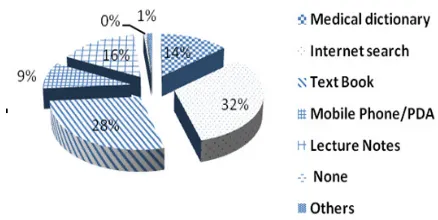
The different resources used by the students for
searching information before their second PBL session
were internet 80.3% (n=61) followed by text books
69.7% (n=53) and lecture notes 39.5% (n=30). The
details of different resources referred by the students
are presented in figure 1. Depending on their learning
pattern, our study respondents used different types of
resources for preparing for their PBL sessions. It is
paradoxically significant that majority of our study
respondents have used internet as a main source for
learning and preparing. This finding of ours was in
accordance with a study, which reported students’
reliance on electronic resources rather than the
printed materials for the learning process of PBL. [16]
Easy accessibility and availability of the information
could be the main reason for it, but there is a threat
that the available information may not be accurate or
peer reviewed and it may be misleading. [17]
Accessibility and availability of resources
Good part of the students 59 (77.6%) reported that
they were satisfied with the accessibility and
availability of various learning resources required for
the preparation for PBL session. The opinion
regarding availability and accessibility of learning
resources are presented in table 1. Our findings are in
contrast to a study, in which only 34.4% of students
reported the availability of adequate learning
resources for preparing for their PBL sessions. [1]A
study by M Das et al. has expressed that lack of
learning resources can be a factor for student
dissatisfaction in PBL. [18] Hence adequate learning
resources are a must for the proper conduct of the
PBL process which supports our study.
Presentation modes used
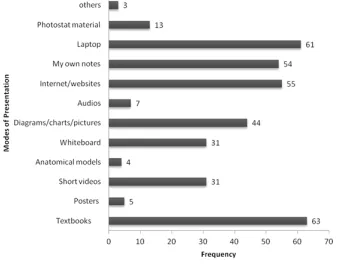
The most commonly used presentation modes by
students during the discussion & presentation of
second session of PBL were textbooks 81.6% (n=62)
followed by internet/website 71.1% (n=54) and
lecture notes 69.7% (n=53). Different presentation
modes used by the students are presented in figure2.
Fig 2: Different modes of presentation used in PBL
It is noteworthy from our study that majority of the
students utilized textbooks followed by laptop for the
power point presentation. Only very small numbers of
respondents have used other modes of presentations
such as posters, audios or anatomical models. Studies
suggest that using different modes of presentation will
help in enhancing students’ communication and
presentation skills, self-confidence, application of
acquired knowledge base and understanding group
dynamics. [19]A study conducted by Kinnunen P et al.
reports the significance of referring multiple
resources resulted in increased ability of the students
to search for the information. [20]
Challenging part of PBL
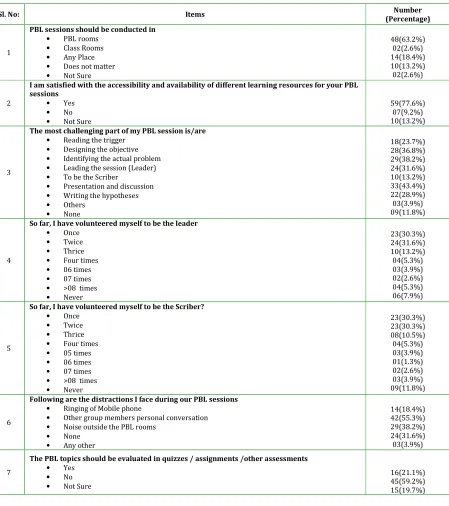
Regarding the most challenging part of the PBL
session, a total of 33 students (43.4%) reported it as
presentation and discussion . This was followed by
identifying the actual problem 38.2% (n=29) and
designing the objectives 36.8% (n=28). Different
challenges faced by the students are presented in
table 2. However, this was in contrast to a study
where identifying the actual problem and writing the
hypothesis as most challenging part of PBL. [8]
Volunteering as a Leader and Scriber
It is interesting to note that a small number of
students reported that they have never volunteered to
be a leader (n=6, 7.9%) or scriber (n=9, 11.8%) during
all the PBL sessions that they have experienced. The
details of the number of times, students volunteered
as a leader & scriber are presented in table 2.
Students who have never volunteered to be a leader
or a scriber should be identified and must be
encouraged for it. [12] Krishnan S in his study has
mentioned that students feltthe leadership role gave
them the decision making rights as well as helped
them in directing the team to successful outcomes.
[21]
Venue of PBL Sessions
Preponderance of the students 63.2% (n=48)
expressed that PBL sessions should be conducted in
PBL rooms only, whereas the choice of 14 (18.4%)
students was ‘any place’ (Table 2). Conducting PBL
sessions in the PBL rooms has an added advantage of
limiting the distractions faced by the students.
Distractions during PBL Sessions
Larger number 55.3% (n=42) of respondents reported
that other group members personal conversation was
the main distraction they faced during their sessions
followed by noise outside the PBL rooms
29(38.2%).The details of different distractions faced
by students are presented in table 2.Distractions such
phones during the learning sessions may affect the
whole PBL learning process. [22-23]
Skills gained through PBL Sessions
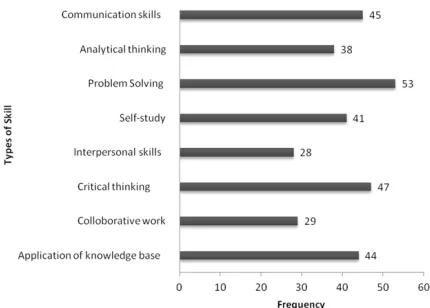
As reported, problem solving was the most important
skill gained by the students 53(69.7%)
followed by improvement in critical thinking
47(61.8%). The important skills improved by PBL
methodology have been presented in figure 3.
Fig 3: Important Skills improved through PBL
Having PBL topic related questions in exams
A good number of the students 59.2% (n=45)
expressed that the topics covered in PBL should not
be assessed in quizzes or in semester exams (Table 2).
Students’ opinion regarding the PBL sessions
Majority of the students 60 (78.9%) agreed that the
quality of the PBL triggers given to them were
excellent. This is supported by a study by O’Grady et al
who has reported that defining appropriate problem
triggers is of fundamental importance in engaging
students and in achieving the intended learning
outcomes by them. [24]
Good number of the study respondents 57(75%) also
agreed that they receive constructive feedback from
their PBL facilitators after their PBL sessions. Effective
communication is essential to the PBL process. This
involves inter group and intra group communication,
which includes facilitator-and student communication.
[23]Discussion in the tutorial groups has shown to
have positive cognitive and motivational effects on
student learning. [25]
Greater part of study respondents 47(61.8%) agreed
that “all their team members actively participated in
the PBL discussions”. However, more than half of the
study respondents 44 (57.9%) felt that some of their
group members worked more than their peers. Details
of different opinions of respondents regarding the PBL
are presented in table 3. It was noted in a study that
students during their active discussion of the PBL
problem with their peers, attempted to understand
the underlying principles or processes much better.
Moreover small group discussion helped students to
enhance their knowledge, which leads to the
improvement in their critical thinking and analyzing
skills during the problem solving. [25]It was also
shown to enhance their basic interest in the subject
matter. [25]
A good number of respondents agreed that some of
their group members worked more than their peers.
This is in agreement with a study conducted by
Chakravarthi S et al. where the students have
responded that “not all learners are active” during the
PBL learning sessions. [26] The success of PBL
depends on the collectivism of mutual trust and
confidence of each individual. [26] Group members
who are quiet and are not actively participating are
found to be a problem in PBL process The tutor should
play an important role here by finding out the exact
reasons for their being quiet and to appropriately
address the issue. [26]
CONCLUSION
Majority of the pharmacy students believed that
learning through PBL sessions is very beneficial for
them. Our study highlighted the significant role of PBL
in enhancing students problem solving, critical
thinking, literature search and most importantly
communication skills through team work. This
different mode of learning is distinct from didactic
lectures. The data obtained from the study will be
useful to improve the quality and the process of the
Table 2: Students’ opinion regarding the conduct of PBL sessions
Sl. No: Items Number
(Percentage)
1
PBL sessions should be conducted in
• PBL rooms • Class Rooms • Any Place • Does not matter • Not Sure
48(63.2%) 02(2.6%) 14(18.4%) 10(13.2%) 02(2.6%)
2
I am satisfied with the accessibility and availability of different learning resources for your PBL sessions
• Yes • No • Not Sure
59(77.6%) 07(9.2%) 10(13.2%)
3
The most challenging part of my PBL session is/are
• Reading the trigger • Designing the objective • Identifying the actual problem • Leading the session (Leader) • To be the Scriber
• Presentation and discussion • Writing the hypotheses • Others
• None
18(23.7%) 28(36.8%) 29(38.2%) 24(31.6%) 10(13.2%) 33(43.4%) 22(28.9%) 03(3.9%) 09(11.8%)
4
So far, I have volunteered myself to be the leader
• Once • Twice • Thrice • Four times • 06 times • 07 times • >08 times • Never
23(30.3%) 24(31.6%) 10(13.2%) 04(5.3%) 03(3.9%) 02(2.6%) 04(5.3%) 06(7.9%)
5
So far, I have volunteered myself to be the Scriber?
• Once • Twice • Thrice • Four times • 05 times • 06 times • 07 times • >08 times • Never
23(30.3%) 23(30.3%) 08(10.5%) 04(5.3%) 03(3.9%) 01(1.3%) 02(2.6%) 03(3.9%) 09(11.8%)
6
Following are the distractions I face during our PBL sessions
• Ringing of Mobile phone
• Other group members personal conversation • Noise outside the PBL rooms
• None • Any other
14(18.4%) 42(55.3%) 29(38.2%) 24(31.6%) 03(3.9%)
7
The PBL topics should be evaluated in quizzes / assignments /other assessments
• Yes • No • Not Sure
16(21.1%) 45(59.2%) 15(19.7%)
Table 3: Students’ attitude to the PBL sessions
Items Agree
n(%)
Strongly agree n(%)
Disagree n(%)
Strongly Disagree n(%)
As a team member I have contributed effectively 50(65.8) 26(34.2) - -
I am always in time for all my PBL sessions 41(53.9) 33(43.4) 2(2.6) -
The quality of triggers are excellent 60(78.9) 12(15.8) 4(5.3) -
Some of the group members work more than the others 44(57.9) 20(26.3) 10(13.2) 2(2.6)
I receive constructive feedback from my PBL facilitator 57(75) 12(15.8) 6(7.9) 1(1.3)
All my team members actively participate in the PBL discussion 47(61.8) 10(13.2) 18(23.7) 1(1.3)
The triggers given to us are very simple 34(44.7) 7(9.2) 32(42.1) 3(3.9)
The triggers given to us are complex 30(39.5) 3(3.9) 38(50) 5(6.6)
We distribute our work for the discussion and presentation during the
ACKNOWLEDGEMENTS
We express our sincere gratitude to the Vice
Chancellor, RAK Medical and Health Sciences
University for his encouragement and support for our
study. We thank all the students for their willingness
to take part in the study.
CONFLICT OF INTEREST
-Nil-
REFERENCES:
1. Schmidt HG. Foundations of problem-based learning:
some explanatory notes. Med Educ. 1993; 27:
422-32.
2. Erlinda T.M.M and Kaitell C.A. Problem- paradigm
shifts and their Influence on the use of based
learning in a new Canadian curriculum. J. Adv.
Nursing. 2000; 33(1): 13-19.
3. Alavi C, Problem –based learning in a health sciences
curriculum. Routeledge. London; 2007.
4. Saalu LC. Abraham AA, Aina WO. Quantitative
evaluation of third year medical students’perception
and satisfaction from problem based learning in
anatomy: A pilot study of the introduction of
problem based learning into the traditional didactic
medical curriculum in Nigeria. Educational Research
and Reviews.2010; 5(4):193-200.
5. Habib F, Baig L, Mansuri FA. Opinion of Medical
Students regarding Problem Based Learning. J Pak
Med Assoc. 2006; 56 (10): 430.
6. Roche WP, Scheetz AP, Dane FC, Parish DC. O'Shea JT.
Medical Students' Attitudes in a PBL Curriculum:
Trust, Altruism, and Cynicism. Academic Medicine.
2003; 78 (4): 398-402.
7. Schwartz P, Mennin S and Webb G. Problem-based
learning case studies, experience and practice.
Routeledge Taylor and Francis Group. London.2006;
1-3
8. Alper A. Attitudes Toward Problem Based Learning
in a New Turkish Medicine Curriculum. World
Applied Sciences Journal. 2008; 4(6): 830-836.
9. Elsie KM, Francis B, Gonzaga MA. Attitudes and
perceptions of students and teachers about problem
based learning in the radiography curriculum at
Makerere University, Uganda. European Journal of
Radiography.2009; 1:156-162.
10. Tavare V. PBL in physiotherapy: A review of
perceptions and attitudes of Students. Pacific Public
health.2006; 13(2): 137-139.
11. Hamoudi NM, Nagavi BG, Al-Azzawi AMJ. Problem
Based Learning and its Impact on Learning Behavior
of Pharmacy Students in RAK Medical and Health
Sciences University.Indian J.Pharm. Educ. Res 2010;
44(3): 206-219.
12. Reynolds F. Initial experiences of interprofessional
problem-based learning: A comparison of male and
female students’ views. J Interprof Care .2003;
17(1):35-44
13. Alghasham AA. Effect of students’ learning styles on
classroom performance in problem-based learning.
Medical teacher.2012; 34: S14–S19.
14. Kassab S, Abu-Hijleh M, Al-Shboul Q, Hamdy H.
Gender-Related Differences in Learning in
Student-Led PBL Tutorials. Education for Health.2005;
18(2):272 – 82.
15. Ghosh S, Dawka V. Combination of didactic lecture
with problem-based learning sessions in physiology
teaching in a developing medical college in Nepal.
Adv Physiol Educ. 2000 ;24(1):8-12.
16. Deretchin LF, Yeoman LC, Seidel CL. Student
information resource utilization in problem-based
learning Med Educ Online [serial online] 1998;4:7.
Available. from URL http://www.utmb.edu/meo/
17. Benigeri M and Pluye P Shortcomings of health
information on the Internet Health Promotion
International.2003;18 (4 ): 381-85
18. M Das et al Student perceptions of tutor skills in
problem-based learning Tutorials. Blackwell Science
Ltd ,Medical Education 2002;36:272-78
19. Razzaq Z, Ahsin S . PBL wrap up sessions: An
approach to enhance generic skills in medical
students. J Ayub Med Coll Abbottabad
2011;23(2):162-65.
20. Kinnunen P, Malmi L. Problems in Problem-Based
Learning –Experiences, Analysis and Lessons
Learned on an Introductory Programming Course.
Informatics in Education, 2005;4(2): 193–214
21. Krishnan S, Vale CM, Gabb R, Making PBL teams
successful-A study on student diversity in a first year
electrical engineering programme .Proceedings of
Learning, Aalborg, Denmark. Available from
www.academia.edu
22. Williams JA, Berg H, Gerber H, Miller M, Cox D,
Votteler N et al. “I get distracted by their being
distracted” Etiquette of in class texting. Eastern
Educational Journal 2011;40(1):48-56
23. Shelton JT, Elliott EM, Lynn SD, and Exner AL. The
Distracting Effects of a Ringing Cell Phone: An
Investigation of the Laboratory and the Classroom
Setting. J Environ Psychol. 2009:29(4): 513–21.
24. O'Grady M et al.Reflecting On The Need For Problem
Triggers In Multidisciplinary PBL.
AISHE-J.2013;2(5):1-21
25. Dolmans DHJM, Wolfhagen IHAP, Van der Vleuten
CPM & Wijnen WHFW Solving problems with group
work in problem-based learning: hold on to the
philosophy.Blackwell Science Ltd Medical
Education.2001;35:884-89
26. Chakravarthi S, Nagaraja HS, Judson JP. An
exploration of the strategic challenges of problem
based learning (PBL) in medical education
environment: A paradigm shift from traditional
lectures. Indian Journal of Science and Technology
2010;3(2):216-221
27. Walsh A. The tutor in problem based learning: A
novice’s guide. Program for faculty development,
Mcmaster university, Canada.2005. Available from:
http://fhs.mcmaster.ca/facdev/documents/tutorPB
L.pdf
How to cite this article: Sathvik B. S*, Smitha C Francis,
Padma G. M Rao, B. G Nagavi; Attitudes and Perceptions of Pharmacy Students of Ras Al Khaimah towards Problem Based Learning; J. Adv. Pharm. Edu. & Res. 2013: 3(3): 217-225.