Copyright © 2014 IJECCE, All right reserved
International Journal of Electronics Communication and Computer Engineering Volume 5, Issue 1, ISSN (Online): 2249–071X, ISSN (Print): 2278–4209
Cloud Computing Technology in Iran: Opportunities,
Threats
Elias Fathi Kiadehi, Shahriar Mohammadi
Abstract–Cloud computing is a technology that uses the internet as a base for service provision. Some strategies are provided to implement and adopt cloud computing by organizations and enterprises. The Main purpose of these strategies is to help organizations to adopt cloud computing opportunities and prevent its threats. In this article, we tried to assess different aspects and strengths, weaknesses, opportunities and threats of these strategies for Iranian organizations and enterprises.
In addition some recommendations are provided for Iranian organizations and enterprises to help them to adopt cloud computing technology. In section one, an introduction to cloud computing technology and its specification is provided. In section two, a literature review about cloud computing services, models and strategies is provided. In section three, strengths, weaknesses, opportunities and threats of cloud computing and in section four, some recommendations for cloud computing adoption in Iranian organizations and enterprises are provided.
Keywords–Cloud Computing, Implementation Strategies, Iranian Organizations and Enterprises, Opportunities, Strengths, Threats, Weaknesses.
I. INTRODUCTION
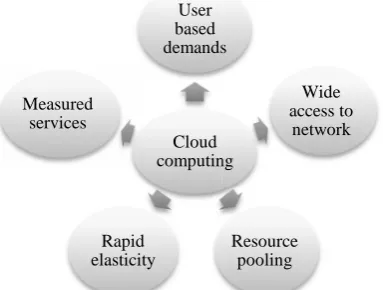
The National Institute of Standard and Technology (NIST) defined cloud computing as a model for network access to configurable and demand-based computing resources. These computing resources can be networks, servers, storage media, applications and services. Provided services can be accessed with minimum managerial efforts with high quality and low price.[1]NIST defined five qualities for cloud computing which are shown in Fig.I
Cloud computing services can be provided based on user's demand; these services can be accessed from network and standard mechanism. Based on cloud structure, resources are shared with a multi-tenant model, among some service consumers. This service can be changed based on user's needed capabilities and is managed, monitored and reported automatically. Cloud computing providers divide cloud infrastructure like data centers within different centers to optimize accessibility and decrease costs. [2]
II. LITERATURE
REVIEW
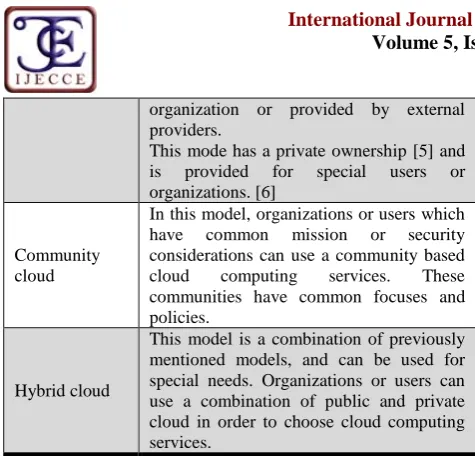
Users can access cloud computing services, using three services. These three services are shown in table I. Users can choose their needed services based on their needed service level and type. NIST defined four deployment models for cloud computing. These four models are provided in table II.
Different articles are provided to introduce and implement cloud computing as a new technology. These
articles include some topics such as identifying organizations and enterprises readiness to adopt cloud computing technology, returning of the investment modeling, business perspective of cloud computing, cloud manufacturing, cloud computing roles in competitive advantage improvement, cloud computing roles in e-government and e-voting security, cloud related risk and security considerations.
Fig.I. NIST five cloud computing qualities Table I: Cloud computing services
Service type Description
Infrastructure as a service (IaaS)
In this service, IT infrastructure is provided as a service for customers. These infrastructures include hardware, software, computing power, memory and etc. which are provided by virtual machine. [3]
Platform as a service (PaaS)
In this service, a platform for users to create software is provided. Users can run their own software or use created software by other users.
Microsoft Azure is an example of this service.
Software as a service (SaaS)
In this service, software is provided as a service for customers. [4]
Users have no controls on cloud's platform and infrastructure and have limited control on software configurations. [4]
Table II: Cloud computing deployment model
Deployment model
Description
Public cloud
In this model, cloud computing infrastructure is shared among different users. Different users' infrastructures are separated by virtual machines and users do not have access to other users' information. These services have low price and is provided to all customers.
Private cloud
In this model, cloud infrastructure is provided separately for customers. Cloud infrastructure can be inside of an Copyright © 2014 IJECCE, All right reserved
International Journal of Electronics Communication and Computer Engineering Volume 5, Issue 1, ISSN (Online): 2249–071X, ISSN (Print): 2278–4209
Cloud Computing Technology in Iran: Opportunities,
Threats
Elias Fathi Kiadehi, Shahriar Mohammadi
Abstract–Cloud computing is a technology that uses the internet as a base for service provision. Some strategies are provided to implement and adopt cloud computing by organizations and enterprises. The Main purpose of these strategies is to help organizations to adopt cloud computing opportunities and prevent its threats. In this article, we tried to assess different aspects and strengths, weaknesses, opportunities and threats of these strategies for Iranian organizations and enterprises.
In addition some recommendations are provided for Iranian organizations and enterprises to help them to adopt cloud computing technology. In section one, an introduction to cloud computing technology and its specification is provided. In section two, a literature review about cloud computing services, models and strategies is provided. In section three, strengths, weaknesses, opportunities and threats of cloud computing and in section four, some recommendations for cloud computing adoption in Iranian organizations and enterprises are provided.
Keywords–Cloud Computing, Implementation Strategies, Iranian Organizations and Enterprises, Opportunities, Strengths, Threats, Weaknesses.
I. INTRODUCTION
The National Institute of Standard and Technology (NIST) defined cloud computing as a model for network access to configurable and demand-based computing resources. These computing resources can be networks, servers, storage media, applications and services. Provided services can be accessed with minimum managerial efforts with high quality and low price.[1]NIST defined five qualities for cloud computing which are shown in Fig.I
Cloud computing services can be provided based on user's demand; these services can be accessed from network and standard mechanism. Based on cloud structure, resources are shared with a multi-tenant model, among some service consumers. This service can be changed based on user's needed capabilities and is managed, monitored and reported automatically. Cloud computing providers divide cloud infrastructure like data centers within different centers to optimize accessibility and decrease costs. [2]
II. LITERATURE
REVIEW
Users can access cloud computing services, using three services. These three services are shown in table I. Users can choose their needed services based on their needed service level and type. NIST defined four deployment models for cloud computing. These four models are provided in table II.
Different articles are provided to introduce and implement cloud computing as a new technology. These
articles include some topics such as identifying organizations and enterprises readiness to adopt cloud computing technology, returning of the investment modeling, business perspective of cloud computing, cloud manufacturing, cloud computing roles in competitive advantage improvement, cloud computing roles in e-government and e-voting security, cloud related risk and security considerations.
Fig.I. NIST five cloud computing qualities Table I: Cloud computing services
Service type Description
Infrastructure as a service (IaaS)
In this service, IT infrastructure is provided as a service for customers. These infrastructures include hardware, software, computing power, memory and etc. which are provided by virtual machine. [3]
Platform as a service (PaaS)
In this service, a platform for users to create software is provided. Users can run their own software or use created software by other users.
Microsoft Azure is an example of this service.
Software as a service (SaaS)
In this service, software is provided as a service for customers. [4]
Users have no controls on cloud's platform and infrastructure and have limited control on software configurations. [4]
Table II: Cloud computing deployment model
Deployment model
Description
Public cloud
In this model, cloud computing infrastructure is shared among different users. Different users' infrastructures are separated by virtual machines and users do not have access to other users' information. These services have low price and is provided to all customers.
Private cloud
In this model, cloud infrastructure is provided separately for customers. Cloud infrastructure can be inside of an
Cloud computing User based demands Resource pooling Rapid elasticity Measured services
Copyright © 2014 IJECCE, All right reserved
International Journal of Electronics Communication and Computer Engineering Volume 5, Issue 1, ISSN (Online): 2249–071X, ISSN (Print): 2278–4209
Cloud Computing Technology in Iran: Opportunities,
Threats
Elias Fathi Kiadehi, Shahriar Mohammadi
Abstract–Cloud computing is a technology that uses the internet as a base for service provision. Some strategies are provided to implement and adopt cloud computing by organizations and enterprises. The Main purpose of these strategies is to help organizations to adopt cloud computing opportunities and prevent its threats. In this article, we tried to assess different aspects and strengths, weaknesses, opportunities and threats of these strategies for Iranian organizations and enterprises.
In addition some recommendations are provided for Iranian organizations and enterprises to help them to adopt cloud computing technology. In section one, an introduction to cloud computing technology and its specification is provided. In section two, a literature review about cloud computing services, models and strategies is provided. In section three, strengths, weaknesses, opportunities and threats of cloud computing and in section four, some recommendations for cloud computing adoption in Iranian organizations and enterprises are provided.
Keywords–Cloud Computing, Implementation Strategies, Iranian Organizations and Enterprises, Opportunities, Strengths, Threats, Weaknesses.
I. INTRODUCTION
The National Institute of Standard and Technology (NIST) defined cloud computing as a model for network access to configurable and demand-based computing resources. These computing resources can be networks, servers, storage media, applications and services. Provided services can be accessed with minimum managerial efforts with high quality and low price.[1]NIST defined five qualities for cloud computing which are shown in Fig.I
Cloud computing services can be provided based on user's demand; these services can be accessed from network and standard mechanism. Based on cloud structure, resources are shared with a multi-tenant model, among some service consumers. This service can be changed based on user's needed capabilities and is managed, monitored and reported automatically. Cloud computing providers divide cloud infrastructure like data centers within different centers to optimize accessibility and decrease costs. [2]
II. LITERATURE
REVIEW
Users can access cloud computing services, using three services. These three services are shown in table I. Users can choose their needed services based on their needed service level and type. NIST defined four deployment models for cloud computing. These four models are provided in table II.
Different articles are provided to introduce and implement cloud computing as a new technology. These
articles include some topics such as identifying organizations and enterprises readiness to adopt cloud computing technology, returning of the investment modeling, business perspective of cloud computing, cloud manufacturing, cloud computing roles in competitive advantage improvement, cloud computing roles in e-government and e-voting security, cloud related risk and security considerations.
Fig.I. NIST five cloud computing qualities Table I: Cloud computing services
Service type Description
Infrastructure as a service (IaaS)
In this service, IT infrastructure is provided as a service for customers. These infrastructures include hardware, software, computing power, memory and etc. which are provided by virtual machine. [3]
Platform as a service (PaaS)
In this service, a platform for users to create software is provided. Users can run their own software or use created software by other users.
Microsoft Azure is an example of this service.
Software as a service (SaaS)
In this service, software is provided as a service for customers. [4]
Users have no controls on cloud's platform and infrastructure and have limited control on software configurations. [4]
Table II: Cloud computing deployment model
Deployment model
Description
Public cloud
In this model, cloud computing infrastructure is shared among different users. Different users' infrastructures are separated by virtual machines and users do not have access to other users' information. These services have low price and is provided to all customers.
Private cloud
In this model, cloud infrastructure is provided separately for customers. Cloud infrastructure can be inside of an
Copyright © 2014 IJECCE, All right reserved
International Journal of Electronics Communication and Computer Engineering Volume 5, Issue 1, ISSN (Online): 2249–071X, ISSN (Print): 2278–4209
organization or provided by external providers.
This mode has a private ownership [5] and is provided for special users or organizations. [6]
Community cloud
In this model, organizations or users which have common mission or security considerations can use a community based cloud computing services. These communities have common focuses and policies.
Hybrid cloud
This model is a combination of previously mentioned models, and can be used for special needs. Organizations or users can use a combination of public and private cloud in order to choose cloud computing services.
In recent years, some strategies are provided by different governments and responsible organizations to adopt and implement cloud computing technology. The main objectives of these strategies are about organizations and governments awareness from cloud computing opportunities and threats and the provision of a framework in order to make decision about the adoption and implementation of cloud computing. In table III, these strategies are summarized.
Federal cloud computing strategy [4] is provided by Chief Information Officer (CIO) of U.S government in February 2011. This strategy, which uses cloud computing strengths and weaknesses, provides a decision framework to help organizations in the way of cloud adoption.
In addition, some cases are provided to support organizations.
Provided decision framework has three steps of “select”, “provision” and “manage”. In the first step, candidate
services are selected for cloud transition. In addition, organizations readiness for this transition is assessed.
In the second step, cloud computing provisions and guides are discussed. In the third step of this strategy, cloud computing accelerators are discussed. These accelerators include cloud computing accelerator, confident and secure environment, procurement processes simplification, international dimension of cloud computing and foundation of a strategy governance.
Table III: Cloud computing strategies
Strategy Name Scope Date of Publish
Federal Cloud Computing strategy
All
organizations
2011
Department of Defense (DOD) Cloud
Computing strategy
DOD Agencies
2012
Federal Aviation Administration(FAA) Cloud Computing strategy
FAA's NAS and non-NAS systems
2012
An Australian government strategic approach to Cloud implementation
All
organizations
2012
Department of Defense (DOD) cloud computing strategy [7] is published by the U.S department of defense
in 2012. This strategy used the federal cloud computing strategy as a base and its goal is about implementing cloud computing in order to support DOD missions for anywhere and at any time. This strategy includes cloud computing adoption promotion, data centers consolidations, DOD enterprise cloud computing infrastructure establishment, and continuing to provide cloud services.
DOD cloud computing strategy has four planned phases
in order to adopt DOD’s cloud computing services. The main goals of this strategy can be concluded as following: decreasing he costs and increasing the operations efficiency, increasing the mission efficiency and cyberspace security. Some steps are suggested by this strategy in order to adopt cloud computing which include DOD enterprise cloud governance and adopting a strategic first approach.
Federal Aviation Administration (FAA) cloud computing strategy [8] is published by the U.S federal aviation administration in 2012. The purpose of this strategy is defining and expanding a cloud computing strategy to adopt cloud opportunities and provision of secure, confident service environment for aviation administration systems. This strategy is a guide for organizations to identify services, decrease costs, increase speed, security and performance. In order to achieve the desired goals, some objectives are defined by this strategy including adopting a wide approach, developing a cloud computing architecture, developing a cloud computing strategy and increasing efficiency on IT investments.
Based on this strategy, cloud computing implementation
will take place in three phases including “Foundation”, “Manage”, and “Optimize”. The First phase goal is to create a base to acquire cloud computing benefits. The Second phase goal is to practice the related technology development and the third phase goal is to increase the
organization’s practices and technologies.
Australian strategic approach to cloud computing [2] is a risk based approach to develop and implement cloud computing in organizations.
In this strategy, a strategic approach will be presented to guide organizations and enterprises to identify cloud opportunities. Some steps are proposed by this strategy in order to establish a direction for cloud computing implementation.
These steps include “suitability assessment”, “considering timing and triggers”, “considering financial
impacts and considerations”, “changing management”, “governance review”, “creating a business model”, “risk assessment”, “requirement gathering”, “building a
business case”, “providing an exit strategy”, “defining contractual terms”, “approaching the market”, “provider
selection”, and “designingto implement”.
III. CLOUD
COMPUTING' SWOT FOR
IRAN
Copyright © 2014 IJECCE, All right reserved
International Journal of Electronics Communication and Computer Engineering Volume 5, Issue 1, ISSN (Online): 2249–071X, ISSN (Print): 2278–4209
organization and industries. In this section with a focus on cloud computing strengths and weaknesses tried to derive these strengths and weaknesses for Iranian organizations and industries.
Cloud computing strengths and opportunities vs. weaknesses and threats for Iranian organizations and industries are summarized in table IV.
A. Cloud computing weaknesses and threats for
Iranian organizations and industries
Cloud computing has many strengths and opportunities for Iranian organizations and industries.
Service scalability
Aligned with unpredicted service demands, cloud computing shows its better functionality. Cloud computing can respond best to demand changes. Scalability is the provision of this specification for Iranian organizations and industries to be more flexible against IT demand changes. This specification leads to improve IT service provision. In some applications in which this unpredicted demand is associated with a period of time, this specification shows most of its functionalities.
Financial efficiency
In Cloud computing model, customers will pay based on their service usage. According to cloud service scalability, by using cloud computing, IT infrastructure needs to respond to unpredicted demand will be decreased. In addition, a dramatically decrease in IT costs will occur due to service transition to cloud computing. Using cloud computing, IT costs such as infrastructure, maintenance and operational costs will be decreased.
Efficiency in the use of IT
Iranian organizations and industries can be more efficient with some features such as the increase of IT infrastructure usage, the creation of new technical and economical solution which is not possible without cloud computing, prototyping and acceptance review for new approaches. In addition, IT services will be more resistant against substitution threats.
Table IV: Cloud computing strengths and opportunities vs. weaknesses and threats for Iranian organizations and
industries
Strengths and opportunities Weaknesses and threats
-Service scalability [8,9,10] -Financial efficiency [7,8,10] -Efficiency in the use of IT [7,8] -Service agility [7,10]
-Availability [4,10] -Innovation [4,10]
-IT development in small and medium size industries(SME’s) [10]
-Using cloud service in the development of e-learning and e-education [11] -Using cloud service in order to develop and implement enterprise resource planning systems and customers' relationships management [12,13] -Using cloud computing service in order to realize e-government and e-voting [14]
-Using cloud computing in teleworking - Green IT deployment [13]
Security and -privacy [9] -Change in organizational -structure [9] -Performance [9] -Financial [9] -Legal [9] -Learning [9] -Sanctions -Lack of standards
Service agility
When responding to emergency needs, Iranian organizations and industries can easily and rapidly increase or decrease their needed computing power.
Availability
Cloud computing services are designed to be compatible with network needs. In addition, service availability from anywhere and at any time can increase availability level of Iranian organizations and industries.
Innovation
Provided service by cloud computing can be more innovative than other services. Using innovative feature of cloud computing, Iranian organization and industries can expand their organizational cultures.
IT development in small and medium-sized
industries(SME’s)
Iranian small and medium-sized industries are faced with the problems in their services because of low IT budget. Cloud computing provides some opportunities for organization which have low investment power on IT infrastructures. These organizations can use cloud computing technologies to expand IT services.
Using cloud service in developing e-learning and
e-education
Using cloud computing technology, Iranian organizations and industries can access the educational services collaboratively and beyond the geographic. This level of access improves staffs' educational level.
Using cloud service in order to develop and
implement enterprise resource planning systems and
customers' relationships management
Iranian SME’s are faced with many problems in the context of enterprise resource planning (ERP) and customer relationships management (CRM) systems. These problems include: high investment power, security and privacy considerations.
ERP service based on cloud computing technology can help organization to acquire cloud opportunities. In this context, provision of such services is essential and Iranian government can play vital role with provision of enterprise resource planning services based on cloud computing technology.
Using cloud computing service to realize
e-government and e-voting
Cloud computing roles in provision of such services is highlighted every day. Iranian government can use these opportunity to improve its e-government and e-voting. Cloud computing can play an important role in this topic by the provision of communication channels and elimination of barriers.
Using cloud computing in teleworking
Copyright © 2014 IJECCE, All right reserved
International Journal of Electronics Communication and Computer Engineering Volume 5, Issue 1, ISSN (Online): 2249–071X, ISSN (Print): 2278–4209
Green IT expansion
Using power saving mechanisms, cloud computing deploys green IT. The decrease of IT infrastructures and aggregation and transition of these infrastructures into cloud computing service leads to decrease in environmental pollution.
B. Cloud computing weaknesses and threats for
Iranian organizations and industries
Cloud computing provides some strengths and opportunities for Iranian organizations and industries; in contrast, cloud computing has some weaknesses and threats. These weaknesses and threats are described as follows:
Security and privacy
One of the most important cloud computing challenges against Iranian organizations and industries is security. The internet is used by cloud computing technology as a base for service provision. Lack of access to the internet may cause lack of cloud service availability. In addition all risks and threats to the internet for Iranian organizations and industries will also associate with cloud computing technology. In public platforms of cloud computing due to adjacent physical data and users' environments, some threats such as information leakage, side channels, covert channels and etc. may occur. Privacy of users or organization is at risks because of access to sensitive information. Damage that may be caused from security risks for Iranian organizations and industries is very serious that make organizations consider such risks before any decision to adopt cloud computing technology.
Change in organizational structure
Cloud computing framework will change organizational structure. Organizations and industries in Iran must assess their business processes and organization for compatibility with cloud computing and overcome any obstacles before any decisions. Some skills such as project, change and contract management should be considered.
Financial
Cloud computing changes IT budget from capital to operational. This change must be considered in the case of organizations budgeting process.
Legal
With storing data in third country, Iranian organizations and industries should be aware of legal issues in the field of international and national law of both source and destination countries.
Learning
In cloud computing adoption by Iranian organizations and industries, consider staffs and IT managers' training is important.
Sanctions
One of the threats that the Iranian organizations and industries are faced with isthe threat of international sanctions. If an organization moves its data and critical applications to provided cloud service by international providers, risk of unavailability due to sanctions would be immense. Therefore, it's recommended that the government provides a framework to stop this threat.
Lack of standards
Because of poor standards in cloud infrastructures and services, there is a risk of inconsistent service which is provided by different providers. In this context, governmental agencies are responsible for the task of writing and publishing standards for cloud computing services.
IV. RESULT AND
DISCUSSION
In order to introduce the benefit and opportunities that cloud computing brings for Iranian organizations and industries, the need to develop a strategy in this area seems critical for responsible organizations. With provision of cloud computing strategies in the world and highlighting its roles and applications in organizations and industries, responsible organizations and agencies must play their roles in the deployment of this technology with formulation of a systematic and integrated strategy.
In this section, we tried to use important strategies in the world and cloud computing opportunities for Irani an organizations and industries to develop a framework in order to help them in developing their own strategies.
Organizations and industries can use these guidelines to make decision about cloud computing implementation and also to implement a correct and effective strategy.
This framework is provided to prepare a decision making framework and present some steps for cloud computing implementation.
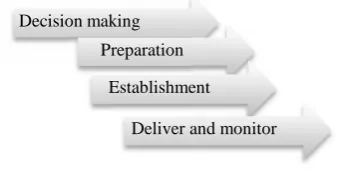
In Fig.II, proposed steps for cloud adoption and implementation by Iranian organization and industries are shown.
Fig. II. Proposed steps for cloud adoption and implementation in Iran
In the proposed framework, the implementation of cloud computing in Iranian organizations and industries is proposed in four steps. For each step, some suggestionsare proposed using current cloud computing strategies as a guide for organizations and industries to be used in this context.
Step I: Decision making
In this step, organizations readiness to implement cloud computing technology is assessed. Toward this assessment, value resources and readiness of the organization to implement cloud computing is investigated. In the first move, the value resources for cloud computing must be determined. These resources include cloud computing strengths and opportunities. These strengths and opportunities are agility, efficiency, cost saving, availability and etc. according to these values and resources, organizations and industries must make Copyright © 2014 IJECCE, All right reserved
International Journal of Electronics Communication and Computer Engineering Volume 5, Issue 1, ISSN (Online): 2249–071X, ISSN (Print): 2278–4209
Green IT expansion
Using power saving mechanisms, cloud computing deploys green IT. The decrease of IT infrastructures and aggregation and transition of these infrastructures into cloud computing service leads to decrease in environmental pollution.
B. Cloud computing weaknesses and threats for
Iranian organizations and industries
Cloud computing provides some strengths and opportunities for Iranian organizations and industries; in contrast, cloud computing has some weaknesses and threats. These weaknesses and threats are described as follows:
Security and privacy
One of the most important cloud computing challenges against Iranian organizations and industries is security. The internet is used by cloud computing technology as a base for service provision. Lack of access to the internet may cause lack of cloud service availability. In addition all risks and threats to the internet for Iranian organizations and industries will also associate with cloud computing technology. In public platforms of cloud computing due to adjacent physical data and users' environments, some threats such as information leakage, side channels, covert channels and etc. may occur. Privacy of users or organization is at risks because of access to sensitive information. Damage that may be caused from security risks for Iranian organizations and industries is very serious that make organizations consider such risks before any decision to adopt cloud computing technology.
Change in organizational structure
Cloud computing framework will change organizational structure. Organizations and industries in Iran must assess their business processes and organization for compatibility with cloud computing and overcome any obstacles before any decisions. Some skills such as project, change and contract management should be considered.
Financial
Cloud computing changes IT budget from capital to operational. This change must be considered in the case of organizations budgeting process.
Legal
With storing data in third country, Iranian organizations and industries should be aware of legal issues in the field of international and national law of both source and destination countries.
Learning
In cloud computing adoption by Iranian organizations and industries, consider staffs and IT managers' training is important.
Sanctions
One of the threats that the Iranian organizations and industries are faced with isthe threat of international sanctions. If an organization moves its data and critical applications to provided cloud service by international providers, risk of unavailability due to sanctions would be immense. Therefore, it's recommended that the government provides a framework to stop this threat.
Lack of standards
Because of poor standards in cloud infrastructures and services, there is a risk of inconsistent service which is provided by different providers. In this context, governmental agencies are responsible for the task of writing and publishing standards for cloud computing services.
IV. RESULT AND
DISCUSSION
In order to introduce the benefit and opportunities that cloud computing brings for Iranian organizations and industries, the need to develop a strategy in this area seems critical for responsible organizations. With provision of cloud computing strategies in the world and highlighting its roles and applications in organizations and industries, responsible organizations and agencies must play their roles in the deployment of this technology with formulation of a systematic and integrated strategy.
In this section, we tried to use important strategies in the world and cloud computing opportunities for Irani an organizations and industries to develop a framework in order to help them in developing their own strategies.
Organizations and industries can use these guidelines to make decision about cloud computing implementation and also to implement a correct and effective strategy.
This framework is provided to prepare a decision making framework and present some steps for cloud computing implementation.
In Fig.II, proposed steps for cloud adoption and implementation by Iranian organization and industries are shown.
Fig. II. Proposed steps for cloud adoption and implementation in Iran
In the proposed framework, the implementation of cloud computing in Iranian organizations and industries is proposed in four steps. For each step, some suggestionsare proposed using current cloud computing strategies as a guide for organizations and industries to be used in this context.
Step I: Decision making
In this step, organizations readiness to implement cloud computing technology is assessed. Toward this assessment, value resources and readiness of the organization to implement cloud computing is investigated. In the first move, the value resources for cloud computing must be determined. These resources include cloud computing strengths and opportunities. These strengths and opportunities are agility, efficiency, cost saving, availability and etc. according to these values and resources, organizations and industries must make
Decision making
Preparation
Establishment
Deliver and monitor
Copyright © 2014 IJECCE, All right reserved
International Journal of Electronics Communication and Computer Engineering Volume 5, Issue 1, ISSN (Online): 2249–071X, ISSN (Print): 2278–4209
Green IT expansion
Using power saving mechanisms, cloud computing deploys green IT. The decrease of IT infrastructures and aggregation and transition of these infrastructures into cloud computing service leads to decrease in environmental pollution.
B. Cloud computing weaknesses and threats for
Iranian organizations and industries
Cloud computing provides some strengths and opportunities for Iranian organizations and industries; in contrast, cloud computing has some weaknesses and threats. These weaknesses and threats are described as follows:
Security and privacy
One of the most important cloud computing challenges against Iranian organizations and industries is security. The internet is used by cloud computing technology as a base for service provision. Lack of access to the internet may cause lack of cloud service availability. In addition all risks and threats to the internet for Iranian organizations and industries will also associate with cloud computing technology. In public platforms of cloud computing due to adjacent physical data and users' environments, some threats such as information leakage, side channels, covert channels and etc. may occur. Privacy of users or organization is at risks because of access to sensitive information. Damage that may be caused from security risks for Iranian organizations and industries is very serious that make organizations consider such risks before any decision to adopt cloud computing technology.
Change in organizational structure
Cloud computing framework will change organizational structure. Organizations and industries in Iran must assess their business processes and organization for compatibility with cloud computing and overcome any obstacles before any decisions. Some skills such as project, change and contract management should be considered.
Financial
Cloud computing changes IT budget from capital to operational. This change must be considered in the case of organizations budgeting process.
Legal
With storing data in third country, Iranian organizations and industries should be aware of legal issues in the field of international and national law of both source and destination countries.
Learning
In cloud computing adoption by Iranian organizations and industries, consider staffs and IT managers' training is important.
Sanctions
One of the threats that the Iranian organizations and industries are faced with isthe threat of international sanctions. If an organization moves its data and critical applications to provided cloud service by international providers, risk of unavailability due to sanctions would be immense. Therefore, it's recommended that the government provides a framework to stop this threat.
Lack of standards
Because of poor standards in cloud infrastructures and services, there is a risk of inconsistent service which is provided by different providers. In this context, governmental agencies are responsible for the task of writing and publishing standards for cloud computing services.
IV. RESULT AND
DISCUSSION
In order to introduce the benefit and opportunities that cloud computing brings for Iranian organizations and industries, the need to develop a strategy in this area seems critical for responsible organizations. With provision of cloud computing strategies in the world and highlighting its roles and applications in organizations and industries, responsible organizations and agencies must play their roles in the deployment of this technology with formulation of a systematic and integrated strategy.
In this section, we tried to use important strategies in the world and cloud computing opportunities for Irani an organizations and industries to develop a framework in order to help them in developing their own strategies.
Organizations and industries can use these guidelines to make decision about cloud computing implementation and also to implement a correct and effective strategy.
This framework is provided to prepare a decision making framework and present some steps for cloud computing implementation.
In Fig.II, proposed steps for cloud adoption and implementation by Iranian organization and industries are shown.
Fig. II. Proposed steps for cloud adoption and implementation in Iran
In the proposed framework, the implementation of cloud computing in Iranian organizations and industries is proposed in four steps. For each step, some suggestionsare proposed using current cloud computing strategies as a guide for organizations and industries to be used in this context.
Step I: Decision making
In this step, organizations readiness to implement cloud computing technology is assessed. Toward this assessment, value resources and readiness of the organization to implement cloud computing is investigated. In the first move, the value resources for cloud computing must be determined. These resources include cloud computing strengths and opportunities. These strengths and opportunities are agility, efficiency, cost saving, availability and etc. according to these values and resources, organizations and industries must make
Preparation
Establishment
Copyright © 2014 IJECCE, All right reserved
International Journal of Electronics Communication and Computer Engineering Volume 5, Issue 1, ISSN (Online): 2249–071X, ISSN (Print): 2278–4209
decision about the implementation of cloud computing services.
In Fig.III, some specifications are provided which can be valuable in identifying suitable service that has high priorities to move in cloud computing services. [4]
In order to identify the resources value, the following steps can be used [8]:
1. Conducting an extensive and comprehensive analysis of an organization's IT environment to identify cloud computing adoption candidates.
2. Candidates' prioritizing based on the benefits and risks. 3. Developing a business model to measure the value and
benefits derived from the candidates.
4. Identifying the models to analyze the value of cloud computing.
Fig.III. Suitable services specification to move in cloud computing.
The second move in this step is to assess readiness of the organizations to adopt cloud computing. In this field, some factors including: security, market and service specifications, government readiness and technology life cycle can be mentioned. [4]Organization readiness considerations for cloud adoption are mentioned as follows:
Security: laws and organizational needs, Data specifications, Privacy and confidentially, Integration, Data control, Access policies, Governance. [4]
Service specifications: Interoperability, Availability, Performance, Reliability, Portability [4].
Market specification: Market landscape, Maturing cloud market competition, Ability to move among multiple service providers and distributors [4].
Governmental service specification: Availability of network infrastructure and needed software, capable managers, negotiation ability, relevant technical experience, Change management culture [4].
Step II: Preparation
This step is preparation of needed platform for the transition to the cloud computing technology. In this step, some technical and managerial considerations are provided to prepare organizations and industries to adopt cloud computing. These technical and managerial considerations are summarized as follows:
Technical:
o Gathering department's requirements.
o Ensuring the interoperability and integration with IT cases. [4]
o Deciding on the necessary components in order to move data to cloud computing to create a balance between the benefits and risks of cloud computing. [7] o Analysis, measure
o Evaluation of technology and market perspective to ensure the adoption process and support the transition to cloud computing. [8]
o Identifying and adopting tactical cloud computing standards. [8]
o Reviewing system engineering processes throughout the organizations life cycle, in order to ensure the adoption and transition process support. [8]
o Checking the compatibility of current software to run on a cloud computing platform. [8]
o Requirement gathering. [2] o Building a business case. [2] o Preparing an exit strategy. [2]
o Developing a risk assessment of cloud computing in the organization to identify risks associated with IT environment. [8]
o Considering timing and triggers. [2]
o Converting systems and processes to an integrated, cooperative, united and with integrated and data centric organizational data environment. [7]
Managerial:
o Changing IT mindset from equipment thinking to service thinking. [4]
o Creating a new set of skills depending on the needs. [4] o Creating a risk management plan to address cloud
computing challenges. [7]
o Contracting effectively and ensuring that it meets the organizational needs. [4]
o Working effectively with key leaders and stakeholders of organization. [7]
o Investing and revising on the organization's IT roadmap [7]
o Creating plan and policies to implement cloud computing. [8]
o Reviewing exiting IT governance model and developing a governance model related to organization's strategy. [8]
o Identifying and reviewing all related policies to ensure support for cloud computing services. [8]
o Developing guidelines to guide adoption and transition to cloud computing services. [8]
o Determining and disseminating of policies to guide all relevant programs. [7,8]
Step III: Establishment of cloud computing
infrastructure
After the preparations for the adoption of cloud computing, organization can implement their suitable cloud computing. In this context, the following considerations can assist organizations in the establishment of the cloud infrastructure. These considerations include: High per user costs High update costs Fragmented
High costs for capacity change
Innovative
Copyright © 2014 IJECCE, All right reserved
International Journal of Electronics Communication and Computer Engineering Volume 5, Issue 1, ISSN (Online): 2249–071X, ISSN (Print): 2278–4209
decision about the implementation of cloud computing services.
In Fig.III, some specifications are provided which can be valuable in identifying suitable service that has high priorities to move in cloud computing services. [4]
In order to identify the resources value, the following steps can be used [8]:
1. Conducting an extensive and comprehensive analysis of an organization's IT environment to identify cloud computing adoption candidates.
2. Candidates' prioritizing based on the benefits and risks. 3. Developing a business model to measure the value and
benefits derived from the candidates.
4. Identifying the models to analyze the value of cloud computing.
Fig.III. Suitable services specification to move in cloud computing.
The second move in this step is to assess readiness of the organizations to adopt cloud computing. In this field, some factors including: security, market and service specifications, government readiness and technology life cycle can be mentioned. [4]Organization readiness considerations for cloud adoption are mentioned as follows:
Security: laws and organizational needs, Data specifications, Privacy and confidentially, Integration, Data control, Access policies, Governance. [4]
Service specifications: Interoperability, Availability, Performance, Reliability, Portability [4].
Market specification: Market landscape, Maturing cloud market competition, Ability to move among multiple service providers and distributors [4].
Governmental service specification: Availability of network infrastructure and needed software, capable managers, negotiation ability, relevant technical experience, Change management culture [4].
Step II: Preparation
This step is preparation of needed platform for the transition to the cloud computing technology. In this step, some technical and managerial considerations are provided to prepare organizations and industries to adopt cloud computing. These technical and managerial considerations are summarized as follows:
Technical:
o Gathering department's requirements.
o Ensuring the interoperability and integration with IT cases. [4]
o Deciding on the necessary components in order to move data to cloud computing to create a balance between the benefits and risks of cloud computing. [7] o Analysis, measure
o Evaluation of technology and market perspective to ensure the adoption process and support the transition to cloud computing. [8]
o Identifying and adopting tactical cloud computing standards. [8]
o Reviewing system engineering processes throughout the organizations life cycle, in order to ensure the adoption and transition process support. [8]
o Checking the compatibility of current software to run on a cloud computing platform. [8]
o Requirement gathering. [2] o Building a business case. [2] o Preparing an exit strategy. [2]
o Developing a risk assessment of cloud computing in the organization to identify risks associated with IT environment. [8]
o Considering timing and triggers. [2]
o Converting systems and processes to an integrated, cooperative, united and with integrated and data centric organizational data environment. [7]
Managerial:
o Changing IT mindset from equipment thinking to service thinking. [4]
o Creating a new set of skills depending on the needs. [4] o Creating a risk management plan to address cloud
computing challenges. [7]
o Contracting effectively and ensuring that it meets the organizational needs. [4]
o Working effectively with key leaders and stakeholders of organization. [7]
o Investing and revising on the organization's IT roadmap [7]
o Creating plan and policies to implement cloud computing. [8]
o Reviewing exiting IT governance model and developing a governance model related to organization's strategy. [8]
o Identifying and reviewing all related policies to ensure support for cloud computing services. [8]
o Developing guidelines to guide adoption and transition to cloud computing services. [8]
o Determining and disseminating of policies to guide all relevant programs. [7,8]
Step III: Establishment of cloud computing
infrastructure
After the preparations for the adoption of cloud computing, organization can implement their suitable cloud computing. In this context, the following considerations can assist organizations in the establishment of the cloud infrastructure. These considerations include: Low usage rate High maintainance costs High update costs
Copyright © 2014 IJECCE, All right reserved
International Journal of Electronics Communication and Computer Engineering Volume 5, Issue 1, ISSN (Online): 2249–071X, ISSN (Print): 2278–4209
decision about the implementation of cloud computing services.
In Fig.III, some specifications are provided which can be valuable in identifying suitable service that has high priorities to move in cloud computing services. [4]
In order to identify the resources value, the following steps can be used [8]:
1. Conducting an extensive and comprehensive analysis of an organization's IT environment to identify cloud computing adoption candidates.
2. Candidates' prioritizing based on the benefits and risks. 3. Developing a business model to measure the value and
benefits derived from the candidates.
4. Identifying the models to analyze the value of cloud computing.
Fig.III. Suitable services specification to move in cloud computing.
The second move in this step is to assess readiness of the organizations to adopt cloud computing. In this field, some factors including: security, market and service specifications, government readiness and technology life cycle can be mentioned. [4]Organization readiness considerations for cloud adoption are mentioned as follows:
Security: laws and organizational needs, Data specifications, Privacy and confidentially, Integration, Data control, Access policies, Governance. [4]
Service specifications: Interoperability, Availability, Performance, Reliability, Portability [4].
Market specification: Market landscape, Maturing cloud market competition, Ability to move among multiple service providers and distributors [4].
Governmental service specification: Availability of network infrastructure and needed software, capable managers, negotiation ability, relevant technical experience, Change management culture [4].
Step II: Preparation
This step is preparation of needed platform for the transition to the cloud computing technology. In this step, some technical and managerial considerations are provided to prepare organizations and industries to adopt cloud computing. These technical and managerial considerations are summarized as follows:
Technical:
o Gathering department's requirements.
o Ensuring the interoperability and integration with IT cases. [4]
o Deciding on the necessary components in order to move data to cloud computing to create a balance between the benefits and risks of cloud computing. [7] o Analysis, measure
o Evaluation of technology and market perspective to ensure the adoption process and support the transition to cloud computing. [8]
o Identifying and adopting tactical cloud computing standards. [8]
o Reviewing system engineering processes throughout the organizations life cycle, in order to ensure the adoption and transition process support. [8]
o Checking the compatibility of current software to run on a cloud computing platform. [8]
o Requirement gathering. [2] o Building a business case. [2] o Preparing an exit strategy. [2]
o Developing a risk assessment of cloud computing in the organization to identify risks associated with IT environment. [8]
o Considering timing and triggers. [2]
o Converting systems and processes to an integrated, cooperative, united and with integrated and data centric organizational data environment. [7]
Managerial:
o Changing IT mindset from equipment thinking to service thinking. [4]
o Creating a new set of skills depending on the needs. [4] o Creating a risk management plan to address cloud
computing challenges. [7]
o Contracting effectively and ensuring that it meets the organizational needs. [4]
o Working effectively with key leaders and stakeholders of organization. [7]
o Investing and revising on the organization's IT roadmap [7]
o Creating plan and policies to implement cloud computing. [8]
o Reviewing exiting IT governance model and developing a governance model related to organization's strategy. [8]
o Identifying and reviewing all related policies to ensure support for cloud computing services. [8]
o Developing guidelines to guide adoption and transition to cloud computing services. [8]
o Determining and disseminating of policies to guide all relevant programs. [7,8]
Step III: Establishment of cloud computing
infrastructure
Copyright © 2014 IJECCE, All right reserved
International Journal of Electronics Communication and Computer Engineering Volume 5, Issue 1, ISSN (Online): 2249–071X, ISSN (Print): 2278–4209
Choosing a suitable platform for cloud computing implementation according to organization's features, opportunities and threats.
Choosing an appropriate service provider. Implementing a suitable cloud infrastructure.
Changing the organization to a stable, secure, integrated and etc. cloud environment.[7]
Planning current implementation activities. [2]
Using an agile approach toward innovation in services.[7]
Transferring data to a central data centers in cloud computing environment.[7]
Optimization, using multiple providers' services.[7] Implementing a security structure in order to defend/
IT environment against threats in cyberspace.[8] Step IV: Delivering and monitoring
In this step, cloud computing service is delivered to organizations or industries and periodically monitor and review processes are done.
Some considerations are provided by this step. These considerations include:
Proactively monitoring service level agreements (SLA) and service models periodically, in order to maximize benefits and minimize risks.[4]
Reviewing services and providers, in order to ensure its maximum effectiveness, agility and innovation.[4] Monitoring the performance of cloud computing and
the issues associated with service consumer and provider.[7]
Using cloud services, which are supplied by external providers.[7]
In the implementation of cloud computing in Iranian organizations and industries, responsible organization roles should be identified. These organizations are responsible for establishing standards and frameworks for the adoption of cloud computing in Iran. Ministry of communication and information technology of Iran and Iranian institute of standard should be responsible in this context. These agencies are responsible for the classification and prioritization of standards and guides for cloud computing, software development, monitoring related security issues and defining priorities of cloud computing technology.
In this context, Iranian government has an important role in determining responsibilities of each organization and agency to avoid Reduplication.
V. CONCLUSION
Cloud computing is a new service model that uses the internet as a base for service provision. Cloud services are used in any aspect of information technology. In order to implement cloud computing, some strategieshave been provided by organizations and agencies in order to reveal the opportunities and threats of this technology and provide a framework for transition to cloud computing services.
Iranian organizations and industries can take opportunities and advantages that come with this
technology. These opportunities include: scalability, cost efficiency, IT efficiency, availability, innovation, e-learning and etc. In contrast, this technology has some threats such as security, privacy, organizational structure change, financial and legal issues, learning, sanctions and lack of standards.
Using different cloud computing strategies and their comparison, we tried to provide a framework to help Iranian organizations and industries to develop their own strategies. This framework consists of four steps of decision making, preparation, establishment and delivering and monitoring.
In each of these steps, some considerations are provided to help Iranian organizations and industries in order to adopt cloud computing technology.
In future, will try to work on cloud computing applications in Iran in some topics such as:
Cloud computing application in the implementation of enterprise resource planning in Iran.
Cloud computing application in the implementation of internet banking in Iran.
Cloud computing application in the implementation of teleworking in Iran.
Cloud computing application in the implementation of e-education in Iran.
REFERENCES
[1] N. A. Sultan, "Reaching for the cloud: how SME’s can manage" International Journal of Information Management, vol 31,pp. 272-278, 2011.
[2] Australian government information management office,"A strategic approach to cloud implementation: An Australian government perspective," 2012.
[3] M. Gregg, "10 security concern of CloudComputing," Global knowledge training, 2010.
[4] V. Kundra, "Federal cloud computing strategy," Washington, The White House, 2011.
[5] IBM,"Cloud computing in the Enterprise: an overview," IBM Corporation, 2009.
[6] S. L. Saini, D. Kumar and H. Jaber, "Cloud computing and enterprise resources planing systems," In world congress on engineering, London, 2011.
[7] U.S department of defense chief information officer,"DOD cloud computing strategy," 2012.
[8] Federal Aviation Administration,"FAA Cloud Computing strategy," 2012.
[9] Australian government department of finance and deregulation,"Cloud computing strategic direction paper, opportunities and applicability for use by the Australian government," 2011.
[10] S. Marston, et al, "Cloud computing- the business perspective," Journal of decision support systems vol. 51, pp. 176-189, 2011. [11] H. M., et al,"Education system in the cloud to improve student
communication in the institutes of: C-learnXML++. Fardoun," Journal of Procedia–social and behavioral sciencesvol. 47, pp. 1762-1759, 2012.
[12] S. Ramgovind, M. M. Eloff, Smith E., "The management of security in cloud computing," inInformation Security for South Africa (ISSA), Johannesburg, 2010.
[13] C. Lin,"A novel green cloud computing framework for improving system efficiency," in Proceeding of International conference on applied physics and industrial engineering, Elsevier, pp. 2326-2333, 2010.
Copyright © 2014 IJECCE, All right reserved
International Journal of Electronics Communication and Computer Engineering Volume 5, Issue 1, ISSN (Online): 2249–071X, ISSN (Print): 2278–4209
AUTHOR
’
SPROFILE
Elias Fathi Kiadehi
holds a master degree in the field of Information Technology at K.N. Toosi University of technology. His work deals with cloud computing, information systems and data bases