Copyright © 2013 IJECCE, All right reserved
Face Recognition Using Gabor Wavelet, LBP and its
Variants
Jyoti H. Patil
MGMCOE, NandedDr. Sanjay N. Talbar
SGGSIE &T, NandedAbstract–This paper comprises with different methods of facial feature extraction of Face Recognition using Gabor, Local Binary Pattern and its fusion. In addition, Principle Component Analysis (PCA) is applied for dimension reduction. For similarity measurement, Euclidean, City-block, and Cosine distance metrics are used. Results are taken with different databases having major/minor variations in pose, illumination and expression.
Keywords –Face Recognition (FR), Local Binary Pattern (LBP), Principle Component Analysis (PCA), Gabor Wavelet, Eigenspace.
I. I
NTRODUCTIONBiometrics has become a ubiquitous technology in human identification system. It includes various human physical characteristics like voice, face, iris, fingerprint, veins, ear and so on. Among these, facial features have acquired special attention in research as it involves various challenges. The challenges includes non-ideal nature of the available images like misalignment, out of pose (non-frontal), blur, very low resolution, occlusion (like partial face, glasses), aging, illumination variation, expressions, facial marks (such as scars, moles, warts) and so on.
Face recognition, in general, refers to the ability to identify one or more human faces with the help of given dataset of images or videos. Face recognition technology can be used for various applications including surveillance, authentication, law enforcement, security, human-computer interaction and so on.
A typical face recognition system consists of four modules; acquisition and detection (localization), preprocessing (face alignment/normalization, illumination or correction), feature extraction, and matching as shown in Fig. 1.
Fig.1. A typical face recognition system
This paper is organized as follows. Section II gives a glimpse on few available techniques of efficient face recognition and current advances in face recognition. Section III gives the prerequisites of our approach. Section IV describes the feature extraction. Finally, conclusions are drawn in Section V.
II. E
XISTINGT
ECHNIQUESFace recognition techniques can be broadly classified into holistic and feature based approaches. Moreover, combination of holistic and feature based approaches are named as hybrid approaches.
The well known holistic approach towards face recognition was given by Turk et. al. [1]. Other examples of holistic approach are Fisher Linear Discriminant (FLD), Independent Component Analysis (ICA) [2], [3], [4]. Feature based approaches of face recognition has a long history. Work by M. Yanget. al. [5] and Y. Xu [6] are few to list.
Recent efforts are taken to deal with such challenges. Wilman W. W. Zouet al. [7] discusses learning based super-resolution method to learn relationship between very low and high resolution image space. In this approach the relation between low resolution and high resolution images is formed in the training phase using a linear regression model. Rui Min et. al. [8] used local binary patterns (LBP) based descriptors and sparse representation based classification for face recognition.
III. P
REREQUISITESA. Gabor wavelet
Feature extraction using wavelets represents the image under consideration in multiresolution fashion. Gabor wavelet gives flexibility to extract the features along any direction and in multiple scales. Gabor wavelet representation of a face image is given by [9][10],
,
( )
( )
,( )
G
z
I z
z
(1)where,
I z
( )
represents the 2D facial image under consideration, * denotes the convolution operation, z denotes the pixels( , )
x y
and
,( )
represents the 2D Gabor wavelet kernel with orientation
and scale
which is given by,2 2 ,
2
2 ,
2 2
, / 2
,
( )
2k z
ik z
k
z
e
e
e
(2)
denotes the norm operator and the wave operatork
,is defined as follows,
,
i
k
k e
(3)Where,
k
vk
max/
f
and
/ 8;
k
max is theGabor parts, i.e., real part
Re
,( )
z
and imaginary part,
Im
( )
z
, can be generated. Based on these two parts, magnitudeA
,v( )
z
and phase
,v( )
z
are given respectively by,2 2
,v
( )
Im
,( )
Re
,( )
A
z
z
z
(4),
,
( )
z
arctan (Im
,( ) / Re
z
( ))
z
(5)(a)
(b)
(c)
Fig.2. (a) Sample image and starting pixel values of 1.bmp of ORL face database. (b) LBP operator applied with 3x3 neighborhoods. (c) Resulting Output after
applying LBP operator.
B. Local Binary Pattern (LBP)
The local binary pattern of an image is a descriptor which assigns a 3×3 neighborhood; a value calculated by thresholding these neighboring pixels with the center
pixel. Interpolation can be used to calculate a sampling point that does not fall in the center of a pixel [11].
For feature extraction, the LBP operator can be applied to a face image by dividing the image into 3×3 blocks. Then a block processing can be done to get the resultant LBP operated image. This is illustrated with the help of an example shown in Fig. 2.
C. Principle Component Analysis (PCA)
PCA is a dimensionality reduction technique to project the higher dimension image data onto a comparatively smaller dimension feature space, called as eigenspace. The algorithm steps are as follows.
Step 1. Concatenate each face image to form a single
column vector
x
i. This creates the database matrix,1 2
{ ,
,...,
n}
X
x x
x
.Step 2. Calculate the mean vector
using,1
1
n i ix
n
Step 3. Select highest eigenvectors corresponding to highest eigen values. These eigenvectors are called principal components.
Step 4. Project the mean subtracted column vectors calculated in Step 3 onto the eigenvectors calculated in Step 6. These projections are stored as features vectors of the training images.
Step 5. Concatenate probe image to form a single column vector, in the same way as that of the training images. Step 6. The probe image feature vector is then searched for closest match among the database images using different distance metrics. Minimum distance finds the closest match in the database.
IV. E
XPERIMENTALR
ESULTSA. Face databases
Our experiments are performed on following seven databases.
a) Yale face database
The Yale face database [12] contains 165 images of 15 subjects. There are 11 images per subject, one for each of the following facial expressions or configurations: center-light, with glasses, happy, left-center-light, without glasses, normal, right-light, sad, sleepy, surprised, and wink.
b) Computer Vision Science Research CVSR face
database
The CVSR database [13] contains a sequence of 20 images of 18 different individual, using a fixed camera. During the sequence the subject moves his/her head and makes grimaces which get more extreme towards the end of the sequence
c) University of Bern face database
The University of Bern face database [14] contains frontal views of 30 people. For each person 10 gray level images with slight variations of the head positions (right into the camera, looking to the right, looking to the left, downwards, and upwards).
d) Japanese Female Facial Expression (JAFFE)
Copyright © 2013 IJECCE, All right reserved posed by 10 Japanese female models. Each image has
been rated on 6 emotion adjectives by 60 Japanese subjects.
e) Olivetti Research Laboratory(ORL) face database
The ORL face database [16] contains ten different images of each of 40 distinct subjects. For some subjects, the images were taken at different times, varying the lighting, facial expressions (open/ closed eyes, smiling/ not smiling) and facial details (glasses/ no glasses). All the images were taken against a dark homogeneous background with the subjects in an upright, frontal position (with tolerance for some side movement). There are 10 images per subject.
f) S.G.G.S (Indian) face database
The SGGS database [17] contains 25 different images of each of 30 distinct people taken in one session at Shri Guru Gobind Singhji (S.G.G.S.) Institute of Engineering and Technology, Nanded (MS), India. For some subjects, some additional photographs are included. All the images were taken in plain background, variation in illumination, pose, facial expressions and facial details (glasses / no glasses) in robust environment. Figure 3 shows samples from each of the above databases.
Fig.3. Database samples: (a) Yale, (b) CVSR [Grimace], (c) University of Bern, (d) JAFFE, (e) ORL, (f) S.G.G.S.
B. Feature extraction
Experiments are carried out using following methods. (a) Gabor Magnitude
(b) Local Binary Pattern (LBP)
(c) Principle Component Analysis (PCA) (d) PCA applied on Gabor magnitude features
(e) PCA applied on fusion of Gabor magnitude with LBP For feature extraction using Gabor wavelet, initially, a Gabor kernel is formed with empirically calculated variances and initial frequencies. This kernel is then convolved with the input face images to extract features in
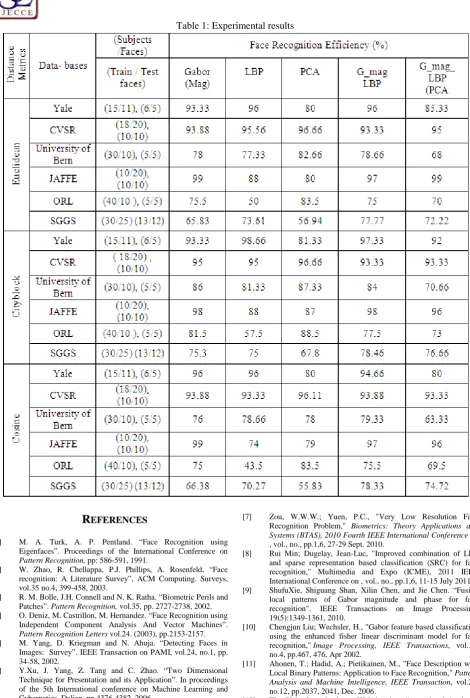
the desired direction. The LBP is then applied on the Gabor convolved face images. Further PCA is applied to reduce the dimension of the feature vector. The results are tabulated in Table 1.
C. Distance Measures
The distance between training image and test image is calculated by three different traditional distance metrics. The various distance metrics used are as follows: City-block distance, Euclidean distance, Cosine (COS). All these equations assume that x, y, z are k-dimensional vectors and xi, yi and zi are the i
th
components of the vectors.
1) City Block Distance:
1
,
|
|
|
|
k
i i i
d x y
x
y
x
y
2) Squared Euclidian Distance:
2 21
,
||
||
(
)
k
i i i
d x y
x
y
x
y
3)
Cosine Distance
12 2
1 1
,
,
|| ||||
||
( )
( )
k
i i i
k k
i i
i i
x y
x y
d x y
x
y
x
y
V. C
ONCLUSIONIn this paper, face recognition using LBP, Gabor wavelet and its fusion with PCA is analyzed in detail. Comparison of Gabor Magnitude, LBP, PCA, PCA applied on Gabor magnitude features, and fusion of Gabor magnitude with LBP followed by PCA is done.
Table 1: Experimental results
R
EFERENCES[1] M. A. Turk, A. P. Pentland. “Face Recognition using Eigenfaces”. Proceedings of the International Conference on
Pattern Recognition, pp: 586-591, 1991.
[2] W. Zhao, R. Chellappa, P.J. Phillips, A. Rosenfeld, “Face
recognition: A LiteratureSurvey”, ACM Computing. Surveys, vol.35 no.4, 399-458, 2003.
[3] R. M. Bolle, J.H. Connell and N. K. Ratha.“BiometricPerils and
Patches”.Pattern Recognition, vol.35, pp. 2727-2738, 2002.
[4] O. Deniz, M. Castrillon, M. Hernandez. “Face Recognition using Independent Component Analysis And Vector Machines”.
Pattern Recognition Letters vol.24. (2003), pp.2153-2157.
[5] M. Yang, D. Kriegman and N. Ahuja. “Detecting Faces in
Images: Survey”. IEEE Transaction on PAMI, vol.24, no.1, pp. 34-58, 2002.
[6] Y.Xu, J. Yang, Z. Tang and C. Zhao. “Two Dimensional Technique for Presentation and its Application”. In proceedings
of the 5th International conference on Machine Learning and Cybernetics, Dalian, pp.4376-4382, 2006.
[7] Zou, W.W.W.; Yuen, P.C., "Very Low Resolution Face Recognition Problem," Biometrics: Theory Applications and
Systems (BTAS), 2010 Fourth IEEE International Conference on
, vol., no., pp.1,6, 27-29 Sept. 2010.
[8] Rui Min; Dugelay, Jean-Luc, "Improved combination of LBP and sparse representation based classification (SRC) for face recognition," Multimedia and Expo (ICME), 2011 IEEE International Conference on , vol., no., pp.1,6, 11-15 July 2011 [9] ShufuXie, Shiguang Shan, Xilin Chen, and Jie Chen. “Fusing
local patterns of Gabor magnitude and phase for face recognition". IEEE Transactions on Image Processing, 19(5):1349-1361, 2010.
[10] Chengjun Liu; Wechsler, H., "Gabor feature based classification using the enhanced fisher linear discriminant model for face recognition," Image Processing, IEEE Transactions, vol.11, no.4, pp.467, 476, Apr 2002.
[11] Ahonen, T.; Hadid, A.; Pietikainen, M., "Face Description with Local Binary Patterns: Application to Face Recognition," Pattern
Analysis and Machine Intelligence, IEEE Transaction, vol.28,
no.12, pp.2037, 2041, Dec. 2006.
Copyright © 2013 IJECCE, All right reserved [13] The CVSR Grimace database. Website. http://cswww.essex.
ac.uk /mv/allfaces/index.html.
[14] The University of Bern face database. Website. http://www.ph.tn.tudelft.nl/PRInfo/data/msg00010.html. [15] The Japanese Female Facial Expression (JAFFE) database.
Website. http://www.kasrl.org/jaffe.html.
[16] AT & T: The database of faces (formerly: The ORL database of faces). Website.
http://www.cl.cam.ac.uk/Research/DTG/attarchive/facedatabase. html.
[17] The SGGS face database. Website. http://sggs.ac.in.
AUTHOR’SPROFILE
Ms. Jyoti Patil
is an Associate professor in the Department of Computer Science and Engineering in Mahatma
Gandhi Mission’s College of Engineering, Nanded
(MS), India. ObtainedBachelor’s degree inComputer Science and Engineering in 1992 andMaster’s degree
in Electronics sp. in Computer Technology in 2011 from SGGSIE & T Nanded (MS), India. Areas of interest are Image Processing and Database Management Systems.
Prof. Sanjay N. Talbar
is a Professor in the Department of Electronics and Telecommunication Engineering, Shri Guru Gobind Singhji Institute of Engineering and Technology, Nanded, MS, India. He has received B.E and M.E degrees from SGGS Institute of Technology, Nanded, India in 1985 and 1990 respectively. He obtained his Ph D from SRTM University, Nanded, India in 2000.
He received the “Young Scientist Award” by URSI, Italy in 2003. He