P
ATRYKS
MOLIŃSKI1, M
ARCINN
OWAK2, B
ARBARAD
OLIŃSKA−K
RAJEWSKA3Comparative Quantitative and Qualitative Analysis
of Mitochondria in Chronic Hepatitis B and C Patients*
Analiza porównawcza zmian jakościowych i ilościowych mitochondriów
u chorych na przewlekłe wirusowe zapalenie wątroby typu B i C
1Internal Diseases Department, Lower Silesian Center for Lung Diseases, Wrocław, Poland 2Wrocław University of Environmental and Life Sciences, Wroclaw, Poland
3Electron Microscopy Department, Wroclaw Medical University, Poland
Adv Clin Exp Med 2009, 18, 6, 575–584 ISSN 1230–025X
ORIGINAL PAPERS
© Copyright by Wroclaw Medical University
Abstract
Background.Studies imply that mitochondria have a role in viral pathologies, but hardly any objective proof has been presented based on structural analysis.
Objectives. In this study, changes in hepatocyte mitochondria in chronic hepatitis B (CHB) and C (CHC) patients were analyzed and compared with each other and with reference data.
Material and Methods. Overall, 1200 hepatocyte mitochondria of CHB and CHC patients were analyzed. Mitochondria were assessed at ×15,000 and ×5000 magnification in a scanning electron microscope. All parame− ters were analyzed with MultiScane Base v 8.08 and statistically analyzed with Statistica PL v. 5.01 using the Student’st, χ2, and Pearson’s linear correlation tests.
Results. The average numbers of mitochondria seen in both groups did not differ (p= 0.76). A difference in the number of shape−changed organelles was especially noted in CHC rather than CHB (p= 0.00026). A significant dif− ference was found in the occurrence of abnormally large mitochondria (p= 0.01). The average number of mito− chondrial cristae varied in both groups, more in CHC than CHB (p= 0.0004). Special differences were noted in the length of the cristae (p= 0.0075), but no clear change was found in the intermembrane space diameter (p= 0.04). The average mitochondrion area significantly differed in both groups and larger values were noted in the CHB group (p= 0.0001).
Conclusions. The mitochondrial structural changes are not homogenous in the HBV and HCV groups. Abnormalities were more prevalent in CHC patients and especially concerned shape changes, differences in mito− chondrial length and width, and internal structural changes rather than the area or overall number of mitochondria. Assuming that the observed mitochondrial changes were related exclusively to viral pathogens, the changes in their structure revealed by electron microscopic analysis strongly imply that severe changes in function are induced more by HCV than HBV (Adv Clin Exp Med 2009, 18, 6, 575–584).
Key words: mitochondria, viral hepatitis, HCV, HBV, analysis.
Streszczenie
Wprowadzenie. W poprzednich pracach na temat wirusowych zapaleń wątroby wielokrotnie sugerowano kluczo− wą rolę mitochondriów w ich patogenezie, ale bez obiektywnie przeprowadzonych analiz porównawczych.
Cel pracy. W pracy posłużono się obrazowymi metodami badawczymi mitochondriów, aby porównać dwie repre− zentatywne grupy chorych na wirusowe zapalenie wątroby typu B (CHB) i C (CHC) oraz ocenić potencjalne róż− nice w występowaniu nieprawidłowości mogących mieć kluczowe znaczenie w ich patogenezie.
Materiał i metody. Zbadano 1200 mitochondriów hepatocytów chorych na wirusowe zapalenie wątroby typu B i C pod kątem różnic jakościowych i ilościowych w powiększeniu 15 000×i 5000×mikroskopu elektronowego i ana− lizowano za pomocą programu MultiScane Base v 8.08 oraz statystycznie testem t−Studenta, χ2i korelacją Pearsona.
Mitochondria have been found to be a key fac− tor in apoptotic processes [1]. They may induce or inhibit apoptosis depending on the given cellular signaling pathway due to several different factors. The apoptotic role of primary hepatic viruses is well known, but some aspects remain unclear. There seem to be different directions of the mech− anism depending on the pathogen, as some may inhibit or boost the underlying processes [2]. They may directly or indirectly impair the internal mem− brane production of superoxides [3]. Alternatively, cell stress, as a secondary hit of intrinsic factors, induces mitochondrial changes and leads directly to different organelle disturbances [4]. In chronic hepatitis B (CHB) and C (CHC), apoptosis may have several sources, of which those involving Fas and TNF−αare the best known [5]. Although most of them are nucleus derived [6], some may be launched independently, causing extensive cell malfunction [7]. Nonetheless, it has still not been demonstrated what role may be attributed to CHB and CHC in detail. As an example, it is suggested that HBx expression may have a crucial role in inducing the mitochondria−dependent apoptosis pathway in CHB as it affects at least two mito− chondrial proteins, VDAC and Hsp60 [8]. In CHC, mitochondrial function and, probably, struc− tural changes may be caused independently of the nuclear sources, as supported by some studies [9]. The changes may be responsible for the multior− gan injury seen in the clinical picture of chronic hepatitis [10]. Some data also suggest a possible correlation between ultrastructural changes in hepatocyte mitochondria and the biochemical alterations in CHC, which may account for the varied outcomes of the liver disease in such patients [11].
The detailed structure of mitochondria as well as their three−dimensional image was first described by Pallade and Sjöstrand in the middle of the last century. In some studies, mitochondria were also found to be a large compartment of the
viral genome [12]. Impairment of mitochondrial function may be the cause of the significant pathologies known as mitochondrial syndromes. Several mitochondrial DNA depletions have been described whose presence strongly affects several protein activities [13]. Active impairment of oxidative phosphorylation may lead to the multi− organ dysfunctions lethal in most cases of primary mtDNA deletions [14]. A similar process may con− cern secondary pathologies. Thus long−term evok− ing factors such as toxins, drugs, or viruses that affect the mitochondrial genome result in mtDNA damage [15].
The abnormalities present in mitochondrial syndromes are the shapes of organelles, crista mal− formations, reduction in size and number, as well as different frequencies of Pallade’s granules and paracrystalline inclusions. Such changes have also been found in CHB and CHC patients with hepatosteatosis. As a matter of fact, different authors described giant mitochondria (megamito− chondria), with “dumpy” shapes, higher matrix density, as well as membrane discontinuation and crista abnormalities. At early stages of chronic viral hepatitis, mitochondrial polymorphism is observed, with a predominance of megamitochon− dria and crystalline inclusions. In certain cases, broadened cristae and denser matrix suggest a highly energetic process occurring within the organelles. At more advanced phases, swollen mitochondria, reduction in matrix density (less energized organelles), loss of granules, and frag− mented cristae were observed. This could account for a further cell malfunction that occurs and boosts an inflammatory process [16].
As certain similarities in liver cell ultrastruc− tural profile in the two pathologies are found and no comparative analysis of mitochondria in CHB and CHC patients using objective imaging meth− ods has been done, the present authors wondered how far the pathologies may be explained by mito− chondrial abnormalities, assuming an influence of
Wyniki. Średnia liczba mitochondriów widziana w preparacie nie różniła się w obu grupach badanych (p = 0,76). Jakościowe różnice dotyczące kształtu obserwowano zwłaszcza w grupie CHC (p = 0,00026). Duże mitochondria (tzw. olbrzymie) były właściwe dla grupy CHC (p = 0,01). Średnia liczba grzebieni mitochondriów była zróżnico− wana w obu grupach, większą ich liczbę obserwowano jednak w grupie CHC niż CHB (p = 0,0004). Zmiany do− tyczyły zwłaszcza ich wielkości – dłuższe grzebienie dominowały w grupie CHC (p = 0,0075). Nie wykazano istot− nych różnic szerokości przestrzeni międzybłonowej (p = 0,04). Mimo że w grupie CHC częściej obserwowano olbrzymie mitochondria, średnia powierzchni mitochondrialnej była mniejsza niż w grupie CHB (p = 0,0001).
Wnioski. Różnice zmian struktury nie są właściwe dla żadnej z obserwowanych grup. Jednak stwierdzane zmia− ny, które odnoszono do wartości referencyjnych, częściej różniły się od wartości prawidłowych w grupie CHC. Do− tyczyło to zwłaszcza kształtu mitochondriów, różnic ich poszczególnych pomiarów, jak również struktur wewnę− trznych. Zakładając, że za stwierdzane zmiany odpowiada czynnik wirusowy, wykazane różnice zdecydowanie po− twierdzają tezę, że patologia mitochondriów bardziej dotyczy wirusowego zapalenia wątroby typu C niż B (Adv Clin Exp Med 2009, 18, 6, 575–584).
the two pathogens. It is strongly suggested then that viral proteins may directly or indirectly impair mtDNA or nuclear DNA and potentially induce mitochondria−dependent pathologies.
Material and Methods
Based on the comparative profiles of patients chronically infected with HBV or HCV, hepatocyte mitochondrial structures were analyzed by means of objective ultrastructural methods. The number of visible mitochondria in the measurement area (MA) was counted. Specifically, the focus was on internal and external structures. The shapes, diam− eters, and circumferences of all the visible organelles’ cross−sections were determined. All abnormalities within the matrix, such as granules and inclusions, were described. All available data were compared between the two groups to draw conclusions and further implications. At baseline, a blind liver biopsy was performed to obtain a 3−cm piece that was divided into a sample for a patholo− gist’s assessment (METAVIR group) and for trans− mission electron microscopy (TEM).
The liver sample for TEM was put into a solu− tion of 2.5% glutaraldehyde buffer and stained with a 1% osmium solution. The whole was embedded in Epon 812 epoxy resin and contrasted according to Raynold's method [17]. A thorough observation was performed using a JEM 100B transmission electron microscope. In each case, several random pictures of hepatocytes were taken: 1–5 scans at 5000× (small dimension) and 15,000× (large dimension), examining 2–6 hepatocytes overall. At the small dimension the mitochondria were count− ed and assessed qualitatively (shape, regularity, polymorphism). At the large dimension the mito− chondria were assessed quantitatively and qualita− tively (shape, size, crista dimensions, inclusion and granule presence). Reference data were taken from the literature sources [18–20].
All measurements were done by means of MultiScane Base v 8.08, pathology software rou− tinely used for subcellular microscopy assessment. Quantitative values (e.g. diameters) were com− pared with source data and categorized thereafter whether they were within or outside normal ranges (Tables 3–4). The shapes of the mitochondria or their single components (cristae) were indexed (oval shapes exceeded a value of 1.1).
Metabolic and Demographic
Overview
All patients were admitted to the Infectious Diseases and Hepatology Department, Wroclaw
Medical University, in 2004–2006. They were sep− arated into chronic hepatitis B patients (group 1, 12 men and 4 women) and chronic hepatitis C patients genotype 1 (group 2, 8 men and 7 wo− men). Metabolic and demographic parameters were determined for all individuals (age, weight, BMI, triglyceride and cholesterol fasting serum concentrations, liver enzyme activity).
Comparative Analysis
Biochemical and pathology parameters were used to find how far the groups were alike. Thus metabolic parameters such as weight, BMI, age, lipid profile, and liver enzymes were set apart and compared. Liver pathology results were obtained by the same pathologist. Some of the results were assessed as qualitative traits (normal or outside reference ranges).
All distinguishable cristae were counted at the large dimension. Crista shape was assessed as the length/width index. The largest visible diameter between both membranes of a mitochondrion within each group was measured and compared. Areas were determined at the large dimension. All visible mitochondria were counted and compared between the groups as well as with the reference data [21]. Granules and inclusions were counted within each group and compared.
Statistical Analysis
Statistical analysis was performed using Statistica PL 5.1 software. For variables with a normal distribution, Student’s t test was used when comparing the means of two independent samples. For variables with a distribution other than normal the nonparametric χ2 test was per−
formed to verify the hypothesis. Results with a sig− nificance level of p≤0.05 were considered statis− tically significant. Pearson’s method to assess how far abnormalities differed from each other was also used.
Results
Comparative Analysis
of the Population’s Demography
mal values of liver enzyme activity (at least twice the reference values, 2 × GOT, 2 × GPT) were established as the reference (Table 2). The same concerned BMI, which was comparable when a value of ≥ 30 kg/m2 as signifying obesity was
established as the reference. More advanced pathological changes (METAVIR) were found in the CHC group (Table 1).
Comparative Analysis
of Mitochondria
Analyzed were 1200 organelles of 31 liver patients (493 and 707 with CHB and CHC, respec−
tively). The groups did not differ in the number of visible mitochondria (p = 0.76). On average, 30 mitochondria were seen in the MA of both groups. Large changes in shape were noted. Abnormal mitochondrial shapes were more fre− quently observed in the CHC than in the CHB group (0.07 and 0.02, respectively, p= 0.00026).
There was an average change in the short diameter of mitochondria in the groups; the change was less in the CHC group than in the CHB group (1.53 and 1.35 µm, respectively, p= 0.0001). No change was found in the larger diameter (2.02 and 2.04 µm for CHB and CHC, respectively, p= 0.67). In qualitative analysis it was found that mitochon− dria with both diameters exceeding the reference
Table 1. Quantitative comparative analysis of biochemical, metabolic, and liver pathology characteristics
Tabela 1.Jakościowa analiza porównawcza parametrów biochemicznych, metabolicznych i histopatologicznych wątroby
CHC CHB pvalue
Cholesterol (mg%) 169.7 173.4 0.79
Triglycerides (mg%) 109.5 108.8 0.98
GOT (IU/ml) 62.8 33.8 < 0.005
GPT (IU/ml) 100.3 41.5 < 0.005
Alkaline phosphatase (IU/ml) 63.0 64.8 0.80
GGTP (IU/ml) 47.8 25.4 < 0.005
Bilirubin (mg%) 0.9 0.9 0.88
Weight (kgs) 74.7 70.5 0.38
Height (cm) 168.4 175.3 0.05
Age (yrs) 41.2 32.3 0.04
BMI (kg/m2) 26.1 22.8 < 0.005
Grading 1.4 0.6 < 0.005
Staging 1.5 0.1 < 0.005
Steatosis 1.1 0.3 0.02
Table 2.Qualitative characteristics of biochemical and metabolic parame− ters in the studied groups
Tabela 2.Jakościowa charakterystyka cech metabolicznych i bio− chemicznych badanych grup
CHB CHC χ2 pvalue
GOT (IU/ml) 68.8 33.3 2.6 0.10
GPT (IU/ml) 56.3 13.3 4.5 0.03
GGTP (IU/ml) 93.8 53.3 4.6 0.03
Bilirubin (mg%) 87.5 93.3 0.0 0.95
2 × GOT (IU/ml) 100 66.7 4.1 0.04
2 × GPT (IU/ml) 75.0 40.0 2.5 0.10
Cholesterol (mg%) 87.5 73.3 0.2 0.58
values were more frequently noted in the CHC than the CHB group (p= 0.01) (Table 3).
Significant differences were found in the larger and shorter diameters in the groups. Mitochondria with higher indexes were more frequently observed in the CHC than in the CHB group (1.54 and 1.31, respectively, p= 0.0001). The more oval mitochon− drial shape in the CHC group was associated with abnormally positioned cristae.
The average number of mitochondrial cristae differed greatly between the two groups. The num− ber was lower in the CHC than in the CHB group (p= 0.0004). The cristae in the CHC group were significantly shorter than in the CHB group (0.512 and 0.472 µm, respectively, p = 0.0075). No changes were found in the width of the mitochon− drial cristae of the groups (0.051 and 0.053 µm, respectively, p= 0.69). More dilated cristae were found in the CHC than in the CHB group (11.2 and 10.4, respectively, p= 0.05).
A difference was found in the width of the inter− membrane space between the two groups. A larger space was noted in the CHC than in the CHB group (0.048 and 0.041 µm, respectively, p= 0.04).
There was a significant change in the mito− chondrial areas of the CHC and CHB groups. Larger mitochondria were found in the CHB than in the CHC group (2.50 and 2.19 µm2, respective−
ly, p= 0.0001).
The difference in the frequency of mitochon− dria without granules was insignificant in the two groups (17.0 and 13.62, respectively, p = 0.34). The same applied to paracrystalline inclusions,
which were more frequently seen in the CHC group (3.0 and 0.62, respectively, p= 0.28).
Discussion
In this study, organelles were analyzed with a widely performed ultrastructural method and assessed by means of conventional pathology measurement techniques to obtain objective vali− dation. Current literature data suggest that the role of mitochondria in chronic hepatitis is still not suf− ficiently known and different aspects of it should be further pursued. Most of the studies on mito− chondria in chronic hepatitis performed to date focus on biochemical and molecular methods. As some of them are not consistent or even contradic− tory (e.g. HCV’s influence on mtDNA [22]), the present authors found comparative ultrastructural analysis more useful in the basic assessment of potential differences between the groups. The results of this study strongly imply that mitochon− drial pathology is expressed more in CHC than in CHB patients, regardless of biochemistry or liver changes. Alterations were specially found in shape, overall dimension, and both external and internal structures.
As previously demonstrated, there may be other extranuclear sources of apoptosis in chronic viral hepatitis [23]. In the present study it was found that, overall, shape changes of mitochondria were largely present in CHC, with high diversity
Table 3.Comparison of the mean numbers of mitochondria seen in the measurement area (MA) with diameters within or outside the reference ranges in the two groups
Tabela 3.Jakościowe porównanie średnic mitochondriów widocznych w polu pomiarowym (MA) w obrębie badanych grup
Mean number of Mean number of pvalue mitochondria in mitochondria
MA (CHC) in MA (CHB)
Category 1 1.53 1.12 0.47
(Kategoria 1)
Category 2 36.86 27.06 0.01
(Kategoria 2)
Category 3 8.73 2.62 0.01
(Kategoria 3)
Category 1 – both mitochondrial diameters within the reference range. Category 2 – both mitochondrial diameters outside the reference range. Category 3 – one of the diameters outside the reference range.
Kategoria 1 – obie wartości prostopadłych średnic mieszczą się w zakresie wartości referencyjnych.
especially in conjunction with lipid drops nearby (Figs. 1 and 2).
A previous study concerning overall mito− chondria, quantitative changes were seen in up to 30% of CHC organelles [24]. In the present study, each individual presented lesions in mitochondria. Thus one cannot definitely exclude that the differ− ence may come from a different stage of the infec− tion as the former authors provided no pathology profile for comparison. They emphasized differ− ences in the organelles’ shapes, with a strong dom− ination of large forms. The present study indicated that the average size of mitochondria was about four times larger than normal in both CHC and CHB. This may suggest a certain ongoing process within the matrix and intermembrane space caus−
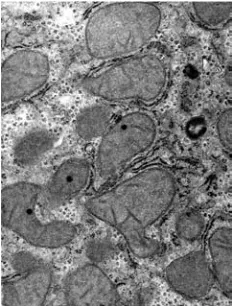
ing the organelles to become more swollen. As a matter of fact, the abnormalities were associated with broadened cristae and irregular intermem− brane space, which suggest impaired oxygen− dependent processes in the cell (Fig. 3). In relation to this, some authors found that hepatotropic viruses, specially HCV. impair calcium efflux, responsible for the membrane gradient of mito− chondria, causing changes in their shape and area [25]. However, differences in single measurements of the organelles may also be responsible for the shape changes (Fig. 4). This was especially pre− sent in CHC mitochondria, where ovular shapes prevailed, which confirms previous studies only in terms of larger forms of mitochondria [26]. Although no explanation has been given for the ovular shape changes of mitochondria in liver pathology in current literature, the present study found that a more scattered crista system was
Fig. 1.CHC, ablong highly energized mitochondria, some of pituitary shapes (arrow, ×15 000)
Ryc. 1.CHC, wydłużone bardzo zenergizowane mito− chondria, niektóre cechuje kształt przysadki (strzałka, 15000 ×)
Fig. 2.CHC, large lipid droplets in relation to mito− chondria (T) (×5000)
Ryc. 2.CHC, duże krople lipidowe w sąsiedztwie mitochondriów (T) (5000 ×)
Fig. 3.CHC, enlarged dilatated cristae and irregular intermembraneal space (× 5000)
Ryc. 3.CHC, poszerzone grzebienie mitochondriów z nieregularną przestrzenią międzybłonową (5000 ×)
Fig. 4.CHC, shape polymorphism of mitochondria (× 15 000)
noted in the ovular forms. This may account for the impaired mitochondrial functions in the CHC group compared with the other to a large extent.
This study regarded several factors potentially influencing the appearance of megamitochondria. Such organelles are noted in NASH and ASH, especially at the early phases of the pathology [27–29]. Alcohol intake may influence the changes and resemble those noted in hepatitic mitochondria (dumpy, polymorphism of internal structures). In this study the authors meticulously interviewed each patient about their alcohol intake within the past five years, finally excluding all those consuming more than 20 g of alcohol daily. A similar analysis was done in terms of hepatotoxic drugs. Special attention was also paid to the appear− ance paracrystalline inclusions (Fig. 5), as they occur in ASH and, more frequently, in NASH [30]. In this study there were no patients with metabol− ic syndrome or isolated obesity that could suggest lipid disturbances affecting mitochondrial changes.
Contrary to the observations of the present study, some studies, such as that of Verucchi et al., did not find giant dumpy organelles in hepatitic mitochondria, but crystalline inclusions and poly− morphic changes [31]. The present authors assume that dumpy mitochondria, rarely seen in this CHC group, should be more expected when additional factors overlap and consequently impair mem− brane voltage [32]. In relation to this, inclusions should also be noticeable in CHC as it usually coexists with NASH rather than in CHB and may account for severe mitochondrial damage, induc− ing further liver degenerative changes [33]. The present study did not find any difference in the appearance of inclusions between the two groups, which may suggest that NASH played a minor role in the analysis. The significance of inclusion is
still unknown, but they were well studied in myopathies [34]. It is suggested that they are occa− sionally seen in the early phases of metabolic hepatocyte degeneration [35, 36]. As the study groups comprised a moderately advanced liver pathology overall (METAVIR score), the thesis can be supported.
Unlike megamitochondria, small variants of the organelles (“minimitochondria”) may be found in certain severe liver injury processes, for exam− ple in the course of AIDS. Such organelles are usually 5–6 times shorter and their cristae are reduced in size and number [37]. In this study, such mitochondria were rarely seen (Fig. 6), although organelles with cristae reduced in size and scarce Pallade’s granules were widely domi− nant in CHC (Fig. 7). The role of cristae is strictly linked to mitochondrial functions of internal mem− brane structures. In the present study, overall crista reduction was seen both in CHB and CHC. Their system was frequently disorganized and, surpris− ingly, in CHC mitochondria reduced, especially in length (Fig. 8). Such a picture may suggest that in CHC and CHB patients, metabolic functions are impaired by the organelle malfunction, although in CHC cells are more prone to further impairment of non−toxic reactions.
Available data suggest that studying mitochon− drial changes may be helpful to assess mtDNA injury, as the human mitochondrial genome encodes at least 13 proteins of internal membrane structures of the organelles [38]. The present find− ings may support the thesis that disruptions in the internal structure of mitochondria could be an expression of mtDNA damage and further lead to a wide variety of clinical consequences, as seen in the CHC profile (e.g. extrahepatic manifestation) and as seen in secondary mtDNA depletion syn− dromes. Some similarities have already been demonstrated in diabetes, NASH, and Kearns− Sayre syndrome, but there are not sufficient data
Fig. 5.CHC, paracrystalline inclusions inside megamitochondrion (× 15 000)
Ryc. 5.CHC, wtręty parakrystaliczne wewnątrz mito− chondrium (15 000 ×)
Fig. 6.CHB, minimitochondrion (arrow) (× 15 000)
for viral hepatitis. Still of much discussion is whether mitochondrial pathology should be regard− ed as an effect of extranuclear apoptosis or just cell injury in the course of steatosis induction. More probable may be that the two processes overlap (“two hits”). In the present study, there were more advanced pathological changes in the liver in CHC, but only one patient had cirrhotic lesions. However, surprisingly, no special mitochondrial changes were noted in the individual. This implies that mitochondrial changes might be independent of liver fibrotic lesions.
Barbaro et al. described mitochondrial changes such as pituitary shape, polymorphism, megamitochondria, and inclusions more frequent− ly in CHC genotype 1 than non−1 genotype patients. Some perimitochondrial changes were also observed in genotype 3, for example dilated reticulum. As the Polish population is predomi− nantly infected with genotype 1, the results of the present study seem compatible with those above.
Another implication of the study is the reversibility of the mitochondrial changes. Effective therapy may potentially revert the changes and such a possibility in terms of toxic agents has already been demonstrated (reversion of dumpy changes, megamitochondria) [39]. In the present study, separating mitochondria were observed in several cells of both groups, suggesting that mitochondria undergo constant regeneration and may compensate a lesions (Fig. 9). Thus one can wonder how far potent antiviral therapy could revert mitochondrial alterations, which may be of great concern for future therapeutic implications.
Few comparative analyses of mitochondrial changes in CHB and CHC have been done. The largest, such as that of Balercia et al., did not find any significant differences between the two groups, but they attributed mitochondrial changes to shape diversion and size changes [40]. In the present analysis, more objective methods of assessment were used and it was found that mito− chondrial changes were more frequently found in CHC. It can therefore be concluded that mitochon− dria may be the key organelles engaged in the viral process, but HCV may have additional impairment potential on the organelles. It is especially worth− while to track the evolution of mitochondrial changes in the course of effective therapy.
The authors concluded that significant changes in mitochondria were found in both CHC and CHB patients. The abnormalities were attrib− uted to shape, diameter, cristae, as well as some internal structures. Morphologically, abnormal mitochondria were more frequently observed in CHC patients; oval, dumpy, and polymorphic changes were overwhelming in such patients. Mitochondria with such shapes were especially predisposed to dislocation of the cristae. The more frequent presence of changes implies a greater role
Fig. 9. CHB a narrowing within mitochondrion sug− gests division process (× 15 000)
Ryc. 9.CHB, mitochondrium w czasie podziału (15 000 ×)
Fig. 7.CHC, low energized mitochondria, scarce Pallade granules (× 15 000)
Ryc. 7.CHC, słabo zenergizowane mitochondria, niewielka liczba ziarnistości w macierzy (15 000 ×)
Fig. 8.CHC, cristae reduction (× 15 000)
of mitochondrial function impairment in the pathology. Thus such processes as oxidative phos− phorylation, fatty−acid metabolism, and apoptosis might be affected. Structural abnormalities may
indirectly demonstrate that there is a certain influ− ence of the overall viral pathology on DNA encod− ing mitochondrion structures as in secondary mito− chondrial diseases.
References
[1] Suzuki A, Tsutomi Y, Yamamoto N:Mitochondrial regulation of cell death: mitochondria are essential for pro− caspase3−p21 complex formation to resist Fas−mediated cell death. Mol Cell Biol 1999, 19, 3842–3847.
[2] Vlahakis SR, Villasis−Keever A, Gomez TS:Human immunodeficiency virus−induces apoptosis of human hepa− tocytes via CXCR4. J Infect Dis 2003, 188, 1455–1460.
[3] Mansouri A, Fromenty B, Person A:Multiple hepatic Mitochondria DNA deletions suggests premature oxida− tive aging in alcoholic patients. J Hepatol 1997, 27, 96–102.
[4] Kowaltowski AJ, Vercesi AE:Mitochondria damage induced by conditions of oxidative stress. Free Radical Biol Med 1999, 26, 463–471.
[5] Lowin B, Hahne M, Mattmann C, Tschopp J:Cytolytic T−cell cytotoxicity is mediated through perforin and Fas lytic pathways. Nature 1994, 370, 650–652.
[6] Tanaka Y, Kanai F, Kawakami T:Interaction of the hepatitis B virus X protein (HBx) with heat shock protein 60 enhances HBx−mediated apoptosis. Biochem Biophys Res Commun 2004, 318, 461–469.
[7] Ruggieri A, Harada T, Matsuura Y, Miyamura T:Sensitization to Fas−mediated apoptosis by hepatitis C virus core protein. Virology 1997, 229, 68–76.
[8] Takada S, Shirakata Y, Kaneniwa N, Koike K:Association of hepatitis B virus X protein with mitochondria causes mitochondrial aggregation at the nuclear periphery, leading to cell death. Oncogene 1999, 18, 6965–6973.
[9] Li Y, Boehning DF, Qian T, Popov VL, Weinman SA:Hepatitis C virus core protein increases mitochondrial ROS production by stimulation of Ca2+ uniporter activity. FASEB J 2007, 21, 2474–2485.
[10] Hinokio Y, Suzuki S, Komatu K, Ohtomo M, Onoda M, Matsumoto M:A new mitochondrial DNA deletion associated with diabetic amyotrophy, diabetic myotrophy and diabetic fatty liver. Muscle Nerve 1995, Suppl 3, S142–149.
[11] Barbaro G, Lorenzo G, Asti A:Hepatocellular mitochondrial alterations in patients with chronic hepatitis C: Ultrastructural and biochemical findings. Am J Gastroenterol 1999, 94, 2198–2205.
[12] Somasundaran M, Zapp ML, Beattie LK:Localization of HIV RNA in Mitochondria of infected Wells: poten− tial role in cytopathogenicity. J Cell Biol 1994, 126, 1353–1360.
[13] Thorbun DR, Chow CW, Kirby DW:Respiratory chain enzyme analysis in muscle and liver. Mitochondrion 2004, 4, 363–375.
[14] Mandel H, Hartman C, Berkovitz D: The hepatic mitochondrial DNA Depletion syndrome: ultrastructural changes in liver biopsies. Hepatology 2001, 34, 776–784.
[15] Guo LJ, Oshida Y, Fuku N, Takeyasu T:Mitochondrial genome polymorphism associated with type 2 diabetes or obesity. Mitochondrion 2005, 5, 15–33.
[16] Maki A, Kono H, Gupta M, Asakawa M, Suzuki T, Matsuda M:Predictive Power of Biomarkers of Oxidative Stress and Inflammation in Patients with Hepatitis C Virus−Associated Hepatocellular Carcinoma. Ann Surg Oncol 2007, 14, 1182–1190.
[17] Raynolds ES:The use of lead citrate at high pH as an electron opaque stain in electron microscopy. J Cell Biol 1963, 17, 208–212.
[18] Ma MH, Biempica L:The normal human liver cell. Cytochemical and ultrastructural studies. Am J Pathol 1971, 62, 353–390.
[19] Philips MJ, Poucell S, Patterson J, Valencia P:The liver, an atlas and text of ultrastructural pathology. Raven Press, New York 1987.
[20] Sternlieb I:Electron microscopy of mitochondria and peroxisomes of human hepatocytes. In: Progress in Liver Disease. Eds.: Popper H, Schaffner F. Grune and Stratton, New York 1979, 6, 81–104.
[21] Ma MH, Biempica L: The normal human liver cell. Cytochemical and ultrastructural studies. Am J Pathol 1971, 62, 353–390.
[22] Latorre P, Rubbia−Brandt L, Siostra E:The 4977 base pair common deletion of mitochondrial DNA is not asso− ciated with steatosis in chronic hepatitis C patients. Hepatology 2002, 35, 239–240.
[23] Okuda M, Li K, Beard M, Showalter L:Mitochondrial injury, oxidative stress, and antioxidant gene expression are induced by hepatitis C virus core protein.. Gastroenterology 2002, 122, 366–375.
[24] Kasprzak A, Biczysko W, Adamek A, Zabel M:. Morphological lesions detected by light and electron micro− scopies in chronic type C hepatitis. Pol J Pathol 2003, 54, 129–142.
[25] Piccoli C, Scrima A, D’Aprile A:Mitochondrial dysfunction in hepatitis C virus infection. Biochim Biophys Acta 2006, 1757, 1429–1437.
[26] Kasprzak A, Biczysko W, Adamek A, Zabel M:Morphological lesions detected by light and electron micro− scopies in chronic type B hepatitis. Pol J Pathol 2003, 53, 103–115.
[28] Petersen P:Abnormal mitochondria in hepatocytes in human fatty liver. Acta Path Microbiol Scan Sect. A 1977, 85, 413–420.
[29] Klar A, Livni N, Gross−Kieselstein E:Ultrastructural abnormalities of the liver in total lipodystrophy. Arch Pathol Lab Med 1987, 111, 197–199.
[30] Berson A, Beco V, Letteron P:Steatohepatitis inducing drugs cause mitochondrial dysfunction and lipid perox− idation in rat hepatocytes. Gastroenterology 1998, 114, 764–774.
[31] Verucchi G, Calza L, Biagetti C: Ultrastructural liver mitochondrial abnormalities in HIV/HCV−coinfected patients receiving antiretroviral therapy. J Acquir Immun Defic Syndr 2004, 3, 326–328.
[32] Lemasters JJ:Possible role of the mitochondrial outer membrane as an oncotic regulator of mitochondrial vol− ume. FEBS Letters 1978, 88, 10–14.
[33] Van Huyen JP, Landau A, Pikkety C: Toxic effect of nucleoside reverse transcriptase inhibitors on the liver: value of electron microscopy analysis for the diagnosis of mitochondrial cytopathy. Am J Clin Pathol 2003, 119, 546–555.
[34] Farrants GW, Hovmoller S, Stadhouders AM:Two types of mitochondrial crystals in diseased human skeletal muscle fibres. Muscle Nerve 1988, 11, 45–55.
[35] Sanyal AJ, Campbell−Sargent C, Mirshahi F:Nonalcoholic steatohepatitis: association of insulin resistance and mitochondrial abnormalities. Gastroenterology 2001, 120, 1183–1192.
[36] Piccoli C, Scrima A, D`Aprile A:Mitochondrial dysfunction in hepatitis C virus infection. Biochim Biophys Acta 2006, 1757, 1429–1437.
[37] Radovanovic J, Todorovic V, Boricic I, Jankovic−Hladni M, Korac A:Comparative ultrastructural studies on mitochondria pathology in the liver of AIDS patients: clusters of Mitochondria, protuberances, mimimitochondria, vacuoles and virus−like particles. Ultrastructural Pathol 1999, 23, 19–24.
[38] Fernandez−Moreno MA, Bornstein B, Petit N:The pathophysiology of mitochondrial biogenesis: towards four decades of mitochondrial DNA research. Mol Genet Metab 2000, 71, 481–495.
[39] Poynard T, Ratziu V, McHutchinson J:Effect of treatment with peginterferon or interferon alpha−2b and rib− avirin on steatosis in patients infected with hepatitis C. Hepatology 2003, 38, 75–85.
[40] Balercia G, Accordini C, Di Piramo:An ultrastructure study of six cases of chronic active C hepatitis. A com− parison with chronic active B hepatitis. Ultrastructural Pathol 1993, 17, 477–482.
Address for correspondence:
Patryk Smoliński
Internal Diseases Department
Lower Silesian Center for Lung Diseases Grabiszyńska 105
53−439 Wrocław Poland
E−mail: [email protected]
Conflict of interest: None declared