D. K. Vir
Department of Pharmacology, IPS Academy, College of Pharmacy, Indore (M.P.)
Email: [email protected]
Address for correspondence
Access this article online www.japer.in
Evaluation of Anti-Asthmatic and Anti-Cholinergic activity of
Ethanolic extract of
Artocarpus Heterophyllus Linn Leaves
INTRODUCTION
Asthma is the result of chronic inflammation of the airways which subsequently results in increased contractability of the surrounding smooth muscles.(1,2)
This among other factors leads to bouts of narrowing of the airway and the classic symptoms of wheezing. The narrowing is typically reversible with or without treatment. Occasionally the airways themselves change. Typical changes in the airways include an increase in eosinophils and thickening of the lamina reticular. Typical changes in the airways include an increase in eosinophils and thickening of the laminal reticulars . Chronically the airways' smooth muscle
may increase in size along with an increase in the numbers of mucous glands. Other cell types involved include: T lymphocytes, macrophages, and neurtrophils. The jackfruit (alternately jack tree, jakfruit, or sometimes simply jack or jak; scientific name Artocarpus heterophyllus), is a species of tree in the Artocarpus genus of the mulberry family (Moraceae) (3,4). The jackfruit tree is widely cultivated
in tropical regions of India, Bangladesh, Nepal, Sri Lanka, Vietnam, Thailand, Malaysia, Indonesia, and the Philippines. Ripe jackfruit is naturally sweet with subtle flavoring. It can be used diets. Fresh jackfruit has small amounts of vitamin-A, flavonoid pigments such as carotene-ß, xanthin, lutein and cryptoxanthin-ß. Together, these compounds play vital roles in antioxidant and vision functions. Vitamin A is also required for maintaining integrity of mucus membranes and skin. Consumption of natural fruits Asthma is a chronic disease that affects approximately 300 million people worldwide. Although wide range of drug is available, the relief is mainly symptomatic and short lived. Heterophyllus Linn leaves (Moraceae), also known as jack fruit (English), is traditionally used to treat asthma. However, the scientific data on anti-asthmatic and anti- Cholinergic of this plant has got little attention. An attempt has been based on ethanolic extract of leaves of A. Heterophyllus linn shown a tremendous effect on asthma when comparative study was done with normal and treated group. The anti-asthmatic activity of a 50% aqueous ethanol extract of dried and fresh leaves, and the volatile and fixed oils of A.
Heterophyllus was evaluated against histamine and acetylcholine-induced
pre-convulsive dyspnea (PCD) in guinea pigs fasted for 24 h were exposed to an atomized fine mist of 2% histamine dihydrochloride aerosol (dissolved in normal saline) using nebulizer at a pressure of 300 mm Hg in the histamine chamber (24 x 14 x 24 cm, made of perplex glass). Guinea pigs exposed to histamine aerosol showed progressive signs of difficulty in breathing leading to convulsions, asphyxia and death. The time until signs of convulsion appeared is called pre-convulsion time (PCD). By observation experience was gained so that the preconvulsion time can be judged accurately. As soon as PCD commenced, animals were removed from the chamber and placed in fresh air to recover. In the present experiments the criterion used was time for onset of dysponea and percent protection was calculated. Those animals which developed typical histamine asthma within 3 min were selected out three days prior to the experiment and were given habituation practice to restrain them in the histamine chamber. They were divided in groups Mepyramine (8 mg/kg) and polyherbal formulation (300 mg/kg) were administered intraperitonially 30 min prior to exposure. Animals, which did not develop typical asthma within 6 minutes, were taken as protected.
Keywords: Anti-Asthmatic, Anti-Cholinergic, Heterophyllus Linn leaves ABSTRACT
D. K. Vir*
Department of Pharmacology, IPS Academy, College of Pharmacy, Indore (M.P.)
rich in vitamin-A, and carotenes has been found to protect from lung and oral cavity cancers.Jackfruit is rich in B-complex vitamins, with large amounts of vitamin B-6 (pyridoxine), niacin, riboflavin, and folate(5). Fresh jackfruit provides potassium,
magnesium, manganese, and iron. Potassium provides cell and body fluids that help regulate heart rate and blood pressure. a good bulk laxative because of its dietary fiber which helps to protect mucous membranes in the colon by decreasing exposure time and binding to cancer-causing chemicals. petroleum ether (60-800) and then extracted separately with ethanol (95%, v/v) Leaves of different plants of A. Heterophyllus linn. (6,7,8)
MATERIALS AND METHODS Collection of plant materials (9,10)
The leaves of A. Heterophyllus Linn Leaves were collected from the outfield of Nimar Region, MP, India in February-March 2013. The plant materials were identified and authenticated by Dr. Rao, HOD, Botany and Plant Anatomy, Khargone, India. Voucher specimens (NIP/13/009) of the collected plant samples were deposited in the Department of Pharmacognosy, Nimar Institute of Pharmacy, Dhamnod, India for future reference.
Drugs and Chemicals
Compound disodium chromoglycate (DSCG), histamine dihydrochloride, acetylcholine chloride, atropine sulfate, mepyramine meleate, and toluidine blue were purchased from CAL Laboratories, Supplied by Kasliwal Brothers, Indore. Histamine solution was freshly prepared in normal saline (NaCl, 8.5 g/l). All the other chemicals were of analytical grade.
Extraction (11)
Leaves of different plants were washed with distilled water to remove dirt and soil, and shade dried. The dried materials were powdered and passed through a 10-mesh sieve. The coarsely powdered materials (500 g) of each plant was defatted with petroleum ether
(60-800) and then extracted separately with ethanol (95%, v/v) in a Soxhlet apparatus. The extracts were filtered and concentrated by distilling off the solvents and evaporated using water bath to get crude ethanol extract.
Experimental Animals
Antihistaminic and anticholinergic studies were conducted on guinea pigs (350-500 g) of either sex. For mast cell stabilization paradigm, adult Wistar albino rats weighing 140–160 g of either sex were used. All the Experimental animals were fed on commercial pellet diet (Poshak Ahar Pt.Ltd. India). They were group housed under standard conditions of temperature (22 ± 20C), relative humidity (60 ± 5%) and 12:12 light/dark cycle, where lights on at 0700 and off at 1900 h).
They were divided in groups of ten animals each. (12,13)
Group 1. The saline fed group served as control Group 2. Treated with a standard drug.
Before experimentation, the animals were kept on fast for 24 h but water was given ab de libitum. During experiments, animals were also observed for any alteration in their general behavior. All the experimental protocols were approved by the Institutional Animal Ethics Committee (IAEC), Nimar Institute of Pharmacy, Dhamnod.
Preparation of the test extracts (13)
The polyherbal formulation was suspended in 1% SCMC in distilled water and administered orally or intraperitonially. The control animals were given an equivalent volume of SCMC vehicle. The standard group received various standard anti-asthmatic Drugs.
Pharmacological Screening (Antiasthmatic paradigms)
Histamine-induced Bronchospasm in guinea pigs
(14,15,16)
a pressure of 300 mm Hg in the histamine chamber (24 x 14 x 24 cm, made of perplex glass). Guinea pigs exposed to histamine aerosol showed progressive signs of difficulty in breathing leading to convulsions, asphyxia and death. The time until signs of convulsion appeared is called pre-convulsion time (PCD). By observation experience was gained so that the preconvulsion time can be judged accurately. As soon as PCD commenced, animals were removed from the chamber and placed in fresh air to recover. In the present experiments the criterion used was time for onset of dysponea and percent protection was calculated. Those animals which developed typical histamine asthma within 3 min were selected out three days prior to the experiment and were given habituation practice to restrain them in the histamine chamber. They were divided in groups of ten animals each. Mepyramine (8 mg/kg) and polyherbal formulation (300 mg/kg) were administered intraperitonially 30 min prior to exposure. Animals, which did not develop typical asthma within 6 minutes were taken as protected.
Acetylcholine-induced bronchospasm in guinea pigs (18,19,20)
Procedure was similar to the histamine aerosol study except that animals were exposed to aerosol of 0.5% acetylcholine in another set of animals (n = 10). Atropine sulphate (2 mg/kg) was used as a standard drug. Mast cell degranulation by compound 48/80 this was carried out as per the method described by Kaley and Weiner (1971) with little modification. Male albino rats were sacrificed by cervical dislocation. The animals were immediately injected with 15 ml of pre-warmed (37°C) buffered salt solution (NaCl 137 mM; KCl 2.7 mM; MgCl 2; 1 mM; CaCl20.5 mM; NaH2PO40.4 mM; Glucose 5.6 mM; HEPES 10 mM) into the peritoneal cavity, and massaged gently in this region for 90 s, to facilitate cell recovery. A midline incision was made and the peritoneum was exposed. The pale fluid was aspirated using a blunted plastic Pasteur pipette, and collected in a plastic centrifuge tube. The
fluid was then centrifuged at 1000 rpm for 5 min, and the supernatant discarded to reveal a pale cell pellet. The cell pellets were re-suspended in fresh buffer and re-centrifuged. Aliquots of the cell suspension were incubated with the test compounds or disodium cromoglycate, before challenge with compound 48/80. The aliquots were carefully spread over glass slides and the mast cells were stained with 1% toluidine blue and counterstained with 0.1% light green. The slides were dried in air and the mast cells counted from randomly selected high power objective fields (X450). The effect of polyherbal formulation on mast cells was studied by incubating the mast cells for 10 min with the above formulation in a concentration of 1, 10 or 100 μg/ml. In another set of experiments the mast cells which were pre-incubated with polyherbal formulations were exposed to the mast cell degranulator, compound 48:80 (10 μg/ml) and the incubation continued for a further 10 min. Then, the mast cells were carefully spread over glass slides. The percent degranulation of the mast cells was calculated. Disodium cromoglycate (DSCG) (20 μg/ml) was included in one of the study group for comparison. Table1. Effect of polyherbal formulation on mast cell
Acute Toxicity Test (Determination of LD50) (16,17)
polyherbal formulations was composed of ethanolic extracts of Solanum xanthocarpum (50 mg), Aegle marmelos (50 mg), Caesalpinia bonduc(100 mg), and Murraya koenigii(100 mg).
RESULTS AND DISCUSSION
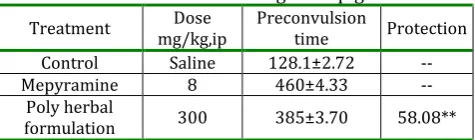
The results of the present study revealed mast cell stabilization, antihistaminic and anti-cholinergic actions of polyherbal formulation. In the mast cell stabilization paradigm, 33% of mast cells were degranulated in the control group. Addition of DSCG (20 μg/ml), and the polyherbal formulation (100 μg/ml) reduced the percentage of mast cell degranulation (P< 0.01) compared to the control group. Compound 48/80 (10 μg/ml) produced about 76% degranulation of mast cells. Pretreatment with DSCG (20 μg/ml) and the polyherbal formulation (1, 10, and 100 μg/ml) significantly reduced (P< 0.01) degranulation of mast cells as compared to compound 48/80-tretaed control group (Table 1). The protection given by them at higher concentrations was comparable to that of DSCG, a potent mast cell stabilizing agent. These results suggest hat polyherbal formulation protects mast cells from compound 48/80-evoked degranulation. In the histamine aerosol study, the control animals showed convulsion during the first 3 min of the experiment. Prior treatment of polyherbal formulation (300 mg/kg, i.p.) protected the animals (Table 2) to a significant extent (P< 0.01) from the development of asphyxia produced by histamine aerosol confirming that it has antihistaminic activity. The role of histamine in asthma is well established (Nelson, 2003). The close resemblance of pulmonary responses to histamine challenge in both guinea pigs and humans, as well as the anaphylactic sensitization made this species the model of choice. In the present study, guinea pigs were used because of the extreme sensitivity of their airways to the primary mediators of bronchoconstriction, including histamine and leukotrienes, and their ability to be sensitized to foreign proteins.
Table 1: Effect of polyherbal formulation on histamine-aerosol in guinea pigs
Treatment mg/kg,ip Dose Preconvulsion time Protection
Control Saline 128.1±2.72 --
Mepyramine 8 460±4.33 --
Poly herbal
formulation 300 385±3.70 58.08**
Values are mean ± S.E.M. (n = 10); **P< 0.01 vs. control; Dunnett’s t-test after way ANOVA.
Table 2: Effect of polyherbal formulation on acetylcholine induced bronchospasm in guinea pigs
Treatment mg/kg,ip Dose Preconvulsion time Protection
Control Saline 128.1±2.72 --
Atropine
Sulphate 2 380±4.33 --
Poly herbal
formulation 300 255±3.70 55.08**
Values are mean ± S.E.M. (n = 10); **P< 0.01 vs. control; Dunnett’s t-test after way ANOVA.
Table 3: Effect of polyherbal formulation on mast cell
Treatment (mg/kg ,p Dose o)
Weight of
granuloma (mg) Inhibition %
Control Saline 110.1±2.20 --
Prednosoline 10 63.4±1.60 42.41 **
Polyherbal
formulation 300 55.4±1.32 49.68
Values are mean ± S.E.M. (n = 10); **P< 0.01 vs. control; Dunnett’s t-test after way ANOVA.
CONCLUSION
Result study on A. Heterophyllus linn. Suggest that, there was appreciable decrease in severity of symptoms of asthma and also simultaneously improvement in lung function parameters. In conclusion, the results of present investigation suggest that, polyherbal formulation have significant bronchodilator activity against histamine and acetylcholine. However, further studies are suggested to establish molecular mechanism and also to isolate and characterize the active principles responsible for the action. Further study is ongoing to characterize the active principles of the extract which are responsible for antiasthmatic activity.
REFERENCES
1. Govindan S, Viswanathan S, Vijayasekaran V, et al. A pilot study on the clinical efficacy of Solanum xanthocarpum and Solanum trilobatum in bronchial asthma. Journal of Ethnopharmacology 1999;66:205-10.
2. Kirtikar KR, Basu BD. Indian Medicinal Plants. 2nd ed. Dehradun, India Oriental Enterprises. 2001:131– 134.
3. Yusuf M, Chowdhury JU, Wahab MA. Medicinal Plants of Bangladesh. Dhaka, Bangladesh. Council for Scientific and Industrial Research 1994:172-1205. 4. Idárraga-Piedrahita, A., R. D. C. Ortiz, R. Callejas
Posada & M. Merello. 2011. Flora de Antioquia. Catálogo de las Plantas Vasculares, vol. 2. Listado de las Plantas Vasculares del Departamento de Antioquia. Pp. 1-939.
5. Shah GB, Parmar NS. Antiasthmatic property of polyherbal preparation E-721 B.Phytother Res 2003;17:1092-1097.
6. Spirometry: An essential clinical measurement. Australian family physician 34 (7): 535–539. PMID 15999163.
7. Amin AH, Mehta DR. Bronchodilator alkaloid from Adhatoda vasica. Nature 1959;184:1317-1318. 8. Lorke D. A new approach to acute toxicity testing.
Arch Toxicol 1983;54:275–287.
9. Armitage AK, Boswood J, Large BJ. Thioxanthines with potent bronchodilator and coronary dilator
properties. British Journal of Pharmacology and Chemotherapy, 1961;16:56-76.
10. Kaley G, Weiner R., Prostaglandin ‘E’ a potential
mediator. Ann New York Academic Science,1971;180:347–348.
11. B. Armitage Etal 2,988,965 Spindle Construction and dual transmission therefor Original Filed June 14, 1954.
12. Sachin Parmar, Amit Gangwal and Navin Sheth Evaluation of antiasthmatic activity of a polyherbal formulation containing four plant extracts. Journal of Current Pharmaceutical Research 2010; 2(1): 40-44. 13. Jean Bousquet, K. Jeffery Peter, W. Busse William,
Malcolm Johnson, and M. Vignola Antonio “Asthma", American Journal of Respiratory and Critical Care Medicine, Vol. 161, No. 5 (2000), pp. 1720-1745. 14. Brownlee G, Madigan DG, Griffiths LL, et al. Para
aminosalicylic acid in tuberculosis: Clinical and pharmacological aspects. The lancet 1950;255(6598):239-45.
15. Zhimmet I, Tashkin DP. Alternative medicines for allergy and asthma. J Allergy Clinical Immunology, 2000;106:603-614.
16. Thomas G, Araujo CC, Duarte JC, Desouza DP. Bronchodilatory activity of an aqueous fraction of an ethanol extract of the leaves of Cissampelos sympodialis in guinea pigs. Phytomedicine 1997;4:233-238.
17. Saraf MN, Patwardhan BK. Pharmacological studies on Sarcostemma brevistigma. Part II Bronchodilator activity. Indian Drugs 1988;26:54-57.
18. Di-Rosa M, Giroud JP, Willoughby DA. Studies on the mediators of acute inflammatory response induced in rats in different sites of carrageenan and turpentine. J Pathol 1971;104:15–29.
19. Horwitz RJ, Busse WW. Inflammation and asthma. Clin Chest Med 1995;16:583-620.
20. Kumar A, Ramu P. Effect of methanolic extract of Benincasa hispida against histamine and acetylcholine-induced bronchospasm in guinea pigs. Indian J Pharmacol. 2002; 34: 365-366.
How to cite this article: D. K. Vir; Evaluation of Anti-Asthmatic and Anti-Cholinergic Activity of Ethanolic Extract Of Artocarpus Heterophyllus Linn Leaves; J. Adv. Pharm. Edu. & Res. 2016: 6(4): 22-26.