R E S E A R C H
Open Access
Molecular profiling of thyroid cancer subtypes
using large-scale text mining
Chengkun Wu
1,2,3, Jean-Marc Schwartz
1, Georg Brabant
4,5, Goran Nenadic
3,6,7*From
Asia Pacific Bioinformatics Network (APBioNet) Thirteenth International Conference on Bioinformatics
(InCoB2014)
Sydney, Australia. 31 July - 2 August 2014
Abstract
Background:Thyroid cancer is the most common endocrine tumor with a steady increase in incidence. It is classified into multiple histopathological subtypes with potentially distinct molecular mechanisms. Identifying the most relevant genes and biological pathways reported in the thyroid cancer literature is vital for understanding of the disease and developing targeted therapeutics.
Results:We developed a large-scale text mining system to generate a molecular profiling of thyroid cancer subtypes. The system first uses a subtype classification method for the thyroid cancer literature, which employs a scoring scheme to assign different subtypes to articles. We evaluated the classification method on a gold standard derived from the PubMed Supplementary Concept annotations, achieving a micro-average F1-score of 85.9% for primary subtypes. We then used the subtype classification results to extract genes and pathways associated with different thyroid cancer subtypes and successfully unveiled important genes and pathways, including some instances that are missing from current manually annotated databases or most recent review articles.
Conclusions:Identification of key genes and pathways plays a central role in understanding the molecular biology of thyroid cancer. An integration of subtype context can allow prioritized screening for diagnostic biomarkers and novel molecular targeted therapeutics. Source code used for this study is made freely available online at https:// github.com/chengkun-wu/GenesThyCan.
Background
Thyroid cancer (TC) is the most common endocrine malignancy [1] and its incidence increase has been sig-nificant in recent years despite some controversies about the extent [2]. Many possible factors causing thyroid cancer have been reported including exposure to ionis-ing radiation, iodine-deficiency and heredity [3]. Con-ventional treatment strategies include surgical resection, radiation therapy (especially radioactive iodine therapy), chemotherapy and thyroid hormone therapy [4]. How-ever, the understanding of the underlying molecular mechanisms is still incomplete.
Thyroid tumours are usually classified into multiple subtypes according to their histopathological character-istics, and treatments are selected depending on the sub-type and stage of thyroid cancer. The main subsub-types include papillary thyroid cancer (PTC), follicular thyroid cancer (FTC), anaplastic thyroid cancer (ATC) and medullary thyroid cancer (MTC) [4]. PTC and FTC are also sometimes collectively referred to as differentiated thyroid cancer (DTC) or well-differentiated thyroid can-cer (WDTC), while ATC can also be referred to as undifferentiated thyroid cancer. In addition, a number of rare subtypes have been described. Cellular origins and some of the known molecular mechanisms differ for each subtype [5], which may include subtype-specific alterations in DNA methylation patterns [3] and have led to new therapeutic approaches based on the molecu-lar signature of the tumours.
* Correspondence: [email protected] 3
Manchester Institute of Biotechnology, 131 Princess Street, Manchester M1 7DN, UK
Full list of author information is available at the end of the article
These“targeted therapeutics”of thyroid cancer are being rapidly developed [6,7]. Several potential drugs are cur-rently in preclinical testing or in clinical use [8,9]. How-ever, lack of systematic studies of underlying molecular mechanisms can lead to a high risk for thyroid cancer patients, who might suffer from unexpected side effects. For instance, RET has been shown to be an oncogene in thyroid cancer but is considered as a potential tumour suppressor gene in colorectal cancer [10]. Consequently, studies focusing on one or a few genes are likely to miss the molecular context that could be vital for a comprehen-sive understanding of the disease.
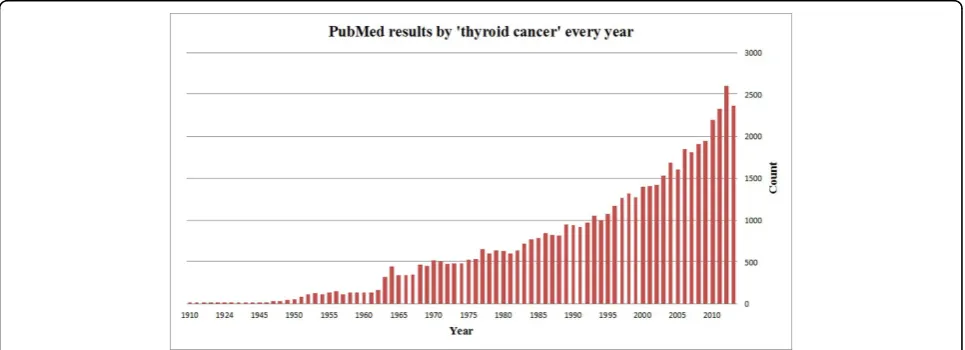
For systematic studies, a major challenge is to effi-ciently utilise the myriad of knowledge and information from unstructured scientific literature. PubMed, one of the most widely used systems for biomedical literature search [11], returns over 50,000 results with the search query‘thyroid cancer’. The number is increasing rapidly, with over 2,000 articles published annually in recent years, as illustrated in Figure 1. This trend has made it extremely difficult for scientists to identify, retrieve and assimilate all relevant publications.
To support the identification and retrieval of relevant articles, MeSH (Medical Subject Headings, http://www. nlm.nih.gov/pubs/factsheets/mesh.html) terms are used in PubMed to label the topic of each document, along with additional headings known as Supplementary Con-cepts (SCs). The MeSH term used for thyroid cancer is
‘thyroid neoplasms’, and the major subtypes are repre-sented as SCs. However, the thyroid cancer SCs were only introduced in August 2010, which means the majority of the thyroid cancer literature does not have a subtype label indicated by SC.
Text mining techniques have been extensively used to support access to the biomedical literature [12,13]. A
number of tasks can now be successfully fulfilled by text mining, including gene mention recognition and nor-malization [14,15], pathway mention recognition [16] and event extraction [17,18]. Those efforts enable the extraction of structured and explicit data, and this further targets the exploration and investigation of spe-cific biological questions.
In this paper we focus on identifying genes and path-ways that are reported in the thyroid cancer literature, grouped by subtypes. We then compare our systematic effort to some established databases and demonstrate how our results could boost the understanding of thyr-oid cancer and promote comprehensive investigation for potential therapeutic targets.
Related work
There are several curated databases that contain mole-cular information of thyroid cancer. For example, the Thyroid Cancer and Disorder Gene Database (TCGDB, http://www.juit.ac.in/attachments/tcgdb/) contains infor-mation about genes and miRNAs involved in different thyroid cancer subtypes. The data in TCGDB have been extracted through manual literature review of a few selected articles. However, details of these articles are not revealed, so it is not clear how systematic and com-prehensive the database is.
MalaCards is a generic integrated compendium for dis-eases and associated annotations [19], with some informa-tion related to TC. It provides disease-specific informainforma-tion from multiple sources, including related publications, genes and pathways. However, there are several limita-tions: firstly, the publications associated with a disease are obtained by title search only, which could miss out many relevant articles; secondly, pathways are provided by affiliated genes rather than their mentions in the literature.
Finally, the coverage of this data set is limited: for example,
a search for “anaplastic thyroid cancer” returns no
affiliated genes.
Gene2Pubmed [20] is a generic database maintained by NCBI that provides a set of manually added links from PubMed articles to genes. Gene2Pubmed integrates infor-mation from a number of public databases and the links are not limited to articles specifically defining the function of a given gene. However, similarly to other resources, its coverage is limited: for example, we found quite a few examples where TC-related genes were missing from the Gene2Pubmed annotation (see Results).
Several databases contain information about pathways and their associations to diseases. KEGG [21], for exam-ple, contains pathways for different diseases, but its cov-erage is often limited, in particular for diseases that are not widely studied (e.g. there is a single pathway dia-gram for thyroid cancer). Even for databases that focus on specific diseases (e.g. AlzPathway [22] is a database of pathways associated to Alzheimer’s disease) it is often difficult to keep up with new findings through manual curation, and automated text mining approaches need to be used to ensure a wider coverage [16].
There are various efforts to automatically extract rela-tionships between cancer and its molecular bases from the literature. For instance, a maximum entropy-based named entity recognizer and relation recognizer were applied to find relations between prostate cancer and genes [23]. Other relation finding tools can be applied to cancer related studies as well, including FACTA [24], CoPub [25], DigSee [26] and OncoSearch (http://onco-search.biopathway.org). Both FACTA and CoPub sup-port searching for co-occurring biomedical concepts (genes/diseases), facilitated by indexing through diction-ary matching or regular expression matching. DigSee and OncoSearch can scan the literature to identify whether a gene is up-regulated or down-regulated in a particular type of cancer. The systems look for genes that are reported together with a biological event and cancer in the same sentence. While the results are therefore often highly accurate, they may not be com-prehensive. However, no systems could support extrac-tion of informaextrac-tion specific to thyroid cancer subtypes.
Methods
Pipeline for generating the molecular profiling
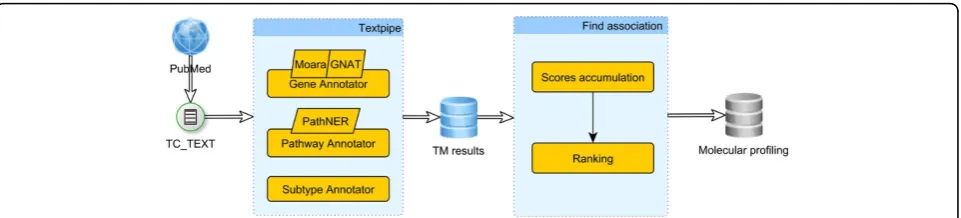
The pipeline we engineered to generate the molecular pro-filing of thyroid cancer subtypes is depicted in Figure 2. It starts with the corpus construction and is followed by the text mining tasks implemented as annotators within TextPipe [18], a framework designed for large-scale, mod-ular text processing and data integration. Text mining results are then used to find the association between
genes/pathways and thyroid cancer subtypes. These stages are explained in the following subsections.
Data - a corpus of thyroid cancer from MEDLINE
All the documents in our corpus were retrieved from MEDLINE. We performed a PubMed search with the
query“(((thyroid neoplasms[majr] AND human[mh] AND
english[la]) OR thyroid[ti]) AND (cancer OR carcinoma OR malignant OR malignancy))“, as suggested by the National Cancer Institute for retrieving the TC-relevant literature (see http://www.cancer.gov/cancertopics/lit-search/endocrine). It should be noted that the query limits the results to human studies in English. A total of 38,572 PubMed IDs (PMIDs) were fetched from PubMed (accessed on 13/01/2014). The complete list of PMIDs is available in Additional File 1. We retrieved abstracts from PubMed using those PMIDs and constructed the thyroid
cancer corpus (TC_TEXT) usingPyPubmedText, which
is freely available from https://github.com/chengkun-wu/ PyPubmedText.
For the evaluation, we created the SC_GOLD corpus, which consists of all 1,213 documents with specified subtype SCs since their introduction in 2010 (see Addi-tional File 2).
Subtype classification using subtype scoring
For subtype classification, we aimed to label the articles in the TC_TEXT corpus with the major TC subtype(s) discussed in the associated abstract. The subtypes we investigated included PTC, ATC, FTC and MTC. We considered this as a document classification task and have developed an efficient classification method based on a subtype-scoring scheme. Although machine-learn-ing methods are popular for document classification [27], we did not employ them here due to insufficient training data for each of the TC subtypes: while the recent articles with SCs can be used as the training data, the number of documents is still limited (1,213 in total, much fewer for each subtype). Instead, we used a flexible dictionary matching method as described below.
For each article in the corpus, we calculate a vector of scores corresponding to each TC subtype through the following steps:
SK is “papillary”, the AK is“thyroid” and the MK is
“cancer”. We then match those parts against text separately, maintaining the three separate keyword lists for matching: a subtype keyword list, an anat-omy keyword list and a malignancy keyword list. For each list, possible variants are also included. For instance, “anaplastic thyroid cancer” is also named as “undifferentiated thyroid cancer”, which can be written as “un-differentiated thyroid cancer”. So
“anaplastic”, “un-differentiated” and “ undifferen-tiated”will all be mapped to “anaplastic”. The lists are included in the additional files. For matching, we applied the open-source package LINNAEUS [28]. 2. Each input document is split into sentences. For each sentence, we apply dictionary matching to cal-culate the subtype relevance scores of that sentence calculated as follows: (1) if SK co-occurs within that sentence with both AK and MK, then the sentence has a relevance score 1 to the subtype SK; (2) if SK co-occurs with only AK or MK, then the sentence has a relevance score 0.5 to the subtype SK; (3) if SK appears alone without the presence of either AK or MK, the sentence has a relevance score 0.25 to the subtype SK. We defined these rules to cover the situations where subtype names are simplified, as illustrated above.
3. The vector of subtype scores Si=
SP
i,SAi,SFi,SMi
for article diis calculated by weighted accumulation of the vectors of subtype scores for each sentence
(the four elements in Sicorrespond to PTC, ATC,
FTC and MTC respectively). The weights of differ-ent sdiffer-entences are assigned in the following way: the title of a document is considered as the most impor-tant element and is assigned a weight of 4; the first sentence in the abstract usually mentions the main topic of the document and the last sentence usually concludes the article, and both are assigned a weight of 2; the second and the penultimate sentence can be quite important as well, and are both assigned a weight of 1; other sentences in the abstract are given
a weight of 0.5 in order to weaken bypassing men-tions of subtype names that are not the major scope of the article.
For classification, we set threshold values for each subtype and assign the corresponding label to the article if the associated subtype score is above a pre-set value. We assigned slightly different thresholds to different subtypes, with the PTC’s percentage threshold slightly higher than other subtypes, given that PTC occurs more frequently in the literature (over 50%).
Gene recognition and normalisation
A number of tools are available for identifying mentions of genes in the literature and normalising them to data-base identifiers. We utilized two open source libraries, Moara [14] and GNAT [15], which have been success-fully applied in other studies [18,26]. For gene name recognition, Moara utilizes the CBR-tagger [29], which treats the recognition problem as a binary classification on each token; GNAT employs dictionary-expanded reg-ular expressions together with BANNER [30]. For the normalisation of recognized gene names, both tools map mentions to the Entrez Gene database [20], adopting similar methods for disambiguation. We wrapped Moara and GNAT as TextPipe annotators that output normal-ised gene mentions including document ID (PubMed ID), positions in the text, normalised Entrez Gene ID, original text and the applied tool (Moara or GNAT). If the two tools report overlapping mentions, we created a new one covering both mentions (union); if the overlap-ping mentions have been assigned different Entrez Gene identifiers, the priority is given to GNAT as its reported performance is higher.
Pathway mention recognition
We utilised PathNER for pathway mention recognition from the literature [16]. PathNER is implemented using soft dictionary matching and manually created rules. For this study, we recompiled the pathway dictionary using
the data from the 2013 update of the ConsensusPathDB interaction database [31]. The outputs from this annota-tor are biological pathway mentions including document ID (PubMed ID), positions in the text, pathway database identifier (if available) and original text.
Association between genes/pathways and subtypes
To establish the association between text-mined informa-tion and thyroid cancer subtypes, we performed the follow-ing steps for each text-mined entity (gene or pathway, referred to as E thereafter):
1. Get all the documents DE={di|i∈[1,n]} that mention E according to the text-mining results; 2. For each document di∈DE, get the subtype score vectorSi=
SPi,SAi,SFi,SMi as described above; 3. Sum up allSito give the subtype relevancy vector of E:
SE= n
i=1
Si= n i=1 SP i, n i=1 SA i, n i=1 SF i, n i=1 SM
i =SPE,SEA,SFE,SME
For a given subtypej∈ {P,A,F,M}, we generate a list of entitiesLj, which is composed of entities that have at least one document labelled as subtypejin the classification stage; we then rank the entities inLj=[E1,E2,· · ·,Ek]in a descending order by the value ofSjEfor each entity E inLj.
Results and discussion
Subtype classification evaluation
For performance assessment against the gold standard, we adopted the standard metrics:Precision (P), Recall (R)andF1-score (F1)defined by the following equations:
P= TP
TP+FP, R= TP
TP+FN, F1 = 2 P·R P+R
Here, TP is the number of true positives, FPis the number offalse positives andFNis the number offalse negatives. Those metrics were calculated for each sub-type. For documents with multiple subtype labels, the labels were evaluated separately.
The evaluation of the classification performance against the SC_GOLD corpus for each TC subtype is listed in Table 1. The performance for PTC, ATC and MTC shows good precision and moderate recall, with F1-score over 85%. This demonstrates the effectiveness of our scoring scheme.
Unexpectedly, the precision for FTC was low (17.5%). We therefore performed error analysis to investigate the reason for that. We found that more than half of all errors (54 of the 99 FPs for FTC) are from articles about DTC or WDTC, referring to both PTC and FTC [32]. However, it seems that the PubMed SCs typically only annotate an article with PTC if it is about DTC.
This is probably because the SC for FTC was introduced in August 2012, while the SC for PTC was introduced two years earlier. If those 54 cases are considered TPs then the performance is obviously improved (F1 is 72.5%; listed in Table 1 as FTC*). We also found a few other variants such as“follicular variant papillary carci-noma”, “mixed medullary-follicular carcinoma of the thyroid”, “follicular variant of PTC”, etc. We checked the frequency of those variants by dictionary matching and we found them in 31 documents in SC_GOLD. As our classification “dissects” thyroid cancer subtype names into several parts, follicular variants will score and get incorrectly classified as FTC in those situations. The FTC precision is thus more affected as “follicular” is a word commonly used in PTC articles, since PTCs are derived from follicular cells [33].
In Table 1, we also listed the performance of a base-line method for comparison. The basebase-line method per-forms classification based on subtype name occurrences in titles and abstracts by dictionary matching using LIN-NAEUS [28]. The dictionary includes all available syno-nyms for the TC subtype names. The performance results demonstrate that our method outperforms the baseline for all subtypes.
Application to TC_TEXT
We ran our classification method on the whole TC_TEXT corpus (38,572 abstracts). The complete clas-sification results (with subtype relevancy scores and pre-dicted labels) can be found in Additional File 3. The number of articles labelled with each subtype is listed in Table 2, which also shows the incidence rate of each
Table 1 TC subtype classification performance on the SC_GOLD corpus.
TP TN FN FP Precision Recall F1
Our Method
PTC 641 372 186 14 0.979 0.775 0.865
ATC 114 1066 27 6 0.950 0.809 0.874 FTC 21 1081 12 99 0.175 0.636 0.275 FTC* 75 1081 12 45 0.625 0.862 0.725 MTC 189 979 41 4 0.979 0.822 0.894 Micro
Average
1019 3498 266 69 0.937 0.793 0.859
TP TN FN FP Precision Recall F1
Baseline PTC 601 372 226 14 0.977 0.727 0.834 ATC 109 1063 32 9 0.924 0.773 0.842 FTC 19 1061 14 119 0.320 0.485 0.386 FTC* 73 1061 14 65 0.529 0.839 0.649 MTC 181 971 49 12 0.938 0.787 0.856 Micro
Average
964 3467 321 100 0.906 0.750 0.821
subtype. We can see that the amount of literature some-what reflects the incidence rate, with PTC as the most frequent and ATC as the least frequent among the four subtypes studied here. The results also show that it is relatively uncommon to discuss more than one subtype in an article (see Figure 3), with the exception of PTC and FTC, which are frequently studied together as they are both derived from follicular cells [33].
Gene normalization results and gene-subtype association
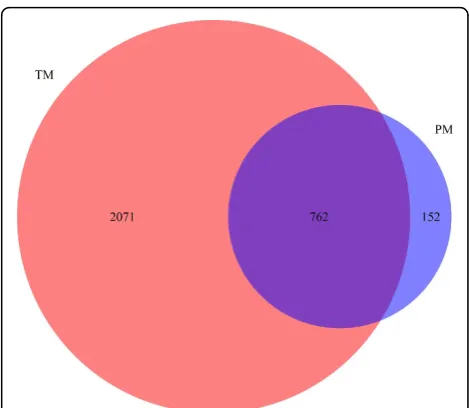
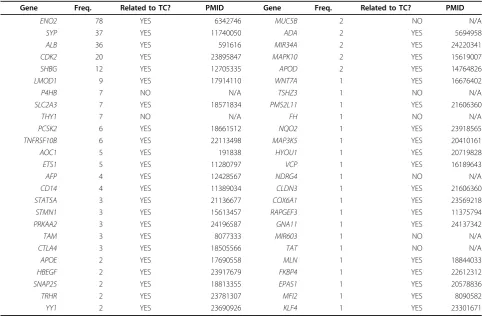
We ran gene recognition and normalization on the TC_TEXT corpus and a total number of 2,833 unique genes were detected. We first compared the resulting list against the gene list generated from the Gene2Pubmed database [20]. Out of 914 genes identified in Gene2-Pubmed, 762 (83.4%) are found by our text mining approach. On the other hand, 2,071 out of 2,833 text-mined genes (73.1%) are not listed in the Gene2Pubmed database (see Figure 4). We randomly sampled 50 genes from that difference set and manually checked whether they are associated with TC or not. Table 3 shows these genes sorted by their document-level frequency, according to text mining results. If a gene is related to TC, an exam-ple of relevant document is given. Overall, 42 genes out of
50 are found to be reported as associated with thyroid can-cer. This highlights the importance of using text mining for a comprehensive retrieval of information, complement-ing manually annotated data, which may potentially miss over 1,700 TC-related genes (84% of 2,071). We also note that even genes with low document-level frequencies can be relevant: for instance,WNT7A (Entrez Gene ID: 7476) was only detected once by text mining, but is reported to be over expressed in both PTC and its aggressive variant. Therefore, we did not use any filters based on document-level frequency in this study.
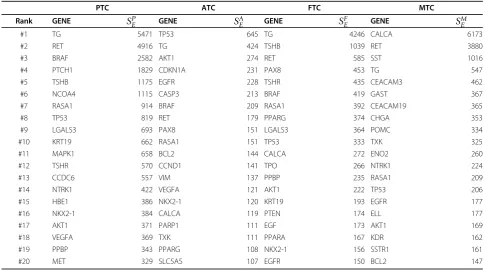
With the subtype classification, we generated ranked gene lists for each subtype as discussed in the Methods section (see Table 4 for the statistics). The top 20 genes for each subtype are given in Table 5 (the full results are provided in Additional File 4). The genes are ranked in descending order by their subtype scores (as described in Methods section). To validate the results, we looked at the most recent review on thyroid cancer [34]. Almost all well-observed mutations (see Table 1 in [34]) are identified by our top text mining results,
including BRAF, RET, TP53, TRK (NTRK1), RAS
(RASA1), PAX8-PPARG, RET/PTC (PTCH1), PTENand
AKT. The only missing genePIK3CAis ranked 30thand 32nd in the lists for FTC and ATC, respectively. This provides solid evidence for the capability of our method in assisting systematic acquisition of knowledge of the molecular biology of thyroid cancer.
We also compared the subtype gene lists generated by text mining to the manually created TCGDB database
Table 2 Number of articles for each subtype in the TC_TEXT corpus.
PTC ATC FTC MTC XTC* TOTAL
#Articles 7795 1122 4696 3316 3768 26866 % 29.0% 4.2% 17.5% 12.3% 14.0%
Incidence§ 75% 1-2% 10-15% 5-10%
XTC*: represents articles that contain more than one subtype labels. Incidence§
data source: PTC, FTC, ATC [2], MTC [39]
Figure 3 Overlap of documents related to different TC subtypes. The Venn diagram illustrates the overlap between documents associated to different subtypes.
(see Table 6): only a small number of genes for each subtype were missed by our method. The majority of the genes in the subtype lists from TCGDB have been successfully retrieved by our method, along with a num-ber of candidates for further manual curation.
Figure 5 shows a Venn diagram of gene lists shared between the four subtypes. Compared to Figure 3, we observe a much higher degree of overlap among sub-types. This indicates that a considerable number of common genes are investigated across different subtypes but in separate studies. Meanwhile, each subtype is still characterized by a significant number of unique genes.
Pathway mention recognition results
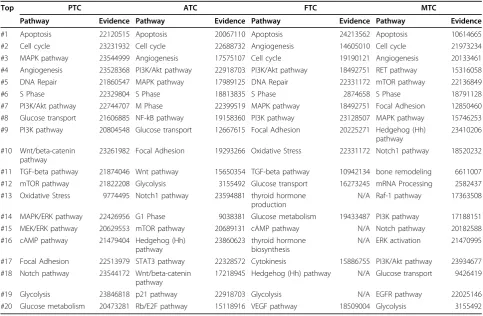
Table 7 presents the top 20 pathways for each TC sub-type (For the complete text mining results for TC
related pathways, please refer to Additional File 5). The most frequently mentioned pathways are typical biologi-cal processes involved in most cancers, including apop-tosis, angiogenesis, cell cycle, etc.
To validate these results, we compiled a list of path-ways from the most recent review on the molecular biology of thyroid cancers mentioned above [34]. The list includes five pathways: the mitogen-activated protein kinase (MAPK) pathway, the phosphatidylinositol 3-kinase (PI3K)/Akt signaling pathway, the Wnt/beta-catenin pathway, the NF-kB pathway and the
Hypoxia-Inducible Factor (HIF)-1a pathway. Except for the
HIF-1a pathway, all other pathways are present in the top 20 pathways extracted for subtypes by text mining (see Table 8). The HIF-1apathway was reported to be a potential therapeutic target for thyroid cancer [35] and
Table 3 Results of TC-relevance for 50 sampled text-mined genes not in Gene2PubMed.
Gene Freq. Related to TC? PMID Gene Freq. Related to TC? PMID
ENO2 78 YES 6342746 MUC5B 2 NO N/A
SYP 37 YES 11740050 ADA 2 YES 5694958
ALB 36 YES 591616 MIR34A 2 YES 24220341
CDK2 20 YES 23895847 MAPK10 2 YES 15619007
SHBG 12 YES 12705335 APOD 2 YES 14764826
LMOD1 9 YES 17914110 WNT7A 1 YES 16676402
P4HB 7 NO N/A TSHZ3 1 NO N/A
SLC2A3 7 YES 18571834 PMS2L11 1 YES 21606360
THY1 7 NO N/A FH 1 NO N/A
PCSK2 6 YES 18661512 NQO2 1 YES 23918565
TNFRSF10B 6 YES 22113498 MAP3K5 1 YES 20410161
AOC1 5 YES 191838 HYOU1 1 YES 20719828
ETS1 5 YES 11280797 VCP 1 YES 16189643
AFP 4 YES 12428567 NDRG4 1 NO N/A
CD14 4 YES 11389034 CLDN3 1 YES 21606360
STAT5A 3 YES 21136677 COX6A1 1 YES 23569218
STMN1 3 YES 15613457 RAPGEF3 1 YES 11375794
PRKAA2 3 YES 24196587 GNA11 1 YES 24137342
TAM 3 YES 8077333 MIR603 1 NO N/A
CTLA4 3 YES 18505566 TAT 1 NO N/A
APOE 2 YES 17690558 MLN 1 YES 18844033
HBEGF 2 YES 23917679 FKBP4 1 YES 22612312
SNAP25 2 YES 18813355 EPAS1 1 YES 20578836
TRHR 2 YES 23781307 MFI2 1 YES 8090582
YY1 2 YES 23690926 KLF4 1 YES 23301671
The PMID column shows an example of document that reports evidence that a given gene is linked to TC, or N/A if we were not able to find support for the relationship.
Table 4 Number of genes extracted for each TC subtype.
PTC ATC FTC MTC TOTAL
#Genes 1256 538 791 613 2834
%Unique 38.7% 25.5% 15.8% 40.6%
has been experimentally verified in a couple of cell lines [36]. However, this pathway is absent from the text-mined results, even though the reporting paper [36] was included in TC_TEXT corpus. Our method did detect
the HIF-1apathway mention and found its association
with thyroid carcinomas. However, the subtype rele-vancy scores for that abstract (PMID: 19808899) are low. The reason is that the cell lines used in the study were actually subtype-specific but this information was only available in the full-text. This example suggests the importance and potential of the analysis of full text arti-cles as opposed to abstracts, which is an objective for future work.
For other pathways in Table 7 that have not been mentioned in the above review, we have further investi-gated whether they are associated with the correspond-ing subtypes. For instance, the Notch signallcorrespond-ing appears in the top 20 pathways for PTC, ATC and MTC but was not mentioned in [34]. We however found direct
literature evidence that links this pathway to TC: the Notch pathway has crosstalk with the MAPK pathway and affects the PTC proliferation [37], and the activation of the Notch signalling has been identified as the poten-tial therapeutic strategy for ATC [38]. We followed this procedure for each pathway in Table 7: an example PMID is given in the“Evidence” column, which repre-sents an article that reports the association between the subtype and the pathway (if applicable). Almost all
Table 5 Top 20 genes for the four thyroid cancer subtypes as extracted from the literature.
PTC ATC FTC MTC
Rank GENE SP
E GENE SAE GENE SFE GENE SME
#1 TG 5471 TP53 645 TG 4246 CALCA 6173
#2 RET 4916 TG 424 TSHB 1039 RET 3880
#3 BRAF 2582 AKT1 274 RET 585 SST 1016
#4 PTCH1 1829 CDKN1A 231 PAX8 453 TG 547
#5 TSHB 1175 EGFR 228 TSHR 435 CEACAM3 462
#6 NCOA4 1115 CASP3 213 BRAF 419 GAST 367
#7 RASA1 914 BRAF 209 RASA1 392 CEACAM19 365
#8 TP53 819 RET 179 PPARG 374 CHGA 353
#9 LGALS3 693 PAX8 151 LGALS3 364 POMC 334
#10 KRT19 662 RASA1 151 TP53 333 TXK 325
#11 MAPK1 658 BCL2 144 CALCA 272 ENO2 260
#12 TSHR 570 CCND1 141 TPO 266 NTRK1 224
#13 CCDC6 557 VIM 137 PPBP 235 RASA1 209
#14 NTRK1 422 VEGFA 121 AKT1 222 TP53 206
#15 HBE1 386 NKX2-1 120 KRT19 193 EGFR 177
#16 NKX2-1 384 CALCA 119 PTEN 174 ELL 177
#17 AKT1 371 PARP1 111 EGF 173 AKT1 169
#18 VEGFA 369 TXK 111 PPARA 167 KDR 162
#19 PPBP 343 PPARG 108 NKX2-1 156 SSTR1 161
#20 MET 329 SLC5A5 107 EGFR 150 BCL2 147
Table 6 Text-mined genes compared with the TCGDB database.
PTC ATC FTC MTC
#TCGDB 60 15 10 20
#TM Missed 8 2 3 2
%Coverage 86.7% 86.7% 70% 90%
The first row represents the total numbers of genes in TCGDB associated to a given subtype. The second row represents the number of genes missed by text mining. The final row is the coverage: (#TCGDB-#TM Missed) / #TCGDB.
pathways in the top 20 list are supported by literature evidence: only for five pathways in the FTC list we were not able to find support in the literature. This demon-strates the potential of our work for the systematic and comprehensive acquisition of knowledge of thyroid cancer.
Conclusions
In this paper we presented an approach to finding mole-cular information associated with different subtypes of thyroid cancer. We developed a method for subtype classification and performed text mining to identify genes and biological pathways associated with each
subtype. The generated gene and pathway lists provide a comprehensive compendium of the key molecular infor-mation related to thyroid cancer subtypes.
The data and results from our study form the basis for a further comprehensive analysis of the molecular biology of thyroid cancer, enriched by subtypes. Based on the molecular differences between subtypes revealed in our study, biologists can look for better diagnostic biomarkers. In addition, the molecular information can be used to build molecular networks of thyroid cancer subtypes, which would enable further systems biology analyses and stimulate the development of targeted therapeutics.
Table 7 Top 20 pathways for the four thyroid cancer subtypes as extracted from the literature.
Top PTC ATC FTC MTC
Pathway Evidence Pathway Evidence Pathway Evidence Pathway Evidence
#1 Apoptosis 22120515 Apoptosis 20067110 Apoptosis 24213562 Apoptosis 10614665 #2 Cell cycle 23231932 Cell cycle 22688732 Angiogenesis 14605010 Cell cycle 21973234 #3 MAPK pathway 23544999 Angiogenesis 17575107 Cell cycle 19190121 Angiogenesis 20133461 #4 Angiogenesis 23528368 PI3K/Akt pathway 22918703 PI3K/Akt pathway 18492751 RET pathway 15316058 #5 DNA Repair 21860547 MAPK pathway 17989125 DNA Repair 22331172 mTOR pathway 22136849 #6 S Phase 22329804 S Phase 18813835 S Phase 2874658 S Phase 18791128 #7 PI3K/Akt pathway 22744707 M Phase 22399519 MAPK pathway 18492751 Focal Adhesion 12850460 #8 Glucose transport 21606885 NF-kB pathway 19158360 PI3K pathway 23128507 MAPK pathway 15746253 #9 PI3K pathway 20804548 Glucose transport 12667615 Focal Adhesion 20225271 Hedgehog (Hh)
pathway
23410206
#10 Wnt/beta-catenin pathway
23261982 Focal Adhesion 19293266 Oxidative Stress 22331172 Notch1 pathway 18520232
#11 TGF-beta pathway 21874046 Wnt pathway 15650354 TGF-beta pathway 10942134 bone remodeling 6611007 #12 mTOR pathway 21822208 Glycolysis 3155492 Glucose transport 16273245 mRNA Processing 2582437 #13 Oxidative Stress 9774495 Notch1 pathway 23594881 thyroid hormone
production
N/A Raf-1 pathway 17363508
#14 MAPK/ERK pathway 22426956 G1 Phase 9038381 Glucose metabolism 19433487 PI3K pathway 17188151 #15 MEK/ERK pathway 20629553 mTOR pathway 20689131 cAMP pathway N/A Notch pathway 20182588 #16 cAMP pathway 21479404 Hedgehog (Hh)
pathway
23860623 thyroid hormone biosynthesis
N/A ERK activation 21470995
#17 Focal Adhesion 22513979 STAT3 pathway 22328572 Cytokinesis 15886755 PI3K/Akt pathway 23934677 #18 Notch pathway 23544172 Wnt/beta-catenin
pathway
17218945 Hedgehog (Hh) pathway N/A Glucose transport 9426419
#19 Glycolysis 23846818 p21 pathway 22918703 Glycolysis N/A EGFR pathway 22025146 #20 Glucose metabolism 20473281 Rb/E2F pathway 15118916 VEGF pathway 18509004 Glycolysis 3155492
“Evidence”column presents one example PMID that reports a given relationship (N/A: Not Applicable if there is no evidence)
Table 8 Reviewed TC related pathways and text-mined evidence for each subtype.
Pathway Related to TC? Evidence PMIDs
PTC ATC FTC MTC
MAPK pathway YES 16896265 16410725 21196179 23934677
PI3K/Akt signaling pathway YES 18000091 22918703 17426084 23329180
Wnt/beta-catenin pathway YES 22204713 17218945 18727708 N/A
NF-kB pathway YES 23528368 19885592 16314832 N/A
Availability
The code and data files are available at https://github.com/ chengkun-wu/GenesThyCan.
Additional material
Additional File 1: TC_TEXT PMID list. The PMIDs in the TC_TEXT corpus are listed in this .txt file, one PMID per line.
Additional File 2: SC_GOLD PMID list. The .txt file is the gold standard derived from the MeSH Supplementary Concepts for thyroid cancer. It consists of 1,213 PMIDs and their corresponding thyroid cancer SCs. The values in the file are tab separated.
Additional File 3: Classification results with scores and subtype labels. The .xlsx (Excel) file contains the classification results on the TC_TEXT corpus with subtype relevancy scores and predicated subtype labels. If a document is not related to TC at all, it is given the label “NON"; if a document is related to TC but without a specific focus on one or multiple subtypes, it is given the label“TC"; if a document is assigned multiple subtype labels, the labels are separated by‘|’. Additional File 4: Text-mined gene results. The .xlsx (Excel) file contains the text mining results for TC-related genes. The file contains a mapping between TC-related documents and their associated genes, categorized by subtypes.
Additional File 5: Text-mined pathway results. The .xlsx (Excel) file contains the text mining results for TC-related pathways. The file contains a mapping between TC-related documents and their associated pathways, categorized by subtypes.
List of abbreviations
NER: Named Entity Recognition; PMID: PubMed ID; TC: Thyroid Cancer; PTC: Papillary Thyroid Cancer; FTC: Follicular Thyroid Cancer; ATC: Anaplastic Thyroid Cancer; MTC: Medullary Thyroid Cancer; DTC: Differentiated Thyroid Cancer; WDTC: Well-Differentiated Thyroid Cancer; MeSH: Medical Subject Headings; SC: Supplementary Concept; TCGDB: Thyroid Cancer and Disorder Gene Database; SK: Subtype Keyword; AK: Anatomy Keyword; MK: Malignancy Keyword; TP: True Positives; FN: False Negatives; FP: False Positives;
Competing interests
The authors declare that they have no competing interests.
Authors’contributions
CW developed the system for the detection on the subtype-genes/pathways association, and drafted the manuscript. GN provided support and guidance from the text mining perspective and JMS from the systems biology perspective. GB provided expertise on thyroid cancer. GN and JMS conceived and supervised the project. CW, JMS, GB and GN wrote the manuscript. All authors read and approved the final manuscript.
Acknowledgements
CW is co-funded by UK Biotechnology and Biological Sciences Research Council (BBSRC), the University of Manchester and the Chinese Scholarship Council (CSC) for his PhD study in the Doctoral Training Centre for Integrative Systems Biology at the University of Manchester. GN
acknowledges support from the Serbian Ministry of Education and Science (projects III44006; III47003) and the Health eResearch Centre (HeRC).
Declarations
Publication of this article was funded by the UK Biotechnology and Biological Sciences Research Council (BBSRC) through the Doctoral Training Centre for Integrative Systems Biology at the University of Manchester. This article has been published as part ofBMC Medical GenomicsVolume 7 Supplement 3, 2014: Thirteenth International Conference on Bioinformatics (InCoB2014): Medical Genomics. The full contents of the supplement are
available online at http://www.biomedcentral.com/bmcmedgenomics/ supplements/7/S3.
Authors’details 1
Faculty of Life Sciences, University of Manchester, Manchester, M13 9PT, UK. 2Doctoral Training Centre in Integrative Systems Biology, University of Manchester, 131 Princess Street, Manchester M1 7DN, UK.3Manchester Institute of Biotechnology, 131 Princess Street, Manchester M1 7DN, UK. 4
Department of Endocrinology, Christie Hospital, University of Manchester, Wilmslow Road, Manchester M20 4BX, UK.5Experimental and Clinical Endocrinology, Med Clinic I, University of Luebeck Ratzeburger Allee 160 D-23538, Lübeck, Germany.6School of Computer Science, University of Manchester, Manchester M13 9PL, UK.7Health e-Research Centre (HeRC), Manchester M13 9PL, UK.
Published: 8 December 2014
References
1. Nix P, Nicolaides A, Coatesworth AP:Thyroid cancer review 1: presentation and investigation of thyroid cancer.International Journal of Clinical Practice2005,59:1340-1344.
2. Ito Y, Nikiforov YE, Schlumberger M, Vigneri R:Increasing incidence of thyroid cancer: controversies explored.Nature Reviews Endocrinology2013,9:178-184. 3. Rodríguez-Rodero S, Fernández AF, Fernández-Morera JL, Castro-Santos P,
Bayon GF, Ferrero C, Urdinguio RG, Gonzalez-Marquez R, Suarez C, Fernández-Vega I, Fresno Forcelledo MF, Martínez-Camblor P, Mancikova V, Castelblanco E, Perez M, Marrón PI, Mendiola M, Hardisson D, Santisteban P, Riesco-Eizaguirre G, Matías-Guiu X, Carnero A, Robledo M, Delgado-Álvarez E, Menéndez-Torre E, Fraga MF:DNA methylation signatures identify biologically distinct thyroid cancer subtypes.J Clin Endocrinol Metab2013,98:2811-2821.
4. Lalami Y, Awada A:Recurrent thyroid cancer: a molecular-based therapeutic breakthrough.Curr Opin Oncol2011,23:235-240. 5. Xing M, Haugen BR, Schlumberger M:Progress in molecular-based
management of differentiated thyroid cancer.Lancet2013,
381:1058-1069.
6. Sipos JA, Shah MH:Thyroid cancer: emerging role for targeted therapies. Ther Adv Med Oncol2010,2:3-16.
7. Antonelli A, Fallahi P, Ferrari SM, Ruffilli I, Santini F, Minuto M, Galleri D, Miccoli P:New targeted therapies for thyroid cancer.Curr Genomics2011,
12:626-631.
8. Nikiforova MN, Nikiforov YE:Molecular genetics of thyroid cancer: implications for diagnosis, treatment and prognosis.Expert Rev Mol Diagn
2008,8:83-95.
9. Russo D, Damante G, Puxeddu E, Durante C, Filetti S:Epigenetics of thyroid cancer and novel therapeutic targets.J Mol Endocrinol2011,
46:R73-R81.
10. Mulligan LM:RET revisited: expanding the oncogenic portfolio.Nat Rev Cancer2014,14:173-186.
11. Hunter L, Cohen KB:Biomedical language processing: what’s beyond PubMed?Mol Cell2006,21:589-594.
12. Ananiadou S, Kell DB, Tsujii J-I:Text mining and its potential applications in systems biology.Trends in Biotechnology2006,24:571-579.
13. Ananiadou S, Pyysalo S, Tsujii J, Kell DB:Event extraction for systems biology by text mining the literature.Trends in Biotechnology2010,
28:381-390.
14. Neves ML, Carazo J-M, Pascual-Montano A:Moara: a Java library for extracting and normalizing gene and protein mentions.BMC Bioinformatics2010,11:157.
15. Hakenberg J, Gerner M, Haeussler M, Solt I, Plake C, Schroeder M, Gonzalez G, Nenadic G, Bergman CM:The GNAT library for local and remote gene mention normalization.Bioinformatics2011,27:2769-2771. 16. Wu C, Schwartz J-M, Nenadic G:PathNER: a tool for systematic
identification of biological pathway mentions in the literature.BMC Syst Biol2013,7:S2.
17. Bjorne J, Ginter F, Pyysalo S, Tsujii J, Salakoski T:Complex event extraction at PubMed scale.Bioinformatics2010,26:i382-i390.
19. Rappaport N, Nativ N, Stelzer G, Twik M, Guan-Golan Y, Stein TI, Bahir I, Belinky F, Morrey CP, Safran M, Lancet D:MalaCards: an integrated compendium for diseases and their annotation.Database (Oxford)2013,
2013:bat018.
20. Maglott D, Ostell J, Pruitt KD, Tatusova T:Entrez Gene: gene-centered information at NCBI.Nucleic Acids Res2011, ,39 Database:D52-7. 21. Kanehisa M, Goto S, Sato Y, Furumichi M, Tanabe M, Kanehisa M, Goto S,
Sato Y, Furumichi M, Tanabe M:KEGG for integration and interpretation of large-scale molecular data sets.Nucleic Acids Res2011,40:D109-D114. 22. Mizuno S, Iijima R, Ogishima S, Kikuchi M, Matsuoka Y, Ghosh S,
Miyamoto T, Miyashita A, Kuwano R, Tanaka H:AlzPathway: a
comprehensive map of signaling pathways of Alzheimer’s disease.BMC Syst Biol2012,6:52.
23. Chun H-W, Tsuruoka Y, Kim J-D, Shiba R, Nagata N, Hishiki T, Tsujii J:
Automatic recognition of topic-classified relations between prostate cancer and genes using MEDLINE abstracts.BMC Bioinformatics2006,7:S4. 24. Tsuruoka Y, Tsujii J, Ananiadou S:FACTA: a text search engine for finding
associated biomedical concepts.Bioinformatics2008,24:2559-2560. 25. Frijters R, Heupers B, van Beek P, Bouwhuis M, van Schaik R, de Vlieg J,
Polman J, Alkema W:CoPub: a literature-based keyword enrichment tool for microarray data analysis.Nucleic Acids Res2008, ,36 Web Server:1-5. 26. Kim J, So S, Lee H, Park JC, Kim J-J, Lee H:DigSee: Disease gene search
engine with evidence sentences (version cancer).Nucleic Acids Res2013, ,
41 Web Server:W510-7.
27. Sebastiani F:Machine learning in automated text categorization.ACM Computing Surveys (CSUR)2002,34:1-47.
28. Gerner M, Nenadic G, Bergman CM:LINNAEUS: a species name identification system for biomedical literature.BMC Bioinformatics2010,
11:85.
29. Neves M, Chagoyen M, Carazo JM, Pascual-Montano A:CBR-Tagger: a case-based reasoning approach to the gene/protein mention problem.
Association for Computational Linguistics; 2008.
30. Leaman R, Gonzalez G:BANNER: an executable survey of advances in biomedical named entity recognition.Pac Symp Biocomput2008, 652-663. 31. Kamburov A, Stelzl U, Lehrach H, Herwig R:The ConsensusPathDB
interaction database: 2013 update.Nucleic Acids Res2013, ,41 Database:
D793-800.
32. Busaidy NL, Cabanillas ME:Differentiated thyroid cancer: management of patients with radioiodine nonresponsive disease.Journal of Thyroid Research2012,2012:618985.
33. Grande E, Díez JJ, Zafon C, Capdevila J:Thyroid cancer: molecular aspects and new therapeutic strategies.Journal of Thyroid Research2012,
2012:847108.
34. Omur O, Baran Y:An update on molecular biology of thyroid cancers.Crit Rev Oncol Hematol2014,90:233-252.
35. Burrows N, Babur M, Resch J, Williams KJ, Brabant G:Hypoxia-inducible factor in thyroid carcinoma.Journal of Thyroid Research2011,2011:762905. 36. Burrows N, Resch J, Cowen RL, Wasielewski von R, Hoang-Vu C, West CM,
Williams KJ, Brabant G:Expression of hypoxia-inducible factor 1 in thyroid carcinomas.Endocrine Related Cancer2010,17:61-72.
37. Yamashita AS, Geraldo MV, Fuziwara CS, Kulcsar MAV, Friguglietti CUM, da Costa RB, Baia GS, Kimura ET:Notch pathway is activated by MAPK signaling and influences papillary thyroid cancer proliferation.Transl Oncol2013,6:197-205.
38. Yu X-M, Jaskula-Sztul R, Ahmed K, Harrison AD, Kunnimalaiyaan M, Chen H:
Resveratrol induces differentiation markers expression in anaplastic thyroid carcinoma via activation of Notch1 signaling and suppresses cell growth.Mol Cancer Ther2013,12:1276-1287.
39. Sippel RS, Kunnimalaiyaan M, Chen H:Current management of medullary thyroid cancer.Oncologist2008,13:539-547.
doi:10.1186/1755-8794-7-S3-S3
Cite this article as:Wuet al.:Molecular profiling of thyroid cancer subtypes using large-scale text mining.BMC Medical Genomics2014
7(Suppl 3):S3.
Submit your next manuscript to BioMed Central and take full advantage of:
• Convenient online submission
• Thorough peer review
• No space constraints or color figure charges
• Immediate publication on acceptance
• Inclusion in PubMed, CAS, Scopus and Google Scholar
• Research which is freely available for redistribution