https://doi.org/10.5194/gmd-11-1785-2018 © Author(s) 2018. This work is distributed under the Creative Commons Attribution 4.0 License.
Impacts of the horizontal and vertical grids on the numerical
solutions of the dynamical equations – Part 2: Quasi-geostrophic
Rossby modes
Celal S. Konor and David A. Randall
Department of Atmospheric Science, Colorado State University, Fort Collins, CO 80523, USA Correspondence:Celal S. Konor ([email protected])
Received: 25 September 2017 – Discussion started: 22 December 2017 Revised: 29 March 2018 – Accepted: 3 April 2018 – Published: 8 May 2018
Abstract. We use a normal-mode analysis to investigate the impacts of the horizontal and vertical discretizations on the numerical solutions of the quasi-geostrophic anelastic baroclinic and barotropic Rossby modes on a midlatitudeβ plane. The dispersion equations are derived for the linearized anelastic system, discretized on the Z, C, D, CD, (DC), A, E and B horizontal grids, and on the L and CP vertical grids. The effects of various horizontal grid spacings and vertical wavenumbers are discussed. A companion paper, Part 1, dis-cusses the impacts of the discretization on the inertia–gravity modes on a midlatitudef plane.
The results of our normal-mode analyses for the Rossby waves overall support the conclusions of the previous studies obtained with the shallow-water equations. We identify an area of disagreement with the E-grid solution.
1 Introduction
In a companion paper (Konor and Randall, 2018; hereafter Part 1), we discuss the horizontal discretization of the lin-earized anelastic equations on the Z, C, D, CD, (DC), A, E and B grids, and vertical discretization on the L and CP grids. We introduced the DC grid in Part 1 to test the hy-pothesis that the CD-grid (and DC-grid) solutions are dom-inated by the corrector step and the grid used with it. Part 1 focuses on the dispersion of nonhydrostatic inertia–gravity modes on anf plane. The present paper gives a correspond-ing analysis of the dispersion of three-dimensional Rossby modes on a midlatitudeβplane. Previous studies (e.g., Neta and Williams, 1989; Dukowicz, 1995) have mostly used the
discrete shallow-water equations on a midlatitudeβ plane. Thuburn (2008) analyzed the inaccuracies of the Rossby modes on the hexagonal C grid and proposed a discretiza-tion that minimizes these inaccuracies.
We use the quasi-geostrophic and quasi-static equations in our analysis because Rossby waves are not significantly in-fluenced by ageostrophic or nonhydrostatic effects. Further-more, the quasi-hydrostatic equations produce an exact solu-tion on theβ plane while the basic dynamical equations, in-cluding fully compressible and anelastic equations, produce exact solutions only for particular cases. A more detailed dis-cussion is given in the Supplement.
In Sect. 2, we present the continuous linearized anelas-tic equations with the quasi-geostrophic and quasi-staanelas-tic ap-proximations on the midlatitudeβplane and discuss the persion of the Rossby modes. Section 3 discusses the dis-cretization of these equations on the seven horizontal grids listed above and the discrete dispersion of the modes. At the end of Sect. 3, we present a comparison of the performance of the grids in simulating the Rossby modes. The vertical dis-cretization using the L and CP grids is discussed in Sect. 4. Finally, a summary and conclusions are provided in Sect. 6. Additional details are given in the Supplement.
2 Linearized anelastic equations with an isothermal basic state
Basic equations
Following Arakawa and Konor (2009), we assume quasi-geostrophic (and quasi-static) balance with the midlatitude β-plane approximation to obtain the dispersion relationship for the baroclinic and barotropic Rossby waves.
Baroclinic Rossby modes.Baroclinic modes involve vertical motions and are influenced by the static stability (B6=0 and w6=0). The equations for this case can be obtained by assuming ∂D/∂t=0 and ∂w/∂t=0 in Eqs. (2)–(7) of Part 1, adding a β term in the form of −(β/f0) (∂P /∂x) to the vorticity equation and replacing f with f0 in the divergence equation. The results are
∂ωz
∂t = −f0D− β f0
∂P
∂x, (1)
0=f0ωz− ∇H2P , (2)
and
N2D= "
∂2 ∂z2−
1
2ρ0 ∂ρ0
∂z
2#∂P
∂t . (3)
Note that for an isothermal atmosphere (1/ρ0) (∂ρ0/∂z)=
−1/H and N2=gκ/H. By using Eq. (10) of Part 1 in Eqs. (1)–(3), we obtain the continuous dispersion relation for the baroclinic Rossby waves as
ν= −βk
k2+`2 +f
2 0
N2
m2+ 1 4H2
. (4)
Barotropic Rossby modes. Barotropic modes involve purely horizontal motion and are not affected by the static stability (B=0). They also satisfy w=0, D=0 and ∂/∂z−(1/2ρ0) (∂ρ0/∂z)P =0. The equations that govern the barotropic motion can be obtained by using these assumptions in Eqs. (1)–(3) as
∂ωz ∂t = −
β f0
∂P
∂x, (5)
and
0=f0ωz− ∇H2P . (6)
Similarly, the continuous dispersion relation for the barotropic modes is given by
ν= −βk
k2+`2. (7)
3 Horizontal discretization on different grids and discrete dispersion equation
In this section, we discuss the discretization of the basic equations and derive the discrete dispersion relation on each horizontal grid. At the end of this section, we present an il-lustrative discussion of the dispersion equations showing fre-quency plots that are similar to the ones presented in Part 1. 3.1 Solutions for the Z grid
Baroclinic Rossby modes. We horizontally discretize Eqs. (1)–(3) on the Z grid shown in Fig. 1a of Part 1 as
∂
∂t(ωz)i,j= −f0Di,j− β f0
Pi+1,j−Pi−1,j
2d , (8)
0= (9)
f0(ωz)i,j− 1
d2 Pi+1,j+Pi−1,j+Pi,j+1+Pi,j−1−4Pi,j
,
and N2Di,j=
" ∂2 ∂z2−
1
2ρ0 ∂ρ0
∂z
2#∂P i,j
∂t , (10)
respectively. By using Eq. (16) of Part 1 in Eqs. (1)–(3), we obtain the discrete dispersion relation as
ν= −βeξ k
ξ2k2+η2`2+f02
N2
m2+ 1 4H2
, (11)
where eξ≡
sin(kd)
kd , (12)
ξ≡
sin12kd 1 2kd
and
η≡
sin12`d 1 2`d
.
Barotropic Rossby modes. We horizontally discretize Eqs. (5) and (6) on the Z grid as
∂
∂t(ωz)i,j= − β f0
Pi+1,j−Pi−1,j
2d , (13)
and
0=f0(ωz)i,j
− 1
d2 Pi+1,j+Pi−1,j+Pi,j+1+Pi,j−1−4Pi,j
, (14) respectively. Equations (12) and (14) can also be obtained by assuming D=0 in Eqs. (8) and (9), respectively. The dis-crete dispersion equation for the barotropic modes is ν= −βeξ k
whereeξ,ξ andηare given by Eq. (12), which have the same definitions in Part 1. For d→0, both Eqs. (11) and (15) become identical to their continuous counterparts given by Eqs. (4) and (7), respectively. This confirms that the dis-crete solutions are consistent and that they correspond to the solutions of the continuous equations. On the other hand, as the zonal scale approaches the shortest resolvable zonal scale (hereafter SRZS), i.e.,kd→π andeξ→0, the discrete modes lose their ability to recognize theβeffect, and the fre-quency of the modes becomes zero at the SRZS. This result has been derived using theβ-plane approximation. It is not immediately clear whether or not it holds in true spherical geometry. This could be studied through a discrete normal-mode analysis on the sphere and/or numerical integrations of the linearized equations on the sphere.
As in Part 1, we present plots of the discrete dispersion of the Rossby modes generated by using the Z, C, D, CD, A, E and B grids. The basic state and plot design are the same as Part 1. We use β=1.62×10⁻¹¹m−1s−1, which is typical for a midlatitude plane.
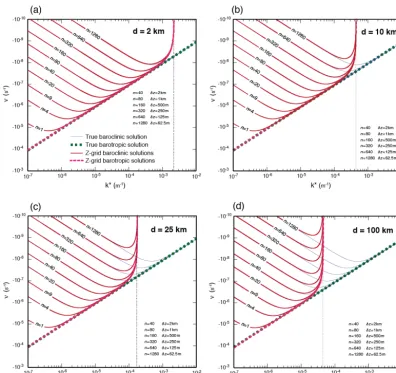
The dispersion plots for baroclinic and barotropic Rossby modes with the Z grid are presented in Fig. 1. The most strik-ing feature is that the frequencies of all modes, for all verti-cal sverti-cales and horizontal grid spacings, approach zero at the SRZS. We use k=` to plot these results. This is a conse-quence of the use of the centered finite difference to approx-imate the zonal pressure gradient at cell centers. As a result, theβeffect cannot be recognized by any of the modes at the SRZS. Consequently, a dynamically inert mode is generated. Again, it should be checked whether or not this conclusion carries over to the linearized equations on the sphere. 3.2 Solutions for the C grid
Baroclinic Rossby modes.We horizontally discretize Eqs. (1) and (2) on the C grid shown in Fig. 1b of Part 1 as
∂(ωz)i+1/2,j+1/2
∂t =
−f0 1
4 Di,j+Di+1,j+Di,j+1+Di+1,j+1
− β
f0
Pi+3/2,j+1/2−Pi−1/2,j+1/2 2d
!
, (16)
where
Pi+1/2,j+1/2≡ (17)
1
4 Pi,j+Pi+1,j+Pi,j+1+Pi+1,j+1 , and 0= f0 1 4
(ωz)i+1/2,j+1/2+(ωz)i+1/2,j−1/2+(ωz)i−1/2,j+1/2
+(ωz)i−1/2,j−1/2
− 1
d2 Pi+1,j+Pi−1,j+Pi,j+1
+Pi,j−1−4Pi,j.
Equations (16), (17) and (10) complete the set of discrete equations for the C grid. By using Eqs. (16) and (22) of Part 1, we obtain the discrete dispersion relation as
ν= −µ
2 eξ βk ξ2k2+η2`2+µ
2f2 0
N2
m2+ 1
4H2
, (18)
whereeξ,ξ andηare given by Eq. (12), and
µ≡cos 1 2kd cos 1 2`d . (19)
The definition ofµis identical to that used in Part 1.
Barotropic Rossby modes. By using D=0 in Eqs. (16) and (17) and then using Eqs. (16) and (22) of Part 1, we obtain the discrete dispersion relation for barotropic Rossby modes on the C grid as
ν= −µ
2 eξ βk
ξ2k2+η2`2. (20)
The discrete baroclinic and barotropic dispersion relations, Eqs. (18) and (20), for the C grid include an averaging fac-torµ2. This is a difference from their Z-grid counterparts, Eqs. (11) and (15). Averaging of pressure termP from the cell centers to the corners in Eq. (17) leads to the factor ofµ2 in the numerators of Eqs. (18) and (20). A factor ofµ2also appears in the inertia term at the denominator of Eq. (18), due to the averaging of divergence and vorticity to each other’s grid points. Sinceµandeξare both equal to zero at the SRZS, dynamically inert modes exist for both the baroclinic and barotropic Rossby modes on the C grid, similar to those that exist in the Z-grid solutions.
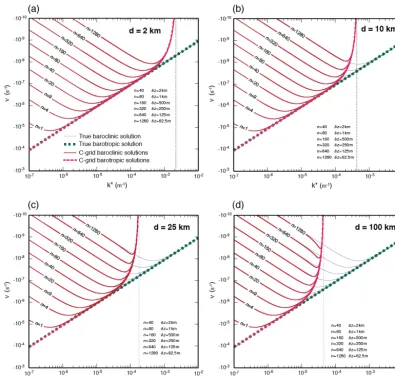
The C-grid solutions shown in Fig. 2 are qualitatively sim-ilar to the Z-grid solutions, but the C-grid solution deviates slightly because the dispersion relation for the C grid given by Eq. (18) contains an averaging factorµ2in the numerator. Sinceµalso approaches zero at the SRZS, andeξ approaches zero, the small-scale modes on the C grid move or oscillate more slowly than on the Z grid. As mentioned above, at the SRZS, a dynamically inert mode is generated with the C grid. 3.3 Solutions for the D grid
Baroclinic Rossby modes.We horizontally discretize Eqs. (1) and (2) on the D grid shown in Fig. 1c of Part 1 as
∂(ωz)i,j
∂t = (21)
−f01
4 Di−1/2,j−1/2+Di+1/2,j−1/2+Di−1/2,j+1/2
+Di+1/2,j+1/2− β f0
Pi+1,j−Pi−1,j
Figure 1.Plots of the absolute value of frequency of the baroclinic (red lines) and barotropic (dashed red lines) Rossby modes obtained on the Z grid for the grid spacings(a)2 km,(b)10 km,(c)25 km and(d)100 km, and for the various vertical wavenumbers. The thin blue and thick green dashed lines are the corresponding true baroclinic and barotropic frequencies, respectively.
and
0= (22)
f0 1 4
(ωz)i+1,j+1+(ωz)i,j+1+(ωz)i+1,j+(ωz)i,j
− 1
d2 Pi+3/2,j+1/2+Pi+1/2,j+3/2+Pi+1/2,j−1/2
+Pi−1/2,j+1/2−4Pi+1/2,j+1/2,
respectively. In Eq. (22), Pi+1/2,j+1/2≡ 1
4 Pi,j+Pi+1,j+Pi,j+1+Pi+1,j+1
. By adding the discrete version of Eq. (3) given by
N2 1
4 Di−1/2,j−1/2+Di+1/2,j−1/2+Di−1/2,j+1/2 (23)
+Di+1/2,j+1/2− "
∂2 ∂z2−
1
2ρ0 ∂ρ0
∂z 2# ∂
∂tPi,j=0 to Eqs. (21) and (22), we complete the discrete equations for the D grid. The resulting discrete dispersion relation is
ν= −eξ βk
ξ2k2+η2`2+f02
N2
m2+ 1 4H2
Figure 2.Same as Fig. 1 but on the C grid.
Barotropic Rossby modes. By usingD=0 in Eqs. (21) and (22), and using Eqs. (16) and (22) of Part 1, we obtain the discrete dispersion relation for the discrete barotropic modes as
ν= −eξ βk
ξ2k2+η2`2. (25)
The dispersion equation for the discrete baroclinic and barotropic Rossby modes on the D grid is identical to that of the Z-grid solution. In the linear system, every averaging introduces a factorµ. For nontrivial solutions of Eqs. (21)– (23), the factors ofµcancel each other. As a result, the dis-persion equation is identical to that of the Z grid.
Figure 1 is effectively a plot of the frequencies for the D grid because the dispersion equations for the Z grid given by Eqs. (11) and (15) are identical to those for the D grid, as given by Eqs. (24) and (25), respectively.
3.4 Solutions for the CD grid
Baroclinic Rossby modes.By dropping the finite-difference time derivatives of divergence and vertical velocity in Eqs. (32)–(42) of Part 1 and adding−i
∼
1
2τ µ (β/f0)eξ kPˆ and −i
∼τ (β/f0)eξ k
ˆ
P to Eqs. (32) and (38) of Part 1, respectively, we write the CD-grid equations for a midlatitudeβplane as Predictor step on the C grid:
ˆ
ωz(∗)=µωˆz(n)−1
2τ f0
ˆ
D−i
∼
1
2τ µ (β/f0)eξ k
ˆ
P , (26)
0=f0wˆ(n)z +L
2P ,ˆ (27)
0= −
i
∼m
+ 1
2H
ˆ
P + ˆB(n), (28)
ˆ
B(∗)= ˆB(n)−1
2τ N
ˆ D+ i ∼m − 1 2H ˆ
w=0. (30)
Corrector step on the D grid:
ˆ
ωz(n+1)= ˆω(n)z −τ f0µDˆ−i
∼τ (β/f0)eξ k
ˆ
P , (31)
0=f0wˆ(n)z +µL2P ,ˆ (32)
0= − i ∼m + 1 2H ˆ
P+ ˆB(∗), (33)
ˆ
B(n+1)= ˆB(n)−τ N2w,ˆ (34) µDˆ+
i ∼m − 1 2H ˆ
w=0. (35)
In these equations,eξ is given by Eq. (12),L2≡ξ2k2+ η2`2,ξandηare given by Eq. (12) andµis given by Eq. (15). In this system, the divergence is a diagnostic variable, de-fined on the cell corners. This is why the divergence Dˆ is multiplied by the averaging factor µ in Eq. (31) but not in Eq. (26). Using Scheme I, as discussed in Part 1, we elimi-nateωˆ(z∗)by using Eq. (26) in Eq. (32) and eliminateBˆ(∗)by using Eq. (29) in Eq. (33). Then Eq. (43) of Part 1 is used to obtain the real frequency and amplification factor equations as follows:
e2νiτµ2N2L2+f2 0σ
2 m
sin(2νrτ ) (36)
+1
2τ e
2νiτµ2N2β
eξcos(2νrτ )+τ eνiτµ2N2cos(νrτ ) βeξ k +2f02eνiτµ2−1σ2
msin(νrτ )+ 1 2τ µ
2N2β eξ k=0, and
eνiτ=−b+ √
b2−4ac
2a , (37)
where
a ≡µ2N2L2cos(2νrτ )− 1 2τ µ
2N2β
eξ ksin(2νrτ ) (38a)
+f02σm2cos(2νrτ ) ,
b ≡2f02µ2−1σm2cos(νrτ ) (38b)
−τ µ2N2βeξ ksin(νrτ ) , and
c≡f021−2µ2σm2−µ2N2L2. (38c)
Barotropic Rossby modes.By eliminating the divergence, vertical velocity and buoyancy in Eqs. (26)–(35), we obtain the two-part dispersion equation for the barotropic modes as
0= " L2 2 − 1
2τβeξ k 2#
sin(νrτ ) (39)
+τβeξ kL2cos(νrτ ) , and
eνiτ= L
2
L2cos(ν
rτ )−12τβeξ ksin(νrτ )
. (40)
At the SRZS, for whicheξ=0 andµ=0, the real frequency νr becomes 0 in Eqs. (36) and (39), and the amplification factoreνiτ becomes 1 in Eqs. (37) and (40). The Supplement gives a more detailed derivation of the discrete equations.
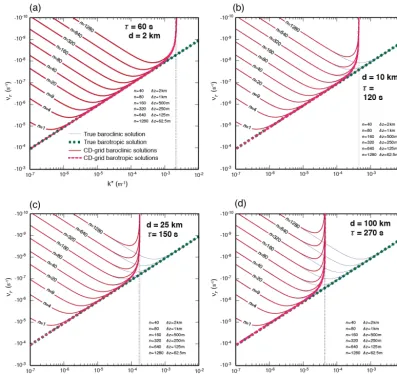
The CD-grid solution shown by Fig. 3 is virtually identical to that for the Z-grid solutions (and D-grid solutions) shown in Figs. 1 and 2, respectively.
DC grid
As stated above, the CD grid behaves similarly to the D grid rather than the C grid in the numerical solution of the Rossby waves on a midlatitudeβ plane. The normal-mode analysis of the Rossby waves with the DC grid produce a solution that is very close to the C-grid solution. A detailed discussion and frequency plots are presented in the Supplement. This is consistent with the findings of Part 1 that the correction step dominates the solutions with the CD and DC grids.
3.5 Solutions for the A grid
Baroclinic Rossby modes. We horizontally discretize Eqs. (1)–(3) on the A grid shown in Fig. 1e of Part 1 as
∂
∂t(ωz)i,j= −f0Di,j− β f0
Pi+1,j−Pi−1,j
2d , (41)
and
0= (42)
f (ωz)i,j− 1
4d2 Pi+2,j+Pi,j+2+Pi,j−2+Pi−2,j−4Pi,j
,
respectively. Similarly, we obtain the discrete dispersion re-lation for the baroclinic Rossby modes as
ν= −βeξ k eξ2k2+eη2`2+
f02 N2
m2+ 1 4H2
, (43)
where the definition ofeξ is given by Eq. (12) and
eη≡
sin(`d)
`d . (44)
Figure 3.Same as Fig. 1 but on the CD grid.
Barotropic Rossby modes. By dropping
f02/N2 m2+1/4H2 in Eq. (43), the discrete dis-persion relation for the barotropic Rossby modes can be obtained as
ν= −βeξ k eξ2k2+eη2`2
. (45)
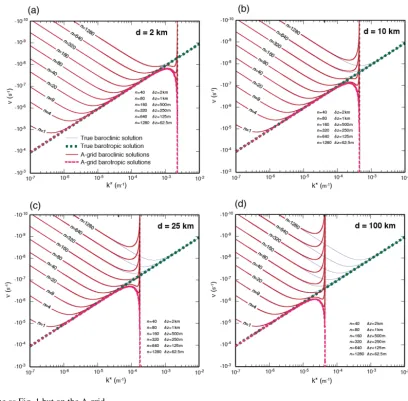
The frequency of the barotropic modes becomes strongly negative (retrogressing) at the SRZS. This means that small-scale barotropic Rossby modes can behave very badly. We discuss the behavior of these modes in connection with the plots below.
Figure 4 shows the frequency of the Rossby modes ob-tained on the A grid. The A grid produces very fast retrogres-sion speeds of the barotropic mode at the SRZS. The baro-clinic modes with short vertical scales retrograde faster than the true solution near the SRZS, but right at the SRZS, they do not move at all.
3.6 Baroclinic and barotropic Rossby modes with the E grid
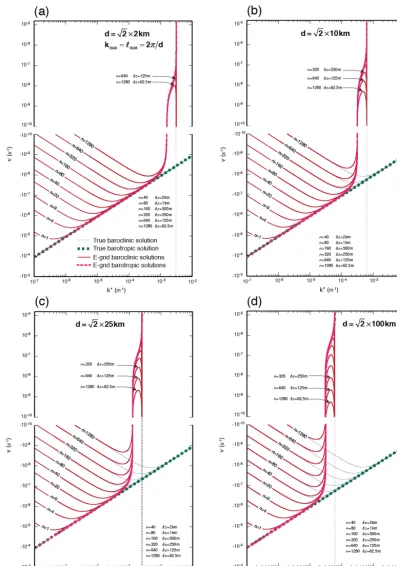
Part 1 discusses in detail the horizontal discretization on the E grid. There it is pointed out that the E grid can be viewed as the superposition of the two C grids, in which the cell cen-ters of one C grid are placed at the corners of a second C grid. It is also shown that, from the vorticity and divergence point of view, the E grid can be viewed as a superposition of two independent and non-interacting Z grids, as shown in Fig. 1f of Part 1. The dispersion relation for the E grid is iden-tical to that for the Z grid, but the smallest resolvable zonal scale extends tokmax=2π/d (and`max=2π/d)for the E grid. Therefore, the dispersions of baroclinic and barotropic modes on the E grid are governed by Eqs. (11) and (15) with kmaxand`maxas described above. Recall that we use a grid spacing of
√
2d with the E grid to maintain the same cell density as with the other grids.
Figure 4.Same as Fig. 1 but on the A grid.
modes. The modes with all vertical scales and horizontal grid spacings used in the models generate prograding solu-tions near the SRZS. The deeper the mode is, the faster the progradation speed is. The prograding modes are generated near the SRZS because the factoreξyields negative values for k > π/d. A interpretation is that the finite-difference pres-sure gradient determined over the two-grid distance is sub-ject to aliasing errors for zonal waves withk > π/d, which causes the system to recognize the pressure gradient with the wrong sign.
3.7 Solutions for the B grid
Baroclinic Rossby modes. We can obtain the equations for the B grid by ignoring∂D/∂tin Eq. (63) of Part 1, replacing f withf0and using Eqs. (8) and (9). Similarly, we obtain the discrete dispersion relation for the baroclinic Rossby modes
on the B grid as
ν= −eξ βk
ξ2k2+η2`2−1
2d2ξ2k2η2`2+ f0
N2
m2+ 1 4H2
, (46)
where the factorsξ,ηandeξ are defined by Eq. (12). The fre-quency becomes zero for the SRZS becauseeξ is zero. The Laplacian termξ2k2+η2`2−1
2d
2ξ2k2η2`2also approaches zero in the numerator of Eq. (46) as the zonal wavenumber approaches the SRZS. This makes the frequency behave sim-ilarly to that of the A grid.
Barotropic Rossby modes. By dropping
f02/N2 m2+1/4H2 in Eq. (46), we obtain the dis-crete dispersion relation of the barotropic Rossby modes as
ν= −eξ βk
ξ2k2+η2`2−1
2d2ξ2k2η2`2
. (47)
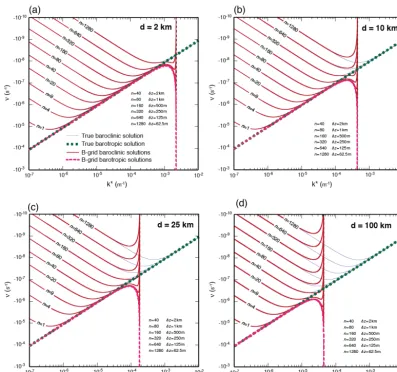
Figure 6.Same as Fig. 1 but on the B grid.
Figure 6 shows the frequency of the Rossby modes on the B grid. As with the A-grid solutions, the B grid produces infinitely fast retrogression speeds for the barotropic mode at the SRZS, and the shallow baroclinic modes retrograde faster than the true solution near the SRZS and do not move at all at the SRZS.
As discussed in Sect. 3.8 of Part 1, the A, E and B grids generate multiple (or non-unique) solutions and dynamically inert modes. Here, we see that the impact of the dynamically inert modes on the short Rossby waves is very severe.
The results of our normal-mode analysis of the nonhydro-static anelastic barotropic and baroclinic Rossby waves on a midlatitudeβ plane the C, D, A, E and B grids overall agree with the results of Dukowicz’s (1995) normal-mode analy-sis with the shallow-water equations. An exception is that we include the prograding modes with the E-grid solutions, whereas Dukowicz (1995) excludes them as “inadmissible”.
3.8 Vertical discretization of the linear anelastic equations on the L and CP grids and discrete dispersion equation
Part 1 presents a discussion on the vertical grids, including a historical perspective, used in atmospheric models. Our pur-pose in this section is to assess and compare the performance of the L and CP grids in simulating Rossby modes on a mid-latitudeβplane through a normal-mode analysis.
3.9 The L grid
Figure 7. Plots of(a, d) true and discrete frequencies for the baroclinic and barotropic Rossby modes obtained on the (b, e) L and
(c, f)CP grids. The thick blue and green dashed lines on the left panels indicate the true baroclinic and barotropic frequencies, respectively. The thick red and red dashed lines on the center and right panels indicate the discrete baroclinic and barotropic frequencies, respectively. The upper and lower panels show the plots for the maximum vertical integer wavenumbers ofnmax=320 (δz=250 m) andnmax=80 (δz=1 km), respectively.
dispersion relation for the baroclinic Rossby modes as
ν= −µ
2 zβk µ2
z k2+`2
+f 2 0
N2
ζ2m2+µ2 z
1 4H2
, (48)
where ζ ≡ 1
1 2mδz
sin 1
2mδz
andµz≡cos 1
2mδz
. (49)
By dropping f02/N2 ζ2m2+µ2z/4H2in Eq. (48), we obtain the discrete dispersion relation for the barotropic Rossby mode as
ν= −βk
k2+`2. (50)
In Eq. (48), the numerator is proportional to µ2z, which is zero for the smallest resolvable vertical scale (SRVS), for whichmδz=π. This means that, for all horizontal scales, the modes with the SRVS cannot propagate. They are dy-namically inert (computational) modes. The pressure in the β term cannot recognize the SRVS buoyancy perturbation in the vertical velocity equation Eq. (67) of Part 1 with the quasi-static assumption (∂wk+1/2/∂t≈0). The frequency of the discrete barotropic mode given by Eq. (50) is identical to the true frequency in Eq. (7), which is expected because the
barotropic mode has no vertical structure and therefore is not affected by the vertical discretization.
3.10 The CP grid
We now derive the discrete dispersion relation for the baro-clinic and barotropic Rossby modes on the CP grid, follow-ing the same strategy used with the L grid. The results are
ν= −βk
k2+`2 +f
2 0
N2
ζ2m2+µ2 z4H12
, (51)
and ν= −βk
k2+`2, (52)
respectively. The dispersion equation for the baroclinic Rossby modes on the CP grid given by Eq. (51) does not have an averaging factor in the numerator, and therefore it does not allow a dynamically inert mode with zero frequency at the SRZS.
Table 1.A summary of the continuous and discrete dispersion relations with various horizontal and vertical grids.
True Z and D grid
Baroclinic modes: Barotropic modes: Baroclinic modes: Barotropic modes:
ν= −βk k2+`2
+f
2 0 N2
m2+ 1 4H2
ν
= −βk
k2+`2 ν=
−βeξ k
ξ2k2+η2`2
+f
2 0 N2
m2+ 1 4H2
ν
= −βeξ k
ξ2k2+η2`2
m≡π n/zT forn=1,2,3, . . . ξ≡sin
1 2kd
/12kd, η≡sin12`d/12`d,
eξ≡sin(kd) / (kd), 0≤[kd, `d]≤π
C grid E grid
Baroclinic modes: Barotropic modes: Baroclinic modes: Barotropic modes:
ν= −µ2eξ βk
ξ2k2+η2`2+µ2f02 N2
m2+ 1 4H2
ν
= −µ2eξ βk
ξ2k2+η2`2 Same as Z grid but for 0≤[kd, `d]≤2π
µ≡cos12kdcos12`d
CD grid
Baroclinic modes: Barotropic modes:
e2νiτ
µ2N2L2+f02σm2
sin(2νrτ )+1
2τ e2νiτµ2N2βeξ kcos(2νrτ ) 0= L2 2 − 1 2τβeξ k
2
sin(νrτ )+τβeξ kL2cos(νrτ )
+τ eνiτµ2N2cos(νrτ ) βeξ k+2f02eνiτµ2−1σm2sin(νrτ ) eνiτ=L2/hL2cos(νrτ )−1
2τβeξ ksin(νrτ ) i
+1
2τ µ2N2βeξ k=0 L2≡ξ2k2+η2`2, σm2≡m2+1/
4H2, 0≤[kd, `d]≤π
eνiτ=−b+pb2−4ac/ (2a)fora,bandc; see Eqs. (38a)–(38c)
A grid B grid
Baroclinic modes: Barotropic modes: Baroclinic modes: Barotropic modes:
ν= −βeξ k eξ2k2+eη2`2+
f02 N2
m2+ 1
4H2
ν
= −βeξ k eξ2k2+eη2`2
ν= −eξ βk
L2B+f0 N2
m2+ 1 4H2
ν=
−βeξ k
L2B
eη≡sin(`d) / (`d), 0≤[kd, `d]≤π L
2
B≡ξ2k2+η2`2− 1
2d2ξ2k2η2`2
L grid CP grid
Baroclinic modes: Barotropic modes: Baroclinic modes: Barotropic modes:
ν= −µ 2 zβk µ2
z k2+`2
+f 2 0 N2
ζ2m2+µ2 z4H12
ν
= −βk
k2+`2 ν=
−βk k2+`2
+f
2 0 N2
ζ2m2+µ2 z4H12
ν
= −βk k2+`2
ζ≡sin 1 2mδz / 1 2mδz
µz≡cos
1 2mδz
0≤mδz=nπ δz/zT ≤πforn=1,2,3, . . .
number of layers), namelynmax=320 and 80. We included additional frequency lines corresponding to more vertical wavenumbers than were used in the plots of Sect. 3 (indi-cated by thinner solid lines in the plots). In the L-grid so-lutions shown in Fig. 7b and e, the frequency of the smallest vertical resolvable mode, identified bynmax, deviates greatly from the true frequency, which yields zero values. Similar to the case of the inertia–gravity modes, as the vertical scale approaches the smallest resolvable scale, the modes gradu-ally lose their ability to recognize the effects of buoyancy and therefore baroclinicity. For the mode with the smallest scale, the buoyancy and baroclinicity are completely decou-pled from the wind field; for that mode, the buoyancy is dy-namically inert. In contrast, the frequency of the CP-grid so-lutions shown in Fig. 7c and f is generally close to the true frequency but slightly higher.
4 Summary and conclusions
We have discussed the effects on the dispersion of middle-latitude Rossby waves of the horizontal and vertical dis-cretizations of the quasi-geostrophic (quasi-static) linearized equations on the A, B, C, CD, (DC), D, E and Z horizontal grids and the L and CP vertical grids. We present a summary of the discrete dispersions of Rossby modes for the horizon-tal and vertical grids in Table 1 for an easy comparison.
SHZS prograde, while the true modes retrograde. The A, E and B grids generate multiple (non-unique) solutions, includ-ing dynamically inert (computational) modes. The impact of the computational modes on the short Rossby modes appears very severe on these grids.
The results of our normal-mode analysis of the Rossby waves for the C, D, A, E and B grids overall agree with the results of Dukowicz’s (1995) normal-mode analysis with the shallow-water equations. Dukowicz (1995) considers the prograding modes with the E-grid solutions “inadmissible”, however, while we include them.
The selection of the vertical grid impacts the dispersion of the Rossby modes as much as the horizontal grid selection. The modes with the smallest resolvable vertical scale on the L grid do not retrograde. The CP-grid solutions are much more accurate than the L-grid solutions.
Code and data availability. Fortran codes that are used to compute and plot the frequencies for the CD grid will be provided by the corresponding author upon request. Related files can also be found in http://doi.org/10.5281/zenodo.1117930.
Supplement. The supplement related to this article is available online at: https://doi.org/10.5194/gmd-11-1785-2018-supplement.
Competing interests. The authors declare that they have no conflict of interest.
Acknowledgements. We are grateful to Bill Skamarock for his comments and suggestions to improve the manuscript. We thank the reviewer Almut Gaßmann and an anonymous reviewer for their constructive and helpful comments. This research was supported by the National Science Foundation (NSF) under AGS-1500187, the US Department of Energy Office of Science DE-SC07050 (Sci-DAC), DE-SC00016273 (ACME) and DE-SC00016305 (CMDV).
Edited by: Paul Ullrich
Reviewed by: Almut Gaßmann and one anonymous referee
References
Arakawa, A. and Konor, C. S.: Unification of the anelastic and quasi-hydrostatic systems of equations, Mon. Weather Rev., 137, 710–726, 2009.
Dukowicz, J. K.: Mesh effects for Rossby waves, J. Comput. Phys., 160, 336–368, 1995.
Konor, C.: Codes and data used for plotting some figures in Konor and Randall (2017), Zenodo, https://doi.org/10.5281/zenodo.1117930, 2017.
Konor, C. S. and Randall, D. A.: Impacts of the horizontal and ver-tical grids on the numerical solutions of the dynamical equa-tions – Part 1: Nonhydrostatic inertia–gravity modes, Geosci. Model Dev., 11, 1753–1784, https://doi.org/10.5194/gmd-11-1753-2018, 2018.
Neta, B. and Williams, R. T.: Rossby wave frequencies and group velocities for finite element and finite difference approximations to the vorticity-divergence and primitive forms of the shallow-water equations, Mon. Weather Rev., 117, 1439–1457, 1989. Thuburn, J.: Numerical wave propagation on the hexagonal C grid,