The Variable-Increment Counting Bloom Filter
Ori Rottenstreich
Technion
Yossi Kanizo
Technion
Isaac Keslassy
Technion
Abstract—Counting Bloom Filters (CBFs) are widely used in networking device algorithms. They implement fast set represen-tations to support membership queries with limited error, and support element deletions unlike Bloom Filters. However, they consume significant amounts of memory.
In this paper we introduce a new general method based on variable increments to improve the efficiency of CBFs and their variants. Unlike CBFs, at each element insertion, the hashed counters are incremented by a hashed variable increment instead of a unit increment. Then, to query an element, the exact value of a counter is considered and not just its positiveness. We present two simple schemes based on this method. We demonstrate that this method can always achieve a lower false positive rate and a lower overflow probability bound than CBF in practical systems. We also show how it can be easily implemented in hardware, with limited added complexity and memory overhead. We further explain how this method can extend many variants of CBF that have been published in the literature. Last, using simulations, we show how it can improve the false positive rate of CBFs by up to an order of magnitude given the same amount of memory.
I. INTRODUCTION
A. Motivation
CBF (Counting Bloom Filter) variants are increasingly used in networking device algorithms, in fields as diverse as ac-counting, monitoring, load-balancing, caching, policy enforce-ment, routing, filtering, security, and differentiated services. For instance, for a given flow, they can determine whether it has at least one packet currently queued (set membership), how many of its packets are queued (counter representation), whether it is in a given state (state representation), or where to forward its packets (IP lookups) [1]–[6].
CBFs are often used because they can be easily imple-mented in hardware. In particular, element insertions, deletions and queries can be implemented in CBFs using a constant complexity that is essentially independent of the number of elements for a given bits-per-element ratio. However, CBFs also consume significant amounts of memory. For instance, using four bits per entry and ten entries per element yields a needed memory space in bits that is 40 times larger than the number of inserted elements.
This paper is about a general method to improve the memory efficiency of CBFs with limited added hardware complexity. We introduce a novel method based on variable increments to reduce the amount of memory used by CBFs for a given false positive rate. This method can also implement element insertions, deletions and queries using a constant complexity per element. It has a low hardware implementation overhead when compared to CBFs, and can replace CBFs as a
sub-module in any algorithm implementation without required outside changes.
B. Intuition for Variable Increments
We now provide some intuition for variable increments by comparing Bloom Filters (BFs), Counting Bloom Filters (CBFs) and Variable-Increment Counting Bloom Filters (VI-CBFs).
A Bloom Filter (BF) is a well-known simple data structure used to represent a set of n elements S = {x1, . . . , xn}
elements from a universe U using an array of m bits [7]. However, it is not designed to support deletions of elements, which are often needed in networking device algorithms.
As illustrated in Figure 1(a), BF uses k uniformly-distributed hash functions over the range{1, . . . , m}of itsm -bit filter. For each elementx∈S,khash entries are calculated using the hash functions and the corresponding bits are set to one. For instance, in the figure, the bits of x and y are set to one. In order to check whether an element z is in S, we check whether all of its k corresponding bit locations hi(z)
are set to one. If this is not the case, we know thatz is not in S. If all of them are set, as in Figure 1(a), we state that
z∈S, although this might be afalse positiveerror. For each
z /∈ S, the false positive rate, i.e. the probability of a false positive error, is (1−p0)k, where p0 = (1−1/m)nk is the
probability that a specific bit is still zero after the insertion of
nelements. Since BF does not support deletions of elements, it cannot for instance be used to represent the current set of packets of a flow in a router where flows might dynamically change.
The Counting Bloom Filter (CBF) suggested by Fan et al. [1] is a generalization of BF, in which each hash entry contains a counter with a fixed size of b bits, instead of a single bit in BF. Unfortunately, while supporting deletions, CBF also needs large amounts of memory space (i.e.b times the memory space consumed by BF), which is often valuable in networking devices.
As shown in Figure 1(b), to insert an element, all the corre-sponding hashed counters are incremented by one. Likewise, to delete it, all of its hashed counters are decremented. To determine if an elementz ∈S, we check if all of its hashed entries are positive. For instance, in Figure 1(b), we state that
(a) BF (Bloom Filter) (b) CBF (Counting Bloom Filter) (c)V I−CBF (Variable-Increment CBF)
Fig. 1. Comparison of the concepts behind BF, CBF and our proposedV I−CBF, usingS={x, y}and a query of elementz /∈S. In this example, BF
and CBF yield false positives whileV I−CBF does not.
on its counter sizeb, althoughb= 4is sufficient to practically obtain a negligible overflow probability [1].
We now want to introduce the use of variable increments. We notice that CBF does not store much information in its counter values. When querying an element, it does not distinguish between any counter values greater than zero, and only considers their positiveness. In this paper, we use the
specific value of a counter in order to give a more complete answer to the query.
The Variable-Increment Counting Bloom Filter, denoted as
V I−CBF, is a generalization of CBF that uses variable increments to update each entry. We first define a set of possible variable incrementsD. Then, for each counter update by an element, we hash the element into a value ofDand use it to increment the counter. Likewise, to delete an element, we decrement by its hashed value in D. Last, to determine if an elementz∈S, we check in each of its counters if its hashed value in D could be part of the sum. If this is not the case in at least one counter, then necessarily z6∈S. Otherwise, as for BF and CBF, we state that z∈S, which might be a false positive.
Figure 1(c) illustrates V I−CBF with D = {4,5,6,7}. First,xandyincrement their corresponding counters by their corresponding hashed values inD. For instance,xincrements its first counter value by 7 ∈ D. Consider now a query of whether z is inS. The second hashed entry ofz has counter value 9, while for this entryz hashes to increment7 ∈ D. Since 9−7 = 2 cannot be presented as a sum of elements of D, the increment 7 cannot be part of the sum 9, and we deduce that necessarilyz /∈S, avoiding the false positive that occurred in CBF (Figure 1(b)). Note that we could have known that as well from the third hashed entry of z (since 6 >5), but not from its first entry (becausexandzhash to the same increment, so the sum of5can be composed of the increment
5).
C. Related Work: Applications of the Variable-Increment Method
The variable-increment method is a generic approach that can actually be implemented to improve or extend most variants of CBF. In this paper, we detail and evaluate its application to both CBF and ML-HCBF.
• CBF [1]: As presented above.
• ML-HCBF(MultiLayer Hashed CBF) [6]: This algorithm uses a hierarchical compression of CBF filters to achieve
better performance. We explain in Section V how the same hierarchical compression idea could be combined with V I−CBF, and show in Section VI how this combination can achieve even better results.
• VL-CBF(Variable Length CBF) [8]: This algorithm uses a variable-length coding, such as the Huffman coding, to represent counters with a variable number of bits. A similar coding can be used for efficient representation of counters inV I−CBF. Unfortunately, even using index tables, a lookup in VL-CBF might be 100 times slower than in the standard BF. Thus, it cannot be implemented at line rate.
• SBF(Stateful BF)ACSM(Approximate Concurrent State Machine) [2]: This scheme enables the representation of dynamically-changing states of flows. Using variable increments, it is possible to represent the set of two states hashing into the same entry as the sum of their hashed values, instead of simply storing a DK (Don’t Know) value as currently done.
• Fingerprint-based Schemes [2], [3]: Fingerprint-based schemes typically use multiple-choice hashing schemes (e.g. d-left) to obtain balanced allocations of elements into buckets, and then use hashed fingerprints within each bucket to store information associated with each flow. While fingerprint-based schemes belong to a different family of algorithms than CBF, they may also be comple-mented using the variable-increment idea. For instance, a fingerprint-based scheme may store up to hstates for each flow, or allow to store up tohflow mini-fingerprints together with each main fingerprint. By summing these state values, a variable-increment idea may decrease the number of bits required to store these values. In addition, it may behave more gracefully when there are more than h states, by temporarily losing some information, but being able to recover it with high probability upon deletion (i.e. decrement) of some of the states.
• And many additional schemes like Counter Braids [4], Selective CBF [9] and Access-Efficient Balanced BF [10].
Finally, there are many works on Bh sequences, e.g. [12], [13], yet none have been used in network applications.
D. Contributions
This paper presents an improved Counting Bloom Filter technique based on variable increments. This technique can also implement element insertions, deletions and queries using a constant complexity per element. We suggest two schemes based on CBFs with variable increments.
We first present the Bh−CBF scheme. This scheme is based on Bh sequences. To the best of our knowledge, this is the first time that Bh sequences are used in network applications. Intuitively, a Bh sequence is a set of integers with the property that for any h′
≤ h, all the sums of h′ elements from the set are distinct. Therefore, given a sum of
h′
elements, we can determine whether an element of theBh
sequenceis a part of the sum. In the Bh−CBF scheme we have in each hash entry a pair of counters: one with fixed increments, and another one with variable increments that are selected from theBh sequence. We illustrate theBh−CBF
scheme and compute its false positive rate.
Then, we present the V I−CBF scheme. In this scheme, each hash entry only contains a single counter, as illustrated above. We analytically show that theV I−CBF scheme can always achieve a lower false positive rate and a lower overflow probability bound than CBF in practical systems.
We also provide detailed implementation considerations for these schemes. We discuss the complexity and throughput of the schemes, and show that their complexity overhead is lower than would be expected, especially for theV I−CBF
scheme, which can avoid using any lookup table.
Further, although in each operation both schemes require calculating 2k hash functions instead of k in CBF, we show that the relative increase in the number of required random bits is very small. For instance, the V I−CBF scheme typically needs k·(⌈log2(m)⌉+ 1) bits instead ofk·(⌈log2(m)⌉) in
CBF.
Last, we evaluate all schemes using simulations. We show that this method can reduce the false positive rate of the original CBF by up to an order of magnitude, or alternatively reduce the memory requirements for a requested false positive rate by 33%.
II. THEBh−CBF SCHEME
A. Bh Sequences
In this section we introduce the Bh−CBF scheme, a
variable-increment CBF (Counting Bloom Filter) based on
Bh sequences [12]. We start with the formal definition ofBh
sequences.B2sequences are also called Sidon sequences [13]. Definition 1 (BhSequence): Let D = {v1, v2, ..., vℓ} ⊆ N∗
be a sequence of positive integers. Then D is a Bh
sequenceiff all the sums vi1+vi2+· · ·+vih with1≤i1≤
· · · ≤ih≤ℓare distinct.
Example 1: LetD={v1, v2, v3, v4}={1,4,8,13} ⊆N∗.
We can see that all the 20 sums of 3 elements ofDare distinct:
1 + 1 + 1 = 3,1 + 1 + 4 = 6,1 + 1 + 8 = 10,1 + 1 + 13 =
15,1 + 4 + 4 = 9,1 + 4 + 8 = 13,1 + 4 + 13 = 18,1 + 8 + 8 = 17,1 + 8 + 13 = 22,1 + 13 + 13 = 27,4 + 4 + 4 = 12,4 + 4 + 8 = 16,4 + 4 + 13 = 21,4 + 8 + 8 = 20,4 + 8 + 13 = 25,4 + 13 + 13 = 30,8 + 8 + 8 = 24,8 + 8 + 13 = 29,8 + 13 + 13 = 34,13 + 13 + 13 = 39. Therefore,D is aB3 sequence.
However,4 + 4 + 4 + 4 = 16 = 1 + 1 + 1 + 13, thereforeD
is not aB4 sequence.
We can observe that for anyh′
∈[1, h]the sums of exactly
h′
elements of the Bh sequence are also distinct.
B. Scheme Principles
We now introduce the Bh−CBF scheme to represent
|S| = n elements using m entries. While in CBF, each entry contains a single counter with fixed increments of one, in Bh−CBF, each entry contains a pair of counters: The first counter, with fixed increments of one, counts the number of elements hashed into this entry (as in CBF). The second counter, with variable increments, provides a weighted sum of these elements. Its variable increments are selected from a pre-determinedBh sequenceD={v1, v2, ..., vℓ}.
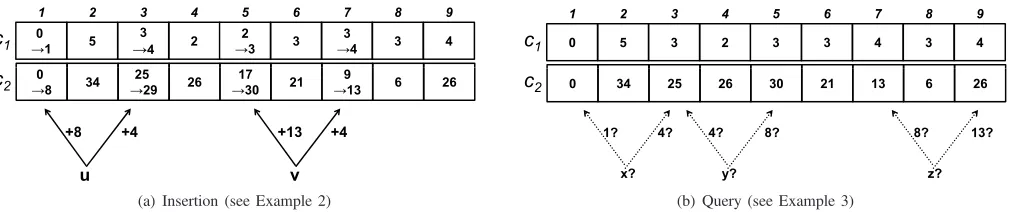
Figure 2 illustrates how these counters are used and updated given element insertions and queries. Note that in Section IV we further show how to implement these operations efficiently in hardware.
Bh−CBF uses two sets of k hash functions. The first
set H = {h1, . . . , hk} uses k hash functions with range
{1, . . . , m}, i.e. it points to the set of entries. The second
setG={g1, . . . , gk}usesk functions with range{1, . . . , ℓ},
i.e. it points to the setD.
Insertion —Upon insertion, an elementxis hashed into the
khash entries pointed by {h1, . . . , hk}. At each entryhi(x),
Bh−CBF updates the pair of counters as follows. The first counter, with fixed increments, is incremented by one. The second counter, with variable increments, is incremented by the element vgi(x) of the Bh sequence D, where gi is the
corresponding hash function ofG.
Upon deletion, the counters are decremented similarly.
Example 2: Figure 2(a) illustrates the insertion of two ele-mentsuandv. It uses the B3 sequenceD ={v1, v2, v3, v4} ={1,4,8,13} from Example 1, and each element is hashed into k = 2 entries. In this example, {h1(u), h2(u)} = {1,3} and {g1(u), g2(u)} = {3,2}. The packet belonging
to flow u is hashed into entries 1,3 using hash functions
h1, h2. It increments the first counter of each entry by one.
It also increments the second counters of these entries by
(vg1(u), vg2(u)) = (v3, v2) = (8,4), respectively. Similarly, a
packet of flowvis hashed into entries5and7and increments their variable-increment counters by13 and4, respectively.
Query — To query whether an element y is in S,
Bh−CBF uses the unique properties of the Bh sequence. Fori ∈[1, k], let c1(i) andc2(i) be the values of the
9 17
0 25
5 3
→4 3 4
2 3
0 →1
3
→4
c1
2 4 5 6 7 8 9
1 3
2 →3
34 9
→13 6 26
26 17
→30 21
0 →8
25 →29
c2
u +4 +8
v +4 +13
(a) Insertion (see Example 2)
5 2 3 4 3 4
0 3
c1
2 4 5 6 7 8 9
1 3
3
34 26 30 21 13 6 26
0 25
c2
z? 13? 8?
y? 8? 4?
x? 4? 1?
[image:4.612.56.562.55.161.2](b) Query (see Example 3)
Fig. 2. Examples of insertion and query inBh−CBF with theB3 sequenceD={1,4,8,13}.
elements includingvgi(y). Specifically, in each entryhi(y), it
considers several cases depending on the value of c1(i): • Ifc1(i) = 0,then as in CBF,Bh−CBF determines that
y /∈S.
• If c1(i) ∈[1, h], Bh−CBF considers the exact values
of both the counters. In this case, no more than h elements were hashed into the hash entry hi(y). Therefore,c2(i)is a
sum ofc1(i)≤helements of D. Since D is aBhsequence,
Bh−CBF can deduce the elements of D used in the sum
c2(i) (i.e. in the insertions of these elements into this hash
entry). In particular,Bh−CBF can determine whethervgi(y)
is part of the sumc2(i). Otherwise, necessarilyy /∈S.
• Ifc1(i)> h,Bh−CBF considers the entry as useless.
The value of c2(i)is not used and we cannot determine that
y /∈S based on the current hash entry.
If Bh−CBF cannot determine that y /∈ S based on any of the k hash functions, it determines thaty∈S. With some probability, Bh−CBF might be wrong and yield a false positive. More precisely, in case y /∈ S, the false positive occurs if for each of thekhash functions, either there are more thanhelements hashed into the corresponding hash entry, or the corresponding element of the Bh sequence was used by another element hashed into the same entry.
Example 3: As illustrated in Figure 2(b), we look at three queries for the Bh−CBF introduced in Example 2. In this figure, we assume that for x, y, z the hash entries selected by the hash functions h1 and h2 are provided by their left
and right outgoing arrows, respectively. For each elementa∈
{x, y, z}, we denote the values of the two counters in the hash
entryhi(a)byca
1(i), ca2(i).
First, in order to determine whether x ∈ S, we start by looking at the hash entryh1(x). Sincecx1(1) = 0,Bh−CBF
can determine immediately that x /∈ S. We now considery. In its first hashed entry, h1(y), the number of elements is
cy1(1) = 3. Since we use aBh sequence D withh= 3, then
Bh−CBF can determine the components of the weighted sum by definition of theBhsequence. In this case,Bh−CBF
can deduce thatcy2(1) = 25is comprised of4 + 8 + 13 = 25. Since y increments this counter by vg1(y) = 4, Bh−CBF
cannot exclude y ∈ S based on this hash entry. However, since cy1(2) = 3≤has well, the variable-increment counter
cy2(2) = 30 = 4+13+13is not comprised ofvg2(y)= 8. Thus,
Bh−CBF can also determine thaty /∈S. Finally, applying the above method toz,Bh−CBF cannot deduce thatz /∈S
based on the two hash entries since cz
1(1), cz1(2) = 4 > h.
Therefore,Bh−CBF determines thatz∈S. This might of course yield a false positive ifz /∈S. (In fact, using a more careful examination, it is possible to determine that indeedz /∈
S, as detailed below with theimprovedBh−CBF scheme.)
C. False Positive Rate
We now provide the false positive rate of Bh−CBF. As shown in the literature, in real-world systems, practical hash functions usually work as if they were fully random [14]. We assume in our proofs that the hash functions map items to random numbers uniformly distributed over their given range, and that the inserted elements and the elements in the query are independent.
Theorem 1: The false positive rate ofBh−CBF is given by:
F P R= 1−
h
X
j=0
nk
j
ℓ−1
ℓm
j
1− 1
m
nk−j!k
. (1)
Proof:LetX denote the number of elements hashed into an arbitrary entry. The probability of the eventX =j is given by
Pr(X =j) =
nk j
1
m
j 1− 1
m
nk−j
. (2)
When exactly X = j elements are hashed into an entry, a specific value of theBh sequence is not used by any of them
with probability1− 1
ℓ
j
. Therefore, the false positive rate
F P R, i.e. the probability that for an elementy /∈Swe cannot
deduce from each of the khash entries thaty /∈S, is
F P R=1−
h
X
j=0
Pr(X =j)1−1
ℓ
jk
, (3)
yielding the result.
Note that by adopting a more complex query scheme, we can further decrease the false positive rate. This improved
Bh−CBF schemeanalyzes the hash entry even when there are more than h hashed elements. In such a case, the Bh
sequence definition does not directly help anymore, because the elements in the sumc2(i)are not necessarily unique when
possible variable increments that can lead to the sumc2(i), we
can still conclude that an element cannot have been inserted into this entry. For instance, in Figure 2(b), the first hashed entry of z indicates that there are cz
1(1) = 4 > h values
totalingcz
2(1) = 13. In addition, the first hashed value ofz is 8. But 8 cannot be possible part of this sum, since the other
cz
1(1)−1 = 4−1 = 3values of the sum would need to total
cz
2(1)−vg1(z)= 13−8 = 5, and this is impossible, as shown
in Example 1. So z6∈S.
III. THEV I−CBF SCHEME
A. Scheme Description
TheBh−CBF scheme suggested above uses two counters per entry instead of a single counter. This nearly doubles the needed number of bits (neglecting the differences in counter sizes). Consequently, we introduce V I−CBF (Variable-Increment Counting Bloom Filter), which also uses variable increments but only relies on a single variable-increment counter per entry, without the additional counter that indicates the number of hashed elements.
Specifically, as previously illustrated in Figure 1(c), we use again an array of m entries to represent |S| = n elements. In each array entry, the single variable-increment counter is updated exactly like the second counter in the Bh−CBF
scheme, using variable increments selected from a set D =
{v1, v2, ..., vℓ}. We use again two sets of k hash functions,
H = {h1, . . . , hk} and G = {g1, . . . , gk}. Upon insertion,
at each corresponding array position hi(x), the counter is incremented by the element vgi(x) of the set D. Likewise,
upon deletion, counter hi(x)is decremented byvgi(x)∈D.
We now want to find an appropriate set D for the
V I−CBF scheme. A problem in the V I−CBF scheme is that it cannot directly use Bh sequences anymore. This is because the Bh sequence definition requires to know the number of elements in a sum. However, unlike theBh−CBF
scheme, the V I−CBF scheme cannot obtain it because it does not have a small counter that provides the number of elements hashed into a given entry.
B. A Simple Option forD:DL= [L,2L−1]
In the general case, to query whether an element is hashed into an entry, the implementation of the Bh−CBF and
V I−CBF schemes requires the use of a predetermined two-dimensional binary table based on the setD(see Section IV). However, we will now present a set D =DL thatdoes not need such a lookup table. Therefore,DLis easier to implement in hardware.
In the next subsections, we first analyze the V I−CBF
scheme given D =DL. In Section IV we show that for this case, no additional memory is required. We then provide an exact calculation of the false positive rate of this detailed scheme. We also show that it always improves the false positive rate of CBF given a number m ≥ 10 of memory entries and a numbernof inserted elements.
Let L ≥ 2 be a positive integer of the form L = 2i
. We define the set DL of sizeL as DL = [L,2L−1] ={L, L+
1, ...,2L−1}.
We now want to compute the false positive rate of the
V I−CBF scheme. First, if an element y /∈ S hashes into an entry counter hi(y) of value c, we want to determine the probability that we will be able to tell thaty /∈Sgivenc. Note that the entry counter valuec is defined as a sum of elements of DL. To do so, we distinguish different values of c using the following lemma.
Lemma 1: Let y be an element whose i-th hash function
hi(y) hashes into an entry of value c. If c −vgi(y)
∈ (−∞,−1]∪[1, L−1]theny /∈S.
Proof:We distinguish different values of c:
•Ifc= 0, then the number of elements in the sum is zero, and thereforey /∈S.
• Ifc∈[L,2L−1], we can deduce that c is composed of a single element ofDL, because the minimal value of a sum of two or more elements isL+L= 2L. Further, this element is of coursec. Therefore ifvgi(y)6=c, theny /∈S.
•Ifc∈[2L, ...,3L−1], we must have thatcis a sum of two
elements, because the maximal value of one element is2L−1
and the minimal value of three elements is 3L. For instance,
c=L+ (c−L),orc= (L+ 1)+ (c−L−1),etc. Therefore,c
can be comprised of any of the elements{L, L+ 1, ..., c−L}, but not of anyx∈ {c−L+ 1, ...,2L−1}, since in such a
case (c−x) < L. So if vgi(y) ∈ {/ L, L+ 1, ..., c−L} (i.e.
(c−vgi(y))< L), theny /∈S.
• Ifc≥3L,c can be comprised of any of the elements in
DL, since(c−vgi(y))> Lfor anyvgi(y)∈[L,2L−1].
Summarizing the cases above, we cannot exclude thaty∈S
ifc=vgi(y)or(c−vgi(y))≥L, hence the result.
In the next theorem we present the false positive rate of this case.
Theorem 2: The false positive rate of the V I−CBF
scheme usingD=DL is given by:
F P R= 1−1− 1
m
nk
−L−1
L
nk
1
1
m
1− 1
m
nk−1
(4)
−(L−1)(L+ 1) 6L2
nk
2
1
m
2
1− 1
m
nk−2 !k
.
Proof:Lety /∈S be an input to a query. As usual, since there arekhashed entries, the false positive rateF P Ris given by
(1−p)k, (5)
where p is the probability that by considering one of the k
hash entries used by hash functionhi, we can determine that
y /∈ S. Let X denote again the number of elements hashed into this entry and letcbe the resulting counter value, i.e. the weighted sum of X elements of DL. We distinguish several cases based onX.
IfX = 1, thenc has one of theLvalues ofDL, each with the same probability of L1. Thereforec has one of theL−1
values that differ fromvgi(y)w.p.
L−1
L ·Pr(X= 1), in which
case we can deduce thaty /∈S.
IfX = 2, there areL2possible ordered pairs of increments.
Further, there are L3 combinations of the values of the two
increments and the corresponding increment vgi(y) of the
examined element, each having an equal probability of 1/L3.
We now distinguish depending on the value of c. First, as explained in the proof of Lemma 1, if c ∈ [2L, ...,3L−1], there are exactlyc−2L+ 1options to obtain a sum ofc with two addends ofDL: The possibilities are{(L) + (c−L),(L+ 1) + (c−L−1), ...,(c−L) + (L)}. Also, the sum ofccannot be comprised of(3L−c−1)of the values inDL. Therefore, out of the L3 combinations above, in
3L−1 X
c=2L
(c−2L+ 1)(3L−c−1) =
L−1
X
i=1
i(L−i)
of them, we can determine thaty /∈S. In addition, ifc≥3L, then the value of X is not necessarily known and c can be comprised of any of the L values of DL. Thus, the current entry is not used to determine that y /∈S.
If X ≥ 3 then c ≥ 3L and the current entry is not used again to determine thaty /∈S.
Combining all cases forX, we obtain the following formula for the probabilitypthat we can determiney /∈S usingc.
p= Pr(X= 0) +L−1
L Pr(X = 1)+
1
L3Pr(X = 2)
L−1 X
i=1
i(L−i).
Simplifying p, using Equations (2) and (5), we obtain the result.
C. Improving the False Positive Rate of CBF
We now demonstrate thatV I−CBF can always improve the false positive rate of CBF as the system is scaled. For a fair comparison, we assume that the two schemes use the same amount of memory for the same number of inserted elements. In addition, since this false positive rate computation does not take into account the counter overflow probability, we also show thattheV I−CBF scheme always obtains a lower overflow probability bound than CBF.
Assume that CBF uses four bits per counter (a common assumption, initially suggested by Fan et al. [1]). Let α
denote the memory bit-per-element ratio, so that for every number of elements n, the memory size is αn bits with
m = ⌈αn4 ⌉ counters. Then the following theorem compares the performances of V I−CBF and CBF as nis scaled and
both schemes use the same memory size.
Theorem 3: While keeping the same bit-per-element ratio
α > 0 (and, as a consequence, also the same total memory
size), V I−CBF satisfies the following properties when compared to CBF:
(i) V I−CBF obtains a lower false positive rate than CBF
withmcounters for anym≥m0= 10.
(ii) When α goes to infinity, i.e. the two systems are made increasingly efficient, the ratio of their false positive rates goes to0.
(iii)V I−CBF obtains a lower counter overflow probability bound than the classical bound for CBF from [1].
Proof Outline:(The full proof is longer, and can be found in [15].) Given a CBF withm≥m0= 10counters of four bits
andk hash functions, we build a V I−CBF withDL=4 =
{L, L+ 1, ...,2L−1} = {4,5,6,7}, m′
= ⌊m
2⌋ counters
of eight bits and the same number k of hash functions. This
V I−CBF can fit within the same total memory size as CBF. We first show, by comparing the false positive rate of CBF with Theorem 2, that while the false positive rate of CBF is
F P R(CBF) = 1−
1− 1
m
kn!k
>1
2 k
,
the false positive rate ofV I−CBF is
F P R(V I−CBF) = (1−p)k <(1/2)k
for somep≥p0> 12, for fixed p0.
Likewise, we show that whenαgoes to infinity, the optimal number of hash functionskfor CBF also goes to infinity. Thus,
F P R(V I−CBF)
F P R(CBF) ≤
1−p 0 1/2
k
k→∞
−−−−→ 0.
Last, since the maximal increment is 2L−1 = 7 and counters of eight bits are used, at least ⌈256
7 ⌉= 37insertions
to the same counter are required to encounter an overflow, instead of only 16 in CBF. We finally show that although the number of counters in CBF is twice as large, this observation leads to an improved overflow probability.
IV. IMPLEMENTATIONCONSIDERATIONS
In this section we discuss the implementation of the
Bh−CBF and V I−CBF schemes in comparison with CBF. We consider several issues such as logic complexity, memory throughput and hashing complexity.
Pipeline Complexity —The insertion, deletion and query of each element can be organized in a pipeline manner, so that each operation is implemented at line rate. We assume for simplicity that there are no conflicts between elements at different steps of the pipeline. Note also that the set D is fixed, and therefore the pipeline is also fixed and there is no need to recompute online any of the values related to theBh
sequences.
Figure 3 illustrates the logical pipeline implemented to go through a query of packet x. It focuses on one of k parallel pipelines, shown on k parallel planes, and corresponding to thek hash entries.
entry array
Flow ID Hash1
(flow ID)
Lookup (index) entry index
counter c
>0? If false stop else continue
12 k
12 k 12
k
(a) CBF
k
2 If false stop else continue Flow ID
Hash2 (flow ID)
Lookup (index)
increment v
counter pair
(c1, c2)
Hash1 (flow ID)
entry index
>0? entry array
12 k
12
k 12
k Lookup (c1-1, c2-v) D-based table
1
12 k
(b)Bh−CBF
k
2 If false stop else continue Flow ID
Hash2 (flow ID)
Lookup (index)
increment v
counter
c
Hash1 (flow ID)
entry index
>0? entry array
12 k
12
k 12
k
c - v:
(=0 or ≥L) ? 1
12 k
[image:7.612.55.568.55.126.2](c)V I−CBF
Fig. 3. Logical View of Hardware Implementation. Components that also appear in CBF are presented in gray, while white ones are new.
Figure 3(b) illustrates the implementation of Bh−CBF. Components that also appear in CBF are presented in gray, and the additional components in white.Bh−CBF uses two hash functions instead of one. The first points to an entry in the Bh−CBF array with the pair of counters (c1, c2). The
second points to an increment from the set D denoted byv. In order to efficiently determine whether the weighted sum
c2can be comprised ofvusing exactlyc1addends, we suggest
using a predetermined two-dimensional binary table A that is based on D. The bit A[i][j] is set if there is a sum of i
addends from D that equals j. We notice that the value c2
can be comprised of v using c1 addends for c1 ≥ 1 only if
there is a sum of exactlyc1−1addends that equals the value
c2−v, i.e. if the bit valueA[c1−1][c2−v] is set. The cases
out of the table boundary (c1= 0 andc1 > h) can easily be
defined in the lookup procedure. In summary, ifc1> hor if
the relevant bit value is set, Bh−CBF continues to the next hash entry. Otherwise, it determines thatx /∈S
Note that Bh−CBF enters table Aonly for cases where
c1∈[1, h]. Therefore the first dimension index isc1−1≤h−1
and the maximal possible value of the weighted sum is at most
(c1−1)·max(D)≤(h−1)·vℓ. Thus, the memory size of
the tableA is at mosth·((h−1)·vℓ+ 1)≤h2·vℓ bits.
Next, we consider the implementation of the V I−CBF
scheme given the set D=DL. As explained in Section III-B a lookup table is not required in this case. As in the previous scheme, two hash functions are calculated. The first points to an entry in the V I−CBF array with a counter c and the second points again to an increment v ∈ D. Instead of the lookup operation, we just check whether c−v = 0 or
(c−v)≥L (Lemma 1). If so,V I−CBF continues to the next hash entry. Otherwise, it determines that x /∈S.
Memory Throughput — In order to increase the memory throughput, we can implement the two schemes using the ideas implemented in the Blocked Bloom Filter [16]. For each element, all hash functions are mapped into a single block in the memory, i.e. a single memory word. Although this technique suffers from a higher false positive rate, it is clearly energy-efficient and improves the memory throughput, because there is a single memory word access instead of up to k.
Hashing Complexity — In each operation of insertion, deletion or query, the two suggested schemes require the com-putation of 2k hash functions instead ofk in CBF. However, the total required number of random bits is much less than twice the number in CBF. In order to point to a random element inD, only ⌈log2(|D|)⌉=⌈log2(ℓ)⌉ random bits are
required. Since the selection ofDwith small cardinality (such
asℓ= 4) is enough to have an improved false positive rate, as explained in the proof of Theorem 3, we can reduce to two the number of random bits generated by each ofG={g1, . . . , gk}
hash functions. In addition, given the same overall memory size, the number of counters in V I−CBF is reduced by a factor of two, because they are twice larger, therefore they need one less bit for each counter selection. Thus,V I−CBF typ-ically needsk·(2 + (⌈log2(m)⌉ −1)) =k·(⌈log2(m)⌉+ 1)
bits instead ofk·(⌈log2(m)⌉)in CBF.
V. COMBINING WITH THEML-HCBF
In this section we show thatV I−CBF can be combined with the MultiLayer Hashed CBF scheme (ML-HCBF) [6] to further decrease its memory requirements for a requested false positive rate.
Instead of using one level with a constant number of bits per counter,ML-HCBFuses a hierarchical structure of several layers with narrower counters such that the number of counters is a decreasing function of the level number. The number of counters in the first level is a baseline number of counters, and their number in each additional level is based on the overflow probability of counters in the previous level. During insertion, a counter in the first level is examined. If it is not saturated, it is simply incremented. If it is saturated, the counter position is hashed to obtain an address of a counter in the next levels. If it is also saturated, the procedure continues in the next levels until a non-saturated counter is found.
A similar concept can be implemented using variable in-crements, as in V I−CBF. We denote it ML-VI-HCBF. We increment a counter in the first level by a variable increment till it reaches its maximal value. If it was saturated, we continue and increment another counter in the next level by the rest of the increment, such that the sum of their increments equals the requested one. By using perfect hashing as in [6], the actual value of a counter can be calculated as the sum of the corresponding counters in one or more levels. For instance, instead of using counters of8bits as for theV I−CBF, we can have a hierarchical structure of 4 levels with (4,3,3,3)
bits per counter, i.e. only four bits per counter in the first level and three bits per counter in all the other levels.
VI. EXPERIMENTALRESULTS
A. Trace-Driven Simulation
Spectral Improved ML-
ML-CBF BF dlCBF ML-HCBF Bh-CBF Bh-CBF VI-HCBF, VI-CBF, VI-CBF, VI-HCBF,
D=DL D=DL generalD generalD
Main Structure (KB) 14.1 8.12 5.2 7.14 12.07 11.31 10.97 6.27 9.28 5.80 Secondary Structure (KB) - - - 0.41 - - - 0.33 - 0.82 Additional Tables (KB) - 4 - - 0.02 0.07 - - 0.03 0.03
Total Size (KB) 14.1 12.12 5.2 7.55 12.09 11.38 10.97 6.60 9.31 6.65
False Positive Rate 10−3 10−3 1
.5·10−3 10−3 10−3 10−3 10−3 10−3 10−3 10−3
TABLE I
MEMORYREQUIREMENTSCOMPARISON. THE RESULTS OF FOUR STATE-OF-THE-ART ALGORITHMS ARE PRESENTED ON THE LEFT SIDE OF THE TABLE,
AS IN[6],AND THE RESULTS OF SIX SUGGESTED SCHEMES APPEAR ON THE RIGHT SIDE.
20 25 30 35 40 45 50 55
10−4 10−3 10−2 10−1
bits per element
false positive rate
CBF (theory) CBF (simulation)
[image:8.612.48.580.54.141.2]Bh − CBF (theory) Bh − CBF (simulation) Improved Bh − Bloom (simulation) VI − CBF, D = DL (theory) VI − CBF, D = DL (simulation) VI − CBF, general D (simulation)
Fig. 4. Comparison of the false positive rates of CBF, V I−CBF
and Bh−CBF schemes and the theoretical models from Theorem 1 and
Theorem 2.
Figure 4 plots the false positive rate of various schemes as a function of the memory size (in bits per element). It also compares the experimental values with the values obtained by theory. For Bh−CBF, we use D = {1,4,13,15}, which was found to yield a low false positive rate on synthetic inputs, and compare the false positive rate of the basic scheme with Theorem 1. We also present the results of the improved
Bh−CBF scheme that we introduced after Theorem 1. For
V I−CBF, we first use D = DL with L = 4, where the false positive rate is given by Theorem 2, and later also use the more general set D = {8,12,14,15} (that was again found to be a good set) to compare the two sets. We classically assume four bits per counter for CBF, and for the two Bh−CBF schemes, twelve bits per hash entry (four and eight bits for the fixed-increment and variable-increment counters, respectively). For theV I−CBF, we use seven bits per counter for the V I−CBF withD =D4 and eight bits
per counter for the generalD.
First, the simulation results confirm the theory from Theo-rem 1 and TheoTheo-rem 2. Further, all the suggested schemes im-prove upon CBF. In addition, the two variants ofV I−CBF
outperform the Bh−CBF and the improved Bh−CBF.
V I−CBF with the general set D yields the best perfor-mance, and the improvement is especially significant for larger numbers of bits per element. For instance, for 30 bits per element, the false positive rate for CBF,Bh−CBF, improved
Bh−CBF, V I−CBF with D = DL and V I−CBF
with a general D are 0.02803, 0.01521, 0.00970, 0.00825
and 0.00383, respectively, thus obtaining an improvement by a factor of 7. Likewise, for 50 bits we have 0.00258, 0.00092, 0.00048, 0.00031 and 0.00011 respectively, thus improving the result by over an order of magnitude. Of course, as mentioned,
V I−CBF withD=DLis easier to implement in hardware than V I−CBF with a general D, hence there is a clear tradeoff between efficiency and complexity.
Alternatively, for the same false positive rate of CBF with 50 bits per element, V I−CBF with a general D requires approximately 32 bits per element, hence a reduction of about a third in the memory requirement.
B. Comparison with State-of-the-Art Algorithms
We adopt the same settings as in [6] to examine the memory requirements of our suggested schemes in comparison with several well-known schemes such as CBF [1], Spectral BF [11], dlCBF [3] and ML-HCBF [6]. Specifically, we compare the total memory size required to obtain a false positive rate of 10−3
when |S| = n = 2000 elements are represented.
The performance results of the previous schemes are taken from [6]. We present the results of six new schemes:
Bh−CBF, the improved Bh−CBF, V I−CBF with
D = DL, V I−CBF with a general D and each of these two versions ofML-VI-HCBF, i.e.V I−CBF combined with
ML-HCBF. ForBh−CBF andV I−CBF, we use the same set D and the same number of bits per counter as in the previous simulation. Table I summarizes the results.
For the new schemes, we consider the additional size of the lookup table, when required. For instance, as explained in Section IV, theBh−CBF requires a table of size h2·vℓ= 33·15 = 135bits≈0.02KB. For the improvedBh−CBF
we base, in this simulation, the query decision on counters with up to 2·h= 6. Thus, the table size is(2h)2·vℓ≈0.07
KB. ForV I−CBF scheme given the setD=DL, a lookup table is not required. For the general setD, the size is at most
15·15 = 225bits≈0.03KB.
InBh−CBF, the required memory size is12.09KB, and it drops to11.38KB in the ImprovedBh−CBF.V I−CBF
with D = D4 requires 12842 counters of seven bits, while
with the general D,9500 counters of eight bits are used in addition to the lookup table. This yields a total memory size of10.97KB and9.31KB, respectively, i.e. improvements of
20 25 30 35 40 45 50 55
10−4
10−3
10−2
10−1
bits per element
false positive rate
[image:9.612.105.279.54.152.2]L=2 L=4 L=8 L=16
Fig. 5. False positive rate of theV I−CBF withD=DLfor variousL
values.
present lower memory requirements than CBF and the Spectral BF, but higher than those of the dlCBF. However, dlCBF may have additional issues, like overflows and complexity [6]. As mentioned in the Introduction, improving dlCBF in the same way by using variable increments is left to future work.
ForML-VI-HCBF withD=D4, we use four layers with 12842 counters in the first level (as in the original scheme),
802 in the second, 100 in the third and 6 in the fourth levels. In these four levels,4,3,3and3bits per counter were used, respectively. ML-VI-HCBF uses a total memory size of 6.60 KB, an improvement of 40% in comparison with
V I−CBF, and a 2x improvement (precisely,53%) in com-parison with CBF. Likewise, when the setD={8,12,14,15}
is considered, we have four levels of 5,5,5,4 bits with an almost similar memory consumption of6.65KB. Both of these hierarchical schemes also perform better than ML-HCBF.
C. Optimizing the V I−CBF Parameters
We want to examine the effect of the parameter L for the
V I−CBF scheme with D=DL on the false positive rate. On the one hand, increasing L makes it easier to exclude membership of a non-member element based on one counter, while on the other hand it requires more bits per counter and thus reduces their number.
We now assume a set withn= 1024elements and variable numbers of bits per elements. We examine the values2,4,8,16
for L and for each value we use the optimal number k of hashed functions. Further, for each value of L, we use 4 + ⌈log2(vℓ)⌉=4+⌈log2(2L−1)⌉bits per counter. For instance,
forL= 4, we have4 + 3 = 7bits. The false positive rates of the optimal values of kare presented in Figure 5.
We can see that the performances of DL with L= 4 and
L= 8are similar and are much better than the cases ofL= 2
and L = 16. For example, for 30 bits per element we have false positive rates of 0.01388,0.00825,0.00841,0.01105for
L= 2,4,8,16, respectively.
VII. CONCLUSION
In this paper we presented a novel method based on vari-able increments to improve the efficiency of CBFs and their variants. We also demonstrated that this method can always achieve a lower false positive rate and a lower overflow prob-ability bound than CBF in practical systems. More generally,
we explained how this method can extend many variants of CBF published in the literature.
To our knowledge, this is the first time thatBh sequences are used in network applications. We believe that this is a first step towards a more general use, because they seem to fit increasingly-complex coding needs in networking appli-cations. These applications often require both a scalability in the number of states to encode, yet also low hardware complexity—and indeed, as explained in this paper, Bh se-quences efficiently compress sets of h states, yet can also be readily encoded and decoded at line rates using fixed translation tables.
VIII. ACKNOWLEDGMENT
We would like to thank David Hay for his helpful sug-gestions. This work was partly supported by the European Research Council Starting Grant No. 210389, by the Jacobs-Qualcomm fellowship, by an Intel graduate fellowship, by a Gutwirth Memorial fellowship, by an Intel research grant on Heterogeneous Computing, and by the Hasso Plattner Center for Scalable Computing.
REFERENCES
[1] L. Fan, P. Cao, J. M. Almeida, and A. Z. Broder, “Summary cache: a scalable wide-area web cache sharing protocol,” IEEE/ACM Trans. on
Networking, vol. 8, no. 3, 2000.
[2] F. Bonomi, M. Mitzenmacher, R. Panigrahy, S. Singh, and G. Vargh-ese, “Beyond Bloom filters: from approximate membership checks to approximate state machines,” inACM SIGCOMM, 2006.
[3] ——, “An improved construction for counting Bloom filters,” inESA, 2006.
[4] Y. Lu, A. Montanari, B. Prabhakar, S. Dharmapurikar, and A. Kabbani, “Counter braids: a novel counter architecture for per-flow measurement,”
inACM SIGMETRICS, 2008.
[5] H. Song, F. Hao, M. S. Kodialam, and T. V. Lakshman, “IPv6 lookups using distributed and load balanced Bloom filters for 100gbps core router line cards,” inIEEE Infocom, 2009.
[6] D. Ficara, A. D. Pietro, S. Giordano, G. Procissi, and F. Vitucci, “Enhancing counting Bloom filters through Huffman-coded multilayer structures,”IEEE/ACM Trans. on Networking, vol. 18, no. 6, 2010. [7] B. Bloom, “Space/time tradeoffs in hash coding with allowable errors,”
Communications of the ACM, vol. 13, no. 7, 1970.
[8] L. Li, B. Wang, and J. Lan, “A variable length counting Bloom filter,”
in2nd Int’l Conf. on Computer Engineering and Technology, 2010.
[9] O. Rottenstreich and I. Keslassy, “The Bloom paradox: When not to use a Bloom filter?” inIEEE Infocom, 2012.
[10] Y. Kanizo, D. Hay, and I. Keslassy, “Access-efficient balanced Bloom filters,” inIEEE ICC, 2012.
[11] S. Cohen and Y. Matias, “Spectral Bloom filters,” inACM SIGMOD, 2003.
[12] S. Graham, “Bhsequences,”Analytic Number Theory, vol. 1 (Allerton
Park, IL, 1995).
[13] K. OBryant, “A complete annotated bibliography of work related to Sidon sequences,”Electron. J. Combin Dynamic Survey 11, 2004. [14] A. Kirsch, M. Mitzenmacher, and G. Varghese, “Hash-based techniques
for high-speed packet processing,” inAlgorithms for Next Generation
Networks, Springer-Verlag, 2009.
[15] O. Rottenstreich, Y. Kanizo, and I. Keslassy, “The variable-increment counting Bloom filter,” Comnet, Technion, Israel, Tech. Rep. TR11-05, 2011. [Online]. Available: http://webee.technion.ac.il/∼isaac/papers.html [16] F. Putze, P. Sanders, and J. Singler, “Cache-, hash- and space-efficient
Bloom filters,” inWorkshop on Experimental Algorithms, 2007. [17] C. Shannon, E. Aben, K. Claffy, and D. E. Andersen, “CAIDA
anonymized 2008 Internet trace equinix-chicago 2008-03-19 19:00-20:00 UTC (DITL) (collection),” http://imdc.datcat.org/collection/. [18] T. Wang, “Integer hash function,” http://www.concentric.net/∼Ttwang/