B.Tech Physics Course NIT Jalandhar
electrostatics Lecture 2
Dr. Arvind Kumar Physics Department
Electrostatics: It involve the study of the phenomenon e.g. electric force, electric potential etc due to charges at rest.
Electric force:
Coulomb's Law: The Magnitude of the force between two point charges at rest is directly proportional to the product of the charges and inversely proportional to the square of the distance between
them.
Permittivity of the vacuum Separation distance between charges
Above law obeys superposition principle.
Electric field:
Continuous types of charge distributions:
If the charge is distributed over some region of space then the expression for the E.F. can be written in
terms of the integral
Charge may be distributed along a line with some linear charge density
, over some surface with surface charge density or
E.F. for the line charge distribution
E.F. for the surface charge distribution
Electric field lines: A kind of model used to represent the E.F. in some region of space
E.F. vector E is tangent to the electric field lines at that point
Number of lines per unit area through a surface perpendicular to
the lines is proportional to the magnitude of E.F. in that region. The E.F. is larger when the lines are closed together and small when they are far apart
The E.F. due to a +ve point charge
The E.F. due to a -ve point charge point radially inward.
The electric field lines start at +Ve charge and end at –Ve charge
Model of electric field lines is consistent with the Coulomb law
Number of electric lines of force per unit area =
which is proportional to E.F.
Electric flux :
Consider the electric field lines penetrating the rectangular surface which is
perpendicular to these field lines
Number of field lines per unit area is proportional to the strength of E.F.
Total number of field lines penetrating the surface of area A = EA
The product of the magnitude of the E.F. and area
When the E.F. penetrate the surface at some angel then flux is
If E.F. is not uniform the we consider a
small area element over which the field is uniform
The we sum over all small area elements to get the total flux. The summation approaches integral when the small area
Gauss Law : It gives us the relation between the electric flux
through the closed surface and the charge enclosed by the surface
Consider a sphere of radius r which enclose a charge q at the origin. The electric flux through this is
E.F. due to a point charge
Note that the electric flux through a closed surface is proportional to the charge enclosed by the surface but independent of the shape
If the charge is outside the surface then the net flux is zero because
If instead of single point charge we have a number of point charges enclosed by the surface, then total electric field is obtained
using superposition principle
Differential form of Gauss Law:
Using Gauss Divergence theorem the electric flux can be written as
Also the total enclosed charge can be written in terms of volume charge density
Therefore, using eqns (2) and (3) , eqn (1) can be written as
Which is differential form of Gauss law In integral form Gauss law is
---(1)
---(2)
---(3)
Applications of Gauss Law:
In integral form the Gauss law is
The Gauss law can be used to find the E.F. due to some electric
charge distribution which is highly symmetric
For this purpose we first choose some Gaussian surface
A Gaussian surface is some kind of hypothetical closed surface which is constructed to find the electric flux
While choosing Gaussian surface following conditions may be satisfied •The value of E.F. can be chosen constant over the surface
(I) Starting from the Gauss law find the E.F. due to an isolated point charge distribution
Ans:
Choose a spherical sphere of radius r with center at The point charge
•The E.F. due to point charge direct radially
outward and is normal to the surface
•The area vector is also normal to surface and therefore both
Are parallel and angle between them is zero and dot product Can be written as simple algebraic product
•Thus we can write Gauss law as ,
•Since the electric field is constant over the surface and therefore the E.F. can be taken outside the integral
which is Coulomb’s law.
---(2)
(2) Find the E.F. due to a uniformly charge solid sphere of radius R and total charge q at a point
(i) Outside the sphere (ii) Inside the sphere
Ans.
(i) Outside the sphere: To find the E.F. due to a uniformly charged sphere of radius a outside the sphere consider a Gaussian
sphere of radius r which is co-centric with the charged sphere.
Now we know the Gauss law says:
In above the total charge enclosed , Qenc, is equal to q
Since the E.F. is directed radially outward and is normal to surface and therefore the dot product of E.F and area changes to a simple algebraic product i.e.
Since the field is uniform and constant over the sphere and therefore can be taken outside the integral
Thus using eqn. (1) and (3) we get
Above eqn gives the E.F outside the uniformly charged solid sphere
---(2)
---(3)
Also we observe that the E.F. outside the sphere is same as due to single point charge. It seems as whole charge is concentrated at the center.
(ii) Inside the sphere:
To find the E.F. inside the sphere we consider now the Gaussian sphere of radius r inside the sphere
Now first we need to find the charge enclosed by this Gaussian sphere.
If ρ is the volume charge density then charge enclosed by the sphere of radius r = volume of sphere * volume charge density
Here again by symmetry, the electric field is directed radially out ward on the surface and Also is constant and therefore using the Gauss law we can write
Thus using Gauss law we write
---(6)
---(7)
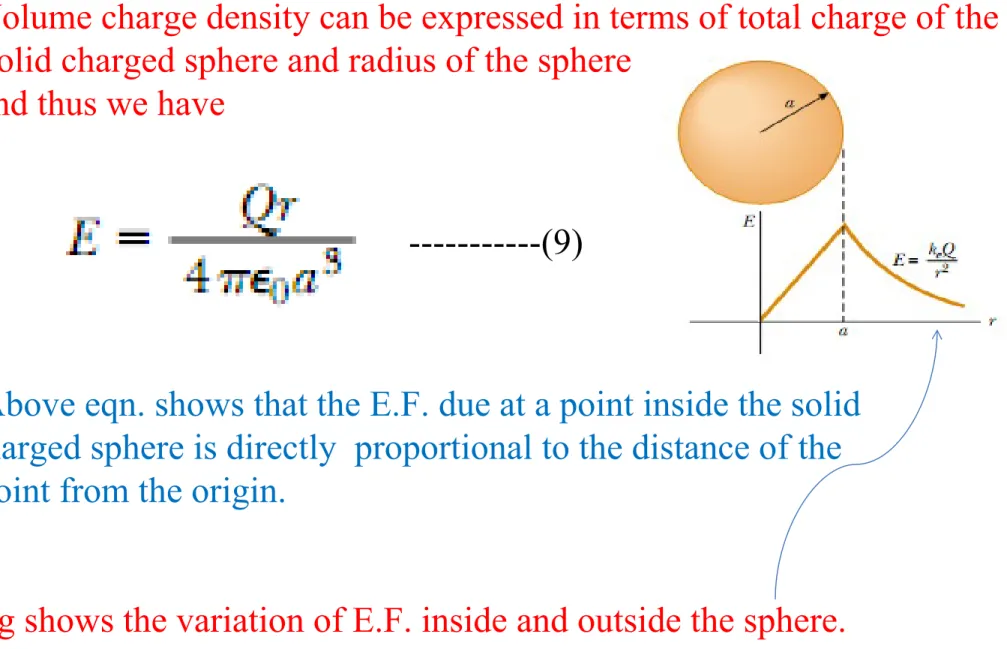
Volume charge density can be expressed in terms of total charge of the Solid charged sphere and radius of the sphere
and thus we have
•Above eqn. shows that the E.F. due at a point inside the solid
charged sphere is directly proportional to the distance of the point from the origin.
Fig shows the variation of E.F. inside and outside the sphere.
III. Find the E.F. inside and outside of a spherical shell using Gauss law
Ans: Outside the Spherical shell:
Consider Gaussian sphere of radius r co-centric with the spherical shell
In above the total charge enclosed , Qenc, is equal to q
Since the E.F. is directed radially outward and is normal to surface and therefore the dot product of E.F and area changes to a simple algebraic product i.e.
Since the field is uniform and constant over the Gaussian sphere and therefore can be taken outside the integral
Thus using eqn. (1) and (3) we get
Above eqn gives the E.F outside the spherical shell
---(2)
---(3)
Inside the spherical shell: To find the E.F. inside the spherical shell we consider the Gaussian sphere inside the shell as shown in fig
Now according to Gauss Law
But in case of spherical shell the charge inside the shell is zero.
IV. Find the E.F. due to infinitely long straight wire at a distance . The wire has uniform linear charge density λ.
Ans. Here symmetry of the charge distribution requires that the E.F. is perpendicular to line charge
distribution. We choose the Gaussian surface in form of a cylinder.
Now acc. To Gauss law
At curved surface the E.F. points radially outward and makes zero angle with area vector. Also magnitude is constant
Also the charge enclosed by the cylinder
= length of cylinder * linear charge density =λl
Using above properties eqn (1) can be written as
Also area of cylinder is = = 2πrl
= =
---(3)
Using (3) in (2) we get
•Note that there is no contribution to E.F. due to end points of cylinder
Because E.F. vector and area vector are perpendicular at end points.
•Note that E.F. due to cylindrical charge distribution is inversely
proportional to r whereas due to spherical charge distribution it is Inversely proportional to r2