Student Worksheet
Simple Machines – Lesson 2: The Inclined Plane and Pulley
Name(s):____________________________ ___________________________________
Section:____________________________________ Date:______________________________________
Talk Now – 2a: Inclined Planes
With your partner, think of as many examples of inclined planes as you can. Record your list.
Lab Instructions
1. Select a length for the inclined plane.
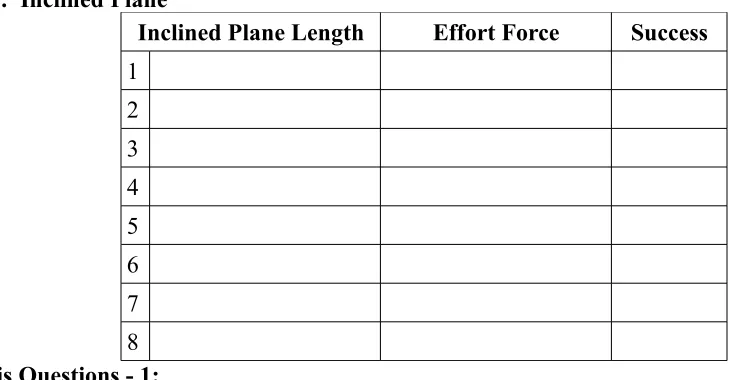
2. Record the length, effort force and indicate whether or not it was successful. 3. Repeat using various lengths.
Data Collection:: Table 1: Inclined Plane
Inclined Plane Length Effort Force Success
1 2 3 4 5 6 7 8 Analysis Questions - 1:
1. From your chart of data, find the maximum effort our crew member can sustain to pull the stone up from the inclined plane.
3. Would this be the ideal length to use for the inclined plane?
4. What other factors might you consider?
Talk Now – 2b: Discuss the inclined plane optimal length
Defend your choice for the ideal length. Give your reasons in complete sentences.
Data Analysis - 1: calculate work done with inclined plane
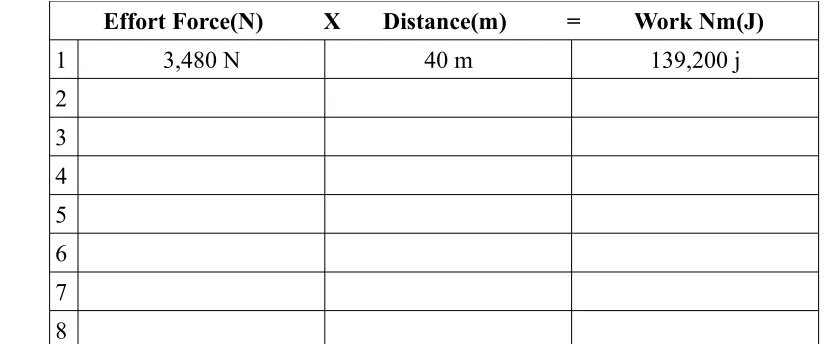
Transfer the data for length and effort from Table 1 onto Table 2. Calculate the amount of work done to get the stone to the top of each inclined plane. Remember: Work = Force applied X distance mass is moved.
Table 2: Incline Plane work done
Effort Force(N) X Distance(m) = Work Nm(J)
1 3,480 N 40 m 139,200 j
2 3 4 5 6 7 8
Graphing Data - 1::
Label the graph and plot the data from Table 1:
Graph 1A
F
orc
e
Length
1. Describe the arrangement of points on your graph in words:
2. What happens to the effort force needed as the length of the inclined plane increases?
3. What do we call this kind of relationship?
The Wedge Connection: Talk Now - 2c: Harry's Ramp
Confer with your partner and make a list of how the wedge and the inclined plane are similar. (Be sure to consider both form and function.)
1. What happens to the stone as Harry pushes the inclined plane?
2. In what direction is Harry applying the force?
3. In what direction is the force acting on the stone?
4. What is moving the most, the inclined plane or the stone?
Talk Now – 2d: which force is greater?
Discuss what you have just done with your partner: Remember: Work = force X distance the force moves. Predict which force is greater: the force Harry is applying to the magical weightless inclined plane or the force acting on the stone? Explain your answer using complete sentences.
Talk Now – 2e: The Pulley
Lab Instructions:
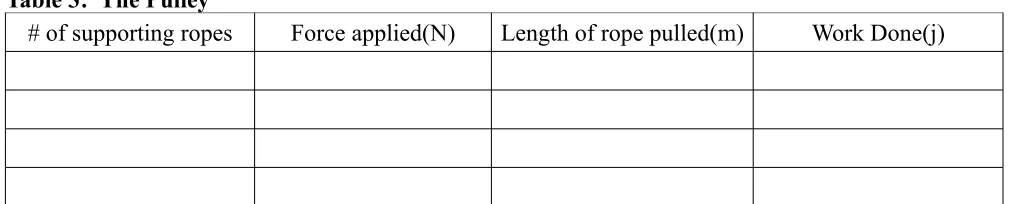
Record the number of supporting ropes, the effort force applied to the rope, and the distance the rope is pulled on Table 3. Record the data for all 4 available arrangements. Calculate the work input for each trial on Table 3 by multiplying the force applied by the length the rope was pulled.
Data Collection:: Table 3: The Pulley
# of supporting ropes Force applied(N) Length of rope pulled(m) Work Done(j)
Compare your 4 values for work, and using complete sentences describe what you found.
Data Analysis – 2:
Table 4: calculate the Pulley MA
Transfer the data needed from Table 3 to Table 4 and calculate the mechanical advantage(MA) for each of the pulley systems used.
# of supporting ropes Resistance Force / Effort Force = MA
1 3480
2 3480
3 3480
4 3480
Talk Now – 2F
Graphing Data – 2::
Graph 2A - Use the number of supporting ropes and thelength of rope used to lift our stone to
complete Graph 2A.
# of S
upport
ing
R
ope
s 7
6 5 4 3 2 1
1m 2m 3m 4m 5m 6m 7m 8m 9m 10m
Analysis Questions:
1. As the number of supporting ropes on the pulley increases, what happens to the length of rope that must be pulled to lift the stone into place?
2. Using this graph, predict the length of rope that would be pulled if you were using 5 supporting ropes.
Graph 2B - Use the force applied in each test and the length of the force pulled to complete Graph 2B:
eng
th of R
ope
s(m
) 7
Analysis Questions
1. As the amount of force increases, what happens to the length of rope pulled?
2. Predict the force if the length of rope pulled had been 7 meters.
Graph 2C -Use the number of supporting ropes and the force applied to complete graph C.
# of S
upport
ing
R
ope
s 7
6 5 4 3 2 1
500 1000 1500 2000 2500 3000 3500 4000 4500 5000
Analysis Questions
1. As the number of supporting rops increases, what happens to the amount of force applied?
2. Predict the force needed if 5 supporting ropes were used.
Talk Now – 2g: Graph analysis
With your partner, compare the patterns formed by the points on each of the graphs. Using complete sentences describe the pattern of each graph and what that pattern tells you.
Talk Now – 2h: The Ramp & the Pulley
With your partner discuss all of the variables available in this type of combined system. (What kinds of things could you change?) List the variables you thought of and explain what each type of change would do to the mechanical advantage. Be sure to answer using complete sentences.
Lab Instructions:
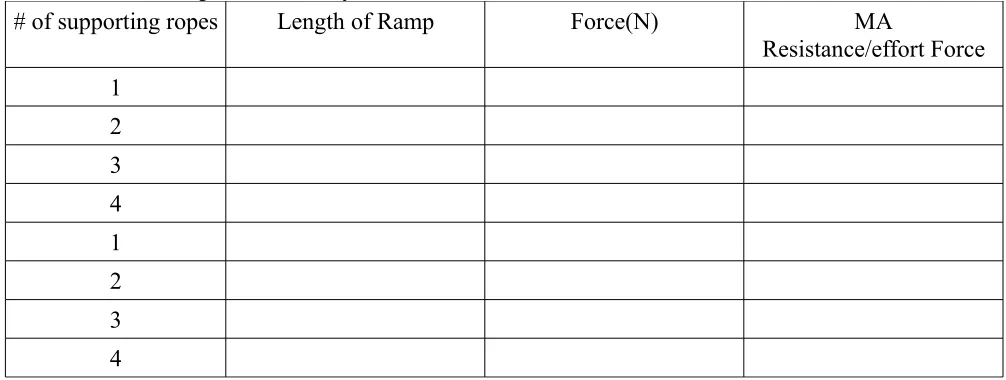
Select a length for the ramp by dragging the tip of the ramp to the length you choose. Test each of the four possible pulley selections for this ramp and record the information on Table 5. Select a different length for the ramp and test each of the pulley selections. Record this data in Table 5 also.
Data Collection:: Cooperation Table 5 – The Ramp & The Pulley
# of supporting ropes Length of Ramp Force(N) MA
Resistance/effort Force 1
2 3 4 1 2 3 4
Analysis Questions
1. In each trial, how does the input force compare to the weight of the stone?
Weight [Resistance force (3480 N)] divided by effort force equals mechanical advantage
2. Calculate the system mechanical advantage for each of your tests. • Select one line of data from Table5
• Calculate the MA of the inclined plane [ramp length divided by ramp height (1.3)]: • Calculate the MA for the pulley system
• Select a second line of data from table 4 and calculate the MA for the inclined plane and the pulley as you did above.
Work space:
3. Compare these values with the MA you recorded for the same systems on Table 4.
Talk now – 2i:
Discuss your results with your partner. Using full sentences, describe what happens to the mechanical advantage when you combine simple machines.