Classical Encryption Techniques
Classical Encryption Techniques
Cryptography
is the science of using mathematics to
encrypt and decrypt data.
Cryptography enables you to store sensitive
information or transmit it across insecure networks
(like the Internet) so that it cannot be read by anyone
except the intended recipient.
•
The art of secret writing
•
The art of protecting information
•
The science of encrypting or hiding
secrets
•
Needed for confidentiality
BASIC TERMINOLOGY
•
plaintext
- the original message
•
ciphertext
- the coded message
•
cipher
- algorithm for transforming plaintext to ciphertext
•
key
- info used in cipher known only to sender/receiver
•
encipher (encrypt)
- converting plaintext to ciphertext
•
decipher (decrypt)
- recovering ciphertext from plaintext
•
cryptography
- study of encryption principles/methods
•
cryptanalysis (codebreaking)
- the study of principles/ methods
of deciphering ciphertext
without
knowing key
SYMMETRIC ENCRYPTION
•
or conventional / private-key / single-key
•
sender and recipient share a common key
•
all classical encryption algorithms are
private-key
•
was only type prior to invention of public-key in
REQUIREMENTS
• two requirements for secure use of symmetric encryption:
• a strong encryption algorithm
• a secret key known only to sender / receiver
• mathematically have:
• Y = E(K, X)
• X = D(K, Y)
• assume encryption algorithm is known
CRYPTOGRAPHY
can be characterized by:
•
type of encryption operations used
• substitution / transposition / product
•
number of keys used
• single-key or private / two-key or public
•
way in which plaintext is processed
• block / stream
CRYPTANALYSIS
• objective to recover key not just message
• general approaches:
• cryptanalytic attack
• brute-force attack
TYPES OF CRYPTANALYTIC ATTACKS
1. ciphertext only
• only know algorithm / ciphertext, statistical, can identify plaintext
2. known plaintext
• know/suspect plaintext & ciphertext to attack cipher
3. chosen plaintext
• select plaintext and obtain ciphertext to attack cipher
4. chosen ciphertext
• select ciphertext and obtain plaintext to attack cipher
5. chosen text
• select either plaintext or ciphertext to en/decrypt to attack cipher
An encryption scheme: computationally secure if
• The cost of breaking the cipher exceeds the value of encrypted information
BRUTE FORCE SEARCH
always possible to simply try every key
most basic attack, proportional to key size
assume either know / recognise plaintext
Key Size (bits) Number of Alternative Keys Time required at 1 decryption/µs Time required at 106
decryptions/µs
32 232 = 4.3 109 231 µs = 35.8 minutes 2.15 milliseconds
56 256 = 7.2 1016 255 µs = 1142 years 10.01 hours
128 2128 = 3.4 1038 2127 µs = 5.4 1024 years 5.4 1018 years
168 2168 = 3.7 1050 2167 µs = 5.9 1036 years 5.9 1030 years
26 characters
(permutation) 26! = 4
SUBSTITUTION CIPHERS
A substitution cipher replaces one symbol with another.
Substitution ciphers can be categorized as
•
Monoalphabetic ciphers
CIPHERS
Monoalphabetic ciphers: each letter in the plaintext is
encoded by only one letter from the cipher alphabet,
and each letter in the cipher alphabet represents only
one letter in the plaintext.
Polyalphabetic ciphers: each letter in the plaintext can
be encoded by any letter in the cipher alphabet, and
each letter in the cipher alphabet may represent
Monoalphabetic Ciphers
In monoalphabetic substitution,
The following shows a plaintext and its corresponding
ciphertext. The cipher is probably monoalphabetic
because both
l’
s (els) are encrypted as
O
’s.
Example
The following shows a plaintext and its corresponding
ciphertext. The cipher is not monoalphabetic
because each
l
(el) is encrypted by a different character.
Example
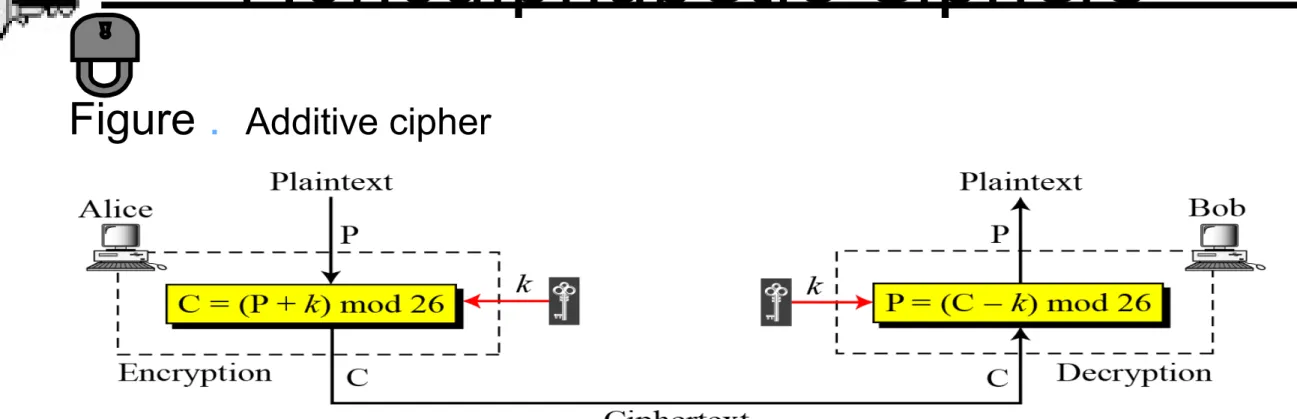
The simplest monoalphabetic cipher is the additive cipher. This
cipher is sometimes called a
shift cipher
and sometimes a
Caesar cipher
, but the term additive cipher better reveals
its mathematical nature.
Additive Cipher
Figure .
Plaintext and ciphertext in Z26Figure
.
Additive cipherWhen the cipher is additive, the plaintext, ciphertext,
and key are integers in Z
26.
Use the additive cipher with
key = 15
to encrypt the
message “hello”.
Example
We apply the encryption algorithm to the plaintext, character
by character:
Solution
Use the additive cipher with key = 15 to decrypt the message
“WTAAD”.
Example
We apply the decryption algorithm to the plaintext character
by character:
Solution
Historically, additive ciphers are called shift ciphers.
Julius Caesar used an additive cipher to communicate with his
officers. For this reason, additive ciphers are sometimes
referred to as the Caesar cipher. Caesar used a key of 3 for his
communications.
Shift Cipher and Caesar Cipher
Additive ciphers are sometimes referred to as
shift ciphers or Caesar cipher.
Eve has intercepted the ciphertext “UVACLYFZLJBYL”.
Show how she can use a brute-force attack to break the
cipher.
Example
Eve tries keys from 1 to 7. With a key of 7,
the plaintext is “not very secure”, which makes sense.
Solution
Monoalphabetic Ciphers
CRYPTANALYSIS OF CAESAR CIPHER
only have 26 possible ciphers
• A maps to A,B,..Z
could simply try each in turn a brute force search
MONOALPHABETIC CIPHER
rather than just shifting the alphabet
could shuffle (jumble) the letters arbitrarily
each plaintext letter maps to a different random ciphertext
letter
hence key is 26 letters long
PERMUTATION
A permutation of a finite set of elements
is an ordered sequence of all the elements of S , with each element appearing exactly once.
For example, if S = {a, b, c}, there are six permutations of S :
MONOALPHABETIC CIPHER SECURITY
now have a total of 26! = 4 x 1026 keys
with so many keys, might think is secure but would be !!!WRONG!!!
LANGUAGE REDUNDANCY AND CRYPTANALYSIS
human languages are redundant
eg "th lrd s m shphrd shll nt wnt"
letters are not equally commonly used
in English e is by far the most common letter
then T,R,N,I,O,A,S
other letters are fairly rare
Z,J,K,Q,X
Table.1
Frequency of characters in EnglishTable .2
Frequency of diagrams and trigramsPLAYFAIR CIPHER
Not even the large number of keys in a monoalphabetic cipher
provides security
One approach to improving security was to encrypt multiple letters
The Playfair Cipher is an example
PLAYFAIR KEY MATRIX
A 5X5 matrix of letters based on a
keyword
Fill in letters of keyword
Fill rest of matrix with other
letters(minus duplicates)
eg. using the keyword MONARCHY
M
O
N
A
R
C
H
Y
B
D
E
F
G
I/J
K
L
P
Q
S
T
ENCRYPTING AND DECRYPTING
plaintext encrypted two letters at a time:
•
if a pair is a repeated letter, insert a filler like 'X',
eg. "balloon" encrypts as "ba lx lo on"
•
if both letters fall in the same row, replace each with letter to right
(wrapping back to start from end), eg. “ar" encrypts as "RM"
•
if both letters fall in the same column, replace each with the letter
below it (again wrapping to top from bottom),
eg. “mu" encrypts to "CM"
SECURITY OF THE PLAYFAIR CIPHER
security much improved over monoalphabetic
since have 26 x 26 = 676 digrams
would need a 676 entry frequency table to analyse (verses 26
for a monoalphabetic)
and correspondingly more ciphertext
PLAYFAIR EXAMPLE
Using "playfair example" as the keyword, (assuming I and J are interchangeable) the table becomes:
Encrypting the message "Hide the gold in the tree stump":
P L A Y F
I R E X M
B C D G H
K N O Q S
The pair DI forms a rectangle, replace it with BE The pair NT forms a rectangle, replace it with KU. The pair HE forms a rectangle, replace it with DM The pair TR forms a rectangle, replace it with UI
The pair ES forms a rectangle, replace it with MO The pair TU is in a row, replace it with UV
The pair MP forms a rectangle, replace it with IF