The First World War
The First World War
1914-1918
Causes of the War
Historians have traditionally cited four long-term
causes of the First World War
NATIONALISM
– a devotion to the interests and
culture of one’s nation
IMPERIALISM
– Economic and political control over
weaker nations
MILITARISM
– The growth of nationalism and
imperialism led to increased military spending
Nationalism
Often
nationalism
led
to rivalries and conflicts
between nations.
Additionally, various
ethnic
groups
resented
domination by others and
wanted independence.
Finally, Russia and
Austria-Hungary disagreed
over the treatment of
Serbs in central Europe.
Germany was allied with Austria-Hungary while Russia, France and
Imperialism
For many centuries,
European nations
built
empires.
Colonies
supplied raw materials
and provided markets for
manufactured goods. As
Germany
industrialized,
she competed with other
nations and colonies
Militarism
Empires had to be defended and
European nations increased military
spending enormously in the late 19th and early 20th century.
By 1890 the strongest nation
militarily in Europe was Germany
Germany had a strong army and built up a navy to rival England’s fleet.
France, Italy, Japan and the United
States quickly joined in the naval
Alliance System
By 1907 there were two
major defense alliances in Europe
The Triple Entente, later
known as the Allies,
consisted of France, Britain, and Russia
The Triple Alliance, later
known as the Central
Powers, consisted of
Germany, Austria-Hungary, and Italy (Soon joined by the
FRANCE BRITAIN RUSSIA
The Spark: An Assassination
The Balkan region was considered
“the powder keg of Europe” due to competing interests in the area.
Russia wanted access to the
Mediterranean Sea. Germany
wanted a rail link to the Ottoman
Empire. Austria-Hungary, which had
taken control of Bosnia in 1878,
accused Serbia of subverting its rule over Bosnia.
Finally, in June of 1914, Archduke
The Fighting Begins
The Alliance system pulled one nation after another into the conflict – The Great War had begun. On August 3, 1914, Germany invaded
Belgium, following a strategy known as the Schlieffen Plan.
This plan called for a quick strike through Belgium to
Paris, France. Next, Germany would attack Russia
The plan was designed to prevent a two-front war for
The War Becomes A Stalemate
Unable to save Belgium, the Allies retreated to the Marne River in
France where they halted the
German advance in September of 1914. Both sides dug in for a long siege. By the spring of 1915, two parallel systems of deep trenches
crossed France from Belgium to Switzerland. Between enemy
trenches was “no man’s land” – an area pockmarked with shell craters
The conditions in these trenches were horrific. Aside from the fear of
bombardment, soldiers also had to contend with mud, flooding, lice, vermin, and disease associated with living in such an unhealthy environment.
First Battle of The Somme
During the First Battle of the Somme
—which began on July 1, 1916, and lasted until mid-November—the
British suffered an enormous number of casualties (60,000 on the first
day). Final casualties for this phase of the war totaled 1.2 million, yet only 7 miles of ground was gained. This bloody trench warfare, in which
armies fought for mere yards of ground, lasted for three years.
Gas attacks were common features of trench life and often caused
Americans Question Neutrality
In 1914, most Americans saw no reason to join a struggle 3,000 miles away – they wanted
neutrality. Some simply did not want their sons to experience the horror of warfare. Some German-Americans supported Germany in World War I. However, many
Americans felt closer to the British because of a shared ancestry and language. Most importantly,
American economic interests were far stronger with the Allies.
French propaganda poster portrayed the Germans as
The War Hits Home
During the first two years of the war,
America was providing (selling) the allied forces dynamite, cannon
powder, submarines, copper wire and tubing and other war material.
Both the Germans and British
imposed naval blockades on each other. The Germans used U-boats
The Lusitania Disaster
United States involvement in
World War I was hastened by the
Lusitania disaster. The Lusitania was a British passenger liner that carried 1,198 persons on a fateful trip on May 7, 1915.
A German U-boat sank the British passenger liner killing all aboard including 128 American tourists. The Germans claimed the ship was carrying Allied ammunition.
Americans were outraged and public opinion turned against
Germany and the Central Powers.
1916 Election
The November 1916 election pitted incumbent Democrat
Woodrow Wilson vs. Republican candidate Supreme Court justice
Charles Evans Hughes.
Wilson won a close election using the slogan, “He kept us out of war.” That slogan
would prove ironic because within a few months the
America Edges Closer To War
Several factors came together to bring
the U.S. into the war:
1. Germany ignored Wilson’s plea
for peace.
2. The Zimmerman Note, a telegram from the German foreign minister to the German Ambassador in
Mexico, proposed an alliance with Mexico and a return of their “lost territory” in Texas, New Mexico, and Arizona.
3. Next came the sinking of four
unarmed U.S. merchant ships by
German subs.
Zimmerman note
America Declares War
On April 2, 1917, senators, representatives,
ambassadors, members of the Supreme Court, and other guests crowded into the Capital building to hear Wilson deliver his
declaration of war.
Wilson said, “The world must be mad safe for democracy.”
Congress passed the
American Power Tips the Balance
America was not ready for war. Only 200,000 men were in service when war was declared, so Congress passed the Selective
Service Act in May of 1917.
By the end of 1918, 24 million had signed up and almost 3 million were called to duty. About 2 million
Fresh U.S. Soldiers Join Fight
After 2 ½ years of fighting, the Allied forces were
exhausted. One of the main contributions of the
Americans was fresh and enthusiastic troops.
American infantry were
nicknamed “doughboys”
Important New Weapons
Machine Guns: Guns could now fire 600 rounds per
minute.
The Tank: New steel tanks ran on caterpillar treads.
Airplanes: Early dogfights resembled duals, however by 1918 the British had a fleet of planes that could deliver bombs.
Other Weapons & Equipment
Howitzers
Flame throwers
Torpedoes
U-boats
Phosphorus grenades
Field phones
Search lights
Gas masks
Camouflage
Railroad guns
American Troops Go On the Offensive
Men of the 42nd Division during the Second Marne. These men were killed by artillery fire just 5 minutes
after this photo was taken
When Russia surrendered to the Germans in 1917, the
Central Powers were able to focus on the Western Front .
By May, the Germans were within 50 miles of Paris. The Americans arrived and
immediately played a major role in pushing the Germans back. In July and August the
Germany Collapses, War Ends
On November 3, 1918,
Germany’s partner, Austria-Hungary, surrendered to the Allies. That same day,
German sailors mutinied against their government.
Other revolts followed, and
Germany was too
exhausted to continue.
So at the eleventh hour, on the eleventh day, of the
eleventh month of 1918,
The War At Home
The Entire U.S. Economy Was Focused On The War Effort. The Shift From A Consumer Economy To War Economy Required A
Collaboration Between
Business And Government.
In The Process, The Power Of The U.S.
Government Expanded.
War Industries Board
The War Industries Board
(WIB) encouraged companies to use mass-production
techniques. Under the WIB
industrial production and wages increased 20% and
union membership increased
from 2.5 million to 4 million.
To deal with disputes between management and labor,
President Wilson set up the
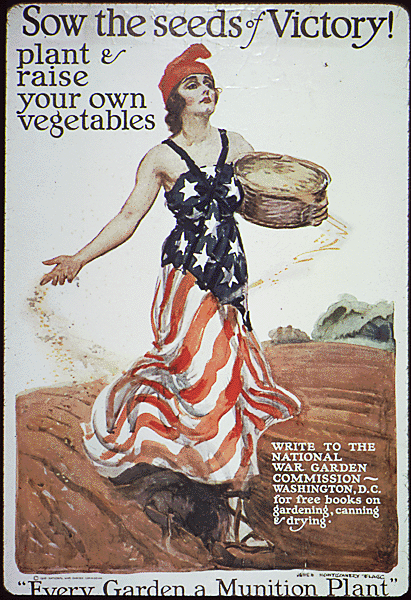
Victory Gardens
To conserve food, Wilson set up the Food Administration
(FA) which declared one day a week “meatless,” another
“sweetless,” and two days
“wheatless.” Homeowners planted “victory gardens” in their yards and school
children worked after school growing tomatoes and
cucumbers in public parks.
Farmers increased production
Selling The War
The U.S. had two major tasks:
raising money and convincing the public to support the war.
The U.S. spent $35.5 billion on the war effort.
The government raised about 1/3 of that through an income tax and “sin” taxes.
Propaganda
To popularize the war, the government set up the
nations first propaganda agency called the
Committee on Public Information (CPI)
George Creel led the agency and persuaded
many of the nation’s artists to create thousands of
Attack on Civil Liberties
As the war progressed, Civil Liberties were compromised.
Anti-Immigrant feelings were openly expressed especially anti-German and Austrian- Hungarian.
Espionage and Sedition Acts
were passed by Congress. These acts were designed to prevent anti-war protests but went against the spirit of the First Amendment (free speech)
Socialists and labor leaders were targeted for disloyalty.
Any anti-American sentiments were targeted
Wilson Fights for Peace
Wilson’s 14 points in his own short hand
Despite the hero’s welcome he received in Europe, Wilson’s plan for peace would be rejected by the Allies. Wilson’s plan was called the “Fourteen points” and included:
No secret treaties
Freedom of the Seas
More free trade
Reduction of arms
Less colonialism
A League of Nations to promote peace through collective
Allies Reject Wilson’s Plan, Sign Treaty
The Big Four leaders, Wilson (U.S.), Clemenceau (France), Lloyd George (England), and Orlando (Italy), worked out the Treaty’s details
Wilson conceded on most of his 14 points in return for the
establishment of the League of Nations.
On June 28, 1919, the Big Four and the leaders of the defeated nations gathered in the Hall of Mirrors at Versailles and signed the Treaty of Versailles.
Treaty Of Versailles
The Treaty established nine
new nations including
Poland, Czechoslovakia, and Yugoslavia.
It broke up the
Austro-Hungarian Empire and the Ottoman Empire empires. It barred Germany from
maintaining an army,
required them to give Alsace-Lorraine back to France, and forced them to pay $33 billion
The Weakness of the Treaty
The harsh treatment of Germany prevented the Treaty from creating a lasting peace in Europe
The Treaty humiliated the Germans by forcing them to admit sole
responsibility for the war (War-Guilt Clause)
Furthermore, Germany would never be able to pay $33 billion in
reparations.
Debate Over Treaty at Home
The U.S. never did join the league
In the United States, the Treaty was hotly debated especially the League of Nations.
The Legacy of the War
At home, the war strengthened both the military and the power of the government.
The propaganda campaign provoked
powerful fears in society.
For many countries the war created
political instability and violence that lasted for years
Russia established the first Communist
state during the war
Americans called World War I, “The War to end all Wars” --- however unresolved issues would eventually drag the U.S. into an even deadlier conflict.