17
Transdisciplinary Instruction:
Implementing and Evaluating a
Primary-School STEM Teaching Model
Rekha Koula, Barry J. Frasera and Hendrati Nastitiaa
Corresponding author: Rekha Koul ([email protected])
aCurtin University
Keywords: attitudes; learning environment; primary-school level; STEM education
International Journal of Innovation in Science and Mathematics Education, 26(8), 17–29, 2018.
Special Issue: STEM Education
Abstract
This article reports the implementation of a series of innovative STEM lessons, which were integrated into primary-school students’ teaching and learning programs, and their evaluation using a mixed-methods approach. We provided 1095 grade 4-7 students in 36 classes from 10 schools with a series of STEM lessons modified from Tryengineering to fit local needs. Effectiveness was evaluated by administering a questionnaire to students before (pretest) and after (posttest) the STEM lessons. The questionnaire included two scales assessing student perceptions of their learning environment (Cooperation and Involvement), two scales assessing student attitudes (Enjoyment of Lessons and Career Interest in STEM) and two scales assessing student understanding of the work undertaken by people employed in engineering and technology. Also our evaluation involved qualitative information based on classroom observations and interviews. Statistically-significant improvements between pretest and posttest in career interest in STEM (0.70 standard deviations), understanding of engineering (0.81 standard deviations) and understanding of technology (0.74 standard deviations) supported the efficacy of the instructional activities, while lessons observations and student interviews further supported, explained and clarified the quantitative findings.
Introduction
The role of STEM (Science, Mathematics, Engineering and Technology) cannot be underestimated in preparing global citizens for the challenges of the future. Because innovation is the key to economic growth and STEM is a key driver of innovation, opportunities for engaging and supporting young people in pursuing their love of STEM, or even helping them to better understand what STEM entails, strengthens the future workforce and a country’s international standing.
18
Aims
The two purposes of this article are to:
Describe the development and implementation of primary-school instructional materials in STEM
Report an evaluation of these STEM instructional materials in terms of students’ perceptions of classroom environment, attitudes and understanding, as well as
qualitative information based on observations and interviews.
Background context of STEM education
Challenges of the global economy and the move from the technology era to the information era require that educators transform students’ classroom experiences to keep up with the opportunities and demands brought by the information era. Initiatives such as the integration of Science, Technology, Engineering and Mathematics subjects into STEM (Honey, Pearson, & Schweingruber, 2014; Zollman, 2012) and the Partnership for 21st Century Skills (http://www.p21.org/) reflect this transformation. Integration of the individual STEM subjects has the potential to prepare students for the workforce of the future by equipping them with 21st century skills such as problem-solving, innovation, creativity, collaboration and critical thinking, as explicated by the Australian Office of the Chief Scientist:
An education in STEM also fosters a range of generic and quantitative skills and ways of thinking that enable individuals to see and grasp opportunities. These capabilities – including deep knowledge of a subject, creativity, problem solving, critical thinking and communication skills – are relevant to an increasingly wide range of occupations. They will be part of the foundation of adaptive and nimble workplaces of the future. (2014, p. 7)
The importance of STEM is highlighted by the shortfall in the global STEM workforce, gender gaps in both STEM-related occupations and STEM education, and disparities among education providers (Beede et al., 2011; Diekman & Benson-Greenwald, 2018; Engineers Australia, 2017; Kier, Blanchard, Osborne & Albert, 2014). These issues call for initiatives that can nurture and improve student retention and interest in STEM subjects. In order for these initiatives to be effective, factors that influence students’ career choices need to be identified and addressed.
Honey et al. (2014, p. 33) identified five goals for students and two goals for educators in integrated STEM education:
Goals for students
• STEM literacy
• 21st century competencies
• STEM workforce readiness
• Interest and engagement
• Ability to make connections among STEM disciplines Goals for educators
• Increased STEM content knowledge
• Increased pedagogical content knowledge.
19
STEM education is important not only for promoting cognitive outcomes, but also for affective aspects of education. Students’ attitude towards STEM was identified as one of the factors that determine whether or not students make career decisions in STEM (Bandura, Barbaranelli, Caprara, & Pastorelli, 2001; Osborne, Simon, & Collins, 2003; Tseng, Chang, Lou, & Chen, 2013). Hence, STEM education needs to create a rich and holistic learning experience that excites students, motivates them to pursue deeper understanding and stronger skillsets, and facilitates the attainment of 21st century skills.
Review of learning environment literature
Because students spend approximately 20,000 hours in classrooms by the time they complete a university degree, the quality of their classroom environments is highly important (Fraser, 2001). For this reason, Walberg and Anderson’s (1968) evaluation of Harvard Project Physics included as process criteria of curricular effectiveness students’ perceptions of the quality of their classroom learning environments, which were assessed by a multidimensional questionnaire called the Learning Environment Inventory (LEI). This pioneering research marked the beginning of the field of classroom learning environments.
Walberg and Anderson’s (1968) work was pioneering not only because it introduced the use of learning environments dimensions as criteria of effectiveness in the evaluation of educational programs, but also because classroom processes were assessed through students’ perceptions using the LEI questionnaire (in contrast to the prevailing domination of direct observational methods at the time). Therefore, this work in the US spawned much research around the world that involved the development and validation of new learning environment questionnaires and their use in curriculum/program evaluation.
However, the LEI has some limitations. It is uneconomical in terms of the time needed for students to respond to 105 items in 15 scales (e.g. Competitiveness, Goal Direction). Because the LEI was designed for the senior high-school level, some of its language is unsuitable for younger students. Importantly, the LEI was designed for teacher-centred classrooms that were the norm at the time. Later questionnaires overcame these shortcomings.
The first learning environment questionnaire with a specific focus of student-centred classrooms was the Individualised Classroom Environment Questionnaire (ICEQ), which has 50 items in the 5 scales of Personalisation, Participation, Independence, Investigation and Differentiation (Fraser, 1990; Rentoul & Fraser, 1979). The ICEQ’s scales have been found to be significantly related to several types of student attitudes to science (Fraser & Butts, 1982).
The Constructivist Learning Environment Survey (CLES) contains 35 items in 5 scales (Personal Relevance, Uncertainty, Critical Voice, Shared Control and Student Negotiation) that assess the extent to which a classroom’s environment is consistent with constructivism (Taylor, Fraser, & Fisher, 1977). The CLES has been useful in research involving a comparison of Australian and Taiwanese science classrooms (Aldridge, Fraser, Taylor, & Chen, 2000), an evaluation of science teacher professional development in the US (Nix, Fraser, & Ledbetter, 2005), and science teachers’ action research aimed at improving classroom environments in South Africa (Aldridge, Fraser, & Sebela, 2004).
20
Giddings, & McRobbie, 1995). Interestingly, the SLEI was field tested and validated simultaneously with 5447 students in 269 classes in six countries (US, England, Canada, Australia, Israel and Nigeria). The SLEI has been applied in investigating associations between the laboratory environment and student attitudes (Fraser & McRobbie, 1995), evaluating the use of anthropometric activities (Lightburn & Fraser, 2007) and identifying differences in the learning environments of science students in different streams (Fraser & Lee, 2009).
In the study reported in this article, selected scales were drawn from the 56-item What Is Happening In this Class? (WIHIC) questionnaire, which currently is the world’s most-frequently used learning instrument and which assesses the 7 scales of Student Cohesiveness, Teacher Support, Independence, Investigation, Task Orientation, Cooperation and Equity (Aldridge, Fraser, & Huang, 1999). The WIHIC has been used as a source of criteria of effectiveness in the evaluation of many science programs, including a field-studies centre (Zaragoza & Fraser, 2017), an innovative university science course for prospective elementary teachers (Martin-Dunlop & Fraser, 2008) and the use of student response systems (Cohn & Fraser, 2016).
In the numerous studies reviewed above, learning environment variables have been used as dependent variables in evaluations of educational programs. When used as independent variables, learning environment scales were consistently, positively and strongly related to science students’ outcomes in many studies reviewed by Fraser (2012, 2014, 2018). Therefore, having positive classroom environments should be seen not only as a worthwhile end in its own right, but also as a means for improving student outcomes.
Science teachers have used learning environment assessments in successful action-research attempts at improving their classrooms (Fraser & Aldridge, 2017). By assessing students’ actual and preferred classroom environment perceptions and reflecting on gaps between the actual and the preferred, teachers have been guided in implementing classroom changes to reduce these gaps (Aldridge, Fraser, Bell, & Dorman, 2012; Aldridge, Fraser, & Sebela, 2004).
Our STEM education initiative
This project was motivated by the importance of providing high-quality STEM education in preparing the next generation for the future. The overarching aim was to promote interest and understanding among primary school students in STEM as potential career choices through creating engaging learning environments. The project addressed the teaching component in teaching and learning by providing support and experience for teachers, as well as the learning component by providing STEM learning experiences for students. Importantly, as described below, this initiative was evaluated quantitatively with a questionnaire assessing the learning environment, student attitudes and student understanding, as well as qualitatively based on reflections from students and teachers.
21
Give Me a Brake - lesson focused on brakes, force and friction, using bicycle rim brakes to demonstrate basic braking mechanisms to stop, slow or prevent motion. The topic was introduced using a short PowerPoint presentation that introduced science (friction), technology (bicycle brakes), engineering (design) and mathematics (measurement) ideas into the activity. This 45-minute activity aimed to teach students how simple rim brake systems work for bicycles. Teams of 3 students each explored how different materials react when used in a braking system to stop the motion and then evaluated the design and materials used in standard bicycle brakes. Students developed and presented a design for improved safety using words and sketches given in information sheets. Students were encouraged to make amendments to improve the design. The teams then were required present their ideas to the class.
Oil Spill Solutions - lesson focused on the use of various techniques to provide speedy solutions for oil spills or other threats to natural water resources. Effort was made to integrate all the four streams of STEM by bringing in the science (environmental impact), technology (testing the system), engineering (design of system) and mathematics (measurement) in this activity. Students worked in teams of 3 to analyse an oil spill in the classroom and then to design, build and test a system that first contained and then removed the oil from the water. Students selected items from everyday use to build oil containment and clean-up systems, evaluate the effectiveness of their solution and those of other teams, and present their findings to the class.
Solar Structures - lesson focused on how the sun energy can be used to heat and cool buildings. Teams of students were asked to design and build a one-bedroom model house, using passive solar heating techniques to warm up the house as much as possible. The house needed to be big enough to be able to place a thermometer inside the middle of the model with the door closed and be able to read the thermometer through the window. The passive solar houses were constructed from everyday materials and they were tested to determine how well they regulate temperature. In contrast to the first two activities, Solar Structures took a longer time (approximately 2 hours) to complete. Concepts of science (passive solar design convection, radiation and conduction), technology (regulating the temperature of the building with electronic devices such as thermostats or blinds), engineering (design in the form of cross ventilation, vegetation, colours used, windows direction) and mathematics (amount of heat generated, length and breadth of windows, angle of sun from the location, recording the temperature) were introduced.
Research methods
22
Ethics approval for the study was granted by the Human Ethics Research Committee of Curtin University.
Sample
Our sample comprised 1095 grade 4-7 students (570 male and 525 female) in 36 classes in 10 schools. Classes consisted of only grade 4, only grade 6 or a composite of grades 4/5, grades 5/6 or grades 6/7. Approximately 10% of participating students reported that one of their parents works or is qualified as an engineer. The study was carried out in a mix of private and public schools in suburban Perth, Western Australia. All schools were co-educational.
All 1095 students completed our questionnaires both as a pretest and a posttest. From these 1095 students, 265 students from five schools representing all grade levels were randomly selected to complete a reflection sheet to capture their learning experiences. Interviews were also conducted with 29 students from this group, as well as with their seven teachers.
Questionnaire
Salient aspects of the learning environment were assessed using scales from the widely-used and extensively-validated What Is Happening In this Class? (WIHIC) developed by (Aldridge, Fraser & Huang, 1999). According to Dorman (2008), the WIHIC is the most-frequently used classroom environment questionnaire around the world today. Two scales that were most appropriate for our study, namely, Cooperation and Involvement, were selected and modified. However, only 5 of the original 8 items in each scale were used because of the young age of students. Additionally, again because of student age, the original 5 response alternatives were reduced to only 3 (Disagree, Not Sure, Agree). Items in these two learning environment scales are listed in the Appendix.
Similarly, in order to measure student attitudes, the widely-used and -validated Test of Science-Related Attitudes (TOSRA) developed by Fraser (1981) was drawn upon. Two salient scales, namely, Enjoyment of Lessons and Career Interest in STEM, were selected and modified. Again, to minimise fatigue among young students, only five items per scale and only 3 response alternatives (Disagree, Not Sure, Agree) were used. Items in these two attitude scales are listed in the Appendix.
The validity and reliability of our four learning environment and attitude scales were found to be satisfactory for our sample. The 4-scale structure of the questionnaire was supported by principal axis factor analysis with varimax rotation and Kaiser normalisation, with the 4 scales together accounting for 52.46% of pretest variance and 60.55% of posttest variance. Eigenvalues ranged from 1.24 to 4.09 for the pretest and from 1.14 to 5.58 for the posttest. All items in the four scales could be retained. Cronbach alpha reliability coefficients for the four different scales ranged from 0.88 to 0.90 for the pretest and from 0.89 to 0.94 for the posttest.
23
Qualitative data collection
In addition to quantitative data collection based on administering our questionnaire to 1095 students, a reflection sheet that was collected from a randomly-selected group of 265 students after the lessons. This reflection sheet contained five questions that were similar across topics and only slightly changed to reflect each particular topic. These five questions were designed to help students to reflect on the challenges which they encountered during the lessons, the interesting aspects of the lessons that they enjoyed, the changes that they would make to their designs and solutions, and suggestions for improving the lessons.
From these 265 students, 29 were selected and interviewed about their interest in their science class, their understanding of engineering and technology, the sources of information to which they have had access, their career choices and their parents’ occupations. The purpose of these interviews was to collect information about factors that could influence students’ career choices. Also interviews with seven teachers were conducted to gather information about their perceptions and experiences regarding STEM education. Observations were made by the researchers during the lessons.
Results
Quantitative questionnaire data
Our STEM teaching model was evaluated in terms of changes between pretest and posttest on each of the six constructs in our questionnaire described above: the learning environment scales of Cooperation and Involvement; the student attitude scales of Enjoyment of Lessons and Career Interest in STEM; and student Understanding of Engineering and Understanding of Technology. Koul, Fraser, Maynard and Tade (2018), reported on how 1095 students’ questionnaire responses were analysed using one-way MANOVA with repeated measures with the six questionnaire scales as the set of dependent variables. Testing occasion (pretest/postest) was the repeated-measures factor. Because pretest–posttest differences for the 6 scales as a whole (using Wilks’ lambda criterion) were statistically significant, the one-way ANOVA was interpreted for each of the individual questionnaire scale.
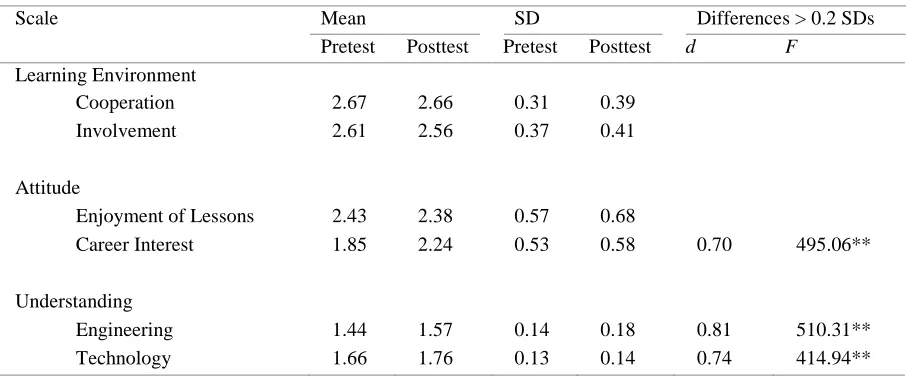
Table 1 shows for each questionnaire scale, the mean and standard deviation (SD) separately for pretest and posttest, as well as the ANOVA results for the statistical significance of pretest– posttest changes. In addition to reporting the statistical significance of pretest–posttest changes, we also estimated their magnitude using Cohen’s d effect size, which expresses a difference in standard deviation units. Table 1 reports effect sizes for those scales for which pretest–posttest changes were at least 0.2 SDs.
24
Table 1: Descriptive statistics and ANOVA results and effect sizes for pretest–posttest changes in learning environment, attitude and understanding scales
Scale Mean SD Differences > 0.2 SDs
Pretest Posttest Pretest Posttest d F
Learning Environment
Cooperation 2.67 2.66 0.31 0.39
Involvement 2.61 2.56 0.37 0.41
Attitude
Enjoyment of Lessons 2.43 2.38 0.57 0.68
Career Interest 1.85 2.24 0.53 0.58 0.70 495.06**
Understanding
Engineering 1.44 1.57 0.14 0.18 0.81 510.31**
Technology 1.66 1.76 0.13 0.14 0.74 414.94**
**p<0.01, N = 1095
Cohen’s d effect size = Difference between means divided by pooled SD. Based on Koul et al. (2018)
It is noteworthy that, for the three scales for which pretest-postest changes were small and nonsignificant, the pretest mean out of a maximum of 3 was already high (ranging from 2.38 2.67). Because this suggests the presence of a possible ceiling effect for the three scales of Cooperation, Involvement and Enjoyment, the teaching and learning activities in the participating schools already were characterised by high levels of Cooperation, Involvement and enjoyment prior to our intervention.
In addition to the overall effectiveness of the instructional materials for the whole sample (as reported in Table 1), the possible differential effectiveness of the materials for male and female students was important. We explored differential effectiveness by comparing males and females in terms of the magnitudes of their pretest–posttest changes in learning environment, attitude and understanding scores. Because the magnitudes of these pretest-posttest changes were found to be quite similar for males and females, it appears that the instructional materials were equally effective for students of different sexes.
Qualitative student reflection
Qualitative data from student reflection also reflected the effectiveness of the STEM lessons, with students reporting their engagement and enjoyment with responses such as:
I was enjoying it, It was prepared well and everyone had a lot of fun and learned lots of new things about engineering, and It was fun and interesting. Comments for all three activities also reflected students’ design thinking and ability to evaluate their activities and methods: I would have a sensor instead of a button (Give Me a Brake) and If I were to do this again, I would put Glad Wrap under the rice: this way, when the rice absorbs the oil, we can lift it up (Oil Spill). The design component of the lessons Give Me a Brake and Oil Spill Solutions was reported to be challenging but also interesting while, for Solar Structures, the creation part was found to be more difficult than the design component.
25
would work best, including cotton buds and Glad Wrap while, for Solar Structures, most students considered location and isolation to be the most important factors in heat retention.
When asked about which elements of the activities they enjoyed most, students who undertook Give Me a Brake identified the design process, collaboration, observing other students’ designs, learning about the system, experiments and the presentation. For Oil Spill Solutions, in addition to these elements, most students enjoyed the activity most when their experiments worked. In contrast, for Solar Structures, students most enjoyed the building and temperature-measuring elements.
With regards to how the activities could be improved, many students expressed their satisfaction with the activities, but several students suggested more tangible approaches and technologies such as by working on a real bike, using more materials, or using their computers to draw their design.
Qualitative interviews with students
All students who were interviewed reported experiments as being an interesting aspect of their science class. They enjoyed science most when: they could relate the topic to real life and the environment; the topic was relevant, useful and exciting; and when they could design, build and manipulate different materials.
When asked about their understanding of what engineers do, most students were hesitant, except students whose parent was an engineer or who were interested in becoming an engineer. They defined an engineer as a designer, maker, builder or repairer. The skills and traits that they associated with engineers included being intelligent, creative, innovative, good in science and mathematics, helpful, resourceful, calm, strong, patient and hard- working.
Students’ source of understanding of engineering and what engineers do included books, school, friends, parents, television and the internet, as well as the lessons in which they had just participated. Most students had never considered a career in engineering but several reported that they had started to think about the possibility.
Qualitative interviews with teachers
Teacher interviews about each of the three STEM activities reflected overall satisfaction. The chosen activities were within the framework of their science curriculum, were well planned and catered for the needs of the children. All seven teachers recognised the connection between the STEM activities and the curriculum being covered during the term and generally appreciated the support provided by the researchers. Teacher responses reflected that activities involved:
the curriculum-related topic being chosen; discussions, communication and team work; problem-solving and critical thinking; relevance to real life; and
fun and motivational elements.
26
Discussion
The STEM lessons were considered effective by students and teachers reported their satisfaction. There were large and statistically-significant pretest-postest improvements in students’ career interest and understanding related to STEM, and students’ reflections showed engagement in both the activities and design thinking. STEM activities were identified by students as developing skills and positive attitudes such as curiosity, innovation, collaboration, critical thinking and problem-solving. The alignment to the curriculum was also found to contribute to the effectiveness of the STEM lessons.
Students’ engagement with STEM activities is likely to create positive attitudes towards further study and future career in STEM. In this study, all students reported interest and enjoyment when lessons were tangible, contextual, useful and relatable. The lack of pretest-postest improvement for two learning environment scales and an enjoyment scale could suggest that student engagement with STEM activities needs to be better facilitated (but also could be explained by a ceiling effect in which scores were already high at pretesting). Creating positive classroom environments that emphasise cooperation, involvement and enjoyment is likely to further engage students in STEM activities and develop their 21st century skills.
Shortages in STEM-related occupations have made it vital for educators to prepare students for the future workforce. Studies show that students’ career interests are affected by factors such as self-efficacy, positive experience, early exposure, peer influence and the availability of role models (Bandura et al., 2001; Diekman, Brown, Johnston & Clark, 2010; Kier, Blanchard, Osborne, & Albert, 2014). Similar to these findings, our study revealed that students’ career interest was influenced by parents as role models, information from various sources, and positive experiences during STEM activities. If education is to prepare students for a future in STEM, educators need to tap into these factors and provide sufficient information and experience in STEM.
Contrary to most research findings on gender gaps in STEM (Beede et al., 2011; Diekman et al., 2010), this study revealed that the STEM lessons were relatively comparable in their effectiveness for boys and girls in terms of pretest–posttest changes in learning environment, attitudes and understanding. Research also shows that early exposure to STEM activities and scaffolded learning could bridge gender gaps in STEM (Kier et al., 2014; Reilly, Neumann, & Andrews, 2017; Sadler, Sonnert, Hazari, & Tai, 2012) and that students’ level of interest in STEM subjects in the early high-school years strongly influences their career choices at the end of high school (Sadler et al., 2012). By exposing students to exciting and engaging STEM activities during early schooling, gender disparity in STEM occupations could be reduced.
well-27
equipped to facilitate STEM learning. This calls for frequent initiatives to support primary-school teachers in their STEM teaching.
References
Aldridge, J. M., Fraser, B. J., Bell, L., & Dorman, J. P. (2012). Using a new learning environment questionnaire for reflection in teacher action research. Journal of Science Teacher Education, 23, 259–290.
Aldridge, J. M., Fraser, B. J., & Huang, T. C. I. (1999). Investigating classroom environments in Taiwan and Australia with multiple research methods. The Journal of Educational Research, 93(1), 48–62. Aldridge, J. M., Fraser, B. J., & Sebela, M. P. (2004). Using teacher action research to promote constructivist
learning environments in South Africa. South African Journal of Education, 24, 245–253.
Aldridge, J. M., Fraser, B. J., Taylor, P. C., & Chen, C.-C. (2000). Constructivist learning environments in a cross-national study in Taiwan and Australia. International Journal of Science Education, 22, 37–55. Bandura, A., Barbaranelli, C., Caprara, G. V., & Pastorelli, C. (2001). Self‐efficacy beliefs as shapers of
children's aspirations and career trajectories. Child development, 72(1), 187–206.
Beede, D. N., Julian, T. A., Langdon, D., McKittrick, G., Khan, B., & Doms, M. E. (2011). Women in STEM: A gender gap to innovation. Washington, DC: US Department of Commerce.
Cohn, S. T., & Fraser, B. J. (2016). Effectiveness of student response systems in terms of learning environment, attitudes and achievement. Learning Environments Research, 19, 153–167.
Creswell, J. W., & Clark, V. P. (2007). Designing and conducting mixed methods research. Thousand Oaks, CA: Sage.
Diekman, A. B., & Benson-Greenwald, T. M. (2018). Fixing STEM workforce and teacher shortages: How goal congruity can inform individuals and institutions. Policy Insights from the Behavioral and Brain Sciences, 5(1), 11–18.
Diekman, A. B., Brown, E. R., Johnston, A. M., & Clark, E. K. (2010). Seeking congruity between goals and roles: A new look at why women opt out of science, technology, engineering, and mathematics careers.
Psychological Science, 21(8), 1051–1057.
Dorman, J.P. (2008) The effect of clustering on statistical tests: an illustration using classroom environment data. Educational Psychology, 28:5, 583-595.
Engineers Australia. (2017). Engineers make things happen: The need for an engineering pipeline strategy. Retrieved from
https://www.engineersaustralia.org.au/sites/default/files/resource-files/2017-03/Engineers%20Make%20Things%20Happen%20-%20Summary.pdf
Fraser, B. J. (1981). Test of Science-Related Attitudes (TOSRA). Melbourne, Australia: Australian Council for Educational Research.
Fraser, B.J. (1990). Individualised Classroom Environment Questionnaire. Melbourne, Australia: Australian Council for Educational Research.
Fraser, B. J. (2001). Twenty thousand hours. Learning Environments Research, 4, 1–5.
Fraser, B. J. (2012). Classroom learning environments: Retrospect, context and prospect. In B. J., Fraser, K. G. Tobin, & C. J. McRobbie (Eds.), Second international handbook of science education (pp. 1191–1232). New York: Springer.
Fraser, B.J. (2014). Classroom learning environments: Historical and contemporary perspectives. In N.G. Lederman and S.K. Abell (Eds.), Handbook of research on science education, Volume II (pp. 104–119). New York: Routledge.
Fraser, B.J. (2018). Milestones in the evolution of the learning environments field over the past three decades. In D.B. Zandvliet and B.J. Fraser (Eds.), Thirty years of learning environments: Looking back and looking forward (Advances in Learning Environments Research Series (pp. 1–19). Leiden, The Netherlands: Brill. Fraser, B.J., & Aldridge, J.M. (2017). Improving classrooms through assessment of learning environments. In
J.P. Bakken (Ed.), Classrooms Volume 1: Assessment practices for teachers and student improvement strategies (pp. 91–107). New York: Nova.
Fraser. B.J., & Butts, W.L. (1982). Relationship between perceived levels of classroom individualization and science-related attitudes. Journal of Research in Science Teaching, 19(2), 143–154.
Fraser, B.J., Giddings, G.J., & McRobbie, C.J. (1995). Evolution and validation of a personal form of an instrument for assessing science laboratory classroom environments. Journal of Research in Science Teaching, 32(4), 399–422.
Fraser, B.J., & Lee, S.S.U. (2009). Science laboratory classroom environments in Korean high schools.
Learning Environments Research, 12, 67–84.
28
Goodrum, D., & Rennie, L. J. (2007). Australian school science education national action plan 2008-2012. Retrieved from
http://www.dest.gov.au/NR/rdonlyres/94684C4C-7997-4970-ACAC-5E46F87118D3/18317/Volume1final_28August2008.pdf
Honey, M., Pearson, G., & Schweingruber, H. (2014). STEM integration in K-12 education: Status, prospects, and an agenda for research. Washington, DC: National Academies Press.
Kier, M. W., Blanchard, M. R., Osborne, J. W., & Albert, J. L. (2014). The development of the STEM career interest survey (STEM-CIS). Research in Science Education, 44(3), 461–481.
Koul, R. B., Fraser, B. J., Maynard, N., & Tade, M. (2018). Evaluation of engineering and technology activities in primary schools in terms of learning environment, attitudes and understanding. Learning Environments Research, 21(1), 285–300.
Koul, R., Fraser, B., Maynard, N., Tade, M., & Henderson, D. (2016). Science, Technology, Engineering and Mathematics (STEM) teaching to primary-school students: Some case studies. In R. Nata (Ed.), Progress in Education (pp. 97–118). New York: Nova Science Publishers.
Lightburn, M.E., & Fraser, B.J. (2007). Classroom environment and student outcomes among students using anthropometry activities in high school science. Research in Science and Technological Education, 25,
153–166.
Mackenzie, N., & Knipe, S. (2006). Research dilemmas: Paradigms, methods and methodology. Issues in Educational Research, 16(2), 193–205.
Martin-Dunlop, C., & Fraser, B.J. (2008). Learning environment and attitudes associated with an innovative course designed for prospective elementary teachers. International Journal of Science and Mathematics Education, 6, 163–190.
Nix, R. K., Fraser, B. J., & Ledbetter, C. E. (2005). Evaluating an integrated science learning environment using the Constructivist Learning Environment Survey (CLES). Learning Environments Research, 8, 109-133. Office of the Chief Scientist. (2014). Science, technology, engineering and mathematics: Australia's future.
(1925092402). Retrieved from https://www.chiefscientist.gov.au/wp-content/uploads/STEM_AustraliasFuture_Sept2014_Web.pdf.
Osborne, J., Simon, S., & Collins, S. (2003). Attitudes towards science: A review of the literature and its implications. International Journal of Science Education, 25(9), 1049–1079.
Reilly, D., Neumann, D. L., & Andrews, G. (2017). Gender differences in spatial ability: Implications for STEM education and approaches to reducing the gender gap for parents and educators. In M. S. Khine (Ed.), Visual-spatial ability in STEM education (pp. 195–224). New York: Springer.
Rentoul, A.J., & Fraser, B.J. (1979). Conceptualization of enquiry-based or open classroom learning environments. Journal of Curriculum Studies, 11, 233–245.
Sadler, P. M., Sonnert, G., Hazari, Z., & Tai, R. (2012). Stability and volatility of STEM career interest in high school: A gender study. Science Education, 96(3), 411–427.
Taylor, P.C., Fraser, B.J., & Fisher, D.L. (1997). Monitoring constructivist classroom learning environments.
International Journal of Educational Research, 27, 293–302.
Tseng, K.-H., Chang, C.-C., Lou, S.-J., & Chen, W.-P. (2013). Attitudes towards science, technology, engineering and mathematics (STEM) in a project-based learning (PjBL) environment. International Journal of Technology and Design Education, 23(1), 87–102. doi:10.1007/s10798-011-9160-x Walberg, H.J., & Anderson, G.J. (1968). Classroom climate and individual learning. Journal of Educational
Psychology, 59, 414–419.
Zaragoza, J.M., & Fraser, B.J. (2017). Field-study classrooms as positive and enjoyable learning environments.
Learning Environments Research, 20(1), 1-20.
29
Appendix
Listing of all items in four learning environment and attitude scales
Working Together
1. I cooperate with other students when doing science work.
2. I share my books and resources with other students when doing work in science. 3. I work with other students on projects in this class.
4. I learn from other students in this class. 5. Students work with me to achieve class goals.
Involvement
6. I discuss ideas in class. 7. The teacher asks me questions.
8. My ideas are used during classroom discussions. 9. I ask the teacher questions.
10. Other students in the class discuss problems with me.
Enjoyment
11. Science lessons are fun.
12. School should have more science lessons each week. 13. Science is one of the most interesting school subjects. 14. I enjoy going to science lessons.
15. I look forward to science lessons.
Career Interest in Engineering
16. When I leave school, I would like to work with engineers.
17. Working as an engineer would be an interesting way to earn a living. 18. I would like to teach engineering when I leave school.
19. A job as an engineer would be interesting.
20. I would like to be an engineer when I leave school.
Footnotes